THE ASSOCIATION OF ISLAMIC BASED CARING MODEL AND
COMMITMENT TO ORGANIZATION IN STAFF NURSES
Yuda Ayu Timorita1*, Tri Hartiti2, Bambang Edi Warsito1, Suhartini Ismail1
1Department of Nursing, Faculty of Medicine, Diponegoro University, Semarang, Indonesia
2Faculty of Nursing, Universitas Muhammadiyah, Semarang, Indonesia
*Corresponding author: Yuda Ayu Timorita
Department of Nursing, Faculty of Medicine, Diponegoro University Tembalang, Semarang, Central Java 50275, Indonesia
E-mail: [email protected]
Abstract
Background: Strong organizational commitment is needed by hospitals to attract and retain nursing staffs in order to consistently deliver good quality of nursing services. The decrease in organizational commitment among nurses can cause many losses to the organization, including increased organizational spending, breakdown in patient care, and cause performance trends that appear not for the benefit of the organization or unit, but more for personal self-interest.
Objective: To analyze the relationship of the application of Islamic Based Caring (IBC) model with organizational commitment among nurses.
Methods: This was a correlation analytic research with cross sectional design. There were 108 nurses selected using a proportionate stratified random sampling. Islamic Based Caring was measured using a questionnaire developed based on the theory of Suhartini Ismail (2016), and organizational commitment was measured using a questionnaire developed based on the concept of Caldwell, O’Reilly & Chatmann (1990) and Mowday, Porter dan Steers (1982) in Asmaningrum (2009). Logistic regression and forward stepwise (conditional) method were used for data analysis.
Results: There was a statistically significant correlation of a healing presence (p=0.000), caring relationship (p=0.010), caring environment (p=0.045) and belief in God (p=0.000). Belief in God (Allah SWT) has the highest correlation (OR=6.660) with organizational commitment among nurses.
Conclusion: There is a positive and significant relationship between the implementation of Islamic Based Caring with the organization's commitment among nurses.
Keywords: Islamic based caring; caring; organizational commitment; nurse
INTRODUCTION
Development of health and nursing services in hospitals is increasing. People are increasingly critical of the quality of health services in hospitals. Nursing staff is the spearhead and backbone of health services in hospitals. Nurses become innovators in providing quality health services. Study said that 80% of health services are provided by nurses (Baumann, 2007); while as many as 40% of health care providers in Indonesia are nursing personnel (MOH, 2005). Nursing services are good indicators of poor quality of hospital health services. Thus, a nurse's high
commitment to the organization is needed to show good performance and productivity (Asmaningrum, Keliat, & Hastono, 2011).
Organizational commitment is a global construction that reflects the affective response and the relative strength of an individual's identification and involvement of the entire organization. This is manifested by strong confidence (identification) and acceptance (internalization) of the organization's goals and values, the willingness to strive for the achievement of © 2017 The Author(s)
This is an Open Access article distributed under the terms of the Creative Commons Attribution 4.0 International License which permits unrestricted non-commercial use, distribution, and reproduction in any medium, provided the original work is properly cited.
organizational interests (job involvement) and a strong desire to maintain the position of an organization member (Asmaningrum et al., 2011).
The low commitment of nurses can cause many losses to the organization. Some of these include increased organizational spending and breakdown of patient care (Anisah, 2016). The lack of commitment of nurses has led to a tendency for performance not to be of interest to the organization or to its unit, but rather to private interests (Asmaningrum et al., 2011). Borhani suggested that there is a positive relationship
between organizational climate,
professionalism, caring with organizational commitment (Borhani, Jalali, Abbaszadeh, & Haghdoost, 2014). Caring climate of organization, job satisfaction and organizational commitment can improve staff organizational behavior (Huang, You, & Tsai, 2012). Caring climate significantly affects employee performance and influence directly to organizational commitment through mediation of job satisfaction (Fu & Deshpande, 2014).
The impact of caring for nurses is to develop a sense of accomplishment, satisfaction, and achievement of goals and gratitude as well as to maintain integrity, integrity of functions and responsibilities, and improve self-confidence; otherwise, non-caring effects for nurses, such as nurses become emotional, less caring, feelings of fear and fatigue (Jane Lee-Hsieh Msn & Chien-Lin Kuo Ms, 2005).
Caring in Islam means commitment to helping others (Ismail, Hatthakit, & Chinnawong, 2015). Employees who strongly support the work ethic of Islam are more committed to their organization and are more likely to make changes where the change has no potential to change the basic values and organizational goals, and is considered to be a benefit to the organization (Jamil, 2007).
The spiritual climate in the workplace affects organizational commitment, therefore the spiritual workplace needs to be developed to foster a sense of community resulting in self-harmony, environmental harmony and transcendence (Anisah, 2016). The more
understanding of norms or rules of work both in professional ethics and the dimensions of accountability, then justice and the truth in the work ethic of Islam will actually carry out its duties and functions, and further affect commitment to the profession and organization (Aji, 2016).
Islamic hospital of Kendal is a hospital that has a special character with Islamic nuance that is reflected in everyday culture. Number of nurses in this hospital is currently as many as 208 people or 43.4% of the total number of employees and 100% are Muslims. This hospital brings the motto of "Working as a worship, goodness in service, proficient in performing actions and putting trust in Allah SWT". This tells that the hospital has embedded Islamic values in its organization which is expected to become individual values for all employees working at this hospital.
Various efforts to maintain nursing staff in order to increase the commitment of nursing organizations have been done by the hospital management, including the provision of health insurance for all employees, providing incentives to nurses either directly or indirectly received, the opportunity to continue education, both formal and informal. In addition, large and clean mosque is built to support the spiritual activities of Islam for employees, patients and visitors; while there are routine morning prayer activities held three times a week, such as reading al-Qur’an and translation, praying together for the healing of patients and tausyiah / Islamic studies, tahajud prayer culture every month regularly, Islamic guidance for all employees, including nurses. Additionally, the voice of Adzan as a call to prayer is always heard through the sound system in all rooms, and infaq box is provided for each employee. Thus, it could be said that the Islamic hospital of Kendal has created a spiritual climate of Islam in the workplace.
values and goals. The numbers of turn over nurses in 2016 as many as 14 nurses (6.73% ) of 208 nurses, and in January - February 2017 there were 4 nurses resigned. The result of the evaluation showed the reason for the nurses' resignation from this hospital was to move to another hospital which was considered better, and some nurses had to follow their families and husbands.
Given various problems above, researchers are encouraged to conduct research on the application of Islamic Based Caring Model which includes healing presence, caring relationship, caring environment, and belief in God according to the theory from Suhartini Ismail in relating to organizational commitment to nurses. So, it is expected to attract and retain nursing staff to show the performance and productivity of good nurses so that the quality of nursing services and patient satisfaction can increase.
Healing presence is about how nurses build capabilities and strengthen and maintain the application of caring. Caring relationships is a relationship in coordination and collaboration with health teams and relationships with patients and families based on Islam, while caring environment is an environment that can support spiritual beliefs; and belief in God is a belief in Allah SWT so that feel satisfaction (ridha).
METHODS Study design
This was a correlation analytic research with cross sectional design to analyze the application of Islamic Based Caring Model in relation with organizational commitment among staff nurses in 2017.
Sample
The population in this study was the nurses in the inpatient ward of Islamic hospital of Kendal amounted to 129 nurses. There were 108 nurses selected using a proportionate stratified random sampling. The inclusion criteria of the sample were nurses who worked more than a year, were not undergoing education, day off, or sick and willing to be a respondent. The exclusion
wards or special units, and nurses who occupied positions as structural and functional officials at the hospital.
Instruments
Islamic based caring questionnaire was used to measure the application of Islamic based caring model. This questionnaire was developed based on the concept of Islamic Based Caring Model (Ismail et al., 2015). It consisted of a healing presence, caring relationship, caring environment and belief in God (Allah SWT). There were 37 closed questions in the questionnaire in Likert scale (5 = strongly agree, 4 = agree, 3 = neutral, 2 = disagree, and 1 = strongly disagree), with a range of values from 146-178. Its category consisted of: Poor if value <156.69, and Good if value > 156.69, with mean value as a cut of point. The content validity was 0.89. Of 38 items, one item (#18) was deleted due to low correlation coefficient (0.230) based on Pearson product moment; and the rest of questions ranged from 0.4777-0.780 (with sig 0.05, r table value 0.361). Cronbach alpha was 0.941.
The nurse organizational commitment questionnaire was developed by researchers by adopting the organizational commitment concept of Caldwell, O’Reilly & Chatmann (1990) and Mowday, Porter dan Steers (1982) in Asmaningrum (2009), which consisted of identification, internalization, work involvement and the desire to survive. The questionnaire consisted of 15 closed questions in Likert scale (5 = strongly agree, 4 = agree, 3 = undecided, 2 = disagree and 1 = strongly disagree), with a range of values 57 – 75; and its category consisted of: Poor if value <61.77, and Good if value > 61.77, with mean value as a cut of point. Correlation coefficient in all items ranged from 0.601 – 0.926, and Cronbach alpha was 0.931.
Data analysis
between individual characteristics with organizational commitment, and the relationship between the implementation of Islamic Based Caring with organizational commitment. (iii) Multivariate analysis was to determine the most dominant application of Islamic Based Caring related to the dependent variable.
RESULTS
Based on Table 1, the sample of this study amounted to 108 nurses in inpatient ward of the Islamic Hospital of Kendal with age of respondents ranging between 22 - 39 years, with confidence interval 95% ranging between 27.53 - 29.13 years. While the shortest working experience was 1 year and the longest was 17 years, with confidence interval 95% ranging between 4.148 to 5.487 years.
Table 1 Frequency distribution of respondents based on age and length of work experience in the Islamic Hospital of Kendal in August 2017 (N=108)
Variable Mean SD Min-Max CI 95%
Age (year) 28.33 4.194 22-39 27.53-29.13
Length of work experience (year) 4.818 3.5109 1-17 4.148-5.487
Table 2 Frequency distribution of respondents based on gender, education, and marriage status in the Islamic Hospital of Kendal in August 2017 (N=108)
Characteristics Frequency (%)
Gender Male Female
26 82
24.1 75.9 Education
Diploma III in Nursing Bechelor degree in Nursing Ners
73 4 31
67.6 3.7 28.7 Marital status
Single Married
40 68
37.0 63.0 *Ners: A program after bachelor degree in nursing
Table 2 showed that the frequency distribution of respondents consisted of 26 males (24.1%) and 82 females (75.9%). Based on educational background, 73 respondents (67.6%) had Diploma III in nursing, 4 respondents (3.7%) had bachelor degree in
nursing, and 31 respondents (28.7%) with Ners program background. Of all participants, 40 respondents (37%) were single and 68 respondents (63%) were married.
Table 3 Frequency distribution of the application of Islamic based Caring model in the Islamic Hospital of Kendal in August 2017 (N=108)
Category Frequency Percentage (%)
Poor 60 55.6
Good 48 44.4
Total 108 100.0
Table 3 shows that the application of Islamic based caring model was poor (55.6%) and 44.4% was good; while the organizational commitment as shown in the Table 4 was
Table 4 Frequency distribution of the commitment to organization in the Islamic Hospital of Kendal in August 2017 (N=108)
Organizational
commitment Frequency Percentage (%)
Poor 65 60.2
Good 43 39.8
Total 108 100.0
Table 5 The relationship between the application of Islamic Based Caring Model with the organization commitment of nurses in the Islamic Hospital of Kendal in August 2017 using Chi-Square (N=108)
Application of Islamic Based Caring
Model Variable p-value
A healing presence Organizational commitment 0.000
Caring relationship Organizational commitment 0.010
Caring environment Organizational commitment 0.045
Belief in God (Allah SWT). Organizational
commitment
0.000
Table 5 shows that all indicators (a healing presence, caring relationship, caring environment and belief in God ) of Islamic Based Caring Model had a significant correlation with the organizational commitment of nurses with p-value <0.05;
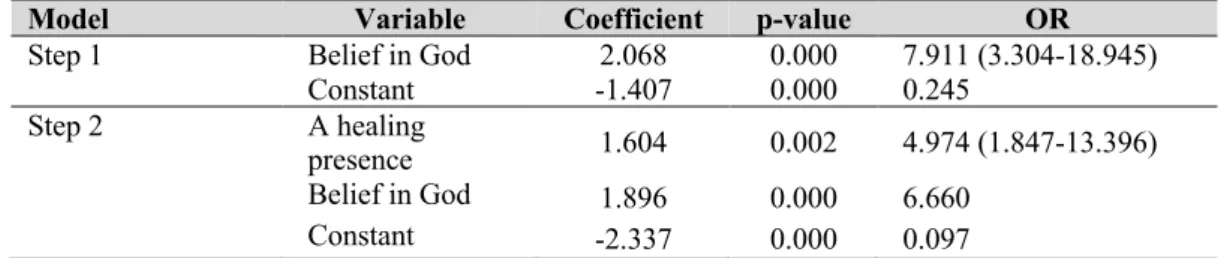
while Table 6 shows that the variable that has the highest correlation with organizational commitment of nurses was Belief in God (Allah SWT) with the strength of correlation (OR) of 6.660.
Table 6 Logistic regression of a healing presence, caring relationship, caring environment and belief in God with the organizational commitment of nurses in the Islamic Hospital of Kendal in August 2017 using forward
stepwise (conditional) (N=108)
DISCUSSION
The result of the research shows that there was a significant relationship of healing presence, caring relationship, caring environment, and belief in God with organizational commitment of nurses with p-value <0.05. Based on Forward Stepwise analysis, Belief in God was the only variable having the highest correlation to the organizational commitment of nurses. The statistical test results obtained an OR (Ex B) of 6660, which indicated that the strength of the relationship of the belief in God variable was 6.660 times in increasing the nurse's organizational commitment.
Belief in God (Allah SWT) is closely related peace, inner strength, personal well-being, and hope in crisis situations (Ismail et al., 2015). According to this theory, nurses are able to maintain a balance between all dimensions through their caring. Ultimately, harmony in life can be achieved. From the patient side, nurses are encouraged to practice their beliefs by praying five times a day, dhikr, and reciting the Quran to maintain the balance of body, mind and soul through their belief in God. In addition, patients and families are also encouraged to be patient and sincere with the illness experienced and the risk of death by praying and asking for help
Model Variable Coefficient p-value OR
Step 1 Belief in God 2.068 0.000 7.911 (3.304-18.945)
Constant -1.407 0.000 0.245
Step 2 A healing
presence 1.604 0.002 4.974 (1.847-13.396)
Belief in God 1.896 0.000 6.660
from Allah SWT. They were also asked to accept the disease as a form of repentance for their sins and deaths as part of a journey to meet with Allah SWT.
Universal belief implies that the policies and systems applied in hospitals are not based on a particular religion or culture (Ismail et al., 2015). The hospital provides religious figures (Ulama in Indonesian term) to help patients and their families to support their belief in God. Nurses suggest integrating spiritual needs into nursing care and the hospital system.
The Islamic hospital of Kendal is a hospital that has a special character with Islamic nuance that is reflected in everyday culture, employees who strongly support the work ethic of Islam are more committed to the organization and then more likely to make changes, which the change does not have the potential to change the basic values and objectives of the organization and are considered to be beneficial to the organization (Jamil, 2007).
The spiritual climate in the workplace affects organizational commitment, therefore the spiritual workplace needs to be developed to foster a sense of community resulting in self-harmony, environmental harmony and transcendence (Anisah, 2016). Gain more understanding of norms or work rules both in professional ethics and the dimensions of accountability, justice and truth in the work ethic of Islam will actually carry out its duties and functions, which further affecting its commitment to the profession and its organization (Aji, 2016). It is asserted that Islam is not only religion, it teaches its followers to obey the rules of God and follow the Prophet of Muhammad SAW in lifestyle (Ismail et al., 2015). Islam declares that every action taken will be asked for responsibility both in the world and in the hereafter. Islamic values are very influential on the attitude of an employee to the work so that it can affect the commitment of employees to the organization.
This research has several advantages included: the research of the implementation of Islamic Based caring model with
organizational commitment among nurses has never been studied by previous research, though because the IBC model is a new model created by Suhartini (2016). The results of this study indicated that there was a significant relationship between the implementation of Islamic Based Caring Model with organizational commitment of nurses, therefore this research can be an input for the management of the Islamic hospital of Kendal in particular or other Islamic hospital management in applying the model in order to attract and retain qualified nursing staff to be consistent in providing professional nursing service.
This study has several limitations included that theory mentioned several factors influencing organizational commitment of nurses. However, this study did not include all variables, as the researchers only tested the model of Islamic based caring. A cross sectional design in this study might have a limitation, which its sampling was done simultaneously in one time without any direct control by the researcher on the independent variable. As this study only aimed to know the relationship among some variables, further study is needed to analyze cause and effect of the Islamic based caring model or quasi experiments or qualitative research methods to gain more comprehensive information on the application of this model and organizational commitment, and to examine this model in relating to nurses' job satisfaction, nurse's motivation and performance, nurse burnout, patient satisfaction and patient safety.
CONCLUSION
nursing practice to increase the organizational commitment of nurses.
Declaration of Conflicting Interest
None declared.
Funding
This study was supported by Department of Nursing, Faculty of Medicine, Diponegoro University, Semarang, Indonesia.
Author Contribution
All authors contributed equally in this study.
References
Aji, G. (2016). Analisis pengaruh etika kerja Islam terhadap komitmen organisasi dengan komitmen profesi sebagai variabel intervening (Studi empiris terhadap internal auditor bank di Jawa Tengah) [Analysis of the effect of Islamic work ethics on organizational commitment with professional commitemnt and intervening variable (Empirical study of bank internal auditor in Central Java].
Economica: Jurnal Ekonomi Islam, 1(2), 93-108. Anisah, A. (2016). Hubungan spiritualitas di tempat
kerja dengan komitmen organisasi perawat di RSI Ibnu Sina Padang tahun 2016 [Relationship of spirituality in workplace and organizational commitment of nurses at RSI Ibnu Sina Padang in 2016] . Padang: Universitas Andalas.
Asmaningrum, N., Keliat, B. A., & Hastono, S. P. (2011). Pengaruh penerapan spiritual leadership terhadap komitmen perawat pada organisasi di Rumah Sakit Islam Surabaya [Effect of the application of spiritual leadership on nurses' organizational commitment in Islam Hospital Surabaya]. Jurnal Keperawatan Soedirman, 6(1), 9-19.
Baumann, A. (2007). Positive practice environments: Quality workplaces = quality patient care information and action tool kit', Geneva: International Council of Nurses.
Borhani, F., Jalali, T., Abbaszadeh, A., & Haghdoost, A. (2014). Nurses’ perception of ethical climate and organizational commitment. Nursing Ethics, 21(3), 278-288.
Fu, W., & Deshpande, S. P. (2014). The impact of caring climate, job satisfaction, and organizational commitment on job performance of employees in a China’s insurance company. Journal of Business Ethics, 124(2), 339-349.
Huang, C.-C., You, C.-S., & Tsai, M.-T. (2012). A multidimensional analysis of ethical climate, job satisfaction, organizational commitment, and organizational citizenship behaviors. Nursing Ethics, 19(4), 513-529.
Ismail, S., Hatthakit, U., & Chinnawong, T. (2015).
Islamic based caring in nursing science: A literature review. Paper presented at the ASEAN/Asian Academic Society International Conference Proceeding Series, Bangkok, Thailand.
Jamil, A. (2007). Pengaruh etika kerja Islam terhadap sikap-sikap pada perubahan organisasi: Komitmen organisasi sebagai mediator [Effect of Islamic work ethics on organizational change: Organizational commitment as a mediator].
Semarang: Universitas Diponegoro.
Jane Lee-Hsieh Msn, R. N., & Chien-Lin Kuo Ms, R. N. (2005). Application and evaluation of a caring code in clinical nursing education. Journal of Nursing Education, 44(4), 177.
Mowday, R. T., Porter, L., & Steers, R. (1982).
Employee-organization linkages: The philosophy of commitment, absenteeism and turnover. New York: Academic Press.
MOH. (2005). Pedoman pengembangan manajemen kinerja perawat dan bidan [Guideline of the development of management of nurses and midwives performance]. Jakarta: Ministry of Health of Indonesia.
Caldwell, D. F., Chatman, J. A., & O'Reilly, C. A. (1990). Building organizational commitment: A multifirm study. Journal of Occupational and Organizational Psychology, 63(3), 245-261.
Cite this article as: Timorita, Y. A., Hartiti, T., Warsito, B. E., Ismail, S. (2017).The association of Islamic based caring model and commitment to organizations in staff nurses. Belitung Nursing Journal, 3(6), 670-676.