266
THE INFLUENCE OF FREEZING ON THE VITAMIN C CONTENT IN SOME
VEGETABLE PRODUCTS
Elena Roșculete, Roșculete C. A. University of Craiova, Faculty of Agronomy, 19 Libertatii street, Craiova, e-mail: [email protected]
Keywords: freezing, vegetable products, vitamin C
ABSTRACT
Vitamin C, or the ascorbic acid, is one of the most valuable substances on earth. Without it, it would be unable for us to perceive differences between colors, to realize the passing of time, to experience joy and enthusiasm.
There are a number of ways we can conserve Vitamin C in large quantities in the products, in which it can be found, and one of them could be freezing, since it has been shown that this vitamin can be preserved by freezing.
From the chemical content’s point of view, during freezing, the vegetable products lose a series of nutritive substances, especially vitamin C.
Frozen green vegetables contain considerable amounts of vitamin C, which can be oxidized during storage in the presence of different enzymes.
In this particular study we aimed indeed the effect freezing has on the content of vitamin C in some vegetable products, more precisely we analyzed the influence of the freezing time on the content of products analyzed in absorbic acid.
The determination of the content of vitamin C in the analyzed products was carried out both in the fresh plant material, as well as in the frozen plant material. For the frozen product, there were made three determinations every day for a month, and the obtained results were compared with those obtained from the fresh plant material for each product.
INTRODUCTION
Conservation means keeping food in good condition for as long as we can.
The conservation methods and techniques are chosen according to the nature of the food and the storage conditions. They are divided into: - coldness procedures - dehydration procedures, heating procedures - other methods of conservation.
The coldness procedures (cooling and freezing), use low temperatures, which helps maintaining foods because they slow down or totally interrupt the activity of microorganisms.
Freezing is an excellent means of maintaining the qualitative characteristics of various perishable foods almost unchanged for a long time.
It has been found that the nutritional value of frozen products is at least as high as the foods preserved by other means, and supports a favorable comparison to fresh or frozen products.
Of the over 30 nutrients of food, a very small number is affected at their storage in frozen state, namely: water-soluble vitamins B and C (Vitamin C is also easily destroyed by heat in alkaline or neutral environs).
It can be concluded that the nutritive qulity of macronutrients does not decrease at the storage of frozen products at - 18 ° C temperature.
267
MATERIALS AND METHODS
The plant material used was represented by several species of vegetables and fruits that are normally high in vitamin C, purchased exclusively from the supermarket. The study analyzed 13 samples of vegetable products: cabbage, orange, grapefruit, kiwi, strawberries, yellow peppers, red peppers, papaya, parsley, kohlrabi, cauliflower, broccoli, Brussels sprouts.
To achieve the proposed objective, determinations on the content of vitamin C in some vegetable products (fruits and vegetables) were made.
The chemical methods of vitamin C dosage is based on its reducing properties. Ascorbic acid oxidizes the acid to dehydroascorbic acid. Various oxidizing agents can be used. Errors may arise in determining because in the vegetable products other oxidized substances can be found (reducing agents). Another drawback is the rapid oxidation of vitamin C, which can occur even during preparation of material for analysis. Therefore dosage must be done quickly.
In the presented study the iodometric method was chosen for determining.
The original content of vitamin C from the fresh product was found, after which the frozen products were analyzed, namely three measurements were made at an interval of about one month. It should be noted that, freezing was carried out in a normal freezer with temperatures of - 18 0C.
This way, we have followed the effect of freezing on the change in the content of vitamin C in the examined product, which were compared with the result of the determination made in the fresh product.
RESULTS
In the textbook, the products analyzed for this particular study present an appreciable content of vitamin C (table 1).
Estimated vitamin C content in the analyzed products (Data from textbook)
Table 1
No. Product Estimated content of vitamin C (Mg / 100 g fresh
weight)
1. White cabbage 30 – 50
2. Orange 50 -70
3. Grapefruit 30 – 40
4. Kiwi 90 -100
5. Strawberry 25 – 120
6. Yellow pepper 160 – 180
7. Red pepper 140 -160
8. Papaya 60 – 70
9. Parsley 110 – 120
10. Kohlrabi 40 -60
11. Cauliflower 40 -70
12. Broccoli 80 – 132
268
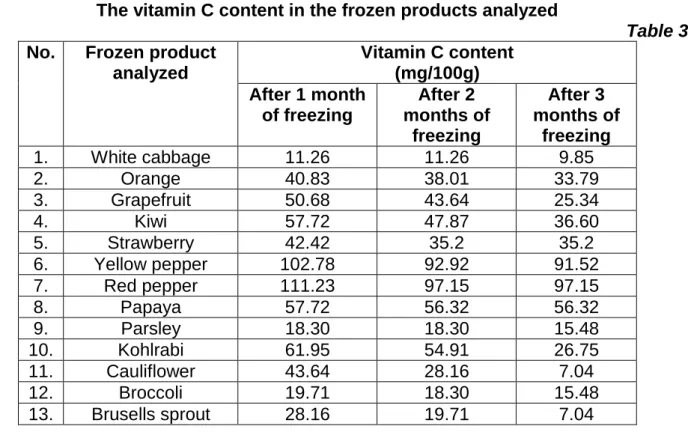
The determination of vitamin C in the analysis of the 13 products was performed both for the fresh plant material and for the frozen plant material. For the frozen product, there were made three determinations every day for a month, and the results were compared with those obtained from the fresh plant material for each product.
The obtained results are shown in table 2 and table 3.
The vitamin C content in the fresh products analyzed
Table 2
No. Analyzed product Vitamin C content (Mg / 100 g fresh
weight)
1. White cabbage 25.34
2. Orange 46.46
3. Grapefruit 53.50
4. Kiwi 68.99
5. Strawberry 45.05
6. Yellow pepper 126.72
7. Red pepper 118.27
8. Papaya 60.54
9. Parsley 98.56
10. Kohlrabi 67.58
11. Cauliflower 47.87
12. Broccoli 28.16
13. Brussels sprout 32.38
Analyzing the results obtained from the determinations made from the fresh plant material, it is found that the yellow pepper, red pepper, broccoli and Brussels sprouts’ vitamin C content was much lower than the data in the textbook. This allows us to assume that vitamin C in these products is quickly lost when not complied with certain conditions of storage and transport. E.g:
- For the yellow peppers, there was determined a content of vitamin C of 126.72 mg/100 g fresh weight compared to 160 - 180 mg/100 g as reported in the textbook;
- For the red peppers, there was determined a content of vitamin C of 118.27 mg/100 g fresh weight compared to 140 - 160 mg/100 g, referred to in the textbook;
- For Broccoli, there was determined a vitamin C content of 28.16 mg/100 g fresh material compared to 80 -132 mg /100 g fresh weight as reported in the textbook;
- For the Brussels sprouts, tehere was determined a vitamin C content of 32.38 mg/100 g fresh weight, compared with 70 - 80 mg/100 g as set out in the textbook.
269
The vitamin C content in the frozen products analyzed
Table 3
No. Frozen product analyzed
Vitamin C content (mg/100g) After 1 month
of freezing
After 2 months of
freezing
After 3 months of
freezing
1. White cabbage 11.26 11.26 9.85
2. Orange 40.83 38.01 33.79
3. Grapefruit 50.68 43.64 25.34
4. Kiwi 57.72 47.87 36.60
5. Strawberry 42.42 35.2 35.2
6. Yellow pepper 102.78 92.92 91.52
7. Red pepper 111.23 97.15 97.15
8. Papaya 57.72 56.32 56.32
9. Parsley 18.30 18.30 15.48
10. Kohlrabi 61.95 54.91 26.75
11. Cauliflower 43.64 28.16 7.04
12. Broccoli 19.71 18.30 15.48
13. Brusells sprout 28.16 19.71 7.04
Regarding the frozen plant material, the results of the analysis show decreasingly vitamin C content while increasing the freezing period. Knowing from the textbook that through cooling and freezing Vitamin C is well maintained compared to other vitamins, the data obtained are found to have decreased the content of vitamin C in the products concerned, though they were quite small.
The biggest change was recorded for parsley, where after a month of freezing, there was lost a large amount of vitamin C, specifically, the content decreased from 98.56 mg/100 g to 18.30 mg/100 g, meaning that after freezing, there were lost 80.26 mg/100 g.
After this sharp decline, the following determinations (2 months and 3 months) showed the vitamin C content remaining at about the same values.
Higher differences regarding the content of vitamin C in the products that were analyzed, both fresh and frozen ones, were highlighted just for a few of the analyzed products.
According to the results obtained from the analysis of frozen products, it has been found that the freezing period has not such a great influence on the content of vitamin C.
CONCLUSIONS
Vitamin C can be found in fruits and vegetables in appreciable quantities.
1. The iodometric method allows the determination of vitamin C in a series of foods with different complexities. The only condition is for the used extraction process to achieve high efficiency and the shortest time possible, in order to avoid degradation.
2. The vitamin C content in the fresh products analyzed was close to the estimated one in the textbook, with a few exceptions: yellow pepper, red pepper, broccoli and Brussels sprouts.
3. Lower values of the vitamin C content determined in certain fresh products is related to the terms and conditions of storage.
270
after freezing only for cabbages, peppers and parsley; for the rest, in a month’s freeze, products did not show any large losses of this vitamin.
5. Higher freezing periods (2 months and 3 months), do not lead to large losses of vitamin C from the plant products analyzed, which were subjected to freezing.
6. The freezing of plant products does not lead to large losses on the content of vitamin C than the ones they had when they were fresh.
BIBLIOGRAPHY
1.Banu, C., ş.a., 1992 - Progrese tehnice, tehnologice şi ştiinţifice, vol. I, Ed.Tehnică,Bucureşti.
2. Banu Constantin, 2002 - Tratat de chimia alimentelor, Editura Agir Bucuresti 3. Beceanu, D., Chira, A., 2003 – Tehnologia produselor horticole – valorificarea în
stare proaspătă şi prin industrializare, Ed. Ceres, Bucureşti.
4. Ciobanu., A, Lascu. G s.a, 2005 - Frigul artificial în fabricarea și conservarea
produselor, considerații referitoare la particularitatile refrigerarii legumelor si fructelor, Editura Ceres, București.
5. Gherghi, A., 1999 – Prelucrarea şi industrializarea produselor horticole, Vol. III,
Ed. Olimp, Bucureşti.
6. Paraschivu M., Babeanu C., Soare R., Dinu M., Drăgoi M., 2014, Influence of
late blight (Phytophthora infestans) attack on nutritional qualities of tomato, Analele
Universităţii din Craiova, seria Agricultură – Montanologie – Cadastru (Annals of the University of Craiova - Agriculture, Montanology, Cadastre Series) Vol. XLIV/1, p.188-193
7. Tofan I., Clemansa Tofan, 2002 - Utilizarea frigului artificial la procesarea, depozitarea si comercializarea produselor alimentare perisabile, Editura AGIR, București.