218
PARTICULARITIES IN CREATING AN ONLINE HOTEL ROOM BOOKING
SOLUTION FOR THE ROMANIAN SEA-SIDE
CRISTIAN VASILE1, SABIN-MIHAI SIMIONESCU2, MIHNEA GLODEANU3
1University of Craiova, Faculty of Agriculture and Horticulture, e-mail:
2White Pyramid Company,L.L.C., Craiova, Romania 1University of Craiova, Faculty of Agriculture and Horticulture e-mail: [email protected]
Keywords: Tourism, ecommerce, online software, software as a service, pricing strategies
ABSTRACT
Vacations represent an important part of tourism, and tourism represents an important part of a nation’s economy. Thus, citizens vacationing in-country help the local budget, and foreign tourists contribute too. In the age of ecommerce, tourism agencies are turning to the Internet to expand their businesses into the digital domain. This paper displays a software developer’s perspective to creating an ecommerce application to handle the surprisingly complex process of booking a room for the Romanian sea side.
INTRODUCTION INTO HOTEL RESERVATIONS
When a tourist walking into a tourism agency looking for a vacation, there are plenty of things he or she might be looking for. Some look for a cheap vacation, some look for an exotic destination, some are looking to visit new places filled with culture while others are just looking for a room close to the beach and clubs.
Also, when the same tourist walks into the same agency, the sales representative is looking for many things: first, to make a sale; then, to fill a certain room that someone cancelled and they had already paid the hotel and now will lose the entire amount; then, maybe not that specific room, but a room in that hotel, and maybe they will convince the hotel owner to transfer the dates on the room. The key to making the sale is to match the requirements and wishes of the tourist with the availabilities of the company. To do that, the agency must know at all times exactly what they have available, at what price and in what conditions. An informational system with a central database will offer exact data about reservations and availabilities at all times. In Romania, there is no law specifying exactly how room price should be calculated, and what price variations can be applied and for what reason, so every hotel makes their own rules. For an informational system, this means all those rules need to be combined into a general rule set, so they all function under the same booking and availability algorithms.
CONTRACTING ROOMS FOR THE SUMMER SEASON
Every year, every hotel counts the actual usable number of rooms they have, and distribute them with contracts: some rooms go to mainstream online booking systems, like www.booking.com, other rooms are contracted to tourism agencies and some are kept for sale at the reception. The usual contracting period is in September, and agencies usually ask for how much they sold last year. This means agencies can have on their availabilities list from one simple double room to over 10 double rooms plus extra apartments and others, like villas and penthouses, in every hotel. Some agencies target specific hotels, in specific tourist destinations, while others get an assortment of double rooms from an as wide as possible array of hotels, automatically getting both cheap and expensive rooms.
219
PRICE VARIATIONS
Open market means everybody is free to choose the price for their products and services. A regulated market, like the energy & natural gas ones in Romania, means the state has something to say in the pricing. The free market also brings the freedom to vary different discounts, creating a wide variation between providers. Also, almost every hotel on the sea shore has a different owner.
The factors that define the price for hotel rooms are as follows:
- Room type – standard double rooms have a price, higher quality rooms have a higher
price, apartments for 3 adults are priced lower per person yet higher per room than double rooms etc.
- Tourist’s age – rooms are calculated for 1, 2 or more adults, and children, depending
on the hotel’s choice, pay:
Nothing under a certain age, with the parents in the same bed(s)
Something usually under 50% of an adult price, below a certain age, still no extra bed 50% or more for an extra bed, usually over the age of 12
Over 14, some hotels consider them adults and payment calculated as an extra adult By default, there are no discounts for senior citizens
- Booked period – the most expensive weeks are in July and August, which is
considered the peak of the season, and outside these 2 months, prices are lower, since the water is colder and thus fewer tourists are willing to spend their vacation time then.
- Period when the reservation is paid: Early Booking is a percent type discount applied to
the room price when the entire price is paid before a certain date. Multiple early-booking discounts are possible for the same hotel, based on how early the date is compared to the season peak period.
- Bundled discounts – pay for 6 nights and spend 7 is a common offer for Romanian hotels, outside the peak period
Not only the price of the room has variations for these factors: meal prices vary for the exact same reasons, on top of which meal option the tourist chooses from the available one available differently between hotels.
MEAL OPTIONS AND PERIODS WITH IMPOSED MEALS
Meal prices are the same over the entire season – in most of the cases. Some hotels include free meals for children under a certain age (hotel dependent), and most hotels offer meals for children at a smaller percentage of the adult meal price. One of the most complicated situations is when the room price includes breakfast for 2 adults, and they bring along a 9-12 year old child, or twins.
Imposed meals is a concept where the hotel defines a specific period when agencies cannot sell room bookings without including specific meals in the package. Many hotels bundle breakfast with the room, and in the peak of the season, they force tourists to buy lunch too or all-inclusive. From an economic point of view, it’s simple: the hotel knows how many rooms are occupied, and thus knows how much to cook and automatically how much food to buy in the first place. From the tourist’s point of view, this concept is not welcomed by younger tourists, who sleep though breakfast anyway and want to go out into the city/town to eat with friends, at a different restaurant every day.
From the programming perspective, the chosen implementation method was to declare “2 meals” as an upgrade of “breakfast” and “all inclusive” as an upgrade of “2 meals”. This means that in a period with mandatory breakfast and lunch, a tourist can
choose all inclusive, and thus satisfy both the requirement of the hotel – pay for 2 meals,
220
Also, when a tourist chooses an interval which is not completely included in the mandatory meal period, the chosen option was to extend that meal and its upgrades to the entire period of the tourist’s stay, thus satisfying the hotel requirement completely.
Figure 1 - meal upgrade and inclusion options
RESELLING OPTIONS FOR CONTRACTED ROOMS
Commerce functions like an ecosystem – you buy from one and sell to another, while adding some personal involvement and potential improvement(s) along the way (concept of “added value”).
Hotels have a limited number of rooms, so they contract them out to agencies that have the business volume necessary to actually sell most or all of the rooms provided. That means that small agencies and start-ups do not have access to direct hotel reservations with internal room stocks. The solution is to subcontract from larger agencies, and sell rooms contracted between those agencies and the hotels.
Because of the speed a client wants an answer today, only agencies with online reservation systems can become resellers. To do this, they need the ability to advertise the available rooms and to instantly book/unbook them, so the availabilities stock is up to date constantly.
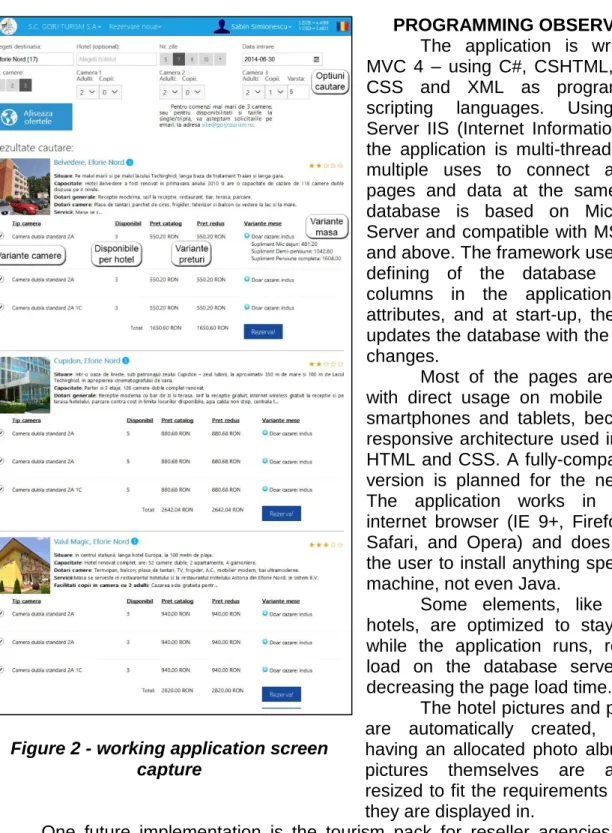
Smaller agencies willing to become reseller-partners on this platform can do so by registering on the dedicated online form, and then sign a contract with the primary agency who has the contracts with the hotels. The reselling process is mostly automated – the room is reserved directly in the tourist’s name, and if the room stock is large enough to accommodate the required number of rooms, the reservation is instant, and the rooms are booked. If the tourists choose a hotel with too little availability, an “on-request” order is made, which, after the primary agency validates availabilities with the hotel, is either approved or rejected. Vouchers for tourists can be downloaded directly from the application, as well as invoices for both tourists and reseller agencies.
COMMUNICATION WITH HOTELS
Contracts are done outside the application. The inclusion of contracts in the business process handled by the application was discussed, and because of the customization for each hotel, it was decided to leave this part out for the first version.
221
PROGRAMMING OBSERVATIONS
The application is written in C#
MVC 4 – using C#, CSHTML, JavaScript,
CSS and XML as programming and
scripting languages. Using Windows
Server IIS (Internet Information Services), the application is multi-threaded, allowing multiple uses to connect and request pages and data at the same time. The database is based on Microsoft SQL Server and compatible with MS SQL 2005 and above. The framework used allows the defining of the database tables and columns in the application code, as attributes, and at start-up, the application updates the database with the most recent changes.
Most of the pages are compatible with direct usage on mobile devices like smartphones and tablets, because of the responsive architecture used in writing the HTML and CSS. A fully-compatible mobile version is planned for the next upgrade. The application works in any recent internet browser (IE 9+, Firefox, Chrome, Safari, and Opera) and does not require the user to install anything special on their machine, not even Java.
Some elements, like the list of hotels, are optimized to stay in-memory while the application runs, reducing the load on the database server and thus decreasing the page load time.
The hotel pictures and photo gallery are automatically created, each hotel having an allocated photo album, and the pictures themselves are automatically resized to fit the requirements of the place they are displayed in.
One future implementation is the tourism pack for reseller agencies – including offers from this booking application directly on their websites, thus leveraging their online traffic to boost sales for both the reseller and the owner agency.
The application includes general web features like sitemaps (for easier integration with search engines), robots.txt to fight spam, email address masking to fight email address harvesters, CSS and JavaScript bundling, minification and caching to reduce the size and number of requests made for each visited page. The application runs in its own dedicated application pool on the server, so resources like memory and CPU are protected against other applications on the same server over-using and thus slowing everything down. The file transfer method is based on a web application method used for Microsoft projects, and thus is immune to brute force FTP (file transfer protocol) attacks that put viruses into PHP applications on both Linux and Windows servers.
222
IDEAS FOR CONTINUATION
The application is currently usable only in Romanian. The platform it is written on is based on a multiple-language interface engine, making English availability an easy task from the programming perspective. Other languages can be added as well. A market study will be necessary, to identify which languages should be prioritized, depending on what chances of selling vacations in Romania are for the countries speaking that language.
Another important component is to integrate direct-tourist sales, and currently it only works for the owner agency and resellers. Selling directly to tourists, via the Internet, with online credit/debit card payments can go a long way into promoting the tourism resorts of Romania on the European market.
Another direction is the inclusion of mountain-side hotels, for the people who prefer quiet places and hiking against crowded beaches and sun bathing. Another important tourism attraction in Romania are the Monasteries in the northern part of Moldova, which require hotel reservations as there are too many to visit in one day.
CONCLUSIONS
Creating an online hotel room booking solution for the Romanian sea-side is a process that accustomed the authors with the specifics of the Romanian hotel industry. The complexity of the process is mostly given by the lack of standards, because every hotel makes their own rules every year, and a computer application requires a common set of rules to function properly. Exceptions can be implemented, but implementing an exception for each and every hotel is not financially feasible.
In the end, a functional web application was built, which is currently used by a company in a neighboring county. While some of the concepts explained in this paper were not implemented in the actual application, they were explained to the application owner and most are targeted to be implemented within the next months.
BIBLIOGRAPHY
1. Vasile C., Savescu P., Simionescu S.M., Iosif Gh., 2012 - Developing an Online GIS
Application for Tourism and Business, Scientific Symposium with International
Participation “65 Years of Higher Agronomic Education and 50 Years of Higher Horticulture Education in Craiova”, Annals of the University of Craiova - Agriculture, Montanology, Cadastre Series, Vol 42, No 2 (2012), ISSN: 2066-950X, Pages: 465-470, Index Copernicus, Ulrich, DOAJ, CABI
2. Vasile C., Simionescu S.M., Iosif Gh., 2012 - Marketing and resource management in
the digital era, Scientific Symposium with International Participation “65 Years of Higher
Agronomic Education and 50 Years of Higher Horticulture Education in Craiova”, Annals of the University of Craiova - Agriculture, Montanology, Cadastre Series, Vol 42, No 2 (2012), ISSN: 2066-950X, Pages: 471-475, Index Copernicus, Ulrich, DOAJ, CABI
3. Resceanu I.C., Resceanu C.F., Simionescu S.M., 2013 - Developing a framework for
websites with international audience, System Theory, Control and Computing (ICSTCC),
17th International Conference, Publisher: IEEE, Pages: 453 – 458, Print ISBN: 978-1-4799-2227-7
4. Resceanu I.C., Simionescu S.M., 2014 - Study on website development practices from
a global market perspective, Analele Universitatii din Craiova, seria Automatica,