211
THE EFFECT OF CADMIUM EXCESS ON LIPID PEROXIDATION AND
ANTIOXIDANT DEFENCE SYSTEM IN WHEAT SEEDLINGS
MATEI GHEORGHE1,BABEANU CRISTINA2, SOARE MARIN1, BIRZANU OANA FELICIA3
1 Faculty of Agriculture and Horticulture, University of Craiova, 2 Department of Chemistry, University of Craiova, 165 Calea Bucuresti, Craiova, Romania; Tel/fax:
+400251597048; e-mail: [email protected]
3 Master student, Faculty of Agriculture and Horticulture, University of Craiova -Biodiversity and
ecosystem conservation
Key words: wheat, enzymes, lipid peroxidation, proline,cadmium
ABSTRACT
The objective of this study was to investigate the changes in some biochemical indices and the changes in antioxidant enzyme activities in wheat seedlings in presence of different amounts of cadmium. Two varieties of wheat were studied (Triticum aestivum L.cv. Dropia and cv. Alex) Obtained results illustrate that cadmium uptake was positively correlated with antioxidant enzyme activities, lipid peroxidation, proline and phenols content. Measurement of oxidoreductase activity, especially peroxidase and studied biochemical indices might be used as biomarkers to asses the phytotoxicity for wheat grown on cadmium contaminated media.
INTRODUCTION
Numerous anthropogenic and industrial activities lead to the accumulation of heavy metals in soil and the serious consequences for agriculture. While metal ions such as copper, zinc and nickel are considered essential micronutrients for plants, the same metal ions can become phytotoxic at higher levels (Nagajyoti et al., 2010). Cu and Zn, are constituents of many enzymes and other proteins and the requirement of plants for Ni appears to be mainly related to its role in forming the active metallocentre of urease (Page and Feller 2005). On the contrary, metal ions with no known physiological function in plants, such as cadmium is toxic to many plant species even at a very low concentration causing perturbations in various plant processes, such as development of chloroplasts, sugar metabolism, biological nitrogen fixation, sulphate assimilation, respiration and in several enzyme activities. (Sanità di Toppi and Gabrielli, 1999, Kevresan et al. 2003). Photosynthesis is inhibited at several levels: CO2-fixation, stomatal conductance, chlorophyll synthesis, electron transport and enzymes of the Calvin cycle (Cosio et al., 2004). Changes in cellular metabolism can be observed even at low levels of Cd, before visual symptoms become evident.
One possible mechanism by which excess heavy metals may damage plant tissues is the stimulation of free radical production, by imposing oxidative stress (Zengin and Munzuroglu 2005; Nadgórska-Socha et al., 2013). One of the first symptoms of oxidative stress in plant tissues is lipid peroxidation of cell membranes (Malizia et al., 2012). Plants protect themselves against heavy metals through various antioxidative strategies, by increasing antioxidative enzyme activities (superoxide dismutase, ascorbate peroxidase, glutathione reductase, catalase and peroxidase) or by higher production of low molecular compounds such as proline, phenolic compounds, poliamines, tocopherols, etc (Teklic et al. 2008, Cui and Wang 2006, Szafranska et al., 2011).
212
activity of ascorbate peroxidase, total soluble peroxidase and catalase, enzymes involved in the scavenging of reactive oxygen species, were measured.
Information about the response of plants to heavy metal contamination would be important in an assessment of the safe production of crops.
MATERIAL AND METHODS
Two varieties of wheat were studied (Triticum aestivum L.cv. Dropia and Alex ) in order to determine the response of plants to cadmium stress. Wheat seeds were obtained from University of Craiova, Faculty of Agronomy. Dry seeds sterilized with 5% sodium hypochlorite were rinsed twice with distilled water and sown in Petri dishes with Hoagland solution containing 0,5% agar and supplied with cadmium (as CdCl2) at three concentrations V1=0 (control), V2=100μM and V3=150 μM. Distilled water was added when necessary, in order to maintain a constant degree of humidity. Biochemical analyses were done 14 days after seeds germination.
For antioxidant enzymes extraction, fresh tissue was homogenised with 0,1M phosphate buffer (pH 7.5) containing 0,1mM EDTA. The homogenates were centrifuged for 20 min at 6000 r.p.m. and the supernatants were used for enzyme assays.
The activity of ascorbate peroxidase was measures by determining the oxidative rate of ascorbic acid and is expressed as µmoles ascorbic acid/min/g fw.
Total soluble peroxidase (guaiacol-type E.C.1.11.1.7) activity was measured at 470
nm according to Fang and Kao (2000) with guaiacol as the substrate and their activity was expressed as ΔA/min/1g fresh weight .
Catalase activity (E.C.1.11.1.6) was assayed through the colorimetric method of
Sinha (1972) and expressed as as mmoles H2O2/min/g at 25C.
Lipid peroxidation was determined by estimating the malondialdehyde (MDA)
content by colorimetric methodwith thiobarbituric acid in 0,1 % trichloroacetic acid extract at 532nm and expressed as thiobarbituric reactive substances, TBARS in nmol MDA /g fw (Szafranska et al, 2011)
Proline content: was determined in 3% aqueous sulfosalicylic acid extract by
spectrophotometry at 520 nm following the ninhidrin method of Bates et al. (1973) using L-proline as a standard. The results were expressed as μmol proline/ g fw.
The total phenolic content (TPC) were extracted in methanol and assayed using
Folin-Ciocalteu reagent. The total phenolic content (TPC) was calculated using a standard curve prepared using gallic acid and expressed as μmol of gallic acid equivalents (GAE) per gram
Protein concentration was evaluated by the method of Bradford (1976) using bovine
albumin as a standard.
All assays were performed in triplicate and the results presented here are the mean values.
RESULTS AND DISCUSSION
213
Figure 1. Total soluble protein content Figure 2. Ascorbate peroxidase activity (µmoles ascorbic acid/min/g)
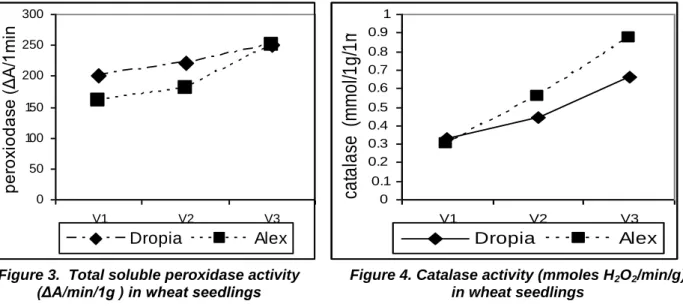
As catalase and peroxidase are parts of the antioxidant system of the cell, their activities can change drastically depending upon the physiological conditions of the plant and the integration of different environmental, developmental and biochemical stimuli. When seedlings were subjected to cadmium stress ascorbat peroxidase (figure 2) and
total soluble peroxidase (guaiacol peroxidase), figure 3 activity increased for all studied
genotypes in comparison with control and this increase is proportional to the applied dose. The catalase activity (figure 4) for both varieties of wheat is increasing with the cadmium dose, in accordance with its role of decomposing the hydrogen peroxide formed in excess. The great increase of the catalase activity is indicating an oxidative stress state generated by the dose of the applied heavy metal. The results show higher values of the catalase activity on the Alex variety.
Cadmium can also indirectly participate in the induction of oxidative stress condition. An indication of this condition is the content of lipid peroxidation products, substances that react with thiobarbituric acid (TBARS).
Figure 3. Total soluble peroxidase activity
(ΔA/min/1g ) in wheat seedlings Figure 4. Catalase activity (mmoles Hin wheat seedlings 2O2/min/g)
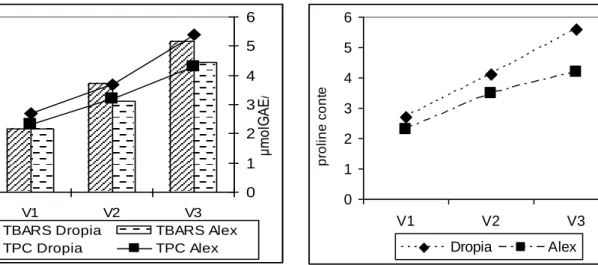
A high level of TBARS show a high degree of deterioration of membrane lipids. The obtained data concerning this parameter are presented in figure 5. For both studied
0 20 40 60 80 100 120 140 160 180 200
V1 V2 V3
p ro te in e ( m g /g ) Dropia Alex 0 0.1 0.2 0.3 0.4 0.5 0.6 0.7 0.8 0.9 1
V1 V2 V3
ca ta la se (mmo l/1 g /1 mi n ) Dropia Alex 0 50 100 150 200 250 300
V1 V2 V3
214
varieties it can be observed an increase of malondialdehyde content (MDA) with the applied dose. Higher values of TBARS can be noticed in the Dropia variety.
Figure 5. TBARS (nmol MDA /g) and total phenolic compounds ((μmol GAE/g)
Figure 6. Free proline content in wheat seedlings(μmol proline/ g)
Other compounds involved in the mechanism to detoxify cadmium and limit damages are phenolic compounds. Phenolic compounds play an important role in the metabolism of plants to survive in heavy metal polluted soils.
Phenolic compounds have been described as electron-donating agents, and therefore they can act as antioxidants, acting as reducing agents, hydrogen donors, and singlet oxygen quenchers and preventing the evolution of oxidant-free radical and reactive species (Michalak, 2006).
The obtained data concerning total phenolic compounds content are presented in figure 5. Compared to control, both studied varieties registered increased of total phenolic compounds content with the applied dose. As a result of the stress condition imposed by 100 μM Cd, the phenolic compounds content amount increased by 37% compared to control for Dropia variety and by 52% for Alex variety. The obtained data indicated an increase of 100% and 87% of phenolic compounds content for Dropia variety respectively for Alex variety in 150μM Cd-treated plants compared to control.
Another parameter that has been studied is proline. The principal role of proline probably is to protect enzymes against dehidration and salt accumulation (Unyayar et al., 2004). For plants subject to various type of stress literature recorded the rise of the proline content. Proline has several functions during stress: osmotic adjustment, osmo-protection, free radical scavenger and antioxidant, protection of macromolecules from denaturation, regulation of cytosolic acidity and carbon and nitrogen reserve after stress relief. Proline can serve as a quick source of available nitrogen, carbon and reducing equivalents. Plants that accumulate proline, by either overexpression of proline synthesis enzymes, removal of enzyme feedback inhibition, or loss of catabolic enzymes, show also enhanced tolerance to other stress. However, doubts still persist whether the accumulation of this amino acid provides adaptative advantage or it is only a consequence of changes in the metabolism due to stresses. Increase in proline content in plants is either due to the inhibition of proline oxidation or to the more rapid biosynthesis of proline from its precursors.
The results obtained for proline content is presented in figure 6. For both studied varieties it can be observed an increase with the applied dose. Higher values of proline content can be noticed in the Dropia variety.
0 10 20 30 40 50
V1 V2 V3
T
BAR
S
(n
mo
lMD
A/
g
)
0 1 2 3 4 5 6
μmo
lG
AE/
g
TBARS Dropia TBARS Alex
TPC Dropia TPC Alex
0 1 2 3 4 5 6
V1 V2 V3
p
ro
li
n
e
co
n
te
n
t
215
CONCLUSIONS
The cadmium up-take influence not only antioxidant enzymes systems but also on synthesis another nonenzymatic antioxidants such as phenols and proline. Our obtained results show the following conclusions:
- Cadmium excess disturb the redox homeostasis and lead to oxidative stress, increasing production of reactive oxygen species (ROS). Balance between the production and the scavenging of ROS is critical to the maintenance of growth and metabolism of plants.
- When seedlings were subjected to cadmium supply antioxidant enzyme activities and malondialdehyde content (expression of TBARS) increased proportional to the applied dose for all studied genotypes in comparison with control
- The higher level of enzyme activities means an efficient control of preventing cell damage and lower malondialdehyde content is a consequence of more effective protective mechanisms
- Other effect of cadmium is the induction of soluble phenolics synthesis. Total phenolic compounds content increased proportional to the applied dose for both genotypes in comparison with control
- In all varieties cadmium stimulated proline and proteines accumulation.
- Measurement of antioxidant enzymes activity and change in the malondialdehyde, proline and phenolic compounds might be used as biomarkers to asses the phytotoxicity for wheat grown on cadmium contaminated media.
BIBLIOGRAPHY
1. Bates L.S., Waldren R.P., Teare I.D., 1973- Rapid determination of free proline for water stress studies, Plant Soil, 9, 205–207
2. Bradford M.M., 1976- A rapid and sensitive method for the quantitation of microgram quantities of protein utilizing the principle of protein-dye binding. Anal Biochem, 72, 248–254
3. Cosio C., Martinoia E., Keller C. 2004- Hyperaccumulation of cadmium and zinc in
Thlaspi caerulescens and Arabidopsis halleri at the leaf cellular level. Plant Physiol. 134, 716–725
4. Cui Y., Wang Q., 2006- Physiological responses of maize to elemental sulphur and cadmium stress, Plant Soil Environ, 52,(11),523–529
5. Fang W.C., Kao C., 2000- Enhanced peroxidase activity in rice leaves in response
to excess iron, copper and zinc, Plant Sci, 158, 71–76
6. Kevresan S., Kirsek S., Kandrac J., Petrovic N., Kelemen D., 2003- Dynamics of
cadmium distribution in the intercellular space and inside cells in soybean roots, stems and leaves. Biol Plantarum, 46, 85–88
7. Malizia D., Giuliano A., Ortaggi G., Masotti A., 2012- Common plants as alternative analytical tools to monitor heavy metals in soil, Chemistry Central Journal, 6 (Suppl 2), 6-16
8. Michalak A, 2006- Phenolic compounds and their antioxidant activity in plants growing under heavy metal stress, Polish J. of Environ. Stud. 15, 4, 523-530,
9. Nadgórska-Socha A., Kafel A., Kandziora-Ciupa M., Gospodarek J.,
Zawisza-Raszka A., 2013- Accumulation of heavy metals and antioxidant responses in Vicia
faba plants grown on monometallic contaminated soil , Environ Sci Pollut Res, 20, 1124–1134
10. Nagajyoti P.C., Lee K.D., Sreekanth T.V.M., 2010- Heavy metals, occurrence and
216
11. Page W., Feller U., 2005- Selective transport of zinc, manganese, nickel, cobalt and cadmium in the root system and transfer to the leaves in young wheat plants, Ann Bot, 96, 425–434
12. Sanità di Toppi L., Gabbrielli R., 1999- Response to cadmium in higher plants. Environm. Exp. Bot. 41, 105–130.
13. Sinha , A.K., 1972- Colorimetric assay of catalase, Anal. Biochem., 47, 389-391.
14. Szafranska K., Cvikrova M., Kowalska U., Gorecka K., Gorecki R., Martincova
O., Janas K.M., 2011- Influence of copper ions on growth, lipid peroxidation, and proline and polyamines content in carrot rosettes obtained from anther culture, Acta Physiol Plant, 33, 851–859
15. Teklic T., Hancock J.T., Engler M., Paradicovic N., Cesar V., Lepedus H., Stolfa
I, Beslo D., 2008- Antioxidative responses in radish (Raphanus sativus L.) plants stressed by Cu and Pb in nutrient solution and soil, Acta Biol Crac, 50, 2, 79–86 16. Unyayar S., Keles Y., Unal E., 2004 -Proline and ABA levels in two sunflower
genotypes subjected to water stress, Bulg.J.Plant Physiol, 30, 3-4, 34-47