301
RESEARCH CONCERNING THE EFFECT
OF
SUPPLMENTARY
PROTECTION WITH
DIFFERENT TYPES OF MATERIALS
IN
GREENHOUSES
TO
RADISH CROP
RODICA SOARE, MARIA DINU, LASCU N.
University of Craiova [email protected] Key words: protection, Agril, radish crop
ABSTRACT
To obtain early production of vegetables, with a view to marketing at profitable prices, in practice, it recourse to different methods to improve the cultivation technologies in protected spaces. One of additional possibilities is the supplementary protection of the cultures with the different materials, against low temperatures to save energy from conventional sources.
From vegetable species that are suitable for this crop system, there are also radishes, that have minimum germination temperature of 3-40C, and the optimum of 12-140C, and the growing season is short, only 28-50 days.
At the Banu Maracine Research Station it was studied an experimental model regarding the use of material culture frost protection, to radish crop, against the frost ensuring optimal micro-climate, without using high energy heat consumption.
Radishes crop was established in the third decade of February, in the solar. The biological material was represented by Sora cultivar and were studied the next variants: V1-control experience without protection V2-protection with manure, half fermented and well cut, V3 - protection with perforated polyethylene V4-protection with Agril microporous foil type (50gr/m2) V5-protected with microsporous foil Agril type (17gr/m2).
From the experimental results it is found that in terms of production efficiency and precocity, the weakest was variant V1 and the highest efficiency was found to variant V5.
INTRODUCTION
For additional protection it can use various wovens, Agryl type, used in the quilt system, polyethylene film or mulch with organic materials.The use of these materials enables the selection of more intense protected spaces, obtaining thus extratimpurii productions with minimal cost, to provide energy and calories. In horticultural technologies are much used various materials to protect crop materials. Organic materials are also used for mulch, on completion of the cycle, it can incorporate into the soil thereby improving soil structure and increase the humus content. To an early lettuce crop it was used fresh and mowed turf mulch in order to obtain higher yield and smaller diseases risk (Hoza Gheorghita, Todica Al., 2005). Also, organic materials used for mulching the cucumber culture it were used as compost from the white mushroom, from Pleurotus and straws and it were obtained higher yields of 30 t/ha comparatively with the one at control, of 23 t/ha (Hoza Gheorghita, 2011). It was also studied the effect of Agryl P-19 upon the environmental factors to early cabbage cultivated in plastic tunnel and field. To white cabbage, with the view to obtain early yields in greenhouse it was used as mulch material the Agryl P foil – 19 type (Erzebet Buta, Alexandru Apahidean, 2009).
Mulch also can be applied in horticultural crops to defeat weeds. After Anzalone, A. and all, 2010, the use of many types of mulch in a tomatoes crop used for defeat weeds, good results were obtained in black polyethylene (PE), followed by paper, manual weeding and biodegradable plastic.
302
a temperature of 10-150C day and 8 to 100C at night, for 5-7 days, then raise the temperature with 3-40C, elongation of the spindle to prevent hypocotil, caused by insufficient light (Dumitru Indrea, 2007). The period of vegetation in this species being short, 28-50 days, depending on the cultivar.
Economically, culture extra-early of the month radish has proved to be particularly profitable because they capitalize on the season, in the form of links, at discount prices.
MATERIAL AND METHOD
At Banu Maracine Research Station was taken in an experimental model study concerning the use of protective materials to the culture of radish, Frost, by ensuring optimal conditions of micro climate, without large caloric energy consumption. The study was carried out in the year 2013, in the greenhouses and the results are preliminary. Biological material was represented by cultivar Sora. The aim of the study was to track the effect of these materials to protect against earliness, quantity and quality of production of radish. In this way, as a record of protecting the slurry used, half fermented and chipping well, as mulch after sowing, knowing that, as applied in fertilization or soil through heating ensures mulch increasing temperature by 1-20C for optimal caloric effect on plants was used to protect the culture and microporosa-type fabric, Agril and perforated polyethylene foil.The experience was the randomized blocks, with five variations, 3 repetitions, as follows: V1-unprotected, control of the experience, V2-protected with manure, half fermented and chipping well, V3-protection with perforated polyethylene film; V4-microporoasa type foils protected Agril (50gr/m2); V5-microporosa type foils protected Agril (17gr/m2).
Preparatory work began in the autumn of the greenhouses by the abolishment of the preceeding culture through the collection and disposal of refuse, solar disinfection with Basamid soil. In the spring, to prepare the seedbed was fertilized with complex fertilizers 15: 15: 15, 100 kg/ha and was executed by soil modeling.
Sowing was carried out beginning in the second decade of the month February, 6 rows spaced at scarce layer 15 cm being performed approximately, 1.333.000 plants/ha. Immediately after planting to watering, then executed the installation material for protection.
Care proceedings had in mind to ensure optimal microclimate in the greenhouses, thermal regime, by ensuring the hydric and:
-the temperature was maintained at the level of 12-140C day and 8-100C by and night;
-irrigation culture was executed immediately after seeding to ensure plants reasing. Still, it provided a constant moisture in the soil, 75% of the I.U.A and 80-85%.
-applied fertilisation with a Cropmax 0.2% and preventive treatment for pests, with systemic Mosplian product;
No treatments have been carried out against above ground.
After March 30, the Agril has been removed and perforated sheet, because the temperature was rising, it indoors at 25 0C.
In order to achieve the proposed objectives were carried out following registration and analysis:
prompted vegetative period, depending on the variant of protection, taking into account the number of days of the pre-emergence hoeing and harvesting;
biometric measurements have been performed at plants (height, diameter and average root mass in bold;
303
determined the main biochemical components that determine the nutritive value of radish the content of total acidity, and vitamin C, NO3.
OBTAINED RESULTS
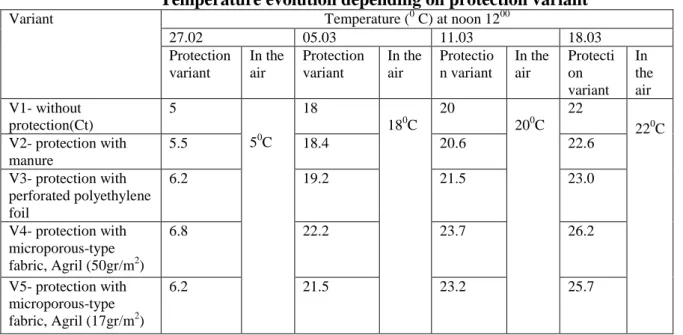
For a good observation of the effect of the protection type has been sought under the temperature of material and the greenhouse, inside, every day at 12 noon. This ranged from the beginning of the growing season, depending on which version to protect, but also by changes in atmospheric temperature. Thus, inside the protection variants was an all-round increase in temperature compared to the control group, with 2 to 4 °C. In table 1 the temperature values are presented in certain days of the vegetation period of radish. In version 4 it has recorded the highest temperature comparative with control.
Table 1.
Temperature evolution depending on protection variant Variant Temperature (0 C) at noon 1200
27.02 05.03 11.03 18.03 Protection
variant
In the air
Protection variant
In the air
Protectio n variant
In the air
Protecti on variant
In the air V1- without
protection(Ct)
5
50C 18
180C 20
200C 22
220C V2- protection with
manure
5.5 18.4 20.6 22.6
V3- protection with perforated polyethylene foil
6.2 19.2 21.5 23.0
V4- protection with microporous-type fabric, Agril (50gr/m2)
6.8 22.2 23.7 26.2
V5- protection with microporous-type fabric, Agril (17gr/m2)
6.2 21.5 23.2 25.7
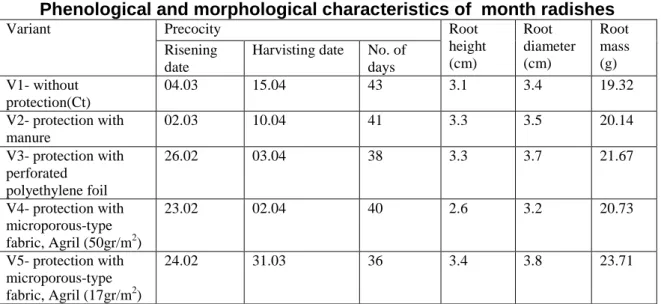
Phenological data concerning the behaviour of radish plants indicate the degree of precocity of Sora cultivar depending on the variant the protection. Thus, the date of sowing was February 2, emergence, 23 February - 04 March, and thickening of the roots in order to harvest took place gradually, depending on the variant the protection.
Phenological data recorded, it is found that the emergence harvest has been greatly influenced by the protect mode for calorie regime. Thus, in the unprotected control, emergence has been uniformelly and the formation of the offal has been slow and has led to the extension of the period of vegetation and hence delay in samples that have been. Growth of the month radishes period in this variant has recorded 43 days.
In respect of variant 2 - protect with manure, emergence was earlier with two days comparative with control. Regarding the 3 - protection with perforated foil is an all-round with five days earlier comparative with control and a much better uniformity, vegetation period is 40 days.
304
Table 2.
Phenological and morphological characteristics of month radishes
Variant Precocity Root height (cm)
Root diameter (cm)
Root mass (g) Risening
date
Harvisting date No. of days V1- without
protection(Ct)
04.03 15.04 43 3.1 3.4 19.32
V2- protection with manure
02.03 10.04 41 3.3 3.5 20.14
V3- protection with perforated
polyethylene foil
26.02 03.04 38 3.3 3.7 21.67
V4- protection with microporous-type fabric, Agril (50gr/m2)
23.02 02.04 40 2.6 3.2 20.73
V5- protection with microporous-type fabric, Agril (17gr/m2)
24.02 31.03 36 3.4 3.8 23.71
It were determined the characteristics of morphological roots of radish bold per month, depending on the variant the protection. Thus, the average height of the thickened roots was located within the boundaries of 2.6 cm to V4 and 3.4 cm in diameter, and medium V5, between 3 cm to 3.8 cm and the V1 and V5.
In variant 4 it was found a slight elongation of the thickened roots to form feature Sora genotype. This phenomenon can be explained by increasing the temperature under the coating material.
The size of the root mass bold, respectively, indicate an individual's productive yield. In this respect, the variants placed between 20.14 – 23.71 g and in the control variant, the edible parts have presented the lowest average weight of 19.32 g.
In the case study, bold roots productions of radishes, made by Sora genotype grown in greenhouse, in light of the protection are generally favorable. Thus, yields were located within the boundaries of 23.5 t/ha and 27.24 t/ha, the control with the smallest production (table 3).
Table 3.
Average yield of radishes cultivated in greenhouses
Variant Yield Diference
±(t/ha) Significance (t/ha) (%)
V1- without protection(Ct) 23.50 100.00 - -
V2- protection with manure 24.82 105.61 +1.32 *
V3- protection with perforated polyethylene foil
26.18 111.40 +2.68 *
V4- protection with microporous-type fabric, Agril (50gr/m2)
25.60 108.93 +2.10 *
V5- protection with microporous-type fabric, Agril (17gr/m2)
27.24 115.91 +3.74 **
DL 5 % = 1.06 t/ha; DL 1 % = 2.71 t/ha; DL 0.1 % = 5.10 t/ha
The best productive yield recorded at variant 5, of 27.24 t/ha, with a difference of production compared to control, of 3.74 t/ha, distinctly significant positive difference. The lower production was recorded in the version without protection, 23.5 t/ha. In variant 2, 3 and 4, the productions have recorded significant differences compared to the control group, ranging from 1.32 and 2.68 t/ha.
305
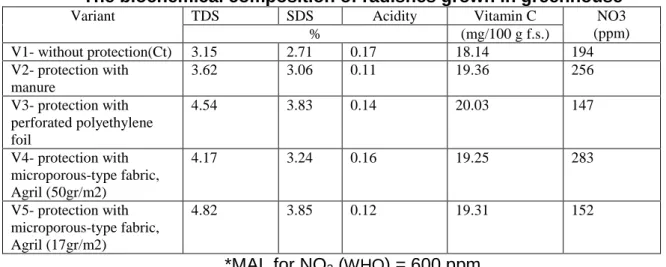
the main components of the thickened roots biochemical radishes grown in greenhouse, the accumulations spooks the fall in average values of characteristic scale of this species, and there are no big differences influenced by the method of protection (table 4).
Table 4.
The biochemical composition of radishes grown in greenhouse
Variant TDS SDS Acidity Vitamin C NO3 (ppm) % (mg/100 g f.s.)
V1- without protection(Ct) 3.15 2.71 0.17 18.14 194 V2- protection with
manure
3.62 3.06 0.11 19.36 256
V3- protection with perforated polyethylene foil
4.54 3.83 0.14 20.03 147
V4- protection with microporous-type fabric, Agril (50gr/m2)
4.17 3.24 0.16 19.25 283
V5- protection with microporous-type fabric, Agril (17gr/m2)
4.82 3.85 0.12 19.31 152
*MAL for NO3 (WHO) = 600 ppm
Thus, at harvest, in the roots of radishes bold has been dosed in the TDS content falling within the boundaries of 3.15% (V1) – 4.82% (V5), upwards of 2.71% (V1) - 3.85% (V4). Total acidity presented values from 0.11 to 0.17%.
Vitamin C has registered values, from 18.14 up 20.3 mg/100 g, fresh substance, significant differences between variants of the protection.
Regarding the accumulation of nitrates, the process is slightly different in the variants considered in the study of 147 ppm up to 283 ppm, far below the maximum limit allowed by the rules WHO (600 ppm).
CONCLUSIONS
From the experimental results concerning the influence of the type of protection of month radish against frost, it can outline the following conclusions:
The phenological data recorded are found in variant 5 - microporous protection foil type of Agril, of 17gr/m2, the radish harvesting was early. The period of vegetation of Sora cultivar was 30 days;
Root weight bold indicates an individual's productive yield. In this respect the protected variants placed between 23.71 – 20.14 cm and in control had recorded 19.32 g;
Yields were located within the boundaries of 23.5 t/ha and 27.24 t/ha. The best production was recorded at variant 5, of 27.24 t/ha, which outperforms the production with a difference of control with 3.74 t/ha;
Variant 4, although it was protected with canvas Agril more dense (50gr/m2) recorded lower production due to the increase inside temperature;
At harvest, bold roots of month radish was dosed in TDS between 3.15% (V1) – 4.82% (V5), SDS up from 2.71% (V1) - 3.85% (V4) and in vitamin C from 18.14 up to 20.3 mg/100 g fresh substance;
Nitrates have accumulated under the MAL (600 ppm), from 147 ppm up to 283 ppm, values that are lower than the MAL.
Bibliography
1. Anzalone, A., Cirujeda, A., Aibar, J., Pardo, G. and Zaragoza, C., 2010 -
306
2. Dumitru Indrea and all., 2007 – Cultura legumelor. Editura Ceres
3. Erzebet Buta, Alexandru Apahidean, 2009 - Observations Concerning the Effect of Agril on Enviromental factors of cabbage Cultivated in plastic Tunnel and field. Buletin of University of Agricultural Sciences and Veterinary Medicine Cluj-Napoca, Vol. 66 (1).
4. Hoza Gheorghiţa, Todică Al., 2005 - Preliminary researches regarding the influence of some organic materials used for mulching the cucumber culture, Lucr.şt.
UŞAMV Bucureşti, seria B Horticultură, Vol. XLVIII, pag. 80-84.