Deduplication Avoidance Using Convergent
Key Management in Cloud
P.G. Student, Department of C
Assistant Professor, Department of C
Abstract—Data deduplication is a technique for needs to save its data. In many organizations, the storage and its information. For example, a equivalent
more files that aren't equivalent may still include much of the same data. Deduplication copies by saving just one copy of the data and
original copy. In this paper first attempt to key management in deduplication. encrypting the convergent keys and
construction in which users are not need to manage any keys on their own. Security Deckey is secure in terms of the exposition
implement Deckey using the Ramp secret sharing on realistic environments.
Keywords—Deduplication, deckey
1. INTRODUCTION
Cloud Storage is a service where data is fully handled, managed, and backed up. It allows the user to store
that the user can access them from any location. The provider company makes them available to the users online by keeping the upload the files on an external server gives companies using cloud storage services ease and convenience, but it c
Users should also be aware that backing up their data is still required whe
storage services, because recovering data from cloud is much slower than local ba
From a user’s perspective, data outsourcing raises security and privacy We must trust third-party cloud providers to properly enforce confidentiality, integrity checking, and access control mechanisms against any insider and outsider attacks. However, deduplication, while
storage and bandwidth proficiency
incompatible with traditional encryption. Specifically, traditional encryption needs
118
Deduplication Avoidance Using Convergent
Key Management in Cloud
P.Gokulraj
P.G. Student, Department of CSE, Nandha College of Technology, Erode
K.Kiruthika Devi
Assistant Professor, Department of CSE, Nandha College of Technology, Erode
Data deduplication is a technique for decreasing the amount of storage space
organizations, the storage systems have duplicate copies of many pieces of data . For example, a equivalent file may be saved in several places by
may still include much of the same data. Deduplication
copies by saving just one copy of the data and changing the other copies with pointers that lead back to the attempt to conventionally address the problem of resolve
deduplication. In the baseline approach each user holds a separate encrypting the convergent keys and redistributes them to the cloud. And we propose a method
not need to manage any keys on their own. Security analyses establish exposition specified in the proposed security model. As a proof of concept, we key using the Ramp secret sharing scheme and determine that Deckey acquire
, convergent encryption, key management
INTRODUCTION
Cloud Storage is a service [1] , managed, and backed up. It allows the user to store files so that the user can access them from any provider company makes them available to the users online by keeping the files on an external server. This cloud storage services it can be costly. Users should also be aware that backing up their data is still required when using cloud recovering data from is much slower than local backup.
s perspective, data outsourcing raises security and privacy affair. party cloud providers to properly enforce confidentiality, integrity checking, and access control mechanisms against any insider and outsider attacks. ation, while increasing storage and bandwidth proficiency [3], is incompatible with traditional encryption. traditional encryption needs
different users to encrypt their data with their own keys. Thus, identical data copies of various users will lead to different cipher texts, making deduplication impossible.
Convergent encrypt allowed one cloud storage provider to claim ‘ storage’ in addition to ‘security’. encryption is an interesting efficiency and privacy. encryptions [8] include enforce data confidentiality
realizing deduplication. It encrypts and decrypts a data copy with a convergent ke which is derived by the
value of the content of th
After key generation and data encryption, users maintain the keys and send the ciphertext to the cloud service. Since encryp
deterministic, equivalent
generate the same convergent key and the same ciphertext.
To understand how convergent encryption can be accomplished
baseline approach that implements convergent encryption based on a layered
Deduplication Avoidance Using Convergent
Key Management in Cloud
, Nandha College of Technology, Erode.
, Nandha College of Technology, Erode.
space for an organization duplicate copies of many pieces of data places by many users, or two or may still include much of the same data. Deduplication remove these extra the other copies with pointers that lead back to the resolve dynamic and reliable separate master key for a method Deckey, a new analyses establish that specified in the proposed security model. As a proof of concept, we acquire limited overhead
different users to encrypt their data with their own keys. Thus, identical data copies of will lead to different cipher texts, making deduplication impossible.
Convergent encrypt allowed provider to claim ‘many age’ in addition to ‘security’. Convergent encryption is an interesting concern between efficiency and privacy. Convergent a viable option to confidentiality reliability while zing deduplication. It encrypts and decrypts a data copy with a convergent key, by the cryptographic hash value of the content of the data copy itself. After key generation and data encryption, the keys and send the ciphertext . Since encryption is deterministic, equivalent data copies will generate the same convergent key and the
is, the real data copy is first encrypted with a convergent key which are derived by the data copy, and the convergent key is then encrypted by a master key that will be kept locally and securely by each user. The en
convergent keys are stored, along with the parallel encrypted data copies, in cloud storage services. The master key can be used to recover the encrypted keys and hence the encrypted files. In this way, each user only needs to store the master key.
This paper makes the following contributions.
A new construction Deckey is proposed to provide efficient and reliable convergent key management through convergent key deduplication and secret sharing. Deckey supports both file-level and block deduplication.
Security analysis demonstrates that Deckey is secure in terms of the definitions specified in the proposed security model. In particular, Deckey remains secure even the adversary controls a limited number of key servers.
We implement Deckey using the Ramp secret sharing scheme that enables the key management to adapt to different reliability and confidentiality levels. Our evaluation demonstrates that Deckey incurs limited overhead in normal upload/download operations in realistic cloud environments.
2. PRELIMINARIES
In this section, we formally define the Cryptographic primitives used in our secure deduplication.
2.1 SYMMETRIC ENCRYPTION
Symmetric encryption uses a common secret key to encrypt and decrypt information. A symmetric encryption scheme consists of three primitive functions:
KeyGenSE(1
) k
generation algorithm that generates using Security parameter 1
EncryptSE(k,M) C is the symmetric
encryption algorithm that takes the secret k and message and then outputs the ciphertext C.
119
data copy is first encrypted with a which are derived by the data and the convergent key is then encrypted by a master key that will be kept locally and securely by each user. The encrypted stored, along with the encrypted data copies, in cloud storage . The master key can be used to recover the encrypted keys and hence the ay, each user only
This paper makes the following contributions.
A new construction Deckey is proposed to ent and reliable convergent key management through convergent key deduplication and secret sharing. Deckey level and block-level
Security analysis demonstrates that Deckey is secure in terms of the definitions in the proposed security model. In particular, Deckey remains secure even the adversary controls a limited number of key
We implement Deckey using the Ramp secret sharing scheme that enables the key management to adapt to different reliability and confidentiality levels. Our evaluation key incurs limited overhead in normal upload/download realistic cloud environments.
PRELIMINARIES
y define the primitives used in our secure
SYMMETRIC ENCRYPTION
Symmetric encryption uses a common secret key to encrypt and decrypt symmetric encryption scheme consists of three primitive functions:
k is the key
generation algorithm that generates k using Security parameter 1.
is the symmetric encryption algorithm that takes the nd then outputs
DecryptSE(k,M)
decryption algorithm that takes the secret k and ciphertex
the original message M.
2.2 CONVERGENT ENCRYPTION Convergent encryption [8] provides data confidential
A user (or data owner) derives a convergent key from each original data copy and encrypts the data copy with the convergent key. user extracts a tag for the data copy, such tha the tag will be used to find
assume that the tag property [5] holds, i.e., if two data copies are the same, then their tags are also the same. To find
first sends the tag to the server side to c the identical copy has been stored
Note that both the convergent key and the tag are independently derived
be used to deduce the convergent key and compromise data confidentiality. The both encrypted data copy and its corresponding tag will be stored on the server side.
2.3 RAMP SECRET SHARING Deckey uses the Ramp sharing scheme (RSSS) [4]
convergent keys. Especially (where n>k>r≥0) generates
secret sharing such that 1) the secret can be recovered from any k shares but cannot be replaces from fewer than
There is no information about the secret can be consider from any r shares. It is known that when r=0, the (n,k,0)-RSSS becomes the ( Rabin’s Information Dispersal Algorithm (IDA) [5]; when r=k-1, the (
becomes the (n,k,)Shamir’s S Scheme (SSSS). The (n,k,r two primitive functions:
Share divides a secret S into
equal size, generates r random pieces of the same size, and encodes the
non-systematic k-of-n erasure code into shares of the same size;
Recover takes any k
inputs and then outputs the original secret S.
M is the symmetric decryption algorithm that takes the secret k and ciphertext and then outputs the original message M.
CONVERGENT ENCRYPTION
Convergent encryption [8] [2] s data confidentiality in deduplication. (or data owner) derives a convergent key from each original data copy and encrypts the data copy with the convergent key. The the data copy, such that the tag will be used to find duplicates. We assume that the tag property [5] holds, i.e., if he same, then their tags are also the same. To find duplicates, the user first sends the tag to the server side to check if the identical copy has been stored already. Note that both the convergent key and the tag derived and the tag cannot be used to deduce the convergent key and e data confidentiality. The both data copy and its corresponding tag will be stored on the server side.
RAMP SECRET SHARING
Deckey uses the Ramp secret sharing scheme (RSSS) [4] [9] to store the convergent keys. Especially, the (n,k,r)-RSSS ≥0) generates n shares from a such that 1) the secret can be shares but cannot be from fewer than k shares, and 2) no information about the secret can be shares. It is known that RSSS becomes the (n,k,) ion Dispersal Algorithm 1, the (n,k,k-1)-RSSS )Shamir’s Secret Sharing
n,k,r)-RSSS builds on
Share divides a secret S into ,k-,r)-pieces of equal size, generates r random pieces of the same size, and encodes the k pieces using a n erasure code into n shares of the same size;
To make the generated shares appropriate for deduplication, we replace the above random pieces with pseudorandom pieces in the implementation of Deckey. Deckey uses RSSS to provide a tunable key management mechanism to balance among confidentiality, reliability, storage overhead, and performance
3. PROBLEM FORMULATION 3.1 SYSTEM MODEL
We first develop
outsourcing model used by Deckey. There are three entities, namely: the user, the cloud service provider Storage (CSP
cloud service provider key-management (CSP KM), as categorized below.
User: A user is an entity that outsource data storage to the S access the data later. To store bandwidth, the user only uploads data but does not upload any du
which may be retained by the same user or different users.
CSP-S: The CSP-S provides the data outsourcing service and stores data on behalf of the users. To reduce the cost of storage the CSP-S removes the storage of redundant data via deduplication and keeps only unique data.
CSP-KM: A CSP-KM maintains convergent keys for users, and provides users with small storage and computation services to facilitate key management. In the fault tolerance of key management, we consider a quorum of KMs, each being a separate
convergent key is distributed across multiple CSPs-KM using RSSS (see Section 2).
In this, we specify a data copy to be either a whole file or a smaller-size block, and this point to two types of deduplication: 1) file-level deduplication, which
storage of any repeated files, and 2) block level deduplication, which fragment
smaller fixed-size or variable-size blocks and delete the storage of any redundant bloc
deploy our deduplication mechanism in both file level and block level. Specifically, to upload a file, a user first executes
duplicate check. If the file finds to be a
120
To make the generated shares appropriate for deduplication, we replace the above random pieces with pseudorandom pieces in the implementation of Deckey. Deckey uses RSSS to provide a tunable key management mechanism to balance among confidentiality, ability, storage overhead, and performance.
3. PROBLEM FORMULATION
We first develop a data outsourcing model used by Deckey. There are tities, namely: the user, the cloud CSP-S), and the management
(CSP-A user is an entity that needs to outsource data storage to the S-CSP and access the data later. To store the upload bandwidth, the user only uploads different data but does not upload any duplicate data, by the same user or
provides the data outsourcing service and stores data on behalf reduce the cost of storage, the storage of redundant ication and keeps only unique
maintains convergent and provides users with small storage and computation services to facilitate fault tolerance of key management, we consider a quorum of
CSP-separate entity. Each convergent key is distributed across multiple
using RSSS (see Section 2).
a data copy to be size block, and to two types of deduplication: 1) level deduplication, which remove the files, and 2)
block-fragment a file into size blocks and the storage of any redundant blocks. We deploy our deduplication mechanism in both . Specifically, to a user first executes the file-level the file finds to be a
duplicate, then all its bl duplicates; otherwise, the block-level duplicate to
unique blocks to be uploaded. Each copy is associated with a tag for the dupl check. All data copies and tags will be stored in the CSP-S.
4. CONSTRUCTIONS
In this section, we
baseline approach that realizes convergent encryption in deduplication, and examine limitations of the baseline approach in key management. To this end, we
construction Deckey, which aims to mitigate the key management overhead and provide fault tolerance guarantees for
management, while protecting
security properties of secure deduplication.
4.1 SYSTEM SETUP The system setup
the necessary parameters in the following two steps:
S1: The following points
symmetric encryption scheme with the primitive functions (KeyGen
DecryptSE) and the user’s master key
KeyGenSE (1) for scurity parameter 1
convergent encryption scheme with the primitive functions (KeyGen
DecryptCE, TagGenCE).
S2: The CSP-S initializes two types of storage systems: a rapid storage system for store tags for efficient duplicate checks, and a file storage system for storing both encrypted data copies and convergent keys.
4.2 FILE UPLOAD
Suppose that a user uploads a file F . First, it performs file-level deduplication as follows.
S1: On input file F, the user the file tag T(F)= TagGenCE
S2: Upon receiving T(F)
whether there exists the same tag on the S. If so, the CSP-S replies the user with a response ‘‘file duplicate,’’ or ‘‘no file duplicate’’ otherwise.
duplicate, then all its blocks must be otherwise, the user performs the check and find the to be uploaded. Each of the data is associated with a tag for the duplicate All data copies and tags will be stored
4. CONSTRUCTIONS
In this section, we represent a baseline approach that realizes convergent on in deduplication, and examine the limitations of the baseline approach in key management. To this end, we denote our construction Deckey, which aims to mitigate anagement overhead and provide fault tolerance guarantees for key management, while protecting the required
perties of secure deduplication.
The system setup phase computes the necessary parameters in the following two
The following points are initialized: 1) a symmetric encryption scheme with the (KeyGenSE, EncryptSE,
) and the user’s master key k= curity parameter 1; 2) a convergent encryption scheme with the primitive functions (KeyGenCE, EncryptCE,
initializes two types of storage rapid storage system for store the duplicate checks, and a file storage system for storing both encrypted data
ies and convergent keys.
Suppose that a user uploads a file F . First, it level deduplication as follows.
the user execute and sends
CE(F) to the CSP-S.
), the CSP-S checks whether there exists the same tag on the
S3: If the user receives the response ‘‘no file duplicate’’, then it jumps to S5 to
block-level deduplication. If the response is ‘‘file duplicate,’’ then the user runs PoW with the CSP-S to prove that it actually owns the same file F that is stored on the S
S4: If PoWF is passed, the CSP
returns a file pointer of F to the user, and no further information will be uploaded. If PoW fails, the S-CSP aborts the upload operation.
4.2 DECKEY
Deckey is designed to efficiently and reliably maintain convergent keys. Its idea is to implement deduplication in convergent keys and distribute the convergent keys across different CSPs-KM. Instead of encrypting the convergent keys on a per-user basis, Deckey constructs secret shares on the original convergent keys (that are in plain) and distributes the shares across multiple KM. If multiple users share the same block, they can access the same convergent key. significantly decreases the storage overhead for convergent keys. In addition, this approach gives fault tolerance and allows the co
keys to remain accessible even if any subset of CSPs-KM fails. We now elaborate the details of Deckey as follows.
4.2.1 System Setup
The system setup phase in Deckey is similar to that in the baseline approach, but involves an additional step for initializing the key storage in CSPs-KM. In Deckey, we assume that the number of
CSPs-S1: On input security parameter 1
initializes a convergent encryption scheme, and two PoW protocols POW
for the file ownership proof and block ownership proof, respectively.
S2: The CSP-S initializes both the rapid storage system and the file storage system.
S3: Each CSPs-KM initializes a rapid storage system for block tags and a lightweight storage system for holding convergent key shares.
121
If the user receives the response ‘‘no file duplicate’’, then it jumps to S5 to proceed with . If the response is ‘‘file duplicate,’’ then the user runs PoWF on F
to prove that it actually owns the same file F that is stored on the S-CSP.
CSP-S simply pointer of F to the user, and no further information will be uploaded. If PoWF
CSP aborts the upload operation.
Deckey is designed to efficiently and reliably maintain convergent keys. Its idea deduplication in convergent keys and distribute the convergent keys across . Instead of encrypting the user basis, Deckey constructs secret shares on the original convergent keys (that are in plain) and s the shares across multiple CSPs-. If multiple users share the same block, they can access the same convergent key. This the storage overhead for convergent keys. In addition, this approach es fault tolerance and allows the convergent keys to remain accessible even if any subset of fails. We now elaborate the details
The system setup phase in Deckey is similar to that in the baseline approach, but for initializing the . In Deckey, we
-KM is n.
On input security parameter 1, the user initializes a convergent encryption scheme, protocols POWF and POWB
for the file ownership proof and block
initializes both the rapid tem and the file storage system.
initializes a rapid storage system for block tags and a lightweight storage
key shares.
5. IMPLEMENTATION
In this section, we discuss the implementation details of Deckey. Deckey builds on the Ramp secret sharing scheme (RSSS) [3], [4 distribute the shares of convergent keys across multiple key servers (see Section 2)
5.1 RSSS with Pseudorandomness
In Deckey, the RSSS secret is the hash key H0 of a data block B, where
H0=hash(B). Recall from Section 2 that the
Share function of the (n,k,r
random pieces to achieve a confidentiality level of r. One challenge is that randomization conflicts with deduplication, since the random pieces cannot be deduplicated with each other. Instead of directly adopting RSSS, we here replace these random pieces
pseudorandom pieces in our De implementation.
We generate the r pseudorandom pieces as follows. Let m =
generate m additional hash values as
H1=hash(B+1), H2=hash(B+2), . . . , Hm=hash(B+m). We then fill in the r pieces with the generated m additional hash values
H1. H2,. . . ; Hm.
5.2 EVALUATION
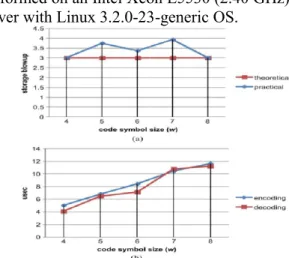
In this section, we evaluate the encoding and decoding performance of Deckey on generating and recovering key shares, respectively. All our experiments were performed on an Intel Xeon E5530 (2.40 GHz) server with Linux 3.2.0-23
Fig. 1 Impact of code symbol size w on storage blowup and performance in the case of (6, 4, 2)-RSSS. (a) Storage blowup. (b) Encoding/decoding time
5. IMPLEMENTATION
In this section, we discuss the implementation key builds on the Ramp scheme (RSSS) [3], [4] to distribute the shares of convergent keys across
servers (see Section 2)
RSSS with Pseudorandomness
key, the RSSS secret is the of a data block B, where =hash(B). Recall from Section 2 that the
n,k,r)-RSSS embeds r
random pieces to achieve a confidentiality . One challenge is that randomization conflicts with deduplication, since the random pieces cannot be deduplicated with each other. Instead of directly adopting RSSS, we here replace these random pieces with pseudorandom pieces in our Deckey
We generate the r pseudorandom pieces as follows. Let m = [
[ ]]. We first
generate m additional hash values as =hash(B+2), . . . , =hash(B+m). We then fill in the r pieces with the generated m additional hash values
In this section, we evaluate the encoding and decoding performance of key on generating and recovering key All our experiments were performed on an Intel Xeon E5530 (2.40 GHz)
23-generic OS.
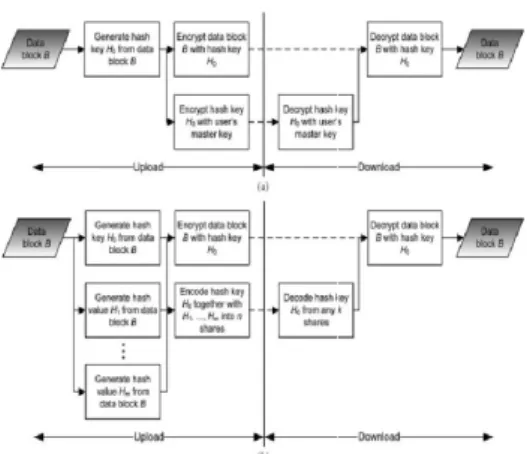
Fig. 2 Flow block diagrams of core modules in two different approaches. (a) Baseline approach (keeping the hash key with an encryption scheme). (b) Deckey (keeping the hash key with (n,k,r)-RSSS)
5.3 OVERALL RESULTS
With (n,k,r)-RSSS being used, we all the following cases:3≤n≤8,2≤
1≤r≤k-1. We can see that the encoding and decoding times of Deckey for each hash key (per 4 KB data block) are always on the order of microseconds, and hence are negligible compare to the data transfer perfor
the Internet .
6. RELATED WORK
6.1 CONVERGENT ENCRYPTION Convergent encryption
data privacy in deduplication. Bellare et al. [2 formalize this primitive as a messag
encryption, and analyze its application in space-efficient secure outsourced storage. There are also several implementations of different convergent encryption variants for secure deduplication. It is known that some commercial cloud storage providers, such as Bitcasa, also deploy convergent encryption [2
7. CONCLUSION
We propose Deckey is an efficient and reliable convergent key management scheme for secure deduplication. Deckey
deduplication among convergent keys and distributes convergent key shares across many key servers, while protecting semantic security
122
diagrams of core modules in two different approaches. (a) Baseline approach (keeping the hash key with an encryption scheme). (b) Deckey (keeping the
RSSS being used, we test ≤8,2≤k≤n-1,and 1. We can see that the encoding and decoding times of Deckey for each hash key (per 4 KB data block) are always on the order nd hence are negligible r performance in
6. RELATED WORK
CONVERGENT ENCRYPTION Convergent encryption [8] ensures
duplication. Bellare et al. [2] message-locked its application in efficient secure outsourced storage. There are also several implementations of different convergent encryption variants for secure deduplication. It is known that some commercial cloud storage providers, such as oy convergent encryption [2]
CONCLUSION
an efficient and reliable convergent key management scheme for secure deduplication. Deckey assign deduplication among convergent keys and rgent key shares across many semantic security
of convergent keys and confidentiality of outsourced data. We implement Deckey using the Ramp secret sharing scheme and implement that it incurs small encoding/decoding overhead com
network transmission overhead in the regular upload/download operations.
REFERENCES
[1] Ed. Michael Waidner“On the Security of Cloud Storage Services” SIT Technical Reports,
2012-001 March 2012, Fraunhofer Institute for Secure Information Technology SIT.
[2] M. Bellare, S. Keelveedhi, and T. Ristenpart, ‘‘Message-Locked Encryption and Secure Deduplication,’’ in Proc. IACR Cryptology ePrint Archive, 2012, pp. 296-3122012:631.
[3]Nesrine Kaaniche, Maryline Laurent “
Client Side Deduplication Scheme Cloud Storage Environments” 6TH International Conference On New Technologies, And Security Year 2014 [4] A.D. Santis and B. Masucci, ‘‘Multiple Ramp Schemes,’’ IEEE Trans. Inf. Theory, vol. 45, no. 5, pp. 1720-1728, July 1999.
[5]M.O. Rabin, ‘‘Efficient Dispersal of Information for Security, Load Balancing, Fault Tolerance,’’ J. ACM, vol. 36, no. 2, pp. 335
[6]S. Halevi, D. Harnik, B. Pinkas, and A. Shulman-Peleg, ‘‘Proofs of Ownership in Remote Storage Systems,’’ in Proc. ACM
Commun. Security, Y. Chen, G. Danezis, and V. Shmatikov, Eds., 2011, pp. 491
[7]R.D. Pietro and A. Sorniotti, ‘‘Boosting Efficiency and Security in Proof of Ownership for Deduplication,’’ in Proc. ACM Symp. Inf., Comput. Commun. Security, H.Y. Youm and Y. Won, Eds., 2012, pp.81-82.
[8]J.R. Douceur, A. Adya, W.J. Bolosky, D. Simon, and M. Theimer, ‘‘Reclaiming Space from Duplicate Files in a Serverless Distrib
System,’’ in Proc. ICDCS, 2002, pp. 617
[9]G.R. Blakley and C. Meadows, ‘‘Security of Ramp Schemes,’’ in Proc. Adv. CRYPTO, vol. 196, Lecture Notes in Computer Science, G.R. Blakley and D. Chaum, Eds., 1985, pp. 242
[10]”Data Deduplication in Cloud Exxplained” http://www.computerworld.com/article/2474479/da
ta-center/data-deduplication-of convergent keys and confidentiality ta-center/data-deduplication-of outsourced data. We implement Deckey using the Ramp secret sharing scheme and that it incurs small encoding/decoding overhead com-pared to the smission overhead in the regular upload/download operations.
REFERENCES
On the Security of Cloud SIT Technical Reports, SIT-TR-March 2012, Fraunhofer Institute for Secure Information Technology SIT.
M. Bellare, S. Keelveedhi, and T. Ristenpart, Locked Encryption and Secure Deduplication,’’ in Proc. IACR Cryptology ePrint
3122012:631.
Nesrine Kaaniche, Maryline Laurent “ A Secure Scheme Cloud Storage Environments” 6TH International Conference On New Technologies, And Security Year 2014
A.D. Santis and B. Masucci, ‘‘Multiple Ramp Schemes,’’ IEEE Trans. Inf. Theory, vol. 45, no. 5,
‘‘Efficient Dispersal of Information for Security, Load Balancing, Fault Tolerance,’’ J. ACM, vol. 36, no. 2, pp. 335-348, Apr. 1989.
S. Halevi, D. Harnik, B. Pinkas, and A. Peleg, ‘‘Proofs of Ownership in Remote Storage Systems,’’ in Proc. ACM Conf. Comput. Commun. Security, Y. Chen, G. Danezis, and V. Shmatikov, Eds., 2011, pp. 491-500.
R.D. Pietro and A. Sorniotti, ‘‘Boosting Efficiency and Security in Proof of Ownership for Deduplication,’’ in Proc. ACM Symp. Inf., ity, H.Y. Youm and Y.
J.R. Douceur, A. Adya, W.J. Bolosky, D. Simon, and M. Theimer, ‘‘Reclaiming Space from Duplicate Files in a Serverless Distrib-uted File System,’’ in Proc. ICDCS, 2002, pp. 617-624.
C. Meadows, ‘‘Security of Ramp Schemes,’’ in Proc. Adv. CRYPTO, vol. 196, Lecture Notes in Computer Science, G.R. Blakley and D. Chaum, Eds., 1985, pp. 242-268.
”Data Deduplication in Cloud Exxplained” http://www.computerworld.com/article/2474479/da