IJMESS Vol. 8 Issue 1 (March 2019) www.ijmess.org
KINEMATIC ANALYSIS OF FOREHEAD JUMP SMASH TECHNIQUE AMONG YOUNG SHUTTLER
Mr. Pushkar Yadav, Ph.D Scholar
Dr. Inder Singh Pal, Assistant Prof. ASPESS, Amity University, Nodia (U.P.)
ABSTRACT
The modern age of sports is the excellence, so in every sports perfection and purification of skill has got its immense importance. Biomechanics is an applied form of mechanics and consequently the method used to investigate. Kinematic aims to explain the mechanics of life. Kinematic and mechanical analyses have also generated other efforts at improving athletic performance in different games and sports; it is helpful to minimize sports injuries through both identifying dangerous practice and designing safer equipment and apparel. The purpose of this study was to investigate the smashing technique among young shuttlers with the help of selected kinematic variables. This study may help the coaches and trainees to understand the weakness or flaws or improvement in technique by watching the analyzed smashing videography in slow motion. Here in the study the forehand smashing technique (straight court) was analyzed with the help of selected kinematic variables. The video was shot in two planes in slow motion format at 240 fps.
Keywords: Kinematics, Center of gravity, forehand smash technique, Evaluation of technique, Balance, etc.
INTRODUCTION
Biomechanics is closely related to engineering because it opens by uses traditional engineering sciences to analyze biological system. Some simple applications of
Newtonian mechanics and materials sciences can supply correct approximations of the mechanics of many biological systems. Applied
mechanics, most notably mechanical
engineering discipline such as continuum mechanics, mechanism analysis, structural analysis, kinematics and dynamics play
important role in the study of biomechanics.In
sports biomechanics the law of mechanics are applied to human movement in order to gain a greater understanding of athletic performance and to reduce sports injuries as well. Biomechanics in sports can be stated as the muscular joint and skeletal actions of the body during the execution of a given task, skill or
technique. Proper understanding of
biomechanics relating to sports has the greatest implication on sports performance, rehabilitation and injury prevention along with sports mastery.
METHODOLOGY
The study was delimited to the following variable:
o Height of center of gravity at the time of
stance
o Height of center of gravity at the time of
contact with shuttle (Execution)
o Time of flight during jump
o Height of jump
The digital camera (Canon Eos 5D Mark IV) was employed to register the forehand smash at 240fps. The subjects were photographed at the moment of stance and execution of smash in sagittal plane. From the photographic sequence the data for various variables was calculated at selected moments.
Seven male Indian trainees of Jawaharlal Nehru Stadium were selected as the subject for the present study; these shuttlers have played at inter school and Delhi zonal level. The age was between 12 to 16 years. The analysis of each subject for forehand smash was on the basis of how he cleanly and precisely executes the smash technique. Only five smash were allowed to each subject.
The recording was determined on wooden court at Jawaharlal Nehru Stadium. The subject was asked to smash the tossed shuttle with jump. The filming zone was set up with video camera placed in sagital plane at a distance of 10 feet from the subject. After video recording final position of each selected phase was obtained on the screen by trial and error method and kept in pause.
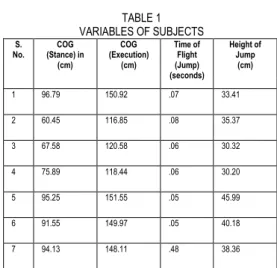
TABLE 1 VARIABLES OF SUBJECTS S.
No. (Stance) in COG (cm)
COG (Execution)
(cm)
Time of Flight (Jump) (seconds)
Height of Jump
(cm)
1 96.79 150.92 .07 33.41
2 60.45 116.85 .08 35.37
3 67.58 120.58 .06 30.32
4 75.89 118.44 .06 30.20
5 95.25 151.55 .05 45.99
6 91.55 149.97 .05 40.18
7 94.13 148.11 .48 38.36
The table depicts, the different selected kinematic variables, for the smashing technique among Young shutlers as COG (in CM)- while in stance position-COG(in CM) in Execution-Time of flight at jump in (Sec) and height of jump in (CM).
IJMESS Vol. 8 Issue 1 (March 2019) www.ijmess.org
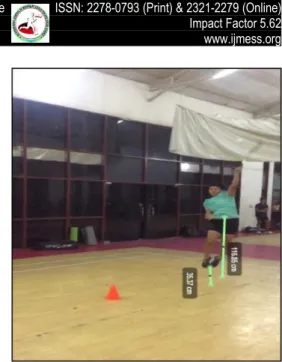
Fig. No. 2: smash was executed but base of support is narrow and body is not in the state of equilibrium, further the Jump of subject is not much, as compared to height of subject where as both the legs are closer.
Fig. No. 3: Shows wider base of support while approaching for smash. COG is much lower compared to former subject and exactly falls within the base of support.
Fig. No. 4: Smash was executed but the base of support is narrow and body is not in the state of equilibrium. Body of subject is slightly turned to left which is not good for forehead jump smash as lot of energy is wasted.
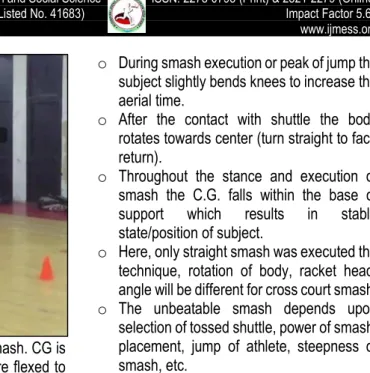
Fig. No. 6: Shows good jump for smash. CG is elevated to maximum and knees are flexed to give more air time. Upper body is wide open to clear the smash.
CONCLUSION
Based on the analysis and within the delimitation of present study following conclusion were drawn:
o The knee is bent during stance which allows
player to push harder off the ground and increase the aerial time.
o From fig. 1, 3, 5 it is clearly visible that C.G.
of the subject lies within the base of support during stance which reveals that the subject is in properly balanced position to execute the smash.
o From the fig. 2, 4, 6 it clearly visible that when the smash is being executed the subject is air borne and position of racket is behind or above head.
o Smash was executed when the body is at
peak of jump and PE (Potential energy) and KE (Kinetic energy) are zero. This is called as stay in air which is fraction of seconds.
o During smash execution or peak of jump the
subject slightly bends knees to increase the aerial time.
o After the contact with shuttle the body
rotates towards center (turn straight to face return).
o Throughout the stance and execution of
smash the C.G. falls within the base of
support which results in stable
state/position of subject.
o Here, only straight smash was executed the
technique, rotation of body, racket head, angle will be different for cross court smash.
o The unbeatable smash depends upon
selection of tossed shuttle, power of smash, placement, jump of athlete, steepness of smash, etc.
REFERENCES
Kasper Sørensen (Sports Science Aalborg University) December, 2010, “A Biomechanical Analysis of Clear Strokes in Badminton Executed by Youth Players of Different Skill”. DBF, 2010: Classification of youth badminton players (downloaded on the 8th of september
2010): Launch
http://www.badminton.dk/DBF/Administrativt/L
ove_og_regler/Ranglisteregler.aspx and
choose "reglement for ungdomsklassifikation". Elliott B.; Marshall, R. & Noffal G.: The Role Of Upper Limb Segment Rotations In The Development Of Racquet-Head Speed In The Squash Forehand, 1996, Journal Of Sport Sciences, Vol. 14, 159-165. Elliott, B.; Marshall, R. and Noffal, G.: Contributions of upper limb segment rotations during the power serve in tennis, 1995, Journal of Applied Biomechanics, Vol. 11, 433-442.
IJMESS Vol. 8 Issue 1 (March 2019) www.ijmess.org
Durovic (2008), kinematic analysis of tennis serve in intermediate tennis players.
HSU (2008), kinematic analysis of forehand stroke between new and the experienced Tennis player.
Budney, D.R. & D.G. Bellow, “On the swing mechanics of a set of matched golf clubs”, Research Quarterly for Exercise and Sport, 53 (1982), pp.185-192.
Escamilla R.F., Fleisi, G.S, DeRenne
C., Taylor M,K., Moorman CT 3rd, Imamura R, Barakatt E, Andrews JR, Effects of bat grip on baseball hitting kinematics, Journal of Applied Biomechanics, 25(3), 2009, 203-9. James G. Hay, The Biomechanics of Sports Techniques (4th Edition) (The University of Michigan, Prentice-Hall, 1993)
Miller, Doris I and Nelson, Richard C. “Biomechanics Of sport” Philadelphia: Lea and Febiger, 1976.
Rochelle L. Nicholls, Karol Miller, Bruce C. Elliott, Numerical analysis of maximal bat performance in baseball, Journal of Biomechanics Vol. 39, Issue 6, 2006, 1001-1009
Tabuchi N, Matsuo T, Hashizume K., Bat speed, trajectory, and timing for collegiate baseball batters hitting a stationary ball, Sports
Biomechanics/International society of