Remuneration Committee Report
The Board supports the principles of good corporate governance relating to Directors’ remuneration and has applied them as described below. In accordance with Schedule 7A ‘‘Directors’ Remuneration Report’’ of the Companies Act 1985, those paragraphs that have been audited have been highlighted as such.
Composition of the Remuneration Committee
During the year ended 30 April 2005, Iain Duffin chaired theRemuneration Committee and the other members were Russell Walls and Janet Morgan, all three of whom are independent Non-Executive Directors. The Committee, which was established in December 1992, has delegated responsibility for approving the remuneration and terms of employment for the Executive Directors and the Chairman, including pensions rights and any compensation payments. The Remuneration Committee also monitors and makes appropriate recommendations with respect to the remuneration of other senior management.
The Board of Directors as a whole, having given due regard to the required time commitment and responsibilities, sets the fees and expenses payable to the Non-Executive Directors. Non-Executive Directors do not hold any share options, nor do they participate in any incentive plans or pension schemes with the exception of Ann Gloag who receives a pension accrued when she was an executive director. The members of the Remuneration Committee have no personal interest in the matters to be decided other than as shareholders, no potential conflicts of interest arising from cross-directorships and no day-to-day involvement in running the businesses of the Stagecoach Group.
Both the constitution and operation of the Remuneration Committee comply with the principles incorporated in the Combined Code, with the prior consent of shareholders where necessary. In preparing this Remuneration Report, the Remuneration Committee has followed the provisions of the Combined Code.
The terms of reference of the Remuneration Committee are available on the Group’s website at http ://www.stagecoachplc.com/sgc/investorinfo/ corpgov.
Performance graph
The graph below charts the performance of the Stagecoach Group Total Shareholder Return (‘‘TSR’’) (share value movement plus reinvested dividends) over the 5 years to 30 April 2005 compared with that of the FTSE Transport All-Share Index, the FTSE Mid 250 Index and the FTSE All-Share Index. We have included a further graph to highlight the Company’s more recent performance, charting TSR for the 12 months up to 30 April 2005.
In assessing the performance of the Company’s TSR the Board believes the comparator groups it has chosen represent a fair benchmark both in terms of the nature of the business activity and size of company.
Remuneration Policy
The Remuneration Policy is consistent with our prior year policy, which was approved by the shareholders at the 2004 Annual General Meeting. However, the Committee has, with the assistance of the Group’s advisers, KPMG LLP (UK), been reviewing the structure of remuneration for Executive Directors and senior management. Proposals will be submitted to shareholders at the 2005 Annual General Meeting to make changes to the various elements of remuneration in the context of the overall objectives of the Remuneration Policy. The Remuneration Committee follows Schedule A of the Combined Code in designing performance-related remuneration schemes.
In determining appropriate levels of remuneration for the Executive Directors, the Remuneration Committee aims to provide overall packages of terms and conditions that are competitive in the UK and will attract, retain and motivate high quality executives capable of achieving the Stagecoach Group’s objectives and to ensure that they are fairly rewarded for their individual responsibilities and contributions to the Group’s overall performance. The Remuneration Committee believes that such packages should contain significant performance-related elements and that these performance-related elements should be designed to align the interests of the Executive Directors and other senior managers with the interests of shareholders. Performance targets are established to achieve consistency with the interests of shareholders, with an appropriate balance between short- and long-term targets. Performance targets include traditional financial indicators and personal targets, successful investment, innovation, staff development, customer satisfaction and achievement of regulatory requirements, including health and safety and environmental targets.
Stagecoach TSR Comparative Performance since 30 April 2000
To this end, the Remuneration Committee reviews the existing remuneration of the Executive Directors, in consultation with the Chief Executive, making comparisons with peer companies of similar size and complexity and with other companies in the public transport industry in the UK and overseas. Proposals for the forthcoming year are then discussed in the light of the prospects for the Group. The Remuneration Committee is also kept informed of the salary levels of other senior executives employed by the Stagecoach Group and of average earnings for all employees. With regard to pensions, the Remuneration Committee has access to reports from the trustees and scheme actuaries regarding the cost of pension obligations.
The Committee has taken advice during the financial year from a firm of independent executive remuneration consultants, Inbucon Consulting. Also, KPMG LLP (UK) provided guidance on the implementation of the proposed changes to the remuneration arrangements as described later in this report. Inbucon has no other relationship with the Group. KPMG LLP (UK) has from time to time provided other consultancy services to the Group and is the auditor of the Stagecoach Group Pension Scheme (‘‘SGPS’’).
Shareholders are invited to specifically approve all new long-term remuneration plans (whether share-settled or cash-settled plans) and any significant changes to existing plans, except where otherwise permitted by the Listing Rules.
The Remuneration Committee believes that remuneration packages should reward the efforts of all staff since a motivated workforce is a key element of Group performance. The Committee recognises that Executive Directors bear the greatest responsibility for delivering corporate strategy that underpins long-term sustainable performance. While the Remuneration Committee’s report focuses on incentive schemes for senior executives,
there are also a number of performance-related bonus schemes within group companies, in addition to the UK-only SAYE scheme.
Remuneration of Executive Directors and Other Executives
(audited)
The remuneration of the Executive Directors and other executives may comprise a number of elements from the following :
. Basic Salary ;
. Performance-related annual cash bonuses ; . Benefits in kind and other allowances ; . Pension arrangements ;
. Share options ;
. Long Term Bonus Scheme (‘‘LTBS’’) ;
. Executive Participation Programme (‘‘EPP’’) ^ proposed ; . Long Term Incentive Plan (‘‘LTIP’’) ^ proposed.
The participation of the three Executive Directors in the above arrangements is summarised in Table 1.
Each Executive Director’s remuneration package is tailored to the individual to ensure an appropriate balance of reward for responsibilities, motivation, retention and share participation, whilst ensuring the overall packages are appropriate to recruit and retain high quality executives capable of achieving the Group’s objectives.
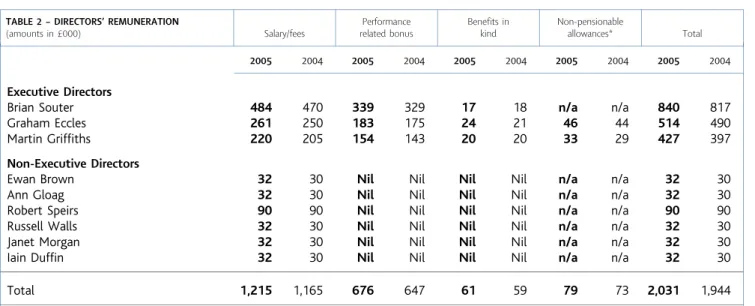
Directors’ remuneration for the year ended 30 April 2005 is shown in Table 2 and Directors’ pension benefits are shown in Table 3.
TABLE 1 ^ DIRECTORS’ PARTICIPATION Basic Salary/Annual Bonus Benefits in kind Pension Share Options LTBS EPP (proposed) LTIP (proposed)
Brian Souter YES YES YES YES* NO YES YES
Graham Eccles YES YES YES YES* YES NO` NO`
Martin Griffiths YES YES YES YES* YES YES YES
*The Executive Directors are not expected to receive further awards of executive share options, following and subject to the approval of the proposed EPP and LTIP.
The existing LTBS will be unwound subject to the approval of the proposed EPP and LTIP.
`Graham Eccles will not participate in the EPP nor the LTIP because he intends to retire as a Director in April 2006.
TABLE 2 ^ DIRECTORS’ REMUNERATION
(amounts in »000) Salary/fees Performance related bonus Benefits in kind Non-pensionable allowances* Total 2005 2004 2005 2004 2005 2004 2005 2004 2005 2004 Executive Directors
Brian Souter 484 470 339 329 17 18 n/a n/a 840 817
Graham Eccles 261 250 183 175 24 21 46 44 514 490
Martin Griffiths 220 205 154 143 20 20 33 29 427 397
Non-Executive Directors
Ewan Brown 32 30 Nil Nil Nil Nil n/a n/a 32 30
Ann Gloag 32 30 Nil Nil Nil Nil n/a n/a 32 30
Robert Speirs 90 90 Nil Nil Nil Nil n/a n/a 90 90
Russell Walls 32 30 Nil Nil Nil Nil n/a n/a 32 30
Janet Morgan 32 30 Nil Nil Nil Nil n/a n/a 32 30
Iain Duffin 32 30 Nil Nil Nil Nil n/a n/a 32 30
Total 1,215 1,165 676 647 61 59 79 73 2,031 1,944
*Non-pensionable allowances represent additional taxable remuneration paid to provide pension benefits.
TABLE 3 ^ DIRECTORS’ PENSION BENEFITS (amounts in »000) Additional accrued benefits in the year Accrued pension Accrued lump sum Transfer value of increase (excluding inflation) Increase in transfer value less Directors’ contributions Excluding Including
Executive Directors inflation inflation 2005 2004 2005 2004 2005 2004
Brian Souter 47 66 244 226 439 391 146 127 116
Graham Eccles 10 14 21 18 64 53 33 29 33
Martin Griffiths 11 13 26 23 78 68 12 10 12
Graham Eccles and Martin Griffiths were not members of the Group pension schemes before the introduction of the pensionable salary cap in June 1989. They are each paid a non-pensionable allowance, which is equivalent to the cost of a money purchase contribution of 20% of their salary in excess of the pensionable salary cap.
During the year ended 30 April 2002, the remaining proceeds of a small self-administered money purchase scheme (‘‘SSAS’’) established for Brian Souter and Ann Gloag in 1992 were transferred into the Stagecoach Group Pension Scheme to secure additional final salary type benefits equivalent in actuarial value to the proceeds transferred. The additional benefits are reflected in the disclosure of Brian Souter’s accrued benefits above. In Ann Gloag’s case, her share of the SSAS assets was used to secure additional money purchase benefits equivalent in actuarial value to the proceeds transferred. This provided her with an initial annual pension of »90,000, reduced to »81,000 from 1 March 2004. Employer contributions to the SSAS ceased in 2000 for Ann Gloag and in 2001 for Brian Souter.
Directors who are members of the Stagecoach Group Pension Scheme have the option to pay additional voluntary contributions (‘‘AVCs’’). Neither the contributions nor the resulting benefits of any AVCs are included in the table above.
Each of the elements of remuneration is discussed further below.
Basic salary
The salary of individual Executive Directors is reviewed at 1 May each year. Account is taken of individual achievements, together with any changes in responsibilities that may have occurred and, as stated above, the salaries for similar roles in comparable companies.
Performance-related annual cash bonuses
An annual discretionary bonus scheme for the Executive Directors was first introduced in 1993. Bonuses are non-pensionable.
At the start of each financial year, the Board agrees specific objectives for each Executive Director. Following the end of each financial year, the Remuneration Committee determines the performance-related annual cash bonus for each Executive Director for the year just ended. This is based on the Director’s performance in achieving the objectives agreed. These comprise both financial and non-financial objectives. For Executive Directors, the financial objectives for the year ending 30 April 2006 are to better the Group’s financial targets for the financial year with respect to measures of earnings before interest and taxation, earnings per share, and net debt. The non-financial objectives are specific to each Executive Director and cover matters such as safety targets, environmental targets, successful investment, innovation, staff development, customer satisfaction, successful business acquisitions/disposals and regulatory requirements. In making its judgement of performance for the last financial year the Remuneration Committee had particular regard to the results as recorded elsewhere in the Annual Report, and relative total return to shareholders over the year, as well as other strategic developments and operating improvements. Bonuses awarded to Executive Directors in respect of the year ended 30 April 2005 were:
Director Actual bonus as a percentage of basic salary Maximum potential bonus as a percentage of basic salary Brian Souter 70% 70% Graham Eccles 70% 70% Martin Griffiths 70% 70%
For the year ending 30 April 2006, Brian Souter and Martin Griffiths will
for meeting financial objectives and 30% for meeting personal non-financial objectives. The change in potential bonus is part of the wider proposals to update remuneration arrangements, including the new proposed EPP and LTIP. As Graham Eccles is expected to retire in April 2006 and is therefore not participating in the new remuneration arrangements, his maximum potential bonus for the year ending 30 April 2006 will be up to 70% of basic salary, 40% for meeting financial objectives and 30% for meeting personal non-financial objectives.
Benefits in kind and other allowances
Certain Executive Directors receive car, fuel, telephone and healthcare taxable benefits. Other allowances may be provided as an additional cash payment: for example, an Executive Director may receive a cash allowance in lieu of a company car. The value of such benefits is included within Table 2 on page 24 of this report.
Pension arrangements
Under the terms of their service agreements, Executive Directors are entitled to become members of one of the Stagecoach Group’s defined benefit pension schemes or, if preferred, to receive payment of a proportion of salary for personal pension schemes. The Stagecoach Group pension schemes are designed to provide a pension for Executives of up to two-thirds of final pensionable salary completed up to normal retirement age, subject to Inland Revenue limits.
Martin Griffiths and Graham Eccles are subject to the pensionable earnings cap so the Company makes cash contributions to them for the part of their salary that exceeds the cap. Only basic salary is pensionable. Life assurance of four times basic annual salary is provided under the Group pension scheme.
The Remuneration Committee is reviewing the implications of the new pensions regime introduced by the Pensions Act 2004. No changes have been made to date and where possible the Committee will look to work to the general principle of not increasing the rate of accrual of pensions benefit nor to increase the annual cost to the Group as a result of the new regime.
Share options (audited)
The Executive Directors are not expected to receive further awards of executive share options, following and subject to the approval of the proposed EPP and LTIP. However, the Executive Directors continue to hold executive share options that were previously awarded.
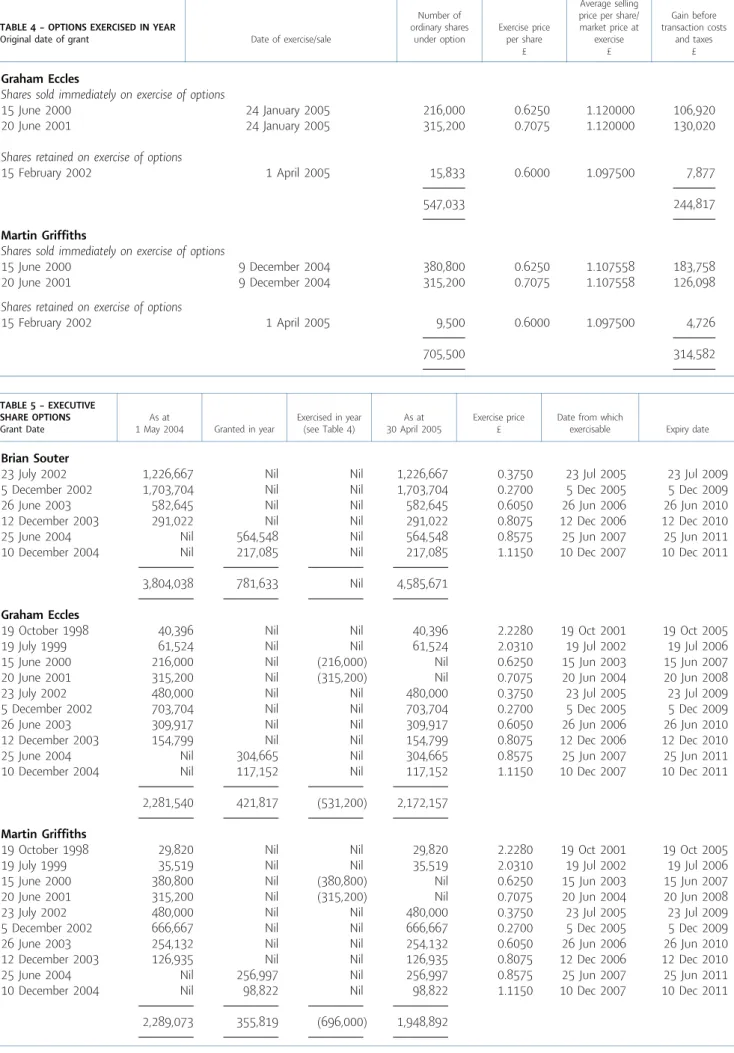
Two Directors exercised Executive share options during the year. Details are shown in Table 4 on page 26.
The interests of Directors who have options to subscribe for ordinary shares of the Company, together with movements during the year, are shown in Table 5 on page 26. All of the share options were granted for nil consideration. The exercise price of the share options reflects the mid-market price immediately preceding the time of the award: the Group’s policy is not to offer executive share options at a discount to the mid-market price. The mid-market price of the underlying ordinary shares at 30 April 2005 was »1.03 per share (30 April 2004: »0.82 per share). The Company’s ordinary shares traded in the range »0.76 to »1.23 (year ended 30 April 2004: »0.44 to »0.93) during the year to that date. Share options are subject to certain performance criteria as discussed on page 27.
In addition to the share options shown in Table 5 on page 26, one Director has been granted and two Directors have exercised options during the year under the Group’s Save As You Earn scheme. Details are shown in Table 7 on page 27.
TABLE 4 ^ OPTIONS EXERCISED IN YEAR
Original date of grant Date of exercise/sale
Number of ordinary shares under option Exercise price per share » Average selling price per share/ market price at exercise » Gain before transaction costs and taxes » Graham Eccles
Shares sold immediately on exercise of options
15 June 2000 24 January 2005 216,000 0.6250 1.120000 106,920
20 June 2001 24 January 2005 315,200 0.7075 1.120000 130,020
Shares retained on exercise of options
15 February 2002 1 April 2005 15,833 0.6000 1.097500 7,877
A A
547,033 244,817
A A
Martin Griffiths
Shares sold immediately on exercise of options
15 June 2000 9 December 2004 380,800 0.6250 1.107558 183,758
20 June 2001 9 December 2004 315,200 0.7075 1.107558 126,098
Shares retained on exercise of options
15 February 2002 1 April 2005 9,500 0.6000 1.097500 4,726 A A 705,500 314,582 A A TABLE 5 ^ EXECUTIVE SHARE OPTIONS Grant Date As at
1 May 2004 Granted in year
Exercised in year (see Table 4) As at 30 April 2005 Exercise price »
Date from which
exercisable Expiry date
Brian Souter
23 July 2002 1,226,667 Nil Nil 1,226,667 0.3750 23 Jul 2005 23 Jul 2009
5 December 2002 1,703,704 Nil Nil 1,703,704 0.2700 5 Dec 2005 5 Dec 2009
26 June 2003 582,645 Nil Nil 582,645 0.6050 26 Jun 2006 26 Jun 2010
12 December 2003 291,022 Nil Nil 291,022 0.8075 12 Dec 2006 12 Dec 2010
25 June 2004 Nil 564,548 Nil 564,548 0.8575 25 Jun 2007 25 Jun 2011
10 December 2004 Nil 217,085 Nil 217,085 1.1150 10 Dec 2007 10 Dec 2011
A A A A
3,804,038 781,633 Nil 4,585,671
A A A A
Graham Eccles
19 October 1998 40,396 Nil Nil 40,396 2.2280 19 Oct 2001 19 Oct 2005
19 July 1999 61,524 Nil Nil 61,524 2.0310 19 Jul 2002 19 Jul 2006
15 June 2000 216,000 Nil (216,000) Nil 0.6250 15 Jun 2003 15 Jun 2007
20 June 2001 315,200 Nil (315,200) Nil 0.7075 20 Jun 2004 20 Jun 2008
23 July 2002 480,000 Nil Nil 480,000 0.3750 23 Jul 2005 23 Jul 2009
5 December 2002 703,704 Nil Nil 703,704 0.2700 5 Dec 2005 5 Dec 2009
26 June 2003 309,917 Nil Nil 309,917 0.6050 26 Jun 2006 26 Jun 2010
12 December 2003 154,799 Nil Nil 154,799 0.8075 12 Dec 2006 12 Dec 2010
25 June 2004 Nil 304,665 Nil 304,665 0.8575 25 Jun 2007 25 Jun 2011
10 December 2004 Nil 117,152 Nil 117,152 1.1150 10 Dec 2007 10 Dec 2011
A A A A
2,281,540 421,817 (531,200) 2,172,157
A A A A
Martin Griffiths
19 October 1998 29,820 Nil Nil 29,820 2.2280 19 Oct 2001 19 Oct 2005
19 July 1999 35,519 Nil Nil 35,519 2.0310 19 Jul 2002 19 Jul 2006
15 June 2000 380,800 Nil (380,800) Nil 0.6250 15 Jun 2003 15 Jun 2007
20 June 2001 315,200 Nil (315,200) Nil 0.7075 20 Jun 2004 20 Jun 2008
23 July 2002 480,000 Nil Nil 480,000 0.3750 23 Jul 2005 23 Jul 2009
5 December 2002 666,667 Nil Nil 666,667 0.2700 5 Dec 2005 5 Dec 2009
26 June 2003 254,132 Nil Nil 254,132 0.6050 26 Jun 2006 26 Jun 2010
12 December 2003 126,935 Nil Nil 126,935 0.8075 12 Dec 2006 12 Dec 2010
25 June 2004 Nil 256,997 Nil 256,997 0.8575 25 Jun 2007 25 Jun 2011
10 December 2004 Nil 98,822 Nil 98,822 1.1150 10 Dec 2007 10 Dec 2011
A A A A
2,289,073 355,819 (696,000) 1,948,892
A A A A
2002 are expected to vest on 23 July 2005.
All of the outstanding executive share options shown in Table 5 were issued under The Stagecoach Unapproved Executive Share Option Scheme (‘‘the Scheme’’). The Scheme was established in September 1997, when it was approved by shareholders at the Annual General Meeting. The scheme was amended by shareholder approval at an Extraordinary General Meeting in January 2002. This scheme is also used to reward senior executives throughout the Group, at the Board’s discretion.
In December 2004, the Board and the Remuneration Committee agreed to remove from the Scheme, the ability to award ‘‘Super Options’’. Therefore, all executive share options awarded on or after 4 December 2004, are ‘‘Ordinary Options’’ which are exercisable between three and seven years after the date of award. The maximum level of executive share options that can now be issued to a given individual in any financial year is two times that individual’s salary, calculated by comparing the salary to the total number of shares covered by the options multiplied by the exercise price. The Board and the Remuneration Committee also agreed to remove from the Scheme, the facility for the performance condition to be re-tested. Re-testing is now prohibited for all executive share options awarded on or after 4 December 2004. Accordingly, the exercise of executive share options awarded on or after 4 December 2004 is subject to earnings per share outperforming inflation over
three consecutive financial years by 3% per annum cumulatively ^ the base year is the latest financial year ended prior to the award of the option and the performance condition may not be re-tested.
For ordinary options awarded up until June 2001, exercise of the options is subject to earnings per share outperforming inflation over
three consecutive financial years by 2% per annum cumulatively. For ordinary options awarded after June 2001 but prior to 4 December 2004, exercise of the options is subject to earnings per share outperforming inflation over three consecutive financial years by 3% per annum, or
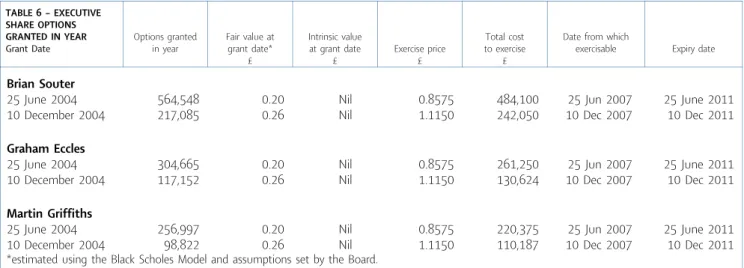
Awards were made to three Directors under this scheme in the financial year ended 30 April 2005, and are shown in Table 6.
Under the rules of the Company’s share option schemes, and consistent with guidance issued by the Association of British Insurers (‘‘ABI’’), there are limits on the number of share options that can be granted that are to be satisfied with the issue of new shares. Following the consolidation of ordinary shares related to the return of capital in September 2004, the number of executive share options that had been granted in the previous 10 years exceeded 5% of the issued number of ordinary shares ^ therefore, it is not possible to satisfy any new grants of share options under the executive share option schemes with newly issued shares since to do so would exceed the limits under the share schemes. Accordingly, the Board and the Remuneration Committee has determined that all future grants of share options under the executive share option schemes will be satisfied with existing shares until such time as there is sufficient headroom available under the new issue share limits.
The Group’s Employee Share Ownership Trusts are used to acquire and finance shares to meet contingent obligations under share-based incentive schemes that are not expected to be satisfied through the issue of new shares. At 30 April 2005, these trusts held 6,501,545 12/19thOrdinary Shares in the Company, representing 0.6% of the total issued Ordinary Shares. The Company follows the ABI guideline that the shares held by Employee Share Ownership Trusts should not exceed 5% of the total shares in issue. The Employee Share Ownership Trusts have waived the right to receive dividends on the shares held by them.
In determining the amounts shown above, issues of new shares and the re-issuing of shares from Treasury are both treated as being dilutive. The Group do not, however, treat shares released from Employee Share Ownership Trusts as being dilutive.
TABLE 6 ^ EXECUTIVE SHARE OPTIONS GRANTED IN YEAR Grant Date Options granted in year Fair value at grant date* » Intrinsic value at grant date » Exercise price » Total cost to exercise »
Date from which
exercisable Expiry date
Brian Souter
25 June 2004 564,548 0.20 Nil 0.8575 484,100 25 Jun 2007 25 June 2011
10 December 2004 217,085 0.26 Nil 1.1150 242,050 10 Dec 2007 10 Dec 2011
Graham Eccles
25 June 2004 304,665 0.20 Nil 0.8575 261,250 25 Jun 2007 25 June 2011
10 December 2004 117,152 0.26 Nil 1.1150 130,624 10 Dec 2007 10 Dec 2011
Martin Griffiths
25 June 2004 256,997 0.20 Nil 0.8575 220,375 25 Jun 2007 25 June 2011
10 December 2004 98,822 0.26 Nil 1.1150 110,187 10 Dec 2007 10 Dec 2011
*estimated using the Black Scholes Model and assumptions set by the Board.
TABLE 7 SAYE OPTIONS At 1 May 2004 No of ordinary shares Granted No of ordinary shares Exercised No of ordinary shares (see Table 4)
At 30 April 2005 No of ordinary
shares
Martin Griffiths 9,500 9,174 (9,500) 9,174
Long Term Bonus Scheme
The Long Term Bonus Scheme is intended to motivate and retain certain key executives at the Board’s discretion.
Graham Eccles and Martin Griffiths are presently the only participants in The Stagecoach Executive Directors’ Long Term Bonus Scheme. Under this Scheme, Graham Eccles may be awarded an additional annual bonus of »100,000 per financial year for each of the three years commencing 1 May 2003 and Martin Griffiths may be awarded an additional annual bonus of »50,000 for each of the five years commencing 1 May 2003. The performance condition of the Scheme is such that the bonuses are payable if the growth in earnings per share each financial year outperforms inflation by at least 5%. The performance conditions in respect of the years ended 30 April 2004 and 30 April 2005 were satisfied and therefore subject to the relevant individual remaining a full-time employee of the Group, the bonus in respect of those years will be paid at the end of the three or five year period.
In conjunction with the proposals set out below to introduce new long-term remuneration schemes, it is proposed that Martin Griffiths waives his entitlement to any current or future amounts under the existing Long Term Bonus Scheme and, subject to shareholder approval for the new schemes being obtained, the Remuneration Committee proposes to make a cash payment to buy out any amounts of the earned bonus accrued up until 30 April 2005. As Graham Eccles is expected to retire in April 2006 his existing arrangement under the Long Term Bonus Scheme will remain in place.
Executive Participation Programme
A new Executive Participation Programme (‘‘EPP’’) is proposed and shareholder approval will be sought at the 2005 Annual General Meeting. Subject to shareholder approval, the first awards under the EPP will be for the financial year ending 30 April 2006, with deferred shares expected to be allocated in June 2006.
The intention of the EPP is to further align the interests of senior executives with shareholders by giving senior executives a greater direct interest in the performance of the Company’s shares. The EPP is such that the executives can benefit from both capital growth (i.e. increases in share price) and dividend yield. This avoids one of the issues with the executive share option scheme that could be seen as discouraging management from increasing dividends at the expense of capital growth. The EPP is also designed to provide an incentive for senior executives to remain with the Group and would form a core part of the Group’s succession and management development plans.
Awards under the EPP can be to Executive Directors and other senior executives. Participants would be required to sacrifice 50% of their actual annual bonus award and would be awarded deferred shares with an initial market value approximately equal to the amount of the actual cash bonus foregone.
Absolute and full entitlement to the shares would be deferred for three years.
There would be no specific performance conditions attaching to the release of deferred shares because the annual bonus is already subject to performance conditions and there will be no awards of matching shares in respect of annual bonuses ^ the EPP is to encourage executives to invest an element of their annual bonus in the Company’s shares. The EPP would be an effective retention programme in that a participant would lose his or her entitlement to the deferred shares if he/she left of his/her own volition during the three-year deferral period.
Further details are provided in the circular sent to shareholders. It is intended that where an individual receives an award under the EPP, he or she would not also receive an award of executive share options in the same financial year.
Long Term Incentive Plan
For a small number of senior executives, including Executive Directors, a new long-term incentive plan (‘‘LTIP’’) is proposed. The LTIP would introduce stringent performance criteria related to total shareholder return (‘‘TSR’’). TSR is calculated as the movement in share value after taking account of re-invested dividends. TSR would be measured against a comparator group, which would be the list of FTSE 250 companies. Subject to shareholder approval, the first awards under the LTIP will be in August 2005.
Under the proposed LTIP, executives would be awarded notional units with a value equal to one of the Company’s ordinary shares, at the discretion of the Remuneration Committee. The maximum award in any year to an individual would be limited to 150% of the individual’s basic salary. The individual would need to remain with the Company for three years in order to receive full entitlement to the deferred shares. The number of shares that would be released after the three years would be calculated as follows:
. If TSR is negative, irrespective of the TSR of the comparator group, no shares would be released ;
. If TSR is positive but is less than the median TSR of the comparator group, no shares would be released ;
. If TSR exceeds the median of the comparator group, 33% of the shares would be released;
. If TSR is in the top quartile of the comparator group, 100% of the shares would be released ;
. If TSR is higher than the median but less than the top quartile, the proportion of shares to be released would be between 33% and 100% depending on the exact ranking against the comparator group. Accordingly, the awards are closely tied to the rewards to shareholders as a whole. The participants will only benefit if TSR is positiveandTSR is above the median of FTSE 250 companies.
An independent third party will calculate the TSR measures for the purposes of determining the extent to which the performance condition is satisfied.
There would be no re-testing of performance conditions. Further details are provided in the circular sent to shareholders.
Directors’ service agreements
The details of the Executive Directors’ service contracts are summarised in the table below :
Name of director Date of contract Notice period
Brian Souter 2 April 1993 12 months
(amended 26 January 1996)
Graham Eccles 27 October 2000 12 months
Martin Griffiths 8 August 2000 12 months
It is the Company’s policy that Executive Directors should have 12-month rolling service contracts providing for a maximum of one year’s notice. Due to the nature of the Group’s businesses, the service contracts contain restrictive covenants that will be rigorously applied.
Non-Executive Directors are appointed by a letter, which makes no specific provision for notice periods. Non-Executive Directors are subject to election and re-election by shareholders as described on page 18.
Early termination
If the Company terminates an Executive Director’s contract, the costs for which the Company is liable will vary depending on length of service and are subject to mitigation. The costs will include a termination payment of up to one times annual salary only and certain benefits and retirement benefits funded under the Company’s pension schemes.
Change of control
The following apply where there is a change in control of the Company : . Executive Directors are entitled to normal termination benefits as
outlined above, except where the director is offered and has refused employment on terms and conditions that were no less favourable to those in place prior to the change of control ;
. With respect to Executive Share Options, options can be exercised within six months of the change of control. For options granted prior to 14 January 2002, the performance condition will not apply. For options granted on or after 14 January 2002, the extent to which the performance condition is applied shall be determined by the Remuneration Committee;
. Under the proposed LTIP, LTIP units would vest on a pro-rata basis taking account of the proportion of the vesting period that had expired and the TSR performance condition.
Outside appointments
Under the terms of their service agreements, Executive Directors require Board approval before accepting any external appointment. Details of remuneration earned where an Executive Director serves as a
Non-Executive Director elsewhere are disclosed in note 27 to the accounts on page 66. Such earnings are paid to the Group and not to individual Directors.
Transition to International Financial Reporting Standards
The Finance Director’s Review summarises the status of the Group’s transition from UK Generally Accepted Accounting Principles (‘‘UK GAAP’’) to International Financial Reporting Standards (‘‘IFRS’’).The Remuneration Committee has introduced measures to ensure a consistent measurement of financial performance during the transition to IFRS. The Group will report IFRS financial information for the year ending 30 April 2006, with comparative information for the year ending 30 April 2005. Where financial performance is being assessed with reference to a base year ending on or after 30 April 2005, the Remuneration Committee will assess performance based on IFRS financial information. Where financial performance is being assessed with reference to an earlier financial year, the Remuneration Committee will assess performance based on UK GAAP financial information. To enable this, the Group will continue to produce key UK GAAP financial measures for the Remuneration Committee as required. Similarly, adjustments will be made for any other changes in accounting policies to ensure financial performance is measured consistently.
Transactions in which Directors have had a material
interest (audited)
(a) Noble Grossart Limited
Ewan Brown (a Non-Executive Director of Stagecoach) is a former executive director and current non-executive director of Noble Grossart Limited that provided advisory services to the Group during the year. Total fees payable to Noble Grossart Limited in respect of the year amounted to »145,950 (2004 : »20,000), including »125,500 (2004 : »Nil) in respect of Noble Grossart’s role as financial advisor in connection with the return of capital in September 2004. Noble Grossart Investments Limited, a subsidiary of Noble Grossart Limited, held at 30 April 2005 6,354,443 (2004 : 8,026,665) ordinary shares in the Company, representing 0.6% (2004 : 0.6%) of the ordinary shares in issue and 8,026,665 B shares in the Company, representing 10.4% of the B shares in issue.
Stagecoach) and Ann Gloag (a Non-Executive Director of Stagecoach) together control 40.0% of the shares and voting rights in
Alexander Dennis Limited. Noble Grossart Investments Limited
(see (a) above) controls a further 30.0% of the shares and voting rights of Alexander Dennis Limited. None of Brian Souter, Ann Gloag or
Ewan Brown is a director of Alexander Dennis Limited nor do they have any involvement in the management of Alexander Dennis Limited. Furthermore, they do not participate in deciding on and negotiating the terms and conditions of transactions between the Group and Alexander Dennis Limited.
In the period from 21 May 2004 to 30 April 2005, the Group purchased »25.5m of vehicles from Alexander Dennis Limited and »2.4m of spare parts and other services. Of the »25.5m worth of vehicles, »20.4m was ordered from Transbus prior to its administration and Alexander Dennis Limited inherited the orders from Transbus. Transbus was not a related party of the Group.
For new orders placed with Alexander Dennis Limited for vehicles, the Group has consulted with the UK Listing Authority and taken the appropriate measures to ensure that the transactions with Alexander Dennis Limited comply with the Listing Rules. In the period from 21 May 2004 to 30 April 2005, the Group has placed orders totalling »49.3m with Alexander Dennis for the purchase of new vehicles. Of this »49.3m, vehicles accounting for »5.1m were delivered prior to 30 April 2005 and are included in the total purchases of »25.5m referred to above. (c) ScotAirways Group Ltd
Brian Souter is Chairman of ScotAirways Group Ltd. During the year the Group purchased flights from ScotAirways Group Ltd totalling »74,905 (2004 : »99,123).
Remuneration policy approval
An ordinary resolution to receive and approve this Remuneration Report will be proposed at the 2005 Annual General Meeting.
On behalf of the Board
IAIN DUFFIN
Chairman of the Remuneration Committee