Operating & Installation Instructions
charnwood
®
C O N T E N T S
O P E R AT I N G I N S T R U C T I O N S
Fuel. . . .4
Fitting The Riddling Grate . . . .4
Lighting. . . . . . . .5 Refuelling . . . .5 Ash Clearance . . . .5 Reduced Burning . . . .6 Maintenance . . . .6
Throat Plate & Flueway Clearing . . . .6
Chimney Sweeping . . . .6
Trouble Shooting . . . .7
CO Alarm. . . 8
If you need further help. . . 8
INSTALLATION INSTRUCTIONS
Health & Safety Precautions. . . .9CO Alarms. . . . Specification . . . . Chimney. . . . Hearth & Fire Surround . . . .10
Connection to Flues . . . .11
Soot Doors . . . .11
Unpacking The Stove . . . .11
Pre Lighting Check . . . .12
Commissioning . . . .12
Clean Air Act Information. . . .12
C-FOUR Dimensions. . . .14
. . . .15
Parts Lists . . . .19
5 Controlling The Fire 9 9 9 Certification . . . .13 C-FIVE Dimensions C-SIX Dimensions . . . .16 C-SEVEN Dimensions . . . .17 C-EIGHT Dimensions . . . .18 C-FOUR C-FIVE Parts Lists . . . .20
C-SIX Parts Lists . . . .21
C-SEVEN Parts Lists . . . .22
C-EIGHT Parts Lists . . . .23
These appliances have been approved by HETAS as intermittent operating appliances for burning dry seasoned wood logs only. HETAS approval does not cover the use of other fuels either alone or mixed with wood logs nor does it cover the instructions for use of other fuels.
Tool required for fitting the riddling grate: 10mm Spanner
Pozidriv screwdriver
Before fitting the riddling grate (Fig. 1) remove the fuel retainer and the wood ash retainer. The wood ash retainer is not required when the riddling grate is fitted.
Undo the nut on the riddling blanking hole using a 10mm spanner. Remove the cover and spacing washer (ensure you keep these in a safe place as you will need to replace them if the riddling grate is removed).
Feed the riddler rod through the hole on the right hand side of the stove, and slide one washer onto the rod (if there is not sufficient room to the right of the stove to do this then remove the riddler knob, fit one washer over the rod and then slide the rod through the hole from the inside of the stove).
Feed the rod through the two side fireplates and slide the other washer on to the rod so that the washers end up outside the two side fireplates. With the side fireplates pushed together fit the retaining clips so that the washers come inside the clips.
Slide the side fireplates apart so that they rest against the sides of the firebox. Slot in the front and rear support plates.
Fit the grate plates into position through the front and rear grate support plates, making sure they locate correctly onto the riddler rod. Fit the fuel retainer. Slide the ashpan under the grate.
FITTING THE RIDDLING GRATE
Congratulations on becoming the owner of a HETAS approvedCharnwood C-Series Stove. Your stove has been approved by DEFRA to burn wood logs in a smoke control area if it is used in accordance with these instructions. It is therefore very important that you read and understand these instructions before using the stove.
FUEL
Before lighting the stove check with the installer that the work and checks described in the Installation Instructions have been carried out correctly and that the chimney has been swept, is sound and free from any obstructions. The stove is not suitable for use in a shared flue system.
Remember that the stove will be hot and that it is made from hard materials – ensure that you have good balance before operating the fire.
Do not use an aerosol spray on or near the stove when it is alight. There is a risk of explosion or flash ignition of the spray.
The stove is suitable for intermittent operation.
This stove has been designated to burn wood. Only dry well seasoned wood should be burnt on this appliance as burning wet unseasoned wood will give rise to heavy tar deposits in the stove, on the glass and within the chimney. For the same reason hard woods (such as Ash, Beech and Oak) are better than soft woods (such as Pine and Spruce). Burning wet unseasoned wood will also result in
considerably reduced outputs. The wood should be cut and split and then left to season in a well ventilated dry place for at least one year but preferably two years before use. Approximate suitable log sizes are:
C4 & C6 255mm (10in) long and 75mm (3in) diameter
C5 & C8 305mm(12in) long and 75mm (3in) diameter
C7 380mm(15in) long and 75mm (3in) diameter.
PETROLEUM COKE IS NOT SUITABLE FOR USE ON
THIS APPLIANCE. ITS USE WILL INVALIDATE THE
GUARANTEE.
This stove is not designed to burn household waste. For advice on other fuels please contact Charnwood.
When using the stove in situations where children, aged and/or infirm persons are present a fireguard must be used to prevent accidental contact with the stove. The fireguard should be manufactured in accordance with BS 8423:2002.
®
OPERATING INSTRUCTIONS
Fig.1. Optional Grate Kit
Front Grate
Support RH Side Grate
Support Grate Plates Rear Grate Support Riddler Rod Ashpan LH Side Grate Support
LIGHTING
CONTROLLING THE FIRE
On initial lighting, the stove may smoke and give off an odour as the silicon paint with which the firebox is painted reacts to the heat. This is normal and will cease after a short time, but meanwhile the room should be kept well ventilated.
At first only light a small fire and burn it slowly for two hours to allow any residual moisture in the chimney to evaporate.
Light the stove using dry kindling wood and paper or fire lighters. Put the paper, or fire lighters, and kindling in the firebox and cover with a few small dry logs. Open the air control fully (see Fig. 2). Light the paper or fire lighters. The door may be left cracked open for a few minutes to assist the combustion and heat up the firebox more quickly. When the kindling wood is well alight add a few more small logs, close the door but leave the air control fully open. When the flames are established around these logs, load the stove with the required fuel load. Maintain the air control at maximum at this stage. Once the fire is up to temperature the airwash system will begin to work, so allow the fire to become hot before adjusting the air control to the required setting. During the lighting period, do not leave the stove unattended. Do not leave the door open except as directed above to avoid excessive smoke.
When relighting the stove, leave the ash on the base if burning wood, unless it is becoming too deep, in which case some of it may be removed. If burning high ash content fuel, clear the grate and empty the ashpan before relighting.
The rate of burning and hence the output is controlled by the air control (see Fig. 2).
Open the air control fully (boost position) when lighting or when rapid burning is required. It should not be left fully open for long periods as this can cause over-firing or excessive smoke production. For high output move the air control to the ‘click position’ or for low burning to the fully closed position.
When the fire is burning normally the air control gives enough airwash to keep the glass clean. However, it will not always be possible to keep the glass clean with the air control fully closed.
Keep the firebox well filled but do not allow fuel to spill over the top of the fuel retainer.
Logs should be evenly distributed, filling the firebed to give the most pleasing flame pattern. The air control must be fully opened after refuelling until the flames are established above the fire. It is best to refuel on to a hot bed of ash. If at this point the fire starts to die, the door must be cracked open until the fire is revived. If the fire has started to die down before refuelling, then more kindling wood must be added, the air control opened fully and the door cracked open to
re-establish the firebed before adding larger logs (see suitable log
sizes in Fuel section). This will avoid excessive smoke emission. Care should be taken, especially when burning wood, that fuel does not project over the fuel retainer or damage to the glass may be caused when the door is closed. It can also cause the glass to blacken up. Maximum filling height is such that logs cannot fall from the fire when the door is opened. In smoke controlled areas do not fill the stove above the level of the front firebars as overloading can cause excess smoke. Liquid fuels are not to be used on this appliance.
The ashpan should be emptied regularly before it becomes too full. Never allow the ash to accumulate in the ashpan so that it comes in contact with the underside of the grate as this will seriously damage the grate bars. The ashpan is handled using the tool provided. Care should be taken to ensure that ash is cool before emptying it into plastic liners or bins.
To make ash removal easier there is a special Charnwood ash carrier available. This may be purchased from your supplier or, in case of difficulty, from Charnwood.
For correct firing we recommend the use of a stove pipe thermometer which may be purchased from your supplier or from Charnwood.
REFUELLING
ASH CLEARANCE
5
®
OPERATING INSTRUCTIONS
Fig.2. Stove Controls
Air Control Pull out to Open Push in to Close Door Handle Pull to Open Low Output High Output (Click) Boost Air Control positions Identification Plate, Lift Plate to View
REDUCED BURNING
MAINTENANCE
For reduced burning the fire door must be closed.
When burning wood in areas that are not smoke controlled, load some large logs on the fire and allow to burn for half an hour before closing the air control (this will help to reduce tar deposits in the chimney). Some experimentation may be necessary to find the setting most suitable for the type of fuel being used and the draw on the chimney.
To revive the fire, empty the ashpan (if burning fuel other than wood), riddle the fire, and open the air control to maximum. When the fire is burning well load on more fuel as necessary and adjust the air control to the desired setting.
Cleaning
Cleaning the Glass
When Not in Use
If the fire is going to be out of use for a long period (for instance in the summer) then to prevent condensation, and hence corrosion, the air control should be left fully open and the fire door left ajar. It Is also advisable to sweep the chimney and clean out the fire. Spraying the inside of the door and firebox with a light oil, such as WD40, will also help to keep all internal parts working well.
Door Seals
For the fire to operate correctly it is important that the door seals are in good condition. Check that they do not become worn or The stove is finished with a high temperature paint which will withstand the temperatures encountered in normal use. This may be cleaned with a damp lint-free cloth when the stove is cold. Should re-painting become necessary, high temperature paints are available from your supplier or from stove shops.
Most deposits on the glass may be burnt off simply by running the fire at a fast rate for a few minutes. If it becomes necessary to clean the glass then open the door and allow it to cool. Clean the glass using a damp cloth and then wiping over with a dry cloth. Any stubborn deposits on the glass may be removed with a proprietary stove glass cleaner or ceramic hob cleaner. Do not use abrasive cleaners or pads as these can scratch the surface which will weaken the glass and cause premature failure
After long periods where the fire has been out of use, the chimney and appliance flueways should be cleaned before lighting.
frayed and replace them when necessary. Servicing
It is recommended that the fire is serviced once a year to keep it in first class working order. After cleaning out the firebox thoroughly, check that all internal parts are in good working order, replacing any parts that are beginning to show signs of wear. Check that the doors seals are in good condition and that the door seals correctly. A servicing guide is available on request. Repairs or modifications may only be carried out by the Manufacturer or their approved agents. Use only genuine Charnwood replacement parts.
THROAT PLATE AND
FLUEWAY CLEANING
CHIMNEY SWEEPING
It is important that the throat plate and all the stove flueways are kept clean in order to prevent potentially dangerous fume emission. They should be cleaned at least monthly, and more frequently if necessary. It is necessary to let the fire out to carry out these operations. The front of the throat plate is pulled forward and then lowered as shown in Fig. 3. Any sooty deposits should then be swept from the plate and into the fire.
Return the throat plate to its correct position - raise the front of the plate, push it back and then lower it onto the retaining lugs.
Where the chimney previously served an open fire, it is possible that the higher flue gas temperature from a stove may loosen soot deposits with the consequent risk of flue blockage. It is therefore recommended that the chimney be swept a second time within a month of regular use after installation.
The chimney should be swept at least twice a year. Where the top ®
OPERATING INSTRUCTIONS
Throat Plate
Fig.3. Throat Plate Position and Lowering
Push up, twist one side down and lower.
possible, do not try to fit too much fuel into the firebox. d) Do not completely close the air control.
It is always more difficult to keep the glass clean when running the stove very slowly for long periods.
If blackening of the glass still occurs check that all flue connections and the blanking plate are well sealed. It is also important that the chimney draw is sufficient and that it is not affected by down-draught. When the chimney is warm a draught reading of at least 2.5 mm (0.10 in.) water gauge (25Pa) should be obtained. Some blackening of the glass may occur below the level of the fuel retainer. This will not obscure the view of the fire or affect its performance.
Fume Emission Warning Note:
Properly installed and operated this appliance will not emit fumes. Occasional fumes from de-ashing and re-fuelling may occur. Persistent fume emission is potentially dangerous and must not be tolerated. If fume emission does persist, then the following immediate actions should be taken:
a) Open doors and windows to ventilate the room and then leave the premises..
b) Let the fire out and safely dispose of the fuel from the appliance.
c) Check for flue or chimney blockage, and clean if required. d) Do not attempt to re-light the fire until cause of fuming has been identified, if necessary seek professional advice.
The most common cause of fume emission is flueway or chimney blockage. For your own safety these must be kept clean.
Fire blazing out of control
Check that:
a) The door is tightly closed.
b) The air control slider is fully closed. c) A suitable fuel is being used.
d) Door seals and airwash slide are intact.
Chimney Fires
If the chimney is thoroughly and regularly swept, chimney fires should not occur. However, if a chimney fire does occur close the air control, and tightly close the door of the appliance. This should cause the chimney fire to go out in which case the controls should be kept closed until the stove has gone out. The chimney and flueways should outlet or vertical rear flue connector is used it will generally be
possible to sweep the chimney through the appliance.
First remove the fuel retainer and the throat plate. Then sweep the chimney ensuring that soot is removed from all horizontal surfaces after sweeping.
In situations where it is not possible to sweep through the appliance the installer will have provided alternative means, such as a soot door. After sweeping the chimney the appliance flue outlet and the flue pipe connecting the stove to the chimney must be cleaned with a flue brush.
After clearing any soot from within the stove, replace the throat plate (see Fig. 3) and the fuel retainer.
Fire Will Not Burn
Check that:
a) the air inlet is not obstructed in any way, b) chimneys and flueways are clear, c) a suitable fuel is being used,
d) there is an adequate air supply into the room,
e) an extractor fan is not fitted in the same room as the stove. f) there is sufficient draw in the chimney. Once the chimney is warm a draught reading of at least 2.5 mm (0.10 in.) water gauge (25Pa) should be obtained.
Blackening of Door Glass
Differences in chimney draughts mean that the best settings of the air controls will vary for different installations. A certain amount of experimentation may be required, however the following points should be noted and with a little care should enable the glass to be kept clean in most situations:
a) Wet or unseasoned wood, or logs overhanging the front fence will cause the glass to blacken.
b) The airwash relies on a supply of heated air to keep the glass clean, therefore, when lighting the stove allow the firebed to become well established before closing the air control. This may also be necessary when re-fuelling the stove.
c) When re-fuelling keep the fuel as far back from the front fence as Different types of sweep’s brushes are available to suit different flueways. For prefabricated insulated chimneys the manufacturers instructions with regard to sweeping should be consulted.
TROUBLE SHOOTING
7
®
then be cleaned. If the chimney fire does not go out when the above action is taken then the fire brigade should be called immediately. After a chimney fire the chimney should be carefully examined for any damage. Expert advice should be sought if necessary.
CO ALARM
Your installer should have fitted a CO alarm in the same room as the appliance. If the alarm sounds unexpectedly, follow the instructions given under “Warning Note” above.
IF YOU NEED FURTHER HELP
If you need further help with your Charnwood then your Installer will be able to provide the answers to most questions. Your Local Charnwood Premier Dealer has a great deal of experience and will also be able to provide helpful advice. Further help is available from the Charnwood Customer Services department who will be pleased to give advice, if necessary.
®
UNPACKING THE STOVE
The stove arrives bolted and shrink-wrapped to its pallet. There must be adequate facilities for unloading and manoeuvring into position The wrapping is first removed, then the stove released from the pallet by either removing the single bolt (C-4) or 4 pallet bolts(C-5 to C-8) using a 10mm spanner. The pallet brackets can now be removed from the stove by tilting it and using a 13mm spanner to remove the bolts. These 4 bolts are required for levelling or fixing on the Store Stand. The Stove may now be moved to its final position. The pallet is intended to be cut up and used for kindling fuel.
The vent must be positioned such that it is not liable to blockage
HEALTH AND SAFETY PRECAUTIONS
Please take care when installing the stove that the requirements of the Health and Safety at Work Act 1974 are met.Some types of fire cement are caustic and should not be allowed to come into contact with the skin. In case of contact wash with plenty of water.
If there is a possibility of disturbing any asbestos in the course of installation then please use appropriate protective equipment. There must not be an extractor fan fitted in the same room as the stove as this can cause the appliance to emit fumes into the room.
. Minimium areas are given in the following table:
This stove is capable of intermittent operation, and is not suitable for use in a shared flue system.
In addition to these instructions the requirements of BS.8303 and BSEN 15287-1:2007 must be fulfilled. Local Authority Bylaws and Building Regulations, including those referring to national and European Standards, regarding the installation of Solid Fuel burning There must be an adequate air supply into the room in which the appliance is installed to provide combustion air. The combustion air supply must be via a permanently open vent. The requirement for minimum free area is partly dependent on the design air permeability of the house. In older properties the air permeability will be above 5.0m³/(h.m²), but in some modern properties it may be less.
appliances, flues and chimneys must also be observed.
CO ALARMS
Building regulations require that whenever a new or replacement fixed solid fuel or wood/biomass appliance is installed in a dwelling a carbon monoxide alarm must be fitted in the same room as the appliance. Further guidance on the installation of the carbon monoxide alarm is available in BS EN 50292:2002 and from the alarm manufacturer's instructions. Provision of an alarm must not be considered a substitute for either installing the appliance correctly or ensuring regular servicing and maintenance of the appliance and chimney system.
The outputs in the table are based on a 45 minute re-fuelling cycle burning seasoned hardwood logs. All tests are carried out in accordance with BSEN 13240.
In order for the appliance to perform satisfactorily the chimney height must not be less than 4 metres measured vertically from the outlet of the stove to the top of the chimney. The internal dimensions of the chimney should preferably be 175 mm (7") or 200mm (8")
SPECIFICATION
CHIMNEY
9
®
INSTALLATION INSTRUCTIONS
Specification C-Four
C-Five
C-Six
C-Seven C-EightNominal Heat
Output
kW (BTU/hr)
4.9
(16,700)
5.0
(17,000)
6.7
(22,800)
7.6
(25,900)
(28,300)
8.3
Stove Weight
kg
(Packed)
83
96
96
115
119
Flue
Temperature
°C
281
259
272
280
316
Flue gas Mass
Flow g/s
4.2
5.3
4.3
7.3
6.3
Hearth
Temperature
°C
51.6
69.9
88.1
55.453.4
Minimum
distance from
combustibles
mm
600 side
600 rear
400 rear
500 side
500 rear
500 side
500 rear
500 side
650 rear600 sideAir Permeability
m³/(h.m²)
Minimum Vent Area cm²(in²)
C-Four C-Five C-Six C-Seven C-Eight
> 5.0 RequirementNo RequirementNo 9.4 (1.5) 11 (1.76) 16.5 (2.6)
either square or round and MUST NOT BE LESS THAN 125 mm (5") for Four and Five or 150mm (6") for Six, Seven and C-Eight.
If an existing chimney is to be used it must be swept and checked, it must be in good condition, free from cracks and blockages, and should not have an excessive cross sectional area. If it was previously used by an open fire then the chimney should be swept one month after installation to clear any soot falls which may have occurred due to the difference in combustion between the stove and the open fire. If you find that the chimney is in poor condition then expert advice
should be soughtregarding the necessity of having the chimney lined.
If it is foundnecessary to line the chimney then a lining suitable for
Solid Fuel must be used.
If there is no existing chimney then a prefabricated block chimney or a twin walled insulated stainless steel flue to BSEN 15287-1:2007 can be used either internally or externally. These chimneys must be fitted in accordance with the manufacturers instructions and Building Regulations.
Single wall flue pipe is suitable for connecting the stove to the chimney but is not suitable for using for the complete chimney. If it is found that there is excessive draw in the chimney then a draught stabiliser should be fitted.
It is important that there is sufficient draw in the chimney and that the chimney does not suffer from down-draught. When the chimney is warm the draw should be not less than 2.5mm (0.10") water gauge (25 Pa). If in doubt about the chimney seek expert advice.
HEARTH AND FIRE SURROUND
The stove must stand on a fireproof hearth and must not be situated closer than the minimum distance from combustible materials (see specification table) to the sides or rear above hearth level unless adequately fireproofed in accordance with local building regulations. The hearth must be of fireproof material and at least 12mm (1/2in.) thick. The positioning of the stove and the size of the hearth are governed by building regulations for Class 1 appliances. These building regulations state that the hearth must extend in front of the stove by at least 300mm (12 in.) and to the sides of the stove by at least 150mm (6 in.).
If in doubt as to the positioning of the stove, expert advice should be When the fire door is open, it extends beyond the flat front of the stove by the following amounts:
Four & Six 365mm, Five 436mm, Seven 515mm, and C-Eight 450mm. ®
INSTALLATION INSTRUCTIONS
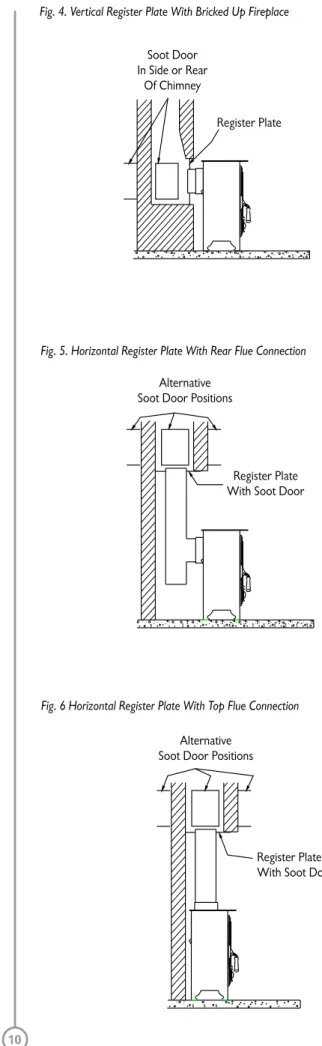
Register Plate Soot Door In Side or Rear Of Chimney Register Plate With Soot Door AlternativeSoot Door Positions
Fig. 4. Vertical Register Plate With Bricked Up Fireplace
Register Plate With Soot Door Alternative
Soot Door Positions
Fig. 5. Horizontal Register Plate With Rear Flue Connection
sought either from the supplier or the local building inspector. The fireplace must allow good circulation of air around the appliance to ensure that maximum heat is transferred to the room and also to prevent the fireplace from overheating. A gap of 150mm (6") each side and 300mm (12") above the appliance should give sufficient air circulation. If a wooden mantelpiece or beam is used in the fireplace it should be a minimum of 460mm (18"), and preferably 600mm (24") from the appliance. In some situations it may be necessary to shield the beam or mantelpiece to protect it.
In order for the fire to operate correctly and to allow for access, there must be an air gap behind the appliance of at least 75mm, but be aware that this distance will need to be greater in some cases to meet Building Regulation requirements.
CONNECTIONS TO FLUES
The stove must be connected to the flue using flue pipe of the following sizes:
Stove Model C-Four & C-Five...125mm (5") i/d pipe. Stove Model C-Six, C-Seven & C-Eight...150mm (6") i/d pipe.
If the optional vertical rear flue connector is used then the chimney may be swept through the appliance.
Horizontal lengths of flue must be kept to a minimum and should not This may be stainless steel, cast iron, or thick wall steel pipe. Straight lengths of Charnwood Pipe to match the stove are available if required.
There are several ways of connecting the stove to the flue. These are illustrated in Figs. 4 to 7.
be more in length than the flue diameter.
The stove comes with the blanking plate fitted to the top flue outlet.
The seal for the top outlet is a 180mm dia ring of rope seal. The seal
for the rear outlet is a length of adhesive backed fibre webbing
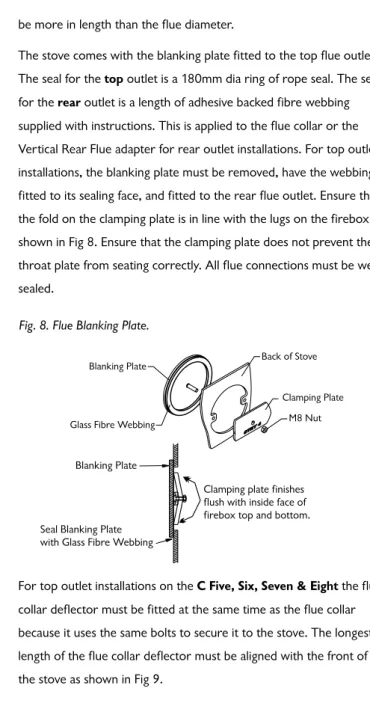
supplied with instructions. This is applied to the flue collar or the Vertical Rear Flue adapter for rear outlet installations. For top outlet installations, the blanking plate must be removed, have the webbing fitted to its sealing face, and fitted to the rear flue outlet. Ensure that the fold on the clamping plate is in line with the lugs on the firebox as shown in Fig 8. Ensure that the clamping plate does not prevent the throat plate from seating correctly. All flue connections must be well sealed.
For top outlet installations on the C Five, Six, Seven& Eight the flue
collar deflector must be fitted at the same time as the flue collar because it uses the same bolts to secure it to the stove. The longest length of the flue collar deflector must be aligned with the front of the stove as shown in Fig 9.
11
®
INSTALLATION INSTRUCTIONS
Register Plate With Soot Door Alternative
Soot Door Positions
Fig. 7. Horizontal Register Plate With Optional Vertical Rear Flue Connector
Fig. 8. Flue Blanking Plate.
Blanking Plate
Clamping plate finishes flush with inside face of firebox top and bottom. with Glass Fibre Webbing
Seal Blanking Plate Glass Fibre Webbing
Blanking Plate Back of Stove
Clamping Plate M8 Nut Flue Collar Rope seal Flue Collar Front of Stove Deflector
SOOT DOORS
PRE LIGHTING CHECK
COMMISSIONING
It is possible to pass a 16 inch diameter sweeps brush through the appliance but in most back outlet installations it will be necessary to have a soot door to enable the chimney to be swept. The optional vertical rear flue connector does allow the chimney to be swept through the stove. Soot doors may either be in the actual brickwork of the chimney or in the register plate. Various positions of soot doors are shown in Figs. 4 to 7.
Ensure that the throat plate is fitted in the roof of the appliance. The location and positioning of the throat plate is shown in Fig. 3. Check that the front fence is fitted correctly and that the door closes properly.
On completion of the installation allow a suitable period of time for the fire cement and mortar to dry out before lighting the fire. If no grate is fitted make a layer of ash or sand on the base of the stove before lighting. Check to ensure that smoke and fumes are taken from the appliance up the chimney and emitted safely. Also check all joints and seals. On completion of the installation and commissioning please leave the operating instructions with the customer and advise them on the use of the appliance.
CAA AND SMOKE CONTROL
The Clean Air Act 1993 and Smoke Control Areas
Under the Clean Air Act local authorities may declare the whole or part of the district of the authority to be a smoke control area. It is an offence to emit smoke from a chimney of a building, from a furnace or from any fixed boiler if located in a designated smoke control area. It is also an offence to acquire an "unauthorised fuel" for use within a smoke control area unless it is used in an "exempt" appliance ("exempted" from the controls which generally apply in the smoke control area).The Secretary of State for Environment, Food and Rural Affairs has powers under the Act to authorise smokeless fuels or exempt appliances for use in smoke control areas in England. In Scotland and Wales this power rests with Ministers in the devolved administrations for those countries. Separate legislation, the Clean Air (Northern Ireland) Order 1981, applies in Northern Ireland. Therefore it is a requirement that fuels burnt or obtained for use in smoke control
®
INSTALLATION INSTRUCTIONS
areas have been "authorised" in Regulations and that appliances used to burn solid fuel in those areas (other than "authorised" fuels) have been exempted by an Order made and signed by the Secretary of State or Minister in the devolved administrations.
The Charnwood C-FOUR, Charnwood C-SIX,
have been recommended as suitable for use in smoke control areas when burning wood logs.
Further information on the requirements of the Clean Air Act can be found here : http://smokecontrol.defra.gov.uk/
Your local authority is responsible for implementing the Clean Air Act 1993 including designation and supervision of smoke control areas and you can contact them for details of Clean Air Act requirements.
Charnwood C-FIVE, Charnwood C-SEVEN and Charnwood C-EIGHT
13
EN13240:2001
ROOMHEATERS FIRED BY SOLID FUEL
A Division of A.J.Wells & Sons Limited Registered in England No. 03809371
14
Bishops Way, Newport, Isle of Wight PO30 5WS, United Kingdom
A.J WELLS & SONS LTD
A.J WELLS & SONS LTD
Roomheater Model
C Four
C Five
C Six
C Seven
C Eight
EC Certificate of conformity no: BR080-CPD-2011 NR080-CPD-2012 CR080-CPD-2012 ER080-CPD-2012 DR080-CPD-2012
Fuel type: WOOD LOGS WOOD LOGS WOOD LOGS WOOD LOGS WOOD LOGS
Emission of CO in combustion
products: 0.18% 0.19% 0.25% 0.14% 0.15%
Mean flue gas temperature: 281°C 259°C 272°C 280°C 316°C
Space heating thermal output: 4.9kW 5.0kW 6.7kW 7.6kW 8.3kW
Energy efficiency 78.3% 75.7% 81.9% 76.9% 78.0%
Minimum distance to combustible materials Side:
Rear:
With heat shield and HT+ insulated flue connector (25mm insulation). Side: Rear: 600mm 600mm 600mm 200mm 500mm 400mm 500mm 175mm 500mm 500mm 500mm 200mm 500mm 500mm 500mm 240mm 600mm 650mm 550mm 250mm
C SERIES
®
C-FOUR
DIMENSIONS (mm)
262 613 560 416 386 84 144 267 373 82 405 114 154 131 45 458 61 ID 64 OD 763 710 416 386 195 608Optional Vertical Rear Flue Adapter
Stor
e St
and St
andar
d Model
Front Side Rear Plan View
150 150
140 i/d to suit 125mm (5") flue pipe
®
C-FIVE
DIMENSIONS (mm)
Stor e St and St andar d ModelFront Side Rear Plan View 15 455 485 560 611 144 292 398 153 82 130 430 114 76 79 65 458 485 455 745 796 185 292 250 643
Optional Vertical Rear Flue Adapter 140 i/d to suit 125mm (5") flue pipe
®
C-SIX
DIMENSIONS (mm)
505 63 79 To suit 80mm ducting 161 292 441 615 411 670 119 398 169 131 88 441 146 292 800 855 411 441 185 690Optional Vertical Rear Flue Adapter
Plan View
Front Side Rear
Stor e St and St andar d Model 156 i/d to suit 150mm (6") flue pipe
®
C-SEVEN
DIMENSIONS (mm)
17 800 855 529 185 564 292 690 244 292 160 615 534 564 670 398 169 130 146 440 85 505 59 79 OD 76 Stor e St and St andar d ModelFront Side Rear
156 i/d to suit 150mm (6") flue pipe Optional Vertical Rear Flue Adapter
®
C-EIGHT
DIMENSIONS (mm)
Optional Vertical Rear Flue Adapter
500 710 764 465 292 163.0 76 79 61 605 185 470 895 949 500 292 246 790 169 133 146 88 398 443
Front Side Rear
Stor e St and St andar d Model 156 i/d to suit 150mm (6") flue pipe
Issue N
19
®
charnwood
T:+44 (0)1983 537799 • F:+44 (0)1983 537788 • [email protected] • WWW.CHARNWOOD.COM
BISHOPS WAY, NEWPORT, ISLE OF WIGHT PO30 5WS, UNITED KINGDOM
®
C-FOUR
PARTS LIST
Item Part No. Description
1* 008/PV21 Rope Door Seal 27 004/BR016 Control Rod
2* 008/FW29 Door Seal Adhesive 28 008/BR052 Felt Washer
3 006/PV19 Glass (Inc Seal) 29 004/BR007 Air Inlet Slide
4* 008/PV55 Glass Seal 30 008/BR045 Lower Air Box Gasket
5 004/KV23 Glass Retainer 31 008/BR006 Airbox Gasket
6 010/BR031 Throat Plate 32 004/BR053 Air Inlet Spigot
7 010/BR058S Inner Plate Set Including Gaskets 33 004/BR015 Clicker Retainer Plate
8 004/DY22 Riddler Blanking Disk 34 008/ES36/01 Brass Ball Catch
9 002/BR017 Fuel Retainer BR 35 004/BR054 Coverplate
10 002/BR034 Wood Ash Retainer 36 008/BR044 Blanking Plate Gasket
11 012/PV09 Blanking Plate 37 012/BR011 Serial No. Label
12 010/EY51 Clamping Plate 38# 001/BR010 Firebox
12a* 008/EY38 Flue Fixing Rope Seal 39 010/BR022 Grate Kit (Inc Handle)
13 002/PV12B Flue Collar 40 012/BV20/A Ashpan Tool
14 002/BR020 Hinge 41 004/BR033 Ashpan
15 008/BW39/S Hinge Pin Set 42 002/EY03 Grate Plate
16# 002/BR001/A Door Assembly 43 010/EY04 L.H. Grate Support
17 008/FFW026 1/4 Heavy Brass Washer 44 010/EY05 R.H. Grate Support
18 004/BR014 Handle Pivot Pin 45 010/EY06 Front Grate Support
19 002/PV13 Door Latch 46 010/EY09 Rear Grate Support
20 002/BR012 Handle Casting 47 010/EY13 Riddler Rod
21 008/FFW015 Spring Washer (Thackery Type) 48 002/DY21 Riddler Knob
22 008/FFB007 M8 x 100mm Allen Head Bolt 49 008/DY27 Riddling Tool
23 008/BR013 Wooden Handle 50# 010/EW51 Ash Carrier (Optional Extra)
24 004/BR041 Airbox Cover 51# 010/PV33 Vert Rear Flue Adaptor (Opt'l Extra)
25 004/BR005 Air Box Control Plate 52# 010/BR050 Store Stand (Optional Extra)
26 008/AY37 Air Control Knob 53# 010/BR057 Heat Shield (Optional Extra)
Item Part No. Description
To obtain spare parts please contact your local stockist giving Model, Part No. and Description. In case of difficulty contact the manufacturer at the address shown. * These items are not shown on the drawing.
# Please specify colour when ordering. This drawing is for identification purposes only.
11 12 37 7 6 7 7 7 7 7 42 44 46 48 49 45 41 40 47 3 5 10 9 31 25 30 29 33 32 20 23 22 13 51 52 28 8 26 14 15 15 16 17 18 19 21 24 27 34 35 36 38 39 43 53
®
C-FIVE
PARTS LIST
Issue H
Item Part No. Description Item Part No. Description
1* 008/NR039 18mm Rope Door Seal (V2 Door) 32 004/CR041 Air Box Cover
2* 008/NR038 Door Seal (10mm Dia) 33 010/CR005 Air Control Plate
3* 008/FW29 Door Seal Adhesive 34 008/AY37 Air Control Knob
4 006/NR019 Glass 35 004/ER016 Control Rod
5* 008/NR044 Glass Seal 36 008/BR052 Felt Washer
6 004/KV23 Glass Retainer 37 004/CR007 Air Inlet Slide
7 010/NR031 Throat Plate 38 008/BR045 Lower Airbox Gasket
8 008/FFB004 Coach Bolt M6 x 30 39 008/CR006 Airbox Gasket
9 010/ER036 Brick Retaining Washer 40 008/CR048 Air Inlet Spigot
10 004/XV30 Brick Bracket 41 004/BR015 Clicker Retainer Plate
11 011/NR030/S Set of Firebricks 42 008/ES36/01 Brass Ball Catch
12 010/NR028 L.H. Brick and Fence Support 43 004/CR064 Coverplate
13 010/NR029 R.H. Brick and Fence Support 44 008/CR063 Duct Gasket
14 004/DY22 Riddler Hole Plug 45 012/NR011 Serial No. Label
15 010/NR018 Ash Deflector 46 001/NR010 Firebox
16 002/NR017 Fuel Retainer 47 010/NR022 Grate Kit (Inc Handle)
17 002/BR034 Wood Ash Retainer 48 012/BV20/A Ashpan Tool
18 010/NR070 Flue Collar Deflector 49 004/BR033 Ashpan
18a* 008/NV38 Flue Fixing Rope Seal 50 010/EY06 Front Grate Support
19 012/PV09 Blanking Plate 51 010/NR043 L.H. Grate Support
20 010/AY51 Clamping Plate 52 010/NR042 R.H.Grate Support
21 002/PV12B Flue Collar 53 010/NR061 Rear Grate Support
22 002/BR020 Hinge Casting 54 002/EY03 Grate Plate
23 008/BW39/S Hinge Pin Set 5mm x 25mm 55 010/DR060 Riddler Rod
24# 002/NR001/A Door Assembly 56 002/DY21 Riddler Knob
25 008/FFW026 M6 Heavy Brass Washer 57 008/DY27 Riddling Tool
26 004/BR014 Handle Pivot Pin 58* 010/EW51 Ash Carrier
27 002/PV13 Door Latch 59# 010/PV33 Vertical Rear Flue Adapter (Opt'l Extra)
28 002/BR012 Handle Casting 60# 010/NR050 Store Stand (Optional Extra)
29 008/FFW015 Thackery Washer 61 010/NR057 Heat Shield (Optional Extra)
30 008/FFB007 M8 x 100 Allen Hd Bolt
31 008/BR013 Wooden Handle
®
charnwood
T:+44 (0)1983 537799 • F:+44 (0)1983 537788 • [email protected] • WWW.CHARNWOOD.COM
BISHOPS WAY, NEWPORT, ISLE OF WIGHT PO30 5WS, UNITED KINGDOM
To obtain spare parts please contact your local stockist giving Model, Part No. and Description. In case of difficulty contact the manufacturer at the address shown. * These items are not shown on the drawing.
# Please specify colour when ordering. This drawing is for identification purposes only.
59 45 46 21 19 20 18 11 7 11 8 11 12 13 14 60 39 33 38 37 47 49 51 48 50 55 56 57 53 54 40 32 44 43 36 35 34 42 41 16 17 6 4 24 23 22 28 29 30 26 25 10 9 27 31 61 52
Optional Grate Kit
Issue L
21
®
charnwood
T:+44 (0)1983 537799 • F:+44 (0)1983 537788 • [email protected] • WWW.CHARNWOOD.COM
BISHOPS WAY, NEWPORT, ISLE OF WIGHT PO30 5WS, UNITED KINGDOM
C-SIX
PARTS LIST
To obtain spare parts please contact your local stockist giving Model, Part No. and Description. In case of difficulty contact the manufacturer at the address shown. * These items are not shown on the drawing.
# Please specify colour when ordering. This drawing is for identification purposes only.
®
Item Part No. Description
1* 008/PV21 Rope Door Seal 30 004/BR016 Control Rod
2* 008/FW29 Door Seal Adhesive 31 008/AY37 Air Control Knob
3 006/PV19 Glass (Inc Seal) 32 008/BR052 Felt Washer
4* 008/PV55 Glass Seal 33 004/CR007 Air Inlet Slide
5 004/KV23 Glass Retainer 34 010/CR005 Air Control Plate
6 010/CR031 Throat Plate 35 008/BR045 Lower Air Box Gasket
7 008/CR027 Back Gasket 36 008/CR006 Airbox Gasket
8 010/CR030 Inner Backplate Inc Gasket 37 008/CR048 Air Inlet Spigot
9 008/CR026 Side Gasket 38 008/ES36/01 Brass Ball Catch
10 010/CR028 L.H. Sideplate Inc Gasket 39 004/BR015 Clicker Retainer Plate
11 010/CR029 R.H. Sideplate Inc Gasket 40 004/CR064 Coverplate
12 004/DY22 Riddler Blanking Disk 41 008/CR063 Duct Gasket
13 002/BR017 Fuel Retainer 42 012/CR011 Serial No. Label
14 002/BR034 Wood Ash Retainer 43# 001/CR010 Firebox
15 010/CR070 Flue Collar Deflector 44 010/CR022 Grate Kit (Inc Handle)
16 010/AY51 Clamping Plate 45 012/BV20/A Ashpan Tool
16a* 008/NV38 Flue Fixing Rope Seal 46 004/BR033 Ashpan
17 012/TW09 Blanking Plate 47 002/EY03 Grate Plate
18 002/CH12B Flue Collar 48 010/CR043 L.H. Grate Support
19 002/BR020 Hinge 49 010/CR042 R.H. Grate Support
20 008/BW39/S Hinge Pin Set 50 010/CR065 Front Grate Support
21 002/BR001/A Door Assembly 51 010/CR061 Rear Grate Support
22 008/FFW026 1/4 Heavy Brass Washer 52 002/DY21 Riddler Knob
23 004/BR014 Handle Pivot Pin 53 008/DY27 Riddling Tool
24 002/PV13 Door Latch 54 010/CR013 Riddler Rod
25 002/BR012 Handle Casting 55# 010/EW51 Ash Carrier (Opt'l Extra)
26 008/FFW015 Thackery Washer 56# 010/CR050 Store Stand (Optional Extra)
27 008/FFB007 M8 x 100 Allen Hd Bolt 57# 010/TW33 Vert Rear Flue Adaptor (Opt'l Extra)
28 008/BR013 Wooden Handle 58# 010/CR057 Heat Shield (Optional Extra)
29 004/CR041 Airbox Cover
Item Part No. Description
57 58 42 18 17 15 16 8 7 6 11 10 12 43 24 56 13 14 5 3 21 19 20 22 25 28 26 27 23 36 34 33 38 37 41 40 29 32 30 31 39 44 47 51 52 53 54 50 48 46 45 49 9 35
Issue F
®
C-SEVEN
PARTS LIST
®
charnwood
T:+44 (0)1983 537799 • F:+44 (0)1983 537788 • [email protected] • WWW.CHARNWOOD.COM
BISHOPS WAY, NEWPORT, ISLE OF WIGHT PO30 5WS, UNITED KINGDOM
To obtain spare parts please contact your local stockist giving Model, Part No. and Description. In case of difficulty contact the manufacturer at the address shown. * These items are not shown on the drawing.
# Please specify colour when ordering. This drawing is for identification purposes only.
20 19 18 17 60 59 44 45 12 38 36 37 35 39 31 42 43 34 33 32 41 40 21 24 22 29 28 30 27 25 23 3 15 16 11 58 9 8 7 10 6 13 46 49 56 50 52 48 51 47 55 54 53 26 14 5
Optional Grate Kit
Item Part Number Description
Item Part Number Description
1* 008/ER003 Door Seal (10mm Dia)
1a* 008/ER038 Door Seal (18mm Dia) 31 004/CR041 AirBox Cover
2* 008/FW29 Door Seal Adhesive 32 004/ER016 Control Rod
3 006/ER019 Glass 33 008/AY37 Air Control Knob
4* 008/ER044 Glass Seal 34 008/BR052 Felt Washer
5 004/KV23 Glass Retainer 35 004/ER007 Air Inlet Slide
6 010/ER031 Throat Plate 36 010/CR005 Air Control Plate
7 004/XV30 Brick Bracket 37 008/BR045 Airbox Gasket
8 008/FFB004 Coach Bolt M6 x 30 38 008/CR006 Air Box Gasket(Upper)
9 010/ER036 Brick Retaining Washer 39 008/CR048 Air Inlet Spigot
10 011/ER030/S Set of Firebricks 40 008/ES36/01 Brass Ball Catch
11 010/ER029 R.H. Brick and Fence Support 41 004/BR015 Clicker Retainer Plate
12 010/ER028 L.H. Brick and Fence Support 42 004/CR064 Coverplate
13 004/DY22 Riddler Hole Plug 43 008/CR063 Duct Gasket
14 010/ER018 Ash Deflector 44 012/ER011 Serial No. Label
15 002/ER017 Fuel Retainer 45 001/ER010 Firebox
16 002/ER034 Wood Ash Retainer 46 010/ER022 Grate Kit (Inc Handle)
17 010/CR070 Flue Collar Deflector 47 012/BV20/A Ashpan Tool
17a* 008/NV38 Flue Fixing Rope Seal 48 004/ER033 Ashpan
18 010/AY51 Clamping Plate 49 002/EY03 Grate Plate
19 012/TW09 Blanking Plate 50 010/ER043 L.H. Grate Support
20 002/CH12B Flue Collar 51 010/ER042 R.H.Grate Support
21 002/BR020 Hinge 52 010/ER065 Front Grate Support
22 008/BW39/S Hinge Pin Set 5mm x 25mm 53 010/ER060 Riddler Rod
23# 002/ER001/A Door Assembly 54 002/DY21 Riddler Knob
24 008/FFW026 M6 Heavy Brass Washer 55 008/DY27 Riddling Tool
25 004/BR014 Handle Pivot Pin 56 010/ER061 Rear Grate Support
26 002/PV13 Door Latch 57* 010/BW51 Ash Carrier
27 002/BR012 Handle Casting 58# 010/ER050 Store Stand
28 008/FFW015 Thackery Washer 59 010/ER057 Heat Shield (Optional Extra)
29 008/FFB007 M8 x 100 Allen Hd Bolt 60# 010/TW33 Vertical Rear Flue Adapter (Opt'l Extra)
Issue F
®
charnwood
T:+44 (0)1983 537799 • F:+44 (0)1983 537788 • [email protected] • WWW.CHARNWOOD.COM
BISHOPS WAY, NEWPORT, ISLE OF WIGHT PO30 5WS, UNITED KINGDOM
®
C-EIGHT
PARTS LIST
Item Part No. Description Item Part No. Description
30 004/BR016 Control Rod
1* 008/DR038 Rope Door Seal (10mm Dia)
31 008/AY37 Air Control Knob
1a* 008/DR039 Rope Door Seal (18mm Dia)
32 008/BR052 Felt Washer
2* 008/FW29 Door Seal Adhesive
33 004/DR007 Air Inlet Slide
3 006/DR019 Glass (Inc Seal)
34 010/CR005 Air Control Plate
4* 008/DR091 Glass Seal
35 008/BR045 Air Box Gasket
5 004/KV23 Glass Retainer
36 008/CR006 Airbox Gasket (Upper)
6 010/DR031 Throat Plate
37 004/CR048 Air Inlet Spigot
7 008/DR047 Back Gasket
38 008/ES36/01 Brass Ball Catch
8 010/DR030 Inner Backplate
39 004/BR015 Clicker Retainer Plate
9 008/DR048 Side Gasket
40 004/CR064 Coverplate
10 010/DR029 R.H. Sideplate Inc Gasket
41 008/CR063 Duct Gasket
11 010/DR028 L.H. Sideplate Inc Gasket
42 012/DR011 Serial No. Label
12 004/DY22 Riddler Blanking Disk
43 001/DR010 Firebox
13 002/BR017 Fuel Retainer
44 010/DR022 Grate Kit (Inc Handle)
14 002/BR034 Wood Ash Retainer
45 012/BV20/A Ashpan Tool
15 010/AY51 Clamping Plate
46 004/BR033 Ashpan
16 010/CR070 Flue Collar Deflector
47 002/EY03 Grate Plate
16a* 008/NV38 Flue Fixing Rope Seal
48 010/DR043 L.H. Grate Support
17 012/TW09 Blanking Plate
49 010/DR042 R.H. Grate Support
18 002/CH12B Flue Collar
50 010/CR065 Front Grate Support
19 002/BR020 Hinge
51 010/DR061 Rear Grate Support
20 008/BW39/S Hinge Pin Set
52 010/DR060 Riddler Rod
21# 002/DR001/A Door Assembly
53 002/DY21 Riddler Knob
22 008/FFW026 1/4 Heavy Brass Washer
54 008/DY27 Riddling Tool
23 004/BR014 Handle Pivot Pin
55* 010/EW51 Ash Carrier (Optional Extra)
24 002/PV13 Door Latch
56# 010/DR050 Store Stand (Optional Extra)
25 002/BR012 Handle Casting
57 010/DR057 Heat Shield (Optional Extra)
26 008/FFW015 Spring Washer (Thackery Type)
58# 010/TW33 Vert Rear Flue Adaptor (Opt'l Extra)
27 008/FFB007 M8 x 100mm Allen Head Bolt
28 008/BR013 Wooden Handle
29 004/CR041 Airbox Cover
23
To obtain spare parts please contact your local stockist giving Model, Part No. and Description. In case of difficulty contact the manufacturer at the address shown. * These items are not shown on the drawing.
# Please specify colour when ordering. This drawing is for identification purposes only.
58 42 15 17 18 37 41 40 32 33 39 35 34 36 14 13 3 5 19 20 23 31 30 25 28 27 12 56 9 11 7 6 8 10 9 44 45 46 48 50 52 51 47 53 54 49 24 38 26 21 22 43 57 16 29
charnwood
T : + 4 4 ( 0 ) 1 9 8 3 5 3 7 7 7 7 • F : + 4 4 ( 0 ) 1 9 8 3 5 3 7 7 8 8 • C O N T A C T U S A T W W W . C H A R N W O O D . C O M
BISHOPS WAY, NEWPORT, ISLE OF WIGHT PO30 5WS, UNITED KINGDOM
y o u r p r e m i e r d e a l e r
REV
.C-Series v2 09.
14