O R I G I N A L R E S E A R C H
Open Access
The predictive value of variables
measurable in the ambulance and the
development of the Predict Sepsis
screening tools: a prospective cohort study
Ulrika Margareta Wallgren
1,2, Jan Sjölin
3, Hans Järnbert-Pettersson
1and Lisa Kurland
1,4*Abstract
Background:Despite sepsis being a time critical condition with a high mortality, it is often not identified in a
timely fashion. The aim of the current study was to create a screening tool based on bedside measurable variables predictive of sepsis among ambulance patients with infection according to clinical judgment by ambulance personnel.
Methods:Prospective cohort study of 551 adult patients presenting with suspected infection, performed in the
ambulance setting of Stockholm during 2017–2018. 18 variables were measured in the ambulance (8 keywords related to medical history, 6 vital signs, 4 point-of-care blood tests, in addition to age, gender, and comorbidity. Logistic regression, area under the curve (AUC) and classification trees were used to study the association with sepsis. The AUC, sensitivity, specificity, predictive values and likelihood ratios were used to evaluate the predictive ability of sepsis screening models.
Results:The six variables with the strongest association with sepsis were: systolic blood pressure≤100 mmHg,
temperature > 38.5 °C, GCS < 15, lactate > 4 mmol/L, gastrointestinal symptoms, and a history of acute altered mental status. These were combined into thePredict Sepsis screening tool 1, with a sensitivity of 0.90, specificity 0.41, AUC 0.77; 95% confidence interval [CI] 0.73–0.81, PPV 0.52, and NPV 0.86. Combining a history of acute altered mental status with GCS < 15 and excluding lactate in thePredict Sepsis screening tool 2did not noticeably affect the AUC. In addition, the AUCs of these models did not differ noticeably when compared to a model including vital signs alone, with novel calculated cut-offs; thePredict Sepsis screening tool 3.
(Continued on next page)
© The Author(s). 2020Open AccessThis article is licensed under a Creative Commons Attribution 4.0 International License, which permits use, sharing, adaptation, distribution and reproduction in any medium or format, as long as you give appropriate credit to the original author(s) and the source, provide a link to the Creative Commons licence, and indicate if changes were made. The images or other third party material in this article are included in the article's Creative Commons licence, unless indicated otherwise in a credit line to the material. If material is not included in the article's Creative Commons licence and your intended use is not permitted by statutory regulation or exceeds the permitted use, you will need to obtain permission directly from the copyright holder. To view a copy of this licence, visithttp://creativecommons.org/licenses/by/4.0/. The Creative Commons Public Domain Dedication waiver (http://creativecommons.org/publicdomain/zero/1.0/) applies to the data made available in this article, unless otherwise stated in a credit line to the data.
* Correspondence:[email protected] 1
Karolinska Institutet, Department of Clinical Science and Education, Söderssjukhuset, Sjukhusbacken 10, 118 83 Stockholm, Sweden
4Department of Medical Sciences, Örebro University, Campus USÖ, Södra
Grev Rosengatan 32, 701 12 Örebro, Sweden
(Continued from previous page)
Conclusions:Systolic blood pressure≤100 mmHg, temperature > 38.5 °C, GCS < 15, lactate > 4 mmol/L,
gastrointestinal symptoms, and a history of acute altered mental status demonstrated the strongest association with sepsis. We present three screening tools to predict sepsis with similar sensitivity. The results indicated no noticeable increase of predictive ability by including symptom-variables and blood tests to a sepsis screening tool in the current study population.
Trial registration:NCT03249597.
Keywords:Sepsis, Screening, Emergency medical services, Prehospital, Emergency care
Background
Sepsis is one of the most common medical emergencies and the mortality is high [1–3]. Despite sepsis being a time critical condition, it is often not identified in a timely fashion. Since time-to-treatment is related to pa-tient outcome, early identification is necessary.
More than half of the patients with sepsis are trans-ported to hospital by ambulance [4] and time to treat-ment is halved when the septic patient is identified by ambulance personnel [5]. Today, identification of the septic patient is based mainly on health care profes-sionals using clinical judgment and this identification rate is inadequately low [6, 7]. Previous studies have demonstrated proof of principle that a screening tool in-creases the identification of septic patients in both the ambulance and the Emergency Department (ED) settings [6–9].
Existing screening tools are mainly based on vital signs and few are developed for use within the ambulance [8–10]. In addition to a complete lack of prospective studies, these screening tools have inherent problems since vital signs are normal in one third of ambulance patients with severe infec-tions [11] which renders a different approach. We have in a previous study demonstrated that certain keywords related to patients´ medical history recur in ambulance records of septic patients [12]. Eight keywords were particularly com-mon with a prevalence exceeding 20%. However, the specifi-city of these keywords with respect to sepsis has not yet been studied and information related to patients´ medical history has not previously been included in sepsis screening tools. Additionally, no prior studies have demonstrated the added value of point-of-care (POC) blood tests for sepsis screening within ambulance care with the exception of lac-tate and glucose [10]. suPAR (soluble urokinase Plasmino-gen Activator Receptor) and HBP (heparin-binding protein) are two novel biomarkers for sepsis [13,14] not previously studied in the ambulance.
We hypothesized that the identification of sepsis within ambulance care could be increased by combining keywords related to the patients’ medical history and POC tests in addition to vital signs for sepsis screening. The aim of the current study was to create a screening tool based on bedside measurable variables predictive of
sepsis among ambulance patients with infection accord-ing to clinical judgment by ambulance personnel. This is, to our knowledge, the first prospective study in the ambulance setting to study the association between symptoms, vital signs and POC tests and the outcome sepsis.
Methods
Study design and setting
The current study was a prospective cohort study in the ambulance setting of Stockholm performed between April 3rd, 2017 and August 30th, 2018. The study was performed Stockholm-county-wide, in collaboration with the ambulance provider Samariten Ambulans AB and all seven hospital bound EDs (Södersjukhuset, Karolinska Huddinge, Karolinska Solna, St Göran, Danderyd, Norr-tälje, Södertälje) in Stockholm County Council. Samari-ten Ambulance AB is one of three ambulance providers in Stockholm, and accounts for 75,000 of approximately 183,000 annual ambulance assignments [15, 16]. Ambu-lances are staffed with two nurse specialists or one nurse specialist and one emergency medical technician [16]. The population of Stockholm county is approximately 2.3 million [17] with approximately 480,000 annual visits to the EDs [18] in the Stockholm City County.
Selection of study participants
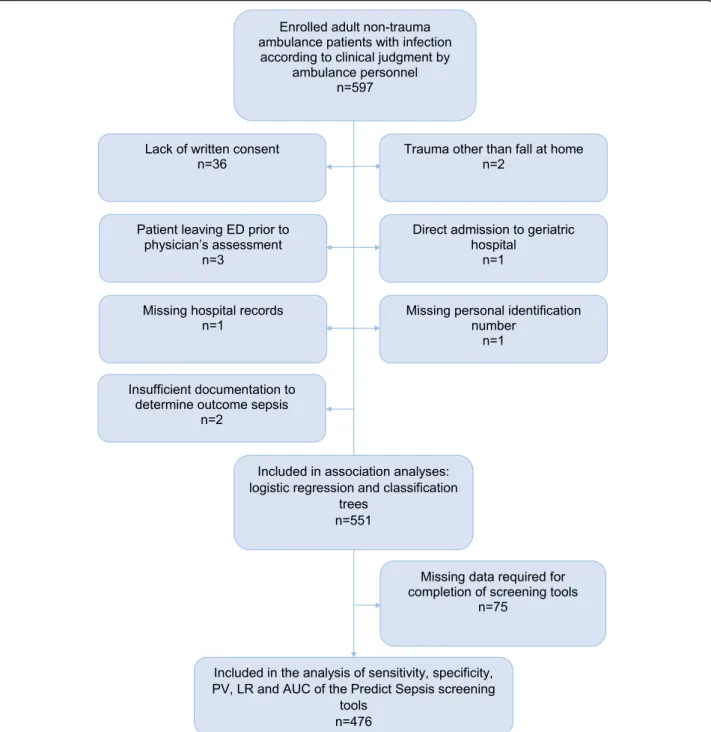
See Fig.1for flow chart of inclusion and exclusion.
Inclusion criteria
Inclusion criteria were adult (≥18 years) non-trauma am-bulance patients considered to suffer from a new onset infection (defined as symptoms that had begun within the last days) according to clinical judgment by the am-bulance personnel.
All patients were enrolled by the ambulance personnel and transported to one of the above listed seven hospital bound EDs.
Exclusion criteria
geriatric hospital i.e. bypassing an ED; 5) missing hos-pital records; 6) missing personal identification number; and 7) insufficient documentation to determine outcome sepsis.
Study protocol
A Case Report Form (CRF) including eight keywords re-lated to medical history and six vital signs was used by the ambulance personnel. Vital signs not recorded in the
CRF were extracted from the ambulance records (amPHI® Prehospital ambulance record, Amphi Systems A/S, Aalborg, Denmark, and the digital IT-support for prehospital care in Stockholm; FRAPP® (Framtida IT-plattform för prehospital vård i Stockholms läns landsting).
Data related to ED arrival time, age, gender, pre-existing comorbidity, criteria for suspicion of a new-onset infection, in-hospital vital signs/ laboratory tests/
mortality and discharge International Classification of Diseases (ICD) code were retrieved from the hospital medical records (TakeCare®, v. 18.3.10, CompuGroup Medical, Stockholm, Sweden).
Predictive variables
A total of 21 variables were measured, as follows:
Keywords related to medical history
Eight keywords related to medical history, with a previ-ously demonstrated prevalence exceeding 20% among septic patients in the ambulance based on results from a prior study [12], were registered in the ambulance. These keywords were: “fever or suspected fever”,“pain”,
“acute altered mental status”, “weakness of the legs”,
“breathing difficulties”,“loss of energy”, “gastrointestinal symptoms” and “risk factors for sepsis” [12], (see Table1).
Vital signs
The first measured value in the ambulance of the six vital signs respiratory rate, oxygen saturation, heart rate, systolic blood pressure, Glasgow coma scale (GCS) and temperature were included.
POC-tests
Blood was drawn in the ambulance for four POC-tests; P-Glucose, P-Lactate, P-HBP and P-suPAR. For a de-tailed description of the handling and analyses of these POC-tests see Additional file1.
Demographic variables
Age, gender, and data required for calculation of Charl-son comorbidity score [19] were extracted from hospital records. Charlson comorbidity score is a validated method used to classify comorbid conditions which in-fluence the risk of mortality and is developed for use in longitudinal studies [19].
Outcomes
The possible outcomes were sepsis or no sepsis, within the first 36 h after ED arrival.
Sepsis
Sepsis was defined as sepsis within 36 h from ED arrival, in accordance with the Sepsis-3 criteria [20]; i.e. infec-tion (as defined in Addiinfec-tional file 2) in combinainfec-tion with an increased Sequential Organ Failure Assessment (SOFA) score of 2 points or more, as compared with the patient’s preexisting status and based on review of the medical record. Septic shock was defined as vasopressor requirement and serum lactate level greater than 2 mmol/L [20]. The preexisting score was set to zero for patients with no previous recordings of variables needed
for calculating the SOFA score [20]. Oxygen saturation level and level of oxygen supplied were converted to the partial pressure of oxygen (PaO2)/fraction of inspired oxygen (FiO2) in accordance with Swedish Intensive care registry [21,22].
No sepsis
Patients that did not fulfill sepsis criteria, as described above, were classified as“no sepsis”.
Calculation of sample size
The current study was the first part of the larger Predict Sepsis study (NCT03249597). The sample size for the current study was originally based on 18 variables to be used in the logistic regression analysis which implied that 180 patients with sepsis were needed i.e. ten events for each predictor variable [23]. 20% additional patients were included to compensate for missing data. Thus, the recruitment goal was set to include 216 patients with outcome sepsis (NCT03249597).
The prevalence of sepsis among ambulance patients was not previously known. Therefore, the first enrolled 315 patients were used to estimate the prevalence of sepsis in the study population and for the calculation of the final sample size.
Data analysis
Statistical analyses were performed using SPSS (Statis-tical Package for the Social Sciences) statis(Statis-tical software v. 23–25.0 (SPSS Inc., Chicago, IL, USA), and Clinical Research Calculators; Calculator 1,Vassarstats.net[24].
Characteristics
Normality distribution was assessed with the Kolmogo-rov–Smirnov and the Shapiro–Wilk tests and visually in histograms. Median and interquartile range (IQR) were used to describe age, vital signs and POC-test levels, since these variables were not normally distributed.
Classification of variables in the regression analysis
Keywords related to medical history Keywords were classified as present (yes)/ not present (no) in the regres-sion analysis. Patients not able to answer yes or no were included in the yes-category for the association analyses since they were few (11–30 patients per keyword) and the prevalence of sepsis was similar.
Vital sign and POC-test categories Categories for nu-merical variables (vital signs and POC-tests) were calculated using a stepwise approach, including the following steps:
Table 1Characteristics of the 551 ambulance patients with suspected infectiona
Variable Numberb
(%b
) N= 551
Median (IQR)
Age (yr) 78 (71–85)
Gender
-male 331/551 (60.1)
Ambulance parameters
Prio 2 (2–2)
1 100/545 (18.3)
2 384/545 (70.5)
3 61/545 (11.2)
Prevalence of keywords related to medical historyc
1. Fever or suspected fever 403/551 (73.1)
2. Pain 256/550 (46.5)
3. Acute altered mental status 328/551 (59.5)
4. Weakness of the legs (difficulties to walk/stand/raise/fallen/found on the floor or similar) 419/551 (76.0)
5. Breathing difficulties 280/549 (51.0)
6. Loss of energy 490/551 (88.9)
7. Gastrointestinal symptoms (vomiting/diarrhoea) 188/550 (34.2)
8. Risk factors for sepsisd 229/549 (41.7)
Vital signs
1. Respiratory rate (min−1) 22 (18–28)
2. Oxygen saturation (%) 94 (91–97)
3. Heart rate (min−1) 94 (80–108)
4. Systolic blood pressure (mmHg) 135 (120–150)
5. GCS (score) 15 (15–15)
6. Temperature (°C) 38.3 (37.5–39.1)
POC-tests
1. P-Glucose (mmol/L) 7.9 (6.8–9.7)
2. P-Lactate (mmol/L) 1.7 (1.3–2.6)
3. P-suPAR (ng/mL) 4.8 (3.5–6.7)
4. P-HBP (ng/mL) 12.9 (5.9–28.4)
Comorbidity
Charlson comorbidity score 2 (1–4)
Admitted to in-hospital care 454/551 (82.4)
Outcome
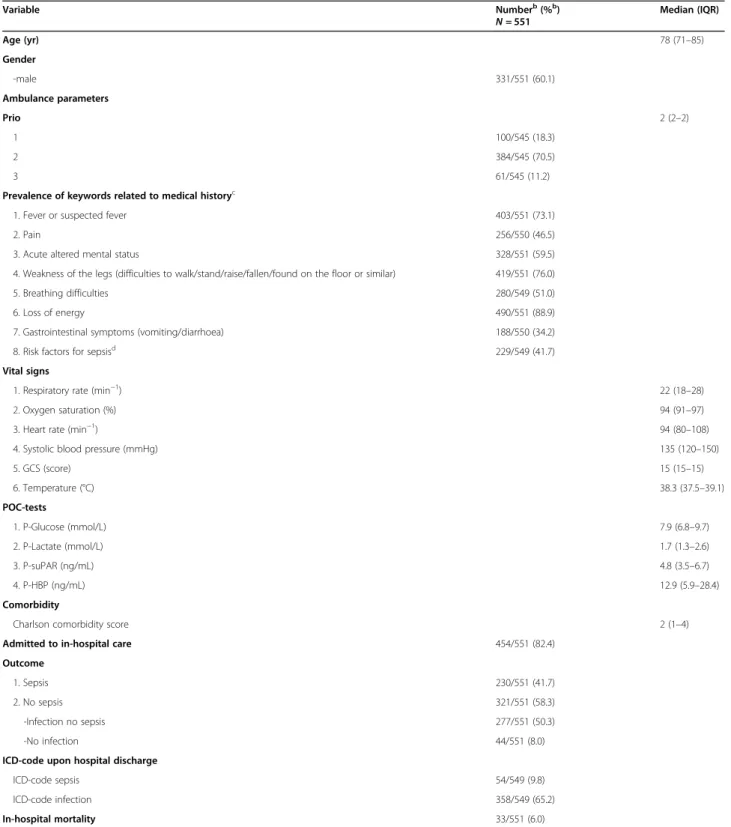
1. Sepsis 230/551 (41.7)
2. No sepsis 321/551 (58.3)
-Infection no sepsis 277/551 (50.3)
-No infection 44/551 (8.0)
ICD-code upon hospital discharge
ICD-code sepsis 54/549 (9.8)
ICD-code infection 358/549 (65.2)
In-hospital mortality 33/551 (6.0)
IQRInterquartile range,GCSGlasgow Coma Scale,POCPoint Of Care,suPARsoluble urokinase Plasminogen Activating Receptor,HBPHeparin Binding Protein,ED
Emergency Department,qSOFAquick SOFA (Sequential Organ Failure Assessment score),ICDInternational Statistical Classification of Diseases and Related Health Problems a
551 adult ambulance patients with infection according to clinical judgment by ambulance personnel and documentation to determine if the patient had outcome sepsis according to Sepsis-3 or not
b
Of patients with documented variable c
All symptoms were new-onset or increased compared to the patient’s habitual state d
according to NEWS [25], SIRS [26], Robson [10] when possible, and aiming for equal ranges for each created category.
2) The 8–10 categories from step 1 were merged into 3–4 categories for each variable, based on odds ratios, with the aim to not overlap the 95% confidence intervals and that the prevalence of sepsis was similar in the merged categories. 3) The 3–4 categories from step 2 were merged into
the final 2–3 categories using the same criteria as above described in step 2.
Comparisons of receiver operating characteristic (ROC) curves and AUC values for the continuous vari-able and their three categorized versions (8–10 categor-ies, 3–4 categories and 2–3 categories for each numerical variable) were performed for each step in order to assess that the categorization had not caused an inacceptable loss of information.
Underlying data describing the prevalence of sepsis within categories is described in Additional file 3.
Determination of predictors of sepsis among patients with infection in the ambulance according to clinical judgment by ambulance personnel
Logistic regression Identification of predictor variables for sepsis was performed as follows: first an unadjusted univariable (crude) analysis was performed for each of the 21 variables. AUC values were calculated for all vari-ables that showed a significant association (p< 0.05) with sepsis. Second, a multivariable adjusted logistic regres-sion was performed including variables which were sig-nificantly associated with outcome sepsis in the univariable analysis. Odds ratios (ORs) were reported with corresponding 95% confidence intervals.
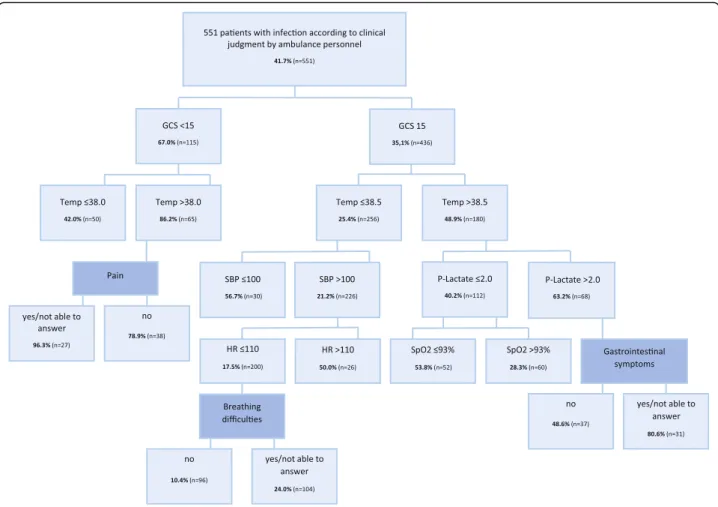
Classification trees Classification trees were used as a complement to logistic regression to identify variables associated with sepsis and to stratify groups of patients according to risk of sepsis. An advantage of this method as compared to logistic regression is that interactions be-tween variables can be discovered and visualized. The Chi-squared automatic interaction detection (CHAID) algorithm was used to build the trees [27] and starts with all data in one group. Each possible split for each variable is considered in order to find the split that leads to the strongest association with the outcome: i.e. sepsis (yes/no). The analysis was based on the 21 variables de-scribed above. The resulting groups were split until one of the following stop criteria was reached: tree depth was limited to five levels, a group with less than 25 pa-tients was formed or a split with a Bonferroni adjust-ment of less than 0.05 was executed.
Models used to predict sepsis
Models for sepsis screening were created based on sig-nificant association with sepsis in univariable and multi-variable regression analyses, in addition to significant association in univariable analysis in combination with significantp-values (< 0.05) for the AUC of the variable.
There was a trade-off between the number of variables included in the model and the contribution to prediction of the outcome sepsis. The objective to include a small number of variables rather than a larger is based on the assumption that the screening tool is a clinical bedside tool vs an electronically embedded tool. As a final step, models combining the keyword acute altered mental sta-tus and GCS < 15 and, additionally, models excluding lactate were tested. This was done to evaluate, by ROC curves, how reduction of variables and avoidance of an invasive step (lactate measurement) affected the predict-ive ability with respect to sepsis identification.
The predictive models were evaluated based on scores for individual variables instead of the estimated regres-sion scores, as follows. First, each individual variable in the model was scored based on the strength of the asso-ciation with sepsis in regression analyses and classifica-tion trees. Secondly, cut-offs for total scores were evaluated with respect to sensitivity and specificity for sepsis by applying ROC curves. A comparison of the predictive ability for each model, given a specific cut-off for total score, was performed by calculating AUC (ac-cording to SPSS), sensitivity, specificity, positive predict-ive value (PPV), negatpredict-ive predictpredict-ive value (NPV) and likelihood ratios (LRs) (according toVassarstat.net[24]).
Ethical approval and compliance with international standards of study procedures
The study received approval from the Stockholm Re-gional Ethical Review Board (reference number 2016/ 2001–31/2 and 2018/2202). Written consent was ob-tained from all participants.
This study complied with the Declaration of Helsinki [28] and the manuscript was drafted according to the Standards for the Reporting of Diagnostic accuracy stud-ies (STARD) criteria [29].
Results
Patient characteristics
Of the 551 included patients 331 (60.1%) were men, the median age was 78 years (IQR 71–85) and 230 (41.7%) had sepsis, see Table1. Of the 230 patients with sepsis, 23 patients (10%) died during in-hospital care. Forty-four of 228 patients (19.3%) with sepsis in accord-ance with the Sepsis-3 criteria [20], and a documented ICD-code upon hospital discharge, had an ICD-code consistent with sepsis.
Predictors of sepsis
Logistic regression analysis
Individual ROC curves for the 17 variables that showed a significant association with sepsis in the univariable analysis are presented in Additional file 4.
Keywords related to medical history The keywords with the strongest association with sepsis were acute al-tered mental status and gastrointestinal symptoms, see Table2.
Vital signs The calculated vital sign and POC-test level categories used in the regression analyses are presented in Table2. The vital signs with the strongest association with sepsis were systolic blood pressure≤100 mmHg, GCS < 15, and temperature > 38.5 °C, see Table 2. Heart rate demonstrated the weakest association with sepsis.
POC-tests All POC-tests except for P-Glucose had a significant association with sepsis in the univariable lo-gistic regression. The only POC-test that remained sig-nificantly associated with sepsis in the multivariable analysis was P-Lactate > 4 mmol/L, see Table2.
Demographic variables A Charlson comorbidity score of ≥5 points was significantly associated with outcome sepsis in univariable analysis. This association did not re-main significant after adjusting for all other variables, see Table2.
Classification trees
The vital signs GCS and temperature were most strongly associated with sepsis according to classification tree analyses, as shown in Fig.2.
Models and the Predict Sepsis screening tools
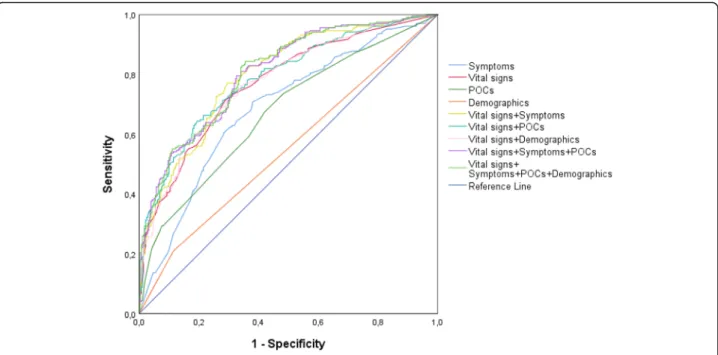
ROC curves for models based on variable groups (symp-toms, vital signs and POC-tests) and combinations thereof are illustrated in Fig. 3. Vital signs were, as a variable group, the strongest predictors of sepsis (Fig.3).
A description of the variables included in the models and the method used to develop each model is presented in Additional file 5. Scores for individual variables in the tools, and total scores for the models, considered
positive for suspected sepsis, were chosen based on com-parisons of AUC values, see Table3and Fig.4.
The variables demonstrating the strongest association with sepsis according to logistic regression and classifi-cation trees were acute altered mental status, gastro-intestinal symptoms, systolic blood pressure≤100 mmHg, GCS < 15, temperature > 38.5 °C and P-Lactate > 4 mmol/L. These variables were combined into the
“Predict Sepsis screening tool 1”, see Table3and Fig.4.
The AUC was not reduced noticeably when a com-bined variable for a decreased level of consciousness (a history of acute altered mental status and/or GCS < 15) was introduced and P-Lactate was excluded in the
Pre-dict Sepsis screening tool 2, based on 4 variables (see
Table3and Fig.4).
The Predict Sepsis screening tool 3was based on the 6
vital signs significantly associated with sepsis in univari-able analysis, applying the novel calculated categories for each vital sign (see Table3and Fig.4).
The Predict Sepsis screening tool 1, 2 and 3 identified the same septic patients to a large extent; 163 patients were identified by all three tools, eight patients were identified by tool 1 and 2 but not by tool 3, eight pa-tients were identified by tool 1 and 3 but not by tool 2, one patient was identified solely by tool 1 and nine sep-tic patients were not identified by either tool.
For AUCs of the Predict Sepsis screening tools before and after introduction of scores, see Additional file 5 and Table3. The sensitivity, specificity, predictive values and likelihood ratios for the Predict Sepsis screening tools are presented in Table3.
Discussion
This is the first prospective study in the ambulance set-ting to study the association between variables measur-able in the ambulance and the outcome sepsis. It is also the first study to include symptom-variables in a sepsis screening tool. Systolic blood pressure≤100 mmHg, temperature > 38.5 °C, GCS < 15, P-Lactate > 4 mmol/L, gastrointestinal symptoms, and a history of acute altered mental status demonstrated the strongest association with sepsis. I.e. two symptoms and one POC-test were significantly associated with outcome sepsis in the multi-variable analysis. However, interestingly, vital signs were, as a variable group, the strongest predictors of sepsis.
The Predict Sepsis screening tool 1 and 2both include
symptom-variables. The second tool is based on only four variables, which makes it feasible to use as a hands-on screening tool without the need of incorporatihands-on in electronic systems. However, the predictive ability of the
Predict Sepsis screening tool 1 and 2 was similar to that
Table 2Association between 21 variables and sepsisaamong 551bambulance patients with suspected infection
Variable Category Crude Univariable, unadjusted Multivariable, adjusted
n= 551 P-value n= 551 Adjusted for all factors that were significant in the univariable analysis,n= 484
nc % sepsis OR 95% CI P-value OR 95% CI
Keywords related to medical history
Fever or suspected fever yesd 417 45.1 0.005 1.8 1.2–2.7 0.98 1.0 0.6–1.7
no 134 31.3 Ref Ref Ref – Ref –
Pain yesd 277 43.0 0.53 1.1 0.8–1.6 – – –
no 273 40.3 Ref Ref Ref – Ref –
Acute altered mental status yesd 344 49.4 < 0.001 2.4 1.7
–3.5 0.03 1.8 1.1–2.9
no 207 29.0 Ref Ref Ref – Ref –
Weakness of the legs yesd 442 44.6 0.007 1.9 1.2
–2.9 0.61 1.2 0.6–2.1
no 109 30.3 Ref Ref Ref – Ref –
Breathing difficulties yesd 299 48.2 0.001 1.8 1.3
–2.6 0.24 1.3 0.8–2.2
no 250 34.0 Ref Ref Ref – Ref –
Loss of energy yesd 501 43.1 0.04 2.0 1.0
–3.7 0.79 1.1 0.5–2.6
no 50 28.0 Ref Ref Ref – Ref –
Gastrointestinal symptoms yesd 214 52.8 < 0.001 2.1 1.5
–2.3.0 0.006 1.9 1.2–2.9
no 336 34.8 Ref Ref Ref – Ref –
Risk factors for sepsis yesd 256 47.7 0.008 1.6 1.1–2.2 0.46 1.2 0.8–1.9
no 293 36.5 Ref Ref Ref – Ref –
Vital signs
Respiratory rate > 24 breaths/min yes 189 56.1 < 0.001 2.4 1.7–3.5 0.53 1.2 0.7–2.0
no 361 34.3 Ref Ref Ref – Ref –
Oxygen saturation < 94% yes 232 55.6 < 0.001 2.8 1.9–3.9 0.08 1.6 1.0–2.5
no 319 31.2 Ref Ref Ref – Ref –
Heart rate > 110 beats/min yes 106 58.1 < 0.001 2.3 1.5–3.5 0.09 1.6 0.9–2.8
no 446 37.8 Ref Ref Ref – Ref –
Systolic blood pressure≤100 mmHg yes 54 68.5 < 0.001 3.4 1.9–6.3 0.001 3.6 1.7–7.6
no 496 38.7 Ref Ref Ref – Ref –
Level of consciousness, GCS <15 yes 115 67.0 < 0.001 3.8 2.4–5.8 < 0.001 3.5 2.0–6.2
no 416 35.0 Ref Ref Ref – Ref –
Temperature, °C < 0.001
≤38.0 yes 235 27.0 Ref Ref Ref – Ref –
38.1–38.5 yes 91 41.8 0.01 1.9 1.2–3.2 0.02 2.2 1.1–4.2
> 38.5 yes 223 56.1 < 0.001 3.4 2.3–5.1 < 0.001 3.3 2.0–5.6
POC-tests
P-Glucose > 6.5 mmol/L yes 410 42.7 0.10 1.5 0.9–2.3 – – –
no 105 33.7 Ref Ref Ref – Ref –
P-Lactate, mmol/L 0.08 –
≤2.0 yes 340 36.1 Ref Ref Ref – Ref
2.1–4.0 yes 160 46.3 0.03 1.5 1.0–2.2 0.35 1.3 0.8–2.1
> 4.0 yes 38 76.3 < 0.001 5.7 2.6–12.4 0.03 2.8 1.1–7.3
P-suPAR, ng/mL 0.31
< 4.0 yes 184 30.4 Ref Ref Ref – Ref –
symptom-variables and POC-tests did not noticeably in-crease the predictive ability of a sepsis screening tool in the current study population.
It is, in our opinion, the clinical setting where the tool is going to be implemented that is the determining fac-tor for which tool to recommend, since the predictive ability of these three tools was similar.
Predictors of sepsis
Keywords reflecting gastrointestinal symptoms and acute altered mental status demonstrated a stronger associ-ation with sepsis than “classic” symptoms of sepsis such as a history of fever. This finding is novel and indicates that these symptoms require more attention.
Systolic blood pressure, GCS and temperature were the vital signs that demonstrated the strongest associ-ation with sepsis. However, one third of the septic pa-tient presented with a normal systolic blood pressure, two thirds had a normal GCS and one third lacked fever. This is consistent with a previous study by Suffoletto et al [11], demonstrating that more than one third of the patients with severe infections present with normal vital signs to the ambulance.
P-Lactate was the POC-test that demonstrated the strongest association with sepsis and was included in some of the models. However, excluding P-Lactate in
thePredict Sepsis screening tool 2did not noticeably
de-crease the predictive ability. This raises the question if the benefit of a slightly higher AUC in a screening tool is worth the disadvantages of a clinically invasive step,
i.e. a blood test. A previous study by Singer et al. dem-onstrated a moderate to good specificity but a low sensi-tivity for POC lactate in adult ED patients with suspected sepsis [30], and Moran et al. stated that the lactate-added value is dependent on the underlying pre-dictive model [31].
Age has been shown to be a predictor of sepsis among ambulance patients [9]. This was however not confirmed in the current study, which could be explained by the median age being similar in the two outcome groups i.e. sepsis and no sepsis.
Models and comparison of screening tools
All the calculated models demonstrated good AUC values. The inclusion of fewer variables in the models did not noticeably affect the AUC. This is valuable infor-mation since the ambulance setting constitutes an envir-onment where every minute counts and using fewer variables should save time, i.e. unless the screening tool can be included in an electronic decision support sys-tem. If a screening tool is incorporated in an electronic system, the number of included variables is of less im-portance. Hence, which tool is the optimal tool will de-pend on how the tool is planned to be implemented within clinical practice, i.e. as a hands-on screening tool or as an electronic decision support tool.
It is a challenge to develop a tool combining a high sensitivity with a high specificity. The low specificity of both the Predict Sepsis screening tools and preexisting screening tools [8,10] is troublesome since it may cause
Table 2Association between 21 variables and sepsisaamong 551bambulance patients with suspected infection(Continued)
Variable Category Crude Univariable, unadjusted Multivariable, adjusted
n= 551 P-value n= 551 Adjusted for all factors that were significant in the univariable analysis,n= 484
nc % sepsis OR 95% CI P-value OR 95% CI
≥8.0 yes 93 64.5 < 0.001 4.2 2.4–7.1 0.13 1.7 0.9–3.4
P-HBP≥15.0 ng/mL yes 235 52.8 < 0.001 2.3 1.6–3.2 0.37 1.2 0.8–2.0
no 290 33.1 Ref Ref Ref – Ref –
Demographic variables
Age≥65 years yes 474 41.6 0.83 0.9 0.6–1.5 – – –
no 77 42.9 Ref Ref Ref – Ref –
Gender, male yes 331 43.8 0.23 1.2 0.9–1.8 – – –
no 220 38.6 Ref Ref Ref – Ref –
Charlson comorbidity score≥5 points yes 86 55.8 0.004 2.0 1.2–3.1 0.13 1.6 0.9–3.1
no 465 39.1 Ref Ref Ref – Ref –
OROdds Ratio,CIConfidence Interval,RefReference,GCSGlasgow Coma Scale,suPARsoluble urokinase Plasminogen Activating Receptor,HBPHeparin Binding Protein
a
Sepsis is defined in accordance with Sepsis-3 as a) infection +≥2 SOFA criteria, or b) infection + vasopressor need and lactate > 2 (septic shock) b
Of total 553 patients with infection according to clinical judgment by ambulance personnel, 551 patients had the required documentation to determine whether the patient had sepsis or not. These 551 patients were included in the regression analysis
c
of patients with documentation of the variable d
Patients that were not able to answer yes or no were included in the yes-category in the logistic regression and classification tree analyses (11–30 patients/ keyword), based on similarity in prevalence of sepsis and overlapping CIs in these groups
false sepsis alerts. However, we considered a high sensi-tivity to be more important since the major clinical problem is not identifying the septic patient in a timely fashion [5,6,32]. Some of the difficulties in combining a high sensitivity with a high specificity could be explained by the heterogenous presentations of sepsis. Sepsis is likely not to be one but rather several conditions influ-enced by both microbial and host factors, which may contribute to the heterogenicity with respect to presen-tation. This line of reasoning is supported by Seymour et al., describing several phenotypes of sepsis [33].
Clinical implementation of the Predict Sepsis screening tools
The objective of the application of a screening tool in the ambulance is to increase the identification of septic patients and enable timely treatment. Previous studies have shown that time to treatment is halved when the
septic patient is identified by ambulance personnel [5] underscoring the importance of identification of the sep-tic patient in the ambulance.
The Predict Sepsis screening tool 1 includes lactate measurement, which is not implemented in all ambu-lance settings. P-Lactate > 4 mmol/L was one of the vari-ables that remained significantly associated with sepsis in the multivariable logistic regression analysis. However, the predictive ability of the models including lactate was not superior to that of the models excluding this invasive step. Hence, we do not consider lactate measurement justifiable as it may cause a delay of the sepsis screening and the transport of the patient in addition to discom-fort from the patient’s perspective.
Predict Sepsis screening tool 2 is based on four vari-ables of which two are vital signs and two symptom-based variables. This makes the Predict Sepsis screening tool 2 feasible to use as a hands-on screening tool in an
ambulance setting without a computer-based alert sys-tem. However, implementation of the Predict Sepsis screening tool 2 requires the ambulance personnel to ask all patients with clinically suspected infection whether they have gastrointestinal symptoms or not. Since this request is not part of standard procedure, it could be considered a disadvantage.
Predict Sepsis screening tool 3 is based on six vital signs alone. The advantage of this tool is that vital signs are routinely measured within ambulance care. It is however noteworthy that the cut-offs for each vital sign were calculated in the current study and not those typic-ally applied today as clinical routine. The application of Predict Sepsis screening tool 3 is particularly feasible in settings with computer-based alert systems, although the tool may also be used manually.
Strengths and limitations of the current study
The strengths of the current study were the prospective design, the novel concept to include keywords related to medical history and POCs in the analyses, in addition to vital signs, and to apply calculated cut-offs for vital signs and POC-tests rather than using previously published cut-off levels. Patients with clinically suspected infection are common in the ambulance and it is of importance to identify those at risk of developing a severe infection such as sepsis. In addition, patients with a decreased level of consciousness were included in the current study, reducing selection bias.
There are several limitations to the current study. The categorization of vital signs and POC-tests could be
questioned. However, the categorized variables followed the ROC curves for the continuous variables to a large extent, supporting well-chosen cut-off levels.
The definition of infection could be criticized. The Sepsis-1 and -2 consensus documents [26,34] defined in-fection as “a pathological process caused by invasion of normally sterile tissue/fluid or body cavity by pathogenic or potentially pathogenic micro-organisms”. Neither does Sepsis-3 include a detailed definition of infection [20], nor are there other consensus criteria for infection. The defin-ition of infection used in the current study is based on clinical experience and symptoms frequently reported by patients suffering from infection and has been used in prior publications [6, 7, 12]. The ability of ambulance personnel to identify patients with infection was high in the current study; 92% of the patients with suspected in-fection according to clinical judgment by ambulance personnel fulfilled the predefined criteria for infection. We consider it an advantage to have used stringent criteria for the definition of infection despite potential shortcomings of this specific definition.
Furthermore, there is an inherent risk that the predict-ive ability of a screening tool is higher in the population in which it is was developed than in other populations. Hence, the Predict Sepsis screening tools need to be ex-ternally validated.
Finally, the results are limited to the specific popula-tion of ambulance patients with suspected infecpopula-tion, ren-dering generalization of the results to the population of all patients presenting to the ambulance as not correct. It would be of interest to study the potential benefit of
adding symptom-variables and POC-tests in other study populations; i.e. not only among those with obvious signs of ongoing infection but rather among patients with non-specific presentations, as these patients are at a higher risk of not being identified as being septic.
The developed screening tools require external validation before clinical implementation and are applicable to adult, non-trauma ambulance patients with suspected infection ac-cording to clinical judgment by ambulance personnel.
Conclusions
Systolic blood pressure≤100 mmHg, temperature > 38.5 °C, GCS < 15, lactate > 4 mmol/L, gastrointestinal symptoms, and a history of acute altered mental status demonstrated the strongest association with sepsis. We present three screening tools to predict sepsis with similar sensitivity. The results indicated no noticeable increase of predictive ability by including symptom-variables and blood tests to a sepsis screening tool in the current study population. The major determining factor for which tool to recommend is the clin-ical setting where the tool is implemented, i.e. the availability of a computer-based alert system or not.
Supplementary information
Supplementary informationaccompanies this paper athttps://doi.org/10. 1186/s13049-020-00745-6.
Additional files 1-5.
Abbreviations
AUC:Area Under the receiver operating Curve; GCS: Glasgow Coma Scale; CI: Confidence Interval; PPV: Positive Predictive Value; NPV: Negative
Predictive Value; NCT: National Clinical Registration; ED: Emergency Department; suPAR: soluble urokinase Plasminogen Activator Receptor; HBP: Heparin Binding Protein; POC: Point-Of-Care; CRF: Case Report Form; FRAPP: framtida IT-plattform för prehospital vård i Stockholms läns landsting; ICD: International Classification of Diseases; SOFA: Sequential Organ Failure Assessment; PaO2: Partial pressure of Oxygen; FiO2: Fraction of inspired Oxygen; SPSS: Statistical Package for the Social Sciences; IQR: Interquartile Range; NEWS: National Early Warning Score; SIRS: Systemic Inflammatory Response Syndrome; ROC: Receiver Operating Characteristic; OR: Odds Ratio; CHAID: CHi-squared Automatic Interaction Detection; LR: Likelihood Ratio; STARD: Standards for the Reporting of Diagnostic accuracy studies
Acknowledgements
The authors would like to acknowledge first and foremost all the patients willing to participate, Samariten Ambulans AB Stockholm’s ambulance personnel, including Torkel and Ulf Kanfjäll for including patients and for your understanding of the underlying incentive of the study, ViroGates Denmark for sponsoring suPAR-kits, Adam Linder, Lund University for information regarding HBP analyses, Daniel Eklund, Eva Särndahl, Örebro University for HBP analyses, Maaret Castren for valuable discussions regarding the selection of POC tests, Veronica Lindström and Veronica Vicente for testing the CRF, and Laerdal, FALCK Foundation, the Emergency Department of Södersjukhuset and Örebro University for funding.
Authors’contributions
UW was responsible for the literature search, study concept and design, information/education of ambulance personnel, data acquisition, analysis and interpretation of the data and the drafting of the manuscript. JS has contributed to the study concept and design, the drafting of the manuscript and to a critical revision of the manuscript for important scientific intellectual content. HP participated in the statistical analyses, had the principal responsibility for critical revision of these and contributed to the manuscript. LK has participated in the study conception and design, interpretation of the data, drafting of the manuscript and critical revision of the manuscript for important scientific intellectual content. In addition, LK contributed with administrative, financial support as well as supervision of the study. The author(s) read and approved the final manuscript.
Funding
This study was supported by grants from Laerdal, Falck Foundation, the Emergency Department of Södersjukhuset, Stockholm, and Örebro University.
suPAR kits were provided by ViroGates, Denmark. The funders did not interfere in the interpretation of data, nor in writing the manuscript. Open access funding provided by Örebro University.
Availability of data and materials
The data that support the findings of this study are available from Karolinska Institutet Södersjukhuset but restrictions apply to the availability of these data, which were used under license for the current study, and so are not publicly available. Data are however available from the authors upon reasonable request and with permission of Karolinska Institutet Södersjukhuset.
Ethics approval and consent to participate
The study received approval from the Stockholm Regional Ethical Review Board (reference number 2016/2001–31/2 and 2018/2202). Written consent was obtained from all participants.
Consent for publication Not applicable.
Competing interests
All authors declare that they have no conflicting interests. UW and LK are members of the Swedish national working group for sepsis and LK is chair of the Swedish national working group for emergency medicine.
Author details
1Karolinska Institutet, Department of Clinical Science and Education,
Söderssjukhuset, Sjukhusbacken 10, 118 83 Stockholm, Sweden.2Fisksätra Vårdcentral (Primary Health Care Center), Fisksätra torg 20, 133 41 Saltsjöbaden, Sweden.3Department of Medical Sciences, Uppsala University, Akademiska sjukhuset, 751 85 Uppsala, Sweden.4Department of Medical
Sciences, Örebro University, Campus USÖ, Södra Grev Rosengatan 32, 701 12 Örebro, Sweden.
Received: 21 March 2020 Accepted: 26 May 2020
References
1. Mouncey PR, Osborn TM, Power GS, Harrison DA, Sadique MZ, Grieve RD, et al. Trial of early, goal-directed resuscitation for septic shock. N Engl J Med. 2015;372(14):1301–11.
2. Yealy DM, Kellum JA, Huang DT, Barnato AE, Weissfeld LA, Pike F, et al. A randomized trial of protocol-based care for early septic shock. N Engl J Med. 2014;370(18):1683–93.
3. Peake SL, Delaney A, Bailey M, Bellomo R, Cameron PA, Cooper DJ, et al. Goal-directed resuscitation for patients with early septic shock. N Engl J Med. 2014;371(16):1496–506.
4. Wang HE, Weaver MD, Shapiro NI, Yealy DM. Opportunities for emergency medical services care of sepsis. Resuscitation. 2010;81(2):193–7.
5. Studnek JR, Artho MR, Garner CL Jr, Jones AE. The impact of emergency medical services on the ED care of severe sepsis. Am J Emerg Med. 2010. 6. Wallgren UM, Castren M, Svensson AE, Kurland L. Identification of adult
septic patients in the prehospital setting: a comparison of two screening tools and clinical judgment. Eur J Emerg Med. 2014;21(4):260–5. 7. Wallgren UM, Antonsson VE, Castren MK, Kurland L. Longer time to
antibiotics and higher mortality among septic patients with non-specfic presentations -a cross sectional study of emergency department patients indicating that a screening tool may improve identification. Scand J Trauma Resusc Emerg Med. 2016;24(1):1.
8. Bayer O, Schwarzkopf D, Stumme C, Stacke A, Hartog CS, Hohenstein C, et al. An early warning scoring system to identify septic patients in the Prehospital setting: the PRESEP score. Acad Emerg Med. 2015;22(7):868–71. 9. Polito CC, Isakov A, Yancey AH 2nd, Wilson DK, Anderson BA, Bloom I, et al.
Prehospital recognition of severe sepsis: development and validation of a novel EMS screening tool. Am J Emerg Med. 2015;33(9):1119–25. 10. Robson W, Nutbeam T, Daniels R. Sepsis: a need for prehospital
intervention? Emerg Med J. 2009;26(7):535–8.
11. Suffoletto B, Frisch A, Prabhu A, Kristan J, Guyette FX, Callaway CW. Prediction of serious infection during prehospital emergency care. Prehosp Emerg Care. 2011;15(3):325–30.
12. Wallgren UM, Bohm KEM, Kurland L. Presentations of adult septic patients in the prehospital setting as recorded by emergency medical services: a mixed methods analysis. Scand J Trauma Resusc Emerg Med. 2017;25(1):23. 13. Huttunen R, Syrjanen J, Vuento R, Hurme M, Huhtala H, Laine J, et al. Plasma
level of soluble urokinase-type plasminogen activator receptor as a predictor of disease severity and case fatality in patients with bacteraemia: a prospective cohort study. J Intern Med. 2011;270(1):32–40.
14. Linder A, Arnold R, Boyd JH, Zindovic M, Zindovic I, Lange A, et al. Heparin-binding protein measurement improves the prediction of severe infection with organ dysfunction in the emergency department. Crit Care Med. 2015;43(11):2378–86. 15. Ulf Kanfjäll CaSAA. Annual ambulance assignments Samariten Ambulans AB
Stockholm: Samariten Ambulans AB; 2019.
16. Årsrapport 2017 Prehospitala verksamheter i SLL Sect. 4.1 and 6.2 (2017). 17. Folkmängd i riket, län och kommuner 31 mars 2018 och
befolkningsförändringar 1 januari–31 mars 2018 [Internet]. Statistiska centralbyrån (SCB). 2018 [cited 23rd of March 2019]. Available from: https:// www.scb.se/hitta-statistik/statistik-efter-amne/befolkning/befolkningens- sammansattning/befolkningsstatistik/pong/tabell-och-diagram/kvartals--och-halvarsstatistik--kommun-lan-och-riket/kvartal-1-2018/.
18. Hälso och Sjukvårdsförvaltningen RS. Akutmottagningsbesök (exkl barnakut och psykakut): sll.se: Hälso och Sjukvårdsförvaltningen, Region Stockholm; 2018. 19. Charlson ME, Pompei P, Ales KL, MacKenzie CR. A new method of classifying prognostic comorbidity in longitudinal studies: development and validation. J Chronic Dis. 1987;40(5):373–83.
20. Singer M, Deutschman CS, Seymour CW, Shankar-Hari M, Annane D, Bauer M, et al. The third international consensus definitions for Sepsis and septic shock (Sepsis-3). JAMA. 2016;315(8):801–10.
21. Swedish Intensive Care registry (Svenska intensivvårdsregistret, SIR) [Web page]. 2015 [updated 2015-05-20 Available from:http://icuregswe.org/. 22. Beräkning av FiO2 vid syrgastillförsel med mask eller kateter [Internet].
Svenska intensivvårdsregsitret. 2018 [cited 2018-12-18]. Available from: https://www.icuregswe.org/globalassets/riktlinjer/sofa.pdf.
23. Peduzzi PCJ, Kemper E, Holford TR, Feinstein AR. A simulation study of the number of events per variable in logistic regression analysis. J Clin Epidemiol. 1996;49(12):1373–9.
24. Lowry R. VassarStats; Clinical Research Calculators, Calculator 1www. vassarstats.net2019[cited 2019. Available from:www.vassarstats.net. 25. Physicians RCo. National Early Warning Score (NEWS) 2: Standardising the
assessment of acute-illness severity in the NHS. Updated report of a working party. London: Royal College of Physicians; 2017.
26. Bone RC, Balk RA, Cerra FB, Dellinger RP, Fein AM, Knaus WA, et al. Definitions for sepsis and organ failure and guidelines for the use of innovative therapies in sepsis. The ACCP/SCCM consensus conference committee. American College of Chest Physicians/Society of Critical Care Medicine. Chest. 1992;101(6):1644–55. 27. Kass G. An exploratory technique for investigating large quantitative of
categorical data; 1980.
28. World Medical Association Declaration of Helsinki: ethical principles for medical research involving human subjects. JAMA. 2013;310(20):2191–4. 29. Bossuyt PM, Reitsma JB, Bruns DE, Gatsonis CA, Glasziou PP, Irwig L, et al.
STARD 2015: an updated list of essential items for reporting diagnostic accuracy studies. Clin Chem. 2015;61(12):1446–52.
30. Singer AJ, Taylor M, Domingo A, Ghazipura S, Khorasonchi A, Thode HC Jr, et al. Diagnostic characteristics of a clinical screening tool in combination with measuring bedside lactate level in emergency department patients with suspected sepsis. Acad Emerg Med. 2014;21(8):853–7.
31. Moran JL, Santamaria J. Reconsidering lactate as a sepsis risk biomarker. PLoS One. 2017;12(10):e0185320.
32. Henriksen DP, Laursen CB, Jensen TG, Hallas J, Pedersen C, Lassen AT. Incidence rate of community-acquired sepsis among hospitalized acute medical patients-a population-based survey. Crit Care Med. 2015;43(1):13–21. 33. Seymour CW, Kennedy JN, Wang S, Chang CH, Elliott CF, Xu Z, et al.
Derivation, Validation, and Potential Treatment Implications of Novel Clinical Phenotypes for Sepsis. JAMA. 2019.
34. Levy MM, Fink MP, Marshall JC, Abraham E, Angus D, Cook D, et al. 2001 SCCM/ESICM/ACCP/ATS/SIS international Sepsis definitions conference. Crit Care Med. 2003;31(4):1250–6.
Publisher’s Note