China’s space program:
How cooperation between China and Europe changes as China’s space program advances
MA thesis
Leiden University East Asian Studies
S.R. Landsberger
ABSTRACT
Petra Ebeling, East Asian Studies, Leiden University Abstract of Master’s Thesis, Submitted 01-06-2016:
China’s space program: How cooperation between China and Europe changes as China’s space program advances
CONTENTS
CONTENTS ... 3
LIST OF ABBREVIATIONS AND ACRONYMS ... 4
1. Chapter 1 INTRODUCTION ... 5
1.1. Background ... 5
1.1.1. A Brief History of Space Exploration ... 5
1.1.2. History of China’s space program ... 7
1.1.3. The nature and levels of the space programs and technologies ... 8
1.1.4. Economic interest regarding cooperation in aerospace ... 8
1.2. Theoretical framework ... 9
1.2.1. Theory of International cooperation and competition ... 10
1.2.2. Power transition theory ... 11
1.2.3. Spillover effect ... 12
1.3. Research questions and hypotheses ... 12
1.4. Importance and goal of research ... 14
1.5. Research method ... 14
2. Chapter 2 POLITICAL ENVIRONMENT... 15
2.1. China – EU relationship ... 15
2.2. China Chinese and European Space industry structure ... 19
2.3. Changing leadership ... 23
2.4. Common goals in space and international agreements ... 27
2.4.1. Common goals ... 27
2.4.2. Expanding cooperation between China and Europe ... 31
2.4.3. China’s role in national and international space laws ... 33
3. Chapter 3 ECONOMIC BENEFITS FOR THE EU AND FOR CHINA ... 35
3.1. Sharing costs ... 35
3.2. Innovation and access to technology ... 38
3.3. Access to resources ... 39
3.4. Job employment ... 40
3.5. Prestige ... 40
4. CONCLUSION ... 41
LIST OF ABBREVIATIONS AND ACRONYMS
CNSA China National Space Agency ESA European Space Agency
EEC European Economic Community EU European Union
GPS Global Positioning System ISS International Space Station MoU Memorandum of Understanding
1. Chapter 1 INTRODUCTION
1.1.Background
Since the beginning of the Space Age, not a single day goes by that humanity does not profit from space technology: better weather forecasts, solar panels, communication, navigation, better healthcare, LED units, radio and television, and so forth. Without space technologies we wouldn’t have smart phones or invisible braces. Space technology made our lives much more convenient and gave our economies an enormous boost.
1.1.1. A Brief History of Space Exploration
Space exploration is the investigation of outer space beyond the Earth’s atmosphere, to gain knowledge about cosmos and humanity. This can be performed from earth or by (manned) spaceflights. Already very early, ancient civilizations like the Greeks, Egyptians and Maya studied celestial objects. Some cultures even used primitive astronomical tools but there was no way to get up into the sky. The motivation for space research was and is not always of a scientific nature. Religious or astrological beliefs, political motives, competition and calendrical practices are examples of driving forces behind space exploration. With the inventions of the telescope in the 17th century and later on rockets that were able to reach outer space, space exploration was brought to a higher level: celestial bodies could be studied more closely than ever. These two inventions enormously contributed to humans’ knowledge of the universe.
As people always dreamt of journeys to space and to the moon, in 1883 a Russian schoolteacher named Konstantin Tsiolkovsky in fact invented the theory of a rocket engine that would actually bring humans into outer space. Tsiolkovsky understood that the
rocket that could reach the moon one day, but most American people laughed at the idea of a spacecraft (McGowen 2008, p10 - 11).
At the same time, in Europe people took the idea of a spacecraft very serious. In 1927, a workgroup named Spaceflight Society was founded in Germany, the members hoped to construct a spacecraft that was able to reach outer space (Darrin 2009, p212 -213). In other European countries similar space societies and associations were founded, for example the Manchester Interplanetary Society founded in the UK (1937), Nederlandse Rakettenbouw founded in the Netherlands (1934) and the Österreichische Gesellschaft für Raketentechnik founded in Austria (1931) (Lent 1945, p.117-118). Some societies got government support with the goal to develop guided missiles (Darrin, p.212) and support from the army for instance to make long-distance bombs (McGowen 2008, p.11).
From a military perspective governments became increasingly interested in rocketry and rocket scientists. The German Army started a secret military rocket project in 1934 based on the work of a scientist named Wernher von Braun (McGowen 2008, p.11). A few years later in 1933-1934 the German Spaceflight Society was disbanded and rocket
development was completely taken over by the Army (Darrin 2009, p.216). After World War II, the allies Soviet Union (USSR) and the United States (US) both wanted to obtain as much information as possible about the German V-2 rockets that were used during World War II. The leading German rocket scientists surrendered and chose to work for the United States. (McGowen 2008, p.14). The competition between the United States and the Soviet Union in various areas soon led to a deterioration of the relationship between the two countries, and within a few years these two nations became rivals during the Cold War. The competition to conquer space, the period known as the Space Race, was an important part of the Cold War. This period started on July 29th when the Press Secretary of President Eisenhower
announced hat the United States would launch satellites. This news reached he 6th
1.1.2. History of China’s space program
The first foundations of modern aerospace are attributed to countries like Soviet Union and the United States. After all, they were the first countries active in the outer space and have accomplished the first successful space missions. Most people will not directly associate China with the beginning of aerospace – in textbooks it is hard to find any discoveries made by Chinese in the field of aerospace for this early period. Nevertheless, during the Song Dynasty some time in the 1200s, the earliest form of the rocket was
invented in China, an indispensible invention to realize rockets that we use for modern space exploration today (Bower 2004, p.200). In addition, among the scholars and engineers who worked on major aeronautic technology in the United States in the early 1950s, there was an outstanding Chinese scholar named Qian Xuesen. Qian studied at Massachusetts Institute of Technology and at the California Institute of Technology (Harvey 2013, p.31). He also was one of the founders of the Jet Propulsion Laboratory in Pasadena, California (Stone 2012, p.1631) and got involved in United States aeronautical and military issues. When he applied for permission to visit his parents in communist China, Qian was accused of being a
is perceived as the father of modern Chinese space technology and exploration (Harvey, 2013 p.31).
1.1.3. The nature and levels of the space programs and technologies
The first space programs set up by the German, Soviet and United States government were mainly established from a military point of view and in the beginning these programs generally focussed on rocket development. During the cold war China couldn’t catch up with space technologies developed in the Soviet Union and the United States. Also, for a long time there was little to no cooperation between China and other countries with high
developed space programs because rivalry existed and China still did not open up until 1978. From the 1970s up to now China has made huge progress and achieved many important milestones, milestones the United States and the Soviet Union had achieved much earlier. Even though Wang Zhaoyao, former director of China's manned space program office, in 2012 officially stated that China is not competing with any country in space program (Shen 2012, Xinhua), at this moment China has caught up with the U.S. and Russia. China has become a global player in aerospace as well.
1.1.4. Economic interest regarding cooperation in aerospace
The interesting thing of technological development is that it has different sides: economic, scientific, and military. After all, the technique that underlies the launch of a weather satellite that helps farmers to improve crop yield or helps to study climate changes, can also be used to launch a satellite for the purpose of espionage. However, after the cold war the focus of many space programs became increasingly more economically and
scientifically oriented. This transformation is a reason for changing international
project (Peng 2007, Xinhua). In 2012, during the Heads of Agency meeting in Quebec, the head of the Russian space agency Roscosmos Vladimir Popovkin, and the head of space agency ESA Jean-Jacques Dordain, stated that they are open for cooperation with China in the ISS program (Atlanta Chinese News 2012, p.2). However, due to NASA’s security concerns, until today the U.S. is not open to Chinese participation in the ISS program. Limitations on U.S. cooperation with China are also set by law, the 112th Congress Public Law 112-55, SEC. 539 (Public law 112–55, 2011). As a result of this Chinese exclusion policy, China increasingly looks for cooperation with Europe and Russia. Cooperation not only
provides insight into each other's goals, but also leads to political trust and economic growth. Since the U.S. is very reluctant in cooperation with China regarding aerospace engineering, the EU is becoming an increasingly attractive and steadfast partner for China. Considering the great potential benefits from the collaboration, this thesis looks at the potential of economic and scientific cooperation between China and the EU in the field of aerospace, and focuses on: How China and Europe complement each other in the field of space
development, and what barriers might stand in the way for China’s collaboration with Europe.
1.2.Theoretical framework
Relations?” (Chambers, 2009). Furthermore, many researchers have focused on the military side of the Chinese space program and the potential danger for international community, in particular the danger for the U.S. The U.S. does not support Chinese participation in the ISS program. Some international researchers, including American researchers, see NASA's Chinese exclusion policy as a problem and have analyzed the importance and opportunities for U.S.-China cooperation (Committee on Human Spaceflight, 2014). China would like to cooperate with the U.S. in the ISS program, but until today there still are no opportunities for such a partnership. To nevertheless build an international partnership with the West, it seems that China increasingly draws closer to the EU to see what possibilities for
cooperation there are. But there still is no thorough investigation into how the EU fits into China's space program, and what barriers might have to be overcome and what benefits the cooperation between China and the EU has to offer for both sides. Therefore, the purpose of this thesis is to examine China-EU cooperation in space by comparing development goals of China’s space program and space policy with those from Europe, in order to find motives or possible barriers for China-EU cooperation. To find a comprehensive answer to these questions, the theories in the next paragraphs are deployed for this study.
1.2.1. Theory of International cooperation and competition
In general, for this in this thesis the term cooperation is defined as “countries working together to achieve the same goal” and competition is defined as “one country trying to gain what another country is trying to gain at the same time”.
There are many theories about international cooperation and competition, for example realism, institutionalism, liberalism, constructivism and the English school. Many of these theories complement each other, therefore this thesis will use the principal theories below as described by Slaughter in “International Relations, Principal Theories” as a guideline (Slaughter, 2011). The most important variables are:
Realism: states constantly have to maintain their power in order to advance material interests necessary for survival;
Institutionalism: cooperation between nations is possible and is a rational, self-interested strategy relying on institutions and a set of rules to reduce uncertainty; Liberalism: national characteristics of individual states matter for their
Constructivism: the social meaning of a state is determining for international relations;
The English school: “Detailed observation and rich interpretation is favoured over general explanatory models.” (Slaughter 2011, p.1-7);
By applying the theories above, driving forces for China-EU cooperation can be revealed.
1.2.2. Power transition theory
The term power transition was originally described by Kenneth Organski in his
textbook World Politics (Organski, 1968). Organski’s theory describes a significant increase of national power when a nation achieves rapid economic development and the international impact of this growing power. The single most powerful nation on earth is decisive for international hierarchy structure (Lai 2011, p.5). The influence of one state over others is mainly based on their position in the hierarchy structure that depends on capacity of power. States compete with each other to get limited goods available, this competition can lead to either conflict or cooperation depending on the net gains (Purba 2012, p.8). An expanding nation will be confronted with the dominant nation and its allies and rules have to be rearranged (Lai 2011, p.6). Hegemonic struggles will result in an international system with changes that may extend into the area of territory, economy and diplomacy (Gilpin 1981, p.198).
1.2.3. Spillover effect
Exchange of ideas through China-EU cooperation in the field of aerospace can cause spillover effects. Spillover is a phenomenon that intentionally or unintentionally generates another phenomenon. Spillovers often refer to the side effect of a strategy (Bondt 1996, p.2).
There are different types of spillover effects, for example technological spillover, economic spillover or behavioural spillover effects. This thesis looks at technology (or knowledge) spillovers which may occur through China-EU aerospace cooperation. Technology or knowledge spillover are defined as “involuntary leakage or voluntary exchange of useful technological information.” (Bondt 1996, p.2).
Spillover effects can be internal or external, direct or indirect, positive or negative. Internal spillover occurs within one nation, external spillover is caused by interaction between one nation and another nation. Technological spillover directly affects innovation and production of a nation, and indirectly influences consumption and society.
In general, technology spillover is considered as non-rival knowledge because more actors can use the knowledge at the same time (Gong 2003, p.1055). “One’s use of a technology does not limit its use by others and the cost for an additional agent to use an
existing technology is negligible compared to the cost of inventing it.” (Peri 2009, p.1) Therefore external, direct and positive spillover effects are mainly relevant for the research question of this thesis. This thesis tries to identify causes for possible spillovers or existing spillover effects.
1.3.Research questions and hypotheses
The main research question of this thesis is: How is cooperation between China and the EU changing in the field of aerospace as China’s space program advances?
To answer the main question, this research addresses three fields of interest. The first question of this study investigates the dynamics of political environment and whether these conditions encourage or impede China-EU cooperation in aerospace.
The second question focuses on benefits China can gain from collaboration with the EU. What are China’s motivations for cooperation in aerospace with the EU? What drives China to enter into a partnership with the EU?
2. What China can gain from the collaboration with EU in space programs?
Finally it is also important to analyse indicators for expanding EU cooperation with China, and what’s in it for Europe. What can the EU obtain through cooperation in aerospace with China? These three fields of interest are key determinants for a successful future China-EU collaboration.
3. Is cooperation with China in aerospace an asset for Europe?
Accordingly, my propositions are as follows:
1: Cooperation in aerospace between China and the EU is increasing because the political environment has become more favourable. In addition, and China and the EU share more
common goals because China’s characteristics are changing.
2: According to the theory of International cooperation and competition, international hierarchy changes, therefore it is in the interest of Europe as well as China to expand
aerospace cooperation.
3: Because China-EU cooperation in aerospace will bring high spillover effects, there must be indications that China and the EU are expanding or preparing a more intensive
1.4.Importance and goal of research
All nations in the world constantly observe activities of other nations in order to secure the nations’ own interests. The impact of foreign operations, for example the change of political leaders, military conflicts and threat of nature can reach far beyond national borders. Space activities are important ones of them, since space technology has brought about important inventions, which have been changing the world continuously.
China’s activities in outer space affect societies all over the world. Therefore it is important for other nations to know what China is doing in outer space and how hierarchical structures and partnerships change when China’s space technology becomes more advanced. Awareness of changing roles in the world makes it possible for other nations to respond with policies, investments, programmes or partnerships. This thesis aims to reveal changing roles in the field of aerospace by analysing China’s rapidly expanding space program and what mutual benefits the eventual cooperation with the EU will bring. Furthermore, this study’s purpose is to provide valuable insights and raise new questions in the field of international relations linked to space programs.
1.5.Research method
A qualitative descriptive research is deployed by this study. The advantage of this methodology is that it provides insight into a specific situation, in this case the cooperation in aerospace between China and Europe. The three theories as described in the theoretical framework will be used to study literature, reports, media articles and websites with official policy statements.
2. Chapter 2 POLITICAL ENVIRONMENT
International legislation and national government policy play a major role in world’s space industry. Rules and laws related to space industry, drafted by international and national governmental bodies, not only determine the direction of government policy, such as the design of partnership-strategies, but also affect the behaviour of commercial space companies. The Chinese and European space programs are structured differently and have a different history but also show similarities. In this chapter, the political environment in China and the EU are discussed and what this means for cooperation in space.
2.1.China – EU relationship
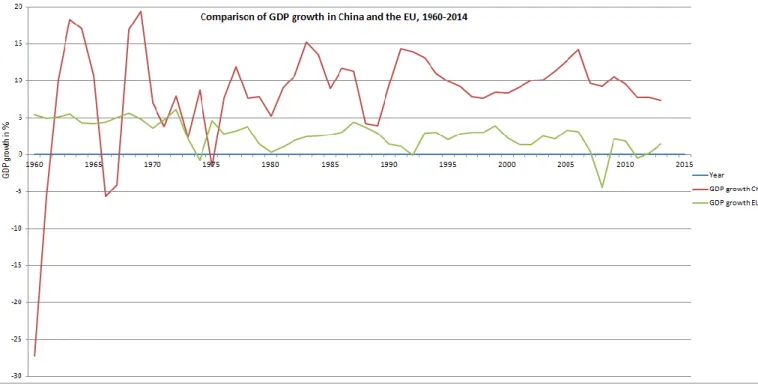
The bond between China and the EU has developed fast since diplomatic ties were established in 1975. The British politician Christopher Soames was the first European Commissioner to visit China on behalf of the then European Economic Community (EEC) (Europa.eu, 2012). From that time mutual political visits were made more frequently and an increasingly number of agreements was signed. This started with the Agreement on trade and economic cooperation that was signed in 1985. Only in 1989 was there a clearly identifiable deterioration in China-EU relations with economic impact, see figure 1. In this year the student protests on Tiananmen Square took place, where the Chinese government cracked down demon stations violently. As a result the EEC condemned the actions of
Chinese government and took a range of countermeasures: an arms embargo, a reduction of economic cooperation, a discontinuation of military cooperation, and a temporary
Figure 1. Source of data: The World Bank, 2016
Except for defence exports, trade relations and cooperation were improved from the 1991’s. In 1995, the European Commission adopted a new strategy where commercial ties were prioritised, Beijing welcomed this approach. (Youngs 2002, p.167-168). In June 1992 a new bilateral political dialogue was established, including an environmental dialogue. At that time the EC-China relations largely normalized (EEAS, 2016). Besides new dialogues, also new, regular meetings were established, like the Asia-Europe Meeting (ASEM). In 1996 the first Asia-Europe Meeting (ASEM) was organised where China and the EU both were active participants. In 1996 the first EU-China Summit was held in London, as where the 17th successful meeting was held in Brussels in June 2015 (EEAS China summits, 2016). These meetings focus on political, economic, social, cultural and educational issues with the purpose to improve the relationship between Asia and Europe in all these fields.
Nowadays, the Agreement on trade and economic cooperation that was signed in 1985, evolved into a more advanced and expanded version. This document was drafted in 2013 and is named the European Union Association Agreement. This agreement has the purpose to even more eliminate trade barriers (Europa.eu, 2012). Furthermore, the EU-China
signed in 1985, also covers foreign affairs, security matters and international challenges, for example climate change and global economy governance (EEAS 2016).
When Chinese economy started to grow, European and Chinese businessmen also started to visit each other more frequently. The trade and investment relationship between China and Europe is a major source of wealth, jobs, development and innovation for both sides. From 2002 up to the moment of writing this thesis, the EU has remained China's top trading partner, while China has remained the EU's second-largest trading partner for 13 consecutive years. During his visit to Paris on April 14th 2016, State Councillor Yang Jiechi
stated that forty years ago, bilateral trade between China and Europe was less than $3 billion. That the trade figure has now grown 200-fold to nearly $600 billion. This means the annual trade volume of forty years ago is now easily met in just two days (China Daily, 2016).
The Chinese government continues to emphasise the positive aspects of the relationship with Europe, but at the same time is fully aware of the different opinions about the arms embargo, trade disputes, the situation in Tibet, human rights and other political
disagreements (Sutter2012, p293-294). This can be illustrated with the EU trade flows in figure 2. Over the past 10 years, both import and export keep growing despite there are occasional political conflicts between the EU and China.
In 2005, President Hu Jintao and Premier Wen Jiaobao visited multiple European countries. In an interview with journalists, the Chinese foreign minister strongly urged for removing the arms embargo, but President Hu and the European leaders diplomatically evaded escalation of this topic. There was no change in lifting the arms embargo by
European countries, but many new agreements in the field of expanding economic ties were made (Sutter2012, p293-294).
In 2008 there is a small dip in the growth of import and export for both countries. At this time the world wide economic crisis took place, because the housing market in the US had collapsed. This affected the economies of other countries because of interdependence of the global markets. However, besides the economic crisis, there were some political disputes and controversies that also influenced mutual trade. Due to human rights violation in China, which still is a present problem, the European Parliament urged European leaders to boycott the opening ceremony at the Beijing Olympics. The French President Sarkozy not only
decided to attend the opening ceremony, but also dispatched his wife for a meeting with the Dalai Lama. Chinese officials were not happy with this meeting. A couple of months later, the Chinese government learned that Sarkozy planned to have a meeting himself with the Dalai Lama in Poland. China’s reaction on this plan was cancellation of the next summit meeting in November 2008 (Men, p.303). There is no analysis of how much the economic crisis and the political clashes each contributed to the downturn in trade this year.
As economic development is the framework of China-EU relations, expanding economic ties for further cooperation makes each other attractive partners. Since the Chinese
obstacles have been around for a while: European countries are not likely to lift the arms embargo within a short term, it is hard for the 27 European union member countries to speak with one voice as their interests are very diverse, and violation human rights still remains a serious problem for European countries to co-operate with China. However, both China and the EU found a way to deal with these problems so economic ties can be
expanded without too many barriers. For example, leaders and politicians of European countries try to mention the importance of protecting human rights during many non-human rights related meetings with Chinese politicians, but just in such a way that is does not affect the good bilateral relationship. For instance, during his state visit to China in 2015, King Willem Alexander of the Netherlands mentioned that the Netherlands appreciates the constructive dialogue with China. He said they agree on many issues but sometimes also disagree, such as in the field of human rights. After this state visit, China even lent out two giant panda’s to the Netherlands (NOS, 2015).
2.2.Chinese and European Space industry structure
Europe
The development of the Chinese and European space programs both know a different history. Starting in the 1950s and 1960s, most European countries initially
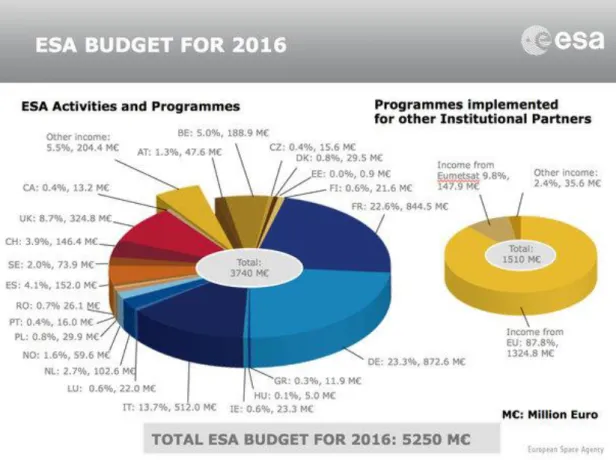
contribute to ESA’s mandatory program in proportion to their GDP. For contribution to the optional programmes, Member States are free to decide (ESA, Budget as Presented during DG Press Conference 24 January 2013, 2015).
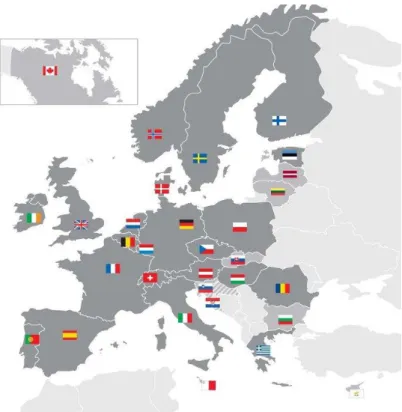
Figure 3. Source: ESA Member States and Cooperating States, 2015
On 22 May 2007, 29 European countries expressed support for a political framework covering Europe’s space activities, in which the approach of ESA, the EU and all participating countries were processed(ESA and the EU, 2015). Following the announcement of this desire, the European Commission and ESA's Director General jointly prepared the first Resolution of European Space Policy. This Resolution sets out guidelines for the implementation of
Europe’s basic vision in space. (ESA Resolution on the European Space Policy, 2007). In addition to governmental space departments of individual EU countries and the intergovernmental space agency ESA, there are also several commercial space companies operating in European countries. The first commercial space companies in the West
Alabama in 1961 (Prestowitz, p.49-50) and the German private company Orbital Transport and Rocket Corporation (OTRAG) was established on 17 October 1974 (Pirard 2003, p.213). Examples of European commercial space companies that currently operate are Europe’s number one defence and space enterprise Airbus Defence and Space, Swedish Space Corporation from Sweden, Aeronamic from the Netherlands and Ariane Space from France, the world’s first commercial satellite launch company (Arianespace, 2015). Companies with commercial purposes sometimes closely work together with governments or with ESA.
Along with governmental and commercial space organisations, there are a number NGO’s in Europe that, if desired, provide relevant information in the framework of Europe’s space activities and strategy to decision makers. Examples of such NGO’s are the European Space Policy Institute (ESPI) and Copenhagen Suborbitals.
China
The creation of China's space agency knows a different history than Europe’s, after all, China is one big country. However, the Chinese space program went off early. From 1956 until now, the Chinese space program was run by various ministries and governmental institutions. The contemporary Chinese space program stems from the Fifth Academy of the Ministry of National Defense established on October 8, 1956, which was under supervision of the Ministry of National Defense (Harvey 2013, p.36). From 1964 until 1982, the space program was covered by the Seventh Ministry of Machine Building Industry. In 1982 the Seventh Ministry of Machine Building Industry was renamed the Ministry of Space Industry which in 1988 merged with the Ministry of Aeronautics Industry into the Ministry of
With the establishment of CNSA, China ultimately got an equivalent of NASA. In addition to CNSA, The China Aerospace Science and Technology Corporation (CASC) was created in 1999. Currently CNSA is the administrative body responsible for civil space management, international cooperation in space and fulfilment of Government (CNSA机构 职能, 2015). CASC is the executive body and mainly works on research, design, manufacture and launch of space systems. CASC also provides international commercial satellite launch service (CASC公司简介, 2015). Besides SASTIND and CNSA, other administrative bodies involved in space policy are the General Armament Department of the People's Liberation Army (PLA), the Ministry of Foreign Affairs and the Ministry of Commerce (Zhao 2015, p.30).
While commercial aerospace companies in the West are active for already several decades, in China privately owned commercial aerospace companies were introduced only very recently. The first Chinese commercial space company was founded in 2012. This
company is called Space Vision (北京金海洋航天科技有限公司) and focuses on space travel and space exploration, scientific experiments and entertainment related to space.
(Spacevision, 2014). A second Chinese commercial space company was founded on January 1, 2014 (Linkspace, 2015). This company is called Link Space (翎客航天) and is the first
commercial company that primarily focuses on rocket design and encouragement of
commercialization of the domestic aerospace industry. The long term goal of Link Space is to ensure that all people have a right to space travel within 10 years (Linkspace, 2015).
Regarding commercial spaceflight, China has to catch up much. In Europe, commercial aerospace companies play a significant role in national and international governmental space programs. National governments or ESA regularly work together with or outsource development and production tasks to private space companies. A recent example is the contract ESA and Airbus Defence and Space signed in order to develop the
Jason-CS/Sentinel-6A satellite. The Chinese government is aware of this delay in the private space sector and encouraged commercial space activity in the 2011 white paper on China's Space Activities: “China actively promotes the participation of Chinese enterprises in international commercial activities in the space field.” (Whitepaper The People's Republic of China 2011, p. 17). Another interesting sign that the Chinese government encourages commercialization of space activities, is that CASC invited 1300 private enterprises to participate in an
on December 2014. CASC’s chief engineer Ba Risi stated that the development of Chinese private space enterprises lags behind. He said: “If aerospace technology and private
economy are combined closer and form an industry, this will make a significant contribution to the national economy.” According to Ba, participation of privately run enterprises will also boost the development of aerospace, a number of private enterprises conducted in-depth research in certain fields. "They used some new materials and technologies that we have never used in the past, there is space for cooperation, it is possible to pass these new materials and technologies on to the aerospace industry.” (Zhang, 2014)
In addition to governmental bodies that are involved in space industry and the recently established commercial space companies, China also knows a space-related NGO, namely KCSA (KCSA, 2015). In China there are not as many NGO’s as in the West. Most advising institutions are run by the government.
Space programs emerged early both in China and in the EU and political structures that regulate space plans have been given a stable form over the years. In addition to governments, in the EU private enterprises as well as NGOs play an important role in the development of space programs. In China aerospace plans still are mostly defined and implemented by the government, but very recently, two private space enterprises emerged in China. The Chinese government has responded positively to the establishment of these private companies and encourages development of this sector to make up for arrears. In order to spur innovation, the Chinese government proactively started to seek for
partnerships with private enterprises.
2.3.Changing leadership
Regarding the view of Chinese and European leaders on developing the space
the late 1970s and 1980s. Regarding Western Europe, Mao Zedong was in favour of European political and economic integration, because a strong Europe would be better for creating a multi-polar world (Wilson Center 2015, p.III). China’s efforts to normalize relations were not always reciprocated by European countries. For instance, China presumed that Germany was willing to normalize relations in 1956, but it took much longer, on October 11th
the Federal Republic of Germany (West Germany) and the People’s Republic of China established diplomatic relations (Wilson Center 2015, p.XV). Nevertheless, for the majority of the European leaders, establishing advanced economic relations with China was an important goal alone, there was no ambition to get involved in geostrategic matters (Sieps, p.16-17).
On the 25th of April 1956, the Chinese Chairman Mao Zedong stated the following during
a meeting of the Political Bureau of the Central Committee:
“ 我们还要有原子弹。在今天的世界上,我们要不受人欺负,就不能没有这个东西。”
(Tang 2012, p. 340)
“We need nuclear weapons. In the world nowadays, to avoid being bullied, we can't
afford not having them.”
“我们现在还没有原子弹。但是,在过去我们也没有飞机和大炮,我们是用小米加
步枪打败了日本帝国朱和蒋介石的。我们现在已经比过去强,以后还要比现在强,不
但要有更多的飞机和大炮,而且还要有原子弹。在今天的世界上,我们要不受人欺负,
就不能没有这个东西。” (Tang 2012, p. 340)
“ We do not have an atomic bomb yet. However, in the past we did not have aircraft and artillery either, we had millet and a rifle and defeated Chiang Kai-shek and the Japanese
Empire Zhu. We are now stronger than in the past, in the future we will be even stronger
than we are now, we will not even have more planes and artillery, but also have an atomic
This statement was mainly directed to the opposing countries of the Chinese communist regime, mainly the US who had also already managed to create an own atom bomb. After making his statement, Mao Zedong took further steps to develop rocketry and the space program.
From the Mao Zedong era from 1945 up to 1976, we now already entered the Xi Jinping era since 2013. Mao Zedong had many military related famous quotes and catchphrases, such as: “Political power grows out of the barrel of a gun” or “We will not attack unless we are attacked; if we are attacked, we will certainly counterattack.” This strong military attitude changed with the coming of new leaders.
After the Tiananmen Square student protests, China took a restrained stance. Deng Xiaoping advocated that China should stay calm:
“When it comes to the international situation, three sentences can summarise it. First, we should observe calmly. Second, we should secure our position. Third, we
should cope with affairs calmly. We need to be calm, calm, and calm; we should
focus on our own job and do it well”. (Chen D. 2011, p. 197).
In the 1980s and early 1990s during his speeches and talks, Deng Xiaoping often focussed on the principle of Tao Guang Yang Hui. However, he first used this phrase in 1992, when he discussed China’s development problems. (Chen D. 2011, p. 197).
President Xi Jinping visited the Beijing Aerospace Control Center in 2013, he spoke with the three astronauts in space working on the Shenzhou 10 mission. In the conversation between President Xijinping and the three astronauts, a clear link between the “China
Dream” and the space program was made. In this conversation, the astronauts and President Xi Jinping said the following:
“聂海胜:感谢习主席的关怀!我和晓光、亚平的身体状况都非常好,各项工作按
计划进行。能够为实现中华民族的航天梦想贡献力量,我们感到非常骄傲和自
豪!”
“Nie Haisheng: thank you for your concern, President Xi! The physical condition of me and Xiaoguang, Yaping is very good, we carry out our work according to the plan. We are very proud that we are able to contribute to achieving the Chinese Space Dream!”
“ 习近平:很好。航天梦是强国梦的重要组成部分。随着中国航天事业快速发展,中
国人探索太空的脚步会迈得更大、更远。我要问一下,晓光、亚平,你们第一次进入
太空,你们感到各方面适应吗?”
“Xi Jinping: Very good. The Chinese Space Dreams is an important part of the Chinese Dream. With the rapid development of China's space industry, Chinese human space exploration will go with a faster pace, and further. I want to ask you, Xiaoguang and Yaping, you entered space for the first time, you are already accustomed to all conditions? “
nowadays the development of the space program is put in another perspective. The Space Dream created by Xi Jinping became a source of inspiration and national pride.
Development of the space program is not only a dream for China. ESA's Director General Jean-Jacques Dordain participated in an interview of JAXA in 2013, where he was asked why people are interested in pursuing space exploration. He answered that space activities are carried out for the benefit of citizens. (JAXA 2016.) Citizens pursue a better quality of life on earth:
“They want greater security and economic wealth, but they also want to pursue their dreams, to increase their knowledge, and they want younger people to be attracted to the
pursuit of science and technology.” (JAXA 2016.)
Jean-Jacques Dordain believes that space exploration can not only help citizens to achieve a higher quality of life, live in a safe environment, bring them more wealth, but also fulfil their dreams and thirst for knowledge. Space exploration has always been important and will even be more important in future. (JAXA 2016.)
2.4.Common goals in space and international agreements
Since the space programs of many nations and cooperating member states became more scientifically oriented, it became possible to work on more common goals. There are fewer reasons for competition if different parties are working on obtaining knowledge that will become available to all participants. When governments have the same mindset and goals this facilitates cooperation even more.
2.4.1. Common goals
of development of China’s space industry. The whitepaper completely focuses on a wide range of goals, and only subtle mentions military goals. For instance, China’s satellites are not only for monitoring environmental change, but also for monitoring Chinese territory (Information Office of the State Council 2011, p. 6). The space industry an important part of China’s general development strategy and primarily points out economic and social
development benefits. The main goals of China’s space program can be categorized in the following subcategories:
“to explore outer space and to enhance understanding of the Earth and the
cosmos;
to utilize outer space for peaceful purposes, promote human civilization and social
progress, and to benefit the whole of mankind;
to meet the demands of economic development, scientific and technological
development, national security and social progress;
and to improve the scientific and cultural knowledge of the Chinese people,
protect China's national rights and interests, and build up its national
comprehensive strength.” (Information Office of the State Council 2011, p. 2).
For comparison, ESA’s purposes representing the common goals of all EU member states, states the following:
“ESA's purpose shall be to provide for, and to promote, for exclusively peaceful
purposes, cooperation among European States in space research and technology
and their space applications, with a view to their being used for scientific purposes
and for operational space applications systems.” (ESA, ESA’s purposes 2007).
China’s Information Office of the State Council as well as ESA both mention the absolutely peaceful purposes of developing their space programs. China emphasises that it opposes weaponisation or any arms race in outer space, it wants to reinforce space
member states while according to the whitepaper, development of China’s space program has to benefit the whole of mankind.
Figure 4: 29 September, 2011. Long March II F carrier rocket will launch the Heavenly Temple One, situated at the Jiuquan Satellite Launch Center. (Source: Xinhua 2015, Tiangong yi Hao).
At the present time, interests and projects of China and ESA have many overlaps and space missions are sometimes suitable for mutual cooperation. An example is ESA’s SMART-1 mission, Europe’s first lunar satellite that orbited around the moon in order to map the moon and identify the minerals present on the moon. The SMART-1 was launched on 27th
September 2003 (Wilson. 2005, p. 129). In China the Chang'e 1 mission was a comparable mission. This obiter was launched on 24 October 2007 and the mission shared two major goals with ESA’s SMART-1 mission: mapping lunar landforms and investigating lunar
resources (ESA 2016, Chang’e 1 New mission to moon lifts off). ESA collaborated with China on this mission by providing support to CNSA. ESA and CNSA also shared data and expertise with each other to enhance knowledge on two sides (ESA 2016, Chang’e 1 New mission to moon lifts off).
However, in some cases there still is a certain degree of competition. Europe is working on a global navigation satellite system, named Galileo. The first operational launches to implement Galileo have started in 2011 already (ESA 2016, What is Galileo?). Whereas the GPS system of the US and the Russian Glonass positioning system were
2.4.2. Expanding cooperation between China and Europe
China actively tries to seek international for cooperation to bridge the lack of experience with advanced space projects (TNO 2015). This is evidenced by the statements several politicians made regarding cooperation with other countries, and this also is underlined in China’s whitepaper on space activities. In 2011, Wang Zhaoyao, former director of the China Manned Space Agency said that China is willing to carry out technical cooperation with other countries and regions in the following missions regarding building a complete space station. This also bring opportunities for the participants, for example cooperation in astronaut selection, training, and research. Wang said that China’s space program is open and transparent, and that China is willing to share technological
achievements and application results with other countries (Xin, 2012).
China already has a good partnership with Russia in the field of space technology. On April 4th 2016 Xu Dazhe, the administrator of the China National Space Administration,
during a press conference on the first "Space Day of China" stated that Russia’s and China's science and technology staff had made a number of achievements in the development of space technology. In particular the construction of engines and various electronic
components for space exploration. Moreover, there also is discussion between the two parties how to wisely allocate the resources of the GLONASS and Beidou Navigation Systems (Hua, 2016).
Besides Russia, China also tried to seek for cooperation with the US, for example participation in the ISS international Space Station project. China is not an ISS partner and attempted to join this program several times. In 2007, vice minister of science and
special law. In the document Public Law 112–55 112th Congress issued in 2011 by the US government, section 539 states:
“SEC. 539. (a) None of the funds made available by this Act may be used for the National Aeronautics and Space Administration (NASA) or the Office of Science and
Technology Policy (OSTP) to develop, design, plan, promulgate, implement, or execute a
bilateral policy, program, order, or contract of any kind to participate, collaborate, or
coordinate bilaterally in any way with China or any Chinese-owned company unless such
activities are specifically authorized by a law enacted after the date of enactment of this
Act.” (Public Law 112–55 112th, p.29).
“The limitations (…) shall not apply to activities which NASA or OSTP have certified pose no risk of resulting in the transfer of technology, data, or other information with
national security or economic security implications to China or a Chinese-owned
company.”(Public Law 112–55 112th, p.29).
This act means that there are more obstacles for cooperation between China and the US, it prevents NASA to cooperate with China and that it is not possible for NASA to use funds to receive Chinese guests at NASA facilities, cooperation is only possible when a new law that approves a particular activity is enacted. With this act NASA tries to prevent espionage and leakage of any technological information or other data to China, which may have consequences for national security.
In spite of this act, China is still open for cooperation with China. This is
demonstrated by a recent statement Yang Liwei, China's first astronaut, made on 24 April 2016. Yang said that China will not exclude any country for cooperation, including the United States (Xinhua news agency, 2016).
Regarding establishing cooperation with Europe in the field of aerospace, in
Chinese officials and ESA staff repeatedly discussed possibilities for cooperation. In 2012, Thomas Reiter, the head of ESA's human spaceflight division, explored possibilities for cooperating with China on manned space missions. Reiter said European astronauts already started to learn Chinese in order to be well prepared for future joint missions. By proceeding this way, ESA hopes to be sure of a seat in space crafts ESA is not able to make itself
(Posthumus, 2012).In 2013, former Director General of ESA Jean-Jacques Dordain had talks with Wang Zhaoyao during a the 64th International Astronautical Congress in Beijing. Wang Zhaoyao expressed that he hoped for stronger cooperation with Russia and Europe. Dordain introduced ESA’s plans for manned space activities and the possibilities for a tripartite cooperation. After the meeting, the three parties signed the summary of the meeting and continued to discuss promotion of exchange and further cooperation (CMSE, 2013). In bilateral talks, Wang and Dordain reviewed the deepening of Sino-European cooperation in space and continued their talks about the exchange of astronauts, research and other space related matters (CMSE, 2013).
On 23 November 2013, new plans for cooperation were put into practice and ESA’s Estrack network provided great support when China’s Chang’e-3 spacecraft was launched. This support was provided because this Chinese mission “is necessary for the future exploration of planets, moons and asteroids, benefitting everyone.” Reiter said. (ESA 2013, Helping China to the moon).
Besides strengthening ties with ESA, China also approaches national space related institutions of several countries. An example of an important new agreement is the MoU that was signed by The Netherlands Space Office and the China National Space
Peaceful Uses of Outer Space of UN (COPUOS) was held where Mr. Zhou Wu, delegate from China, stressed that outer space is a common heritage that must be used for peaceful uses only. China opposes weaponisation and arms race in outer space which is a responsibility of all States. China also strongly supports a multilateral space arms control to ensure security in outer space (United Nations, 2015).
Chapter 3 ECONOMIC BENEFITS FOR THE EU AND FOR CHINA
Investment in space technology, for instance solar panels, global positioning systems and the monitoring of climate changes contributes to economic growth, business
opportunities for companies, better knowledge, more jobs, safety and solutions to social problems. This makes investing in space technology very attractive. China an Europe have common interests investing in space, but also have different motives to develop their space program.
2.5.Sharing costs
High-tech technology is not cheap. The estimated cost for a space station is €100 billion over 10 years (ESA 2013, how much does it cost). Therefore, sharing costs was also one of the reasons that the ISS program could be established faster than when the US had to pay for it alone. Sharing costs stimulates a faster development of space projects because there is more funding available. At the same time, when a party contributes to the funding of a project this party automatically gains the right to interfere in overall development. This means parties can unite their knowledge which even more accelerates development speed.
In China, development of the space program is strongly directed by the government. In this way, the government is trying to improve its knowledgebase. Investment in the space program is related to the GDP growth of China. This means the percentage GDP growth in figure 1 also represents the percentage investment in space. The average growth rate is approximately 7% the past few years. When an estimation is made of China's expenditures on the development of space technology, it was about 11 billion US dollars in 2013 (TNO 2015). According to the OECD, this makes China ranking second after the US (TNO 2015).
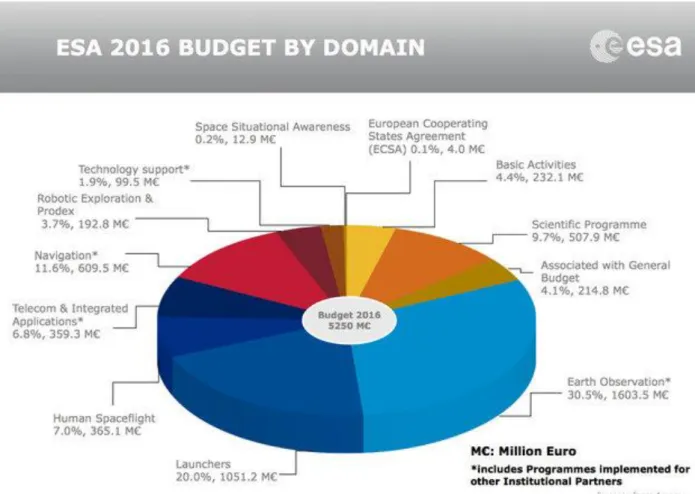
Figure 6. Source: ESA 2016, Funding
As figure 6 shows, basic activities only cover 4.4% of all the investments of the ESA member countries. This means ESA member states are very willing to invest in extra projects regarding space technology, perhaps also in profitable joint projects with China.
The life time expectation for the ISS was the year 2020, but now the Obama Administration decided to extend its life to at least until 2024, to derive maximal benefit and maintain American leadership in space (NASA 2014). When the ISS program really comes to an end, ESA’s investment flow can be transferred to China’s space station project very easily. For ESA the space station is very important for life science studies (ESA 2003). Investing in the
2.6.Innovation and access to technology
Exploring space leads to invention of new techniques, for instance: navigation techniques, predicting weather forecasts, monitoring water quality, air quality and supporting
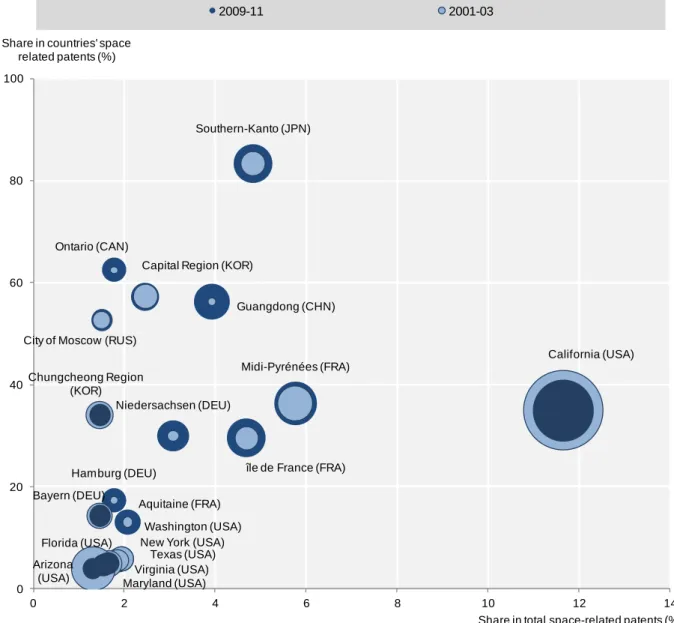
agricultural production. Space technology generates new products and services. The figure below shows the space related patents of the top 20 regions.
California (USA) Midi-Pyrénées (FRA)
Southern-Kanto (JPN)
île de France (FRA) Guangdong (CHN)
Niedersachsen (DEU) Capital Region (KOR)
Aquitaine (FRA)
Washington (USA) Florida (USA)
Hamburg (DEU) Ontario (CAN)
New York (USA)
Maryland (USA) Virginia (USA) City of Moscow (RUS)
Texas (USA) Bayern (DEU) Chungcheong Region (KOR) Arizona (USA) 0 20 40 60 80 100
0 2 4 6 8 10 12 14
Share in countries' space related patents (%)
Share in total space-related patents (%) 2009-11 2001-03
Figure 7 Source: OECD Patent Databases (REGPAT), August 2014.
The figure 7 shows that China had made great progress in inventing space techniques in the period from 2001 until 2011. Member states of ESA have a good share in
space-related patents too. China and European countries desire to share information and
illustrated by the visit of the Dutch premier Rutte to China in 2015. In this year Rutte went to China for a trade mission, Chinese companies were very interested in Dutch technology and tried to make deals in change for technological knowledge. China faces environmental and agricultural problems for a long time already, and enhancing quality of life is a major interest of China. New space techniques can contribute to enhancement of quality of life in China too. The European space program is ahead of China’s space program in techniques and
technologies that support environmental protection (ESA 2014, Clean Space).
Regarding the development of China’s space station Tiangong 1, China is also very interested in a European space technology. China is now using a Russian technique for the docking system, but this technique faces some problems. ESA developed an International Berthing and Docking Mechanism (IBDM) that overcomes these problems and tested this system successfully. China and ESA are now looking for cooperation in the Tiangong 1 project and ESA might build a similar docking system for China so that space crafts of different countries can dock to the space station without connection problems (Al-Ekabi, 2012-2013, p. 37).
2.7.Access to resources
As resources on earth gradually are running out, exploring space for new resources is a way to solve current or future problems. At this moment, for some countries resources deficit is more a problem than for others. China is a top mining country, but due to the large population, declining ecological quality and dry North, finding new resources is very
2.8.Job employment
When starting a joint space project that would not have been possible to realize in a unilateral way, more jobs will become available. As mentioned earlier, space development has a high contribution to economy and is a growing sector. With growth of economy more employment opportunities can be created.
2.9.Prestige
Both China and Europe want to gain a certain degree of prestige on the global level. ESA aims for maintaining the second the position in space for the future. ESA wants to achieve a “world-class industry, outstanding scientific discoveries and a stronger, richer European identity.” (ESA 2013, Space for Europe). China's space program has become part of “China's national Dream” and has achieved more prestige already. China even introduced “National China Space Day” in 2016. The celebration of this day takes place on April 24th, this day was chosen because the first Chinese satellite, the Dong Fang Hong, was launched successfully on April 24th, 1970. This was one of China’s first outstanding achievements in space.
Celebrating this day also has the purpose to get young people get interested in space science (CNSA 2016).
Furthermore, both China and ESA give their space projects interesting or beautiful names. When space projects were given only a number or abbreviation a couple of decades ago, for example TD-1, ECS-2 or ECS-1 for space projects in the 1980s in Europe, more names with a special meaning were given to later projects, for instance project Columbus in 2006 or Galileo in 2008 (Wilson. 2005, p.3). China was working on Project 714 in the 1970s, and had a space craft Project 921 in the 1990s (Harvey 2013, p.262). Chinese space projects of now have mystical names like Divine light (神光), Moon Goddess (嫦娥) or Heavenly Palace 1 天 宫一号. Names of Chinese space projects even more draw attention than the names of ESA’s space projects.
3. CONCLUSION
China’s achievements and innovations in space had come comparatively late, but
nowadays has China a become a world-class player in this field. China’s cooperation in space with Russia is very good already. Because of security concerns of the US, China’s cooperation with the US in the field of space technology development is at a low ebb.
Currently, China’s space program is highly advanced which makes it an interesting cooperation partner for Europe. Since Europe’s space agency ESA has an advanced space program too, ESA is an interesting partner for China as well. Cooperation between Europe and China in the field of space technology development has not been very intense from the start of national space programs in the early 1950s, but after the end of the cold war
relations between China and in particular the West of Europe gradually became better. With the change of leaders and China’s attitude in international affairs, relations between China and Europe improved. China repeatedly declared intentions of the national space program and also clarified the peaceful nature of China’s space program during a UN conference. In addition, China issued a whitepaper in 2011, in which China expresses peacefulness in order not to scare the world for the far advanced space technology. By doing this China created a better political environment to enable cooperation with Europe in space.
Referring to the theoretical framework of this study, some theories can be applied to the development of cooperation between China and Europe but some theories are less
applicable.
Cooperation with China in the field of space technology development is an asset for Europe. China and Europe both work on the shared goals which is defined as cooperation. However, competition is defined as “one country trying to gain what another country is trying to gain at the same time”. In the field of developing space industry, China and Europe both try to gain information and knowledge mainly, which causes less to no competition. This knowledge will be available for both parties.
aware of a possible termination of this program in near future. By contributing to the Chinese Tiangong-1 project, ESA tries to ensure a seat in the Chinese space station to continue activities that always have been carried out in the ISS. When participating in the Tiangong-1 project, ESA can also make use of the latest space techniques.
For China, collaboration with Europe is attractive because the US excludes China from participation in the ISS program and other NASA activities funded by the government.
Regarding cooperation with ESA, China is particularly interested in new technology, gaining resources by using these technologies and prestige. New technologies can also help China to solve environmental and social problems. Moreover, ESA possesses techniques to improve a docking system for the Chinese space station. What still stands in the way for cooperation between China and ESA is the arms embargo which up to now is still effective. When cooperation between China and ESA intensifies, the probability of lifting the arms embargo by Europe may increase, because the influence of the US on Europe to maintain the
BIBLIOGRAPHY / LIST OF REFERENCES
Al-Ekabi, Cenan. Yearbook on Space Policy 2012/2013: Space in a Changing World. Springer, 2015. doi:10.1007/978-3-7091-1827-6.
Anderson, Rupert W. The Cosmic Compendium: Space Law: Space Law. Cosmic Compendium, 2015.
Atlanta Chinese News, "中國大陸可望加入國際太空站." Atlanta Chinese News, March 12, 2012. Accessed March 10, 2015. http://www.atlantachinesenews.com/News/2012/03/03-02/ATL_P02.pdf.
Bondt, de R. Spillovers and innovative activities, International Journal of Industrial Organization, Volume 15, Issue 1, February 1997, Pages 1-28.
Bower, Bert. "Chinese Discoveries and Inventions." In History Alive! The Medieval World and Beyond, 469. California: Teachers' Curriculum Institute, 2004.
CASC. "公司简介." 中国航天科技集团公司. April 12, 2015. Accessed April 12, 2015. http://www.spacechina.com/n25/n142/n152/n164/index.html.
CASC. "集团公司历史." 中国航天科技集团公司. April 10, 2015. Accessed April 10, 2015. http://www.spacechina.com/n25/n142/n152/n174/index.html
Chambers, Rob W. "China's Space Program a New Tool for PRC "soft Power" in International Relations?" The NPS Institutional Archive, March 2009, I-125.
China Daily, 2016, "杨洁篪在法国国际关系研究院发表演讲." Chinadaily
. April 15, 2016. Accessed May 13, 2016. http://world.chinadaily.com.cn/2016-04/15/content_24556245.htm.
Chen, Dingding. "Lying Low No More? China's New Thinking on the Tao Guang Yang Hui Strategy." China: An International Journal Vol.9(2) (September 2011): 195-216.
China Daily 2014, "China Expects to Introduce Space Law around 2020." China Daily. November 17, 2014. Accessed March 03, 2016. http://usa.chinadaily.com.cn/china/2014-11/17/content_18930737.htm.
CNSA. "机构职能." 国家航天局. April 11, 2015. Accessed April 11, 2015. http://www.cnsa.gov.cn/n1081/n7469/n308501/index.html
CNSA. "China National Space Administration." CNSA.gov. March 16, 2015. Accessed March 16, 2015. http://www.cnsa.gov.cn/n615709/n620681/n771918/index.html
CMSE, 2013. "王兆耀会见多国航天机构负责人." September 29, 2013. Accessed February 11, 2016. http://www.cmse.gov.cn/news/show.php?itemid=3703.
EEAS 2016. “EU Relations with China.” EEAS Accessed October 29, 2015. http://eeas.europa.eu/china/index_en.htm .
Encyclopædia Britannica Online, s. v. "European Space Agency (ESA)," accessed April 25, 2015, http://academic.eb.com/EBchecked/topic/196366/European-Space-Agency
European Commission. "European Union, Trade in Goods with China." European Union, Trade with China, April 14, 2016, 1-10.
ESA. "Budget as Presented during DG Press Conference 24 January 2013." European Space Agency. January 24, 2013. Accessed March 25, 2015.
http://www.esa.int/About_Us/Welcome_to_ESA/Budget_as_presented_during_DG_press_conference_24_Jan uary_2013
ESA. "ESA and the EU." European Space Agency. March 30, 2015. Accessed March 30, 2015. http://www.esa.int/About_Us/Welcome_to_ESA/ESA_and_the_EU
ESA. "ESA Member States and Cooperating States." European Space Agency. March 30, 2015. Accessed March 30, 2015. http://www.esa.int/spaceinimages/Images/2013/02/ESA_Member_States_and_Cooperating_States
ESA. "ESA Headquarters." European Space Agency. January 30, 2012. Accessed April 12, 2015. http://www.esa.int/About_Us/Welcome_to_ESA/ESA_headquarters
ESA 2014, clean space. ESA. "CLEAN SPACE – ESA’S RESPONSE TO ENVIRONMENTAL CHALLENGES." ESA. 2014. Accessed April 13, 2016.
http://www.esa.int/Our_Activities/Space_Engineering_Technology/Clean_Space/Clean_Space_ESA_s_respons e_to_environmental_challenges/(print).
ESA 2013. ESA. "Space for Europe." ESA. February 12, 2013. Accessed April 05, 2016. http://www.esa.int/About_Us/Welcome_to_ESA/Space_for_Europe.
ESA 2013. ESA. "How Much Does It Cost?" ESA. May 14, 2013. Accessed March 11, 2016.
http://www.esa.int/Our_Activities/Human_Spaceflight/International_Space_Station/How_much_does_it_cost.
ESA 2016, Chang’e 1 New mission to moon lifts off.
ESA. "ESA 2016, Chang’e 1 New Mission to Moon Lifts off." ESA. October 24, 2007. Accessed February 24, 2016. http://www.esa.int/Our_Activities/Space_Science/SMART-1/Chang_e-1_-_new_mission_to_Moon_lifts_off.
ESA 2003. ESA. "The Importance of Science on the International Space Station." ESA. October 3, 2003. Accessed May 05, 2016.
http://www.esa.int/Our_Activities/Human_Spaceflight/Cervantes_Mission/The_importance_of_science_on_th e_International_Space_Station.
ESA 2016, Funding. ESA. "Funding." ESA. January 20, 2016. Accessed April 05, 2016. http://www.esa.int/About_Us/Welcome_to_ESA/Funding.
ESA 2007, Esa’s purposes. ESA. "ESA's Purpose." ESA. June 14, 2007. Accessed January 13, 2016. http://www.esa.int/About_Us/Welcome_to_ESA/ESA_s_Purpose.
European Space Agency. ESA Resolution on the European Space Policy,. ESA Publications Division, 2007.
ESA 2013. ESA. "Helping China to the Moon." ESA. November 29, 2013. Accessed February 03, 2016. http://www.esa.int/Our_Activities/Operations/Helping_China_to_the_Moon.
Gilpin, Robert. "Hegemonic War and International Change." In War and Change in World Politics, 272. London: Cambridge University Press, 1981
Gong, Guan, and Wolfgang Keller. "Convergence and Polarization in Global Income Levels: A Review of Recent Results on the Role of International Technology Diffusion." Research Policy 32, no. 6 (2003): 1055-079
Hua, Xia. "国际宇航界如何评价“中国航天日”?." Xinhuanet. April 24, 2016. Accessed May 05, 2016. http://news.xinhuanet.com/world/2016-04/24/c_128925677.htm.
Harvey, Brian. "China’s Space Program: Emerging Competitor or Potential Partner,". In J.C. Moltz e.d., New Challenges in Missile Proliferation, Missile Defense and Space Security, 47-53, CNS Occasional Paper No. 12, Monterey: Center for Non-Proliferation Studies, 2003
Harvey, Brian. "Preface." In China in Space: The Great Leap Forward, 399. Springer, 2013
Harvey, Brian. "Tsien Hsue Shen." In China in Space: The Great Leap Forward, 399. Springer, 2013
JAXA 2016. JAXA. "Launching a New Era with JAXA." JAXA. 2015. Accessed February 05, 2016. http://global.jaxa.jp/article/interview/vol4/index_e.html.
KCSA. "成立宣言." 科创航天 KCSA. 2015. Accessed April 19, 2015. http://www.kcsa.cn/?p=32.
Linkspace. "关于." 翎客航天. 2015. Accessed April 19, 2015, http://linkspace.com.cn/about/
Logsdon, John M. Reconsidering Sputnik: Forty Years Since the Soviet Satellite. Routledge, 2013.
Lent, Constantin Paul. Rocket Research: History and Handbook. Pen-ink Publishing Company, 1945.
Lai, David. The United States and China in Power Transition. Carlisle, Pennsylvania: Strategic Studies Institute, U.S. Army War College, 2011. 284
Logan, Jeffrey. China’s Space Program: Options for U.S.-China Cooperation. CRS Report for Congress,Washington D.C.: Congressional Research Service, Library of Congress, 2008. 6.
Lukatch, R. and J. Plasmans, Measuring Knowledge Spillovers Using Belgian EPO and USPTO Patent data, CESifo Research Paper 430, CES, Munich, 2001
McGowen, Tom. Space Race: The Mission, the Men, the Moon. Enslow Publishers, 2008.
Men, Jing. "China’s Economic Diplomacy and Sino-EU Relations." Ekonomiaz N.º 82, 1er Cuatrimestre, 2013.
NASA. "Biographies of Aerospace Officials and Policymakers." NASA.gov. February 6, 2013. Accessed March 20, 2015. http://history.nasa.gov/biost-z.html
NASA 2014. NASA. "Space Station 2024 Extension Expands Economic and Research Horizons." NASA. January 27, 2014. Accessed February 13, 2016.
http://www.nasa.gov/mission_pages/station/research/news/2024extension/#.V03GevmLT4Y.