International Journal of Trend in Scientific Research and Development (IJTSRD)
Volume 5 Issue 1, November-December 2020 Available Online: www.ijtsrd.com e-ISSN: 2456 – 6470
Descriptive Study to Assess the Knowledge and
Attitude on HIV/AIDS among Students
Mr. Bikramjit Singh
1, Dr. Virendra Singh Choudhary
2, Mrs. Jasinderpal Kaur
3 1MSc Nsg, MS Department, Dashmesh College of Nursing, Faridkot, Punjab, India
2Principal, Jaipur National University, School of Nursing, Jaipur, Rajasthan, India
3Associate Professor MSc(N), Dashmesh College of Nursing, Faridkot, Punjab, India
ABSTRACT
A descriptive exploratory study to assess the knowledge and attitude on HIV/AIDS among the students of selected secondary school in Faridkot, Punjab. The study were to assess the knowledge, attitude, find out the relationship between the knowledge and attitude, associate the knowledge score, associate the attitude and to develop and distribute the pamphlets on HIV/AIDS among the students of selected secondary school in Faridkot, Punjab.
A sample size of 100 students from Dasmesh public school, Faridkot Punjab was selected using Non-Probability convenient sampling technique. A structure knowledge questionnaire and attitude scale was administered to assess the knowledge of students on HIV/AIDS. Majority of students (87%) had fair knowledge score (10%) had good knowledge score and remaining (3%) had poor knowledge score. The mean knowledge score was (16.22) and standard deviation was (4.02) Majority of 50% had average attitude score, 43% had fair attitude score,6% had good attitude score and remaining 1% had poor attitude score.
The relationship between knowledge and attitude score was moderate positive significant co- relationship between knowledge and attitude. (0.20) and (p = 0.05).
There was no significant association in knowledge score and attitude score regarding HIV/AIDS among the students of selected secondary school in Faridkot Punjab with selected socio demographic variables.
KEYWORDS: Assess, Knowledge, Attitude, Assumptions
How to cite this paper: Mr. Bikramjit Singh | Dr. Virendra Singh Choudhary | Mrs. Jasinderpal Kaur "Descriptive Study to Assess the Knowledge and Attitude on HIV/AIDS among Students" Published in International Journal of Trend in Scientific Research and Development (ijtsrd), ISSN: 2456-6470, Volume-5 | Issue-1, December 2020, pp.1459-1464, URL: www.ijtsrd.com/papers/ijtsrd38252.pdf
Copyright © 2020 by author (s) and International Journal of Trend in Scientific Research and Development Journal. This is an Open Access article distributed under the terms of
the Creative Commons Attribution
License (CC BY 4.0)
(http://creativecommons.org/licenses/by/4.0)
INTRODUCTION:
Acquired immune deficiency syndrome (AIDS) is caused by a (HIV) human immunodeficiency virus that weakens the immune system and makes the body susceptible to various diseases unable to recover from disease.
Scientist identified type of virus within chimpanzee in West Africa as a source of infection in human. They believe that the chimpanzee version of the immunodeficiency virus most likely was transmitted to humans and mutated into HIV.
According to National AIDS Control Organization of India, the prevalence of AIDS in India in 2015 was 0.26%. While the National AIDS Control Organisation estimated that 2.11 million people live with HIV/AIDS in India in 2015 a more recent investigation by the Million Death Study Collaborators in the British Medical Journal (2010) estimates the population to be between 1.4–1.6 million people.
Globally India is second only to South Africa in terms of the overall number of people living with the disease. The total number of AIDS case in India was 87,596 of whom 24,504 were women. The data also indicate that 37% of reported AIDS case were diagnosed among people under 30.The UN population Division project that India’s adult HIV prevalence
will peak at 1.9% in 2019.The UN estimate that there were 2.7 million AIDS deaths in India between 1980- 2015.
Problem statement “A Descriptive exploratory study to
assess the knowledge and attitude on HIV/AIDS among the students of selected secondary schools in Faridkot, Punjab”
Objectives of the study
1. To assess the knowledge on HIV/AIDS among the students of selected Secondary Schools in Faridkot, Punjab.
2. To determine the attitude on HIV/AIDS among the students of selected Secondary Schools in Faridkot, Punjab.
Operational definitions
Assess-Statistical measurement of knowledge and attitude
on HIV/AIDS among the Secondary school students by structured self-administered questionnaire.
Knowledge- In present study it refers to the correct
responses given by students regarding HIV/ AIDS in the self-administered structured questionnaire.
Attitude- In present study it refers to a settled way of thinking or feeling of students about HIV/AIDS.
HIV/AIDS- Its define as human immunodeficiency virus
infection and acquired immune deficiency syndrome (HIV/AIDS) is a spectrum of conditions caused by infection with the human immunodeficiency virus (HIV).
Secondary School students- In present study we refer to all
Boys and Girls enrolled in 9th and 10th class and having
regular attendance in class.
Research methodology Research Approach
The Research approach indicates the basic procedure for conducting the research. The selection of approach depends upon the purpose of the study. The research approach adopted to assess the knowledge and attitude on HIV/AIDS among the students of selected secondary school, Faridkot Punjab.
Research design
A descriptive research design was adopted for the study to assess knowledge and attitude of secondary school students on HIV/AIDS.
Setting of the study- Setting is the physical location and
condition in which data collection take place the present study was conducted in Dasmesh Public School Faridkot, Punjab.
Population- The population is any group of individual that
has one or more common characteristics that are of interest to the research population in the study consist of 13-14 year students attending selected secondary school, Faridkot, Punjab.
Sample and sampling technique- Sample is a subset of
population selected to participate in a research study. The sample for present study consisted of 100 students residing in selected secondary school, Faridkot, Punjab. Sampling is the process of selecting a portion of population to represent the entire population. Convenient sampling technique used to select the sample.
Sample size- Out of defined population the researcher had
selected the sample size for the present study will be 100 students of 9th and 10th class.
Criteria for selection of sample
Inclusion criteria- The sample were included who fulfilled
the following criteria.
Willing to participate in the study
Will be interested to participate in the study Available at the time of date collection
Exclusive criteria
Student who are enrolled in class but frequently absent.
Research tool- Based on the objectives of study a structured
questionnaire was prepared in order to assess the knowledge and attitude on HIV/AIDS among the students of selected secondary schools in Faridkot, Punjab. The research tool was divided into three parts.
Section A: Socio demographic data
Section B: Structured knowledge questionnaire Section C: Attitude scale
Section A-Socio demographic data- It comprised of 10
items seeking information of socio-demographic data such as age, education of study subjects, types of family, religion, family income, education of father and mother, occupation of father and mother, source of information related to HIV.
Section B-Knowledge questionnaire- It consisted of a
structured knowledge questionnaire on HIV/AIDS which composed of 30 closed ended- multiple choice questions with a single correct answer. Every correct answer was accorded a score one (1) and every incorrect items was accorded zero (0).The maximum score on knowledge questionnaire was 30 and minimum was zero (0).
Section C-Attitude Scale- It consisted of attitude scale
which 5 point Likert Scale on HIV/AIDS. It was composed of 16 positive and negative statements. Every statement scored according to their positive and negative scoring. The reverse scoring was done for negative statements. The maximum score on attitude statements were 80 and minimum were 16.
RESULT–
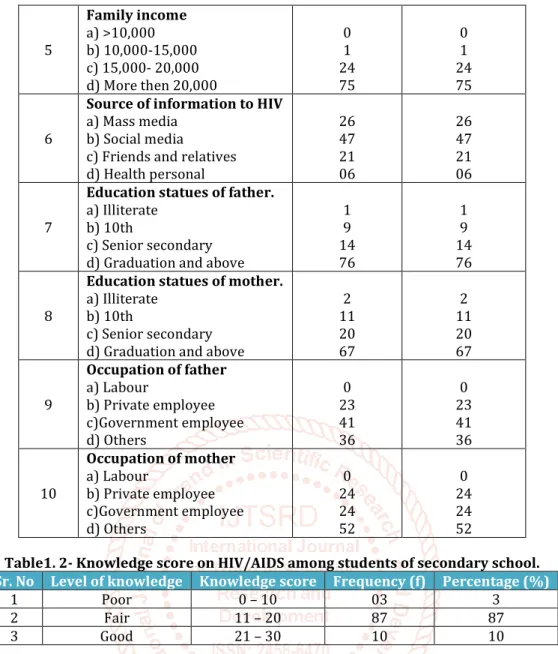
Table1.1: Frequency percentage distribution of students according to socio-demographic variables.
Sr. No. Socio demographic variables Frequency (f) Percentage (%)
1 Age a) 14 b) 15 c) 16 d) 17 25 55 19 01 25 55 19 01 2 Education status a) 9th b) 10th 50 50 50 50 3 Type of family a) Joint family b) Nuclear family 42 58 42 58 4 Religion a) Hindu b) Sikh c) Muslim d) Christian 48 52 0 0 48 52 0 0
5 Family income a) >10,000 b) 10,000-15,000 c) 15,000- 20,000 d) More then 20,000 0 1 24 75 0 1 24 75 6
Source of information to HIV
a) Mass media b) Social media
c) Friends and relatives d) Health personal 26 47 21 06 26 47 21 06 7
Education statues of father.
a) Illiterate b) 10th
c) Senior secondary d) Graduation and above
1 9 14 76 1 9 14 76 8
Education statues of mother.
a) Illiterate b) 10th
c) Senior secondary d) Graduation and above
2 11 20 67 2 11 20 67 9 Occupation of father a) Labour b) Private employee c)Government employee d) Others 0 23 41 36 0 23 41 36 10 Occupation of mother a) Labour b) Private employee c)Government employee d) Others 0 24 24 52 0 24 24 52
Table1. 2- Knowledge score on HIV/AIDS among students of secondary school.
Sr. No Level of knowledge Knowledge score Frequency (f) Percentage (%)
1 Poor 0 – 10 03 3
2 Fair 11 – 20 87 87
3 Good 21 – 30 10 10
Table 1.2- Shows that 87% students had a fair level of knowledge 10% had good knowledge score and only 3% had a poor knowledge score.
Table 1.3 Mean and standard deviation of knowledge score.
Knowledge on HIV/AIDS Mean knowledge score Standard deviation
16.22 4.02
Table1.3- Shows that mean knowledge score (16.22) shows that students had average knowledge on HIV/AIDS and standard deviation (4.02) which show that there was variability in scores of the study subject
Table 1.4: Level of Attitude on HIV/AIDS among students of secondary school
Sr. No Level of attitude Frequency (f) Percentage (%)
1 Strongly agree 529 33
2 Agree 231 15
3 Uncertain 235 15
4 Disagree 367 23
5 Strongly disagree 281 14
Table 1.4- Shows that the attitude on HIV is 33% students strongly agreed, 23% students who disagreed. 15% students agreed and were uncertain. Only 14% students strongly disagreed. Hence it is concluded majority of students had positive attitude and only 14% students had negative attitude
Table 1.5: Relationship between knowledge and attitude on HIV/AIDS
Sr. No Variable Mean SD r 1 Knowledge 16.22 40.2 0.20* 2 Attitude 51.19 7.15 r (98)≥0.195 *significant at .05 level
Table1.5- Shows that the relationship between knowledge and attitude is moderate positive significant relationship between knowledge and attitude score of secondary school students the coefficient of correlation between knowledge and attitude (0.20) is statistically significant at (p = 0.05)
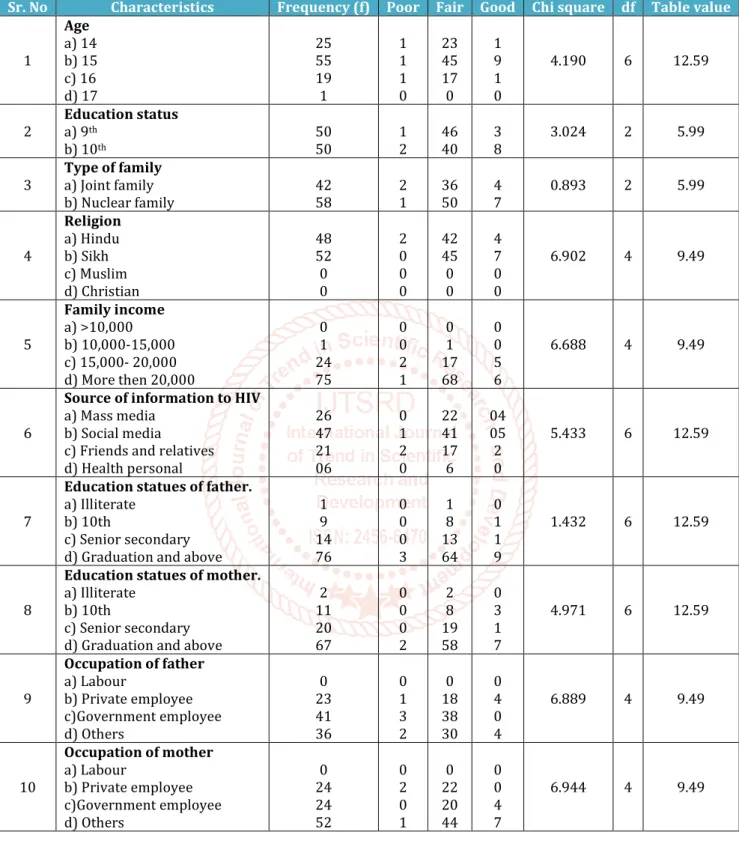
Table 1.6: Association of knowledge on HIV/AIDS among students of secondary school with selected socio-demographic variables
Sr. No Characteristics Frequency (f) Poor Fair Good Chi square df Table value
1 Age a) 14 b) 15 c) 16 d) 17 25 55 19 1 1 1 1 0 23 45 17 0 1 9 1 0 4.190 6 12.59 2 Education status a) 9th b) 10th 50 50 1 2 46 40 3 8 3.024 2 5.99 3 Type of family a) Joint family b) Nuclear family 42 58 2 1 36 50 4 7 0.893 2 5.99 4 Religion a) Hindu b) Sikh c) Muslim d) Christian 48 52 0 0 2 0 0 0 42 45 0 0 4 7 0 0 6.902 4 9.49 5 Family income a) >10,000 b) 10,000-15,000 c) 15,000- 20,000 d) More then 20,000 0 1 24 75 0 0 2 1 0 1 17 68 0 0 5 6 6.688 4 9.49 6
Source of information to HIV
a) Mass media b) Social media
c) Friends and relatives d) Health personal 26 47 21 06 0 1 2 0 22 41 17 6 04 05 2 0 5.433 6 12.59 7
Education statues of father.
a) Illiterate b) 10th
c) Senior secondary d) Graduation and above
1 9 14 76 0 0 0 3 1 8 13 64 0 1 1 9 1.432 6 12.59 8
Education statues of mother.
a) Illiterate b) 10th
c) Senior secondary d) Graduation and above
2 11 20 67 0 0 0 2 2 8 19 58 0 3 1 7 4.971 6 12.59 9 Occupation of father a) Labour b) Private employee c)Government employee d) Others 0 23 41 36 0 1 3 2 0 18 38 30 0 4 0 4 6.889 4 9.49 10 Occupation of mother a) Labour b) Private employee c)Government employee d) Others 0 24 24 52 0 2 0 1 0 22 20 44 0 0 4 7 6.944 4 9.49
Table 1.6- ANOVA shows that the association between knowledge regarding HIV/AIDS and selected socio-demographic variables. None of the socio-demographic variables was statistically significant. Hence it is concluded that there was no significant association between knowledge and selected socio-demographic variables i.e. age, education, type of family, religion, etc.
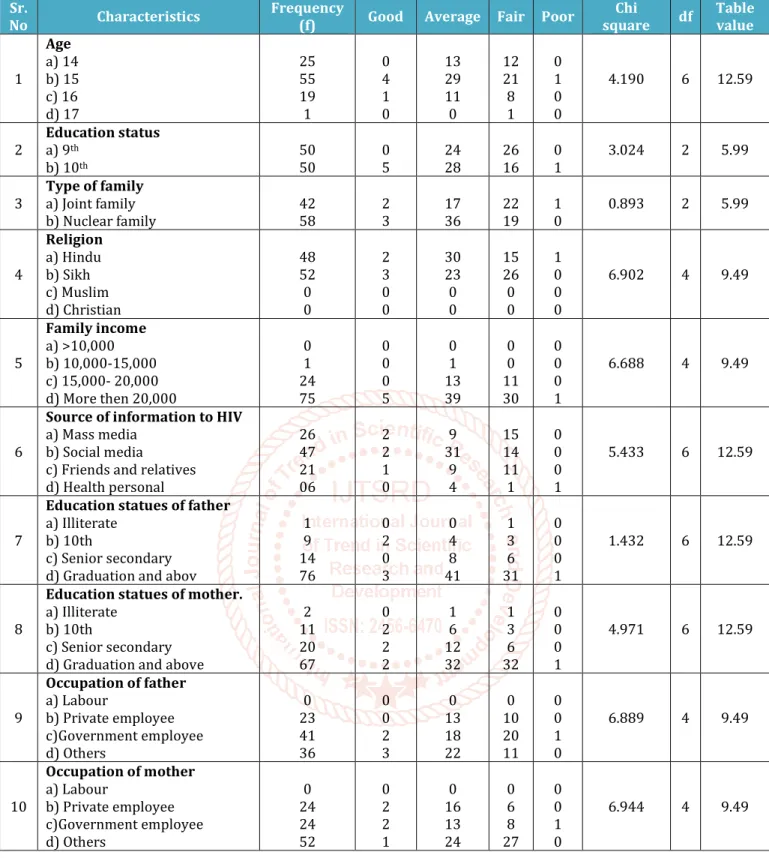
Table 1.7: Association between attitude score on HIV/AIDS with socio-demographic variables
Sr.
No Characteristics
Frequency
(f) Good Average Fair Poor
Chi square df Table value 1 Age a) 14 b) 15 c) 16 d) 17 25 55 19 1 0 4 1 0 13 29 11 0 12 21 8 1 0 1 0 0 4.190 6 12.59 2 Education status a) 9th b) 10th 50 50 0 5 24 28 26 16 0 1 3.024 2 5.99 3 Type of family a) Joint family b) Nuclear family 42 58 2 3 17 36 22 19 1 0 0.893 2 5.99 4 Religion a) Hindu b) Sikh c) Muslim d) Christian 48 52 0 0 2 3 0 0 30 23 0 0 15 26 0 0 1 0 0 0 6.902 4 9.49 5 Family income a) >10,000 b) 10,000-15,000 c) 15,000- 20,000 d) More then 20,000 0 1 24 75 0 0 0 5 0 1 13 39 0 0 11 30 0 0 0 1 6.688 4 9.49 6
Source of information to HIV
a) Mass media b) Social media
c) Friends and relatives d) Health personal 26 47 21 06 2 2 1 0 9 31 9 4 15 14 11 1 0 0 0 1 5.433 6 12.59 7
Education statues of father
a) Illiterate b) 10th
c) Senior secondary d) Graduation and abov
1 9 14 76 0 2 0 3 0 4 8 41 1 3 6 31 0 0 0 1 1.432 6 12.59 8
Education statues of mother.
a) Illiterate b) 10th
c) Senior secondary d) Graduation and above
2 11 20 67 0 2 2 2 1 6 12 32 1 3 6 32 0 0 0 1 4.971 6 12.59 9 Occupation of father a) Labour b) Private employee c)Government employee d) Others 0 23 41 36 0 0 2 3 0 13 18 22 0 10 20 11 0 0 1 0 6.889 4 9.49 10 Occupation of mother a) Labour b) Private employee c)Government employee d) Others 0 24 24 52 0 2 2 1 0 16 13 24 0 6 8 27 0 0 1 0 6.944 4 9.49
Table 1.7-Shows that the association between attitude regarding HIV/AIDS and selected socio-demographic variables. It was found that none of the socio-demographic variables was statistically significant. Hence, that there was no significant association between attitude and their selected socio-demographic variables i.e. age, education, type of family, religion, family income, source of information related to HIV/AIDS, education of father and mother, occupation of father and mother.
Nursing Education- To create awareness about HIV/AIDS
among school students and general population regarding HIV/AIDS. Periodic training for students in college and hospitals regarding HIV/AIDS. Mass media/Posters can be used to educate public and this will help in removing misconception regarding HIV/AIDS.
Nursing Practice- Protocols should be made regarding
sharp handling, waste disposal and wearing of protective
equipment. In all wards isolation or separate wards should be there for HIV/AIDS patients.
Nursing Administration- Continuing nursing education
programme can be planed and conducted to nursing staff regarding the importance of awareness about HIV/AIDS. Nurse administrator can play a schedule education programme regarding knowledge about ill effects of HIV/AIDS among general population in the hospital
Nursing Research- Scientific work and research studies should be conducted and professional knowledge should be updated.
Conclusion – HIV/AIDS is human immunodeficiency virus
that affect the physical and mental health of human being so we need to provide education to people. I distribute pamphlets to students regarding HIV/AIDS. In my study most of the students had good knowledge and positive attitude about HIV/AIDS.
References-
[1] Adam Felman, Explaining HIV/AIDS Medical News today published in 29 November 2018. Available at http://www.medicalnewstoday.com
[2] Lal SS, Vasan RS, Sarma PS, Thankappan KR. Knowledge and attitude of college students in Kerala towards HIV / AIDS, sexually transmitted diseases and sexuality. Natl Med J India 2000; 13: 231–236. http://www.theaidsinstitute.org>EDUCATION>AIDS1 01
[3] http://en.wikipedia.org/wiki/HIV/AIDS in India.
[4] Henry J Kaiser. The global HIV/AIDS epidemic global health policy. Jan 28, 2019, http://www.kff.org/global-health policy.
[5] NACO (2013) naco.gov.in/documents/annual report. [6]
infochangeindia.org/hiv/aidshiv-in-india/the-hivaids-scenario-in-india.html.8.Ptalet.Al.study of awareness about HIV/AIDS among Senior Secondary School Childrens of Delhi. India j Community/Med.jul 2008:33(3):190-190. Doi:10,4103/0970-0218.42063. www.ncbi.nlm.nih.gov/pmc/articals/pmc 276384. [7] World health organization HIv/AIDS Global situation
and trends, http://www.who.int/gho/hiv/en. [8] UNAIDIndia,http://www.unaids.org/en/regionscount
ries/countries/india
[9] Chitleen K Sethi, Hindustan Times, World Aids Day: Punjab has good and badnews, Dec.o1, 2015. https://www.hindustantimes.com/Punjab/world-aids-day-punjab-has-good-and –bad-news.
[10] Punjab Aids control society, Govt of Punjab, India Overview of HIV/AIDS in Punjab (Till March 2017) http://punjabsacs.punjab.gov.in