ProSimPlus: New CAPE-OPEN Capabilities
P. GUITTARD, A. VACHER, S. DECHELOTTE, O. BAUDOUIN ProSim SA, Stratège Bâtiment A, BP 27210, F-31672 LABEGE Cedex, France ProSimPlus is the general steady state process simulator developed by ProSim Company and used by many industrial customers. In the current presentation, we show its new OPEN capabilities. Now, on the one hand, ProSimPlus offers CAPE-OPEN thermodynamic plug and socket facilities after the integration of the new thermodynamic calculation server of ProSim called Simulis Thermodynamics. So, ProSimPlus is able to perform thermodynamic calculations using external models but also to create CAPE-OPEN property packages useable within other CAPE-OPEN compliant software. We demonstrate an example of use of a third-party CAPE-OPEN property package within ProSimPlus. On the other hand, ProSimPlus also offers a CAPE-OPEN unit socket to be able to call external models for unit operations. An illustration is made with the use of two CAPE-OPEN unit operations, a first developed by ProSim and another one from a third-party company. So, with this support of the CAPE-OPEN standard, ProSimPlus purposes a new way to integrate customers' know-how.1. Introduction
Recently, we developed new CAPE-OPEN capabilities within ProSimPlus, our steady-state process simulator. The present paper details these different new functionalities. First, we explain what a “CAPE-OPEN Thermodynamic Socket” is and how it is implemented in ProSimPlus. Then, we explain also what a “CAPE-OPEN Unit Socket” is and why the existing architecture of ProSimPlus helped us to satisfy these CAPE-OPEN specifications. We continue showing another indirect benefit as the “CAPE-OPEN Thermodynamic Plug” and some CAPE-“CAPE-OPEN Unit implementations. After that, to illustrate our purpose, we run an example using components developed by different third-party providers. Finally, we expose our conclusion and we give some perspectives about CAPE-OPEN capabilities.
2. CAPE-OPEN Thermodynamic Socket
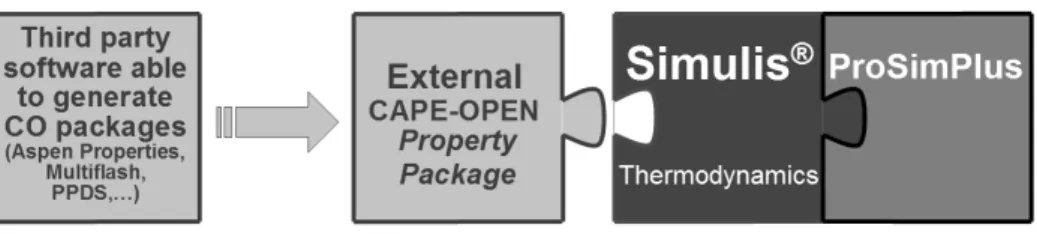
This first concept called “CAPE-OPEN Thermodynamic Socket” is the capability to use a third-party thermodynamic package (CAPE-OPEN compliant). To provide it in ProSimPlus, we wrote a wrapper of Simulis® Thermodynamics to minimize the modifications of the existing code related to unit operations. Simulis® Thermodynamics is our CAPE-OPEN compliant thermodynamic server based on a component approach. Today, the architecture, as shown on Figure 1, allows using external thermodynamic
models through the CAPE-OPEN Thermodynamic Socket available within Simulis® Thermodynamics.
Figure 1: CAPE-OPEN Thermodynamic Socket within ProSimPlus
This new functionality allows to use a thermodynamic model from third party (AspenTech, PPDS…) within ProSimPlus. Note that for the moment only CAPE-OPEN Thermodynamic Specification 1.0 is available.
3. CAPE-OPEN Unit Socket
This second concept called “CAPE-OPEN Unit Socket” is the capability to use a third-party unit operation (CAPE-OPEN compliant). The previous integration of Simulis® Thermodynamics helped the development of this functionality because the notion of a CAPE-OPEN Material Objects representing “material streams” was already implemented within Simulis® Thermodynamics. The existing event handler of ProSimPlus was also an advantage to manage more easily the calculation of a CAPE-OPEN Unit Operation at 2 levels:
• Simulation level:
• OnSimulationStart event (call to the validate method); • OnSimulationEnd event.
• Unit Operation level:
• OnCalculationStart event (mapping of input material and information objects); • OnCalculation event (call to the calculate method);
• OnCalculationEnd event (mapping of output material and information objects).
4. Other CAPE-OPEN Aspects
4.1. CAPE-OPEN Thermodynamic Plug
Another indirect benefit of the integration of Simulis Thermodynamics is the “CAPE-OPEN Thermodynamic Plug” facility allowing the creation of CAPE-“CAPE-OPEN Thermodynamic Property Package useable within third-party software as shown on the Figure 2.
Figure 2: CAPE-OPEN Thermodynamic Plug
4.2. CAPE-OPEN Unit Implementations
We also developed implementations of CAPE-OPEN Unit Operation. Especially, a first one called ProSim CO-SPEC used to solve material recycles and design specifications in a steady-state simulator based on a sequential modular approach. It is clearly a non conventional unit operation able to bring powerful solving capabilities within simulators lacking such capabilities. An extension (CAPE-OPEN Real Parameter used as information object) to CAPE-OPEN standard and specific requirements related to the communication with the simulator (Maximal Cyclic Network marks and convergence flag to stop the iterative process) has been required. Following the same scheme, another CAPE-OPEN Unit Operation called ProSim CO-OPTI has also been developed to solve optimization problems.
5. Example
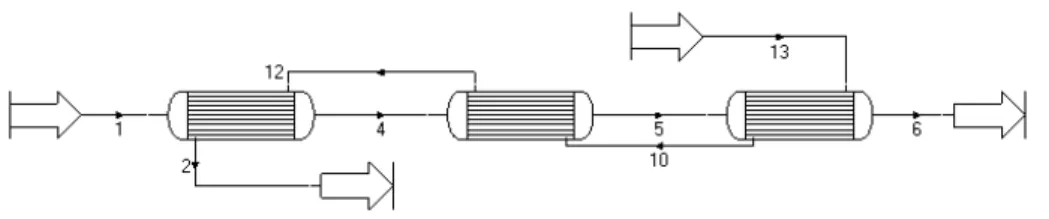
Figure 3: Example View
As shown on Figure 3, the illustration example is a process with 3 heat-exchangers (shell and tubes) including 2 recycles with only water in both sides. To calculate this flowsheet, we use:
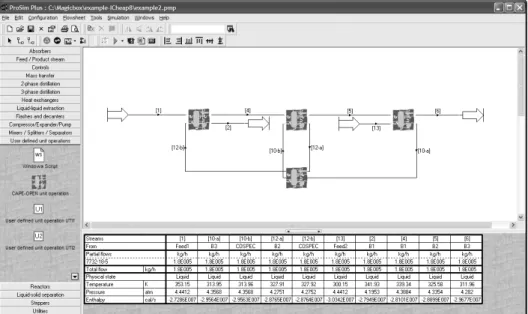
• a CAPE-OPEN Thermodynamic Property Package from COCO TEA; • Xist: a CAPE-OPEN Unit Operation from HTRI to model heat-exchangers; • CO-SPEC: a CAPE-OPEN Unit Operation from ProSim to solve recycles. Graphical and numerical results obtained with ProSimPlus are shown on the Figure 4.
Figure 4: ProSimPlus Flowsheet View
6. Conclusion and Perspectives
ProSimPlus was already an open simulator where the user could add its know-how, either with classical user modules (for instance in FORTRAN), either using the VB Script facility to add some functionalities. New CAPE-OPEN capabilities developed within ProSimPlus increase this openness allowing the use of external thermodynamic packages and/or unit operations which are CAPE-OPEN compliant. It was not a very hard development but a long test period to check the compliance with different external software was required. Furthermore, depending on the quality of software components, the cost of the CAPE-OPEN compliance, in terms of calculation time, is not, generally, very important. Thanks to the CAPE-OPEN Laboratories Network (CO-LaN), successful tests have been performed:
• CAPE-OPEN Thermodynamic Socket: • Aspen Properties (AspenTech) • COM Thermo (AspenTech) • MultiFlash (Infochem) • PPDS (TÜV NEL)
• COCO TEA (AmsterCHEM) • CAPE-OPEN Unit Socket:
• Xist, Xphe… (HTRI)
• COCO-COUSCOUS (AmsterCHEM) • ChemSep (ChemSep)
From there, further interoperability situations of CAPE-OPEN Unit Operations will be checked and the new CAPE-OPEN Thermodynamic Specification 1.1 will be implemented.
References
www.colan.org official Web site of the CO-LaN