Suma Samuel et al JMSCR Volume 07 Issue 04 April 2019 Page 1
Association of Vitamin D deficiency and Hypothyroidism in a tertiary
teaching hospital in Kerala
Authors
Suma Samuel
1,
Jacob K Jacob
2,
Jilse George
3,
Manjula V.D.
41
Asst Professor of Medicine, 2Professor of Medicine,
3
Professor and HOD Dept of Medicine, 4Professor and HOD Dept of Community Medicine, Government Medical College, Ernakulam, Kerala, India
Abstract
Background: Vitamin D deficiency is a global health issue and is associated with myriad health disorders.
Objective: To study the association of Vitamin D levels in hypothyroid patients to find out if low levels of Vitamin D is contributing to hypothyroid states.
Materials and Methods: A cross sectional case control observational study in a single center. The study was conducted in Government Medical College, Ernakulam in the medical department. Vitamin D levels in 60 hypothyroid patients which formed the case group and 60 matched control group was estimated using the Chemiluminescent immune assay during June2016 to December 2018, after obtaining approval of the Institutional Ethics Committee.
Results and Conclusions: This study has revealed that there was a significant number of patients with Vitamin D insufficiency in both groups with a statistically significant difference in females outnumbering males in vitamin D deficiency. However it was found that Vitamin D insufficiency was not present among hypothyroid patients significantly compared to euthyroid patients in the given study population.
Recommendations: The significant prevalence of low vitamin D levels in our population should be highlighted much more and should be a matter to bring in to more public awareness.
Introduction
The role of vitamin D has been evolving since it’s discovery in the early 20th century from being a simple vitamin to a steroid pro hormone. Vitamin D is known as the sunshine vitamin. It is obtained from the diet or synthesized in the human skin on exposure to ultraviolet irradiation. Vitamin D mediates it’s effects through binding to vitamin D receptors (VDR) and activation of VDR responsive gene.1
Vitamin D receptors (VDR) are found in most tissues of the body. It has a main role in calcium
and phosphorous homeostasis and bone strength. Both Vitamin D and thyroid hormone bind to similar receptors called steroid hormone receptors1. The discovery of VDR in other cells highlighted the potential involvement of vitamin D in autoimmune thyroid disorders.1VDR gene polymorphism was found to have an association with autoimmune thyroid disorders1.
Vitamin D levels have been noted to have non skeletal roles in autoimmune disorders like Hashimoto’s thyroiditis, Grave’s disease, Type 1Diabetes mellitus, Rheumatoid arthritis, SLE
www.jmscr.igmpublication.org Index Copernicus Value: 79.54
Suma Samuel et al JMSCR Volume 07 Issue 04 April 2019 Page 2 andatherosclerosis.2 Impaired vitamin D signaling
has been reported to encourage thyroid disorders
3,4,5
Previous studies have reported that Hashimoto’s thyroid disorder had lower vitamin D levels. However Indian studies have shown a weak connection between low vitamin D levels and hypothyroidism. So far the research on its definitive role in thyroid disease is not conclusive. Hence, in the current scenario of low Vitamin D levels in a large section of the population and the same being the causative factor in numerous illnesses and with the high prevalence of hypothyroidism in the community without a definite etiology in all cases, this study was conducted to find out if any association between the two exists in the given population.
Review of Literature
This review is based on an internet search of literature published from 2009-2018 using the title of Vitamin D deficiency in thyroid disorders. The references of selected papers are included.
There is a higher prevalence of Vitamin D deficiency and hypothyroidism in the Indian population3. Despite adequate sunshine in India, Vitamin D deficiency in India is prevalent around 50-90% 6,7
Association studies between low Vitamin D levels and hypothyroidism have given mixed results8. Several epidemiological studies have shown an association between low levels of vitamin D and autoimmune diseases like Type 1 DM, Rheumatoid arthritis, Multiple sclerosis, Inflammatory bowel disorder 8,9,10,11,12,2
A study done by Amal et al in Saudi Arabia showed a significant positive correlation with serum vitamin D and serum calcium level.13A study done in Northern India by Goswami et al demonstrated only a weak association of vitamin D deficiency with autoimmune disease14. But a similar study done in Eastern India by Holder et al showed a significant low level of Vit D level in autoimmune thyroid disorders than in controls15.A study done in Trivandrum showed a significant
association of Vitamin D deficiency with Hashimoto’s thyroiditis16
. The North Bengal study showed that hypothyroid patients were frequently associated with vitamin D deficiency17
Vitamin D deficiency has been noted to have seasonal variation with Vitamin D deficiency more during colder seasons.18,19 Nagmeh et al observed that a significant proportion of Vitamin D deficiency had reported symptoms of brain fog, low mood, poor sleep, weight gain or low energy20
If there was conclusive evidence, Vitamin D supplements could offer a economical approach for autoimmune thyroid disorders and provide protection from developing thyroid disorders20. However there is a scarcity of clinical trials on effects of Vitamin D supplements on thyroid function. A 12 week study showed Vitamin D supplements in hypothyroid patients improved T3 and T4.21 Studies as mentioned above suggest a probable clinical effect20,21,22,23,24
We undertook a study to observe the association of vitamin D levels in hypothyroid patients who attended the Government Medical College, mainly medical outpatients.
Materials and Methods
Objective: To study the association of Vitamin D levels in hypothyroid patients to find out if low levels of Vitamin D is contributing to a lower thyroid status.
Study Design: The study was a cross sectional case control observational study in a single center. Vitamin D levels in 60 hypothyroid patients which forms the case group and 60 matched control group was estimated after obtaining approval of the Institutional Ethics Committee.
Suma Samuel et al JMSCR Volume 07 Issue 04 April 2019 Page 3 above of both gender. The participants all lived in
and around Ernakulam district in Kerala. Sample Size: 60 cases and 60 controls. Study Period: June 2016 to December 2018 Study Method: The case group enrolled 60 consecutive patients who were diagnosed with hypothyroidism and was on treatment. Corresponding control group also had 60 participants who were euthyroid and their TSH values were normal. The case and control group was age, sex and occupation matched (indoor or outdoor work). The research protocol was explained and written informed consent was taken from both case and control group. Their demographics, clinical examination and laboratory investigations for TSH and vitamin D level were done and entered on a proforma. Vitamin D level was estimated by the Chemiluminescent macro particle immuno assay with 5 ml of venous blood. Vitamin D deficiency was defined as levels less than10ng/dl and values in between 10 and 30 ng/ml was defined as insufficient levels. Vitamin D sufficient level was defined as level greater than 30ng/ml. The following information were gathered: age, gender, religion, occupation as indoor or outdoor, presence or absence of thyroid swelling, TSH value, vitamin D levels and dose of hormone replacement in hypothyroid patients Inclusion criteria: Cases were hypothyroid patients and controls were euthyroid. Adults aged 18 and above both males and female
Exclusion criteria: Those who had Diabetes Mellitus, Chronic kidney disease, Connective tissue disorder, On Vitamin D supplements, Malignancy.
Statistical Analysis: Data was collected in the excel format and results were analysed by the SPSS software. Analysis was done using odd’s ratio and chi square. P value <0.05 was taken as significant
Results
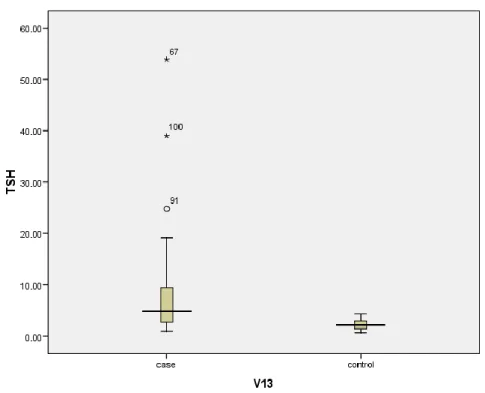
A total of 120 subjects were studied: Males 7 (5.8%); Females 113 (94.2%). Mean age of control group was 48.35 and case was 44.7. Patients with Vitamin D insufficiency were younger and predominantly female. Mean serum TSH was 8.004 in hypothyroid patients. Mean serum TSH was 2.29 in euthyroid patients. Mean serum vitamin D level in Case was 16.82. Mean serum vitamin D level in control 17.42. In cases, Vitamin D deficiency was 10(16.7%), insufficiency 44 (73.3%) and sufficient levels were noted in 6 (10%) patients. In control group, Vitamin D deficiency was 7 (11.7%), insufficiency 49 (81.7%) and sufficient levels were seen in 4 (6.6%). Those who were vitamin D insufficient and deficient were treated with vitamin D tablets with a dose 60,000 IU once weekly for 8 weeks. No relation between Vitamin D and seasonal variation was noted. No differences in vitamin D levels were noted when religions were compared.
Table 1 Age and sex Distribution of study population
Age grp Male Female Total
< 30 1(9.1%) 10(90.9%) 11(100%)
30-60 4(4.3%) 88(95.7%) 92(100%)
>60 2(11.8%) 15(88.2%) 17(100%)
Total 7(5.8%) 113(94.2%) 120(100%)
Table 2 Comparison of TSH and Vit D of cases and controls
Mean SD 95 % Confidence level P value
TSH (Case) 8.004 9.00 5.67 - 10.32 0.001
TSH(Control) 2.29 1.04 2.02 - 2.55
Vit D (case) 16.82 7.52 14.88- 18.77 0.650
Suma Samuel et al JMSCR Volume 07 Issue 04 April 2019 Page 4 Fig 1 Box and whisker plot showing the descriptive of TSH in Case and control
Table 3 Correlation between TSH and Vit D among cases and controls Correlation co-efficient P Value
Case 0.224 0.08
Control 0.253 0.05
Table 4 Vit D Status among cases and controls
Insufficient Deficient Sufficient Total
Case 44(73.3%) 10(16.7%) 6(10.0%) 60(100%)
Control 49(81.7%) 7(11.7%) 4(6.6%) 60(100%)
Total 93(77.5%) 17(14.2%) 10(8.3%) 120(100%)
Suma Samuel et al JMSCR Volume 07 Issue 04 April 2019 Page 5 Table 5 Comparison of vitamin D according to gender
Number Mean SD 95%CI P value
0.005
Male 7 29.42 8.05 21.97-36.87
Female 113 16.36 6.37 15.18-17.55
Table 6 Distribution of Vitamin D status according to age group
Age group Insufficient deficient Sufficient Total
< 30 8(72.7%) 2 (18.2%) 1 (9.1%) 11
30 – 60 72 (78.3%) 15 (16.3%) 5 (5.4%) 92
>60 13 (76.5%) 0 4 (23.5%) 17
Total 93 (77.5%) 17 (14.2%) 10 (8.3%) 120
P 0.07
Discussion
Our study showed a significant number of patients with insufficient vitamin D levels. A statistical significance of Vitamin D insufficiency was noted in females compared to males. Vitamin D deficiency was noted in both hypothyroid patients and euthyroid patients. Most vitamin D insufficiency and deficiency were noted in the middle age group
A study done by Rajeev et al concluded that most hypothyroids had serum vitamin D below 20ng/ml25. Our study also showed a similar deficiency. Vitamin D deficiency could be due to dietary deficiency, reduced outdoor activity and sun exposure. The sunshine vitamin is deficient in the Indian population despite the abundance of sunlight26
Significant decrease in females compared to males is widely prevalent in India. Our study also concurs with this observation.4,5,25,26,27 which had a statistical significance.
Conclusion:
There was a significant number of patients with Vitamin D insufficiency in both groups. A statistically significant difference in females outnumbering males with vitamin D deficiency was noted. However it was found that Vitamin D insufficiency was not present among hypothyroid patients significantly compared to euthyroid patients in our study population.
Recommendations
The significant prevalence of low vitamin D levels in our population should be highlighted much more and should be a matter to bring in to more public awareness. Screening for Vitamin D deficiency among all age groups should be done due to its high prevalence. Further longitudinal long term study in a larger population in different ethnic and geographic populations is recommended to further confirm the association of low Vitamin D levels and hypothyroidism.
Limitations of the study Small sample population.
References
1. Friedman Theodore C. Vitamin D deficiency and Thyroid disease www.goodhormonehealth.com/Vit D 2. Dohee Kim Int J Mol Sci 2017 Sep 18
(9):1949 published online2017 Sep12 The role of vitamin D in Thyroid diseasesPMC5618598
3. Unnikrishna AG, Kalra S, Sahay RK, Bantwal G et al Prevalence of
Hypothyroidism in adults. An
epidemiological study in eight cities of India. Indian J Endocrinological Metabolism2013;17:647-52
Suma Samuel et al JMSCR Volume 07 Issue 04 April 2019 Page 6 5. Marvaha RK, Tandon N, Garg MK,
Kanwar R et al. Vitamin A status in healthy Indians aged 50 and above. J Assoc Phy India 2011,59:706-9
6. Harinarayanan CV and Joshi SR.2009 Vitamin D status in India-it’s implications and remedial measures. J Assoc.Physicians India,57:40-48
7. Londhey,V 2011. Vitamin D Deficiency: Indian Scenario. Editorial J Assoc. Physicians. India,59:695-701
8. Idiculla J, Prabhu P Khadelkan K et al. Vitamin D and Primary hypothyroid. Is there an association? Thyroid Research Prac 2018; 15:34-7
9. Makariou S, LiberopoulosEN,Elisaf M et al 2011Novel roles of vitamin D in disease. What is knew in 2011? Eur J Intern Med22:355-362
10.Plum LA , De LucaHF, 2010 Vitamin D, disease and therapeutic opportunities. Nat Rev drug Discov 9: 941-955
11.Holick MF,2007 Vitamin D deficiency. N EnglJ Med357:266-281
12.Kivity S, Agmon-Levin,Zisappl M et al 2011 Vitamin D and autoimmune thyroid diseases. Cell Mol Immunol8:243-247 13.Amal Muhammed Hussein, Budira et al.
Vitamin D defi and it’s association with thyroid disease. International journal of Health Science 2013 Nov: 7, (3) 267-275 14.Goswami R et al. Prevalence of vitamin D
deficiency and it’s relationship with thyroid autoimmunity in Asian Indians, a community based survey. British journalnutrition2009 Aug 102 (3) 382-6 15.Holder T ,Bhattacharya S. Prevalence of
Hypothyroidism and it’s association with vitamin D deficiency in West Bengal, India. British journal of medicine, medical research (12) 7,1-10,2016
16.C Jayakumari, B Jayakumar, PK Jabbar et al 2017.Vitamin D deficiency-A risk factor for autoimmune thyroiditis. IJCIR,vol 3,issue7:715-8
17.Arup Kumar Debsinha et al. Association of Vitamin D deficiency in hypothyroid population attending NBMC and Hospital.vol7,no 7 (2018). International journal of Scientific research.
18.Y wang, EJ Jacobs,M L Mc Cullough et al. Comparing methods methods for accounting for seasonal variability in a biomarker when only a single sample is available: insights from simulations based on serum 25 hydroxyvitamin D. Am J Epidemiol.170:88-94 2009
19.A Nauri,L H Foo,K Nakamura te al. Serum Vitamin D concentrations and season specific correrelates in Japanese adults. J Epidemiol 21:346-353 2011 20.NaghmehMirhosseini, Ludovic Brunei,
Giovanna Muscogiuri et al. Endocrine
2017.Physiological serum
25-hydroxyvitamin D concentrations are associated with thyroid function-observations from a community based programme.58563-573
21.Al Saneh Talae, Fariba Ghorbani, Zhatollah Asemi-Effect of vitamin D supplement on thyroid function 2018/vol22/issue5:584-588
22.Chaudhary S, Dutta D, Kumar M, Saha S, Mondal SA, Kumar A, Mukhopadhyay S. Vitamin D supplementation reduces thyroid peroxidase antibody levels in patients with autoimmune thyroid disease: an open-labeled randomized controlled trial. Indian J. Endocrinol. Metab. 2016;20:391–398. doi:
10.4103/2230-8210.179997. [PMC free
article] [PubMed] [CrossRef]
23.Mazokopakis EE, Papadomanolaki MG, Tsekouras KC, Evangelopoulos AD, Kotsiris DA, Tzortzinis AA. Is vitamin D related to pathogenesis and treatment of Hashimoto’s thyroiditis? Hell J. Nucl. Med. 2015;18:222–227. [PubMed]
Suma Samuel et al JMSCR Volume 07 Issue 04 April 2019 Page 7 peroxidase antibodies in patients with
autoimmune hypothyroidism. Int. J. Endocrinol. (2016)
25.Rajeev Lohokare, Amita Gupta et al. A study of vitamin levels in hypothyroid patients ,a case contron study in a tertiary care hospital of central india. National journal of medical and dental research, January march 2016:volume4,issue 2 page89-92
26.GR Gupta A,VDD in India. Prevalence, casualties, interventions. Nutrientsb2014; 6 729-75