Volume 1, Issue 2 (2012) pp. 70-82
70 | Page Original Article
Evaluating the Ability of Cash Flow Ratios in Predicting
Auditor’s Opinion
Younes Badavar nahandi, Mehdi Alinezhad sarokolaei, Sima Ghasemi*
Department of Accounting, Tabriz Branch, Islamic Azad University, Tabriz, Iran*Corresponding Author E-mail: [email protected] Received: 19 March 2012, Revised: 18 April 2012, Accepted: 25 April 2012 ABSTRACT
Auditor’s opinion is useful tools for making decisions by the users of financial statements. The ability of financial statements in providing effective information on auditing opinion and their relation with auditor’s opinion has attracted many researchers. Thus, this study evaluates the ability of cash flows in predicting auditor ’s opinion using cash flows of 83 accepted companies in Stock Exchange of Tehran from 2003-2010. This study is post-event with applied goals. Here, auditor’s opinion is a dependent variable in accepted and qualified groups and cash flow ratio are independent variables in 5 ratios of cash flows to assets, cash flows to sale, cash flows to stockholders’ equity, operational earning to cash flows, net profit to cash flows; company size, auditing fee, and the type of auditing institute are classified control variables. The correlation of financial ratios with auditor’s opinion was examined using one main hypothesis and 5 alternative hypotheses. To test hypotheses, logistic regression and discriminate analysis methods were used. The results showed that using both methods, except for the ratio of cash flows to stockholders’ equity, other ratios of cash flow are correlated with auditor’s opinion and are able to predict auditor’s opinion.
Key words: Auditor’s opinion, Cash flow ratio.
Introduction
Nowadays, it is believed that economic bloom highly depends on the range and depth of information utility and information is a national wealth. According to the societies’ experiences, accounting information plays a key role in both micro and macroeconomics. Considering the duties of accounting system, it is stated that the main product of accounting system is financial statements. Thus, it is claimed that analyzing these reports can facilitate the main goal of an accounting system which is assisting users in making economic decisions (Sheikhi, 2009).
Ghasemi et al. Int. J. Adv. Stu. Hum. Soc. Sci., 2012, 1(2):70-82
71 | Page
hand, audited financial statements by independent auditors are tools for information transfer. Auditor plays the role of mediator between providers of financial statements and their users (Shoorvarzi et al., 2011). Accounting reports complement accounting information of financial statements. They provide the concept of increasing credit of managers ’disclosures. As a result, a mixture of auditing reports and data of financial statements can be a good predictor of different events (Anastasia et
al., 2011). This study has attempted to
examine the effects of cash flows on auditor’s opinion. Ratios of cash flows can reveal some important facts about financial operations and status of a non-profit unit whose identification and analysis can improve decision-making problems of stakeholders. Using them, a model is provided which can be predicted using these variables in environmental conditions of Iran.
Auditor’s opinion
Final product of an auditor’s opinion is auditor’s report, defined in unqualified and standard (unmodified) form. Then, it is changed in qualified, adverse or disclaimer opinion forms. In other words, auditing report is opinion of independent auditor on financial statements which accredits them.
Unqualified opinion is in cases that the
auditor concludes that financial statements are based on accounting standards regarding important aspects. Acceptable opinion implies that any change in accounting principles or the methods of applying these principles and their effects are properly determined or disclosed in financial statements.
Qualified opinion is given in important
but not basic cases regarding the lack of
considering accounting standards by monitor unit or for the limitations in examinations. If there is any basic limitation in investigations or a basic ambiguity in financial statements,
disclaimer of opinion occurs. In case of
not considering basic items in accounting standards by investigation unit, auditor gives adverse opinion (Accounting Standards Setting Committee, 2010).
Ratios of cash flows
Evaluating relative performance is an important usage of cash flows that can be discussed with two terms of sufficiency and efficiency. Sufficiency refers to sufficient cash flows for providing the needs of a business unit while efficiency refers to the fitness of gained cash flows compared with previous years or other business units. Sufficiency ratio evaluates the ability of a company in gaining enough cash for removing elementary needs; it also identifies cash flow from operational activities of a company covering long-term debt payments, asset purchase, and paying stock returns. Efficiency ratio compares the ways of gaining cash flow by a company compared with other years or companies (Giacomino, 1993).
In those ratios, focus is on cash flow. They cover the ways of using cash flow and determining the amount of cash owned from production and the amounts that cash caters to obligations.
Background
72 | Page
Gaganis et al., (2007) used neural network likelihood, evaluating features of the business units in relation with auditor’s opinion. They probed 27 highly applicable variables in their researches. They concluded that gross profit, size, profitability, current ratio, productivity, asset turnover, industry, and audit institute are important factors in determining auditors’ opinion type. The effect of profitability had the highest importance degree with 24%. Cornet et al., (2008) classified financial ratios into cash ratio, asset management, debt management ratio, profitability ratio, and market value ratio. This study identified the effect of these variables via identifying their relation with auditor’s opinion.
Setayesh and Jamalianpour, (2009) investigated the correlation between 14 financial and non-financial variables and auditors’ opinion. They concluded that among them, the type of ratio performance, goods turnover, debt ratio, net profit to sale, and net profit to sale ratio have maximum statistical correlation with auditors’ opinion.
Ahmadpour et al., (2009)Identifying effective factors in issuing qualified auditors’ opinion and neural network in stock exchange of Tehran, concluded that among 9 variables, only the times of goods turnover, debt to asset ratio, and ratio of received accounts to total assets have significant effects on issuing qualified report of auditing.
Lai Kam Wah, (2010) examined the types of auditors’ opinion and found that disclosure of auditing fee and auditing report are not correlated. But, company size, profitability, qualified report of auditor in previous year, cash flow, and sale growth are effective factors in issuing unacceptable report of auditor about discontinuing company size.
Heidari and Azami, (2010) in a thorough examination of accounting data of the companies with neural network approach, identified the types of auditors’ opinion. They identified them and used Perceptron neural network, comparing their performance with logistic regression. They concluded that neural network has the best performance in identifying acceptable opinion with prediction precision of 87.76%.
Banimahd (2011) examined effective factors in acceptable auditors’ opinion during 7 years with 56 companies via logistic regression. They concluded that issuing acceptable auditing report is affected by the factors such as manager’s performance, ownership change, auditing privacy, opinion selection, auditor change from a private institute to another, and company size.
Anastasia et al., (2011) examined the correlation between 11 financial ratios and auditors’ opinion type. Using logistic method and discriminate analysis, he offered a model for predicting auditors’ opinion type.
Ghasemi et al. Int. J. Adv. Stu. Hum. Soc. Sci., 2012, 1(2):70-82
73 | Page
report outperforms the techniques of neural network and logistic regression Saif et al., (2012) ,In a study on the rules for predicting auditors’ opinion using data detection with 1018 companies, indices of cash, profitability, return of leverage companies, growth, company size, and staff productivity, offered a model for predicting auditors’ opinion with 30 rules and 20 variables .
Hypotheses
1. There is a correlation between ratios of cash flow and auditors’ opinion.
1.1. There is a correlation between ratio of cash flow to asset and auditors’ opinion.
1.2. There is a correlation between ratio of cash flows to sale and auditors’ opinion. 1.3. There is a correlation between ratio of cash flows to stockholder’s equity and auditors’ opinion.
1.4. There is a correlation between ratio of operational profit to cash flows and auditors’ opinion.
1.5. There is a correlation between ratio net profit to cash flows and auditors’ opinion.
MATERIALS AND METHODS
Regarding study goals, this study is applied but regarding methodology it is correlation. Methodology is post-event. Used data are based on both extant documents and previous information. Accepted companies of Tehran Stock Exchange from 2002-2008 were studied.
Study sample and population
The population of this study includes all companies with following conditions: 1. Companies didn’t have transaction
stoppage of over 6 months.
2. They were accepted in Tehran Stock Exchange from 2002-2008.
3. Necessary information and notes along with calculations of research variables for the companies were accessible in identified time span.
4. Investment companies, banks, insurance and financial institutes were removed from the sample.
5. Their auditing opinions are accepted or qualified in research period; since based on conducted studies from 2002-2008, only 1% of the opinions were adverse opinion or disclaimer of opinion.
6. Their business symbol hadn’t exit from stock boards since 2002-2008.
Based on mentioned conditions, 115 companies were selected. After calculating variables and for not disclosing auditing fee, a sample size of 83 was achieved.
Variables
Dependent variable
The only dependent variable of this study is auditor’s opinion. Identifying the type of companies ’opinion in two groups of unqualified or qualified forms, they were translated into some qualities. If the company has received acceptable auditing opinion, it will get number 1 and if it has received qualified auditing opinion, it will get number 0.
Independent variable
Cash flow ratios are independent variables of this study, divided into 5 groups:
Ratio of cash flow to assets: This
measure reveals cash power of a business unit.
74 | Page Ratio of cash flow to sale: This measure
reveals the power of a business unit in turning sale to cash flow.
Equation 2:
Ratio of cash flow to stockholders equity: This ratio shows power of creating
operational cash flow of a business unit compared to stockholders’ equity.
Equation 3:
Ratio of operational profit to cash flow:
This ratio shows the relationship between accruals’ operational return and cash return and their difference.
Equation 4:
Ratio of net profit to cash flow: This
ratio shows the relationship between net profit of a business unit and cash flow and their differences.
Equation 5:
Control variables
The type of audit institute, company size, and auditing fee are control variables of this study.
The type of audit institute: The type of audit institute will take number 1 if it is auditing organization, otherwise it will take 0.
Company size: Company size is measured via natural log of annual sale of the companies.
Auditing fee: The fee that auditors receive for auditing is measured for homogenizing with natural log of auditor’s fee.
Data analysis
First, companies' data was extracted from audited financial statements of sample companies. After calculations, the data was summarized and classified in Excel. Then, it was given to SPSS and Eviews software. After normalization tests using discrimination analysis and logistic regression, hypotheses were tested.
Hypothesis test by discrimination analysis
1. The correlation between cash flow ratios and auditor’s opinion. Null and main hypotheses of H1 are as follows: H0.There is no correlation between cash flow ratios and auditor’s opinion.
H1. There is a correlation between cash flow ratios and auditor’s opinion.
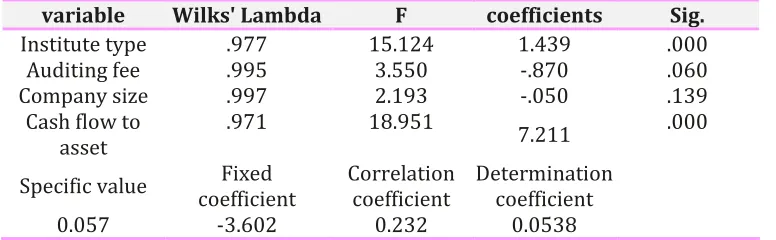
Table 1. The results of H1 test using discrimination analysis
variable Wilks' Lambda F coefficients Sig.
Institute type .977 15.124 1.439 .000
Auditing fee .995 3.550 -.870 .060
Company size .997 2.193 -.050 .139
Cash flow to asset
.971 18.951 7.211 .000
Specific value coefficient Fixed Correlation coefficient Determinationcoefficient
Ghasemi et al. Int. J. Adv. Stu. Hum. Soc. Sci., 2012, 1(2):70-82
75 | Page As seen in Table 1, correlation coefficient
of 0.232 and determination coefficient of 0.053 shows that 5.38 % of the changes in dependent variable (auditor’s opinion) comes from changes in ratio of cash flow to assets and control variables of model. Specific value of 0.057 shows significance of discrimination analysis. Wilks' Lambda has value of 97.1% since significance level is below 5%. Thus, H0 is rejected and H1 is accepted. Therefore, there is a positive correlation between cash flow to asset ratio and auditor’s opinion with coefficient of 7.211. Among control variables, the type of auditing institute type with coefficient of 1.439 and auditing fee with coefficient of -0.870 with significance level less than 5% are correlated with auditor’s opinion. 2. The correlation between ratio of cash flow to sale and auditor’s opinion. Null and main hypotheses of H1 are as follows: H0. There is no correlation between cash flow to sale ratio and auditor’s opinion. H1. There is a correlation between cash flow to sale ratio and auditor’s opinion. As seen in Table 2, correlation coefficient of 0.175 and determination coefficient of 0.0306 reveals that 3.06 % of the changes in dependent variable (auditor’s opinion) come from changes in ratio of cash flow to sale and control variables of model. Specific value of 0.31 shows the significance of discrimination analysis. Wilks' Lambda has the value of 99.3% since significance level is below 5%. Thus, H0 is rejected and H1 is accepted. Therefore, there is a positive correlation between cash flow to sale ratio and auditor’s opinion with coefficient of 3.558. Among control variables, auditing institute type with the coefficient of 1.695 and auditing fee with coefficient of -1.160 at significance level less than 5% are correlated with auditor’s opinion.
3. The correlation between ratio of cash flow to stockholders’ equity and auditor’s opinion. Null and main hypotheses of H3 are as follows:
H0.There is no correlation between cash flow to stockholders’ equity and auditor’s opinion.
H1. There is a correlation between cash flow to stockholders’ equity and auditor’s opinion.
As seen in Table 3, correlation coefficient of 0.173 and determination coefficient of 0.0299 reveals that 2.99 % of the changes in dependent variable (auditor’s opinion) come from changes in ratio of cash flow to sale and control variables of model. Specific value of 0.031 shows the significance of discrimination analysis. Wilks' Lambda has the value of 99.3% since its significance level is below 5%. Thus, H0 is accepted. Therefore, there is no correlation between cash flow to stockholders’ equity ratio and auditor’s opinion. Among control variables, auditing institute type with coefficient of 1.613 and auditing fee with coefficient of -1.578 at significance level less than 5% are correlated with auditor’s opinion.
4. The correlation between ratio of operational profit to cash flow and auditor’s opinion. Null and main hypotheses of H4 are as follows:
H0.There is no correlation between operational profit to cash flow and auditor’s opinion.
H1. There is a correlation between operational profit to cash flow and auditor’s opinion.
76 | Page Table 2. The results of H2 test using discrimination analysis
Table 3. The results of H3 test using discrimination analysis
variable Wilks' Lambda F coefficients Sig.
Institute type .980 12.757 1.613 .000
Auditing fee .991 5.682 -1.578 .017
Company size .996 2.571 -.016 .109
Cash flow to
stockholders .994 3.425 1.305 .065
Specific value coefficient Fixed Correlation coefficient Determinationcoefficient
0.031 -6.146 0.173 0.0299
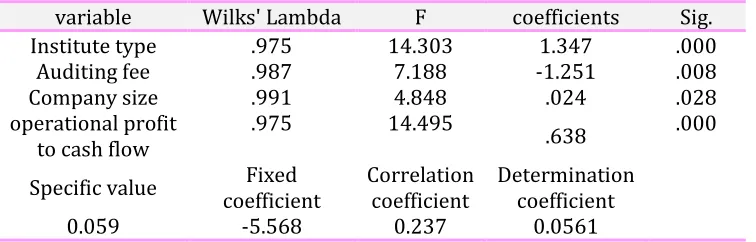
Table 4. The results of H4 test using discrimination analysis
variable Wilks' Lambda F coefficients Sig.
Institute type .975 14.303 1.347 .000
Auditing fee .987 7.188 -1.251 .008
Company size .991 4.848 .024 .028
operational profit
to cash flow .975 14.495 .638 .000
Specific value coefficient Fixed Correlation coefficient Determinationcoefficient
0.059 -5.568 0.237 0.0561
Specific value of 0.059 shows the significance of discrimination analysis. Wilks' Lambda has value of 97.5% since significance level is below 5%. Thus, H0 is rejected and H1 is accepted. Therefore, there is a positive correlation between operational profit to cash flow and auditor’s opinion with coefficient of 0.638. Among control variables, auditing institute type with coefficient of 1.347 and auditing fee with coefficient of -1.251 at
significance level less than 5% are correlated with auditor’s opinion.
5. The correlation between net profit to cash flow ratio and auditor’s opinion. Null and main hypotheses of H5 are as follows: H0.There is no correlation between net profit to cash flow ratio and auditor’s opinion.
H1. There is a correlation between net profit to cash flow ratio and auditor’s opin. variable Wilks' Lambda F coefficients Sig.
Institute type .980 12.739 1.695 .000 Auditing fee .992 5.127 -1.160 .024
Company size .996 2.555 .038 .110
Cash flow to
sale .993 4.175 3.558 .041
Specific value coefficient Fixed Correlation coefficient Determination coefficient
Ghasemi et al. Int. J. Adv. Stu. Hum. Soc. Sci., 2012, 1(2):70-82
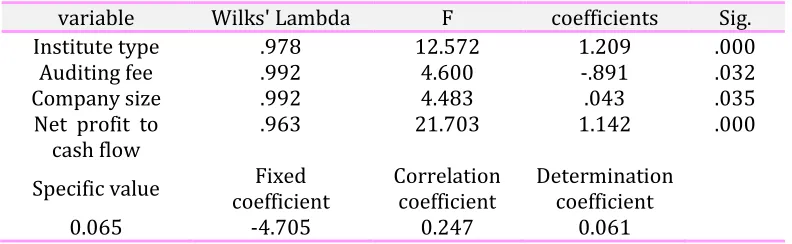
77 | Page Table 5. The results of H5 test using discrimination analysis
variable Wilks' Lambda F coefficients Sig.
Institute type .978 12.572 1.209 .000
Auditing fee .992 4.600 -.891 .032
Company size .992 4.483 .043 .035
Net profit to cash flow
.963 21.703 1.142 .000
Specific value coefficient Fixed Correlation coefficient Determinationcoefficient
0.065 -4.705 0.247 0.061
As seen in Table 5, correlation coefficient of 0.247 and determination coefficient of 0.0610 reveal that 6. 10 % of the changes in dependent variable (auditor’s opinion) come from changes in ratio of net profit to cash flow and control variables of model. Specific value of 0.656 shows the significance of discrimination analysis. Wilks' Lambda has value of 96.3% since significance level is below 5%. Thus, H0 is rejected and H1 is accepted. Therefore, there is a positive correlation between operational profit to cash flow and auditor’s opinion with coefficient of 1.142. Among control variables, auditing institute type with coefficient of 1.209 and auditing fee with coefficient of -0.891 and company size with coefficient of 0.043 at significance level less than 5% are correlated with auditor’s opinion.
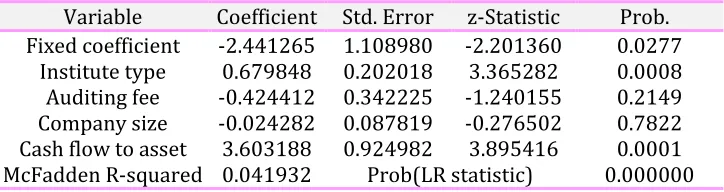
Hypothesis test by logistic regression 1. The correlation between ratio of cash flow to assets and auditor’s opinion. Null and main hypotheses of H1 are as follows: H0.There is no correlation between ratio of cash flow to assets and auditor’s opinion H1. There is a correlation between ratio of cash flow to assets and auditor’s opinion. As seen in Table 6, correlation coefficient of 3.60 and determination coefficient of 0.0419 shows that 4.19 % of the changes
in dependent variable (auditor’s opinion) comes from changes in ratio of cash flow to assets and control variables of model. Thus, H0 is rejected and H1 is accepted. Therefore, there is a positive correlation between cash flow to asset ratio and auditor’s opinion. Among control variables, the type of auditing institute type with coefficient of 0.679 at significance level less than 5% is correlated with auditor’s opinion.
78 | Page statistics is reliable since our significance
level is less than 5%.
3. The correlation between ratio of cash flow to stockholders equity and auditor’s opinion. Null and main hypotheses of H3 are as follows:
H0.There is no correlation between cash flow to stockholders equity and auditor’s opinion.
H1. There is a correlation between cash flow to stockholders equity and auditor’s opinion.
Table 6. The results of H1 test using logistic regression
Variable Coefficient Std. Error z-Statistic Prob. Fixed coefficient -2.441265 1.108980 -2.201360 0.0277
Institute type 0.679848 0.202018 3.365282 0.0008 Auditing fee -0.424412 0.342225 -1.240155 0.2149 Company size -0.024282 0.087819 -0.276502 0.7822 Cash flow to asset 3.603188 0.924982 3.895416 0.0001 McFadden R-squared 0.041932 Prob(LR statistic) 0.000000
Table 7. The results of H2 test using logistic regression
Table 8. The results of H3 test using logistic regression
As seen in Table 8, since our significance level is more than 5%, H0 is accepted. Determination coefficient of 0.0229 reveals that 2.29 % of the changes in dependent variable (auditor’s opinion) come from changes in ratio of cash flow to stockholders equity and control variables of model. Among control variables, auditing institute type with coefficient of 0.344 at significance level less than 5% is
correlated with auditor’s opinion. Then, our statistics is reliable since our significance level is less than 5%.
4. The correlation between ratio of operational profit to cash flow and auditor’s opinion. Null and main hypotheses of H4 are as follows:
Variable Coefficient Std. Error z-Statistic Prob. Fixed coefficient -2.690843 1.111374 -2.421186 0.0155
Institute type 0.596637 0.198875 3.000064 0.0027 Auditing fee -0.424443 0.344170 -1.233235 0.2175 Company size 0.016472 0.087978 0.187233 0.8515 Cash flow to sale 1.329370 0.619347 2.146406 0.0318 McFadden R-squared 0.023492 Prob(LR statistic) 0.000822
Variable Coefficient Std. Error z-Statistic Prob. Fixed coefficient -1.790473 0.704626 -2.541027 0.0111
Institute type 0.344428 0.123022 2.799739 0.0051 Auditing fee -0.363423 0.210938 -1.722895 0.0849 Company size -0.002884 0.052593 -0.054833 0.9563
Cash flow to
Ghasemi et al. Int. J. Adv. Stu. Hum. Soc. Sci., 2012, 1(2):70-82
79 | Page H0.There is no correlation between ratio
of operational profit to cash flow and auditor’s opinion.
H1. There is a correlation between ratio of operational profit to cash flow and auditor’s opinion.
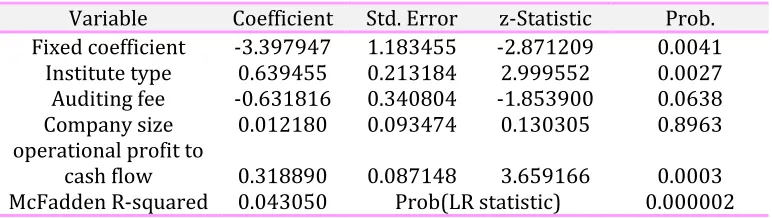
As seen in Table 9, since our significance level is less than 5%, H0 is rejected and H1 is accepted. Thus, ratio of operational profit to cash flow is correlated with coefficient of 0.0430. Determination coefficient of 0.0430 reveals that 4.30 % of the changes in dependent variable (auditor’s opinion) come from changes in ratio of operational profit to cash flow and control variables of model. Among control variables, auditing institute type with coefficient of 0.639 at significance level less than 5% is correlated with auditor’s opinion. Then, our statistics is reliable since our significance level is less than 5%. 5. The correlation between ratio of net profit to cash flow and auditor’s opinion.
Null and main hypotheses of H5 are as follows:
H0.There is no correlation between ratio of net profit to cash flow and auditor’s opinion.
H1. There is a correlation between ratio of net profit to cash flow and auditor’s opinion.
As seen in Table 10, since our significance level is less than 5%, H0 is rejected and H1 is accepted. Thus, ratio of net profit to cash flow is correlated with auditor’s opinion with coefficient of 20.597. Determination coefficient of 0.0467 reveals that 4.67 % of the changes in dependent variable (auditor’s opinion) come from changes in ratio of net profit to cash flow and control variables of model. Among control variables, auditing institute type with coefficient of 0.603 at significance level less than 5% is correlated with auditor’s opinion. Then, our statistics is reliable since our significance level is less than 5%. Table 9. The results of H4 test using logistic regression
Table 10. The results of H5 test using logistic regression
Variable Coefficient Std. Error z-Statistic Prob. Fixed coefficient -3.397947 1.183455 -2.871209 0.0041
Institute type 0.639455 0.213184 2.999552 0.0027 Auditing fee -0.631816 0.340804 -1.853900 0.0638 Company size 0.012180 0.093474 0.130305 0.8963 operational profit to
cash flow 0.318890 0.087148 3.659166 0.0003 McFadden R-squared 0.043050 Prob(LR statistic) 0.000002
Variable Coefficient Std. Error z-Statistic Prob. Fixed coefficient -2.958091 1.206376 -2.452047 0.0142
80 | Page Table 11. Summary of study results
Conclusion
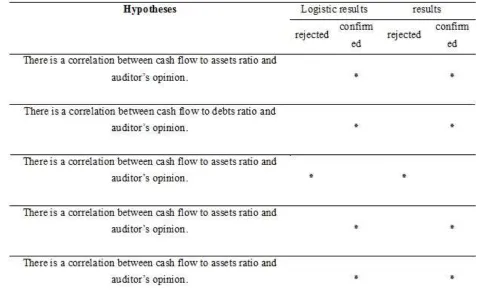
This study examined 5 ratios of cash flows as independent variables and 3 control variables on auditor’s opinion among 83 accepted companies of Stock Exchange of Tehran in 8 years from 2002-2009. First, the correlation of each variable with auditor’s opinion was tested using two methods. In analyzing alternative hypotheses, except for the ratio of cash flow to stockholder’s equity, other hypotheses had a positive correlation with auditor’s opinion. Thus, main hypothesis was confirmed. The ratios of cash flow help understanding the relationships among cash trends and evaluate a company’s performance regarding efficiency and sufficiency. Sufficiency refers to sufficient cash flows for providing the needs of business unit and efficiency refers to appropriates of achieved cash flows by business unit compared with
previous year and other business units. The higher the cash flow, the higher the likelihood of receiving unqualified opinions; on the contrary, the lower the cash flow; the more the likelihood of receiving qualified opinion. In the answer to the study’s question and based on the results, it was concluded that auditor’s opinion can be identified using ratios of cash flows. Thus, the ratios of cash flow have the ability of predicting auditor’s opinion.
Suggestions
Ghasemi et al. Int. J. Adv. Stu. Hum. Soc. Sci., 2012, 1(2):70-82
81 | Page performances of the companies to
decrease qualified opinion.
- Stockholders and investors usually search for cash power and income-making. Because they can start investments and stock sale and purchase with higher certainty using efficient financial statements for auditing opinion and selecting companies with acceptable opinion. Generally, qualified opinion negatively affects stock purchase and investments.
-Banks and credit institutes can use the results of this study for evaluating companies’ performance and analyzing financial ratios and predicting auditing opinion for awarding loans and financial facilities to the companies with qualified opinion.
References
Accounting Standards Setting Committee. (2010). Auditing Standards, Auditing Department. Aflatooni.
Aflatooni. A., Nikbakht. L. (2010). Application of econometrics in accounting researches, financial management and economic sciences.
Ahmadpour. A., Taher abadi. A., Abbasi. Sh. (2010). The effects of financial and non- financial variables on issuing qualified auditing opinion. Quarterly of Stock Exchange of Tehran, spring, 9.
Anastasia. M., Angelous, A. (2011), Predicting Audit Opinions Evidence From the Athens Stock Exchange, The Journal of Applied Bussiness Research, (July/August), 27-53
Bagherpour, S., Meshkani, B. (2012). Predicting independent auditing report in Iran: data examination approach. 2nd national accounting conference of Iran, Alzahra University.
Bahramfar, T., Mahani.S. and Ghayour. F. (2005). Investigating the relationship between traditional cash ratios and ratios of cash flow statements for evaluating continuity of companies' activities, accounting and auditing investigations, no. 40, 4.
Banimahd, B. (2011). Investigating effective factors in unqualified auditing opinion. Quarterly of Stock Exchange of Tehran, 13(4):59-83.
Cornett. M., Millon. T.A., Joh Nofsinger, J. (2008), Finance: applications theory, edition Mac grow-Hill/Irwin.
Gaganis. Ch., Pasiouras. F., and Doumpos. M. (2007). Probabilistic Neural Networks for the Identification of Qualified Audit opinions, Expert Systems with Applications, 32:114-124.
Gassan, F., Al Mataroneh, M. (2011). Effect of Using Financial Ratios on the Auditor ’s opinion: Evidence from Jordan, European Journal of Economics, Finance and Admistrative Sciences
Giacomino, D.E., Mielke David, E. (1993). Cash flow: Approach to Ratio Analysis, Academic journal article from journal of accounting, 175(3).
Lia, K.W. (2009). Audit Opinion and Disclosure of Audit Fees, Journal of Accounting and Finance, 24: 91-114.
Momeni, M. (2010). Statistical analysis by SPSS. Vol.3.
Pasiouras. F., Gaganis. Ch., Zopounidis. C. (2007), Multicriteria Decision Support Methodology for Auditing decisions: The Case of Qualified Audit Reports in the UK, European Journal of Operational Research,
82 | Page Pourheidari. O., Azami. Z. (2010).
Identifying auditor's opinion type using neural network, Accounting Knowledge Journal, winter, 3.
Raymond. P. (2011). Financial management. Jahankhani and parsayian. Tehran. 1.
Saif, M., Sarikhani. M., Ebrahimi, F. (2011), Finding Rules for Audit Opinions Prediction through data mining methods, European Online Journal of Natural and Social Sciences, 2: 28-36
Setayesh, M., Jamalianpor, M. (2009). Investigating the relationship between
financial ratios and non- financial variables with auditor’s opinion, Accounting research Journal, summer, 2
Sheikhi, M. (2010). Investigating the ability of financial ratios in predicting company's crises, MA thesis of Accounting, Islamic Azad University of Tabriz, and Tabriz, Iran. Shoorvarzi, M., Zendehdel, A., Smailzade, M. (2011). Comparing independent auditor’s opinion and financial variables in predicting bankruptcy, Accounting and Auditing Investigation Journal, 18(65): 64-70.
How to cite this article: Younes Badavar nahandi, Mehdi Alinezhad sarokolaei, Sima Ghasemi, Evaluating the Ability of Cash Flow Ratios in Predicting Auditor’s Opinion. International Journal of Advanced Studies in Humanities and Social Science, 2012, 1(2),