hollow spheres with excellent supercapacitor
performance
†
Tao Liu,aChuanjia Jiang, aBei Cheng,aWei You acand Jiaguo Yu *ab
Designing electrode materials with high specific capacitance is crucial for further improving the energy storage performance of supercapacitors. Nickel sulfide (NiS) nanosheets anchored on the surface of N-doped hollow carbon spheres (NiS/NHCS) were rationally designed and synthesized via a multistep transformation approach. Uniform nickel silicate nanosheets were first deposited on the surface of NHCSs, followed by chemical conversion into NiS nanosheets. The NiS/NHCS composite shows excellent electrochemical properties as an electrode material for supercapacitors. The NiS/NHCS electrode can deliver a high specific capacitance of 1150 F g1at 1 A g1and show outstanding cycling performance with a retention rate of 76% over 4000 cycles, which are much higher than those of pure NiS hollow spheres (NiS-HS) (400 F g1 and 63%, respectively). Moreover, a hybrid supercapacitor assembled with NiS/NHCS as the cathode and an activated carbon electrode as the anode delivers a high energy density of 38.3 W h kg1 at a power density of 160 W kg1and has an excellent cycle performance with the retention rate of 96% after 5000 cycles. The exceptional electrochemical performance of the NiS/NHCS composite indicates its potential application in high-performance supercapacitors.
Introduction
Energy storage and conversion devices, in particular recharge-able batteries and supercapacitors, have attracted increasing attention for the better utilization of renewable resources.1–5
Supercapacitors have been considered as one of the most promising device candidates due to their intriguing character-istics of fast charge/discharge capability, outstanding cycle life and high power density.6–10 Nonetheless, the relatively low
energy density of supercapacitors compared with rechargeable batteries still requires signicant improvement. Enhancing the specic capacitance of the electrode materials is one of the compelling approaches to solve this issue.
Recently, transition metal suldes have been extensively investigated as novel electrode materials for supercapacitors,11
due to their high theoretical specic capacitance, excellent
electrical conductivity, and mechanical and thermal stability, including nickel suldes (NiS,12 Ni
2S3 (ref. 13) and Ni7S6 (ref. 14)), cobalt suldes (Co3S4(ref. 15)), manganese suldes (MnS16), and binary metal suldes (NiCo
2S4 (ref. 17) and MnCo2S4 (ref. 18)). Among them, nickel sulde has received special interest. For instance, NiS box-in-box hollow structures reported by Yuet al.19delivered a high specic capacitance of
668 F g1at the current density of 1 A g1and distinguished rate performance (71% capacitance retention at 20 A g1). Yang et al.20synthesized hierarchicalower-like nickel sulde which
exhibited a specic capacitance of 972.3 F g1at 2 A g1and excellent cycling stability. Zhu et al.21 fabricated NiS hollow
spheresviaa facile template-engaged transformation approach, which showed high specic capacitances of 927–583 F g1 at different current densities of 4.08–10.2 A g1. These studies on nickel sulde materials indicate that these unique nano-structures are able to improve the electrochemical performance for supercapacitors.
On the other hand, the growth and anchoring of functional nanomaterials on carbonaceous materials, such as gra-phene,22–25 carbon nanotubes26 and carbon ber,18,27 is an
effective method to improve the cycling performance and rate properties of supercapacitors.28Hollow carbon spheres (HCSs)
have been regarded as an alternative substrate for preparing electrode material due to the following advantages: internal cavities serving as ion reservoirs and rapidly providing electro-lyte ions for the electrochemical reactions, a carbon shell with Received 14th July 2017
Accepted 8th September 2017
DOI: 10.1039/c7ta06149h
rsc.li/materials-a
aStateKeyLaboratoryofAdvancedTechnologyforMaterialsSynthesisandProcessing,
WuhanUniversityofTechnology,LuoshiRoad122,Wuhan430070,PRChina.E-mail: [email protected];Fax:+86-27-87879468;Tel:+86-27-87871029
bDepartmentofPhysics,FacultyofScience,KingAbdulazizUniversity,Jeddah21589,
SaudiArabia
cDepartmentofChemistry,UniversityofNorthCarolinaatChapelHill,ChapelHill,
NorthCarolina27599-3290,USA
good conductivity facilitating electron transport,29and a large
surface area favoring the deposition of active materials. It can therefore be expected that a thin and porous layer of active material grown on the HCS surface could exhibit enhanced energy storage capacity and rate capacity.
Herein, we reported the design and fabrication of porous NiS nanosheets grown on N-doped hollow carbon spheres (NHCSs) via an efficient template-engaged method. The rst step involves fabricating N-doped carbon spheres@SiO2(N-carbon/ SiO2) with a core–shell structure, which serves as the template for the growth of nickel silicate (NiSi) nanosheets on the surface of NHCSs in the second step, yielding NiSi/NHCS hollow structures. Finally, the NiSi/NHCS hollow structure is trans-formed into NHCS-supported NiS nanosheets (NiS/NHCS) by hydrothermal suldation treatment. When used as an electrode material for supercapacitors, the NiS/NHCS composite with a hierarchically hollow structure exhibits better electrochemical properties than pure NiS hollow spheres (NiS-HS).
Results and discussion
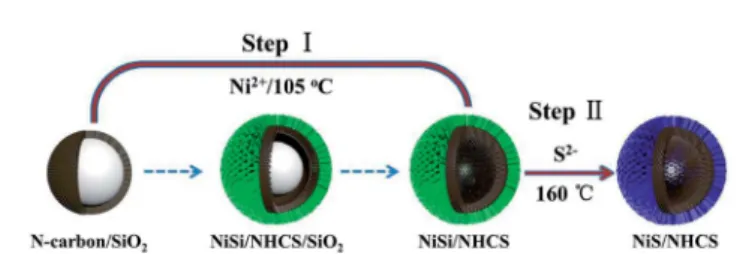
The synthesis process of the hierarchical NiS/NHCS composite with a hollow structure is illustrated in Fig. 1. First, N-carbon/ SiO2 with uniform sizes (Fig. S1a and b†) is synthesized via a one-step process involving the hydrolysis of tetraethoxysilane (TEOS) and the polymerization of dopamine, followed by the carbonization of the polydopamine/SiO2 spheres. Then nickel silicate nanosheets arein situformed on the NHCS surfacevia a facile hydrothermal treatment in dilute ammonia solution, where NHCSs and SiO2cores serve as templates and the self-sacricial substrate, respectively (step I). In this process, ammonia can not only produce an alkaline condition but also provide NH3to coordinate with Ni2+.30Ammonium chloride is a necessary additive to mediate the dissociation of ammonia and inhibit the formation of nickel hydroxide. Silicate anions are released from the dissolution of the SiO2core under alkaline conditions at high temperature. The reaction between the sili-cate ions and Ni2+leads to the nucleation of NiSi, which could preferentially deposit on the carbon shell. Continuous disso-lution of the SiO2 core supplies more silicate anions for the growth of NiSi nanosheets. When there are not enough dis-solved Ni2+ ions, an outer shell composed of nickel silicate nanosheets on the NHCS surface and the remaining SiO2core
enclosed within form a rattle-like structure (NiSi/NHCS/SiO2). As the reaction continues, the SiO2core is fully dissolved and a hollow nanostructure of NiSi/NHCS is eventually fabricated. Finally, the as-prepared NiSi/NHCS is transformed into NiS/ NHCS by a solution-based suldation approach with Na2S as the S2source (step II).
The microstructures of reaction products for each stage were characterized by transmission electron microscopy (TEM). The N-carbon/SiO2 (Fig. 2a and e) solid spheres had a uniform diameter of 310 nm. For NiSi/NHCS/SiO2obtained aer reaction for 2 h (Fig. 2b and f), nickel silicate nanosheets are closely grown on the surface of NHCSs, and a gap between the NiSi/ NHCS shell and SiO2core can be clearly observed. Aer 12 h of reaction, NiSi/NHCS (Fig. 2c and g) shows a hollow structure with a 400 nm outer diameter and shell thickness of 50 nm, and this structure is maintained in the nal product NiS/NHCS (Fig. 2d and h). The hollow structure combining the NiS nano-sheet shell and NHCSs can provide abundant electrochemically active sites and a large electrolyte–electrode contact area for a pseudocapacitive reaction. Meanwhile, the N-doped carbon core can boost the electron transfer, which can improve the rate capacity of supercapacitors. Additionally, the aggregation of electroactive particles and a pronounced volume variation during charge/discharge processes can be effectively inhibited due to the hollow carbon cavities.
Field-emission scanning electron microscope (FESEM) images (Fig. 3a and b) conrmed that the surface of both NiSi/NHCS and NiS/NHCS is assembled by using numerous nanosheets, and the morphology was not altered during sul -dation. The NiSi hollow sphere (NiSi-HS) (Fig. S2†) and NiS-HS (Fig. 3c) are also composed of interconnected nanosheets, and TEM images of NiS-HS (Fig. 3d) further conrm the hierarchical hollow structure. The average diameter of NiS-HS is about 380 nm, which is smaller than that of NiS/NHCS, mainly due to the absence of the NHCS core. The N2adsorption–desorption isotherms (Fig. S3a†) of NiS/NHCS and NiS-HS can be classied as type IV with an overlap of type H2 and H3 hysteresis loops, which shows the existence of ink-bottle mesopores within the NiS nanosheets or porous NHCSs and slit-like mesopores formed between NiS nanosheets, respectively.31NiS/NHCS and NiS-HS
have hierarchical pore structures according to the wide pore size distribution (Fig. S3b†), which is benecial for the electrolyte ion penetration.32Especially, the BET specic surface area and
pore volume of NiS/NHCS (106 m2 g1and 0.30 cm3 g1) are higher than those of NiS-HS (86 m2g1and 0.15 cm3g1), which can provide more electroactive sites for participating in the faradaic redox reactions, leading to improved electrochemical performance.
The crystal structures of NHCSs, NiSi/NHCS and NiS/NHCS were characterized by the XRD patterns (Fig. 4a). The peak at 23.5can be assigned to graphite carbon sheets of NHCSs. In the XRD spectrum of NiSi/NHCS, the weak peaks located at 35.5 and 60.7 are indexed to the (200) and (060) planes of monoclinic nickel hydrosilicate, respectively.21 In the XRD
spectrum of NiS/NHCS, the peaks at 19.4, 30.3, 32.7, 35.9, 49.4, 53.5and 59.8can be indexed to (110), (101), (300), (021), (410), (401) and (012) crystal planes of NiS (JCPDF #86-2281). Fig. 1 Scheme for the formation of nickel sulfide (NiS) nanosheets
supported on the NHCS surface by a novel conversion route: (I) growth of nickel silicate (NiSi) nanosheets on the NHCS surface with the silica core simultaneously eliminated; (II) chemical conversion of nickel silicate into NiS to form NiS/NHCS.
From the Raman spectra of NHCSs and NiS/NHCS (Fig. 4b), typical D and G bands at 1358 and 1596 cm1were observed, further conrming the existence of carbon in the NiS/NHCS composite. The relatively high intensity of the D band demon-strates the existence of substantial defects, mainly resulting from nitrogen dopants and contaminants.33 The peak at
578 cm1in the spectrum of NiS/NHCS is attributed to the F2g model of Ni–S.34
The surface elemental composition and chemical state of N-carbon/SiO2 and NiS/NHCS were analyzed by X-ray photo-electron spectroscopy (XPS). The survey XPS spectrum of N-carbon/SiO2(Fig. S4a†) demonstrates the presence of C, N, O Fig. 2 TEM images of N-carbon/SiO2(a and e), NiSi/NHCS/SiO2(b and f), NiSi/NHCS (c and g) and NiS/NHCS (d and h).
Fig. 4 (a) XRD patterns of NHCSs, NiSi/NHCS and NiS/NHCS. (b) Raman spectra of NHCSs and NiS/NHCS. High-resolution XPS spectra of Ni 2p before and after charging (c) and S 2p (d) for NiS/NHCS.
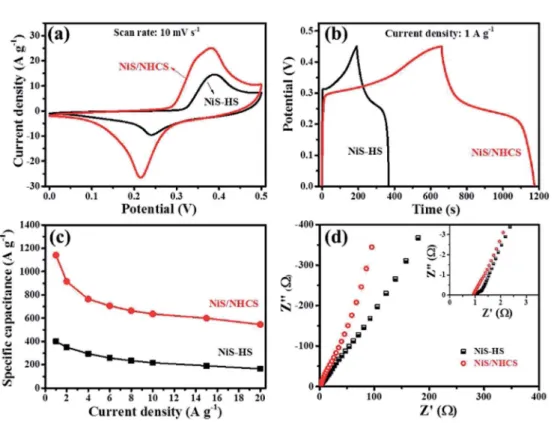
Fig. 5 Cyclic voltammetry curves (a), GCD curves (b), specific capacitance at various current densities (c) and Nyquist plots (d) of NiS/NHCS and NiS-HS electrodes.
2.0 M KOH aqueous solution. The cyclic voltammetry (CV) curves of both samples (Fig. 5a) exhibit a couple of faradaic redox peaks, which can be assigned to the reversible faradaic redox process of Ni3+/Ni2+.29The high-resolution XPS spectra of
Ni 2p for the NiS/NHCS aer charging was used to prove the Ni valence change in the charging/discharging process. The two evident peaks appearing at 854.8 and 872.4 eV can be ascribed to Ni3+, indicating the occurrence of the redox reaction. It is obviously seen that the integrated CV area of NiS/NHCS is much larger than that of NiS-HS, indicating that NiS/NHCS possesses better capacitive properties. In the galvanostatic charge/ discharge (GCD) curve of NiS/NHCS (Fig. 5b), the discharging time matches well with the charging time, revealing a high reversibility of the pseudocapacitive reaction at the surface of the electrodes. And the potential plateaus correspond to the redox peaks of the CV curves. Notably, the discharge time of NiS/NHCS is much longer than that of NiS-HS, indicating the markedly improved specic capacitance due to the introduction of NHCSs as the conductive substrate.
The GCD curves of NiS/NHCS and NiS-HS electrodes were measured at various current densities (Fig. S7a and c†) to evaluate the rate performance (Fig. 5c). The NiS/NHCS electrode outperforms NiS-HS over the entire current density range tested. For example, the NiS/NHCS electrode shows a high specic capacitance of 1150 F g1at 1 A g1and a capacitance
Fig. 6 (a) Configuration and illustration of the energy storage mechanism for the NiS/NHCS||AC device. (b) CV curves of AC and NiS/NHCS from
1.0 to 0 V and 0 to 0.5 V, respectively, at 10 mV s1in a three-electrode system. (c) CV curves of the as-fabricated NiS/NHCS||AC device in various operation voltages at a scan rate of 10 mV s1.
and Si elements. Particularly, the N signal conrms the successful introduction ofNinto the carbon shell.The C1s peak in the high-resolution spectrum (Fig. S4b†) can be deconvoluted into four peaks at 284.6, 285.6, 287.2 and 289.0eV,correspondingtosp3-hybridizedC–C/C]C,C–O/C–N, C]Oand–COObonds.29Thehigh-resolution N1sspectrum
(Fig.S4c†)canbedeconvolutedintofourpeaksat398.3,400.0, 400.9and403.5 eV,corresponding to pyridinic-N,pyrrolic-N, quaternary-N and N-oxide. The N element can not only increasetheconductivityofcarbonmaterials,butalsofacilitate electrolytepenetrationwithafeasiblepathway.ThesurveyXPS spectrumofNiS/NHCS(Fig.S5†)showspeaksforNi,S,C,Nand Oelements, wherethe signal forO can be attributed to the oxygen-containing functional group in the NHCS core and sulfur oxides in the NiS shell.33,35,37 Thehigh-resolution XPS
spectrumofNi2p(Fig. 4c)showstwocharacteristicpeaks at 852.1and 869.7eV andtwo shake-up satellites at 858.0and 876.1 eV, which can be attributed to Ni 2p3/2 and Ni 2p1/2 orbitalsofNi2+.36Furthermore,theXPSpeakofS2p(Fig.4d)is
deconvoluted into two binding energy peaks at 162.5 and 163.8eV,whichcorrespondtoS2p3/2andS2p1/2 orbitalsofS2, respectively.Anotherpeakat 168.3eVbelongs tosulfuroxide fromtheoxidationofSwithresidualO2.37,38
retention rate of 52.2% at the high current density of 20 A g1, which are much higher than those of the NiS-HS electrode (400 F g1at 1 A g1and 45.6% at 20 A g1). The N-doped carbon hollow core uniformly deposited with the NiS nanosheets can promote the electron transfer in the NiS/NHCS electrode, leading to enhanced rate performance. The mechanism for the excellent capacitive properties of the NiS/NHCS electrode was further investigated by electrochemical impedance spectros-copy (Fig. 5d). In the high frequency region, there is a pseudo-semicircle in the Nyquist plot of NiS-HS while the pseudo-semicircle is negligible for NiS/NHCS, indicating that NiS/NHCS exhibits a smaller charge-transfer resistance than NiS-HS. In the low frequency region, the slope for the NiS/NHCS electrode is larger than that for NiS-HS, suggesting that NiS/NHCS not only possesses lower diffusive resistance but offers faster ion trans-port. To evaluate the durability of the electrode materials, the long-term cycling performance of NiS/NHCS and NiS-HS were tested by GCD measurements up to 4000 cycles at 5 A g1. 76% of the specic capacitance of NiS/NHCS was retained aer 4000 cycles compared to 63% retention for NiS-HS (Fig. S8†).
To further evaluate the NiS/NHCS electrode for practical application, a hybrid supercapacitor (HSC) device was assem-bled using the NiS/NHCS electrode as the cathode and the active carbon (AC) electrode as the anode in KOH aqueous electrolyte (Fig. 6a). Fig. 6b shows the CV curves of NiS/NHCS and AC electrodes at a scan rate of 10 mV s1 with a stable potential range of1 to 0 V and 0 to 0.5 V in the three-electrode system,
respectively. The energy storage mechanism of the NiS/ NHCS||AC device is depicted in Fig. 6a. The NiS/NHCS cathode can store energy by an oxidation reaction of NiS with the incorporation of OHduring the charging process while the AC anode can accumulate electrons by cation (e.g.K+) adsorption.39
In the charging process, the NiS/NHCS cathode and AC anode can produce an electric potential from 0 to 0.5 V and from1 to 0 V, respectively, endowing the HSC device with a broad oper-ating voltage window of 1.5 V. In the discharging process, the NiS/NHCS cathode and AC anode can release energy via the reduction reaction and desorption of ions. The employed AC electrode exhibits a specic capacitance of 280 F g1 at the current density of 1 A g1 (Fig. S9†). According to the charge balance theory between the anode and cathode in the HSC device, the optimal mass loading ratio for the NiS/NHCS and the AC electrode ism(NiS/NHCS):m(AC)¼0.54 : 1, while that for the NiS-HS and the AC electrode is m(NiS-HS):m(AC) ¼ 1.4 : 1. Utilizing the different potential window of the NiS/NHCS and the AC electrode, the operating voltage of the fabricated HSC device is expected to be 1.5 V (Fig. 6c and d).
As depicted in Fig. 7a and b, the integrated area of the CV curve of NiS/NHCS||AC was much larger than that of NiS-HS||AC, while the discharging time of the former is also much and longer than that of the latter, indicating that the specic capacitance of NiS/NHCS||AC is much larger than that of NiS-HS||AC (Fig. 7c). The specic capacitance of the NiS/NHCS||AC exhibited a maximum specic capacitance of 120 F g1at the
Fig. 7 (a) CV curves, (b) GCD curves, (c) current–density dependence of the specific capacitance and (d) Ragone plots of NiS/NHCS||AC and NiS-HS||AC. The inset of part d shows two LEDs powered by two NiS/NHCS||AC devices in series.
strategy reported herein can be applied for synthesizing other hierarchical carbon–metal sulde composite materials for energy conversion and storage applications.
Experimental section
Synthesis of N-doped carbon/SiO2spheres
N-doped carbon/SiO2(N-carbon/SiO2) spheres were synthesized by a facile one-step method involving the formation of spherical SiO2cores and the coating of polydopamine. Briey, a mixture containing 12 mL of anhydrous ethanol, 0.5 mL of ammonia (25%) and 40 mL of distilled water was vigorously stirred for 10 min. One milliliter of tetraethoxysilane (TEOS) was added to the mixture dropwise, and the stirring continued for an addi-tional 15 min. Subsequently, 4 mL of dopamine hydrochloride (DA) aqueous solution (50 mg mL1) was added to the above solution and kept stirring for 32 h. Brown polydopamine/SiO2 (PDA/SiO2) spheres were collected aer centrifugation and washed with puried water three times. N-carbon/SiO2spheres were obtained aer calcination at 800 C for 2 h under a nitrogen (N2) atmosphere.
Synthesis of the NiSi/NHCS composite
For preparation of NiSi/NHCS, 40 mg of N-carbon/SiO2 was dispersed in 40 mL of water by sonication for 0.5 h, followed by the addition of NiCl2(0.5 mmol), NH4Cl (5 mmol) and NH3$H2O (0.5 mL) under mild stirring. Aer stirring for 0.5 h, the mixture suspension was transferred into a Teon-lined autoclave and maintained at 105 C. Aer reaction for 2 h and 12 h, NiSi/NHCS/SiO2 and NiSi/NHCS composites were obtained, respectively.
Synthesis of NiS/NHCS
40 mg of NiSi/NHCS and 100 mg of polyvinylpyrrolidone (PVP, K-30) were added to 60 mL of distilled water and sonicated for 0.5 h. Subsequently, 600 mg of Na2S$9H2O was added during stirring, and the suspension was transferred to a 100 mL Te on-lined autoclave and heated at 160C for 12 h. The product was obtained aer washing with puried water and ethanol several times and annealing at 300C for 2 h in a N2atmosphere. For comparison, NiS hollow spheres (NiS-HS) were fabricated under the same conditions as those of the synthesis of NiS/NHCS, except that SiO2 spheres were used instead of the N-carbon/ SiO2.
Materials characterization
Powder X-ray diffraction (XRD) patterns of the samples were recorded on a Rigaku X-ray diffractometer with Cu Karadiation (l¼0.15418 nm). The morphologies were examined with aeld emission scanning electron microscope (FESEM, JSM-7500) and transmission electron microscope (TEM, Titan G2). Nitrogen adsorption–desorption experiments were performed on a Micromeritics ASAP 2020 nitrogen adsorption apparatus to measure the specic surface area and porosity of the samples. The X-ray photoelectron spectroscopy (XPS) was conducted on a Thermo ESCALAB 250. Raman spectrum analysis was currentdensityof0.2Ag1andmaintainedacapacitanceof46
F g1at5Ag1,whilethoseofNiS-HS||ACwere75.3Fg1at 0.2Ag1and28.1Fg1at5Ag1.IncontrasttothesingleNiS/ NHCSelectrodeinthethree-electrodesystem,theGCDcurves of the HSC devices (Fig. S10a and S11c†) exhibited a better linearfeature,demonstratingthattheelectronreleasefromthe NiS/NHCSredoxreactioninthecathodehasbeenwellmatched withtheelectronaccumulationbycationadsorptionintheAC anode.
Energydensityandpowerdensityaretwoimportantfactors for evaluating the electrochemical performance for a hybrid supercapacitordevice.ItcanbeobservedfromtheRagoneplot (Fig. 7d) that the NiS/NHCS||ACdevice demonstrates a high energydensityof38.3Whkg1atapowerdensityof160Wkg1 withachargingtimeof1150s(Fig.S10a†).Itisworthnoting that,evenwhenchargingforonly25s,theHSCcanstillpossess anenergydensityof13.5Whkg1atahighpowerdensityof 4000Wkg1.Bycontrast,theNiS-HS||ACdeviceshowsenergy densitiesof24.8Whkg1at150Wkg1and8.8Whkg1at 3944Wkg1.Tomanifestthepracticaloperatingperformance of the NiS/NHCS||ACdevice, two LEDs (with lowest working voltageof2.2V)canbepoweredbytwoHSCdevicesconnected inseries(1.4mgactivematerialsintotalforeach),withred lightemissionlastingfor110s.Fig.S12†showsthelong-term cyclingproperty ofthe NiS/NHCS||ACat acurrent densityof 3 A g1. Remarkably, the NiS/NHCS||AC exhibited excellent cyclingstabilityandstilldelivered96%ofitsinitialcapacitance aer5000 cycles.Aer5000 cycles,NiSnanosheets were still anchoredonthesurfaceofNHCSs(Fig.S13†),indicatingthat theNiS/NHCScompositepossessedastablechemicalstructure. TheexcellentsupercapacitiveperformanceofNiS/NHCScan beattributedtoseveralaspects.Ontheonehand,theNiS/NHCS compositewithanovelhierarchicalarchitecturecanfacilitate thediffusionofelectrolyteions andsupply sufficient electro-activesitesforredoxreactions.Ontheotherhand,theNHCS corecanmarkedly increasethe electrontransfer efficiencyin the electrode material and alleviate the aggregation of NiS nanosheets during the charge/discharge process.40–42 Finally,
theNHCSsasthebackbonecouldsupporttheNiSnanosheets stablyduringthecharge/dischargeprocess,whichisbenecial forthecyclingstability.Hence,theNiS/NHCScompositecanbe regarded as a promising candidate material for high-performancesupercapacitors, due toits high specic capaci-tanceandoutstandingstability.
Conclusion
performed by using a Renishaw Raman microscope underlexc¼ 633 nm laser excitation.
Electrochemical measurements
The working electrodes were obtained by brushing a mixture of active materials (NiS/NHCS, NiS-HS or AC), acetylene black and polyvinylideneuoride (mass ratio 8 : 1 : 1) in N-methyl pyrro-lidone (NMP) solvent onto nickel foam and air-drying at 100C overnight. The mass loading of the active material for individual electrodes was 1.0 mg cm2. A three-electrode system con gu-ration was used to test the electrochemical performance of individual electrodes, where a platinum foil served as the counter electrode and a Ag/AgCl electrode served as the refer-ence electrode. Cyclic voltammetry (CV), galvanostatic charge/ discharge (GCD) and electrochemical impedance spectroscopy (EIS) were carried out on a electrochemical workstation (CHI 760E) in 2.0 M KOH electrolyte. Moreover, the ACS device was assembled with NiS/NHCS as the cathode and AC as the anode to measure its potential for practical application.
Con
fl
icts of interest
There are no conicts to declare.
Acknowledgements
This work was supported by the NSFC (21433007, 51372190, 21573170 and 51320105001), 973 program (2013CB632402), NSFHP (2015CFA001), Innovative Research Funds of SKLWUT (2017-ZD-4) and Fundamental Research Funds of Central Universities (WUT: 2015-III-034).
Notes and references
1 B. You and Y. Sun,Adv. Energy Mater., 2016,6, 1502333. 2 J. Low, J. Yu and W. Ho,J. Phys. Chem. Lett., 2015,6, 4244–
4251.
3 J. Zhang, H. Hu, Z. Li and X. W. Lou,Angew. Chem., Int. Ed., 2016,55, 3982–3986.
4 T. Liu, C. Jiang, W. You and J. Yu,J. Mater. Chem. A, 2017,5, 8635–8643.
5 Z. N. Yu, L. Tetard, L. Zhai and J. Thomas,Energy Environ. Sci., 2015,8, 702–730.
6 J. Jiang, Y. Li, J. Liu, X. Huang, C. Yuan and X. W. Lou,Adv. Mater., 2012,24, 5166–5180.
7 Z. S. Wu, Y. Sun, Y. Z. Tan, S. Yang, X. Feng and K. Mullen,J. Am. Chem. Soc., 2012,134, 19532–19535.
8 X. Rui, H. Tan and Q. Yan,Nanoscale, 2014,6, 9889–9924. 9 M. Sevilla and R. Mokaya,Energy Environ. Sci., 2014,7, 1250–
1280.
10 W. Xia, A. Mahmood, R. Zou and Q. Xu,Energy Environ. Sci., 2015,8, 1837–1866.
11 W. Zhou, X. Cao, Z. Zeng, W. Shi, Y. Zhu, Q. Yan, H. Liu, J. Wang and H. Zhang,Energy Environ. Sci., 2013,6, 2216– 2221.
12 C. Sun, M. Ma, J. Yang, Y. Zhang, P. Chen, W. Huang and X. Dong,Sci. Rep., 2014,4, 7054.
13 W. Li, S. Wang, L. Xin, M. Wu and X. Lou,J. Mater. Chem. A, 2016,4, 7700–7709.
14 Z. Li, J. Han, L. Fan and R. Guo,CrystEngComm, 2015, 17, 1952–1958.
15 G. Liu, B. Wang, L. Wang, T. Liu, T. Gao and D. Wang,RSC Adv., 2016,6, 54076–54086.
16 S. C. Riha, A. A. Koegel, X. Meng, I. S. Kim, Y. Cao, M. J. Pellin, J. W. Elam and A. B. Martinson, ACS Appl. Mater. Interfaces, 2016,8, 2774–2780.
17 Z. Ai, Z. Hu, Y. Liu, M. Fan and P. Liu,New J. Chem., 2016,40, 340–347.
18 Y. M. Chen, Z. Li and X. W. Lou,Angew. Chem., Int. Ed., 2015,
54, 10521–10524.
19 X. Yu, L. Yu, L. Shen, X. Song, H. Chen and X. W. Lou,Adv. Funct. Mater., 2014,24, 7440–7446.
20 J. Yang, W. Guo, D. Li, C. Wei, H. Fan, L. Wu and W. Zheng,J. Power Sources, 2014,268, 113–120.
21 B. Zhu, Z. Wang, S. Ding, J. Chen and X. W. Lou,RSC Adv., 2011,1, 397–400.
22 X. Cai, R. V. Hansen, L. Zhang, B. Li, C. K. Poh, S. H. Lim, L. Chen, J. Yang, L. Lai, J. Lin and Z. Shen,J. Mater. Chem. A, 2015,3, 22043–22052.
23 J. Yang, C. Yu, X. Fan, S. Liang, S. Li, H. Huang, Z. Ling, C. Hao and J. Qiu, Energy Environ. Sci., 2016, 9, 1299– 1307.
24 Z. Lei, J. Zhang, L. Zhang, N. A. Kumar and X. Zhao,Energy Environ. Sci., 2016,9, 1891–1930.
25 H. Li, Y. Tao, X. Zheng, J. Luo, F. Kang, H. Cheng and Q. Yang,Energy Environ. Sci., 2016,9, 3135–3142.
26 P. R. Jothi, R. R. Salunkhe, M. Pramanik, S. Kannan and Y. Yamauchi,RSC Adv., 2016,6, 21246–21253.
27 L. Chen, Y. Lu, L. Yu and X. W. Lou,Energy Environ. Sci., 2017,10, 1777–1783.
28 G. P. Pandey, T. Liu, E. Brown, Y. Yang, Y. Li, X. Sun, Y. Fang and J. Li,ACS Appl. Mater. Interfaces, 2016,8, 9200–9210. 29 F. Pei, T. An, J. Zang, X. Zhao, X. Fang, M. Zheng, Q. Dong
and N. Zheng,Adv. Energy Mater., 2016,6, 1502539. 30 Y. Wang, G. Wang, H. Wang, C. Liang, W. Cai and L. Zhang,
Chem.–Eur. J., 2010,16, 3497–3503.
31 K. S. W. Sing, D. H. Everett, R. A. W. Haul, L. Moscou, R. A. Pierotti, J. Rouqu´erol and T. Siemieniewska, Pure Appl. Chem., 1985,57, 603–619.
32 J. Fu, B. Zhu, C. Jiang, B. Cheng, W. You and J. Yu,Small, 2017,13, 1603938.
33 S. Gao, G. Li, Y. Liu, H. Chen, L. Feng, Y. Wang, M. Yang, D. Wang, S. Wang and X. Zou, Nanoscale, 2015, 7, 2306– 2316.
34 J. Yang, M. Ma, C. Sun, Y. Zhang, W. Huang and X. Dong,J. Mater. Chem. A, 2015,3, 1258–1264.
35 T. Peng, H. Yi, P. Sun, Y. Jing, R. Wang, H. Wang and X. Wang,J. Mater. Chem. A, 2016,4, 8888–8897.
36 Y. Zhang, L. Zuo, L. Zhang, J. Yan, H. Lu, W. Fan and T. Liu, Nano Res., 2016,9, 2747–2759.
37 Y. Li, K. Ye, K. Cheng, J. Yin, D. Cao and G. Wang,J. Power Sources, 2015,274, 943–950.
38 J. Chen, X. Wang, J. Wang and P. S. Lee,Adv. Energy Mater., 2016,6, 1501745.
39 F. Wang, S. Xiao, Y. Hou, C. Hu, L. Liu and Y. Wu,RSC Adv., 2013,3, 13059–13084.
40 T. Liu, C. Jiang, B. Cheng, W. You and J. Yu,J. Power Sources, 2017,359, 371–378.
41 Y. Wang, B. Chen, Z. Chang, X. Wang, F. Wang, L. Zhang, Y. Zhu, L. Fu and Y. Wu,J. Mater. Chem. A, 2017,5, 8981– 8988.