University of Warwick institutional repository: http://go.warwick.ac.uk/wrap
A Thesis Submitted for the Degree of PhD at the University of Warwick
http://go.warwick.ac.uk/wrap/1299
This thesis is made available online and is protected by original copyright. Please scroll down to view the document itself.
The Determinants of Employees' Affective
Commitment to the Organisation under Downsizing:
The Case of the Banking Industry in Korea
by
Jaewon Lee
A thesis submitted in fulfilment of the requirements for the degree
of Doctor of Philosophy in Warwick Business School
Warwick Business School
University of Warwick
Abstract
This thesis sets out to solve a paradox: maintaining a high level of employees'
affective commitment to the organisation is assumed to be a critical factor for successful
downsizing, but downsizing tends to reduce employees' affective commitment to the
organisation. In seeking to resolve this paradox, the thesis aims to provide insights into how
employees' affective commitment to the organisation under downsizing can be managed.
The thesis first explores the mechanism through which downsizing exerts its
influence on employees' affective commitment to the organisation, i.e. it examines whether
downsizing affects employees' affective commitment to the organisation directly and/or
indirectly through employees' daily work experiences, and seeks to determine which
impact is stronger. Then, it examines whether employees' affective commitment to the
organisation is really important in terms of organisational citizenship behaviour. Finally,
the thesis identifies the determinants of employees' affective commitment to the
organisation and investigates how and why these determinants have such effects.
The results of the research show that the indirect impact of downsizing on
employees' affective commitment to the organisation is much stronger than its direct
impact. That is, employees' affective commitment to the organisation is slightly reduced by
downsizing, but it can be maintained or enhanced if the change of employees' daily work
experiences caused by downsizing is favourable to them. Moreover, employees' affective
commitment to the organisation appears to be very important in terms of organisational
citizenship behaviour. Finally, employees' daily work experiences affect employees'
affective commitment to the organisation through their impacts on the three mediating
variables (organisation-based esteem, perceived organisational support, and
self-efficacy). The results also show that organisation-based self-esteem is the key mediating
Acknowledgements
Although the process of completing this thesis was by no means smooth, it was an
intellectual challenge. I have been able to gain an enormous knowledge of how to conduct
research.
Without the support of several persons, this thesis would never have come into
being. My supervisors, Dr. Martin Corbett, Professor Jean Hartley and Dr. Helen Newell,
offered me their valuable comments on my thesis. They contributed much to the
development of this thesis. My special debt goes to Dr. Martin Corbett for his patience,
understanding and support. Dr. Riccardo Peccei at King's College, London deserves special
mention. He put me on the right road whenever I was confused in relation to academic or
personal matters, and his comments on my thesis helped me a great deal. I am enormously
indebted to him.
I would also like to thank my friends and colleagues for their emotional support
over the past years, especially Hyunjung Kim, Kunjung Lee, and Jayoung Shin. I would
also like to offer my thanks to those who helped me carry out the research fieldwork,
especially Professor Jeehong Kim at Yonsei University, Mr. Eunsoo Chung and Mr. Yoon.
Finally, I wish to thank Professor Jongwook Ko for his help in statistical analysis.
Finally, I am deeply indebted to my family for their emotional and financial
support. My brother, sisters, brother-in-law, and sisters-in-law encouraged me whenever I
was in a difficult situation. However, my greatest debt goes to my parents. I have always
been my parent's cherished little boy. They have always trusted me and showed the greatest
Contents
List of Tables xv
List of Figures xvii
Abbreviations xviii
Declaration . xx
Chapter 1: Introduction
1.1 Background to the Research Problems 2
1.1.1 Downsizing 2
1.1.2 Survivors' Reactions to Downsizing 4
1.1.3 The Importance of Employees' Affective Commitment to the
Organisation under Downsizing 8
1.1.4 Issues Relevant to the Successful Management of Employees' Affective
Commitment to the Organisation Under Downsizing 10
1.1.5 The Change in the Employment System in the Korean Banking
Industry 12
1.1.6 Research Aims 13
1.2 Scope of the Research 14
1.2.1 Attitudinal Commitment vs. Behavioural Commitment 14
1.3 The Structure of the Thesis
Chapter 2: The Meaning of Commitment: The Concept and Its
Relevance to Downsizing
2.1 Introduction 20
2.2 Meyer and Allen's Three-Component Model of Commitment 21
2.3 The Antecedents and Consequences of Organisational Commitment 26
2.3.1 The Antecedents of Organisational Commitment 26
2.3.1.1 Affective Commitment 26
2.3.1.2 Continuance Commitment 29
2.3.1.3 Normative Commitment .29
2.3.1.4 The Implications for the Antecedents of Organisational
Commitment in Relation to Downsizing 31
2.3.2 The Consequences of Commitment to the Organisation 34
2.3.2.1 Turnover, Attendance at Work, and Other Reactions to Work 35
2.3.2.2 Organisational Citizenship Behaviour 37
2.3.2.3 The Implications for the Consequences of Organisational
Commitment 40
2.4 Some Measurement Issues of Meyer and Allen's Model
Relevant to This Thesis .40
2.5 The Development of Affective Commitment .43
2.7 The Cross-Cultural Applicability of Affective Commitment 53
2.8 Summary 54
Chapter 3: The Determinants of Employees' Affective Commitment to
the Organisation: Theoretical Framework and Causal Model
3.1 Introduction 56
3.2 Social Exchange Theory as a Useful Explanation of Affective Commitment 57
3.2.1 Social Exchange Theory 57
3.2.2 The Social Exchange Interpretation of Commitment 61
3.3 The Concept of Organisation-Based Self-Esteem 65
3.3.1 The Concept of Self-Esteem 65
3.3.2 Self-Esteem within the Organisational Context 69
3.4 The Causal Model of the Determinants of Employees' Affective Commitment
to the Organisation 71
3.4.1 Organisation-Based Self-Esteem (OBSE) .72
3.4.2 Self-Efficacy .74
3.4.3 Perceived Organisational Support (POS) .77
3.4.4 Control Variables 82
Chapter 4: Research Aims, Hypotheses and Models
4.1 Introduction 86
4.2 The First Research Aim 87
4.3 The Second Research Aim .90
4.4 The Third Research Aim 92
4.5 The Overall Research Model 93
4.6 Summary 96
Chapter 5: Methodology
5.1 Introduction 97
5.2 Research Design 98
5.2.1 Quantitative versus Qualitative Research 98
5.2.2 The Type of Data Needed to Achieve the Research Aims .100
5.3 The Sample Frame 102
5.3.1 The Selection of Case-Study Banks ...102
5.3.2 The Target Population 103
5.4 Research Instruments 105
5.4.1 Questionnaire .105
5.4.1.2 The Format of the Questionnaire 107
5.4.1.3 Potential Biases 107
5.4.1.4 Piloting .109
5.4.2 Interviews 110
5.4.3 Data from Secondary Sources 111
5.5 Fieldwork Procedures and Associated Problems .112
5.6 Descriptive Statistics on the Achieved Sample 120
5.6.1 The Survey Sample 120
5.6.2 The Interview Sample .123
5.7 Data Analysis 124
5.7.1 Survey Data .124
5.7.2 Interview Data 128
5.8 Summary 128
Chapter 6: The Two Case-Study Banks
6.1 Introduction 129
6.2 Korean Banks Before the Financial Crisis 130
6.3 The Traditional Employment System in the Korean Banking Industry 133
6.3.1 Lifetime Employment and Company-Based Welfare 134
6.4 The Financial Crisis .138
6.5 Korean Banks after the Financial Crisis 140
6.6 The Case-study Organisations — Two Banks 142
6.7 The Breakdown of Lifetime Employment in the Two Banks 146
6.7.1 Redundancy and Job Security Issues .146
6.7.2 The Implications of the Breakdown of Lifetime Employment 148
6.8 Changes in Employees' Daily Work Experiences in the Two Banks .150
6.8.1 Job Complexity 152
6.8.2 Supervisory and Co-worker Support .157
6.8.3 Role Clarity .159
6.8.4 Promotional Chances .160
6.8.5 Favourable Training Policies and Practices 161
6.8.6 Participatory Management .163
6.8.7 Formal Procedural Justice 164
6.8.8 Interactional Justice 166
6.8.9 Distributive Justice 167
6.8.10 Skills/Knowledge Transferability 167
Chapter 7: The Relationship Between Downsizing and Employees'
Affective Commitment to the Organisation
7.1 Introduction 170
7.2 Measures 172
7.2.1 Measures for Employees' Daily Work Experiences 172
7.2.2 Measures for Individuals' Characteristics 177
7.2.3 Measure for Affective Commitment .177
7.3 The Validation of the Measures 178
7.3.1 Factor Analysis 178
7.3.1.1 The Constructs of Employees' Daily Work Experiences 180
7.3.1.2 The Constructs of Positive and Negative Affectivity 189
7.3.1.3 The Commitment Construct 190
7.3.2 Reliability Analysis and Correlation Analysis 190
7.4 The Direct Impact of Downsizing on Employees' Affective Commitment
to the Organisation: Testing Part I-1 of Model 2 193
7.5 The Indirect Impact of Downsizing on Employees' Affective Commitment
to the Organisation: Testing Parts 1-2 and 1-3 of Model 2 194
7.5.1 Testing Part 1-2 in Model 2 195
7.5.2 Testing Part 1-3 in Model 2 198
Chapter 8: The Relationship Between Employees' Affective Commitment
to the Organisation and Organisational Citizenship Behaviour
8.1 Introduction 204
8.2 Measures and Their Validation for Organisational Citizenship Behaviour .205
8.2.1 Measures 205
8.2.2 The Validation of the Measures .205
8.2.2.1 Factor Analysis .206
8.2.2.2 Reliability Analysis and Correlation Analysis 208
8.3 The Impact of Employees' Affective Commitment to the Organisation
on Organisational Citizenship Behaviour 209
8.4 Discussion and Conclusion 211
Chapter 9: The Determinants of Employees' Affective Commitment to
the Organisation
9.1 Introduction 212
9.2 Measures and Their Validation for the Three Mediating Variables 214
9.2.1 Measures .214
9.2.2 Factor Analysis 215
9.2.3 Reliability Analysis and Correlation Analysis 217
9.4 The Assessment of the Measurement Models and the Examination of
Multi -Collinearity 224
9.5 LISREL Estimates of the Structural Equation Model 229
9.5.1 A Comparison of the Competing Models 229
9.5.2 LISREL Estimates for the Causal Model of Employees' Affective
Commitment to the Organisation 236
9.5.3 Path Analysis: The Decomposed Direct, Indirect and Total Causal Effects of the Determinants and Control Variables on Employees'
Affective Commitment to the Organisation 245
9.5.3.1 The Total Causal Effects of the Mediating Endogenous Variables
on Employees' Affective Commitment to the Organisation 247
9.5.3.2 The Total Causal Effects of Hypothesised Daily Work Experiences on Employees' Affective Commitment to the Organisation 248
9.5.3.3 The Total Causal Effects of Control Variables on
Employees' Affective Commitment to the Organisation 250
9.5.4 Discussion 252
9.5.4.1 Discussion of the Impacts of the Hypothesised Employees'
Daily Work Experiences on the Endogenous Variables .253
9.5.4.2 Discussion of the Impacts of the Control Variables on
Employees' Affective Commitment to the Organisation 262
9.6 Conclusion 267
Chapter 10: The Relationship Between Downsizing and the Three
Mediating Variables
10.2 The Direct Impact of Downsizing on the Three Mediating Variables 270
10.2.1 Testing Part III-1 270
10.2.2 Analysis 271
10.3 The Indirect Impact of Downsizing on the Three Mediating Variables 272
10.3.1 Testing Part III-3 272
10.3.2 Analysis 273
10.4 Discussion and Conclusion 275
Chapter 11: Conclusions
11.1 Introduction 276
11.2 Overview of the Main Findings 278
11.2.1 The First Research Aim . 278
11.2.2 The Second Research Aim 278
11.2.3 The Third Research Aim 279
11.2.4 The Generalisability of the Research Findings 281
11.3 Academic and Practical Implications 284
11.3.1 Academic Implications 284
11.3.2 Practical Implications .286
Appendices
Appendix I-1: Questionnaire (English version) 295
Appendix 1-2: Questionnaire (Korean version) 309
Appendix 11: The procedure for the preliminary factor analyses 323
Appendix II-1: Original factor analysis of items measuring employees'
daily work experiences (K bank sample) .325
Appendix II-2: Original factor analysis of items measuring employees'
daily work experiences (B bank sample) .329
Appendix II-3: Original factor analysis of items measuring employees'
daily work experiences (total sample) 333
Appendix IE-4: Original factor analysis of items measuring the
hypothesised mediating constructs in Model 1 337
Appendix III-1: Factor analysis of items measuring employees'
daily work experiences (K bank sample) .339
Appendix 111-2: Factor analysis of items measuring employees'
daily work experiences (B bank sample) .343
Appendix III-3: Factor analysis of items measuring employees'
daily work experiences (total sample) 347
Appendix IV-1: Correlations among variables in the research model
(K bank sample) 351
Appendix IV-2: Correlations among variables in the research model
(B bank sample) 355
Appendix IV-3: Correlations among variables in the research model
(total sample) 359
Appendix V-1: Factor loadings (K bank sample) .364
Appendix V-3: Factor loadings (total sample) .368
Appendix VI-1: LISREL estimates of zero-order correlation matrix
(K bank sample) 370
Appendix VI-2: LISREL estimates of zero-order correlation matrix
(B bank sample) 372
Appendix VI-3: LISREL estimates of zero-order correlation matrix
(total sample) .374
List of Tables
Table 5.1: The proportionate employment rate of each hierarchical level
in total employment 118
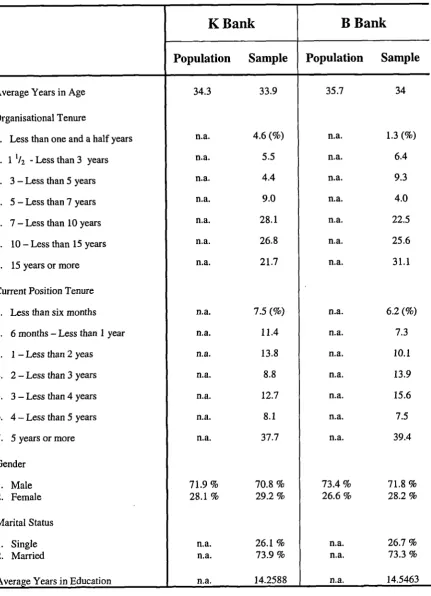
Table 5.2: The demographics of populations and samples for both banks 122
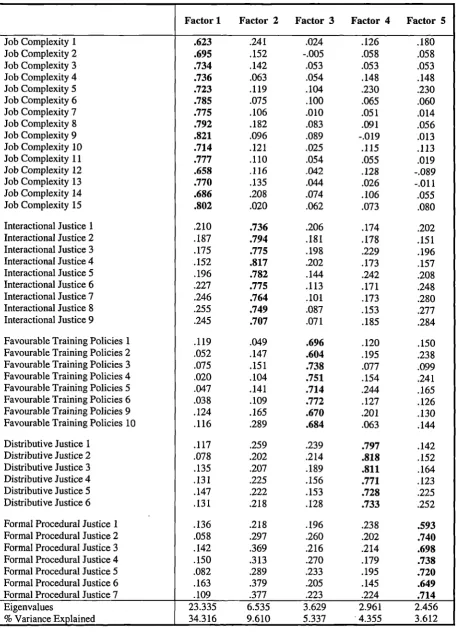
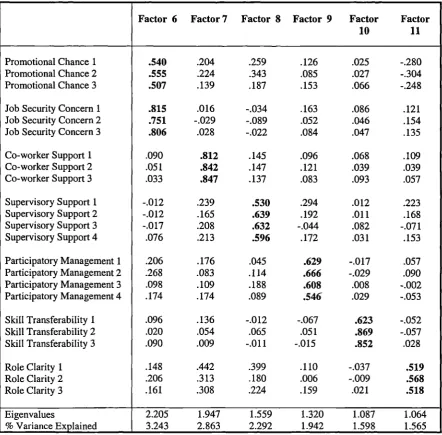
Table 7.1: Factor analysis of items measuring employees' daily work experiences
(K bank sample) 183
Table 7.2: Factor analysis of items measuring employees' daily work experiences
(B bank sample) 185
Table 7.3: Factor analysis of items measuring employees' daily work experiences
(total sample) 187
Table 7.4: Factor analysis of items measuring job security concern and
promotional chances (K bank sample) 188
Table 7.5: Factor analysis of items measuring the hypothesised positive and
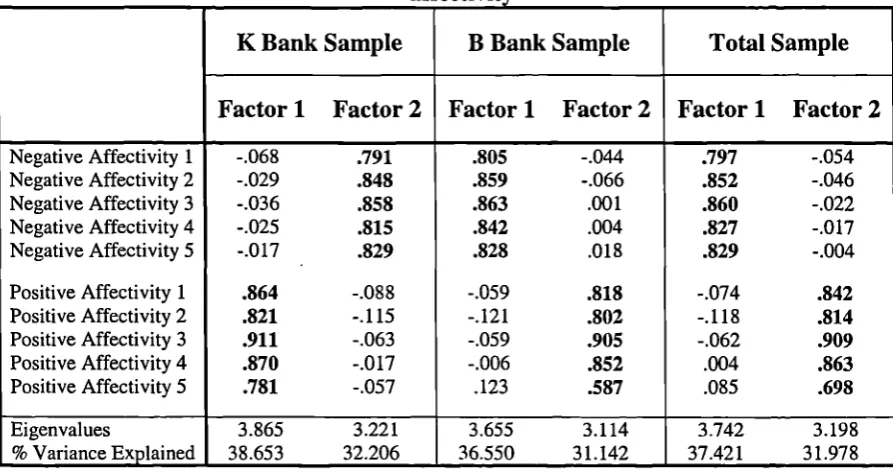
negative affectivity 189
Table 7.6: Factor analysis of items measuring affective commitment .190
Table 7.7: The differences between banks in relation to employees' affective commitment to the organisation (Multiple regression analysis:
total sample) 194
Table 7.8: The differences between banks in relation to employees' daily work
experiences (Multiple regression analysis: total sample) 197
Table 7.9: The impacts of employees' daily work experiences on employees' affective commitment to the organisation (Multiple regression analysis:
total sample) 199
Table 8.1: Factor analysis of items measuring organisational citizenship behaviour
(K bank sample) 206
Table 8.2: Factor analysis of items measuring organisational citizenship behaviour
Table 8.3: Factor analysis of items measuring organisational citizenship behaviour
(total sample) 208
Table 8.4: The impacts of employees' affective commitment to the organisation on the five dimensions of organisational citizenship behaviour (total sample) .210
Table 9.1: Factor analysis of items measuring the hypothesised mediating constructs 216
Table 9.2: Goodness-of-fit statistics of measurement model 227
Table 9.3: Reliability and variance-extracted estimates for constructs .228
Table 9.4: The overall model fit of the causal model of affective commitment
to the organisation (K bank sample) 235
Table 9.5: The overall model fit of the causal model of affective commitment
to the organisation (B bank sample) .235
Table 9.6: The overall model fit of the causal model of affective commitment
to the organisation (total sample) 235
Table 9.7: LISREL estimates (completely standardised coefficients) for the causal
model of employees' affective commitment to the organisation 237
Table 9.8: LISREL estimates (standardised coefficients) of the decomposed direct, indirect, and total causal effects of the determinants and control
variables of employees' affective commitment to the organisation 246
Table 10.1: The differences between banks in relation to the three mediating variables (Multiple regression analysis: total sample) .271
Table 10.2: The impacts of employees' daily work experiences on the three
List of Figures
Figure 3-1:
Figure 4-1:
Figure 4-2:
Figure 9-1:
Figure 9-2:
Figure 9-3:
Figure 9-4:
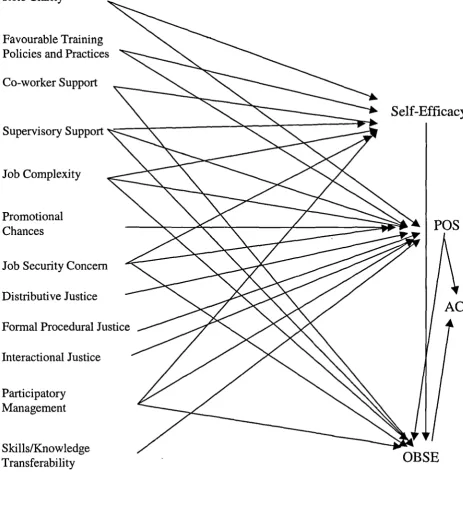
The causal model of the determinants of employees' affective
commitment to the organisation (Model 1) 84
The model of the relationships between downsizing, employees' affective commitment to the organisation and organisational
citizenship behaviour (Model 2) .91
The overall research model (Model 3) 95
The competing models 233
The causal model of the determinants of employees' affective
commitment to the organisation (K bank sample) 242
The causal model of the determinants of employees' affective
commitment to the organisation (B bank sample) 243
The causal model of the determinants of employees' affective
Abbreviations
AC ACS BIS CCS CFI FSC GFI IFI IDS ML NCS NFI NNFI OBSE OCB OCQ PGFI PNFI PUSAffective Commitment to the Organisation
Affective Commitment Scale
Bank for International Settlement
Continuance Commitment Scale
Comparative Fit Index
Financial Supervisory Commission
Goodness-of-Fit Index
Incremental Fit Index
Job Diagnostic Survey
Maximum Likelihood
Normative Commitment Scale
Normed Fit Index
Non-Normed Fit Index
Organisation-Based Self-Esteem
Organisational Citizenship Behaviour
Organisational Commitment Questionnaire
Parsimonious Goodness-of-Fit Index
Parsimonious Normed Fit Index
RMR Root Mean Square Residual
SEM Structural Equation Modelling
SMEs Small and Medium Sized Enterprises
Declaration
The author presents this thesis in accordance with the regulations for the degree of
Doctor of Philosophy. The work presented in this thesis is entirely original and the author's
own, unless otherwise indicated. Moreover, this thesis has not been submitted for a degree
at any other university. The interpretations in this thesis represent nether the views of the
case study organisations nor Warwick Business School. The interpretations are the sole
responsibility of the author.
The following paper based on work on the thesis has been submitted to a journal
before submission:
Chapter 1: Introduction
This thesis seeks to identify and analyse the determinants of employees'
affective commitment to the organisation under downsizing with particular reference to
the Korean banking industry. This chapter addresses the background to the research
problems, the scope of the research, and the structure of the thesis.
Section 1.1 presents the background information for establishing the general
research aims. This section starts from the observation that the majority of downsized
organisations have failed to reap the intended benefits of downsizing, such as improved
labour productivity and improved labour flexibility (e.g. Dunford et al., 1998). It is
suggested that this is because of survivors' poor morale and the failure to maintain a
high level of employees' affective commitment to the organisation. In fact, maintaining
a high level of employees' affective commitment is assumed to be a critical factor for
successful downsizing. These issues are discussed in the first half of Section 1.1 (i.e.
Sections 1.1.1, 1.1.2 and 1.1.3), which emphasises the usefulness of employees'
affective commitment to the organisation for successful downsizing. Next, Section 1.1.4
deals with a number of issues that need to be solved in order to provide insights into
how to manage employees' affective commitment to the organisation under downsizing.
Then, Section 1.1.5 briefly discusses the Korean banking industry (the focus of the
present research) in terms of changes in the employment system. Finally, Section 1.1.6
Section 1.2 discusses the scope of the research. Because the research area of
organisational commitment is so broad, it is essential to define it more precisely in
relation to the research aims. Finally, Section 1.3 describes the structure of the thesis.
1.1 Background to the Research Problems
1.1.1 Downsizing
Corporations in many industrial sectors have been faced with a rapidly changing
environment involving deregulation (which leads to a blurring of boundaries and
therefore the production of new competitors) (Cascio, 1995; Dunford et al., 1998), the
rapid development of information technology (Brynjolfsson, 1996), and global
competition (Cascio, 1995; Tang and Ibrahim, 1998). Such environmental changes have
placed corporations under increased competition domestically and internationally. Thus,
much greater emphasis has been placed on flexibility and efficiency (Meyer and Allen,
1997) and downsizing has been one favoured strategy to achieve these goals (Luthans
and Sommer, 1999; Mishra and Spreitzer, 1998). For example, at least one third of large
and medium-size US companies have downsized their workforces every year since 1988
(Henkoff, 1994), and more than 85 per cent of Fortune 1000 firms pared their
white-collar workforce between 1987 and 1991 (Cascio, 1993).
According to Cameron (1994a), downsizing is something that organisational
an intentional set of activities. Moreover, downsizing usually involves reductions in
personnel and is focused on improving the efficiency of the organisation. Reductions in
personnel normally imply that fewer employees are left to do the same amount of work,
which tends to affect what work gets done and how it gets done. Thus, downsizing
affects work processes wittingly or unwittingly. Therefore, downsizing can be defined
as "an intentionally instituted set of activities designed to improve organizational
efficiency and performance which affect the size of the organization's workforce, costs,
and work processes" (Cameron, 1994a, p. 194), and is viewed as a legitimate response
to increased competition and the need for greater competition by its advocates (Meyer
and Allen, 1997). In fact, Dunford et al.'s (1998) research, which investigated 653
Australian companies, shows that corporations' main objectives in implementing
downsizing were to improve labour productivity, reduce labour costs, improve customer
service, and improve labour flexibility.
However, only some organisations have reaped the intended benefits of
downsizing (e.g. Cascio, 1993; Cameron, 1994b; Cameron et al., 1991; Dunford et al.,
1998, Henkoff, 1994; Wagar, 1998). For example, in a study which examined the actual
economic results of downsizing in Australian public organisations, Dunford et al.
(1998) observed that 32.1, 51.8, 22.1, and 19.4 per cent of organisations achieved
improved labour productivity, reduced labour costs, improved customer service, and
improved labour flexibility respectively through downsizing. In contrast, numerous
researchers have reported that downsizing produces considerable dyfunctional
consequences, including the decline of service quality and innovation, and employees'
"survivor syndrome", as expressed in increasing anxiety and risk aversion (e.g.
2000). The dyfunctional consequences of downsizing are believed to be mainly due to
the poor morale of those who remain after downsizing (hereafter, survivors) and failure
to maintain a high level of employees' affective commitment to the organisation
(Cascio, 1993; Cameron, 1994a).
1.1.2 Survivors' Reactions to Downsizing
Many studies report that downsizing leads to a reduction in survivors' morale
and their affective commitment to the organisation (e.g. Brockner, 1988a; Cameron et
al., 1991; Cascio, 1993; Luthans and Sommer, 1999; Mone, 1994; Tomasko, 1990;
Wagar, 1998). Downsizing-induced stresses, linked for example to work load increase
and uncertainty, may explain this pattern.
People enter organisations with certain needs and desires, and expect a work
environment in which they can satisfy those needs and desires. If the organisation
provides employees with such a work environment, their affective commitment to the
organisation is likely to be enhanced (Mottaz, 1988; Steers, 1977). This coincides with
the social exchange view of the mechanism governing the development process of
employees' affective commitment to the organisation, i.e. employees are seen to
develop their affective commitment to the organisation to the extent that the
organisation provides them with what they value.
Before the era of downsizing, individuals (especially, managers in large-scale
that provided the opportunities for both completing certain tasks and pushing forward
towards longer-term personal goals. Indeed, the major rewards of the modern
managerial career have been constituted by the combined promise of job security and
advancement within corporate hierarchies that link incremental increases in authority,
status and pay (Goffee and Scase, 1992). If individuals (especially, managers in
large-scale organisations) reached a certain level of competence and performance according to
their job description, they could be assured of long-term employment. Moreover, there
was a job structure that allowed them to be regularly promoted. If they did their work
properly and fulfilled their responsibilities, they could ascend the corporate ladder.
Thus, there was a sense of achievement and getting ahead, and this propelled them
along (Isabella, 1989). In the end, for managers in large-scale organisations, the
traditional employment relationship satisfied the needs of their job security and career
aspiration. Thus, according to Isabella (1989), employees' affectiye commitment to the
organisation was the by-product of what the organisation provided — i.e. job security,
promotions and salary increases.
The traditional employment relationship (especially, for managers in large-scale
organisations) was therefore characterised as the straightforward exchange of job
security and material rewards for loyalty and commitment between employer and
employee (Schalk and Freese, 1997). However, downsizing undermines the
fundamental tenet of the employment relationship between employers and employees.
Employees may feel a certain level of uneasiness about job security. In fact, one round
of downsizing is apt to lead to another round of downsizing. For example, according to
Henkoff (1994), two-thirds of corporations that have reduced their workforce will do it
downsizing. Moreover, the conventional idea of a good career structure is also
undermined. That is, the traditional career structure, and the old idea of getting on and
of advancement in one's job can no longer be taken for granted (Isabella, 1989). Thus,
the violation of traditional employment relations between the organisation and its
employees has the potential to produce anxiety and uncertainty concerning job
insecurity and career prospects (Hui and Lee, 2000). Considerable research (e.g.
Brockner, 1988a; Cameron, 1994a; Cascio, 1993; Tomasko, 1990; Luthans and
Sommer, 1999) reports that many survivors become self-absorbed, narrow-minded, and
risk averse, and an attitude of "me-first" becomes dominant after downsizing.
Survivors' morale and trust in management are also eroded. As a consequence,
employees might invest little in the organisation itself and behave like independent
contractors, and they may no longer be committed to the general welfare of the
company as a whole. They just do their jobs as prescribed (Isabella, 1989). Thus,
Waterman et al. (1994) ask the following questions:
How can an enterprise build capabilities, forge empowered teams, develop a deep understanding of its customers, and — most important — create a sense of community or common purpose unless it has a relationship with its employees based on mutual trust and caring? And how can an enterprise build such a relationship unless it commits something to employees and employees commit something to it? (p. 87)
In fact, survivors are the very people who are supposed to revitalise the organisation
and "delight" customers (Henkoff, 1994).
However, some survivors appear to regard downsizing as an opportunity for
personal growth. They are energised, as opposed to experiencing emotional distress. For
managers have clearer areas of responsibility, more control over resources, freedom to
innovate, and freedom to take on new challenges. In fact, several authors (e.g. Emshoff,
1994; Henkoff, 1994) argue that survivors can regard downsizing as an opportunity for
their personal growth if the downsizing results in more favourable changes in their daily
work experiences. Some support for their argument is provided by Brockner et al.'s
(1993) study, which shows that change in the perceived intrinsic quality of the content
of survivors' jobs (in terms of autonomy, task identity, task variety, task significance,
and feedback from the job itself) relative to the situation before downsizing is correlated
with change in survivors' attitudes/behaviours (as expressed in affective commitment
and turnover intention).
Moreover, Cameron's (1994a) study provides an evidence that downsizing does
not produce poor survivors' morale if their work experiences in relation to downsizing
are positive. In his investigation of 30 downsized organisations, Cameron (1994a) found
that organisations had an absence of dyfunctional consequences of downsizing and
improved performance if workforce reduction was accompanied by the effective
management of the human resource system, which includes increased communication,
increased employees' participation, administering downsizing in a trustworthy and fair
manner, and training. Brocicner's (1990) study also reveals that many survivors become
more withdrawn from their jobs and organisations if they perceive that management
handles job-losers unfairly (in terms of decision-makers' conduct during the enactment
of the decision-making procedure and their caretaking of job-losers). These studies
implicitly suggest that employees' daily work experiences in relation to downsizing
It is worth noting that some employees' daily work experiences, which are seen
to affect survivors' reactions to downsizing and are identified in the empirical results
(i.e. increased communication, participation, fairness, job enrichment, and training), are
the determinants of employees' affective commitment to the organisation (which will be
discussed in Section 2.3.1.1). In fact, the existing literature implicitly emphasises the
importance of employees' affective commitment to the organisation for successful
downsizing.
1.1.3 The Importance of Employees' Affective Commitment to the
Organisation under Downsizing
As organisations downsize their workforce, they rely . more than ever on
survivors to do what is needed for the organisation to survive and succeed (Meyer and
Allen, 1997). According to Dunford and his colleagues (1998), downsizing leads to an
increase in work pressure because of a number of interrelated factors. These include
coping with the demands of increased spans of control, taking on the added tasks and
responsibilities of those who have left, and those brought about by the devolution of
tasks previously performed by specialist staff. Moreover, tasks may be defined less
well. Thus, survivors are required to be more flexible and adaptable, to be acutely aware
of all that is going on around them (both internally and externally to the organisation),
to have a greater strategic orientation, and to find creative ways of improving their
efficiency. Moreover, in cases where the workforce has been slimmed down,
performers) can have serious consequences (Dunford et al., 1998; Meyer and Allen,
1997).
These points underline the importance of employees' affective commitment to
the organisation. This is because, as a number of researchers have argued, employees'
affective commitment to the organisation has a potential negative impact on turnover
intentions, actual turnover, voluntary absence, and passive withdrawal from the
dissatisfying situations (Hackett et al., 1994; Meyer et al., 1993; Whitener and Walz,
1993). It also has a positive impact on willingness to suggest improvements (Meyer et
al., 1993). Moreover, many studies (e.g. Meyer et al. 1993; Moorman et al., 1993)
report that employees' affective commitment to the organisation correlates positively
with organisational citizenship behaviour, which promotes the efficient and effective
functioning of the organisation and provides the flexibility needed to work through
many unforeseen contingencies (Tang and Ibrahim, 1998). Thus, maintaining a high
level of employees' affective commitment to the organisation is likely to be a critical
factor for successful downsizing. However, as discussed in Section 1.1.2, many studies
show that downsizing leads to a reduction in employees' affective commitment to the
organisation because of downsizing-induced stresses such as the perception of
uncertainty. Thus, some issues need to be solved in order to overcome this paradox, and
1.1.4 Issues Relevant to the Successful Management of Employees'
Affective Commitment to the Organisation Under Downsizing
Although downsizing per se tends negatively to affect employees' affective
commitment to the organisation, some studies discussed in Section 1.1.2 (i.e. Brocicner
et al., 1993; Cameron, 1994a) implicitly suggest that employees' affective commitment
to the organisation can be maintained or even increased if changes in employees daily
work experiences (caused by or in relation to downsizing) are more favourable
compared with the situation before downsizing. These results suggest that there might
be a certain mechanism through which downsizing positively and/or negatively affects
employees' affective commitment to the organisation. If so, this mechanism might
guide us to information for the successful management of employees' affective
commitment to the organisation under downsizing.
The downsizing literature tells us little about such a mechanism. Nevertheless, it
does provide some clues. Some authors (e.g. Brockner, 1992; Cameron 1994a) stress
that downsizing affects the nature of work, which may produce both threats and
opportunities for employees. Employees, for instance, might experience an increase in
workloads because fewer employees are now doing the same amount of work, which
may be viewed as a possible threat. At the same time, their jobs might become
intrinsically more enjoyable because of the added responsibility and autonomy, and this
might be seen as an opportunity. In fact, a large-scale survey conducted by the Wyatt
Company, which polled 1,005 organisations employing a total of more than four million
people, shows that 58 per cent of respondents experienced increased work overload as a
became more intrinsically enjoyable (Brockner, 1992). Given the fact that employees'
work experiences strongly and consistently appear to be the antecedents of employees'
affective commitment to the organisation (Meyer and Allen, 1997), as we will see in
Chapter 2, if downsizing affects employees' work experiences, it indirectly affects
employees' affective commitment to the organisation. Thus, along with its negative
direct impact on employees' affective commitment to the organisation, downsizing may
affect employees' affective commitment to the organisation indirectly (through
employees' daily work experiences). Moreover, if the indirect impact is stronger than
the direct impact, practitioners can manage employees' affective commitment to the
organisation by making employees' daily work experiences change in a direction that
enhances employees' affective commitment to the organisation.
Here, by identifying what kinds of employees' daily work experiences are the
determinants of employees' affective commitment to the organisation and by
understanding why and how such determinants affect their affective commitment to the
organisation, practitioners can manage employees' daily work experiences more
effectively in order to enhance employees' affective commitment to the organisation.
However, although a number of determinants of employees' affective commitment to
the organisation have been identified (and these will be discussed in Section 2.3.1.1),
we still do not know how and why such determinants affect employees' affective
commitment to the organisation.
This thesis tries to solve these issues with reference to the Korean banking
industry. Since, as we shall show, the indirect impact of downsizing on employees'
affective commitment to the organisation appears to be much stronger than its direct
mechanism through which various determinants exert their influence on employees'
affective commitment to the organisation. These issues will be examined with particular
reference to the Korean banking industry, and the next section briefly describes the
Korean banking industry in terms of change in the employment system.
1.1.5 The Change in the Employment System in the Korean Banking
Industry
Traditionally, Korean corporations in the primary labour market guaranteed their
employees' life-time employment, and their promotion and salary systems were mainly
based on seniority. Moreover, employees were provided with welfare benefits such as
family and children's allowances. They were recruited straight from schools and
universities, and external job markets remained undeveloped. Thus, employees pursued
their careers in their employing organisations. However, with the financial crisis at the
end of 1997, this employment system was shattered. Many companies have carried out
downsizing. Wages and various benefits have been cut. The external job market has
been enlarged because many corporations prefer to hire skilled workers, and, at the
same time, outsourcing has increased. As a result, employees' views of their employing
organisation have changed dramatically. According to a report on "people's views under
the IMF regime" published by Weekly Chosun l (12 November 1998), 60 per cent of
respondents feared that they might lose their jobs. 82 per cent of respondents answered
that their earnings had been reduced. The changed employment environment has
changed people's ideas about their companies and occupations — i.e. people think that
their occupation is more important than the company they work for. Employees are
trying to enhance the value of their trades. Here, the banking sector embodied the
traditional Korean employment system before the financial crisis. Bank employees
boasted of their privileged status in terms of job security and high salaries. Moreover,
promotion was from within, and individuals pursued their careers in the employing
banks. However, this sector was amongst the most badly affected by the financial crisis.
Thus, downsizing has been extensively implemented (in terms of job cuts and earning
reduction) in the Korean banking industry, and employees have experienced tremendous
changes in their employment system.
1.1.6 Research Aims
The discussion up to now highlights several research aims. The first research
aim is to explore the mechanism through which downsizing exerts its influence on
employees' affective commitment to the organisation, i.e. we need to ask: Does
downsizing itself really lead directly to a reduction in employees' affective commitment
to the organisation? Does downsizing indirectly affect employees' affective
commitment to the organisation via employees' daily work experiences? If downsizing
affects employees' affective commitment to the organisation directly and indirectly,
which impact is stronger? The second research aim is to examine whether employees'
identify the determinants of employees' affective commitment to the organisation and to
examine why and how such determinants have these effects. These are the three major
research aims that will be addressed in the current study in the context of the Korean
banking sector. In line with these questions, this thesis will start by examining how the
Korean banking sector has changed since the financial crisis.
1.2 Scope of the Research
1.2.1 Attitudinal Commitment vs. Behavioural Commitment
The literature on commitment is clearly divided into two apparently different
schools. One school of thought on commitment, which is called "attitudinal
commitment", regards commitment largely as an employee attitude or psychological
state. The study of this approach has typically involved the measurement of
commitment (e.g. Hrebiniak and Alutto, 1972; Mowday et al., 1979; Wiener and Vardi,
1980), other variables assumed to be the antecedents to commitment (e.g. Mowday et
al., 1982), and the consequences of commitment (e.g. Buchanan, 1974; Steers, 1977).
The other school of thought on commitment views commitment as a type of
motivational force tying the individual to a particular course of action. This approach is
called "behavioural commitment" and has developed largely out of the work of Becker
(1960) and Kiesler (1971). This perspective considers the development of attitudes to be
Caldwell, 1981; Salancik, 1977) has primarily focused on revealing the conditions
under which a behaviour tends to be repeated and on the effects of such behaviour on
attitude change. According to Salancik (1977), "the degree of commitment derives
from the extent to which a person's behaviors are binding. Four characteristics of
behavioral acts make them binding, and hence determine the extent of commitment:
explicitness; revocability; volition; and publicity" (p. 4). Once commitment is made,
individuals try to find mechanisms for adjusting to such commitment psychologically to
avoid cognitive dissonance or to maintain positive self-perceptions. In their research,
which investigated the effects of post-decisional justifications on the job satisfaction
and commitments of new employees, O'Reilly and Caldwell (1981) found that
individuals who had made the original decision volitionally and who had perceived the
choice to be irrevocable were more satisfied and committed six months later than others.
They suggest that attitudes and commitment may be created retrospectively through
processes of rationalisation and justification.
Mowday et al. (1982) describe the difference between the two approaches:
Attitudinal commitment focuses on the process by which people come to think about their relationship with the organization.... Behavioral commitment, on the other hand, relates to the process by which individuals become locked into a certain organization and how they deal with this problem. (p. 26)
Although the distinction between attitudinal and behavioural commitment is
useful, one approach is not necessarily superior to the other. Rather, both are closely
related in the sense that a self-reinforcing cycle can emerge in the
commitment-behaviour link. In the attitudinal approach, the commitment-behavioural consequences of
commitment. In the behavioural approach, a behaviour causes the development of
congruent attitudes, which in turn leads to further behaviours. Thus, both concepts are
useful (see McGee and Ford, 1987; Meyer and Allen, 1991, 1997; Mowday et al., 1982;
O'Reilly and Caldwell, 1981; Reichers, 1985; Salancik, 1977; Scholl, 1981).
However, this thesis is concerned with how the organisation, after downsizing,
can maintain or increase employees' attachment to the organisation, thereby potentially
leading to employees' willingness to go the extra mile on behalf of the organisation.
Thus, the focus of this thesis is on employees' psychological attachment to an entity
(i.e. the organisation). However, the behavioural commitment approach views
employees as becoming committed not so much to an entity as such, but to a particular
course of action (Meyer and Allen, 1997). Although employees' attachment to the
organisation can develop on the basis of behavioural commitment via retrospective
rationality or justification processes, an organisation wanting to foster its employees'
attachment to the organisation has difficulty in creating the conditions necessary to
include retrospective rationalisation processes (Meyer, 1997). Thus, this thesis is only
concerned with attitudinal commitment, and issues related to behavioural commitment
are outside the scope of this work.
1.2.2 A Three-Component Model
Mowday et al. (1982) note in their literature review on the topic of
definitions to the topic (e.g. Hrebiniak and Alutto, 1972; Porter et al., 1974; Wiener and
Vardi, 1980). Thus, little consensus exists concerning the meaning of commitment.
However, there is growing agreement that organisational commitment is a
multi-dimensional construct. Several authors (e.g. Meyer and Allen, 1991; O'Reilly and
Chatman2, 1986; Mayer and Schoorman3, 1992) have presented their own
multi-dimensional concepts of commitment and, of the multi-multi-dimensional models, Meyer and
Allen's (1991) three-component model has so far received the most extensive empirical
evaluation and has been widely accepted. Thus, this thesis focuses on Meyer and
Allen's approach to commitment. Their three-component model of organisational
commitment embraces affective commitment, continuance commitment and normative
commitment. However, as we will discuss in Chapter 2, affective commitment is likely
to be the most relevant to successful downsizing.
2 O'Reilly and his colleagues (Caldwell et al., 1990; O'Reilly and Chatman, 1986) argue that commitment is best defined as the basis of an individual's psychological attachment to the organisation that is predicated on three independent foundations: compliance, identification and internalisation. "Compliance occurs when attitudes and behaviors are adopted not because of shared beliefs but simply to gain specific rewards...Identification...occurs when an individual accepts influence to establish or maintain a satisfying relationship;.. .Internalization occurs when influence is accepted because the induced attitudes and behaviors are congruent with one's own values" (O'Reilly and Chatman, 1986, p. 493). However, several studies find it difficult to distinguish identification and internalisation (e.g. Becker et al., 1995; Caldwell et al., 1990; O'Reilly et al., 1991; Sutton and Harrison, 1993). Even in studies that show that identification and internalisation are distinguishable, they appear to be highly correlated with each other (e.g. Becker, 1992; Becker et al., 1996; Harris et al., 1993). These studies indicate that the dimensionality of O'Reilly and Chatman's (1986) scale, with regard to distinguishing identification and internalisation, is not stable across all samples and contexts (Harris et al., 1993). Moreover, according to Meyer and Allen (1997), while compliance is clearly distinguished from identification and internalisation, a question as to whether it can be considered to be a commitment might be raised. For whereas compliance has been found to be positively related to employee turnover intention and/or actual turnover (e.g. Becker, 1992; O'Reilly and Chatman, 1986), commitment is generally assumed to reduce turnover (e.g. Mowday et al.,
1982; Meyer and Allen, 1991).
1.3 The Structure of the Thesis
The first half of the thesis is concerned with important conceptual and
theoretical elements. Chapter 2 presents the concept of organisational commitment used
in the study. Chapter 3 is concerned with the development of theory, i.e. the theoretical
basis of the causal model of the determinants of employees' affective commitment to
the organisation is presented. Then, in Chapter 4, the three core research aims and
hypotheses are identified and discussed in detail. Moreover, relevant research models
are also developed on the basis of the causal model of employees' affective commitment
to the organisation. Chapter 5 discusses methodology.
The second half of the thesis concerns the empirical testing of the models.
Chapter 6 discusses the two case-study banks within which the models are tested, and
thereby provides the background information for the subsequent analyses. Chapter 7,
which examines the first research aim, investigates the hypothesised mechanisms
through which downsizing exerts its influence on employees' affective commitment to
the organisation, i.e. it investigates whether downsizing affects employees' affective
commitment to the organisation directly and/or indirectly (through employees' daily
work experiences) and, if so, which impact is stronger. If the direct impact is stronger,
then management has little room to intervene in managing employees' affective
commitment to the organisation. On the other hand, if the indirect impact is stronger,
management has considerable scope to intervene in managing employees' affective
commitment to the organisation through employees' daily work experiences during or
has room to intervene in managing employees' affective commitment to the
organisation in the process of downsizing. If the indirect impact is stronger, we need to
know whether employees' affective commitment to the organisation is worth fostering
enough for management to intervene in managing such commitment. Thus, Chapter 8,
which investigates the second research aim, examines the consequences of employees'
affective commitment to the organisation. If employees' affective commitment to the
organisation appears to be important in the downsizing context, it is then important to
identify and analyse the determinants of employees' affective commitment to the
organisation in order effectively to manage such commitment under downsizing. This is
the focus of Chapters 9 and 10, which identify the determinants of employees' affective
commitment to the organisation and investigate how and why such determinants affect
employees' affective commitment to the organisation (the third research aim) — i.e. the
mechanism through which employees' daily work experiences exert their influence on
employees' affective commitment to the organisation. Chapter 11 discusses the overall
Chapter 2: The Meaning of Commitment: The
Concept and Its Relevance to Downsizing
2.1 Introduction
This chapter seeks to understand the meaning of commitment, especially in
terms of the relevance of its antecedents and consequences to downsizing. These issues
are dealt with in Sections 2.2 and 2.3. Moreover, some measurement issues of
organisational commitment in relation to this thesis are discussed in Section 2.4. These
sections (i.e. 2.2, 2.3 and 2.4) provide the reasons why this thesis only focuses on
employees' affective commitment to the organisation. Next, Section 2.5 discusses the
psychological mechanism through which various antecedents exert their influence on
employees' affective commitment to the organisation. Then, the relationship between
employees' affective commitment to the organisation and their psychological contract
(which has been used as a tool for describing and explaining the impact of downsizing
on employees' organisational commitment) is discussed in Section 2.6. Finally, the
cross-cultural applicability of affective commitment is examined in Section 2.7,
2.2 Meyer and Allen's Three-Component Model of
Commitment
Meyer and Allen (1997) emphasise the importance of formulating a well-defined
concept of commitment and its measures:
From a scientific standpoint, we cannot begin to study the development and consequences of commitment systematically until the construct is defined and measures are developed. Similarly, practitioners will have difficulty taking guidance from the scientific literature, as well as from more popular treatments of the topic, until we clarify what we mean by commitment. (pp. 10-11)
However, the work in the area of commitment is characterised by a variety of
definitions, e.g. "the nature of the relationship of the member to the system as a whole"
(Grusky, 1966, p. 489); "the totality of internalized normative pressures to act in a way
that meets organizational goals and interests" (Wiener, 1982, p. 421); "the willingness
of social actors to give their energy and loyalty to social systems, the attachment of
personality systems to social relations which are seen as self-expressive (Kanter, 1968,
p. 499); "an attitude or an orientation toward the organization which links or attaches
the identity of the person to the organization" (Sheldon, 1971, p. 143); "a structural
phenomenon which occurs as a result of individual-organizational transactions and
alterations in side bets or investments over time" (Hrebiniak and Alutto, 1972, p. 556);
"a partisan, affective attachment to the goals and values of an organization, to one's role
in relation to goals and values, and to the organization for its own sake, apart from its
purely instrumental worth" (Buchanan, 1974, p. 533); "the strength of an individual's
604); "attitudes toward the organization which are based on expectations and values of
loyalty and duty" (Wiener and Vardi, 1980, p. 86). In addition to these diverse
definitions, diverse scales have also been offered to measure the commitment construct,
including Porter et al.'s (1974) Organizational Commitment Questionnaire (OCQ) and
Wiener and Vardi's (1980) three-item scale.
Thus, the empirical literature concerning commitment is potentially confusing.
Moreover, according to Meyer and Allen (1997), it is difficult to say that any particular
definition is more correct or more generally accepted than the others. The definitions are
merely different. Thus, "it can only confuse the issue if we speak of commitment
without indicating which definition we are using" (Meyer and Allen, 1997, p. 11).
However, fortunately, as Meyer and Allen (1997) note, "the picture is not as confusing
as it first appears" (p. 11). These various definitions can be classified into several
categories. Meyer and Allen (1991) observe that the various definitions reflect three
broad themes: affective attachment to the organisation; perceived costs associated with
leaving the organisation; and obligation to remain with the organisation.
Meyer and Allen (1991) note that common to these three approaches is "the
view that commitment is a psychological state that (a) characterizes the employee's
relationship with the organization, and (b) has implications for the decision to continue
or discontinue membership in the organization" (p. 67). Thus, committed employees
tend to remain in the organisation longer than do uncommitted employees, regardless of
which approach is used. Based on the conceptualisation of the three approaches
identified above, the authors develop a three-component multi-dimensional model of
commitment, i.e. it embraces affective commitment, continuance commitment and
Affective commitment is defined as "the employee's emotional attachment to,
identification with, and involvement in the organisation....Continuance commitment
refers to an awareness of the costs associated with leaving the organisation....Finally,
normative commitment reflects a feeling of obligation to continue employment" (Meyer
and Allen, 1991, p. 67). A common denominator of all three conceptualisations of
attitudinal commitment is the binding of the individual to an organisation. However, the
nature of the psychological states reflected in each commitment is different:
Employees with a strong affective commitment continue employment with the organization because they want to do so... .Employees whose primary link to the organization is based on continuance commitment remain because they need to do so.... Employees with a high level of normative commitment feel that they ought to remain with the organization. (Meyer and Allen, 1991, p. 67)
In fact, the central theme emerging from affective commitment is that of an
exchange through which individuals attach themselves to the organisation in return for
certain payments from the organisation (see Mottaz, 1988, p. 490; Mowday et al., 1982,
p. 27; Steers, 1977, p. 53). On the other hand, continuance commitment is based on
Becker (1960)'s side-bet theory', which is consistent with the notion of exchange, where
"commitment develops as a result of an employee's satisfaction with the rewards and
inducements an organization offers - rewards that must be sacrificed if the employee
leaves the organization" (Jaros et al., 1993, P. 953) (see Allen and Meyer, 1990, pp. 2-3;
Farrell and Rusbult, 1981, p. 79; Jaros et al., 1993, p. 953; Meyer and Allen, 1991, pp.
64-66; Meyer and Allen, 1997, p.12). The exchange notion of continuance commitment
is different from that of affective commitment in the sense that it reflects the cold
calculation of costs and benefits. Here, affect plays a minimal role in the
conceptualisation of commitment.
Here, it is important to note that Becker's side-bet theory has often been
discussed in the context of behavioural commitment. This is due to the fact that, like the
behavioural approach described by Salancik (1977), Becker's definition focuses on the
tendency to continue a course of action. However, according to Meyer and Allen
(1991), the two approaches exhibit an important difference that is often ignored.
For Becker, commitment requires a recognition on the part of the individual of the costs associated with discontinuing an activity. Without this recognition there is no commitment... .In contrast, for Salancik (1977), the conditions contributing to the initiation and continuation of behavior may be very subtle and beyond conscious recognition. Moreover, rather than recognition of costs, the psychological state associated with behavioral commitment tends to be a desire to continue the action, or an attraction to the object of that action. That is, under the right conditions (e.g., freedom of choice, irrevocability of the act), agreeing to work for an organization can result in an intention to continue employment, followed by the development of a positive attitude toward the organization that justifies the behavior... (p. 65)
Noting the differences between the two approaches, Meyer and Allen (1991)
argue that Becker's (1960) side-bet theory is more consistent with the framework for the
attitudinal approach than that for the behavioural approach, for Becker emphasises the
awareness of the costs associated with leaving the organisation. For them, this
recognition is a conscious psychological state that is shaped by environmental
turnover) (see Allen and Meyer, 1990, P. 4; Jaros et al., 1993, P. 953; Meyer and Allen,
1991, pp. 65-66).
Normative commitment is different from affective commitment, for it does not
necessarily reflect emotional attachment. Instead, it reflects a sense of duty or obligation
to work in the organisation. It also differs from the approach of continuance
commitment because it does not necessarily fluctuate with personal calculations of
inducements or sunk costs. Because Meyer and Allen's three-component model is based
on common themes in the conceptualisation of commitment from the existing literature,
the model makes it possible to incorporate the results of a wide range of studies using
measures other than those developed specifically to test the model. For example, Allen
and Meyer's (1990) and Shore and Tetrick's (1991) studies show that items from the
Affective Commitment Scale5 load on the same factor as items from the Organisational
Commitment Questionnaire (OCQ), which provides evidence that the OCQ measures
primarily affective commitment. Thus, the many studies using the OCQ can be
discussed in the realm of affective commitment.
2.3 The Antecedents and Consequences of Organisational
Commitment
2.3.1 The Antecedents of Organisational Commitment
Because the three components of organisational commitment are different from
each other in terms of the nature of their underlying psychological states, Allen and
Meyer (1990) argue that each of the three components of commitment develops
independently as a function of different antecedents.
2.3.1.1 Affective Commitment
Several hundred researchers have examined the correlations between affective
commitment and the variables hypothesised as its antecedents. In general, the wide
range of variables examined can be categorised into three groups: organisational
characteristics, personal characteristics, and work experiences.
Although some studies report that organisational structure variables such as size
and centralisation are correlated with affective commitment (e.g. Brooke et al., 1988;
Sommer et al., 1996), Mathieu and Zajac's (1990) meta-analytic evidence suggests that
the links are neither strong nor consistent. This might be due to the fact that the
day-to-day work experiences than to these macro-level variables (Meyer and Allen,
1997).
Research into personal characteristics has focused on two types of variables:
demographic variables (e.g. gender, age, tenure) and dispositional variables (e.g.
positive affectivity and negative affectivity). In general, the relationship between
demographic variables and affective commitment is neither strong nor consistent.
According to Mathieu and Zajac (1990), demographic variables except age and tenure
(e.g. education, gender and marital status) are not likely to be related consistently to
affective commitment. For dispositional variables, although some studies show that
employees' affectivity is related to affective commitment (e.g. Ko et al., 1997), there is
scant consistent evidence that individuals with particular personality characteristics are
more or less likely to become affectively committed to an organisation. If personality
variables are involved in the development of affective commitment, it is more likely to
be through their interaction with particular work experiences. For example, a person
with a strong need for affiliation might have stronger affective commitment to an
organisation that emphasises and encourages teamwork than would a person with a
modest need for affiliation (Meyer and Allen, 1997).
Thus far, the vast majority of studies of antecedents have focused on the
variables falling into the broad category of work experiences (Meyer and Allen, 1997)
and, in many studies, the principle of exchange (mentioned in Section 2.2) has been
postulated to be a mechanism operating in the development of employees' affective
commitment (e.g. Mottaz, 1988; Steers, 1977). That is, employees want to continue
their employment relationship with the organisation if it provides them with positive
return, employees are likely to develop affective commitment and contribute to
organisational effectiveness, thereby maintaining equity in their relationship with the
organisation (Meyer and Allen, 1991). In fact, the literature on the antecedents of
commitment shows that affective commitment is correlated with a number of work
experiences that "communicate that the organization is supportive of its employees,
treats them fairly, and enhances their sense of personal importance and competence by
appearing to value their contributions to the organization" (Meyer and Allen, 1997, p.
46). These include co-worker support (e.g. Ko et al., 1997), distributive justice (e.g.
Allen and Meyer, 1990; Ko et al., 1997; Rhodes and Steers, 1981), formal procedural
justice (e.g. Konovsky and Cropanzano, 1991; Moorman et al., 1993), interactional
justice (e.g. Konovsky and Cropanzano, 1991), job challenge (e.g. Allen and Meyer,
1990; Buchanan, 1974; Ko et al., 1997), job security (e.g. Ko et al., 1997),
organisational dependability (e.g. Allen and Meyer, 1990; Buchanan, 1974; Dunham et
al., 1994; Steers, 1977), participation in decision-making (e.g. Allen and Meyer, 1990;
DeCotiis and Summers, 1987; Dunham et al., 1994; Rhodes and Steers, 1981),
promotional chances (or career satisfaction) (e.g. Dunham et al., 1994; Ko et al., 1997),
role clarity (e.g. Allen and Meyer, 1990; DeCotiis and Summers, 1987; Ko et al., 1997),
supervisor support (e.g. DeCotiis and Summers, 1987; Morris and Sherman, 1981; Ko et
al., 1997), task autonomy (e.g. Colarelli et al., 1987; Dunham et al., 1994; Ko et al.,
1997), training and development (Gaertner and Nollen, 1989), and transferability of
2.3.1.2 Continuance Commitment
Continuance commitment, on the other hand, seems to be affected by anything
that increases the perceived costs of leaving the organisation. Side bets or the
investments an employee has made in the organisation (e.g. time and effort, pension
contributions) will increase his/her level of continuance commitment because leaving
the organisation results in the loss of valuable resources spent in the organisation to
enhance his/her well-being. The lack of comparable employment alternatives is also
likely to increase employees' continuance commitment (see Allen and Meyer, 1990; Ko
et al., 1997).
In fact, research shows that continuance commitment develops through an
employee's recognition of the side-bets (or investments) made in the organisation and
the lack of comparable employment alternatives. These include pensions (Allen and
Meyer, 1990), job alternatives (Allen and Meyer, 1990; Gellatly, 1995; Ko et al., 1997),
and the lack of transferability of skills/knowledge.
2.3.1.3 Normative Commitment
Normative commitment is expected to develop as the result of two
mechanisms: socialisation experiences and a norm of reciprocity. Socialisation,
emphasising commitment to one's employer, includes both family-based experience
concerning work (e.g. parents who stress loyalty to one's organisation) and