Short report
Creating a diabetes foot reminder-based
registry using the electronic medical record
James S Wrobel DPM MS
Staff Podiatrist, James A Lovell Federal Health Care Center, North Chicago, IL, USA and Scholl’s Center for Lower Extremity Ambulatory Research (CLEAR), Rosalind Franklin University of Medicine and Science, North Chicago, IL, USA
William Chagares DPM
Chief, Podiatry Section, James A Lovell Federal Health Care Center, North Chicago, IL, USA
Rodney M Stuck DPM
Staff Podiatrist, Hines Veterans Affairs Medical Center, Hines IL, USA and Stritch School of Medicine, Loyola University, Maywood IL, USA
Frances Weaver PhD
Director, Centre for Management of Complex Chronic Care, Hines Veterans Affairs Medical Center, Hines, IL, USA and Professor, Department of Medicine and Director, Program in Health Services Research, Stritch School of Medicine, Loyola University, Maywood IL, USA
Ryan T Crews MS
Clinical Research Scientist and Operations Manager, James A Lovell Federal Health Care Center, North Chicago, IL, USA and Scholl’s Center for Lower Extremity Ambulatory Research (CLEAR), Rosalind Franklin University of Medicine and Science, North Chicago, IL, USA
Lauren Rapacki MS
Social Science Analyst, Hines Veterans Affairs Medical Center, Hines, IL, USA
Rhonda Paulson RN BSN
Nurse Informaticist, James A Lovell Federal Health Care Center, North Chicago, IL, USA
David G Armstrong DPM PhD
Professor of Surgery and Director, Southern Arizona Limb Salvage Alliance (SALSA), The Southern Arizona Limb Salvage Alliance (SALSA), Department of Surgery, University of Arizona College of Medicine Tucson, AZ, USA
ABSTRACT
Objective We created a new diabetes foot examin-ation clinical reminder to directly populate a foot risk registry and examined its accuracy versus administrative data.
Methods A pre- and post-test design assessed ac-curacy of coding foot risk and clinician accept-ability. The intervention hospital’s reminder was replaced with a dialogue tick box containing the International Diabetic Foot Classification System to populate risk using health factors.
Results There were no hospital agreement differ-ences for each foot condition except diabetes and peripheral neuropathy, demonstrating higher agree-ment at the intervention hospital. There were no differences in service agreement adherence or
consulting rates although both demonstrated sig-nificantly lower consulting rates at study end. The intervention hospital had a significantly lower patient cancellation rate (1% v. 5%,P=0.01) and better coding for grade 3 patients. The new re-minder demonstrated high acceptability.
Conclusions The registry system resulted in im-proved discrimination of the highest foot risk. Further testing is recommended.
Introduction
Disease registries and clinical reminders have been promoted as clinical improvement tools. While diabetes registries to improve the process of care have been described, none have utilised foot risk stratification to better guide care delivery levels. This strategy has led to significantly decreased hospitalisations, skilled nurs-ing admissions and amputations.3
Many registry approaches use administrative data relying on providers to accurately code the visit. Coding accuracy depends on procedure performance, local healthcare setting and reimbursement structure. Overall, coding of diabetes has been described as accurate. However, coding accuracy for amputation risk factors, such as chronic kidney disease4and peripheral neur-opathy may be substantially under-coded.5Therefore, the purpose of this study was to use the Veterans Health Administration’s (VA) Computerized Patient Record System (CPRS) to investigate outpatient coding accuracy for foot risk conditions, and to explore the feasibility of creating a high-risk foot registry using the clinical foot examination reminder.
Methods
Design and setting
We used a pre- and post-test design (2007 and 2008) at the outpatient clinics of two VA hospitals having similar bed capacity, visits, employees and service scope. The study received ethical approval from the institutional review board. Participants included those responsible for performing the foot reminder, includ-ing podiatrists, podiatry residents, advanced practice nurses, primary care physicians and health technicians.
We interviewed the amputation prevention team directors about the value of the tool for improving patient care.
Intervention
The original clinical reminder at the intervention hospital was a free text template note that would appear when the reminder was activated. The clinician would then place an ‘X’ for positive findings, sign the note and fill out an encounter form. This reminder was replaced by a dialogue tick box with the Inter-national Diabetic Foot Risk Classification System.3A Class 3 CPRS software patch was written for the ticked box to automatically populate the visit file with a health factor. A different health factor was created for each risk category: 0=no neuropathy; 1=neuropathy without peripheral arterial disease (PAD) or foot deformity; 2=neuropathy with foot deformity with or without PAD; and 3=history of foot ulcer, ampu-tation or end-stage renal disease. Prior to activating the new reminder, a primary care training seminar was held.
Chart selection
We examined 50 records at each site before and after reminder implementation. International Classification of Diseases (ICD-9) codes were used to identify diabetes patients. A random number generator was used to randomly order patients. We progressed through the list until we had identified 15 grade 3, 15 grade 2, 10 grade 1 and 10 grade 0 patients. This stratified sampling process helped assure equal rep-resentation across risk levels and that higher risk patients were oversampled.
What is known about the subject
Informatics tools such as diabetes registries and clinical reminder have been shown to improve the process of diabetes care. Some of these approaches have also improved intermediate outcomes in diabetes patients. However, only two approaches have used clinical reminders for comprehensive foot examinations and none have used a risk stratification approach to create a registry for risk-based care delivery.
What this study adds
Outcome measures
The main outcome measure was the kappa coefficient of agreement between the risk factor identified in the note and the coded condition(s) (Table 1). Secondary process measures included: changes in rates of podiatry consultations; adherence to service agreements for consultation between primary care and podiatry; patient non-attendances; scheduling errors; clinic cancella-tions and patient cancellacancella-tions. Service agreements are made between clinical services to act as guidance for appropriate referrals.
Analysis plan
Kappa coefficients (k) and 95% confidence intervals were calculated and interpreted according to published criteria: <0 poor agreement; 0–0.2 slight; 0.21–0.4 fair;
0.61–0.8 substantial and 0.81–1.0 almost perfect. Chi-square analysis, Fisher’s Exact Test, or one-way ANOVA were used for secondary measures.
Results
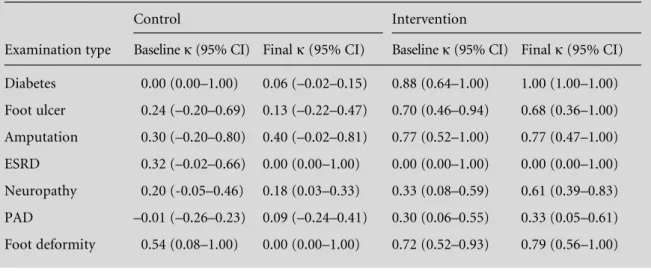
At the control hospital, the majority of foot screenings (45/49) took place in primary care. However, the ran-domisation scheme was exhausted prior to identifying the final grade 3 patient, resulting in 49 observations. At the intervention hospital, podiatrists and residents performed the screening examinations. The control hospital’s agreement ranged from poor to moderate (k=–0.01–0.54), while it ranged from slight to almost perfect (k=0.00–1.00) at the intervention hospital (Table 2). Significantly higher agreement for diabetes
Table 1 ICD-9-CM and CPT codes
Condition Codes
Diabetes 250.xx
Foot ulcer 250.8x, 707.12–707.15, 707.9, 440.23, 454.0
Amputation or amputation status v49.70- v49.76, 84.11–84.18
End stage renal disease 585.6
Neuropathy 250.60, 250.61, 356.9
PAD 250.70, 250.71, 443.9, 459.81
Foot deformity 681.11, 682.7, 711.07, 998.59, 681.10, 682.7, 682.6, 713.5, 736.72, 726.91, 735.0–735.4, 686.9, 681.1, 703.0, 730.27, 730.07, 681.11, 727.1, 735.5, 735.8
Table 2 Criterion validity of visit coding against chart documentation
Control Intervention
Examination type Baselinek(95% CI) Finalk(95% CI) Baselinek(95% CI) Finalk(95% CI)
Diabetes 0.00 (0.00–1.00) 0.06 (–0.02–0.15) 0.88 (0.64–1.00) 1.00 (1.00–1.00)
Foot ulcer 0.24 (–0.20–0.69) 0.13 (–0.22–0.47) 0.70 (0.46–0.94) 0.68 (0.36–1.00)
Amputation 0.30 (–0.20–0.80) 0.40 (–0.02–0.81) 0.77 (0.52–1.00) 0.77 (0.47–1.00)
ESRD 0.32 (–0.02–0.66) 0.00 (0.00–1.00) 0.00 (0.00–1.00) 0.00 (0.00–1.00)
Neuropathy 0.20 (-0.05–0.46) 0.18 (0.03–0.33) 0.33 (0.08–0.59) 0.61 (0.39–0.83)
PAD –0.01 (–0.26–0.23) 0.09 (–0.24–0.41) 0.30 (0.06–0.55) 0.33 (0.05–0.61)
and peripheral neuropathy was observed at the inter-vention hospital’s final measurement (Table 1). At the intervention hospital, Kappa coefficients increased for diabetes, PAD and foot deformity, and nearly doubled for neuropathy; however, overlapping 95% confi-dence intervals suggest lack of statistical significance. We found slight discrimination for cumulative risk for grades 2 and 3 at the control hospital, and fair dis-crimination for grade 2 with substantial and signifi-cant discrimination for grade 3 at the intervention hospital (Table 3).
There were no differences between hospitals for consultations or service agreement adherence, although both hospitals demonstrated significantly lower final consultation rates. There were no hospital differences for baseline patient cancellation and non-attendance rates. The control hospital demonstrated significantly more final patient cancellation and non-attendance rates. The final patient cancellation rate was signifi-cantly improved for the intervention hospital (1% v. 5%,P=0.01).
Amputation prevention director interviews sug-gested high acceptability for the new reminder. The director at the intervention hospital observed that the strength of the new approach was keeping the vital information regarding the foot reminder easily acces-sible to everyone who could access the note. The director also believed that the new registry approach would help amputation prevention efforts.
Discussion
We describe a novel method for creating a high-risk foot registry by populating it directly from the clinical foot examination reminder. The risk factor coding accuracy described in the note may also be considered criterion validity for an administrative data-based registry. Most coding at the intervention hospital exhibited substantial reliability,6the exception being fair reliability for PAD. Some measures appeared to improve with the new reminder although they were not significant. There were no coding differences between
hospitals except for the final peripheral neuropathy measure. The new reminder also demonstrated sig-nificantly better discrimination of grade 3 patients. The new reminder approach may improve coding although this did not occur for all examination ele-ments. Our findings are similar to others suggesting that coding for end-stage renal disease is not very sensitive.4We do not believe a Hawthorne effect was present as residents at the intervention hospital were instructed only that the clinical reminder would change and there was no change in service agreement adher-ence. However, others have described the importance of a clinical nurse to improve initial registry uptake and sustain its progress when general practitioner use begins to decline.7
At the control hospital, most measures demon-strated poor to moderate reliability where reminders were performed in primary care. Primary care pro-viders are responsible for many reminders, and foot screening may not be the primary reason for the visit. Thus, coding may be directed to other competing needs. Newer methods such as using natural language pro-cessing to search for free text phrases in records might have improved this reliability if the entire medical record was searched.8
We believe the tool facilitates programmatic coor-dination9as it provides a link to the service agreement and prompts a mental health referral if needed. Another advantage is insertion of standardised exam-ination and risk language directly into CPRS, thus limiting typing time demands. Generating a risk-based health factor creates a searchable field by the clinic of origin, potentially impacting on better standardis-ation of risk-based care.3 These features have also been described for developing diabetes practice regis-tries in Scotland.10
There are limitations to this pilot study. The small sample size from two centres limits generalisability. Blinding was not entirely possible, although we looked for provider behaviour changes. Finally, there were centre effects, with podiatrists performing the foot examinations at the intervention hospital potentially biasing in favour of the intervention as podiatrists regularly code for these conditions.
Table 3 Discrimination by risk levels
Control Intervention
Examination type Baselinek(95% CI) Finalk(95% CI) Baselinek(95% CI) Finalk(95% CI)
Grade 2 0.00 (–1.00) 0.00 (–1.00) 0.21 (–0.21–0.63) 0.10 (–0.41–0.61)
Implementation of a clinical reminder examination-based registry system resulted in improved discrimi-nation of the highest risk patients and improved coding for peripheral neuropathy. It was well accepted by clinicians due to the tick box format inserting standardised prose into the record, thus avoiding add-itional typing. Further testing of this approach is recommended to include other registry approach fea-tures, such as additional risk-based decision support with therapeutic shoes and insoles and performance feedback with access to benchmarks and evidence, as well as patient education materials.11
REFERENCES
1 Schattner P, Saunders M, Stanger L, Speak M and Russo K. Clinical data extraction and feedback in general practice: a case study from Australian primary care. Informatics in Primary Care2010;18:205–12.
2 Adaji A, Schattner P and Jones K. The use of information technology to enhance diabetes management in primary care: a literature review. Informatics in Primary Care 2008;16:229–37.
3 Lavery LA, Wunderlich RP and Tredwell JL. Disease management for the diabetic foot: effectiveness of a dia-betic foot prevention program to reduce amputations and hospitalizations. Diabetes Research and Clinical Practice2005;70:31–7.
4 Kern EF, Maney M, Miller DRet al. Failure of ICD-9-CM codes to identify patients with comorbid chronic kidney disease in diabetes.Health Services Research2006; 41:564–80.
5 Tseng CL, Rajan M, Miller DRet al. Use of administrat-ive data to risk adjust amputation rates in a national cohort of Medicare-enrolled veterans with diabetes. Medical Care2005;43:88–92.
6 Landis JR and Koch GG. The measurement of observer agreement for categorical data.Biometrics1977;33:159. 7 Evans JM, Guthrie B, Pagliari Cet al. Do general practice characteristics influence uptake of an information tech-nology (IT) innovation in primary care?Informatics in Primary Care2008;16:3–8.
8 Pakhomov SV, Shah ND, Hanson P, Balasubramaniam SC and Smith SA. Automated processing of electronic medical records is a reliable method of determining aspirin use in populations at risk for cardiovascular events.Informatics in Primary Care2010;18:125–33. 9 Wrobel JS, Charns MP, Diehr Pet al. The relationship
between provider coordination and diabetes-related foot outcomes.Diabetes Care2003;26:3042–7. 10 Morris L, Taylor M, Campbell LM and Sullivan FM.
How will practices cope with information for the new GMS contract? Coronary heart disease data recording in five Scottish practices. Informatics in Primary Care 2003;11:121–7.
11 Hunt JS, Siemienczuk J, Gillanders Wet al. The impact of a physician-directed health information technology system on diabetes outcomes in primary care: a pre- and
post-implementation study.Informatics in Primary Care 2009;17:165–74.
FUNDING
This research was supported by the Department of Veterans Affairs HSRandD QUERI Capstone Program RRP 06–182.
CONFLICTS OF INTEREST
The manuscript presents the findings and conclusions of the author(s); and it does not necessarily represent the Department of Veteran Affairs (VA) or HSRandD. The authors declare that they have no competing interests.
STATEMENT OF RESPONSIBILITY
JSW was responsible for writing the grant proposal and drafting the protocol and assisted in creating the new reminder, assembling the research team, analys-ing the results and writanalys-ing of the manuscript. FW assisted with feedback regarding the proposal, drafting of the protocol, assisting as site PI, method develop-ment and writing of the manuscript. WC assisted with feedback regarding the proposal, protocol and manu-script, assembly of the research team and arranging local implementation through primary care. RS con-tributed feedback regarding the proposal, methods and manuscript. RTC and LR were responsible for developing the chart abstraction tool, chart abstraction and contributions to the methods and manuscript. RP was responsible for the creation, programming and implementation of the new reminder, and offering feedback on the proposal and methods. DGA was responsible for method development, and offering feedback on the grant proposal, protocol and writing of the manuscript.
ADDRESS FOR CORRESPONDENCE
James Wrobel
Associate Professor of Internal Medicine; Metabolism, Endocrinology and Diabetes Division
University of Michigan Medical School Domino’s Farms, Lobby G, Suite 1500 24 Frank Lloyd Wright Drive
Ann Arbor, MI 48105 USA
Email: [email protected]