ORIGINAL ARTICLE
E-Cigarette Use Causes a Unique Innate Immune Response in the
Lung, Involving Increased Neutrophilic Activation and Altered
Mucin Secretion
Boris Reidel1,2, Giorgia Radicioni1,2, Phillip W. Clapp3, Amina A. Ford1,2, Sabri Abdelwahab1,2, Meghan E. Rebuli3, Prashamsha Haridass1,2, Neil E. Alexis3, Ilona Jaspers3, and Mehmet Kesimer1,2
1
Marsico Lung Institute,2Department of Pathology and Laboratory Medicine, and3Department of Pediatrics, The University of North Carolina at Chapel Hill, Chapel Hill, North Carolina
Abstract
Rationale:E-cigarettes have become increasingly popular and little is known about their potential adverse health effects.
Objectives:To determine the effects of e-cigarette use on the airways.
Methods:Induced sputum samples from cigarette smokers, e-cigarette users, and nonsmokers were analyzed by quantitative proteomics, and the total and individual concentrations of mucins MUC5AC and MUC5B were determined by light scattering/refractometry and labeled mass spectrometry, respectively. Neutrophil extracellular trap (NET) formation rates were also determined for the same groups.
Measurements and Main Results:E-cigarette users exhibited significant increases in aldehyde-detoxification and oxidative stress–related proteins associated with cigarette smoke compared with nonsmokers. The levels of innate defense proteins associated
with chronic obstructive pulmonary disease, such as elastase and matrix metalloproteinase-9, were significantly elevated in e-cigarette users as well. E-cigarette users’sputum also uniquely exhibited significant increases in neutrophil granulocyte–related and NET-related proteins, such as myeloperoxidase, azurocidin, and protein-arginine deiminase 4, despite no significant elevation in neutrophil cell counts. Peripheral neutrophils from e-cigarette users showed increased susceptibility to phorbol 12-myristate 13-acetate–induced NETosis. Finally, a compositional change in the gel-forming building blocks of airway mucus (i.e., an elevated concentration of mucin MUC5AC) was observed in both cigarette smokers and e-cigarette users.
Conclusions:Together, our results indicate that e-cigarette use alters the profile of innate defense proteins in airway secretions, inducing similar and unique changes relative to cigarette smoking. These data challenge the concept that e-cigarettes are a healthier alternative to cigarettes.
Keywords:e-cigarette; lung; neutrophil; mucin; NET
The adverse health effects of long-term cigarette smoking in the lung (e.g., increased risks of cancer and chronic obstructive pulmonary disease [COPD]), have been well established (1), and public awareness regarding these risks is rising. Although this awareness has led to an ongoing trend of decreased usage of conventional tobacco
products in the United States, new and emerging tobacco products, especially e-cigarettes, have been gaining popularity. These products have become popular and have recently shown dramatic increases (up to 900%) in use, particularly in the younger population, attracting both former tobacco smokers and never-smokers (2, 3).
This trend is supported by the assumption by many that e-cigarette use is harmless and a safe alternative to cigarette smoking and by the fact that e-cigarettes are promoted as cigarette smoking cessation aids in certain health care practices, despite a lack of sufficient health science evidence (4).
( Received in original form August 6, 2017; accepted in final form October 20, 2017 )
The research reported in this publication was supported by the NIH and the Family Smoking Prevention and Tobacco Control Act. The content is solely the responsibility of the authors and does not necessarily represent the official views of the NIH or the Food and Drug Administration. Supported by NIH/FDA grant P50 HL120100.
Author Contributions: Conception and design, M.K., I.J., and N.E.A. Data production, analysis, and interpretation, B.R., G.R., P.H., A.A.F., S.A., M.E.R., M.K., and I.J. Writing the manuscript, B.R., M.K., I.J., and N.E.A. Reviewing the manuscript, B.R., G.R., P.W.C., A.A.F., S.A., M.E.R., P.H., N.E.A., I.J., and M.K.
Correspondence and requests for reprints should be addressed to Mehmet Kesimer, Ph.D., Marsico Lung Institute, 7111 Marsico Hall, 125 Mason Farm Road, Chapel Hill, NC 27599-7248. E-mail: [email protected].
This article has an online supplement, which is accessible from this issue’s table of contents at www.atsjournals.org.
Am J Respir Crit Care Med Vol 197, Iss 4, pp 492–501, Feb 15, 2018 Copyright©2018 by the American Thoracic Society
Originally Published in Press as DOI: 10.1164/rccm.201708-1590OC on October 20, 2017 Internet address: www.atsjournals.org
E-cigarettes are designed to deliver nicotine to the brain via the lungs and cardiovascular system without the combustion of tobacco, which ordinarily results in the production of thousands of toxic compounds. However, vaporization of e-liquids by current-generation e-cigarette devices can generate similar toxic
compounds, such as reactive aldehydes (5). The formation of toxic aldehydes (e.g., formaldehyde and acrolein) in e-cigarette vapors has been attributed to thermal decomposition of the major vehicle components of e-cigarette e-liquids (propylene glycol and glycerol) and flavorings, which are reported to produce levels that exceed occupational safety standards (6). Several of these toxic compounds (e.g., acrolein) are already
associated with the epithelial response to cigarette smoking, specifically increasing mucin secretion (7–9).
E-cigarettes have recently been deemed to be subject to Food and Drug Administration regulation; however, specific aspects of their regulation are not yet in place, primarily because the potential
adverse health effects and risks of e-cigarette use are still unknown. Therefore, it is of great importance to better understand how exposure to e-cigarette vapors modifies human airway biology compared with traditional cigarette smoking and to identify the potentially unique effects e-cigarette vapors might have on lung physiology.
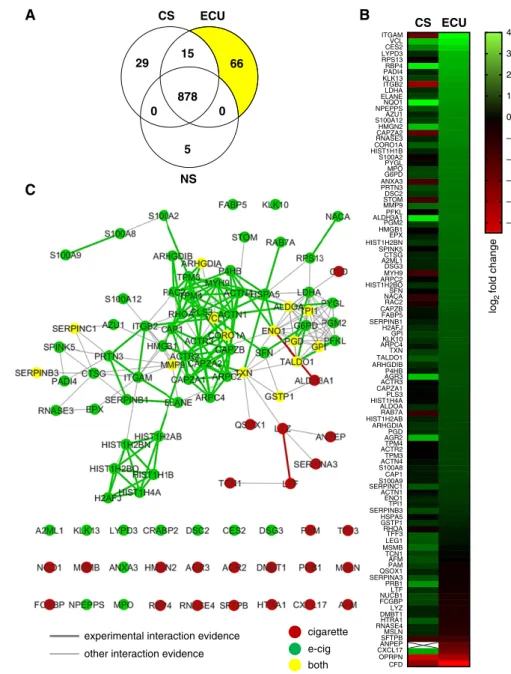
log 2 fold change cigarette ITGAM VCL CES2 LYPD3 RPS13 RBP4 PADI4 KLK13 ITGB2 LDHA ELANE NQO1 NPEPPS AZU1 S100A12 HMGN2 CAPZA2 RNASE3 CORO1A HIST1H1B S100A2 PYGL MPO G6PD ANXA3 PRTN3 DSC2 STOM MMP9 PFKL ALDH3A1 PGM2 HMGB1 EPX HIST1H2BN HIST1H2BO SFN NACA RAC2 CAPZB FABP5 SERPINB1 H2AFJ GPI KLK10 ARPC4 TXN TALDO1 ARHGDIB P4HB AGR3 ACTR3 CAPZA1 PLS3 HIST1H4A HIST1H2AB ARHGDIA PGD AGR2 TPM4 ACTR2 TPM3 ACTN4 S100A8 CAP1 S100A9 SERPINC1 ACTN1 ENO1 TPI1 SERPINB3 HSPA5 GSTP1 RHOA TFF3 LEG1 MSMB TCN1 AFM PAM QSOX1 SERPINA3 PRB1 LTF NUCB1 FCGBP LYZ DMBT1 HTRA1 RNASE4 MSLN SFTPB ANPEP CXCL17 OPRPN CFD ALDOA RAB7A SPINK5 CTSG A2ML1 DSG3 MYH9 ARPC2 e-cig both A B C CS ECU CS ECU NS
experimental interaction evidence
other interaction evidence
29 66 5 15 0 0 878 –5 –4 –3 –2 –1 0 1 2 3 4
Figure 1. Analysis of induced samples of tobacco product users’ sputum indicates a uniquely altered
airway secretome for e-cigarette users in comparison with cigarette smokers and nonsmokers. (A) Venn diagram showing the number of proteins with significantly higher levels than the means in the sputum of cigarette smokers (CS), e-cigarette users (ECU), and nonsmokers (NS). (B) Heatmap of proteins displaying significantly (ANOVAP<0.05) changed levels with respect to nonsmokers based on the total precursor intensity. The protein order in the heatmap is based on descending fold change in the e-cigarette user group. (C) Interactome map showing proteins with significant increases in cigarette smokers, e-cigarette users, and both with respect to nonsmokers. Quantified protein hits were based on at least two assigned peptides per protein.
At a Glance Commentary
Scientific Knowledge on the Subject: New and emerging tobacco products, especially e-cigarettes, have become popular and their use has increased dramatically, particularly among the younger population, by attracting former tobacco smokers and never-smokers. This trend is supported by a common assumption that e-cigarette use is harmless and a safe alternative to cigarette smoking. Despite a lack of sufficient health science evidence, e-cigarettes are promoted as cigarette smoking cessation aids in some health care practices. Little is known about the potential adverse health effects of e-cigarette use on the lungs.
What This Study Adds to the Field: To our knowledge, this is the first study using human airway samples to explore the effect/harm of e-cigarette use on the airways. This study describes a unique e-cigarette–induced innate lung response that includes markers of aberrant neutrophilic response and altered mucin secretion and indicates that the effects of e-cigarettes are overlapping with yet distinct from those observed in otherwise healthy cigarette smokers. Thesefindings challenge the concept that switching from cigarettes to e-cigarettes is a healthier alternative.
The airway epithelial mucosal barrier is part of the innate immune system and protects the underlying epithelia when faced with microbial, physical, and chemical challenges (10), including smoking and vaping. The biophysical properties of airway mucus are primarily established by mucins MUC5B and MUC5AC and their interacting partners (11). Airway secretions from smokers and patients with COPD exhibits quantitative and compositional alterations, with observable changes in mucin concentration and the ratio of MUC5B to MUC5AC, signifying these mucins’importance in the establishment of the biophysical properties of mucus (12, 13).
Neutrophils play an important role in airway maintenance because of their strong antimicrobial activity. However, when left unchecked, activated neutrophils can contribute to inflammatory lung diseases, such as COPD. Neutrophils exert their antimicrobial effects through four major mechanisms:1) phagocytosis,2) degranulation of stored mediators and enzymes,3) reactive oxygen generation, and4) the release of neutrophil
extracellular traps (NETs) (14). NETs are the result of a specific type of cell death called NETosis (15) and consist of chromatinfilaments and specific granule proteins, including neutrophil elastase (NE) and myeloperoxidase (MPO) (16), which have been associated with the bronchial inflammation and structural damage observed in diseases, such as cystic fibrosis and COPD (17, 18). Although NET formation is an antibacterial immune response, it has also been shown to be triggered by constituents of smoke and e-cigarette vapors, such as acrolein (19).
E-cigarettes are fairly new products, and data on the effects of their long-term use remain scarce. The airway epithelium is one of thefirst parts of the body encountered by inhaled smoke and vapors, and the mucus secretion layer acts as thefirst line of defense against inhaled biologic and chemical substances. Analysis of the changes in the airway secretion proteome as a result of e-cigarette vaping can identify potential biomarkers associated with adverse health effects. Using induced sputum samples from tobacco product users participating in the University of North Carolina Tobacco Center of Regulatory Science program, we compared changes in airway mucus composition and integrity among cigarette
smokers, e-cigarette users, and healthy nonsmokers.
Methods
Additional information on the study design and the details of the methods is provided in the online supplement.
Subject Population and Sputum Sample Collection
Informed consent was obtained from all study participants, and the protocol was
submitted to and approved by the University of North Carolina at Chapel Hill Biomedical Institutional Review Board. Induced sputum samples from 14 current cigarette smokers, 15 current e-cigarette users, and 15 never-smokers were collected as previously described (20). Raw sputum expectorant was processed as described later. The smoking status of the participants was confirmed based on serum cotinine and urine 4-(methylnitrosamino)-1-(3-pyridyl)-1-butanol (NNAL) levels.
NS CS ECU
Nucleobindin-1
**
108 109 1010
107 B
NS CS ECU
108 109 1010 1011
Total precursor intensity
Aldehyde dehydrogenase 3A1
**** *
A
Glutathione S-transferase
** *
NS CS ECU
109 1010 1011 D
NS CS ECU
Total precursor intensity
Thioredoxin
**** ***
109 1010 C
NS CS ECU
108 109 1010 1011
Total precursor intensity
Beta-microseminoprotein
***
E
Figure 2.Levels of proteins known to be affected by cigarette smoke exposure are also altered in
e-cigarette users. The total precursor intensity of each sample was plotted for comparison among the groups. (A) Aldehyde dehydrogenase 3A1, (B) nucleobindin-1, (C) thioredoxin, (D) glutathione S-transferase, and (E) microseminoproteinb. Mean and SEM values are indicated by major and minor horizontal bars, respectively. Statistical significance was determined by one-way ANOVA. *P<0.05, **P<0.01, ***P<0.005, and ****P<0.001. CS = cigarette smokers; ECU = e-cigarette users; NS = nonsmokers.
Label-Free Quantitative Proteomic Analysis
An aliquot (100ml) of induced sputum was diluted 1:1 in the chaotropic agent GuHCl at afinal concentration of 4 M, reduced, alkylated, and digested by trypsin. Next, 5ml of solubilized peptides was injected using a Q-Exactive (Thermo Scientific) mass spectrometer coupled to an UltiMate 3000 (Thermo Scientific) nano HPLC system. The raw data were processed and searched against the UniProt protein database (Homo sapiens, January 2017) using Proteome Discoverer 1.4 (Thermo Scientific) software. Protein quantification was performed using the normalized total precursor intensity. The data were log transformed to achieve a normal distribution when necessary. Statistical significance among groups was determined by one-way ANOVA.
Mucin Concentration Measurements The total mucin concentrations in the sputum samples were analyzed by size-exclusion chromatography/differential refractometry (SEC-MALLS/dRI) measurements (21), and the individual concentrations of MUC5AC and MUC5B were measured using stable-isotope-labeled mass spectrometry with parallel reaction monitoring analysis, as described previously (13).
Isolation of Peripheral Blood Neutrophils and Quantitation of NET Formation
Neutrophils from healthy nonsmokers (n= 11), smokers (n= 7), and e-cigarette users (n= 12) were isolated from venous blood as described previously (22). The cells were incubated at 378C and 5% CO2for 30 minutes
before challenge with 25 nM phorbol 12-myristate 13-acetate (PMA; Sigma-Aldrich). The wells were assayed for extracellular chromatin content every hour during a 4-hour challenge to assess NET formation. The amount of chromatin released each hour was quantified using a PicoGreen double-stranded DNA kit (Life Technologies).
Results
To determine how the use of e-cigarettes and conventional cigarettes impacts the airway innate immune response, we collected induced sputum samples from
e-cigarette users and cigarette smokers and compared them with those of nonsmokers. The study participants in the nonsmoker group displayed values for both nicotine exposure (cotinine) and the tobacco-specific marker NNAL at or below the detection limit (seeFigure E1 in the online supplement). In the cigarette smoker group, serum cotinine and urine NNAL levels were significantly correlated with the number of cigarettes smoked per day (P,0.05). In the e-cigarette user group, serum cotinine levels were significantly correlated with the number of e-cigarette puffs per day (P,0.0001), whereas urine NNAL levels were not. Average urine NNAL levels were significantly lower in e-cigarette users compared with smokers (seeTable E1). Only one subject had urine NNAL levels above the cutoff point of 47 pg/ml, which distinguishes smokers from nonsmokers (23), whereas most e-cigarette users had urine NNAL levels comparable with those observed in nonsmokers, suggesting exclusive e-cigarette use.
The average body mass index and age distribution did not significantly differ among the different groups. The average number of cigarettes smoked per day in the cigarette smoker group was approximately 11. E-cigarette users had been using e-cigarettes actively and exclusively or predominantly for at least 6 months. In the e-cigarette user category, the average number of puffs inhaled per day was approximately 280. Of the 15 e-cigarette users, 12 identified themselves as having previously smoked cigarettes, and three indicated no prior cigarette smoking history. In addition,five of the subjects reported occasionally smoking cigarettes (seeTable E2).
Altered Airway Secretion Proteomes in Cigarette Smokers and E-Cigarette Users
Using a peptide confidence interval of 95% and a minimum of two assigned peptides per protein, our proteomic analysis of induced sputum identified a total of approximately 1,000 proteins across all
NS CS ECU
1010
1011
1012
Total precursor intensity
DMBT1
***
* A
NS CS ECU
1010
1011
1012
Lactotransferrin
* B
C
108
109 1010
1011
Total precursor intensity
Trefoil factor 3
***
NS CS ECU
D
0 2×10¹¹
4×10¹¹ 6×10¹¹
8×10¹¹
** ****
p=0.07
NS CS ECU
Lysozyme C
Figure 3.Airway epithelial defense protein levels are significantly altered in tobacco product users.
The total precursor intensity of each sample was plotted for comparison among the groups. (A) Deleted in malignant brain tumors 1, (B) lactotransferrin, (C) trefoil factor 3, and (D) lysozyme C. Mean and SEM values are indicated by major and minor horizontal bars, respectively. Statistical significance was determined by one-way ANOVA. *P<0.05, **P<0.01, ***P<0.005, ****P<0.001. CS = cigarette smokers; DMBT1 = deleted in malignant brain tumors 1; ECU = e-cigarette users; NS = nonsmokers.
cigarette users’, e-cigarette users’, and nonsmokers’samples (seeSheet E1 in the online data supplement). Our label-free quantitative analysis revealed that mucus protein composition in e-cigarette users was qualitatively and quantitatively different than in cigarette smokers and nonsmokers. We detected the highest number of significant changes in protein levels in the e-cigarette user group (Figure 1A). Compared with nonsmokers, induced sputum from e-cigarette users contained approximately 81 proteins with significantly altered abundance, whereas approximately 44 proteins with altered abundance were identified in sputum from cigarette smokers. A heatmap (Figure 1B) was used to summarize all of the proteins with significantly changed levels in cigarette smokers’and e-cigarette users’sputum, sorted by fold change in the e-cigarette group. This representation illustrates that several of the proteins showed similar abundance changes in the two user groups but, more importantly, that the overall patterns of change were relatively different between the two groups (Figures 1B and 1C).
The cigarette smokers’sputum proteome displayed an upregulation of known markers associated with smoking (Figure 2), such as the aldehyde-detoxifying enzyme aldehyde dehydrogenase 3A1 (ALDH3A1) (24, 25), microseminoproteinb and nucleobindin-1 (25), and
antithrombin 3 (26), and an upregulation of oxidative stress response proteins, for example, thioredoxin (25, 27) and glutathione S-transferase (28). The levels of several of these markers (aldehyde-detoxifying enzyme ALDH3A1, thioredoxin, and glutathione S-transferase) were also significantly elevated in the e-cigarette users (Figures 2A, 2C, and 2D).
Another trend that was observable in our dataset was a significant and broad elevation of the levels of mucosal defense proteins in sputum from cigarette smokers, but not e-cigarette users (Figure 3). These proteins, which are known to be airway mucus constituents that are essential in fighting infections, are shown in Figure 3, including lactotransferrin, trefoil factor 3, and lysozyme C (LYSC). The levels of several innate defense proteins, such as deleted in malignant brain tumors 1 (DMBT1) and LYSC, were significantly decreased in the e-cigarette users compared with the nonsmokers (Figure 3).
Elevated Markers of Neutrophil Activation in E-Cigarette Users’ Sputum
Most notable among the functional protein groups with increased abundance in the sputum of e-cigarette users were secreted proteins related to the innate defense functions of leukocytes. Among these, primary neutrophil granule proteins, such as NE, proteinase 3, azurocidin 1, and MPO,
showed significantly higher levels in e-cigarette users than in cigarette smokers or nonsmokers, with slightly, but
nonsignificantly, increased levels in the cigarette user group as well (Figure 4). In addition, we observed significant increases in secondary neutrophil granule proteins, such as collagenase and gelatinase (also known as matrix metalloproteinase [MMP] 8 and MMP9, respectively), in
0 20 40 60 80 100
% PMN
Neutrophil cell count
*
NS CS ECU
F
Myeloperoxidase
** *
NS CS ECU
1011
1010
109
B
MMP9
* *
NS CS ECU
1010
109
108
107
D
Total precursor intensity
Proteinase 3 ** *
NS CS ECU
1010
109
108
C
NS CS ECU
1010
109
108
Total precursor intensity
Neutrophil elastase
*** *
* A
Total precursor intensity
Azurocidin **
NS CS ECU
1010
109
108
E
Figure 4.Neutrophilic granule enzyme levels are significantly increased in e-cigarette users’ airways,
despite no increase in neutrophil cell counts. The total precursor intensity of each sample was plotted for comparison among the groups. (A) Neutrophil elastase, (B) myeloperoxidase, (C) proteinase 3, (D) matrix metalloproteinase 9, and (E) azurocidin. (F) Neutrophil cell counts in sputum samples from e-cigarette users and cigarette smokers and nonsmokers. Mean and SEM values are indicated by major and minor horizontal bars, respectively. Statistical significance was determined by one-way ANOVA. *P<0.05, **P<0.01, ***P<0.005. CS = cigarette smokers; ECU = e-cigarette users; MMP = matrix metalloproteinase; NS = nonsmokers; PMN = polymorphonuclear neutrophil.
cigarette smokers’and e-cigarette users’ sputum (Figure 4D). After observing this pattern of neutrophil proteins, we performed a correlation analysis in which the statistical relationships between the expression profiles of all quantified proteins and the profile of NE were determined across all samples (seeTable E3). Proteins with a Spearman correlation coefficient above 0.6, and indeed most proteins whose profiles were highly correlated with that of NE, were typical neutrophil proteins.
Thesefindings of neutrophil protein enrichment in the e-cigarette group raised the question of whether the number of neutrophils was increased in the sputum samples from e-cigarette users. Interestingly, neutrophil cell counts were not significantly higher in e-cigarette users but were significantly increased in the sputum samples from cigarette smokers (Figure 4F).
In addition, our proteomic analysis identified several proteins that have been shown to be associated with NETs (Figure 5). In particular, sputum from e-cigarette users displayed a significant increase in calprotectin (Figures 5A and 5B) a cytosolic protein in unstimulated neutrophils that is crucial for the clearance of infections when it is released as part of NETs (29). Other NET markers that were significantly increased in our analysis included coronin-1 (Figure 5C) (30) and peptidylarginine deiminase 4 (Figure 5D), an enzyme known to modify histones that becomes part of NETs. Notably, histone H4 was identified among the proteins with the highest correlation with NE in our analysis, providing additional evidence for increased NET formation in the airways of e-cigarette users.
PMA-induced Systemic NET Formation
To determine whether peripheral blood neutrophils were also affected by e-cigarette use, we challenged the neutrophils isolated from cigarette smokers, e-cigarette users, and nonsmokersex vivowith a protein kinase C activator and potent NET agonist PMA. Quantitation of the PMA-induced NETs formed by neutrophils isolated from the venous blood indicated that peripheral neutrophils isolated from e-cigarette users were significantly more susceptible to PMA-induced NET formation at 2 hours (P= 0.01), as assessed based on nucleic acid release over time (Figure 6).
Total Mucin and Individual MUC5AC and MUC5B Concentrations in Tobacco Product Users’Sputum An increased total mucin concentration and a shift in the ratio between the major gel-forming airway mucins MUC5B and MUC5AC have been shown to be correlated with cigarette smoking and COPD progression (31). We observed that the total mucin concentrations in sputum samples were significantly increased (P= 0.04) in cigarette smokers (1,986mg/ml6810 SD) compared with nonsmokers (1,251mg/ml 6964 SD) and that the total mucin concentrations in the sputum samples of the e-cigarette users, although slightly increased (1,322mg/ml6663 SD), were not significantly different from those in nonsmokers’samples (Figure 7D). Analysis of the individual concentrations of MUC5B and MUC5AC (Figures 7A and 7B) showed that MUC5B levels were not altered in the sputum of cigarette smokers or e-cigarette users and thus did not contribute to the
observed increases in total mucin. MUC5AC concentrations, however, were significantly increased in cigarette smokers (132 pmol/ml658 SD; P= 0.02) and in e-cigarette users (58 pmol/ml621 SD; P= 0.05) compared with the nonsmokers (15 pmol/ml66 SD). As a result, the MUC5AC/MUC5B ratio was significantly increased in cigarette smokers (0.32;P= 0.02) and e-cigarette users (0.34;P= 0.05) compared with nonsmokers (0.11) (Figure 7C).
Discussion
In this study, using induced sputum samples from cigarette smokers, e-cigarette users, and healthy never-smokers, we aimed to determine the effects of e-cigarettes on the human airways. Given that e-cigarette use–related changes in lung secretions are mostly unknown, wefirst focused on the known impacts of cigarette use. Comparing
Calprotectin
S100A9
***
NS CS ECU
1010 1011 1012 B
NS CS ECU
1010 1011
Total precursor intensity
S100A8
*** *
A
Total precursor intensity
Coronin-1
*** *
NS CS ECU
109
108
107 C
Protein-arginine deiminase4
*
NS CS ECU
109
108
107 D
Figure 5. Evidence for increased neutrophil extracellular trap formation in current e-cigarette users.
The levels of neutrophil extracellular trapmarker proteins, such as S100A8 (A) and S100A9 (B), which form a heterodimer called calprotectin, (C) coronin-1 (CORO1A), and (D) peptidyl arginine deiminase, type IV (PADI4) were significantly increased. Statistical significance was determined by one-way ANOVA. *P<0.05, ***P<0.005. CS = cigarette smokers; ECU = e-cigarette users; NS = nonsmokers.
our results with published data, we were able to confirm changes in the levels of numerous proteins that are established markers of cigarette smoke exposure, thus validating our quantitative approach to identifying the effects on airways. We detected upregulation of the secreted detoxifying enzyme ALDH3A1, and the levels of other knownin vivoandin vitro markers of cigarette smoke exposure (24, 25, 32, 33) were also elevated in the e-cigarette users, suggesting that e-cigarette exposure might be harmful for the lung as well. Additionally, the elevated levels of markers known to be associated with cigarette smoke and lung
disease/inflammation, such as thioredoxin and MMP9, in the sputum of both cigarette smokers and e-cigarette users indicates commonality in the impacts of these products on airway physiology, such as increased oxidative stress and activation of innate defense mechanisms. Furthermore, proteases of neutrophil and epithelial origin, such as MMP9, are inflammatory mediators known to be major contributors to chronic lung diseases (34, 35).
As shown in Figure 3, increased levels of innate defense proteins secreted by the airway epithelium were observed in cigarette smokers. Several of these proteins, such as DMBT1, trefoil factor 3, lactoferrin, and LYSC, play important roles in
protection against pathogens, either through direct antimicrobial activity or by acting as part of the mucosal barrier network. DMBT1 (11, 36) and trefoil factors (37) have been shown to interact with the building blocks of the mucus gel (i.e., gel-forming mucins) and can therefore potentially alter the viscoelastic properties of this important mechanical barrier (38). Interestingly, in the present study, the levels of these proteins tended to decrease in e-cigarette users; the levels of DMBT1 and LYSC, in particular, were significantly decreased in the e-cigarette users compared with the nonsmokers, suggesting an altered innate immune response in the former group.
The analysis of differentially expressed proteins revealed that a group of innate defense proteins of neutrophilic origin were highly represented in the e-cigarette users (Figures 1B and 1C). Most prominently, primary neutrophilic granule enzymes, such as NE, proteinase 3, and MPO, showed significantly higher levels in e-cigarette users than in nonsmokers (Figure 3). Among other functions, these neutrophilic enzymes are inflammatory mediators and major contributors to the pathogenesis of chronic lung diseases, such as COPD (34). Cell counts, however, showed no significant increase in the number of neutrophils in the sputum of e-cigarette users (Figure 5), suggesting that
the changes were not caused by a greater number of neutrophils in these subjects.
Neutrophil granulocytes possess two major mechanisms for releasing stored mediators and enzymes to perform their antimicrobial activity: degranulation and the release of NETs (14). To gain insight into which of these mechanisms was most likely responsible for the observed proteome changes, we investigated the abundance of marker proteins associated with these processes in our dataset. The combined observations of elevated neutrophil-derived protein levels but no increase in neutrophil cell number in the sputum of e-cigarette users suggests two potential underlying pathogeneses: e-cigarettes may cause altered activation and degranulation of these neutrophils, or e-cigarettes may cause a neutrophilic increase but induce neutrophil death at the same time.
Extensive degranulation of neutrophils is a feature of lung disorders involving inflammation, such as severe asthma and COPD (17, 39). An additional mechanism by which neutrophil granulocytes can eliminate bacteria has been described by Brinkmann and coworkers (14). On activation by specific mediator signals, including cytokines, lipopolysaccharide, and specific complement factors (40), neutrophils were shown to form web-like extracellular structures called NETs. NETs are the product of a specific type of cell death called NETosis (15) and consist of chromatinfilaments and specific globular proteins that are highly effective at trapping and killing invasive bacteria. In our proteomic analysis of sputum from tobacco product users, we were able to identify several proteins that have been shown to be associated with NETs (Figure 5). For example, in the sputum of e-cigarette users, we identified a significant increase in calprotectin (Figures 5A and 5B), a cytosolic protein in unstimulated
neutrophils that is crucial for the clearance of infections when it is released as part of NETs (29). Other NET markers found to be significantly increased in our analysis include coronin-1 (Figure 5C) (30) and peptidylarginine deiminase 4 (Figure 5D), an enzyme known to modify histones that become part of NETs. Notably, histone H4 was identified among the proteins with the highest correlation with NE in our analysis, suggesting increased NET formation in e-cigarette users’airways. Cytokines, such
* *
32 64 128 256 512 1024
Nucleic Acid Release as % of Media
Only Control
p=0.06 NS
CS ECU
1 Hour 2 Hour 3 Hour
Figure 6.Isolated peripheral (blood) neutrophils from e-cigarette users are more susceptible to
phorbol ester stimulation-induced NETosis. Quantitation of phorbol 12-myristate 13-acetate–induced neutrophil extracellular traps (NETs) formed by neutrophils from nonsmokers, cigarette smokers, and e-cigarette users. Neutrophils isolated from the venous blood of nonsmokers (solid squares), cigarette smokers (solid triangles), and e-cigarette users (solid circles) were challenged with 25 nM phorbol 12-myristate 13-acetate, a protein kinase C activator, and potent NET agonist, and assayed for nucleic acid release over time. Mean and SEM values are indicated by major and minor horizontal bars, respectively. Statistical significance was determined by one-way ANOVA. *P<0.05. CS = cigarette smokers; ECU = e-cigarette users; NS = nonsmokers.
as IL-8 and tumor necrosis factor-a, are known mediators of NET formation (41, 42) but were not elevated in the e-cigarette users (data not shown).
The observation of elevated levels of neutrophil-derived proteins, including the proteins related to NET formation, in the absence of increased neutrophil cell
numbers and cytokine levels indicates that the activation state of neutrophils is altered in the airways of e-cigarette users compared with nonsmokers and cigarette smokers. Indeed, the data also suggest that activation may be present systemically because peripheral blood neutrophils from e-cigarette users were more susceptible to PMA-induced NET formation. These data support the sputum proteomic data and are consistent with thefindings of our previous study, which demonstrated that exposure of neutrophils to certainflavored e-liquids ex vivoalso enhanced susceptibility to PMA-induced NET formation (22). Although the exact role of NET formation in respiratory disease is not known, aberrant activation of NET formation likely leads to the release of tissue-damaging proteases. Indeed, accumulation of NETs has been shown to be associated with inflammatory diseases, including cysticfibrosis and COPD (43, 44). The enhanced NET formation in peripheral blood neutrophils from e-cigarette users also suggests the potential for systemic harm beyond the lung. Given that increased NET formation is closely associated with epithelial and endothelial cell death and subsequent pathogenesis, aberrant NET formation in peripheral blood neutrophils from e-cigarette users should be examined in the context of the pathogenesis of systemic diseases, such as systemic lupus erythematosus (45), vasculitis (46), and psoriasis (45).
The secretion of elastase and other proinflammatory mediators by neutrophils has been observed in response to e-cigarette vapor extract exposurein vitro(47), indicating that e-cigarette constituents aberrantly activate neutrophils. Despite the enhanced secretion of elastase, e-cigarette-exposed mice showed a reduced ability to clear either bacteria or an influenza virus, suggesting that innate mucosal defense systems could be impaired by e-cigarette vapors (48). The consistent elevation of innate neutrophil defense protein levels in the e-cigarette users’sputum in the present study suggests a vaping-induced increase in the inflammatory response of neutrophils in the airways that is distinct from the changes induced by cigarette smoke or more effective.
It is crucial to understand the acute and chronic effects of activated neutrophils and altered mucin secretion dynamics on the innate immune properties of airway secretions. The functional consequences of
NS CS ECU
0.1 1 10 100 1000
pmol / ml
MUC5AC
* *
B
0 1000 2000 3000 4000
Total mucin
µ
g/ml
Total Mucin
*
NS CS ECU
D
* *
NS CS ECU
0.001 0.01 0.1 1
MUC5AC/B ratio
C
NS CS ECU
1
0.1 10 100 1000
pmol / ml
MUC5B
A
Figure 7.The ratio between the major airway mucins MUC5AC and MUC5B is significantly shifted
toward MUC5AC in cigarette smokers and follows the same trend in e-cigarette users. Comparison of total and individual mucin concentrations and their ratios in sputum samples from nonsmokers, cigarette smokers, and e-cigarette users. Individual mucin concentrations of the dominant airway mucin MUC5B (A) increased slightly but not significantly in cigarette smokers, and the concentrations of MUC5AC (B) and the MUC5AC/MUC5B ratio (C) significantly increased in both cigarette and e-cigarette users. Total mucin concentrations were increased in cigarette smokers but not in e-cigarette users (D). Mean and SEM values are indicated by major and minor horizontal bars, respectively. *P,0.05. CS = cigarette smokers; ECU = e-cigarette users; NS = nonsmokers.
chromatin
modification NETosis
PAD4 elastase
H2A
MPO
HNE
MPO
CORO1A
MUC5AC/5B
PAD4
redox
calprotectin e-cig
stimulus
neutrophil
airway epithelium 5AC
5B
5B
5AC 5B
5B 5B 5AC 5B
e-cig vapor
Figure 8. Schematic depiction of the impact of e-cigarette smoking on the airways. Vaping uniquely
alters the airway innate immune response by causing an increase in the release of neutrophil extracellular trap–associated proteins; proteins involved in maintaining the redox balance of the airways; and the ratio of the building blocks of airway mucus, namely, the mucins MUC5AC and MUC5B. e-cig = e-cigarette.
these alterations for the antibacterial and antioxidant defense mechanisms of the lung and their contributions to the pathogenesis of chronic lung diseases, such as COPD, remain to be elucidated.
Another key observation in this study is the marked increase in the gel-forming mucin MUC5AC in tobacco product users’sputum, which led to an altered MUC5AC/MUC5B ratio. Increased MUC5AC has previously been associated with cigarette smoke exposure (7, 49), but the current study is thefirst to report an increase in this mucin in response to e-cigarette use. It has been suggested that an elevated mucin concentration is an important hallmark of failed mucus transport in mucoobstructive disease and an important parameter in COPD pathogenesis (13). Additionally, the ratio of the two major gel-forming mucins, MUC5AC and MUC5B, is related to mucus pathologies, including mucus stasis (12) and mucus obstruction (50). The MUC5AC
concentration or the MUC5AC/MUC5B ratio of the airway secretions can therefore serve as a biomarker of exposure to and/or the effects of tobacco smoking.
It is important to note that most of the subjects in the studied e-cigarette user group (12 of 15) had smoked cigarettes at some time in their tobacco product use history before becoming predominant e-cigarette users. Therefore, the observed effects could have partly been a result of the users’smoking history. However, it has been shown that the sputum proteomes of healthy former smokers are essentially similar to those of never-smokers (25) and that there is an absence of residual biomarkers of smoking in the sputum of former smokers. Future studies designed to study e-cigarette smokers who have never smoked cigarettes seem to be warranted.
To our knowledge, this thefirst study using human airway samples to explore the effect/harm of e-cigarette use on
the airways. Our study clearly demonstrates a unique e-cigarette-induced innate lung response that includes markers of an aberrant neutrophilic response (Figure 8). Taken together, our results indicate that the effects of e-cigarettes are overlapping with and distinct from what is observed in otherwise healthy cigarette smokers. In conclusion, our results challenge the concept that e-cigarettes are a healthier alternative to cigarettes and reverse smoking-induced adverse health effects.n
Author disclosuresare available with the text of this article at www.atsjournals.org.
Acknowledgment:The authors thank the University of North Carolina Tobacco Center of Regulatory Science Sample Acquisition Core for providing the sputum samples and Dr. Benowitz’s group at University of California, San Francisco for the cotinine and 4-(methylnitrosamino)-1-(3-pyridyl)-1-butanol analysis.
References
1. Warren GW, Alberg AJ, Kraft AS, Cummings KM. The 2014 Surgeon General’s report:“The health consequences of smoking–50 years of progress”: a paradigm shift in cancer care.Cancer2014;120: 1914–1916.
2. Singh T, Arrazola RA, Corey CG, Husten CG, Neff LJ, Homa DM,et al. Tobacco use among middle and high school students–United States, 2011-2015.MMWR Morb Mortal Wkly Rep2016;65: 361–367.
3. Murthy VH. E-cigarette use among youth and young adults: a major public health concern.JAMA Pediatr2017;171:209–210. 4. Grana RA, Popova L, Ling PM. A longitudinal analysis of electronic
cigarette use and smoking cessation.JAMA Intern Med2014;174: 812–813.
5. Ogunwale MA, Li M, Ramakrishnam Raju MV, Chen Y, Nantz MH, Conklin DJ,et al. Aldehyde detection in electronic cigarette aerosols.
ACS Omega2017;2:1207–1214.
6. Khlystov A, Samburova V. Flavoring compounds dominate toxic aldehyde production during E-cigarette vaping.Environ Sci Technol
2016;50:13080–13085.
7. Borchers MT, Wert SE, Leikauf GD. Acrolein-induced MUC5ac expression in rat airways.Am J Physiol1998;274:L573–L581. 8. Deshmukh HS, Shaver C, Case LM, Dietsch M, Wesselkamper SC,
Hardie WD,et al. Acrolein-activated matrix metalloproteinase 9 contributes to persistent mucin production.Am J Respir Cell Mol Biol
2008;38:446–454.
9. Haswell LE, Hewitt K, Thorne D, Richter A, Gaca MD. Cigarette smoke total particulate matter increases mucous secreting cell numbers in vitro: a potential model of goblet cell hyperplasia.Toxicol In Vitro
2010;24:981–987.
10. Kesimer M, Ehre C, Burns KA, Davis CW, Sheehan JK, Pickles RJ. Molecular organization of the mucins and glycocalyx underlying mucus transport over mucosal surfaces of the airways.Mucosal Immunol2013;6:379–392.
11. Radicioni G, Cao R, Carpenter J, Ford AA, Wang T, Li L, Kesimer M. The innate immune properties of airway mucosal surfaces are regulated by dynamic interactions between mucins and interacting proteins: the mucin interactome.Mucosal Immunol2016;9:1442–1454.
12. Anderson WH, Coakley RD, Button B, Henderson AG, Zeman KL, Alexis NE,et al. The relationship of mucus concentration (hydration) to mucus osmotic pressure and transport in chronic bronchitis.Am J Respir Crit Care Med2015;192:182–190.
13. Kesimer M, Ford AA, Ceppe A, Radicioni G, Cao R, Davis CW,et al. Airway mucin concentration as a marker of chronic bronchitis.N Engl J Med2017;377:911–922.
14. Brinkmann V, Reichard U, Goosmann C, Fauler B, Uhlemann Y, Weiss DS,et al. Neutrophil extracellular traps kill bacteria.Science2004; 303:1532–1535.
15. Steinberg BE, Grinstein S. Unconventional roles of the NADPH oxidase: signaling, ion homeostasis, and cell death.Sci STKE2007;2007:pe11. 16. Borregaard N, Sørensen OE, Theilgaard-M ¨onch K. Neutrophil granules: a library of innate immunity proteins.Trends Immunol2007;28:340–345. 17. Ilumets H, Rytil ¨a PH, Sovij ¨arvi AR, Tervahartiala T, Myll ¨arniemi M,
Sorsa TA,et al. Transient elevation of neutrophil proteinases in induced sputum during COPD exacerbation.Scand J Clin Lab Invest2008;68:618–623.
18. Weiss SJ. Tissue destruction by neutrophils.N Engl J Med1989;320: 365–376.
19. Arumugam S, Girish Subbiah K, Kemparaju K, Thirunavukkarasu C. Neutrophil extracellular traps in acrolein promoted hepatic ischemia reperfusion injury: therapeutic potential of NOX2 and p38MAPK inhibitors.J Cell Physiol2017;233:3244–3261.
20. Alexis NE, Bennett WD, Peden DB. Safety and benefits of inhaled hypertonic saline following airway challenges with endotoxin and allergen in asthmatics.J Asthma2017;54:957–960.
21. Henderson AG, Ehre C, Button B, Abdullah LH, Cai LH, Leigh MW,et al. Cysticfibrosis airway secretions exhibit mucin hyperconcentration and increased osmotic pressure.J Clin Invest2014;124:3047–3060. 22. Clapp PW, Pawlak EA, Lackey JT, Keating JE, Reeber SL, Glish GL,
et al. Flavored e-cigarette liquids and cinnamaldehyde impair respiratory innate immune cell function.Am J Physiol Lung Cell Mol Physiol2017;313:L278–L292.
23. Goniewicz ML, Eisner MD, Lazcano-Ponce E, Zielinska-Danch W, Koszowski B, Sobczak A,et al. Comparison of urine cotinine and the tobacco-specific nitrosamine metabolite 4-(methylnitrosamino)-1-(3-pyridyl)-1-butanol (NNAL) and their ratio to discriminate active from passive smoking.Nicotine Tob Res2011;13:202–208.
24. Jang J-H, Bruse S, Liu Y, Duffy V, Zhang C, Oyamada N,et al. Aldehyde dehydrogenase 3A1 protects airway epithelial cells from cigarette smoke-induced DNA damage and cytotoxicity.Free Radic Biol Med
2014;68:80–86.
25. Titz B, Sewer A, Schneider T, Elamin A, Martin F, Dijon S,et al. Alterations in the sputum proteome and transcriptome in smokers and early-stage COPD subjects.J Proteomics2015;128:306–320. 26. Kimura S, Nishinaga M, Ozawa T, Shimada K. Thrombin generation as
an acute effect of cigarette smoking.Am Heart J1994;128:7–11. 27. Zhang S, Xu N, Nie J, Dong L, Li J, Tong J. Proteomic alteration in lung
tissue of rats exposed to cigarette smoke.Toxicol Lett2008;178:191–196. 28. Harju T, Mazur W, Merikallio H, Soini Y, Kinnula VL.
Glutathione-S-transferases in lung and sputum specimens, effects of smoking and COPD severity.Respir Res2008;9:80.
29. Urban CF, Ermert D, Schmid M, Abu-Abed U, Goosmann C, Nacken W,
et al. Neutrophil extracellular traps contain calprotectin, a cytosolic protein complex involved in host defense againstCandida albicans.
PLoS Pathog2009;5:e1000639.
30. Dwyer M, Shan Q, D’Ortona S, Maurer R, Mitchell R, Olesen H,et al. Cysticfibrosis sputum DNA has NETosis characteristics and neutrophil extracellular trap release is regulated by macrophage migration-inhibitory factor.J Innate Immun2014;6:765–779. 31. Ford A, Radicioni G, Cao R, Ceppe A, Doerschuk C, O’Neal WK,et al.
Mucin hypersecretion associated with chronic bronchitis and not emphysema in sputum from COPD patients from the SPIROMICS cohort [abstract].Am J Respir Crit Care Med2016;193:A3518. 32. Chari R, Lonergan KM, Ng RT, MacAulay C, Lam WL, Lam S. Effect of
active smoking on the human bronchial epithelium transcriptome.
BMC Genomics2007;8:297.
33. Qadir N, Tilley AE, Staudt MR, Fuller J, De BP, Crystal RG. Smoking-induced up-regulation of microseminoprotein beta gene expression in the human airway [abstract].Am J Respir Crit Care Med185;2012: A6052.
34. Caughey GH. Serine proteinases of mast cell and leukocyte granules. A league of their own.Am J Respir Crit Care Med1994;150: S138–S142.
35. Hozumi A, Nishimura Y, Nishiuma T, Kotani Y, Yokoyama M. Induction of MMP-9 in normal human bronchial epithelial cells by TNF-alpha via NF-kappa B-mediated pathway.Am J Physiol Lung Cell Mol Physiol2001;281:L1444–L1452.
36. Thornton DJ, Davies JR, Kirkham S, Gautrey A, Khan N, Richardson PS,et al. Identification of a nonmucin glycoprotein (gp-340) from a purified respiratory mucin preparation: evidence for an association involving the MUC5B mucin.Glycobiology2001;11:969–977.
37. Wright NA. Interaction of trefoil family factors with mucins: clues to their mechanism of action?Gut2001;48:293–294.
38. Thim L, Madsen F, Poulsen SS. Effect of trefoil factors on the viscoelastic properties of mucus gels.Eur J Clin Invest2002;32: 519–527.
39. Wright TK, Gibson PG, Simpson JL, McDonald VM, Wood LG, Baines KJ. Neutrophil extracellular traps are associated with inflammation in chronic airway disease.Respirology2016;21:467–475.
40. Martinelli S, Urosevic M, Daryadel A, Oberholzer PA, Baumann C, Fey MF,et al. Induction of genes mediating interferon-dependent extracellular trap formation during neutrophil differentiation.J Biol Chem2004;279:44123–44132.
41. Gupta AK, Giaglis S, Hasler P, Hahn S. Efficient neutrophil extracellular trap induction requires mobilization of both intracellular and extracellular calcium pools and is modulated by cyclosporine A.
PLoS One2014;9:e97088.
42. Remijsen Q, Kuijpers TW, Wirawan E, Lippens S, Vandenabeele P, Vanden Berghe T. Dying for a cause: NETosis, mechanisms behind an antimicrobial cell death modality.Cell Death Differ2011;18: 581–588.
43. Porto BN, Stein RT. Neutrophil extracellular traps in pulmonary diseases: too much of a good thing?Front Immunol2016;7:311. 44. Gray RD, McCullagh BN, McCray PB. NETs and CF lung disease:
current status and future prospects.Antibiotics (Basel)2015;4:62–75. 45. Lin AM, Rubin CJ, Khandpur R, Wang JY, Riblett M, Yalavarthi S,et al.
Mast cells and neutrophils release IL-17 through extracellular trap formation in psoriasis.J Immunol2011;187:490–500.
46. Kessenbrock K, Krumbholz M, Sch ¨onermarck U, Back W, Gross WL, Werb Z,et al. Netting neutrophils in autoimmune small-vessel vasculitis.Nat Med2009;15:623–625.
47. Higham A, Rattray NJ, Dewhurst JA, Trivedi DK, Fowler SJ, Goodacre R,et al. Electronic cigarette exposure triggers neutrophil
inflammatory responses.Respir Res2016;17:56.
48. Sussan TE, Gajghate S, Thimmulappa RK, Ma J, Kim JH, Sudini K,et al. Exposure to electronic cigarettes impairs pulmonary anti-bacterial and anti-viral defenses in a mouse model.PLoS One2015;10: e0116861.
49. Di YP, Zhao J, Harper R. Cigarette smoke induces MUC5AC protein expression through the activation of Sp1.J Biol Chem2012;287: 27948–27958.
50. Lachowicz-Scroggins ME, Yuan S, Kerr SC, Dunican EM, Yu M, Carrington SD,et al. Abnormalities in MUC5AC and MUC5B protein in airway mucus in asthma.Am J Respir Crit Care Med2016;194: 1296–1299.