ORIGINAL RESEARCH ARTICLE
Plants Used as Abortifacients and Contraceptives in Some
Communities on the Fringes of Subri River Forest Reserve in
Ghana
DOI: 10.29063/ajrh2019/v23i4.11
Gertrude Lucky Aku Dali*, Alexander Nii Moi Pappoe and Hugh Komla Akotoye
Department of Environmental Science, School of Biological Sciences, University of Cape Coast, Ghana
*For Correspondence: Email: [email protected]; Phone: +233-24-4593438
Abstract
Ethnobotanical survey was undertaken in four communities located on the fringes of the Subri River Forest Reserve in the Mpohor Wassa East District of the Western Region, Ghana. Twelve informants, three each from the four communities were called upon to assist with collection of data. The informants who include community leaders, herbalists and traditional birth attendants assisted in field expeditions. They also provided relevant information to a structured questionnaire used to solicit information on the plants of abortifacient and contraceptive importance. In all, 18 angiosperm species distributed in 14 families were identified as being efficacious. Most of the species belong to the family Euphorbiaceae. The crude drugs are prepared mainly by grinding and by decoction of the plant parts. The drugs are administered mainly as enema or by oral and vaginal insertion. There is a high rate of patronage of herbal preparation among the women folk in the four communities where the study was undertaken. (Afr J Reprod Health 2019; 23[4]: 92-98).
Keywords: Abortifacient, Contraceptive, Ethnobotanical, Euphorbiaceae, Enema, Medicinal plants, Ghana
Résumé
Une enquête ethnobotanique a été entreprise dans quatre communautés situées en bordure de la réserve forestière de la rivière Subri dans le district est de Mpohor Wassa, dans la région occidentale du Ghana. Douze informateurs, trois dans chacune des quatre communautés, ont été appelés à participer à la collecte de données. Les informateurs, parmi lesquels des chefs de communauté, des herboristes et des accoucheuses traditionnelles, ont participé aux expéditions sur le terrain. Ils ont également fourni des informations pertinentes à un questionnaire structuré utilisé pour solliciter des informations sur les plantes d'importance abortive et contraceptive. Au total, 18 espèces d'angiospermes réparties dans 14 familles ont été identifiées comme étant efficaces. La plupart des espèces appartiennent à la famille des Euphorbiaceae. Les médicaments bruts sont préparés principalement par broyage et par décoction des parties de la plante. Les médicaments sont administrés principalement sous forme de lavement ou par insertion orale et vaginale. Il y a un taux élevé de patronage de la préparation à base de plantes parmi les femmes dans les quatre communautés où l'étude a été entreprise. (Afr J Reprod Health 2019; 23[4]: 92-98).
Mots-clés: Abortif, Contraceptif, Ethnobotanique, Euphorbiaceae, Lavement, Plantes médicinales, Ghana
Introduction
Every year, some 80 million women worldwide have an unintended pregnancy, and 60% of these are aborted1. Reports indicate that the proportion of women reporting unintended pregnancies and unmet need for contraception remain high, while many women are dying annually from pregnancy-related complications, of which 99% occur in developing countries2. Also, about 19–20 million
of the abortions are carried out in environments below minimum medical standards and by individuals without the requisite skills3.
Even though the use of contraceptive is the major way to prevent unintended pregnancies, most married and sexually active Ghanaian women are not utilizing modern methods5. It has been confirmed that modern contraceptive use is uncommon in Accra in a study conducted on sexual and reproductive health in Accra6. These women do not want a child soon or at all but are not using any preventive method7. Women mention fear of side effects as well a negative rumours about contraception as a deterrent to their use5,8.
For instance, it has been reported that
in Nigeria, some women prefer alternative
means of birth control because it constitutes
little or no side effects, compared to the
artificial contraceptives and other abortion
pills
9. It is thus clear that there cannot be an ideal contraceptive or abortifacient that is suitable for everybody. Nonetheless, the sole objective of both herbal and synthetic medicine is to restore the patient to good and normal or desired health condition9.Throughout history women have tried to control or enhance their fertility using herbal remedies10. Herbal contraceptives and abortifacients are those plants used for birth control or in the prevention of pregnancy and for premature expulsion of a foetus from the womb9. Many plants have been reported to have sterilizing, contraceptive and abortifacient properties9. The fact that herbs have been used, since the beginning of time by women, to control their fertility, has been recently reiterated11.
Other earlier workers have worked extensively on plants for reproductive related issues. For instance, it has been shown that the most reported methods to induce abortion in Central Ghana were using herbs, including species such as Carica papaya Linn. Alchornea cordifolia
(Schum. & Thonn.) Muell. Arg. and pineapple12. Elsewhere in Trinidad and Tobago, Aristolochia rugosa Lam., Ambrosia cumanenesis Kunth and
Cocos nucifera Linn. were reported for abortions10.
Since maternal mortality is the second most common cause of death among women in Ghana, while more than one in 10 maternal deaths
(11%) are the result of unsafe induced abortions13, there is the need for proper fertility regulation, comprising contraception and safe abortion. Also, traditional knowledge on plant uses for medicinal purposes are transferred from one generation to another, without written information on these uses. Hence when one dies, he dies with his/her rich knowledge on the medicinal plants and their uses. Documentation of traditional knowledge on medicinal plants used for contraception and abortion by the native people in the Western Region of Ghana is worthwhile, to ensure continuity of these knowledge, as well as to serve as a baseline data for possible formulation of new drugs for fertility control in Ghana.
Methods
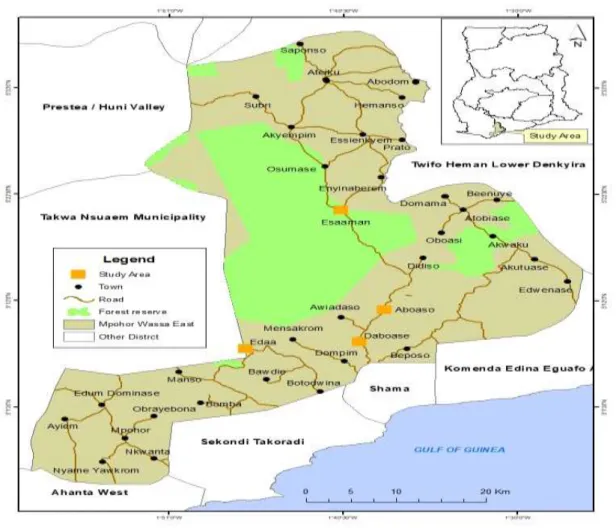
Intensive, as well as extensive field trips were conducted in four different communities (Daboase, Aboaso, Essaman, and Edaa) in Mpohor Wassa East District of the Western Region, Ghana (Figure 1) for collection of information regarding plant species for birth control.
The information was obtained from 12 respondents, three each from the four communities through interviews. Experienced and elderly persons, local traditional healers and traditional birth attendants were interviewed. The information was cross-checked with the help of available literature. Plants specimens were collected, identified and deposited in the University of Cape Coast Herbarium. Identification of plant specimens was facilitated by relevant manuals14-17.
Results
A total of 18 plant species, belonging to 14 families were identified as having abortifacient and contraceptive properties. A list of the species is presented in Table 1. The local name/s, common English name/s, habit, plant parts and how plant parts are used, and the birth control method the plant is used for are also presented.
Figure 1: Map of Western Region of Ghana showing the study sites
Table 1: Plant species used as abortifacient and contraceptive in Western Region of Ghana
Families and plant species
1
Local (Akan) name/s
2
Common English name/s
Habit
3
Plant part used and mode of crude drug preparation
4
Birth control method
5 Apocynaceae
Alstonia boonei
De Wild.
Funtumia elastica (Preuss.) Stapf
Nyamedua
Ofuruntum
Cheesewood/ Patternwood/ Stoolwood West African Rubber Tree
Tree
Tree
Stem bark: Decoction of the bark is used for enema
Leaves: Fresh leaves are crushed with
Manihot esculenta leaf and limestone; water is added. The mixture is used as for enema.
Contraception
Abortion
Asteraceae
Aspilia africana
(Pers.) C. D. Adams
Synedrella
N/Mfofo
Mamponfoapow/
Haemorrhage plant/ wild sunflower
Synedrella/
Herb
Herb
Leaves: Fresh leaves together with leaves of Gossypium arboreum are made into paste and salt petre is added. Also, local gin (akpeteshie) is added to the paste and the mixture is used as enema.
Leaves: Fresh leaves together with the bark of Terminalia catappa are crushed, and water is added. The mixture is both
Abortion
nodiflora Gaertn. Tutummirika-kohwe-Σpo
Cinderella weed drunk and used as enema. Contraception
Caesalpinaceae Cassia alata
Linn.
Duawusu/ Osempε
Ringworm shrub/ Candle tree
Shrub Leaves: Salt petre is added to the decoction of the fresh leaves and fruits of
Citrus medica var. limonum. The mixture is used as enema.
Abortion
Caricaceae
Carica papaya
Linn.
Borofere Pawpaw/
papaye
Tree Leaves/root: Fresh leaves or roots are ground, and used either orally or as enema.
Abortion
Combretaceae
Terminalia catappa Linn.
(A)borofo-nkate(ε) Indian almond/ tropical almond
Tree Stem bark: Stem barks together with leaves of Synedrella nodiflora are crushed. The mixture is drunk and also for enema.
Contraception
Cucurbitaceae Momordica charantia Linn.
Nyinya bitter melon/
bitter gourd/ bitter squash
Herb Seeds: Seeds together with black ants and salt petre are crushed, molded and inserted into the vagina.
Abortion
Euphorbiaceae
Discoglypremna caloneura (Pax) Prain
Manihot esculenta Crantz
Mareya micrantha
(Benth.) Muell. Arg Fetefre Bankye Odubrafo Cassava - Tree Shrub Tree
Stem barks: Stem barks are crushed with leaves of Chaetacme aristata. The mixture is used as enema.
Tuber peels: Tuber peels are crushed with salt; water is added it and the mixture is used as enema.
Leaves: Decoction of leaves and pepper is used as enema.
Contraception
Abortion
Abortion
Malvaceae
Gossypium arboreum Linn.
Asaawa/Asaaba Tree cotton Shrub Leaves: Fresh leaves are ground together with salt; water is added and the mixture is used as enema
Abortion
Meliaceae
Azadirachta indica A. Juss
Duagyene Neem tree Tree Seeds: Seeds are ground and drunk Contraception
Meristicaceae
Pycnanthus angolensis
(Welw.) Exell
Otie/Etsiw African nutmeg/False nutmeg
Tree Root barks: Root barks are crushed and used as enema
Abortion and Contraception
Mimosaceace Pentaclethra macrophylla
Benth
Ekuama/Atawa Oil bean tree/locust bean
Tree Seeds: Seeds are ground, moulded and inserted into the vagina.
Abortion
Rutaceae
Citrus medica
var. limonum
Brandis
Amomoe Lemon Tree Fruits: Salt is added to the decoction of the fruit and leaves of Carica papaya. The mixture is used as enema.
Abortion and contraception
Solanaceae
Solanum torvum
Swartz
Samanntroba/Nsusu wa
Turkey berry/ wild egg plant
Shrub Leaves: Fresh leaves are crushed with salt; water is added and the mixture is used as enema.
Abortion
Ulmaceae
Chaetacme aristata Planch.
Esonoanka Thorny elm Shrub/Sm all Tree
Leaves: Fresh leaves are crushed with stem barks of Discoglypremna caloneura; water is added and the mixture is used as enema.
Discussion
The use of plants as abortifacient and as contraceptive was well known to the ancient physicians18. Therefore, the study of modern herbalism on contraception and abortion is rapidly evolving throughout the world9.This is evident in several works that have been done recently by various workers11, 19-21.
This study has documented 18 species of plants belonging to 14 families, which are used for controlling birth. While 12 species were cited for abortion and eight for contraception only, two species - Carica papaya and Citrus medica var.
limonum were cited for both abortion and contraception. The abortifacient and contraceptive properties of these two species have been previously reported. For instance, it has been reported that the roots Carica papaya and Citrus medica var. limonum serve as contraceptives11.
Carica papaya seeds were stated to be abortifacients11, 21, 22, Citrus medica var. limonum
fruit was cited as abortifacient9. Additionally, the fruit and latex of Carica papaya were confirmed to be used for abortion23, 24, while the fruit latex was also cited for abortion25. Furthermore, the root as well as the unripe fruit can also be used for abortion26.
Several of the species documented in this work for birth control had been reported by other workers both in Ghana and other parts of the world. For example, different parts of Azadirachta indica have been cited by various workers for contraception: seed oil27; fruit19; leaves and seeds28; bark20; seeds, barks and leaves29; and seed9.Besides, the seed of Azadirahta sp. has been revealed to have abortive activity21.
Additionally, the documentation of
Momordica charantia for abortion in this work is in line with earlier findings by other workers. The root had been reported in Pakistan for abortion19. In India, the fruits are used for abortion21, 25. In Ghana also, a survey conducted in 2012 on Ghana‘s herbal market indicated Momordica charantia as the most frequently sold plant species for abortion30.
The other species reported in this work have also been reported in literature. For example,
the root and leaf of Cassia alata are respectively used for abortion and contraception9, while the leaf and bark of Mareya micratha as well as the root bark of Gossypium arboreum are also used for abortion9. Aspilia africana has antiovulatory activity which implies it can be used for birth control19. In addition, the seeds of Pentaclethra macrophylla, when crushed with red ants, have been known to be used by the natives to cause abortion31. The leaf of Solanum torvum has also been recorded for abortion25.
Even though species have been recorded in this survey for abortion and contraception, most of the respondents were not forthcoming with information, and even the few respondents who disclosed their preparations however did it in secrecy. The main reason for their reluctance or total refusal was that ―causing of abortion was an evil thing to do‖. They however admitted they provide herbal remedies for contraception and abortion for women in their communities who sought their services. Other surveys in Ghana also point out that women seek the help of traditional practitioners for abortion.
Conclusion
Herbal medicine can, therefore, provide a valuable and safe alternative to currently available methods of family planning. This fact increases the need for further scientific study on medicinal plants, including documentation, phytochemical, pharmacological and biological activity studies of these plants.
Acknowledgments
The authors sincerely thank Department of Environmental Science, University of Cape Coast, Ghana for providing transportation during data collection. They also thank Mr. Richard Adade of Centre for Coastal Management, University of Cape Coast for designing the map of the study sites and appreciate the cooperation of all the respondents.
Contribution of Authors
revision and final approval of the article: all authors.
References
1. Alan Guttmacher Institute. Sharing responsibilities: women, society and Abortion worldwide. New York: The Alan Guttmacher Institute 1999.
Available from:
https://www.guttmacher.org/sites/default/files/pdfs/ pubs/sharing.pdf. Accessed 26.05.2018.
2. Tilahun D, Assefa T and Belachew T. Knowledge, attitude and practice of emergency contraceptives among Adama University female students. Ethiop J Health Sci. 2010; (3): 195–202. Available from: http://www.researchgate.net/publication/221878453 _Knowledge_attitude_and_practice_of_emergency_ contraceptives_among_adama_university_female_st udents. Accessed 04.02.2017.
3. Grimes DA, Benson J, Singh S, Romero M, Ganatra B, Okonofua FE and Shah IH. Unsafe abortion: the preventable pandemic. Lancet 2006; 368 (9550): 1908–1919.
4. Ghana Maternal Health Survey (GMHS). USAID Documents 2007. Available from:http://dec.usaid.gov/index.cfm?p=search.getCi tation&rec_no=154970
http://pdf.usaid.gov/pdf_docs/PNADO492.pdf. Accessed 11.12. 2012.
5. Ghana Statistical Service (GSS), Ghana Health Service (GHS), and ICF Macro. Ghana Demographic and Health Survey 2008. Accra, Ghana: GSS, GHS, and ICF Macro 2009a.
6. Adanu RM, Seffah J, Anarfi JK, Lince N and
Blanchard K. Sexual and reproductive health in Accra, Ghana. Ghana Medical Journal 2012; 46 (2): 58-65.
7. Sedgh G. Abortion in Ghana, In Brief,New York: Guttmacher Institute 2010; 2. Biney AA. ―At that time I didn‘t understand it!‖: Exploring the subject of contraceptive knowledge and use among women with induced abortion experiences in the Greater Accra Region, Ghana. PRI Working Paper Series
2010; 10-02. Available from: http://www.pop.psu.edu/general/pubs/working_pape
rs/psu-pri/wp1002.pdf. Accessed 12.01.2011 8. KadiriAB.An Examination of the Usage of Herbal
Contraceptives and Abortifacients in Lagos State, Nigeria. Ethnobotanical Leaflets 2009; 13: 140-46. 9. Lans C. Ethnomedicines used in Trinidad and Tobago for
reproductive problems. Journal of Ethnobiology and Ethnomedicine 2007; 3: 13.
10. Gediya S, Ribadiya C, Soni J, Shah N. and Jain H. Herbal Plants Used as Contraceptives. International Journal of Current Pharmaceutical Review and Resaerch 2011; 2(1): 47-53.
11. Hill ZE. The Context of Informal Abortions in Rural
Ghana. Journal of Women's health, 2009; 18 (12): 2017-2022.
12. Ghana Statistical Service (GSS), Ghana Health Service (GHS) and Macro International. Ghana Maternal Health Survey 2007,Accra, Ghana: GSS and GHS; and Calverton, MD, USA: Macro International 2009b.
13. Mshana NR, Abbiw DK, Addae-Mensah I, Adjanouhoun E, Ahyi MR, Ekpere JA, Enow-Orock EG, Gbile ZO, Noamesi GK, Odei MA, Odunlami H, Oteng-Yeboah, AA, Sarpong K, Sofowora A and Tackie AN. Traditional Medicine and Pharmacopoeia contribution to the revision of Ethnobatanical and Floristic studies in Ghana. Organization of African Unity/Scientific, Technical and Research Commission (OAU/STRC) 2000.
14. Dokosi OB. Herbs of Ghana. Ghana Universities Press, Accra 1998.
15. Hawthorne W. Field guide to the forest trees of Ghana. Natural Resources Institute for the Overseas Development Administration, London. Ghana Forestry Series 1 1990.
16. Irvine FR. Woody plants of Ghana. Oxford University Press, London 1961.
17. Priya G, Saravanan K and Renuka C. Medicinal plants with potential antifertility activity- A review of sixteen years of herbal medicine research 2012; (1994-2010). International Journal of PharmTech Research, 4 (1): 481-494.
18. Shah GM, Khan MA, Ahmad M, Zafar M and Khan AA. Observations on antifertility and abortifacient herbal drugs. African Journal of Biotechnology 2009; 8 (9): 1959-1964.
19. Tripathi R, Dwivedi SN and Dwivedi S. Ethno-medicinal plants used to treat gynecological disorders by tribal people of Madhya Pradesh, India. International Journal of Pharmacy & Life Sciences (IJPLS) 2010; 1 (3):160-169
20. Dhore M, Dabhadkar D, Zade, V and Dhore M. Documentation of Fertility Regulatory Ethnomedicinal Plants used by Tribal‘s of Yavatmal District, Maharashtra, India. International Journal of Scientific and Research Publications 2012; 2 (3). 21. Idu M and Onyibe H. (2007). Medicinal Plants of Edo
State, Nigeria. Research Journal of Medicinal Plant 2007; 1: 32-41.
22. Kamble SY, Pati SR, Sawant PS, Sawant S, Pawar SG and Shing EA. Studies on plants used in traditional medicine by Bhilla tribe of Maharashtra Indian Journal of Traditional Knowledge 2010; 7 (2): 591-598.
23. Raju MP, Prasanthi S and Seetharami TVV. Medicinal plants in Folk medicine for Women‘s diseases in use by Konda Reddis. Indian Journal ofTraditional Knowledge 2011; 10 (3): 563-567.
24. Ajesh TP, Krishnaraj MV, Prabu M and
Journal of PharmTech Research 2012; 4 (3): 1015-1017.
25. Naser R. Traditional plants used as abortifacients in Aurangabad district, Maharashtra. Ethnobotany 2011; 23 (1&3): 138-140.
26. Muhammad IC and Khan MA. An ethnomedicinal inventory of plants used for family planning and sex diseases in Samahni valley, Pakistan. Indian Journal of Traditional Knowledge 2008; 7 (2): 277-283. 27. Meena AK and Rao MM. Folk herbal medicines used by
the Meena community in Rajasthan. Asian Journal of Traditional Medicines 2010; 5 (1).
28. Kaur R, Sharma A, Kumar R and Kharb R. Rising
Trends towards Herbal Contraceptives. J. Nat. Prod. Plant Resour 2011; 1 (4): 5-12.
29. Van Andel T, Myrenb B and van Onselenc S. Ghana‘s herbal market Journal of Ethnopharmacology 2012; (140) 368-378.
30. Okunrobo LO, Nwagwuogbe SC and Bafor EE. Phytochemical Evaluation and in vitro Inhibitory effect of the Methanol extract and partitioned chloroform fraction of the stem bark of