Lincoln
University
Digital
Thesis
Copyright
Statement
The
digital
copy
of
this
thesis
is
protected
by
the
Copyright
Act
1994
(New
Zealand).
This
thesis
may
be
consulted
by
you,
provided
you
comply
with
the
provisions
of
the
Act
and
the
following
conditions
of
use:
you
will
use
the
copy
only
for
the
purposes
of
research
or
private
study
you
will
recognise
the
author's
right
to
be
identified
as
the
author
of
the
thesis
and
due
acknowledgement
will
be
made
to
the
author
where
appropriate
you
will
obtain
the
author's
permission
before
publishing
any
material
from
the
Coping with a warming world: genetic studies on thermal adaptation
and links to membrane saturation in Antarctic fish
A thesis
submitted in partial fulfilment
of the requirements for the Degree of
Doctor of Philosophy
at
Lincoln University
by
Vanita Charles Malekar
Lincoln University
ii
Abstract of a thesis submitted in partial fulfilment of the requirements for the
Degree of Doctor of Philosophy
Coping with a warming world: genetic studies on thermal
adaptation and links to membrane saturation in Antarctic fish
By
Vanita Charles Malekar
Stearoyl-CoA desaturase (SCD) plays a key role in thermal adaptation across organisms,
allowing alteration of membranes in response to temperature change. Thermal adaptive
signatures at the gene sequence level and in the primary structure of the SCD protein require
investigation, especially in Antarctic fish. Owing to the stenothermal nature of Antarctic fish,
it remains unclear whether they have retained capacity to modulate their membranes in
response to warming temperatures. The hypothesis that membrane saturation, a major
thermal adaptive mechanism, will occur at reduced capacities in Antarctic notothenioid fish
in response to elevated temperatures was tested
SCD sequences were isolated from 21 fish species (Antarctic and non-Antarctic
notothenioids, and non-notothenioid Antarctic fish species). Phylogenetic analyses
supported the ancestral SCD1 duplication into SCD1a and SCD1b. Lineage-specific
duplication and loss of gene duplicates were identified for specific orders of fish. Cold
adapted notothenioids (Antarctic and non-Antarctic with Antarctic ancestry) SCD isoform
sequences were evolutionarily distinct from non-Antarctic sequences. SCD1a and 1b from
Antarctic fish displayed more diversity with amino acid composition varying across the
isoforms. SCD1a isoforms had more sites under positive selection and a higher rate of
molecular evolution in Antarctic fish than SCD1b, suggesting neofunctionalisation of SCD1a.
Ubiquitous tissue expression of SCD1b was seen in both the Antarctic species Trematomus
bernacchii and Pagothenia borchgrevinki, while ubiquitous expression of SCD1a isoform was
seen in T. bernacchii but not in P.borchgrevinki. Transcriptional response of the SCD isoforms,
along with the biochemical response of membrane saturation, in T. bernacchii and P.
borchgrevinki livers were determined in fish acclimated at 0 °C (control temperature), 4 °C
iii in T. bernacchii, while expression of SCD1a was low to be detected by qPCR in P.
borchgrevinki.
Membrane lipid composition of Antarctic fish species varied significantly when compared to
the New Zealand Perciforme species Notolabrus celidotus. Thermal acclimation at 4 °C did
not result in any detectable change in membrane saturation state or membrane cholesterol
in either Antarctic species. However, 6 °C thermal acclimation induced a homeoviscous
adaptive (HVA) response in the benthic species T. bernacchii, as shown by the significant
increase in membrane saturated fatty acids, and a significant decline in unsaturated fatty
acids. HVA response was not observed in P. borchgrevinki.
This is the first study to determine thermal adaptive signatures in the SCD gene of Antarctic
fish and provides evidence for asymmetric molecular evolution of SCD. This provides a
framework for future functional work. This is also the first study to show a homeoviscous
response to higher temperature in an Antarctic fish although only for one of the two species
examined.
Keywords: Antarctic fish, Stearoyl-CoA desaturase, homeoviscous response, thermal
iv
Acknowledgements
I would like to thank my supervisors Dr. Rob Cruickshank, Dr. Victoria Metcalf, Dr. Adrian
Paterson, Dr. Hayley Ridgway and Dr. Jim Morton for their guidance and insight on various
issues that arose during the research. I acknowledge their support during this period.
I am very thankful to my supervisor Dr. Adrian Paterson for his constant cooperation and
support during the final phase of this study.
I wish to acknowledge and thank Dr. Jim Morton for his timely support and also for the
expertise provided for the biochemical analysis, and for the correction of the thesis chapter.
I would also like to thank and acknowledge the constant technical support provided by
Richard Hider for the the lipid extraction and for the GC analysis.
I acknowledge and thank Dr. Hayley Ridgway for the expertise provided for the
transcriptional analysis and for the correction of the chapter. I thank Dr. David Palmer for
dedicating his time and for the technical feedback provided for the thesis. I thank Dr. Simon
Hodge for his support provided for the statistical analysis and also the support provided by
the Lincoln University Library.
I acknowledge the technical support provided by Scott Gregan for the qPCR analysis and also
acknowledge the support of Martin Wellby and Karl Gately for the support and assisatnce in
my laboratory experiments.
I am grateful to the Brian Mason Trust for the funding provided for this research project as
well as Meadow Mushroom Company for providing me a Scholarship for my studies.
Finally I thank all my friends, relatives, my brothers, sister and mother for their constant
support and encouragement and special thanks to my aunt who always encouraged me for
viii B.6 Alignments of SCD1b isoform sequences from Antarctic and non-Antarctic fish species.
Alignments specific for Antarctic fish and cold adapted notothenioid non-Antarctic fish
have been boxed ... 155
Appendix C : Manufacturer details for chemicals used for the biochemical analysis ... 157
Appendix D Chromatogram of the standard GLC 463 ... 159
ix List of Tables
Table 1 Differential tissue expression of SCD in teleost fish (Castro et al., 2011). ... 22
Table 2: Fish species sampled for the isolation of SCD sequences. ... 34
Table 3 Details of the reverse transcription reaction. ... 36
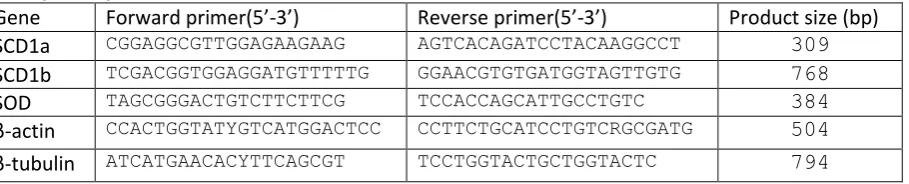
Table 4 Primers designed for isoform-specific amplification of SCD from fish. ... 37
Table 5 List of gene products and the specific requirement for the various analyses along with the research chapter. ... 38
Table 6 General PCR protocol. ... 38
Table 7 Cycling conditions for PCR. ... 38
Table 8 Denaturing gel loading buffer composition... 39
Table 9 Loading dye composition. ... 39
Table 10: Partial trimmed sequences of SCD1a and SCD1b isoforms for Pagothenia borchgrevinki. All of the trimmed SCD1a and SCD1b isoform sequences taken for the amino acid composition analysis started and ended with the motifs highlighted in green... 42
Table 11 Number of sequences isolated from the notothenioid and non-notothenioid fish from Antarctic and non-Antarctic thermal habitats using isoform-specific primers. ... 44
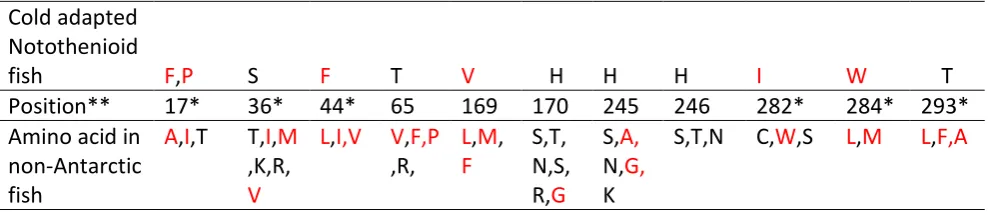
Table 12 Amino acid replacements in the SCD1a isoform of cold adapted notothenioid fish compared with non-Antarctic fish. ... 49
Table 13 Amino acid replacements in the SCD1b isoform of cold adapted notothenioid fish with non-Antarctic fish. ... 50
Table 14 Correlations between the first two principal components and the amino acids. Correlation values strongest 3 (positive/negative) colour coded yellow for the PCA1, while strongest 2 (positive/negative) colour coded orange for PCA2 are taken for the analysis. ... 53
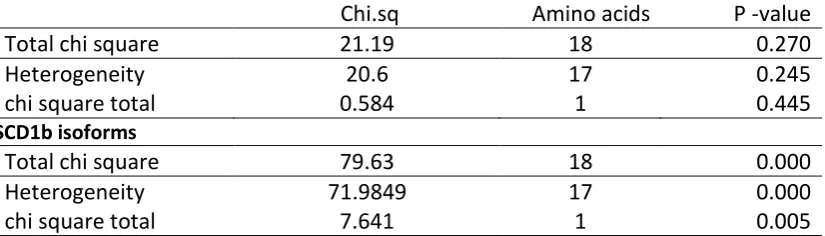
Table 15 Cochran’s test of heterogeneity for all amino acids in SCD isoforms. ... 54
Table 16 Chi-square test for the amino acids of SCD1b isoforms and the P-value for the corresponding amino acid. Significant P-values at the <0.05 level are indicated in orange. ... 55
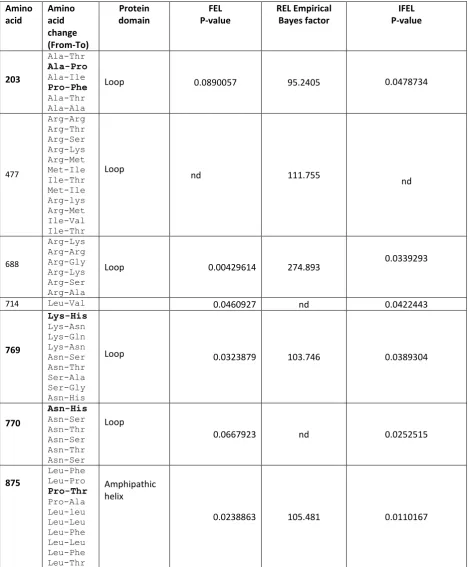
Table 17 Amino acid sites under positive selection identified in SCD 1a sequences of Antarctic and non-Antarctic fish using four different methods in Datamonkey. FEL: Fixed effect likelihood, REL: Random effect likelihood, IFEL: Internal branch fixed effect likelihood, nd: not detected. .. 57
Table 18 Amino acid sites under positive selection identified in SCD1b sequences of Antarctic and non-Antarctic fish using four different methods in Datamonkey. FEL: Fixed effect likelihood, REL: Random effect likelihood, IFEL: Internal branch fixed effect likelihood, nd: Not detected, TM3: transmembrane region ... 58
Table 19 Details of the samples taken for the tissue expression analysis at various time points after acclimation at different acclimation temperatures. D: Days after acclimation, T: temperature (0 °C, 4 °C and 6 °C) PB: Pagothenia borchgrevinki, TB: Trematomus bernacchii ... 78
Table 20 Details of the primers used for the generation of the specific gene products and the construction of gene-specific plasmids. ... 79
Table 21 RT-qPCR primers for target and reference gene used for the transcriptional response study. ... 81
Table 22 Details of the efficiency (%) of the PCR, equation for each assay and the R2 coefficient of the assay. Species TB: Trematomus bernacchii and PB: Pagothenia borchgrevinki are presented in the parentheses. ... 86
Table 23 Results of the BLASTn search with SCD1a (T. bernacchii) as the query sequence of (147bp) ... 86
Table 24 Results of the BLASTn search with SCD1b (T. bernacchii) as the query sequence of (160 bp) ... 86
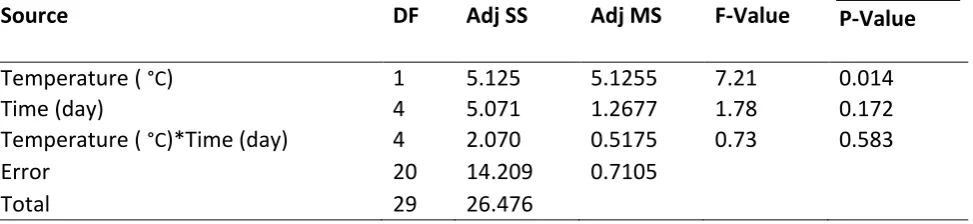
x Table 26 Analysis of Variance of effect of thermal acclimation on SCD1b gene expression relative to β actin in the liver of Pagothenia borchgrevinki, Adj SS: Adjusted sum of squares, Adj MS: Adjusted mean squares ... 89 Table 27 Analysis of Variance of effect of thermal acclimation on SCD1a gene expression relative to β actin in the liver of Trematomus bernacchii. Adj SS: Adjusted sum of squares, Adj MS: Adjusted mean squares ... 91 Table 28 Analysis of Variance of effect of thermal acclimation on SOD gene expression relative to β actin in the liver of Trematomus bernacchii. Adj SS: Adjusted sum of squares, Adj MS: Adjusted mean squares ... 92 Table 29. Analysis of Variance of effect of thermal acclimation on SOD gene expression relative to β actin in the liver of Pagothenia borchgrevinki. Adj SS: Adjusted sum of squares, Adj MS: Adjusted mean squares ... 93 Table 30. Fish location and local temperature range. ... 103
Table 31. Samples taken for phospholipid fatty acid analysis at different acclimation temperatures. TB: Trematomus bernacchii, PB: Pagothenia borchgrevinki, D0, D1, D7, D14 and D28: days after
xi List of Figures
xii Pagothenia borchgrevinki. Five µL of RT-PCR sample was loaded for analysis. (L: Liver, PC: Pyloric caeca, B: Brain, H: Heart, K, Kidney, RM: Red muscle, WM: White muscle, S: Spleen, SCF: Subcutaneous fat, A: Adipose) M: Hyper Ladder I (Bioline), Hyper Ladder II only for SCD1b (Figure 14B) ... 85 Figure 15 Analysis of SCD1b and SCD1a amplified by qPCR from an experimental sample of T. bernacchii liver. 8 µl of the sample was run on a 3.5% agarose gel. ... 87 Figure 16 Effect of thermal acclimation on SCD1b gene expression relative to β actin in the liver of Trematomus bernacchii at the control temperature (0 °C, T0) and acclimated temperature (4 °C, T4). Control (n=3) and acclimated (n=3) fish were sampled at 1, 2, 3, 7 and 14 days after thermal acclimation. Error bars indicate the standard error of mean. Different Roman numerals indicate a significant temperature effect as determined by Holm-Sidak post hoc test after ANOVA (P<0.05). ... 88 Figure 17 Effect of thermal acclimation on SCD1b gene expression relative to β actin in the liver of Pagothenia borchgrevinki at the control temperature (0 °C, T0) and acclimated temperature (4 °C, T4). Control (n=3) and acclimated (n=3) fish were sampled after 1, 2, 3, 7 and 28 days of thermal acclimation. Error bars indicate the standard error of mean. ... 89 Figure 18 Effect of thermal acclimation on SCD1b gene expression relative to β actin in the liver of Trematomus bernacchii and Pagothenia borchgrevinki at the control temperature (0 °C, T0) and acclimated temperature (6 °C, T6). Control (n=3) and acclimated (n=3) fish were sampled after 7 days of thermal acclimation. Error bars indicate the standard error of mean. Significance at (P<0.05) determined by an unpaired t test. ... 90 Figure 19 Effect of thermal acclimation on SCD1a gene expression relative to β actin in the liver of Trematomus bernacchii at the control temperature (0 °C, T0) and acclimated temperature (4 °C, T4). Control (n=3) and acclimated (n=3) fish were sampled after 1, 2, 3, 7 and 14 days of thermal acclimation. Error bars indicate the standard error of mean. Dissimilar Roman numerals indicate a temperature effect and different letters indicate a time (days) effect as determined Holm-Sidak post hoc test after ANOVA (P<0.05). ... 91 Figure 20 Effect of thermal acclimation on SOD gene expression relative to β actin in the liver of Trematomus bernacchii at the control temperature (0 °C, T0) and acclimated temperature (4 °C, T4). Control (n=3) and acclimated (n=3) fish were sampled after 1, 2, 3, 7 and 14 days of thermal acclimation. Error bars indicate the standard error of mean. ... 92 Figure 21. Effect of thermal acclimation on SOD gene expression relative to β actin in the liver of Pagothenia borchgrevinki at the control temperature (0 °C, T0) and acclimated temperature (4
15 Bovichtus variegatus: This is the most basal Notothenioidei species as determined by systematic
(Balushkin, 1984) and karyological research (Prirodina, 1986) as mentioned in (Eastman, 1993). It is
an ideal subject for comparison studies of cold-adapted tissue and organs from Antarctic
notothenioids due to its lack of features that are found in their Antarctic relatives-eg. AFGPs and
aglomerular kidneys. As adults they are bottom dwellers and they are found in southern New Zealand
and subantarctic waters.
1.3.1.2.2 Nototheniidae
This family comprises 49 species within 13 genera and are the most diverse family with respect to
size, body form, habitat and distribution. They are distributed throughout the Antarctic as well as in
coastal waters of New Zealand and South America. Fifteen species have a non-Antarctic distribution.
There is an evolutionary departure from the ancestral benthic habitat in 50% of the Antarctic species
of this family.
Pagothenia borchgrevinki is the principal Antarctic model fish species for this study. P.borchgrevinki
are cryopelagic as they are associated with the under surface of the ice and this niche specialisation
has led to them becoming morphologically and physiologically diverse from other notothenioids
(Eastman & DeVries, 1985). They also exhibit a degree of ecological plasticity. Robust antifreeze
protection is essential for their cryopelagic habitat due to their constant contact with ice in the upper
33 cm of the ice-water column. To achieve this, they have higher concentrations of AFGPs in their
body fluids relative to other notothenioids and these lower the freezing point (DeVries et al., 1971).
P.borchgrevinki are not neutrally buoyant but are lighter than the benthic trematomiids and in the
austral summer they live in the upper 6m of the water column under the ice. They have a more
streamlined body that is laterally compressed compared with benthic trematomiids. They are also
characterised by higher levels of oxygen consumption, haemoglobin concentration and hematocrit
than some of their close relatives. Primarily they are zooplanktivorous (Foster et al., 1987) but they
also consume the notothenioid Pleuragramma antarcticum.
Trematomus bernacchii is a benthic Antarctic species found in both shallow areas and in water up to
550m deep. They feed on plankton to a greater extent than other benthic Trematomiids. As a benthic
species they have a less buoyant body and a heavier skeleton and are also less streamlined than the
cryopelagic P. borchgrevinki. Pelvic and anal fins are used for support and substrate contact and they
have a diet described as predominantly polychaetes, small fishes, fish eggs and amphipods (Eastman,
29 4. What is the transcriptional response of SCD in a thermally challenged environment?
5. What is the biochemical response of membrane saturation in a thermally challenged Antarctic
fish?
The overall aim for this research is to study the SCD gene evolution in the Antarctic and non-Antarctic
fish from the notothenioid suborder and to investigate membrane remodelling, and expression of the
desaturase (SCD) enzyme in thermally challenged Antarctic fish.
To accomplish the above aims of the current study the objectives are as follows.
1) Isolation and identification of partial SCD isoform mRNA sequences from a range of Antarctic
and non-Antarctic notothenioid fish species.
2) Evolutionary analysis of the SCD gene in Antarctic fish by comparative approaches of
phylogenetic analysis, amino acid composition analysis, identifying signatures of selection and
mapping of adaptive signatures on the SCD structure.
3) Determination of tissue expression through end point PCR from stenothermal notothenioid
Antarctic fish.
4) Ascertain the transcriptional response to temperature in the Antarctic stenotherm through
qRT-PCR (target gene: SCD and antioxidant markers) of RNA isolated from liver tissues
harvested from fish from a range of temperatures and time-points in a pilot thermal
acclimation experiment.
5) Ascertain the biochemical response to temperature in the Antarctic stenotherm through
32 Protein structure adaptation in Antarctic fish in relation to temperature has been documented for a
few cytoplasmic proteins, and the protein lactate dehydrogenase has been particularly well studied
(Coppes & Somero, 2007). In addition, membrane proteins the Sec61 translocation channel protein
(Romisch et al., 2003) and PEPT1 peptide transporter protein from Chionodraco hamatus (Rizzello et
al., 2013) have been investigated for signatures relating to cold adaptation. Thermal adaptive
signatures of orthologous protein sequences have also been elucidated using cDNA libraries from two
confamiliar fish species from different thermal habitats (Windisch et al., 2012). These studies
indicated common principles that regulate thermal adaptation. At lower temperatures, due to low
energy states, protein flexibility is enhanced, especially in the active sites. Flexibility achieved by
specific amino acid replacement in the regions involved in the mobility of the enzyme during the
catalytic cycle is the predominant structural cold adaptation (Feller, 2013).
In this chapter major Antarctic and non-Antarctic fish representatives of five of the eight families in
the notothenioid suborder were analysed using partial SCD sequences. The rationale for the use of
partial sequences was to obtain SCD sequences from a large data set including Antarctic fish species.
SCD sequences were PCR amplified and sequenced partial SCD sequences from a range of Antarctic
fish species samples as well as published sequences of notothenioid, and non notothenioid species
of different thermal habitats from databases (GenBank : https://www.ncbi.nlm.nih.gov/genbank/
and ENSEMBL : (http://asia.ensembl.org/index.html ), were used in a comparative study of nucleotide
sequences and inferred primary protein sequences. The purpose of this study was to reconstruct the
phylogenetic history of SCD in Antarctic fish and to determine the signatures of thermal adaptation
in the two SCD isoforms.The term ‘signature’ is used as a proxy for specific changes in the nucleotide
and amino acid sequences of the SCD isoforms of Antarctic fish when compared to non-Antarctic fish,
primarily processes such as temperature reduction have left evidence of such changes. Amino acid
composition and codon usage of both the SCD isoforms were examined from Antarctic fish in
comparison to non-Antarctic fish. The sites of positive selection were determined. Locations of amino
acid substitutions specific to Antarctic fish, and amino acids under positive selection were mapped
onto the primary amino acid sequence of SCD. With the integration of structural data and sequence
44 isolated from ten species (Table 11). The Antarctic and non-Antarctic notothenioid species are
mentioned in Table 2. Non-Antarctic notothenioid are species which have an Antarctic ancestry and
have dispersed to non-Antarctic waters. While some notothenioid species which do not have an
Antarctic ancestry are mentioned in Table 2. The amplified products were sequenced and then
confirmed using BLASTn (http://www.ncbi.nlm.nih.gov) to confirm their identity as sequences from
the gene. SCD1a sequences obtained from Antarctic species had 98% sequence similarity to SCD1a
from the emerald rock cod Trematomus bernacchii (FJ177513.1), the black rockcod Notothenia
coriiceps (XM_010780865), and 91% sequence similarity to SCD1a from the gilthead seabream Sparus
aurata (JQ277703). The SCD1b sequences had 99% sequence similarity with SCD1b of N. coriiceps
(XM_010769852.1) and 88% sequence similarity with the European seabass Dicentrarchus labrax
(XM_010769852.1). This dataset was expanded using SCD sequences obtained from NCBI and
ENSEMBL and provided in the Appendix (B.1)
Table 11 Number of sequences isolated from the notothenioid and non-notothenioid fish from Antarctic and non-Antarctic thermal habitats using isoform-specific primers.
SCD1b SCD1a
Antarctic notothenioid 13 7
Non-Antarctic notothenioid 7 3
Antarctic non-notothenioid 1 0
49 highly conserved across the vertebrates. Fish-specific amino acid replacements were observed, and
most variation was at the N-terminal end of the protein sequence.
Specific amino acid substitutions were observed in the SCD1a and 1b sequences of Antarctic fish
when compared to non-Antarctic fish (shown in Table 12 and 13). In SCD1a (Table 12), there are 11
amino acid substitutions specific for Antarctic fish and out of which five substitutions were for
Antarctic as well as the cold adapted non-Antarctic fish (Notothenia angustata and
Champsocephalus esox). Codon 245 were specific to cold adapted notothenioid fish (Antarctic and
non-Antarctic fish) as well one non-Antarctic warm adapted species Danio rerio. Seven substitutions
were localised in the loop regions, two in the transmembrane regions, one in the helix and one in
the amphipathic helix (Figure 9). Majority of hydrophobic residues and polar residues were replaced
with polar residues in Antarctic fish species (Table 12), this was observed in amino acid positions 36
(serine), 65 (threonine), 170, 245 (histidine). Some replacements involved replacement of
hydrophobic amino acids by other hydrophobic amino acids seen in amino acid position 44
(phenylalanine), 169 (valine), 284 (tryptophan). Replacements of hydrophobic and polar amino
acids by hydrophobic amino acids was observed in amino acid position 17 (phenylalanine and
proline) and 282 (isoleucine). Replacements of polar uncharged by polar charged amino acids was
observed in position 246 (histidine) and replacement of hydrophobic amino acids by polar amino
acids was found only at position 293 (threonine).
Table 12 Amino acid replacements in the SCD1a isoform of cold adapted notothenioid fish compared with non-Antarctic fish.
Cold adapted Notothenioid
fish F,P S F T V H H H I W T
Position** 17* 36* 44* 65 169 170 245 246 282* 284* 293* Amino acid in
non-Antarctic fish
A,I,T T,I,M ,K,R, V
L,I,V V,F,P ,R,
L,M, F S,T, N,S, R,G S,A, N,G, K
S,T,N C,W,S L,M L,F,A
** Refers to the amino acid numbering of Danio rerio in alignment [Appendix: (B.5)] * Replacements observed only in Antarctic fish species. Hydrophobic amino acids are in red.
The SCD1b isoform had six amino acid substitutions that were specific for the cold-adapted
notothenioid fish comprising of Antarctic and non-Antarctic fish species which has a thermal range
from 5 °C to 11°C (Notothenia angustata, Dissostichus eleginoides, Champsocephalus esox,
Pagothenia tessellata) and in Eliginops maclovinus (Table 13). The substitutions were localized in
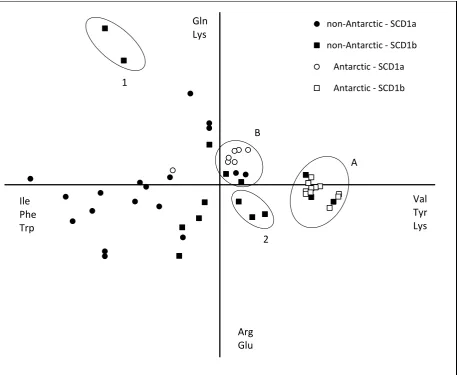
51 SCD1a isoforms from Antarctic fish also formed a cluster characterized by high glutamine and lysine.
This cluster comprised Antarctic species, cold adapted non-Antarctic notothenioid species (C.esox)
and cold adapted non notothenioid species, such as Gadus morhua of SCD1a isoform as well as
Gasterosteus aculeatus and Takifugu rubripes of SCD1b isoform (Figure 7, cluster B). SCD1a from C.
hamatus had high proportions of glutamine acid and lysine compared to other Antarctic fish and
hence was separated from the main cluster of SCD1a Antarctic species. The SCD1a and SCD1b
sequences from non-Antarctic fish were characterized by high proportions of isoleucine,
phenylalanine and tryptophan.
The non-Antarctic warm-adapted fish species Oreochromis niloticus had high proportions of
glutamine and lysine (PCA axis 2) and also isoleucine, phenylalanine and tryptophan (PCA axis 1) when
compared to other fish species. In general, SCD1b from Antarctic species had high proportions of
valine, tyrosine and lysine, while the SCD1a from Antarctic species had high proportions of glutamine
52 Figure 7 Principal Component Analysis of partial SCD1a and SCD1b sequences from Antarctic and non-Antarctic fish. Each point on the graph represents a single fish. PC1 = 26.4 %, PC2 = 13.4%. Amino acids significantly correlated with PC1 and PC2 are indicated on the axes. Warm-adapted fish species Orechromis
niloticus are enclosed (1), non-Antarctic notothenioid fish species are enclosed (2), Antarctic fish species and
non-Antarctic fish species with Antarctic ancestry are enclosed (A) and Antarctic and cold-adapted fish species are enclosed (B). Species in each enclosure are as follows:
1; Orechromis niloticus _SCD1b(1), Orechromis niloticus _SCD1b(2)
2; Bovichtus variegatus_ SCD1b, Eliginops maclovinus_SCD1b and Cottoperca gobio_SCD1b A; All notothenioid Antarctic fish species with SCD1b sequences as given in Table 2
B; All Notothenioid Antarctic fish species with SCD1a sequences as given in table 2 (except Chionodraco
hamatus) along with non-Antarctic fish species C.esox_SCD1a , Gadus morhua_SCD1a, Gasterosteus aculeatus_SCD1b and Takifugu rubripes_SCD1b.
non-Antarctic - SCD1a
non-Antarctic - SCD1b
Antarctic - SCD1a
Antarctic - SCD1b
54 heterogeneity and the chi-square total between the amino acids and the AT3 vs GC3 distribution
across the Antarctic/non-Antarctic habitat was significant for SCD1b, but not for SCD1a (Table 15).
Figure 8 Proportions of GC3 codons in partial sequences of SCD1b from Antarctic and non-Antarctic fish. All the amino acids presented are significant at P<0.05 (Table 16).
Table 15 Cochran’s test of heterogeneity for all amino acids in SCD isoforms. SCD1a isoforms
Chi.sq Amino acids P -value
Total chi square 21.19 18 0.270
Heterogeneity 20.6 17 0.245
chi square total 0.584 1 0.445
SCD1b isoforms
Total chi square 79.63 18 0.000
Heterogeneity 71.9849 17 0.000
chi square total 7.641 1 0.005
0.0 0.2 0.4 0.6 0.8 1.0
Asp Phe Gly Ile Pro Gln Tyr
P ropo rti ons of GC3 usag e Amino acid
Codon usage of SCD1b Isoforms
56 codons 769 and 770, a histidine pair is present in all nine of the Antarctic species but is absent from
non-Antarctic species (except for C. esox) (Figure 9 and 10).
Four codons in SCD1b, are under positive selection 223, 373, 428, and 464 (Table 18). Codons 373
and 464 were identified by all three methods (FEL, IFEL and REL), while codons 223 and 428 were
identified by only one. Codons 223, 428 and 464 are in loop regions while codon 373 is part of the
third transmembrane region of the protein. Of these four codons, 373 and 464 were detected in
Antarctic and cold adapted non-Antarctic notothenioid species. Codon 373 was determined to have
been under positive selection in the non-notothenioid Antarctic species Pachycara brachycephalum;
a few non-Antarctic species, P. tessellata and N. angustata, Antarctic species, N. rossii, N. coriiceps
and G.gibbberifrons, while other Antarctic species were not under positive selection at this site.
Codon 464, which is part of the loop region appears to have undergone positive selection in the
Antarctic species N. coriiceps but it is unclear whether this codon is under selection in other species
57 Table 17 Amino acid sites under positive selection identified in SCD 1a sequences of Antarctic and non-Antarctic fish using four different methods in Datamonkey. FEL: Fixed effect likelihood, REL: Random effect likelihood, IFEL: Internal branch fixed effect likelihood, nd: not detected.
Amino acid Amino acid change (From-To) Protein domain FEL P-value REL Empirical Bayes factor IFEL P-value 203 Ala-Thr Ala-Pro Ala-Ile Pro-Phe Ala-Thr Ala-Ala
Loop 0.0890057 95.2405 0.0478734
477 Arg-Arg Arg-Thr Arg-Ser Arg-Lys Arg-Met Met-Ile Ile-Thr Met-Ile Arg-lys Arg-Met Ile-Val Ile-Thr Loop
nd 111.755
nd 688 Arg-Lys Arg-Arg Arg-Gly Arg-Lys Arg-Ser Arg-Ala
Loop 0.00429614 274.893 0.0339293
714 Leu-Val 0.0460927 nd 0.0422443
769 Lys-His Lys-Asn Lys-Gln Lys-Asn Asn-Ser Asn-Thr Ser-Ala Ser-Gly Asn-His
Loop 0.0323879 103.746 0.0389304
770 Asn-His Asn-Ser Asn-Thr Asn-Ser Asn-Thr Asn-Ser Loop
0.0667923 nd 0.0252515
875 Leu-Phe Leu-Pro Pro-Thr Pro-Ala Leu-leu Leu-Leu Leu-Phe Leu-Leu Leu-Phe Leu-Thr Amphipathic helix
0.0238863 105.481 0.0110167
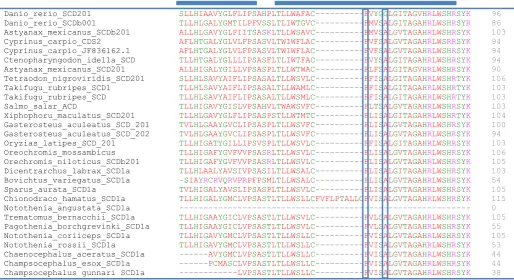
61 Figure 11 Alignment of partial SCD1a sequences from Antarctic and non-Antarctic fish species. Residues in SCD1a isoform which are critical determinants of the substrate length of fatty acyl chain are boxed (phenylalanine and alanine). Blue horizontal boxes represent the transmembrane regions.
Figure 12 Alignment of partial SCD1b sequences from Antarctic and non-Antarctic fish species Residues in SCD1b isoform which are critical determinants of the substrate length of fatty acyl chain are boxed (tyrosine and alanine). Blue horizontal boxes represent the transmembrane regions (TM1 and TM2).
Orechromis_niloticus LRWSKIIAFSLLHLGALYGLILIPSASPSTLAWTAFCYVFSGLGVTAGAHRLWSHRSYKA 95 Orechromis_niloticus_SCD202 LRWSKIIAFSLLHLGALYGLILIPSASPSTLAWTAFCYVFSGLGVTAGAHRLWSHRSYKA 104 Xenopus_laevis_SCD IVWRNVILMCLLHIGAFYGLFFIPAAKPITLAWATVCFMLSALGVTAGAHRLWSHRSYKA 110 Salmo_salar_SCD LVWRNIILMFLLHIGALYGLMIVPSASALTLAWTALCFLLSALGITAGAHRLWSHKSYKA 102 Tetraodon_nigroviridis_SCDb201 LVWRNIILMSLLHVGALYGLLLLPSASASTLAWTAACYLFSALGVTAGAHRLWSHRSYKA 105 Takifugu_rubripes_SCD1b LVWRNIILMTLLHAGALYGLVLLPSASGLTLVWSAVCYLVSALGVTAGAHRLWSHRSYKA 104 Takifugu_rubripes LVWRNIILMTLLHAGALYGLVLLPSASGLTLVWSAVCYLVSALGVTAGAHRLWSHRSYKA 104 Gadus_morhua_SCD_201 LVWRNIILMLLLHSGALYGLMLIPSASVLTLAWTVVCFIISALGVTAGAHRLWSHRTYKA 101 Oryzias_latipes_SCDb_201 FVWRNIILMCLLHLGALYGLVLVPSASPLTLAWSGVCYFLSALGVTAGAHRLWSHKTYKA 118 Xiphophoru_maculatus LVWRNIILMGLLHIGALYGLVLIPSASWLTLGWTAVCYMISALGVTAGAHRLWSHRSYKA 110 Sparus_aurata_SCD1b LVWRNIIMMTLLHVTSLYGLVLLPSASAPTLAWTVVCYLFSALGVTAGAHRLWSHRSYKA 106 Dicentrarchus_labrax_SCD1b LVWRNIILMSLLHIGALYGLVLIPNASTSTLAFTAVCYMFSALGVTAGAHRLWSHRSYKA 105 Gasterosteus_aculeatus_SCDb_201 LVWRNIVLMSVLHAAALYGLVLLPSASVPTLAWTAVCYIISALGVTAGAHRLWSHRSYKA 101 Pachycara_brachycephalum LVWRNIILMSLLHVTALYGLVLLPSASVATLAWTAVCYFISALGVTAGAHRLWSHRSYKA 62 Cottoperca_gobio --WRNIMLMTLLHLGALYGLTLVPSASVLTLAWIAVCYLISALGVTAGAHRLWSHRSYKA 58 Bovichtus_variegatus_SCD1b LVWRNIILMTLLHLGALYGLILMPSASVLTLAWTAVCYLISALGVTAGAHRLWSHRSYKA 77 Eliginops_maclovinus_SCD1b LVWRNIILMTLLHLGALYGLILLPSASVSTVAWTAVCYLISALGVTAGAHRLWSHRSYKA 73 Pagothenia_tessellata_SCD1b LVWRNIILMTLLHLGALYGLVLLPSASVSTVAWTAVCYLISALGVTAGAHRLWSHRSYKA 78 Notothenia_rossii_SCD1b LVWRNIILMTVLHLGALYGLVLLPSASVSTVAWTAVCYLISALGVTAGAHRLWSHRSYKA 77 Notothenia_angustata_SCD1b --WRNIILMTLLHLGALYGLVLLPSASVSTVAWTAVCYLISALGVTAGAHRLWSHRSYKA 58 Notothenia_coriiceps_SCD1b LVWRNIILMTLLHLGALYGLVLLPSASVSTVAWTAVCYLISALGVTAGAHRLWSHRSYKA 104 Dissostichus_eleginoides_SCD1b LVWRNIILMTLLHLGALYGLVLLPSASVSTVAWTAVCYLISALGVTAGAHRLWSHRSYKA 82 Gobionothen_gibberifrons_SCD1b LVWRNIILMTVLHLGALYGLVLLPSASVSTVAWTAVCYLISALGVTAGAHRLWSHRSYKA 72 Gymnodraco_acuticeps_SCD1b LVWRNIILMTFLHLGALYGLVLLPSASVSTVAWTAVCYLISALGVTAGAHRLWSHRSYKA 77 Trematomus_nicolai_SCD1b LVWRNIIMMTLLHLGALYGLVLLPSASVSTVAWTAVCYLISALGVTAGAHRLWSHRSYKA 77 Gobionothen_marionensis_SCD1b LVWRNIILMTLLHLGALYGLVLLPSASVSTVAWTAVCYLISALGVTAGAHRLWSHRSYKA 66 Lepidonotothen_squamifrons_SCD1b LVWRNIILMTLLHLGALYGLVLLPSASVSTVAWTAVCYLISALGVTAGAHRLWSHRSYKA 77 Pagothenia_borchgrevinki_SCD1b LVWRNIILMTLLHLGALYGLVLLPSASVSTVAWTAVCYLISALGVTAGAHRLWSHRSYKA 77 Trematomus_hansoni_SCD1b LVWRNIILMTLLHLGALYGLVLLPSASVSTVAWTAVCYLISALGVTAGAHRLWSHRSYKA 74 Chionodraco_hamatus_SCD1b LVWRNIILMTLLHLGALYGLVLLPSASVSTVAWTAVCYLISALGVTAGAHRLWSHRSYKA 75 Chaenocephalus_aceratus_SCD1b LVWRNIILMTLLHLGALYGLVLLPSASVSTVAWTAVCYLISALGVTAGAHRLWSHRSYKA 77 Champsocephalus_gunnari_SCD1b LVWRNIILMTLLHLGALYGLVLLPSASVSTVAWTAVCYLISALGVTAGAHRLWSHRSYKA 77 Champsocephalus_esox_SCD1b LVWRNIILMTLLHLGALYGLVLLPSASVSTVAWTAVCYLISALGVTAGAHRLWSHRSYKA 77 Pagothenia_georgius_SCD1b LVWRNIILMTLLHLGALYGLVLLPSASVSTVAWTAVCYLISALGVTAGAHRLWSHRSYKA 75 * ::: : .** ::*** ::* *. *: : *:..*.**:**********::***
65 Variation in paralog retention between the orders of fish
In the present study, phylogenetic analysis (Fig. 4) indicates SCD gene duplicates occurring in all
orders of fish used in this study except for Cypriniformes, Characiformes and Gonorynchiformes. Fish
species, namely Danio rerio, Cyprinus carprio belonging to order Cypriniformes, Chanos chanos
(Gonorynchiformes) and Astyanax mexicanus (Characiformes), do not have SCD1b paralogs but only
have the SCD1a paralog suggesting the loss of SCD1b and retention of only SCD1a isoform in these
orders. Also the loss of SCD1b might be due to a disabled pseudogene and not a deletion, which
demands further investigation. One of the variations after gene duplication, involve retention of some
paralogs and also loss of paralogs. Studies on the retention of paralogs in two superorders of teleosts,
Ostariophysi and Acanthopterygii, show that 1.3 % of the teleost-specific gene duplicates (TSGD) gene
paralogs are present in genomes of the superorder Acanthopterygii, whereas a single copy of the
paralogs was retained in the genomes of the Ostariophysi species Danio rerio (Cypriniformes) and
Astyanax mexicanus (Characiformes) (Garcia de la serrana et al., 2014). In general, the study showed,
there was systematic retention of 1-2% of the paralogs across both superorders and these could be
functionally significant for the evolution and diversification of particular lineages (Garcia de la serrana
et al., 2014). Similarly, one of the duplicate genes of the evolutionarily conserved cortisol stress
response genes in zebrafish is lost (Alsop & Vijayan, 2009). Such patterns of retention and loss of
duplicate paralogs conforms to the finding for SCD reported here in the present study.
The relevance of the loss of SCD1b and the retention of SCD1a in some orders is further complicated
by the observation that D.rerio and A. mexicanus have duplicates of SCD1a that are localized on
different chromosomes. The reason for the loss of duplicates is unclear but it could have occurred
after the sub-functionalization of the genes, when the need for the modified function of one duplicate
was lost (Garcia de la serrana et al., 2014). This highlights the need for a better understanding of the
differing functions of gene duplicates in general, and SCD1a and 1b in particular.
Diversity of SCD gene duplicates
The present phylogenetic analysis (Fig. 4) supports existence of lineage-specific duplicates (LSD) of
SCD1a in Gasterosteus aculeatus and Cyprinus carprio, and SCD1b in Oreochromis niloticus. SCD1b
appears to be lost from Cyprinus carprio, but in G aculeatus and O.niloticus both duplicates (SCD1a
and 1b) are retained and a third copy of SCD1b arising from LSD. The apparent absence of SCD1b in
66 sequences do not exist in the databases. However, supporting studies indicate losses of gene
duplicates in other cypriniform fish, conforming with our observations (Garcia de la serrana et al.,
2014). Other than whole genome duplicates, in which duplicates are localized on separate
chromosomes, the lineage-specific duplicates identified in the present study occur on the same
chromosome (Fig. 5) and could perhaps be the result of alternate splicing or gene duplication. The
specific functions of these SCD duplicates in these species are unknown but in C. carprio one duplicate
of the SCD1a gene is regulated by temperature while the other isoform is regulated by diet (Polley et
al., 2003). Studies are needed to examine whether such regulatory patterns as seen in Cyprinus
carprio exist across the isoforms of the genome duplicates in other species in order to elucidate their
functions.
Presence of SCD1 gene duplicates SCD1a and SCD1b in Antarctic fish
This study is the first to show the presence of both the duplicates SCD1a and SCD1b across the
Antarctic notothenioid fish. Previous studies of SCD (Porta et al., 2012) from Antarctic fish (T.
bernacchii and C. hamatus) found the SCD1a isoform, as both these previously identified sequences
occupy the SCD1a clade in the phylogenetic tree (Fig. 4) In addition, the genome sequence of the
Antarctic notothenioid Notothenia coriiceps possesses both SCD1a and SCD1b duplicates (Shin et al.,
2014). In general, gene duplication has played a major role in Antarctic fish influencing their successful
establishment in cold conditions. Transcriptome analysis of three Antarctic species revealed the
presence of Antarctic-specific duplications in 118 protein gene families and many of the duplicated
proteins were upregulated in cold conditions (Chen et al., 2008). SCD1b sequences were successfully
obtained from nineteen Antarctic species targeted in the study, SCD1a sequences could only be
obtained from six species, mostly in the families Channichthyidae and Nototheniidae. The reasons for
this are unclear, but may be due to low expression or loss of this isoform in some species, and requires
further investigation in a larger panel of Antarctic fish species. Investigation involving genome
sequencing of the fish species and also probing using cDNA libraries could perhaps confirm the
67 Cold adapted notothenioid fish species are evolutionary distinct with respect to SCD
Phylogenetic analysis reveals that the cold adapted Antarctic and non-Antarctic notothenioid with an
Antarctic ancestry (Table 2) form a separate clade for each isoform (Fig. 4), as the clade does not
contain any non- notothenioid fish species. This indicates that the isoforms from these two groups
are evolutionarily distinct with respect to SCD and also that they have inherited and retained both
copies from the ancestral duplication. Non-Antarctic notothenioids which do not have Antarctic
ancestry B. variegatus and C.gobio (family Bovichtidae) are together form the sister taxa of the
Notothenidae (Near et al., 2004). This relationship is strongly supported, also more so for SCD1b than
SCD1a. This suggests that the gene trees reflect the phylogenetic relationships of these species.
Although, the secondarily temperate species Notothenia angustata has an Antarctic ancestry and
dispersed to temperate waters around 11 Mya (Cheng et al., 2003), and its position in the phylogeny
does not match its current biogeography, as it is part of the Antarctic clade for both SCD1a and SCD1b
suggesting that the SCD gene tree may reflect phylogeny more than biogeography or habitat, as the
genus Nothothenia is monophyletic for both isoforms. Similarly, phylogenetic position does not
match biogeography occurs in other species of Antarctic ancestry but now dispersed to the
non-Antarctic water such as C. esox for (SCD1a and SCD1b clade), and D. elegenoides and P. tesselata
(SCD1b clade only)
Increased basic amino acids in Antarctic SCD1a isoforms and reduction in the hydrophobic amino
acids in SCD1b
Whether amino acid usage and thermal habitat are correlated was examined in a previous
comparative study of the confamiliar teleost fish species Pachychara brachycephalum (Antarctic) and
Zoarces viviparous (temperate). The authors used transcriptome sequence information to establish
general patterns of amino acid usage. Their comparison of the amino acid compositions of the
orthologous sequence pairs demonstrated a reduction in the frequency of acidic residues (e.g.
glutamic acid) and increase in the frequency of basic residues (e.g. lysine, arginine and histidine),
causing reduction in the charges required for stabilization of salt bridges in the proteins (Windisch et
al., 2012). The aligns with the trend as SCD1a from Antarctic fish in this study and cold-adapted fish
was positively correlated with glutamine and negatively correlated with glutamic acid (Fig. 7). Perhaps
the high frequency of basic amino acids, like lysine and the low frequency of acidic amino acids, like
68 contrary to this, the clustering of the warm-adapted tilapia for SCD1b in the PCA analysis of our
present study are correlated with the presence of high glutamine and lysine.
In the present study a strong correlation of SCD1b from Antarctic species and cold adapted
non-Antarctic fish species, with basic residues like lysine and histidine and a corresponding inverse
correlation with hydrophobic residues, which could result in enhancing flexibility (Fig. 7).
Cold-adapted proteins are characterised by the reduction in the core hydrophobicity, as the amino acids
deeper in the structure tend to be smaller and less hydrophobic, when compared to mesophilic
proteins or warm adapted proteins. Reduced hydrophobicity results in reduction of Van der Waals
interactions. This contributes to destabilization of the protein core and also better solvent
accessibility (Siddiqui & Cavicchioli, 2006). Overall, this suggests that the composition of the SCD1b
isoforms of Antarctic fish could favour reduction in the hydrophobicity, although the localization of
these changes in the protein needs investigation through structural modelling.
Amino acid replacements favouring increase in the protein lipid interaction
A positive correlation within SCD1b for valine in the Antarctic fish species and cold adapted
non-Antarctic fish species was found (Fig. 7). This is in alignment with a previous study where in the
transcriptome of non-notothenioid Antarctic fish were compared to confamiliar temperate fish
(Windisch et al., 2012). That study showed that Antarctic fish have increased replacements of valine
over alanine when compared to confamiliar temperate fish (Windisch et al., 2012). Such replacements
have been suggested to increase protein-lipid interactions due to valine having larger, nonpolar
residues than alanine. The present study showed valine is selectively replaced over leucine, within
the transmembrane 2 and 3 regions in SCD1b of the Antarctic fish species (Fig. 9 and Table 13).
Transmembrane regions are typically rich in hydrophobic residues, but in Antarctic fish species SCD1b
there is an amino acid exchange of phenylalanine with valine in transmembrane 3, located besides
another existing valine residue, forming valine pairs in the SCD1b of Antarctic fish. The membranes
of Antarctic fish have a high proportion of unsaturated fatty acids (Logue et al., 2000) and valine pairs
could be an adaptation to allow interaction with unsaturated membrane lipids of the endoplasmic
69 AT3 codon usage varies across amino acids in the SCD1b isoform of Antarctic fish when compared
to non-Antarctic AT3 codon usage
A strong correlation exists between codon usage and the expression of proteins and this is due to
mutation and selection shape codon usage. An analysis of RNA–seq data from two species of
arthropods has shown that highly expressed genes have a greater proportion of AT3 codons than less
highly expressed genes (Whittle & Extavour, 2015). This has been attributed to these having greater
accuracy and efficiency of translation (Whittle & Extavour, 2015). A similar trend of correlation of AT3
codons with high expression has been found in yeast (Lin et al., 2006). There is little information on
the correlation of codon usage with temperature in fish. One study has shown increased AT3 codon
usage in the Antarctic fish P. brachycephalum in comparison to a confamiliar temperate species
(Windisch et al., 2012) was attributed to a reduction of proof reading costs, which may be
advantageous in energy-constrained cold conditions. Higher preference for AT3 would favour less
stabilized transition enzymatic states during translation, preventing kinetic repression of translation.
Lowering the GC content in the cold environment also helps to prevent the formation of stabilized
mRNA secondary structure ; such secondary structures can inhibit translation (Windisch et al., 2012).
This study show a similar trend to Windish’s study, with some amino acids in SCD1b (but not in SCD1a)
showing a bias for AT3 codons (Figure 8). While for SCD1a, the overall trend across all amino acids is
not statistically significant. While asparagine, glycine, proline and tyrosine all show statistically
significant AT3 bias in SCD1b, phenylalanine, Isoleucine, and glutamine all show significant GC3 bias
in this same isoform, and therefore there is no clear pattern of codon usage bias. AT3 usage is high
for tyrosine, which is more common in SCD1b, while AT3 usage is low for less used amino acids like
phenylalanine, isoleucine and glutamine. The reason for high AT3 usage for less used amino acids like
proline, asparagine and glycine is unclear. Perhaps more proteins other than SCD should be compared
among a larger range of notothenioid fish to examine whether this fits with the findings of higher AT3
use seen in non-notothenioid Antarctic fish (Windisch et al., 2012).
Signatures of thermal adaptation in SCD isoforms of Antarctic fish
Amino acid replacements in the loop regions of Antarctic SCD confer flexibility
The present study identified that the majority of the amino replacements in Antarctic fish have
occurred in the loop regions (seven out of eleven replacements for SCD1a and three out of six for
70 flexibility (Siddiqui & Cavicchioli, 2006). Proteins of cold-adapted organisms are often modified in
regions that are involved in intramolecular flexibility, especially those involved in catalytic activity.
These changes change in loop or hinge regions to enhance flexibility. Loops generally connect the
secondary structures of the enzymes and they surround the active sites or catalytic sites of the
enzymes and add to flexibility (Siddiqui & Cavicchioli, 2006). Other studies investigating adaptive
changes in relation to protein structure have identified localization of amino acid replacements in the
loop regions, as shown in Sec 61 protein, a transmembrane protein localised in the endoplasmic
reticulum that forms a channel in the ER (Romisch et al., 2003). All the secretory proteins enter the
secretory pathway through the channel formed by Sec 61 and certain amino acids in the luminal loop
are important for translocation of proteins. Amino acids replacements in Sec 61 specific to cold fish
were localized in the luminal loop of between transmembrane regions 7 and 8. Furthermore changes
in loop regions appear to facilitate the conformational change required for the translocation of
proteins at low temperatures (Romisch et al., 2003).
Just as the location of the amino acid replacements are important for thermal adaptation, so too are
the types of amino acids that are replaced. The majority of the changes occur at the surface of the
proteins where they are exposed to the environment. Such amino acid replacements are associated
with the change from the non-polar to polar residues, which interact with the environment (Fields et
al., 2015; Siddiqui & Cavicchioli, 2006). For example, lactate dehydrogenase has amino acid
substitutions E233M and Q317V (substitutions at codon 233 and 317 are written from cold- to
warm-adapted) in Antarctic fish compared to warm adapted fish. Methionine (M) and valine (V) in the warm
adapted species were replaced by the polar amino acids glutamic acid (E) and glutamine (Q) in
cold-adapted fish (Fields et al., 2015). However, the reverse is true in the mussel species Mytilus trossulus,
which had a V114N amino replacement with the polar amino acid arginine (N) in the warm-adapted
species replaced by non-polar valine (V) in the cold-adapted species. Thus we do not see a common
pattern and other factors could also contribute to the type of amino acid replacement. In this study
few replacements changed from hydrophobic states in non-Antarctic species to polar amino acids in
the cold adapted Nototheniod species and these replacements were seen in SCD1a than in SCD1b
(Table 12 and 13). A trend observed in cold-adapted proteins involves increase in polar residues which
is attributed to better solvent interaction with the protein by increasing the polarity (Feller & Gerday,
1997; Windisch et al., 2012). However, in the present study changes were observed in both ways and
no clear pattern emerges. However, a pattern in the location of the amino acid replacements,
71 Fate of SCD1 gene duplication in Antarctic fish:
SCD1a of Antarctic fish is under positive selection and SCD1b is under purifying selection
The present study identified seven codons in the SCD1a isoform found across the fish species
examined in the present study, among these four sites under positive selection and were detected
only in Antarctic fish (Table 17, Fig.9), and these sites were replaced in all Antarctic fish, suggesting a
role in thermal adaptation. However, the timing of the positive selection is still needed to be
determined, and also functional studies are needed to ascertain whether temperature or any other
factors associated with narrow temperatures contribute to positive selection. At Codon 203 for the
SCD1a, proline is changed to phenylalanine in the icefish, C. hamatus (family Channichthyidae) and
alanine to proline in other Antarctic fish. Although these changes are localised in the loop regions and
are the result of positive selection, proline is a less preferred amino acid in the loop regions of cold
adapted proteins when compared to mesophilic ones as introduction of a proline introduces a kink in
a protein away from the α helical structures towards the β pleated sheets and reduces
conformational flexibility (Siddiqui & Cavicchioli, 2006). It is unclear why proline is present at codon
203 across the Antarctic species (excluding C. hamatus), as this contradicts the flexibility hypotheses.
In the icefish, with phenylalanine instead of proline, this favours flexibility. Also, it must be noted that
this family has further diversified and evolved with additional, more extreme, physiological changes,
as they completely lack haemoglobin and myoglobin (Sidell & O'Brien, 2006).
The other sites under positive selection for the SCD1a specific to Antarctic fish were codon 769 and
770, comprising the histidine pair, and present in all eight of the Antarctic species examined in the
present study (Fig. 9). Histidine may increase the strength of interactions with water molecules and
add to hydrophilicity. Histidine, is a basic amino acid with an imidazole ring and lower temperatures
enhance its protonation, thereby strengthening its interaction with the water molecule. Water at low
temperatures has a high dielectric constant and more energy is required for release of hydrogen. This
is overcome by charged residues like histidine, which help in the solvation of the water molecule and
contribute to flexibility (Siddiqui & Cavicchioli, 2006). Added to that, histidine is less substituted in
proteins and there are three existing motifs that comprise histidine residues in SCD of both the
isoform, shown by red circles in Fig. 9. These residues are conserved across all the taxonomic groups
and are the catalytic residues of the enzyme. They form ligands with Zn+2 at the centre of activation
of O2 required for the oxidation-reduction reaction (Bai et al., 2015). This additional histidine pair
72 roles and this could be investigated by examining structure-function relationships to attribute
whether it offers catalytic or structural advantage to SCD1a. The other site (codon 875 in SCD1a)
under positive selection is localised in the amphipathic helix region and could aid in the reduction of
steric hindrance as proline has been replaced by threonine.
Among the four sites detected for positive selection within the SCD1b isoform for all the fish species
taken for the analysis, only one site was under positive selection in Antarctic species. The codon
change site in the Antarctic species was detected across few Antarctic species, suggesting that these
changes could be associated with specific taxa and less to do with thermal adaptation. Following gene
duplication, some genes evolve at a rapid rate by various mechanisms and often one of the copies
undergoes positive selection (Steinke et al., 2006).This implies that Antarctic fish SCD1a could perhaps
be evolving at a rapid rate due to more sites under positive selection than the SCD1b isoform.
Signals of asymmetric rates of SCD evolution
The fates of genome duplications can be divided into (1) sub-functionalization, where the ancestral
functions are shared across the duplicates, and (2) neo-functionalization, where one of the duplicates
retains the ancestral functions and the other evolves at a rapid rate to take up a new function
(asymmetric evolution). This can be represented by the DDC (duplication, degeneration, and
complementation) model describing the fate of gene duplications in vertebrates (Force et al., 1999).
In general, in Antarctic fish, few sites are under positive selection in SCD1b compared with SCD1a.
This could perhaps result from asymmetric rates of molecular evolution. A similar fate for duplicated
genes was found in a study examining 2466 genes in four fish species (Steinke et al., 2006). This
previous study identified 49 new paralogous pairs in which one was under positive selection and had
significantly higher rate of molecular evolution than the other, which retained the ancestral functions
and did not have adaptive changes. The results here indicate that SCD1a in Antarctic fish is under
positive selection and could perhaps have a higher rate of molecular evolution than SCD1b, shown by
the GA analysis (Fig. 13). This analysis showed that dN/dS ratio was higher for SCD1a in the Antarctic
species (P. borchgreviniki and C. hamatus) than for the SCD1b isoform in the same species. Another
outcome of faster evolution is an increased probability of the evolution of new functions (Steinke et
al., 2006). A previous study of the sodium channel gene, comprising two paralogs, Scn4aa and Scn4ab,
(Thompson et al., 2014) showed that there was down-regulation of Scn4aa paralogs in muscle tissue
in ancestral lineages of the electric fish and high expression of Scn4ab. Muscle tissues have lost
73 (Thompson et al., 2014). The expression levels of SCD1a are low, and there is also supporting evidence
from other studies for the low expression levels of SCD1a in muscle, brain, liver and white muscle of
Sparus aurata (Benedito-Palos et al., 2014; Benedito-Palos et al., 2012). Low level expression of SCD1a
suggests that the SCD1a paralog is rapidly evolving, indicated by the higher number of sites under
positive selection and lower expression of this gene, which could indicate that this paralog is
undergoing neo-functionalization and acquiring a new function. A study similar to that conducted on
the sodium channel gene needs to be conducted in different species of the Antarctic fish to determine
the fate of the SCD1a duplicate.
Another feature displaying diversity among the SCD isoforms was the structural evolution in the
SCD1a isoform which did not occur in the SCD1b isoform. The conserved tyrosine residue located in
transmembrane 2 of SCD1b isoform is highly conserved across animal SCD1’s (Fig. 12). This residue is
the critical determinant of the length of the fatty acyl chain which the enzyme desaturates. Presently,
the alignments of SCD1a show that the tyrosine is replaced by phenylalanine in the all the fish species
taken for the analysis, suggestive that the fatty acyl chain length on which the enzyme acts could
change (Fig. 11). A change from the conserved tyrosine to methionine in Drosophila melanogaster
resulted in the specificity of SCD to fatty acyl chain substrates containing 14 carbons only, whereas
the conserved tyrosine residue present in fish SCD1b isoform and the animal SCD1, can only act on
(C18:0) fatty acyl chains (Bai et al., 2015).
Conclusion
This study has established a SCD gene duplication has occurred in teleost fish, and that both
duplicates are retained in Antarctic fish. Patterns of duplication (ancestral genome-wide duplication
and lineage-specific duplication) have been identified across the SCD phylogeny, along with probable
losses of duplicates in certain orders of fish. This is the first study to identify SCD gene duplicates in a
group of Antarctic fish and that the notothenioid Antarctic fish are evolutionary distinct with respect
to SCD. Thermal adaptive signatures were found in the Antarctic fish SCD isoforms. Although,
molecular dynamic simulations and functional analysis is still needed to establish the precise nature
of the structure-function relationships in Antarctic fish SCD, comparative analysis of patterns of
structural changes which confer molecular flexibility in cold temperatures across cold-adapted
proteins, reveal that SCD isoforms also exhibit such patterns. SCD has specific amino acid
replacements in Antarctic fish and localization of these replacements in the protein, as determined
74 conferring flexibility to function in the constant cold. Sites that are under positive selection in both of
the SCD isoforms, with more sites under positive selection in SCD1a than SCD1b specific to Antarctic
fish species and hence a higher rate of evolution in SCD1a, suggesting the evolution of additional
functions associated with cold tolerance in SCD1a. SCD1a could indeed be evolving new functions, or
losing ancestral functions, while SCD1b has likely retained ancestral functions following gene
duplication. Sites under positive selection could be potential targets for future mutational studies to
establish their functions with respect to cold tolerance. The expression levels of SCD1a are low
compared to SCD1b suggesting a signal of asymmetric evolution in the SCD gene, where one paralog
evolves at faster rate and has lower expression than the other, which retains the ancestral functions
and has higher expression levels. A study of a larger panel of fish species would further confirm such