International Research Journal of Pharmaceutical and Biosciences(IRJPBS) 3 (5) 1
RESEARCH ARTICLE
International Research Journal of Pharmaceutical and Biosciences
Pri
-
ISSN: 2394 - 5826http://www.irjpbs.com e-ISSN: 2394 - 5834
Biosurfactant production from
bacillus
sp. and its application
in the medical field
A. D. Priyadharshini* and Dr. D. Latha
Division of Microbiology, School of Biological Sciences, CMS College of Science and Commerce, Chinnavedampatti, Coimbatore-641 049, Tamil Nadu, India.
Article info Abstract
Article history: Received 12 NOV 2016 Accepted 23 NOV 2016
*Corresponding author:
Copyright 2016 irjpbs
Biosurfactants as the name suggests are surface active compounds produced by the microorganisms. They are amphiphilic molecules which possess both hydrophilic and hydrophobic moieties and exhibit emulsifying activity. Biosurfactants are eco-friendly, biodegradable and non-toxic compounds. The objective of this study was to isolate biosurfactant producing Bacillus sp and detect its antimicrobial activity against pathogens. Among 10 isolates 5 cultures showed biosurfactant activity which was identified by screening techniques. The screening techniques carried out were drop collapse test, oil spreading technique, emulsification index, foaming activity and haemolysis test. From the five, highest biosurfactant yielding culture was selected for small scale production. Chloroform: methanol extraction procedure was carried out to precipitate out the biosurfactant from the production medium. The crude biosurfactant was found to be lipopeptide by TLC and it showed antimicrobial activity against Staphylococcus aureus and Shigella boydii.
Keywords: Biosurfactants, Bacillus sp., Chloroform: methanol extraction,
TLC, antimicrobial activity.
INTRODUCTION
International Research Journal of Pharmaceutical and Biosciences(IRJPBS) 3 (5) 2 active compounds, they have special properties such as foaming, wetting, emulsification/ de-emulsification, dispersion and coating, which are very useful in biological remediation and physic-chemical technologies of both metal and organic contaminants [3].
Based on molecular weight, biosurfactants are divided into low-molecular weight and high molecular weight compounds. Glycolipids, phospholipids and lipopeptides are low molecular weight compounds whereas proteins, lipopolysaccharides and form high molecular weight compounds. Low molecular weight compounds are effective in lowering surface and interfacial tensions but comparatively high molecular weight compounds are less effective at stabilizing oil-in-water emulsions [4].
Several microorganisms are known for the production of biosurfactants such as Bacillus
subtilis, B. licheniformis, Pseudomonas aeruginosa, Mycobacterium tuberculosis, Nocardia
sp., Corynebacterium sp., Penicillium spiculisporum, Torulopsis apicola, Saccharomyces
cerevisiae, Candida lipolytica etc [5]. The medical purposes of biosurfactant illustrate their role as anti-adhesive coating agents against several pathogens. These coating agents are used as medical insertional materials with synthetic drugs and chemicals which in turn leading to a reduction of a large number of hospital acquired infections. Biosurfactants are widely used therapeutic agents due to their antibacterial, antifungal and antiviral activities [6].
MATERIALS AND METHODS
Collection of soil samples
Ten soil samples were collected from different automobile workshops in and around Coimbatore, Salem and Karur.
Enrichment of the Soil samples
1g of petrol contaminated soil samples were mixed in 100 ml of Mineral Salt Medium (MSM)
with 2 ml diesel oil as the carbon sources and was incubated for 72 h at 30oC [7].
Isolation of Bacillus sp. from enriched soil sample
1ml of the sample from enrichment medium was serially diluted and plated on Nutrient agar
medium. The plates were incubated at 30oC for 24 h. After incubation, morphologically
distinct colonies were selected for further studies.
Screening for Biosurfactant producers
International Research Journal of Pharmaceutical and Biosciences(IRJPBS) 3 (5) 3
The biosurfactant property of Bacillus culture supernatant was assessed by standard
technique as follows:
(a) Drop Collapse Test: In a clean glass slide 0.1 ml of diesel oil was spread evenly. The flattening property of diesel oil was observed for a period of 30 sec to 1 min and the result was recorded [8].
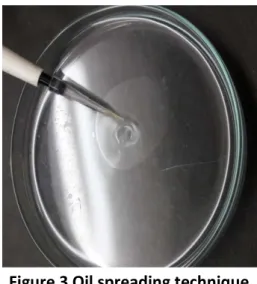
(b) Oil Spreading Test: 40 µl of distilled water was added to a petri dish (15 cm diameter) followed by the addition of 20 µl of diesel oil to the surface of water then 10 µl of culture supernatant was dropped onto the oil surface. The diameter of clear zones on the oil surface was measured and the results were recorded.
(c) Emulsification Index: Equal volumes of supernatant with diesel oil (1:1) were mixed well in a glass tube. Then the mixture was vortexed for 2 min and left to stand for 18 to 24 h. The emulsification index was calculated by dividing the height of the emulsion layer by total height x 100.
(d) Foaming Activity: Isolated strains were grown separately in 250 ml Erlenmeyer flasks, each containing 100 ml of nutrient broth medium. The flasks were incubated at 37°C on a shaker incubator (200 rpm) for 72 h. Foam activity is detected as duration of foam stability and foam height.
(e) Blood Hemolysis Test: Fresh isolated colony was taken and streaked on blood agar plate and incubated for 24 h under 30°C. The presence of clear zone indicates the biosurfactant producing bacteria.
Characterization of selected soil isolates
Morphological, biochemical and physiological characterisation of the isolates were
performed to identify Bacillus sp.
Production of biosurfactants
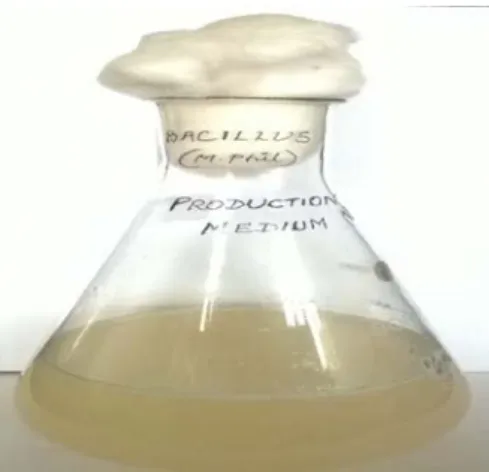
1% inoculum of positive isolate was transferred aseptically into Minimal Salt medium containing: KNO3 (0.3%), Na2HPO4 (0.22%), KH2PO4 (0.014%), NaCl (0.001%), MgSO4 (0.06%), CaCl2 (0.004%), FeSO4 (0.002%) with 2% diesel oil and incubated at 30°C for 72 h at 120 rpm in shaker.
Extraction of Biosurfactant
Cultured supernatant was obtained by centrifugation at 10000 rpm for 30 minutes at 4°C.
International Research Journal of Pharmaceutical and Biosciences(IRJPBS) 3 (5) 4
Identification of crude biosurfactant by Thin Layer Chromatography
Silica plate was prepared and the crude biosurfactant was spotted on the plate. The biosurfactant was separated using the solvent Chloroform: methanol: acetic acid: water in ratio 25: 15: 4: 2. Ninhydrin reagent was sprayed to detect lipopeptide biosurfactant as red spots.
Antimicrobial Activity of Biosurfactant
The medical samples such as E.coli, Pseudomonas aeruginosa, Salmonella typhi, Shigella
boydii, and Staphylococcus aureus were used to determine the antimicrobial activity of
biosurfactant.
RESULTS AND DISCUSSION
Isolation of Bacillus sp.
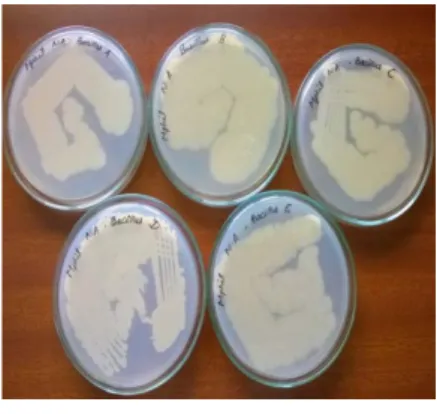
10 different Bacillus cultures were isolated from the soil samples and screened for
biosurfactant production (Figure 1).
Figure 1 Bacillus sp.
Screening for biosurfactant
a) Drop collapse test- Depending on the concentration of crude biosurfactant the drop of supernatant collapses to varying degrees on oil coated glass slide (Figure 2).
International Research Journal of Pharmaceutical and Biosciences(IRJPBS) 3 (5) 5
b) Oil spreading technique- Clear zone in the oil containing plate indicates the ability to displace oil (Figure 3).
Figure 3 Oil spreading technique
c) Foaming activity- Foam activity is detected as duration of foam stability (Figure 4).
Figure 4 Foaming activity
d) Hemolysis- Presence of clear zone indicates the biosurfactant producing bacteria (Figure 5).
International Research Journal of Pharmaceutical and Biosciences(IRJPBS) 3 (5) 6
Production of Biosurfactant
Five isolates which showed positive result in screening for biosurfactant production was inoculated in the production medium (Figure 6).
Figure 6 Production medium inoculated with Bacillus sp.
Extraction of Biosurfactant
The crude biosurfactant was extracted from culture supernatant by chloroform: Methanol extraction method. The product was obtained in the form of creamy white powder (Figure 7).
Figure 7 Crude Biosurfactant
The weight of the crude extract obtained from 5 different Bacillus sp. is given below
(Table 1):
Table 1: Weight of crude extract obtained per 100 ml of production medium
Bacillus Cultures BS (gm/100 ml)
A 0.0254
B 0.3356
C 0.0296
D 0.0364
International Research Journal of Pharmaceutical and Biosciences(IRJPBS) 3 (5) 7
Among the five positive Bacillus sp. culture B showed more production i.e. 0.3356 gm/100
ml compared to the other samples. Thus culture B was selected for more production and application.
Identification of crude biosurfactant Thin Layer Chromatography
The isolated biosurfactant is identified as lipopeptide indicated by the formation of red spot on TLC plate (Figure 8).
Figure 8 Thin layer chromatography
Antimicrobial Activity of Biosurfactant
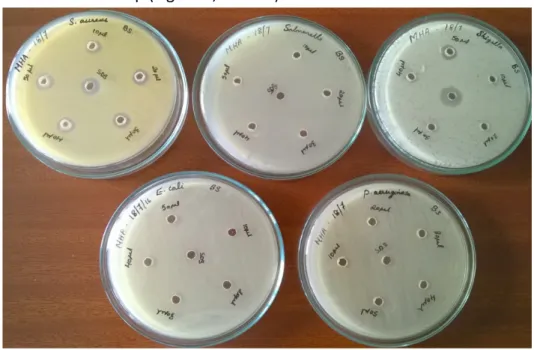
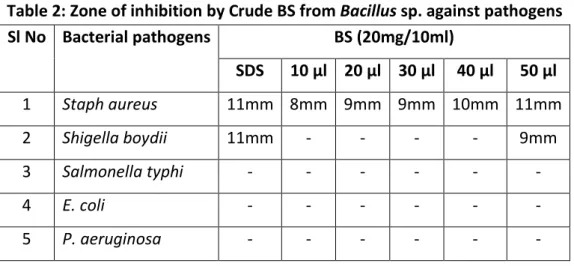
A clear zone was observed on both plate having Staphylococcus aureus and Shigella boydii
with BS concentration of 20 mg/ 10 ml which indicates the antimicrobial activity of crude
biosurfactant from Bacillus sp (Figure 9, Table 2).
International Research Journal of Pharmaceutical and Biosciences(IRJPBS) 3 (5) 8
Table 2: Zone of inhibition by Crude BS from Bacillus sp. against pathogens Sl No Bacterial pathogens BS (20mg/10ml)
SDS 10 µl 20 µl 30 µl 40 µl 50 µl
1 Staph aureus 11mm 8mm 9mm 9mm 10mm 11mm 2 Shigella boydii 11mm - - - - 9mm 3 Salmonella typhi - - - -
4 E. coli - - - -
5 P. aeruginosa - - - -
CONCLUSION
Biosurfactant produced from the Bacillus sp. isolated from petroleum contaminated soil was
found to show antibacterial activity against Staphylococcus aureus and Shigella boydii. This
indicates the applicability of biosurfactants in the medical field. Thus it is a promising alternative to the chemical surfactants used which are toxic. It has the potential to be used as anti-adhesive coating agents for human implants thereby reducing the nosocomial infections and application of synthetic chemicals. Their use is limited due to the high cost of production and extraction and lack of knowledge of toxicity on humans.
REFERENCE
1. Gautam K. K. and Tyagi, V. K. Microbial surfactants: A review. Journal of Oleo Science 2006; 55 (4): 155- 166.
2. Dhara, P.Sachdev and Swaranjit, S. Cameotra. Biosurfactants in agriculture. Appl Microbiol Biotechnol 2013; 97: 1005-1016.
3. Ligia, R. Rodrigues, Ibrahim, M. Banat, Jose, A. Teixeira and Rosario Oliveira. Biosurfactants: Potential applications in medicine. Journal of Antimicrobial Chemotherapy 2006; 57: 609-618.
4. Magdalena Pacwa-Plociniczak, Grazyna, A. Plaza, Zofia Piotrowska-Seget and Swaranjit S. Cameotra. Environmental applications of Biosurfactants: Recent advances. Int. J. Mol. Sci. 2011; 12: 633-654.
5. Thomas, C. P., Duvall, M. L., Robertson, E. P., Barrett, K. B. and Bala, G. A. Surfactant-based EOR mediated by naturally occurring microorganisms. Soc. Petrol. Eng. Reservoir Eng 1993; 11: 285-291.
6. Ligia, R. Rodrigues and Jose, A. Teixeira. Biomedical and therapeutic applications of
Biosurfactants. Biosurfactants2008; 1-14.
7. Mahalingam, P. U. and Nithya Sampath. Isolation, characterization and identification of bacterial biosurfactant. Euro. J. Exp. Bio. 2014; 4 (6): 59-64.
8. Ayed, B. H., Jemil, N., Maalej, H., Bayoudh, A., Hmidet, N., Nasri, M., 2015. Enhancement
of solubilization and biodegradation of diesel oil by biosurfactant from Bacillus