Open Forum Infectious Diseases
Open Forum Infectious Diseases®
Prevalence and Transmission Dynamics of HIV-1
Transmitted Drug Resistance in a Southeastern Cohort
Sara N. Levintow,1 Nwora Lance Okeke,2 Stephane Hué,3 Laura Mkumba,2 Arti Virkud,1 Sonia Napravnik,1,4 Joseph Sebastian,5 William C. Miller,6Joseph J. Eron,1,4 and Ann M. Dennis4
1Department of Epidemiology, University of North Carolina, Chapel Hill, North Carolina; 2Division of Infectious Diseases, Duke University, Durham, North Carolina; 3London School of Hygiene and
Tropical Medicine, London, United Kingdom; 4Division of Infectious Diseases, University of North Carolina, Chapel Hill, North Carolina; 5Campbell University School of Osteopathic Medicine, South
Lillington, North Carolina; 6Division of Epidemiology, College of Public Health, The Ohio State University, Columbus, Ohio
Background. Transmitted drug resistance (TDR) compromises clinical management and outcomes. Transmitted drug resist-ance surveillresist-ance and identification of growing transmission clusters are needed in the Southeast, the epicenter of the US HIV epi-demic. Our study investigated prevalence and transmission dynamics in North Carolina.
Methods. We analyzed surveillance drug resistance mutations (SDRMs) using partial pol sequences from patients presenting to 2 large HIV outpatient clinics from 1997 to 2014. Transmitted drug resistance prevalence was defined as ≥1 SDRMs among anti-retroviral therapy (ART)–naïve patients. Binomial regression was used to characterize prevalence by calendar year, drug class, and demographic and clinical factors. We assessed the transmission networks of patients with TDR with maximum likelihood trees and Bayesian methods including background pol sequences (n = 15 246).
Results. Among 1658 patients with pretherapy resistance testing, ≥1 SDRMs was identified in 199 patients, with an aggre-gate TDR prevalence of 12% (95% confidence interval, 10% to 14%) increasing over time (P = .02). Resistance to non-nucleoside reverse transcriptase inhibitors (NNRTIs; 8%) was common, followed by nucleoside reverse transcriptase inhibitors (4%) and protease inhibitors (2%). Factors associated with TDR were being a man reporting sex with men, white race, young age, higher CD4 cell count, and being a member of a transmission cluster. Transmitted drug resistance was identified in 106 clusters ranging from 2 to 26 members. Cluster resistance was primarily NNRTI and dominated by ART-naïve patients or those with unknown ART initiation.
Conclusions. Moderate TDR prevalence persists in North Carolina, predominantly driven by NNRTI resistance. Most TDR cases were identified in transmission clusters, signifying multiple local transmission networks and TDR circulation among ART-naïve persons. Transmitted drug resistance surveillance can detect transmission networks and identify patients for enhanced ser-vices to promote early treatment.
Keywords. antiretroviral therapy; drug resistance; HIV-1; molecular epidemiology; Southeastern United States.
The widespread use of antiretroviral therapy (ART) has a pro-found impact on reducing morbidity and mortality of people living with HIV and lowering the risk of onward HIV trans-mission [1, 2]. However, the emergence of drug resistance mutations can compromise the effectiveness of ART and, for some regimens, result in a longer time to viral suppression and jeopardize treatment success [3]. Most drug resistance mutations are transmissible, resulting in treatment-naïve per-sons with drug-resistant virus [4]. Globally, transmitted drug resistance (TDR) limits effective options of the treatment of
HIV among treatment-naïve persons, a critical challenge to the consistent gains of effective ART [5]. In recognition of this emerging problem, since 2007 the US Department of Health and Human Services (DHHS) has recommended HIV gen-otyping for all treatment-naïve patients before initiation of ART [6]. The presence of a surveillance drug resistance muta-tion (SDRM) in pretreatment HIV genotyping is indicative of TDR [7].
National and global estimates of TDR vary widely [4, 8]. In a meta-analysis of studies from 2000 to 2013, TDR prev-alence ranged from 2.8% in sub-Saharan Africa to 11.5% in North America [9]. From 2007 to 2010, however, up to 16% of persons with new HIV diagnoses among 10 US surveil-lance sites had TDR [10]. An increasing trend in TDR was specifically observed in mutations to non-nucleoside reverse transcriptase inhibitors (NNRTIs). Similarly, TDR preva-lence has increased in San Diego [11] and is as high as 20% in Washington, DC [12, 13]. Conversely, several European countries recently reported stabilized TDR prevalence of around 8% [8, 14, 15] or evidence that TDR may be decreasing
M A J O R A R T I C L E
© The Author(s) 2018. Published by Oxford University Press on behalf of Infectious Diseases Society of America. This is an Open Access article distributed under the terms of the Creative Commons Attribution-NonCommercial-NoDerivs licence (http://creativecommons.org/licenses/ by-nc-nd/4.0/), which permits non-commercial reproduction and distribution of the work, in any medium, provided the original work is not altered or transformed in any way, and that the work is properly cited. For commercial re-use, please contact [email protected] DOI: 10.1093/ofid/ofy178
Received 30 April 2018; editorial decision 16 July 2018; accepted 18 July 2018.
Correspondence: S. N. Levintow, MSPH, Department of Epidemiology, University of North Carolina, 135 Dauer Drive, 2101 McGavran-Greenberg Hall, Chapel Hill, NC 27599 (levintow@ email.unc.edu).
[16–19]. Phylogenetic clustering studies have revealed that persistence of TDR, particularly for mutations to NNRTIs, is largely due to transmission from treatment-naïve persons [15, 18–20]. Thus, TDR may persist within transmission net-works despite decreasing use of NNRTIs in resource-rich settings. Given prior findings of TDR circulation among treatment-naïve persons, TDR may serve as a marker of recent transmission and possible cluster growth. It could be studied as a potential indication for enhanced testing, link-age, and prevention services.
We investigated the prevalence and transmission dynamics of TDR in North Carolina, drawing from a large cohort with genetic sequencing and clinical data available since 1997 and using phylogenetic reconstruction of HIV transmission net-works. Our objectives were to characterize temporal trends in TDR by ART drug class, identify the demographic and clin-ical factors associated with TDR, and assess genetic cluster-ing of TDR within statewide transmission networks. A better understanding of TDR trends and transmission dynamics can help identify where surveillance and prevention efforts could be intensified, such as for implementation of rapid ART and pre-exposure prophylaxis.
METHODS
Study Population
Clinical Cohort
We assessed TDR prevalence among HIV patients who were enrolled in the University of North Carolina Center for AIDS Research HIV Clinical Cohort (UCHCC) or who received HIV care at the Duke University Infectious Diseases Clinic. The UNC and Duke clinics provide HIV care for most HIV patients in central NC. Patients were included if they had ≥1 pretherapy HIV-1 pol sequences available for analysis. HIV-1 pol sequences were derived from a statewide data set of 15 246 adult patients (aged 18 years or older) with rou-tine drug resistance testing performed by the largest refer-ence laboratory in North Carolina (Laboratory Corporation of America) from 1997 through June 2014. Sequences were matched to clinical data by specimen identifiers and medical record numbers.
At UNC, the UCHCC collects comprehensive data from institutionally available electronic health and administrative records and performs expansive medical record reviews. The data cover demographic factors, clinical diagnoses, laboratory findings, and medication provision. At Duke, clinical data were retrieved by query of the Duke Enterprise Data Unified Content Explorer and manual abstraction of electronic medical records. Patients who received care at both clinics were iden-tified, and data associated with the earliest visit were retained. Following final data collection, all phylogenetic and statistical analyses were performed on de-identified data sets to protect
participants’ anonymity. The study was approved by the UNC Institutional Review Board (No. 16-0228).
Statewide HIV Sequence Data
To characterize transmission clusters involving TDR, the study population was expanded beyond the clinical cohorts of UNC and Duke to include all sequences in the statewide data set (n = 15 246). This data set is estimated to represent more than 50% of people living with HIV in North Carolina [21]. Within the statewide data set, we identified transmission clusters that included ≥1 sequences from a clinical cohort patient with TDR. We analyzed these clusters to understand the connectivity of patients with TDR to other sequences that had SDRMs but did not come from patients in the clinical cohorts.
Sequence and Drug Resistance Analysis
Most genotypic resistance tests were GenoSure MG assay. Sequences spanned protease nucleotide positions 1–297 and reverse transcriptase positions 1–1200 and were aligned using MUSCLE [22] and edited manually in Bioedit [23]. Gapped positions were stripped, and the final sequence length was 1497 bases. We determined HIV subtypes using the Context-based Modeling for Expeditious Typing (COMET) tool [24]. We identified mutations by ART drug class (non-nucleoside reverse transcriptase inhibitor, nucleoside reverse transcriptase inhibitor [NRTI], protease inhibitor [PI]) using the Stanford University HIV Drug Resistance Database genotypic resistance interpretation algorithm (Sierra, v. 1.1) [25]. Major mutations were selected using the 2009 standardized list of SDRMs from the World Health Organization [7]. We defined TDR as the presence of ≥1 SDRMs in a pretreatment genotype.
Phylogenetic Analyses
Using sequence data from all patients (n = 15 246), a maximum likelihood (ML) phylogenetic tree was constructed in FastTree, v. 2.1.4 [26], with the general time-reversible model of nucle-otide substitution using the earliest available sequence from each person. Statistical support of clades was assessed with local branch support values (Shimodaira-Hasegawa-like test [SH test]) in FastTree [27]. Putative transmission clusters were identified using the automated tool ClusterPicker, v. 1.3 [28]. We defined clusters as clades with high branch support (proba-bility ≥0.90, SH test) and a maximum pairwise genetic distance <3.5% difference between all sequences (ie, no 2 sequences in the cluster with a pairwise genetic distance ≥0.035 substitutions per site) [29, 30].
clusters. All analyses were conducted using the SRD06 nucleo-tide substitution model, a log-normal relaxed molecular clock model, and the Bayesian Skyline model as coalescent tree prior. The MCMC chain was run for 50–100 million generations with 1–5 runs performed for each file. Convergence of the estimates was considered satisfactory when the effective sample size was >200 in all parameters, as calculated in Tracer, v. 1.6.0 [31]. BEAST log and tree files obtained for data sets with multiple runs were combined using LogCombiner, v. 1.8.2; 10% of the generations were discarded as burn-in. Maximum clade cred-ibility trees (MCCTs) were summarized using TreeAnnotator, v. 1.8.2, keeping the median height over the posterior distribu-tion of trees [31]. Clades with a posterior probability ≥0.95 were considered highly supported.
We analyzed clusters that included ≥1 sequences with TDR from the clinical cohort to determine the degree of connectivity to other sequences with SDRMs. The time of the most recent common ancestor (tMRCA) was estimated for each cluster as the difference in the sampling date of the most recent sequence in the tree from the median height of the basal node of the clus-ter identified in the MCCT. Clusclus-ter time span was calculated as the difference between each cluster’s tMRCA and the sampling date of the most recent sequence in the cluster.
Statistical Analyses
We estimated the prevalence of TDR over the study period and by year among the patients whose first genotype occurred before ART initiation. We calculated binomial exact 95% con-fidence intervals for prevalence estimates. Binomial regression models with an identity link were used to assess trends in preva-lence by sequencing year and to compare TDR by demographic and clinical factors. Our regression models estimated preva-lence differences (PDs), the absolute difference in TDR prev-alence (in percentage points) when comparing 1 group with another. All models were unadjusted for other covariates, given that our focus was to identify general associations rather than infer causal relationships. Statistical significance was defined at the P <.05 level. All analyses were conducted using R, v. 3.4.3 (R Foundation for Statistical Computing, Vienna, Austria).
RESULTS
Study Population
Between 1997 and mid-2014, HIV-1 pol sequences for 4477 patients were sent from UNC or Duke to the reference labora-tory, and 3711 of those patients were successfully matched to UCHCC or Duke clinical data. For 1658 of 3711 (45%) patients, ≥1 sequences were available before ART exposure, and these 1658 patients were the focus of our analysis (Table 1). Most par-ticipants were male (73%) and black (62%). The average age of patients at the time of genotyping (interquartile range [IQR]) was 37 (27–46) years. The most commonly reported risk factor for transmission was being a man who has sex with men (MSM;
50%), with few patients reporting injection drug use (7%). At the time of genotyping (within 90 days), the median HIV viral load (IQR) was 4.8 (4.1–5.3) log10 copies/mL, and the median
CD4 cell count (IQR) was 283 (75–465) cells/mm3. Nearly all
patients were infected with HIV-1 subtype B (98%).
Overall Prevalence of TDR
Among 1658 ART-naïve patients, the prevalence of TDR was 12% (95% confidence interval [CI], 10% to 14%); 199 patients had ≥1 SDRMs for NNRTI, NRTI, or PI resistance (Table 2). Among patients with TDR, most had 1 drug class mutation (174/1658, 10.5%), whereas dual- and triple-class TDR were uncommon, at 1.2% (20/1658) and 0.3% (5/1658), respectively. Most patients with TDR harbored resistance to NNRTIs (132/1658, 8%), fol-lowed by NRTIs (70/1658, 4%) and PIs (27/1658, 2%). The most
Table 1. Characteristics of 1658 ART-Naïve Patients in Central NC at First Genotype Sequencing During the Study Period, 1997–2014
Characteristic No. (%)
Sex
Male 1211 (73)
Female 447 (27)
Race/ethnicity
Black 1024 (62)
White 454 (27)
Other race or Hispanic/Latino 180 (11)
Age, y
<20 56 (3)
20–29 473 (29)
30–39 456 (28)
40–49 439 (26)
≥50 234 (14)
HIV transmission risk factora
MSM 763 (50)
IDU 69 (7)
MSM + IDU 16 (2)
HIV-1 subtype B 1620 (98)
CD4 cell count, cells/mm3
<200 544 (40)
200–349 272 (20)
350–499 264 (19)
≥500 295 (21)
Median CD4 (IQR) 283 (75–465)
No CD4 within 90 d of sequencing 283
Viral load, copies/mL
Median viral load 64 381
Median log10 viral load (IQR) 4.8 (4.2–5.3)
No viral load within 90 d of sequencing 280
Transmission cluster
Sequence identified in cluster 1084 (65)
Sequence not in cluster 574 (35)
Abbreviations: ART, antiretroviral therapy; IDU, injection drug user; IQR, interquartile range; MSM, men who have sex with men.
aFor MSM, there were 135 missing values, and the percentage is based on the number
frequent SDRM was NNRTI-associated K103N, which was observed for 5.9% of patients (97/1658). For NRTI resistance, thymidine analogue mutations (TAMs) were most commonly observed, with T215Y/F/I/S/D/E/C/V mutations seen in 2.2% of patients (37/1658), followed by M41L in 1.2% (20/1658). M184V was seen in 0.5% (9/1658). Of the PI-associated muta-tions, L90M was seen in 0.8% of patients (13/1658).
The yearly prevalence of TDR varied from 1997 to mid-2014 but, in general, increased over time (Figure 1A). We found an absolute increase in TDR prevalence of 0.5% (95% CI, 0.1% to 0.8%; P = .02) per calendar year. Although TDR prevalence decreased in the first half of 2014 (data only available through June 2014), we found no statistical evidence that the temporal relationship was parabolic rather than linear (quadratic term P = .12, no change in Akaike information criterion (AIC) AIC [linear model AIC, 1216; quadratic model AIC, 1216]). The prev-alence of TDR over time varied by drug class; NNRTI-associated SDRMs increased across the study period (P < .01), whereas NRTI and PI resistance did not show a significant trend (Figure 1B).
Increasing NNRTI resistance over the study period is in con-trast to the declining use of NNRTI regimens among UNC and Duke cohort patients (Figure 1C). Cohort-wide use of ART reg-imens that included an NNRTI decreased by 6% per year from 2001 to 2014 (95% CI, –10% to –2%; P < .01). Despite this declin-ing use, the prevalence of NNRTI-associated TDR increased by 0.6% each year over the same period (95% CI, 0.3% to 0.9%; P < .01), driving the overall rise in TDR prevalence. Consistent with this overall trend in TDR, we observed a decrease in NNRTI resistance in the first half of 2014; however, again, we found no statistical evidence that the temporal relationship was parabolic rather than linear (quadratic term P = .21, no change in AIC [linear AIC, 913; quadratic AIC, 913]).
Factors Associated With TDR
We explored the association between TDR and the demo-graphic and clinical characteristics of patients using absolute differences in TDR prevalence (PDs) (Table 3). Compared with MSM, TDR was less common among men who did not
report sex with men (PD, –4.4%; 95% CI, –8.6% to 0.3%; P = .03) and women (PD, –4.0%; 95% CI, –7.7% to –0.3%; P = .03). TDR prevalence was highest among patients younger than age 20 years; for patients aged 19–29, 30–39, 40–49, and ≥50 years, the PDs were –12.2%, –9.8%, –12.5%, and –12.1%, respectively (all P < .10). Compared with white patients, TDR prevalence was lower among black patients (PD, –3.9%; 95% CI, –7.7% to –0.1%; P = .04) and patients of Hispanic ethnicity or other race (PD, –5.0%; 95% CI, –10.5% to 0.5%; P = .07). At pretherapy sequencing, patients with TDR had higher CD4 cell counts (median, 331 vs 277; P = .04) but similar HIV viral loads (median, 4.79 vs 4.81; P = .18). TDR prevalence was higher among patients identified in a transmission cluster than among patients whose sequence did not cluster (PD, 5.0%; 95% CI, 1.9% to 8.1%; P = .001).
Phylogenetic Clusters With TDR
Using sequences from all 15 246 patients with routine geno-typing in NC from 1997 to 2014, 7591 sequences (50%) were identified in 2297 transmission clusters. Approximately half of the clusters (1111/2297, 48%) included ≥1 patients from the UNC or Duke clinical cohorts (data available on ART exposure and presence of TDR). The prevalence of TDR was strongly associated with transmission clusters; 75% of patients with TDR (149/199) were identified in a transmission clus-ter, whereas 64% of patients without TDR (935/1459) were in a cluster (P = .001). Therefore, our phylogenetic analysis focused on clusters containing ≥1 patients with TDR. We iden-tified TDR in 106 transmission clusters that ranged from 2 to 26 members (35% pairs, 54% 3–9, 11% 10–26) and involved a total of 546 persons (296/546 from clinical cohorts, 54%). Most sequences in TDR clusters had ≥1 SDRMs (348/546, 64%), and only a minority of patients with an SDRM were known to be ART-exposed (41/348, 12%). Most patients in clusters with an SDRM were either known to be ART-naïve (149/348, 43%) or had missing data on ART initiation if they were not in the UNC or Duke clinical cohorts (158/348, 45%).
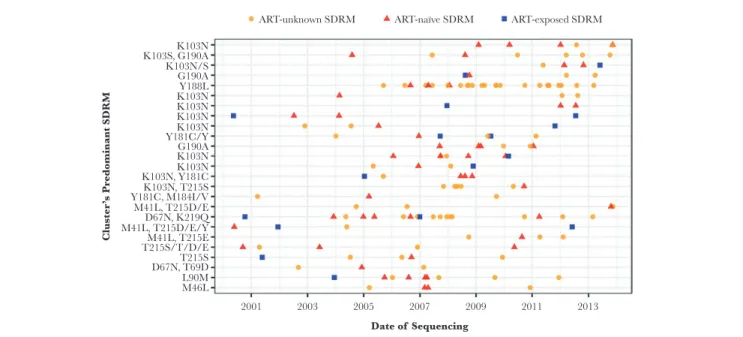
Of 69 TDR clusters with 3 or more members, 25 (36%) were composed of sequences that all had ≥1 SDRMs (Figure 2; phy-logenetic trees in Supplementary Figure 1). In 20 of 25 clusters, all members shared an identical SDRM. NNRTI drug resistance was common, and overall resistance was dominated by patients known to be ART-naïve or with unknown ART initiation (89% of patients in 25 clusters). Among these 25 clusters, most had time of the most recent common ancestor before 2005 (median year of tMRCA, 1997), and the time span of clusters ranged from 3.6 to 20.3 years (median, 12.5 years). In comparison, among all 2297 clusters identified in the statewide data set, the median year of tMRCA was slightly more recent (2000), and the median time span was slightly shorter (11.0 years). Most of the 25 clusters were male-dominated; more than half of the members in 20 of 25 clusters were male, and of these clusters,
Table 2. Prevalence of TDR From 1997 to 2014 Among 1658 Patients in Central NC
TDR Category No. (%) Common SDRMs No. (%)
Any TDR 199 (12.0) K103N 97 (5.9)
NNRTI 113 (6.8) T215Y/F/S/C/D/E/I/V 37 (2.2)
NRTI 48 (2.9) M41L 20 (1.2)
PI 13 (0.8) G190A 19 (1.1)
NNRTI + NRTI 11 (0.7) Y181C 13 (0.8)
NRTI + PI 6 (0.4) L90M 13 (0.8)
NNRTI + NRTI + PI 5 (0.3) M46I/L 11 (0.7)
NNRTI + PI 3 (0.2) L210W 10 (0.6)
75% (15/20) consisted only of men. Most members of these 25 clusters were aged 30 years or older, although 7 of 25 clusters were dominated by persons younger than age 30 years.
DISCUSSION
Transmitted drug resistance persists among treatment-naïve persons and can impact successful HIV therapy, particularly in resource-limited settings. We found a moderate TDR prevalence estimate of 12% overall, but TDR has steadily increased over the 15 years of observation. The TDR rise was driven largely by NNRTI resistance; few cases of dual and triple class resist-ance were noted. By incorporating >15 000 HIV-1 pol sequences
collected statewide, we traced genetic networks involving TDR, revealing significant clustering of NNRTI mutations among ART-naïve persons, including several clusters of young MSM. Altogether, our study provides important insight into TDR trends and characteristics of drug resistance clustering in the Southeast, which has the greatest burden of HIV infection com-pared with other US regions [33, 34].
Although our prevalence estimate of 12% is consistent with other US-based studies [10, 11], recent trends in TDR are higher compared with European studies reporting stable [8, 14, 15] or decreasing [16–19] TDR prevalence. The persistence of TDR in North Carolina is predominantly driven by transmitted 50
40
30
20
% of
patients
10
0
50
40
30 Resistance
NNRTI NRTI PI
20
% of
patients
10
0
1998 2000 2002 2004 2006 Year of sequencing
2008 2010 2012 2014 1998 2000 2002 2004 2006
Year of sequencing
2008 2010 2012 2014
50
40
30 NNRTI
Cohort-wide regimen use Transmitted resistance
20
% of
patients
10
0
1998 2000 2002 2004 2006 Year of sequencing
2008 2010 2012 2014
A B
C
resistance to NNRTI-containing regimens. Despite declining use of these regimens in our clinical cohort, most transmitted resistance mutations were NNRTI-associated, which increased over time. The prevalence of NNRTI-transmitted resistance in our study (8.0%) mirrors a recent study in San Diego [11]; over
the same time period, they observed that prevalence was 8.5% and that it increased in more recent years. This continued prop-agation of NNRTI SDRMs could be driven by the high trans-missibility of the K103N mutation, corroborated by prior work [35]. Despite the absence of drug pressure, the persistence of
2001 2003 2005 2007 2009
Date of Sequencing
ART-unknown SDRM
K103N K103S, G190A K103N/S G190A Y188L K103N K103N K103N K103N Y181C/Y G190A K103N K103N K103N, Y181C K103N, T215S
Cluster’
s Pr
edominant SDRM
Y181C, M184I/V M41L, T215D/E D67N, K219Q M41L, T215D/E/Y M41L, T215E T215S/T/D/E T215S D67N, T69D L90M M46L
ART-naïve SDRM ART-exposed SDRM
2011 2013
Figure 2. Twenty-five transmission clusters illustrating resistance circulation among antiretroviral therapy (ART)–naïve and ART-unknown members. Each horizontal line of dots represents 1 cluster, and each dot indicates a single patient in the cluster by date of first sequencing. All clusters have at least 3 members, all with a surveillance drug resistance mutation (SDRM) and ≥1 members with transmitted drug resistance. Clusters are ordered by drug class resistance (non-nucleoside reverse transcriptase inhibitor [NNRTI], NNRTI/nucleoside reverse transcriptase inhibitor [NRTI], NRTI, protease inhibitor) based on the SDRM shared by the majority of sequences. Within each drug class, clusters are ordered by the most recent member’s sequencing date.
Table 3. Prevalence of TDR Associated With Patient Characteristics, With Absolute Differences in TDR Prevalence Estimated With Binomial Regression Using an Identity Link
Patient Characteristic TDR, No. (%) No TDR, No. (%) Prevalence Difference (95% CI), %
Sex
Male, MSM 108 (14) 671 (86) Ref
Male, not MSM 28 (9) 269 (91) –4.4 (–8.6 to –0.3)a
Female 44 (10) 403 (90) –4.0 (–7.7 to –0.3)a
Age, y
<20 13 (23) 43 (77) Ref
20–29 52 (11) 421 (89) –12.2 (–23.6 to –0.8)a
30–39 61 (13) 395 (87) –9.8 (–21.3 to 1.7)
40–49 47 (11) 392 (89) –12.5 (–23.9 to –1.1)a
≥50 26 (11) 208 (89) –12.1 (–23.9 to –0.3)a
Race
White 68 (15) 386 (85) Ref
Black 113 (11) 911 (89) –3.9 (–7.7 to –0.1)a
Hispanic or other 18 (10) 162 (90) –5.0 (–10.5 to 0.5)
Transmission cluster
In cluster 149 (14) 935 (86) 5.0 (1.9 to 8.1)a
Not in cluster 50 (9) 524 (91) Ref
Median CD4 cell count (IQR) 331 (147–505) 277 (72–459) 0.7 (0.04 to 1.4)a per 100 cells/mm3
Median log10 viral load (IQR) 4.79 (4.13–5.22) 4.81 (4.16–5.32) –1.3 (–3.2 to 0.6) per log10 copies/mL
Abbreviations: CI, confidence interval; IQR, interquartile range; MSM, men who have sex with men; TDR, transmitted drug resistance.
K103N and other NNRTI-associated SDRMs may be a result of low fitness costs (ie, limited effect of the mutation on path-ogen replication) or compensation through additional muta-tions [36]. In contrast, transmitted resistance to NRTIs and PIs was less common and remained at low levels throughout the study period. Our study could not assess transmitted resistance to integrase inhibitors (INSTIs) given that pre-ART integrase genotyping was not yet routine in the UNC or Duke clinics. However, recent work indicates that major INSTI-transmitted resistance is rare in North Carolina [37].
We found that the prevalence of TDR was highest among young white MSM. Globally, the highest rates of TDR have been reported for MSM [36], whereas research is more limited on other demographic or clinical factors associated with transmis-sion of drug resistance. The disproportionately high risk of TDR among MSM could result from unprotected sexual intercourse in the early stages of infection, when HIV is undiagnosed and more likely to have SDRMs (before possible reversion) [15, 38]. The factors found to be associated with TDR—higher CD4 count and transmission cluster member, in addition to young white MSM—represent markers of earlier diagnosis and poten-tially more recent transmission. The enhanced ability to detect TDR in earlier infection may then have resulted in the observed associations.
In addition to examining individual risk factors, we used phylogenetic reconstruction of HIV transmission networks to understand the degree of connectivity of patients with TDR. Most TDR cases were identified in clusters, signifying multiple local transmission networks. Resistance in clusters was dom-inated by patients known to be ART-naïve or with unknown ART initiation, with few known to be ART-exposed. This sug-gests that TDR circulation is driven by ART-naïve persons, which is consistent with previous reports from Europe that treatment-naïve persons are the major source of TDR [4, 9, 15, 18–20]. Compared with prior work in the United States, in our study, we identified a higher proportion of TDR cases in local transmission clusters (75%) than previously found in San Diego (24%) and Washington, DC (6%) [11, 12]. Phylogenetic analy-ses are limited by the inability to infer direction of transmission and the fact that genetic linkage does not indicate direct trans-mission as unsampled persons may be involved in the transmis-sion chain. Nonetheless, transmistransmis-sion networks appear to be an important driver of propagation of SDRM in North Carolina (as opposed to de novo acquisition of resistance), and their con-tinued identification and surveillance will be critical for future intervention efforts and to promote early treatment. In fact, the consolidation of TDR cases in clusters suggests that intervention based on phylogenetic analyses may be particularly effective in identifying and abrogating onward transmission of SDRMs in our region. Similar studies are needed in other locales to better define whether this consolidation of TDR is a unique feature of transmission networks in the Southeast.
Although our data stem from a large HIV patient popula-tion in North Carolina, the cohort may not be representative of all people living with HIV in the state, as only persons diag-nosed and engaged in care were included. The statewide data set included more than 15 000 patients with sequences, but we could only measure TDR prevalence for patients with ≥1 sequences before known ART exposure, resulting in a sample of 1658 patients. However, our phylogenetic analysis involved all 15 246 patients with genotyping and provides an indication of
potential TDR cases missed by our study; of the 546 sequences identified in TDR clusters, 158 contained ≥1 SDRMs but were from patients with missing data on ART initiation. In add-ition, the demographic and clinical data on our sample of 1658 patients are derived from observational clinical cohorts with potential for measurement error, and in particular, the data on transmission risk categories (MSM, injection drug user [IDU]) were not available for all patients (8% missing MSM, 41% miss-ing IDU). We did not have estimates of recency of infection, which would have been informative in understanding the per-sistence of NNRTI drug resistance. Despite these limitations, this study still provides an important indication of the propaga-tion of TDR in the Southeastern United States, where little work has been done previously.
In conclusion, TDR has persisted in North Carolina and is predominantly driven by NNRTI resistance, despite declining use of NNRTI-containing regimens. Most TDR cases were identified in transmission clusters, where resistance was dom-inated by patients known to be ART-naïve or with unknown ART initiation; few were known to be ART-exposed. Consistent with previous findings in Europe, TDR persistence appears to be due to circulation among ART-naïve persons, rather than those failing therapy. Continued TDR surveillance may help detect transmission networks and identify local clusters at high risk of propagating TDR to inform future intervention.
Supplementary Data
Supplementary materials are available at Open Forum Infectious Diseases
online. Consisting of data provided by the authors to benefit the reader, the posted materials are not copyedited and are the sole responsibility of the authors, so questions or comments should be addressed to the corre-sponding author.
Acknowledgment
We thank the patients and staff of the UNC Center for AIDS Research Clinical Cohort and the Duke Infectious Diseases Clinic.
Disclaimer. This content is solely the responsibility of the authors and does not necessarily represent the official views of the National Institutes of Health.
Financial support. This work was supported by the National Center for Advancing Translational Sciences (Grant Award Number UL1TR001111), the National Institute of Allergy and Infectious Diseases (Grant Award Number K08AI112432-02), and the UNC Center for AIDS Research (Grant Award Number P30AI50410). Traineeship support for S.N.L. was provided by the National Institute of Allergy and Infectious Diseases (Grant Award Number T32AI070114-10).
Potential conflicts of interest. All authors: no reported conflicts of interest. All authors have submitted the ICMJE Form for Disclosure of Potential Conflicts of Interest. Conflicts that the editors consider relevant to the content of the manuscript have been disclosed.
References
1. Bradley H, Mattson CL, Beer L, et al; Medical Monitoring Project. Increased anti-retroviral therapy prescription and HIV viral suppression among persons
receiv-ing clinical care for HIV infection. AIDS 2016; 30:2117–24.
2. Cohen MS, Chen YQ, McCauley M, et al; HPTN 052 Study Team. Prevention
of HIV-1 infection with early antiretroviral therapy. N Engl J Med 2011;
365:493–505.
3. Wittkop L, Günthard HF, de Wolf F, et al; EuroCoord-CHAIN Study Group. Effect of transmitted drug resistance on virological and immunological response to initial combination antiretroviral therapy for HIV (EuroCoord-CHAIN joint
project): a European multicohort study. Lancet Infect Dis 2011; 11:363–71.
4. Yang WL, Kouyos R, Scherrer AU, et al; Swiss HIV Cohort Study. Assessing the paradox between transmitted and acquired HIV type 1 drug resistance
muta-tions in the Swiss HIV Cohort Study from 1998 to 2012. J Infect Dis 2015;
212:28–38.
5. Bertagnolio S, Perno CF, Vella S, Pillay D. The impact of HIV drug resistance on the selection of first- and second-line ART in resource-limited settings. J Infect
Dis 2013; 207(Suppl 2):S45–8.
6. DHHS Panel on Antiretroviral Guidelines for Adults and Adolescents. Guidelines
for the Use of Antiretroviral Agents in HIV-1-Infected Adults and Adolescents.
United States Department of Health and Human Services: Washington DC; 2007.
Available at: https://aidsinfo.nih.gov/contentfiles/AdultandAdolescentGL000721.
pdf. Accessed 30 April 2018.
7. Bennett DE, Camacho RJ, Otelea D, et al. Drug resistance mutations for
sur-veillance of transmitted HIV-1 drug-resistance: 2009 update. PLoS One 2009;
4:e4724.
8. Schmidt D, Kollan C, Fätkenheuer G, et al; ClinSurv-HIV Drug Resistance Study Group in CHAIN. Estimating trends in the proportion of transmitted and acquired HIV drug resistance in a long term observational cohort in Germany.
PLoS One 2014; 9:e104474.
9. Rhee SY, Blanco JL, Jordan MR, et al. Geographic and temporal trends in the molecular epidemiology and genetic mechanisms of transmitted HIV-1 drug resistance: an individual-patient- and sequence-level meta-analysis. PLoS Med
2015; 12:e1001810.
10. Kim D, Ziebell R, Saduvala N, et al. Trend in transmitted HIV-1 antiretroviral drug resistance-associated mutations, 10 HIV surveillance areas, United States, 2007–2010. Paper presented at: CROI 3-6 March 2013; Atlanta, GA. Abstract 149.
11. Panichsillapakit T, Smith DM, Wertheim JO, et al. Prevalence of transmitted HIV drug resistance among recently infected persons in San Diego, CA 1996-2013. J
Acquir Immune Defic Syndr 2016; 71:228–36.
12. Kassaye SG, Grossman Z, Balamane M, et al. Transmitted HIV drug resistance is
high and longstanding in metropolitan Washington, DC. Clin Infect Dis 2016;
63:836–43.
13. Aldous AM, Castel AD, Parenti DM; DC Cohort Executive Committee. Prevalence and trends in transmitted and acquired antiretroviral drug resistance,
Washington, DC, 1999-2014. BMC Res Notes 2017; 10:474.
14. Hofstra LM, Sauvageot N, Albert J, et al; SPREAD Program. Transmission of HIV drug resistance and the predicted effect on current first-line regimens in Europe.
Clin Infect Dis 2016; 62:655–63.
15. Drescher SM, von Wyl V, Yang WL, et al; Swiss HIV Cohort Study. Treatment-naive individuals are the major source of transmitted HIV-1 drug resistance in
men who have sex with men in the Swiss HIV Cohort Study. Clin Infect Dis 2014;
58:285–94.
16. Tostevin A, White E, Dunn D, et al; UK HIV Drug Resistance Database. Recent trends and patterns in HIV-1 transmitted drug resistance in the United Kingdom.
HIV Med 2017; 18:204–13.
17. Pineda-Peña AC, Schrooten Y, Vinken L, et al. Trends and predictors of trans-mitted drug resistance (TDR) and clusters with TDR in a local Belgian HIV-1
epidemic. PLoS One 2014; 9:e101738.
18. Vega Y, Delgado E, Fernández-García A, et al; Spanish Group for the Study of New HIV-1 Diagnoses in Galicia and Basque Country. Epidemiological surveil-lance of HIV-1 transmitted drug resistance in Spain in 2004-2012: relevance of
transmission clusters in the propagation of resistance mutations. PLoS One 2015;
10:e0125699.
19. Paraskevis D, Kostaki E, Magiorkinis G, et al. Prevalence of drug resistance among HIV-1 treatment-naive patients in Greece during 2003-2015: transmitted drug
resistance is due to onward transmissions. Infect Genet Evol 2017; 54:183–91.
20. Mbisa JL, Fearnhill E, Dunn DT, et al; UK HIV Drug Resistance Database. Evidence of self-sustaining drug resistant HIV-1 lineages among untreated
patients in the United Kingdom. Clin Infect Dis 2015; 61:829–36.
21. North Carolina HIV/STD Surveillance Unit. North Carolina HIV/STD
Epidemiologic Profile (2013). Raleigh, NC: NC Department of Health and Human
Services; 2015. Available at: http://epi.publichealth.nc.gov/cd/stds/figures/Epi_
Profile_2013.pdf. Accessed 3 July 2018.
22. Edgar RC. MUSCLE: a multiple sequence alignment method with reduced time
and space complexity. BMC Bioinformatics 2004; 5:113.
23. Hall TA. BioEdit: a user-friendly biological sequence alignment editor and
ana-lysis program for Windows 98/98/ NT. Nucleic Acids Symp Ser 1999; 41:95–8.
Accessed 30 April 2018.
24. Struck D, Lawyer G, Ternes AM, et al. COMET: adaptive context-based modeling
for ultrafast HIV-1 subtype identification. Nucleic Acids Res 2014; 42:e144.
25. Liu TF, Shafer RW. Web resources for HIV type 1 genotypic-resistance test
inter-pretation. Clin Infect Dis 2006; 42:1608–18.
26. Price MN, Dehal PS, Arkin AP. FastTree: computing large minimum evolution
trees with profiles instead of a distance matrix. Mol Biol Evol 2009; 26:1641–50.
27. Guindon S, Dufayard JF, Lefort V, et al. New algorithms and methods to estimate maximum-likelihood phylogenies: assessing the performance of PhyML 3.0. Syst
Biol 2010; 59:307–21.
28. Ragonnet-Cronin M, Hodcroft E, Hué S, et al; UK HIV Drug Resistance Database.
Automated analysis of phylogenetic clusters. BMC Bioinformatics 2013; 14:317.
29. Hassan AS, Pybus OG, Sanders EJ, et al. Defining HIV-1 transmission clusters
based on sequence data. AIDS 2017; 31:1211–22.
30. Pasquale DK, Doherty IA, Sampson LA, et al. Leveraging phylogenetics to under-stand HIV transmission and partner notification networks. J Acquir Immune
Defic Syndr 2018; 78:367–75.
31. Rambaut A, Drummond A. Tracer v1.4. 2007. Available at: http://beast.bio.ed.ac.
uk/Tracer. Accessed 30 April 2018.
32. Dennis AM, Hué S, Learner E, et al. Rising prevalence of non-B HIV-1 subtypes in
North Carolina and evidence for local onward transmission. Virus Evol. 2017; 3(1):
vex013.
33. Centers for Disease Control and Prevention. HIV in the United States by
Geography. Division of HIV/AIDS Prevention, National Center for HIV/AIDS, Viral Hepatitis, STD, and TB Prevention, Centers for Disease Control and
Prevention; 2017. Available at:
https://www.cdc.gov/hiv/statistics/overview/geo-graphicdistribution.html. Accessed 30 April 2018.
34. Centers for Disease Control and Prevention. HIV Surveillance Report, 2016; vol.
28. Available at: http://www.cdc.gov/hiv/library/reports/hiv-surveillance.html.
Published November 2017. Accessed 30 April 2018.
35. Wertheim JO, Oster AM, Johnson JA, et al. Transmission fitness of drug-resistant
HIV revealed in a surveillance system transmission network. Virus Evol. In press.
36. Yang WL, Kouyos RD, Böni J, et al; Swiss HIV Cohort Study. Persistence of trans-mitted HIV-1 drug resistance mutations associated with fitness costs and viral
genetic backgrounds. PLoS Pathog 2015; 11:e1004722.
37. Menza TW, Billock R, Samoff E, et al. Pre-treatment integrase strand
trans-fer inhibitor resistance in North Carolina from 2010–2016. AIDS 2017;
31:2235–2244.
38. Pham QD, Wilson DP, Law MG, et al. Global burden of transmitted HIV drug resistance and HIV-exposure categories: a systematic review and meta-analysis.