ISSN: 2147-611X
www.ijemst.com
Secondary
School
Students’
Representations for Solving Geometric
Word Problems in Different Clinical
Interviews
Fadime Ulusoy1, Ziya Argun2 1
Kastamonu University 2Gazi University
To cite this article:
Ulusoy, F. & Argun, Z. (2019). Secondary school students’ representations for solving
geometric word problems in different clinical interviews.
International Journal of Education
in Mathematics, Science and Technology (IJEMST), 7(
1), 73-92. DOI:10.18404/ijemst.328341
This article may be used for research, teaching, and private study purposes.
Any substantial or systematic reproduction, redistribution, reselling, loan, sub-licensing,
systematic supply, or distribution in any form to anyone is expressly forbidden.
Authors alone are responsible for the contents of their articles. The journal owns the
copyright of the articles.
Volume 7, Number 1, 2019
DOI:
10.18404/ijemst.328341
Secondary School Students’ Representations for Solving Geometric Word
Problems in Different Clinical Interviews
Fadime Ulusoy, Ziya Argun
Article Info
Abstract
Article History
Received: 17 July 2016
This paper aimed to investigate secondary school students’ representations for solving geometric word problems in different clinical interviewing processes. More specifically, the focus was to understand the changes/developments in students’ representations through think-aloud interviews (TAIs) and open-ended prompting interviews (OEPIs). Three secondary school students were selected as the participants via maximum variation sampling method. The data sources were obtained from written responses of secondary students for geometric word problems, transcripts of TAIs and transcripts of OEPIs. The results revealed that students generally began to solve word problems by translating verbal representations to pictorial representations without making a complete and careful reading of the problems in TAIs. Due to the local understanding of the problem, they produced useless or incorrect representations. However, the interviewer’s prompting questions in OEPIs increased students’ awareness and attention to the problems. By this means, students had opportunities to change their pictorial and symbolic representations by making a complete and accurate reading of the statements in the problems, verifying and monitoring their solutions, and realizing their own errors or inadequate geometrical knowledge. Considering the results, we recommend to researchers/teachers who wish to understand students’ mathematical thinking in a deeper way to utilize of both clinical interviews together.
Accepted: 01 January 2017
Keywords
Word problems Clinical interviews Representations
Introduction
Problem solving is an ongoing important topic for mathematics education because learners can apply formal mathematical knowledge and skills via them (Common Core State Standards Initiative [CCSSI], 2010; Ministry of National Education [MoNE], 2013; National Council of Teachers of Mathematics [NCTM], 2000). Without a problem situation, what does ―7 x 42 =?‖ mean? It requires only one operation as a ready-made algorithm. At this point, word problems serve as a context to learn mathematical concepts since they involve verbal descriptions of problem situations with basic mathematical operations (De Corte, Verschaffel, & De Win, 1989; Verschaffel, De Corte, & Greer, 2000). Further, word problems can help teachers and researchers to evaluate students’ mathematical skills, to train them to think creatively, to motivate them, and to help them to learn new mathematical concepts (Dewolf, Dooren, Hermens, & Verschaffel, 2015; Wang, Fuchs, & Fuchs, 2016). Thus, students are often confronted with word problems as a major component of the mathematics curriculum across kindergarten through high school, and many high-stakes standardized tests such as PISA (OECD Program for International Student Assessment) and TIMSS (The Trends in International Mathematics and Science Study).
complex cognitive nature. Specifically, in order to solve a geometric word problem, learners must be skillful in solving arithmetic word problems and they must have conceptual and procedural understanding of geometric concepts and properties (Mesquita, 1998; Wong et al., 2007). Consider the geometric problem of ―a rectangle has a perimeter of 50. If one of its sides is 5 more than another one, what is the area of the rectangle?‖ In order to solve this geometric word problem, students need to know how to find area of rectangle and to calculate the length of sides of the rectangle. In other words, comprehending geometric word problems require linguistic, geometric, and schematic knowledge (Wong et al., 2007). At this point, multiple representations have been considered as an important theme to understand students’ constructions of geometric concepts and problem solving process (Font, Godino & D’Amore, 2010; Goldin, 1998; Pape & Tchoshanov, 2001; Tchoshanov, 2002). Concordantly, many researchers have a consensus on the central role of representations in word problem solving process (Boonen et al., 2014; Deliyianni, Gagatsis, Elia, & Panaoura, 2016; Dewolf et al., 2015; Cifarelli, 1998). In particular, some researchers argue that representations have an important role in mathematical problem solving especially for difficult problems or verbal problems as problem solvers commonly externalize verbal expressions in problem situation by using symbols or visual representations (Gagatsis & Shiakalli, 2004; Hitt, 2002; Lesh, Post & Behr, 1987). Furthermore, some researchers and standards of school mathematics point out the importance of developing students’ abilities to use appropriate representations and to make correct and robust translations among them in learning and understanding of mathematics (CCSSI, 2010; Hiebert & Carpenter, 1992; Janvier, 1987; MoNE, 2013; NCTM, 2000; Van de Walle, Karp, & Bay-Williams, 2010).
In the examination of students’ representations, it would be found a remedy for students’ misunderstandings, errors, and difficulties on word problems by obtaining a deep understanding about their comprehension process. However, in case students do not produce suitable correct representations while solving word problems, they can give up solving the problems. At this point, it is necessary to try new approaches that provide opportunities to the students in terms of producing new representations. To achieve this, it is proposed that teachers/researchers may generate a variety of useful questions by presenting an idea in one representational mode and asking the student to illustrate, describe, or represent the same idea in another mode to diagnose a student's learning difficulties (e.g. Gagatsis & Shiakalli, 2004). At this point, researchers recommend asking students open-ended questions in order to attend their mathematical thinking, after they solve a problem. Thus, these questions can give opportunities to understand how they solve problems and why they propose certain strategies and representations (Franke, Webb, Chan, Ing, Freund, & Battey, 2009). Additionally, students must become more precise and clearer as long as they describe their thinking, especially providing enough detail and making referents clear (Franke et al., 2009; Nathan & Knuth, 2003; Sfard & Kieran, 2001). In this regard, clinical interviews have been accepted as a strong qualitative research method by the mathematics educators due to providing ―a window into the learner’s mind‖ as well as developing an understanding about individual differences among the learners in terms of mathematical thinking and problem solving strategies (Clement, 2000; Ginsburg, 2016; Goldin, 1997; Groth, Bergner, & Burgess, 2016; Heng & Sudarshan, 2013; Koichu & Harel, 2007; Newel & Simon, 1972; Zazkis & Hazzan, 1999; Weiland, Gudson, & Amador, 2014).
performance of the control group and the thinking-aloud group. In sum, there is no study that specifically focuses on the changes/developments in learners’ representations when solving word problems through different clinical interviewing process. Instead, studies generally identify learners’ difficulties that they encountered in word problem solving process such as linguistic (vocabulary, syntactic and semantic structures of statements in problems) and non-linguistic factors (concept format and cultural differences, teaching and learning techniques, attitudes and student perceptions). Furthermore, there are a few studies about geometric word problems (e.g. Wong et al., 2007). This situation indicates the presence of a gap in the literature in terms of understanding students’ representations and problem solving process in geometric word problems. In the current study, rather than only identifying learners’ difficulties and their reasons related to word problems, we aimed to investigate how secondary school students’ produced and changed their representations for solving word problems in two different clinical interviewing processes. Therefore, we think that examination of the nature and changes in students’ representations for solving geometric word problems in different interviewing processes would contribute to the literature in terms of methodological and theoretical aspects as a lens of understanding students’ mathematical thinking from an alternative point of view. Considering the purpose, we answered the following research questions:
1) How do secondary school students produce representations when solving word problems in think-aloud interviews (TAIs)?
2) How do secondary school students change their initial representations or reproduce new representations when solving word problems in open-ended prompting interviews (OEPIs)? More specifically, how do researcher’s questions in OEPIs influence on students’ representations in word problem solving processes after TAIs?
Theoretical Background
Word problems and multiple representations
Word problems differ from arithmetic because they involve linguistic information in addition to arithmetic and they require identifying the missing information, constructing a number sentence to find the missing information, and performing calculations to find the missing number (Wang et al., 2016). Specifically, several components of a word problem are distinguished by some researchers, which are (i) the mathematical structure: the nature of given and unknown related to problem; (ii) the semantic structure: the way in which an interpretation of the text points to particular mathematics relationship; (iii) the context: what the problem is about; and (iv) the format: the formulation and presentation of the problem (e.g. Goldin & McClintock, 1984; Verschaffel et al., 2000). Studies indicate that these complex components may create different difficulties when students solve word problems. From this point of view, researchers conducted studies especially on arithmetic and algebraic word problems with students at various grade levels in order to understand students’ difficulties and to overcome them. The results of these studies reveal that students had difficulties due to various reasons as (i) inadequate reading comprehension abilities (Björn et al., 2014; Erdem, 2016), (ii) the semantic and syntactic structure of statements in the problems (Bernardo, 1999; Çelik & Taşkın, 2015; Mellone et al., 2014), (iii) types of numbers used in the problem (Haghverdi, Semnani, Seifi, 2012; Raduan, 2010), (iv) types of required operation (De Corte & Verschaffel, 1987; Varol & Kubanç, 2015; Vicente, Orrantia, & Verschaffel, 2007), (v) presence of relevant and irrelevant statements of problems (Gürsoy et al., 2015; Wang et al., 2016), and (vi) types of representations given in the problem situation (Boonen et al., 2014; Canköy & Özder, 2011; Deliyianni et al., 2016; Göbel, Moeller, Pixner, Kaufmann, & Nuerk, 2014). In conclusion, these studies showed that there are many factors influencing students’ word problem solving. Furthermore, it puts the necessity of developing effective solutions to enhance students’ performance on word problems by overcoming aforementioned difficulties.
representations are regarded as ―cognitive or mental models, schemas, concepts, conceptions, and mental objects‖ which are illusive and not directly observed‖ (Janvier et al., 1993, p. 81). In the communication and expression of mathematical ideas, students and teachers utilize external representations (Lesh et al., 1987). In this study, the word ―representations‖ was used to refer ―external representations‖ that involve both the student’s thinking tools and her/his communication modes for solving geometric word problems. As mentioned Cai and Wang’s (2006) study, in solving a problem, a problem solver needs to formulate a representation of the problem based on her/his interpretation of the statements in word problem. By the help of representations, the solver determines goals and following steps in problem solving process. After the solver solves the problem, s/he may then use certain representations to express her/his solution and representations. Thus, representations are ―visible (external) records generated by the solver to communicate her/his thinking process to a mathematical problem‖ (Cai & Wang, 2006, p.148). In the current study, we examined students’ external representations such as pictorial, symbolic, and verbal in geometric word problem solving process.
Clinical Interviews in Mathematics Education
Mathematics educators have stressed the importance of developing students’ conceptual understanding, the ways of reasoning, and higher level of problem solving competencies rather than focusing on procedural or short-cut heuristic algorithmic processes (Davis, Maher & Noddings, 1990; Goldin, 1997). To achieve this, clinical interviews have become indispensable tools among mathematics education researchers for a long time since they allow researchers to actively and flexibly investigate students’ mathematical thinking and problem solving strategies (Heng & Sudarshan, 2013; Koichu & Harel, 2007; McDonough, Clarke, & Clarke, 2002). NCTM (2007) advocates that teachers/researchers pose ―questions and tasks that elicit, engage, and challenge each student thinking‖ and ask ―students to clarify and justify their ideas orally and in writing‖ (p. 45). From this point of view, as a clinical interview type, think-aloud interviews can give change the researchers to see students’ verbal, symbolic and pictorial representations without make any emphasis on the interviewing process. On the other hand, open-ended prompting interview consists of open-ended questions. In the interviewing process, interviewer makes a hypothesis about student thinking and often maintains a flexible questioning in order to explore alternative hypotheses about the student’s thinking (Heng & Sudarshan, 2013). In contrast to observation and testing, the interviewer also asks additional prompting questions with the intent of ascertaining the student’s underlying thoughts (Goldin, 2000). Thus, both clinical interviews can give opportunity to the researchers/teachers in terms of eliciting and interpreting students’ mathematical thinking. Another important point is that several studies have reported benefits of using clinical interviews in mathematics teacher education in terms of understanding students’ mathematical thinking and learning to ask higher order questions in recent years (Ginsburg, 2016; Groth et al, 2016; Heng & Sudarshan, 2013; Weiland et al., 2014). The growing interest on the use of clinical interviews in teacher education can be evaluated the strong role of clinical interviews in eliciting and interpreting student thinking. In the current study, we utilized both think-aloud clinical interviews and open-ended prompting clinical interviews to understand students’ representations when they solve geometric word problems.
Method
In this study, a case study method was utilized in the data collection and data analysis process to make in-depth analysis of secondary school students’ representations while they solve geometric word problems in different clinical interviews. A qualitative case study is defined as ―intensive, holistic description and analysis of a single instance, phenomenon, or social unit‖ (Meriam, 1998, p. 21). Case studies are utilized in order to answer why and how questions about a phenomenon from the real life (Yin, 2003). Stake (1995) divides case studies into three groups; intrinsic, instrumental, and multiple case studies. In multiple case studies, the researcher selects different cases to explain the situation within different perspectives. To examine of the nature and changes in students’ representations for solving geometric word problems in different interviewing processes, multiple case study method was utilized in the current study. In this method, multiple cases were enabled researchers to compare and contrast them. Each student who had different mathematics achievement level constituted a ―case‖ of the study.
Participants
scores1 at the grade level of 8. In order to select a school, standardized test scores of Anatolian high schools in Ankara were listed in an Excel document. After the calculation of mean score of the test scores, an Anatolian High School having average score among the schools in the list and to be contacted easily was chosen to determine the participants of the study. In a qualitative study, researchers generally select participants based on their purpose in order to examine the situations in more detail (Creswell, 2005). In this regard, the participants were selected by using purposive sampling method for obtaining deep and detailed information. Specifically, maximum variation sampling method was used to select participants of the study to understand how different achievement level students solve the same geometric word problem. For this purpose, a heterogeneous class (n=30) in terms of students’ mathematics achievement levels was selected based on students’ geometry exam scores in previous semesters. Then, their geometry and mathematics teachers’ opinions about students’ talkativeness and mathematics performance in classes were taken through informal interviews. In the interview, the first author asked some questions to understand students’ performance and talkativeness (e.g. ―Could you give information about your students’ math/geometry achievement level as being low/medium/high?‖ and ―Which students can be talkative and willing to explain their mathematical thoughts?‖). According to the teachers’ opinions, we listed fifteen students based on their mathematics performance and talkativeness. Including only talkative students to the list was considered necessary because think-aloud interviews require the participants to explain all details of their thoughts in problem solving process. Further, we wanted to obtain thick and detailed mathematical explanations from the students in open-ended interviews to reveal changes in representations from think-aloud interviews to open-ended prompting interviews. We also examined these students’ geometry scores belonging to the previous semester. Finally, considering teachers’ opinions and students’ geometry scores, we selected three volunteer eleventh grade students aged 16 as the participants of the study. Participants’ pseudonyms, average score of geometry exams (out of 100) in previous semester, and teachers’ opinions about them were illustrated in Table 1.
Table 1. Information about the participants Pseudonyms Average score of
geometry exams1
Teachers’ opinions about the students Talkativeness Math performance
Efe 89 Talkative High
Oya 56 Talkative Medium
Alp 38 Talkative Low
1
The numbers in the table show the score out of 100.
The reason for selecting 11th grade students was related to the nature of geometric word problems because the problems in the current study were related to quadrilaterals (e.g. rectangle) and their properties. In the curriculum (MoNE, 2013), quadrilaterals and their properties were placed in the tenth grade. However, since quadrilaterals have not been addressed yet in the data collection process of this study, we collected data from the eleventh grade students.
Data Sources and Procedure
Students’ written responses for the problems, video-taped interviews and researchers’ field notes were the main data sources in this study. In order to determine geometric word problems, we examined a lot of geometric word problems in national and international geometry textbooks and online sources. Then, we established a problem pool. We thought that it is reasonable to select the problems on same mathematical concept/topic in order to understand students’ thinking from both representational and mathematical perspectives. Based on the topics in the curriculum (MoNE, 2013), since quadrilaterals are quite suitable to visualize verbal expressions to pictorial and symbolic representations we decided to select word problems related to quadrilaterals. Thus, we produced a pool involving 22 geometric word problems about quadrilaterals. While we found some problems from online sources and textbook, we wrote some of them ourselves. In a recent study, Daroczy, Wolska, Meurers and Nuerk, (2015) reviewed previous studies investigating the role of linguistic,mathematical, and general factors of word problems on learners’ problem solving process. Considering the role of each factor, we selected two geometric word problems written by the researchers. The problems have some characteristics as (i) having similar syntactic and semantic structure, (ii) being related to same mathematical concept, and (iii) allowing students to produce various symbolic and pictorial representations. Furthermore, we preferred to select the problems which are open and have one correct answer rather than selecting the problems that have more than one possible answer because our focus is to understand how students visualize and symbolize statements in
1Note: TEOG can be considered as an entry system from primary education to secondary education in Turkey. When listing
textual form of the problems. On the other hand, while selecting and preparing word problems, we also considered some properties that are specific to tasks to be used in clinical interviews like ―content relevance‖ and ―representativeness‖, ―theoretical validity‖, ―process analysis‖, and ―usability‖ (Hunting, 1997; Hunting & Doig, 1992). In order to understand content relevance and representativeness of the problems, we examined national and international curriculum statements to determine links between each word problem and corresponding content cells by asking experts in mathematics education to comment on the problems and interview protocols. In this regard, we asked experts to explain the appropriateness of problems in terms of eliciting students’ representations and mathematical understandings. Furthermore, we asked them to control the prompting questions in open-ended interviews and suggestions for further prompting questions. On the other hand, Hunting (1997) stated that ―theoretical validity entails providing rationales for tasks (or problems) that have a basis in the mathematics education research literature (p.161)‖. In this sense, the problems in the current study has potentials to elicit students’ representations considering the results of studies based on students’ reading comprehension process of problems. In process analysis, we built up response categories that show crucial information about the conceptual understanding of the student being assessed. As a final point, to understand the usability of the tasks, we made evaluations of utility, clarity, and strengths and weaknesses of the problems and we piloted them with three students who were different achievement level. The final versions of the problems were shown:
Garden Problem: A tree will be planted at a point inside of a rectangle garden. The distance of this point to a corner of the rectangle is 3 meters. The distance of the point to aforesaid opposite corner is 5 meters. Distance of the point to the third corner is 4 meters. How many meters is the distance of the point planted the tree to the fourth corner?
Plaque Problem: Four holes to be on the same line will be drilled into a steel plaque. The distance between the center of first hole and the center of fourth hole is 35 millimeters. The distance between the center of second hole and the center of third hole is two times of the distance between the center of first hole and the center of second hole. The distance between the center of third hole and the center of fourth hole is equal to the distance between the center of second hole and the center of third hole. What is the distance between the center of first hole and the center of third hole?
Prior to solving the problems, students were trained in the think-aloud method by the interviewer (first author). In training process, the interviewer explained the purpose of the study and the reasons why think-aloud is a good way to understand how people solve math problems. The interviewer asked each participant to explain every step of his/her thinking process during the problem solving period. Furthermore, if the students were silent for longer than 10 seconds, the interviewer reminded them to say everything they were thinking, feeling, and doing while solving the problem. With the exception of the reminders, interactions between the interviewer and student were minimal in think-aloud interviewing process. After finishing the training process, the interviewer conducted both think-aloud interviews and open-ended prompting interviews for each geometric word problem in order to collect the main data for the current study. Participants individually answered each problem about 25-30 minutes in a special meeting room at the school within different days of a week. In this process, we aimed to display students’ natural inclination and how s/he went about approaching the problem task. As soon as the participant finished problem solving based on think-aloud method, open-ended prompting interview taking approximately 25 minutes was administered in the same room.
properties (e.g. Could you construct a rectangle and show its diagonals?). Moreover, the interviewer asked confidence judgment questions to understand how they make sure themselves about their responses (e.g. How can you make sure that your solution/drawing/calculation is correct?). The data collection period was recorded with a video camera.
Data Analysis
We utilized thematic coding to identify, analyze and report the themes in the data. For this purpose, we examined all data by taking account the phases of familiarization with data, generating initial codes, searching for themes among codes, reviewing themes, defining and naming themes, and producing the final report (Braun & Clarke, 2006). In this regard, all themes were shaped based on the obtained data. As a starting point of data analysis, we carefully examined student’s written solutions and transcribed videotapes to obtain a general sense of the data based on each case’s problem solving process in think-aloud and prompting interviews. In the following, we identified learners’ representation production process and correctness of their representations in think-aloud interviewing process. Specifically, we examined (i) how students read problems to understand their reading comprehension and representation production; (ii) whether the student know properties of geometric concepts or not to understand the role of conceptual knowledge on representation production; and (iii) how the student monitor her/his solutions and representations. After the examination of students’ representations in think-aloud sessions, we compared and contrasted students’ initial representations that they produced in thinking-aloud interviews with the representations that they produced in open-ended prompting interviews. At this point, we analyzed whether students’ representations in solving word problems changed or not in open-ended prompting interviews. We also concentrated on the interactional process between the interviewer and the student by analyzing the illustrative excerpts taken from the interviews. Thus, we get opportunity to understand and to detect the possible influences of the interviewer’s prompting questions on the students’ representation production process in solving, monitoring or verifying the word problems (e.g. under the influence of which prompting questions participants had opportunities to make complete and accurate reading of the statements in the geometric word problems; verified and monitored their solutions; realized their own errors or inadequate geometrical knowledge; and reproduced their pictorial and symbolic representations).
At the end of detailed analysis, two experts examined one participants’ videotapes and transcripts of both interviews. The formula [Reliability = agreement / (agreement + disagreement)] proposed by Miles and Huberman (1994) was used in order to calculate inter-rater reliability between experts in terms of compatibility of the identification of representations and determination of the changes of representations in the interviews. Average reliability among researchers was found 92%, which indicates the presence of sufficient reliability of data evaluation. Furthermore, all differences between the experts analysis were discussed until consensus was reached.
Findings
The findings were presented into two parts. In the first part, each secondary school student’s written responses and verbal responses in the think-aloud interviewing process were analyzed in an attempt to determine participants’ initial representations in solving geometric word problems. In the second part, interactional process between each student and the researcher was analyzed in order to reveal the changes of their initial representations for solving geometric word problems in open-prompting interviewing process.
Students’ Representations for Solving Word Problems in Think-aloud Interviews
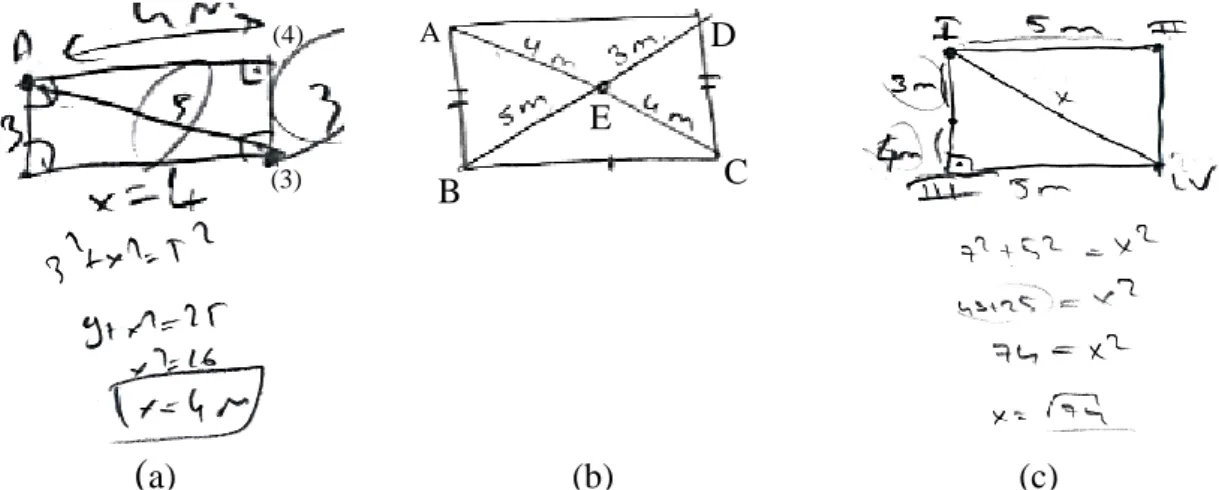
After reading other statements in the problem, they quickly selected given values in the problem and placed these values into the rectangle. For instance, Oya considered that [AC] and [BD] constitute linear line segments in her pictorial representation (see Figure 1-b). Then, she immediately wrote the values into the shape without a complete reading for the problem. She determined the place of the tree as on the intersection point of the diagonals of the rectangle. However, she did not notice the property about the diagonals bisect each other for a rectangle. Following this, she stated that ―the diagonals of any rectangle are equal length, so the distance asked in the problem is 4 meters‖ and finalized her think-aloud interviewing session. This situation showed that she did not monitor her solution process. Similarly, Efe started to update his pictorial representation after reading the second and third statements in the problem. In this regard, he selected numbers from the problem and tried to perform arithmetic calculations rather than reaching a complete understanding the situation described in the problem. Not surprisingly, he produced incorrect symbolic representations (see Figure 1-c) to calculate the distance between first and fourth corners of the rectangle instead of calculating the distance between ―X‖ and fourth corner. He then reached √74. Although he was not sure about the correctness of his response, he decided to finish think-aloud interview session.
Figure 1. Students’ initial representations for solving garden problem in think-aloud interviews (a)Alp’s representations (b) Oya’s representation (c) Efe’s representations
On the other hand, Alp could not correctly place the values to the rectangle because he treated the corner point of the rectangle as the place of the tree. Consequently, he was perplexed about the arrangement of the corner points by referencing to the place of the tree. As a result, he needed to revisit his initial pictorial representation and updated it by drawing one of diagonals of the rectangle. In order to determine distance asked in the problem, he attempted to produce symbolic representations (see Figure 1-a) in which he carried out Pythagoras Theorem and incorrectly reached 4 meters. As in following, Alp realized that he made a mistake.
Alp: A is the point in which the tree will be planted. 5 is the length of the diagonal of the rectangle. This would be 3-4-5 triangle. According to Pythagoras, the square of 5 is equal to the sum of the square of x and the square of 3. Finally, x must be 4 [referring the sides of 3-4-5 in the triangle (see Figure 1-a)]. It was given the distance of tree to the third corner is 4 meters. [He was underlining the last sentence of the problem and smiling silently] The distance of the tree to the fourth corner… [Silence for eight seconds] Where did I make mistake? I must read the problem again… [Silence for eight seconds]
He suddenly decided to read all statements in the problem again. At this point, he realized the distance between the tree and the third corner is given as 4 meters in the problem. Following that, he recognized that he made a mistake when representing the problem. As soon as he realized his mistake, he decided to read all statements in the problem again and updated his pictorial representations by changing the arrangement of the numbers of the corners and the place of the tree (see Figure 2). In that case, Alp placed the point in which the tree will be planted inside of the rectangular area. Nevertheless, he could not understand which one second corner and which one opposite corner because he incorrectly translated second verbal expression in the problem to pictorial representation. After immediately, he arranged numbers for the corners and produced new symbolic representations to perform arithmetic operations just like in Figure 2. As a result, he reached that the place of the tree is at a corner point instead of inside of the garden. This situation indicated that Alp was confused to correctly determine the arrangement of corners of the rectangle. Without confidently reaching an absolute decision, he finalized his thinking-aloud process.
(4)
(3)
(
a) (b) (c)
A
B
C
C
E
D
Figure 2. Alp’s updated pictorial and symbolic representation during think-aloud interview
Plaque Problem Results: For the Plaque problem, students also produced various representations in think-aloud interviewing process (see Figure 3). At the beginning of the think-aloud process, Alp and Oya followed same way in the production of representations. They immediately translated verbal expression in the first sentence to pictorial representation by producing a rectangle. After that, they visualized four holes in the plaque not to be on same line. At this point, they continued to solve the problem by using variables such as ―x‖ and ―2x‖ or ―a‖ and ―2a‖ in order to indicate the distance between the holes (see Figure 3-a and Figure 3-b).
Figure 3. Students’ initial representations of Plaque problem in think-aloud interview (a) Alp’s representation (b) Oya’s representation (c) Efe’s representation
After making a speed reading to the problem situation, Alp decided to change arrangement of third and fourth hole without providing a reasonable explanation about the reason why he made changes on his initial representation. At the end of the thinking-aloud session, he said that I am not sure about what the distance is, but it can be 35= 2x. Similarly, Oya found ―35= 2a‖ by proposing that ―35 mm‖ and ―2a‖ constitutes the diagonals of the rectangle. Then, she made following explanations:
Oya: [By indicating Figure 3-b] If we can take ―a‖ for the distance between the centers of 1st and 2nd hole, the distance among the centers of 2nd and 3rd hole will be ―2a‖. 35 mm was given in the problem. Ok, 35=2a because they are diagonals of the rectangle. [Silence for 4 seconds] Now, I can use Pythagorean Theorem to find the distance between 1st and 3rd hole, but the numbers are not integers. To calculate the distance will be a bit difficult for me… [She made some calculations]
As seen in above explanations, she produced some symbolic representations by utilizing Pythagorean Theorem to find the distance between the center of 1st and the center of 3rd hole. However, she had difficulty to find the value by virtue of her symbolic representations. Furthermore, before finalizing thinking-aloud, she only provided explanations about her difficulties in calculations without mentioning about the reasons why she had difficulties. At this point, it was seen that although she was able to make translations among different representation types such as pictorial, verbal and symbolic, she could not reached correct solution and she did not monitor her solution by making necessary calculations in think-aloud interviewing process.
Different from Alp and Oya, Efe tried to represent each statement in the problem by using ordinary and mathematical language (see Figure 3-c). He then read each statement again and updated his representations with minimal changes. However, he solely focused on quantitative relations between variables as in below expressions without devising a solution plan based on his representations instead of concentrating on understanding situation being described in the problem.
Efe: The distance between 1st hole and 4th hole=35 mm and 2nd hole + 3rd hole = 1st hole + 2nd hole , we can ignore 2nd hole because there are on both sides of the equation. In this instance, 3th hole = 1st hole… Similarly, for 3th hole + 4th hole = 2nd hole + 3rd hole, I can say 4th hole = 2nd hole. Hmm.., [he has controlled his solution for 5 seconds] but they are meaningless. I was confused. This equation does not work [by smiling]. [Silence for 8 seconds] Hmp, I’m not accustomed to solve such questions because it
(2)
(3) (4)
(1)
involves no pictorial or symbolic representations. [He read the question again and did same calculations] Ok, it is enough because I did not find a numerical solution.
It is clear in above explanations that his problem solving process revealed his inadequate knowledge on setting suitable algebraic equations with lack of pictorial representations. He tried to read problem situation again and finalized his thinking aloud process by implementing same procedures.
Changes in Students’ Representations during Open-ended Prompting Interviews
At the beginning of OEPIs, the researcher initiated interviewing process by directing participants to examine their responses and representations that they produced in thinking-aloud sessions. To illustrate how changes occurred in participants’ representations throughout prompting interview sessions, some notable excerpts between the researcher and participants were given in the following.
Garden Problem Results: Excerpt 1 showed Alp’s changing representations in solving Garden problem throughout open-ended prompting interview session.
R1 What do you think about correctness of your representations because you produced two different rectangle constructions [by indicating Figure 1-a and Figure 2.]?
A1 I am not sure whether my answer is correct or not because I could not determine exact place of tree in my constructions. After I noticed that I placed tree not inside of the rectangle in my first drawing I drew a new rectangle figure involving the point inside of the garden. However, I could not get the solution.
R2 You can draw a new figure if you want.
A2 [He then drew a rectangle as in Figure 4] P is the point inside of the garden. The distance between A and P is 3, others are 4 and 5. I can say 32+52=x2+42. From here, x=3√2 but I think this value again cannot be correct.
R3 How did you get the value of x=3√2? Please could you explain the meaning of 32+52=x2+42?
A3 I used the properties of rectangle. If you take a point inside of a rectangle we can apply this property to find distances between corner points and any point in rectangle. However, I doubt about the correctness of my answer.
R4 Why?
A4 In school, we always get integer number results in our solutions. So, I’m not accustomed to square root number for such kinds of problems.
R5 How do you make sure yourself about correctness of the result?
A5 Hmm… I’m not sure. I can draw a new shape [as Figure 5] and make some new calculations by using other properties of rectangle. For example, we know that rectangle has right angles. In this situation, I can use Pythagorean Theorem. I can draw these perpendicular lines [see Figure 5]. There are many equations. [He solved equations] Ok, I got x=3√2. Actually, I’m sure and I think my answer is correct.
Excerpt 1. Alp’s attempt to update his initial representations in Garden problem
Figure 4. Alp’s changing pictorial and symbolic representation in prompting interview
As seen Excerpt 1, the researcher’s first question enabled him to understand the reasons why he had difficulties when producing representations and why he was unsure about the correctness of his responses. Following that, the researcher’s suggestion (R2) encouraged him to read the problem again and revisited her initial representations (remember Figure 1-a and Figure 2). At this point, he tried to arrange all given values by tracing a different approach (see Figure 4), which was a great opportunity for him to change his previous symbolic and
A
B
pictorial representations. He then conducted some calculations as in Figure 4 considering the statements given in the problem situation (A2). Following that, the researcher asked him to explain the meaning of the 32+52=x2+42 (R3). Alp’s explanations about the calculations indicated that although he was knowledgeable about the properties of rectangle, he was suspicious about the correctness of his answers. Hereon, the researcher’s why question (R4) revealed that student evaluated his response as incorrect result since it involves a square root number rather than involving an integer number. At this point, by the influence of the researcher’s how question (R5), Alp needed to again produce new pictorial and symbolic representations in order to be sure about the correctness of his responses. For this, he constructed a new rectangle and produced some symbolic representations as in Figure 5 by using Pythagorean Theorem. In the following, he again obtained same value of (x=3√2). At the end of the open-ended prompting interview, therefore, Alp had an opportunity to become sure about the correctness of representations for the problem.
Figure 5. Alp’s final representations for monitoring and verifying the result
Similar salient changes were also detected in Oya’s initial representations. Excerpt 2 indicated that how Oya challenged with their initial representations when solving Garden problem in the interactional process with the researcher.
Figure 6. Pictorial representations in which Oya placed diagonals of rectangle
R1 What did you notice when you read the problem?
O1 Initially, I determined a point in the middle of the garden to place the tree. I decided that [AC] and [BD] are linear [in Figure 1-b].
R2 How did you understand linearity of [AC] and [BD]?
O2 I know that a line passes three points such as A, E, and C [in Figure 1-b]. From here, the length of [BD] is 8 meters. So, the length of [AE] and [EC] must be 4 meters.
R3 I could not exactly understand. What is the meaning of 3-5 and 4-4 in your drawing [Figure 1-b]?
O3 They are diagonals of the rectangle. I know that diagonals of the rectangle must be congruent.
R4 How do you draw a rectangle and its’ diagonals in this paper? O4 Ok. [She drew the first rectangle in Figure 6].
R5 What do you remember about the intersection of diagonals? O5 I remember they bisect each other.
R6 Do you want to control your first representation [by indicating Figure 1-b]. O6 In my figure, 4-4 and 5-3.
R7 What is the meaning of this?
O7 I realized that they may not be linear. One of them may not be a diagonal. I think I made an incorrect drawing.
R8 If so, how do you draw now in case I say draw it again?
O8 [She drew second rectangle in Figure 6] As far as I remember it will be like that [by showing the rectangle] but I did not know how I can find the place of the tree… Sorry, I did not remember the properties and some formulas of rectangle.
The researcher’s question of what she noticed when reading the problem revealed that she considered a line passes through three points on a plane instead of two points. To be sure about the situation, the researcher asked the student to explain the meaning of 3-5 and 4-4 in her initial representation in Figure 1-b. By the help of this question, we explicitly realized that Oya treated three points as constituting a line segment as well as a diagonal (O2-O3). In order to increase student’s attention to the diagonals of rectangle, the researcher asked her to draw a rectangle and its diagonals. This question acted the student in terms of producing new pictorial representations as in Figure 6. Thus, it was seen that there was an inconsistency between the student’s initial representations (remember Figure 1-b) and current verbal expressions (O5) related to diagonal properties of rectangle. After the researcher suggestive question (R6), Oya understood her mistake related to the diagonals of a rectangle. Nevertheless, she could not find the distance asked in the problem because of limited knowledge about properties of rectangle (O8).
Finally, in Excerpt 3, interactional process between the researcher and Efe was given for the Garden problem solving process.
R1 Please explain how did you get √74?
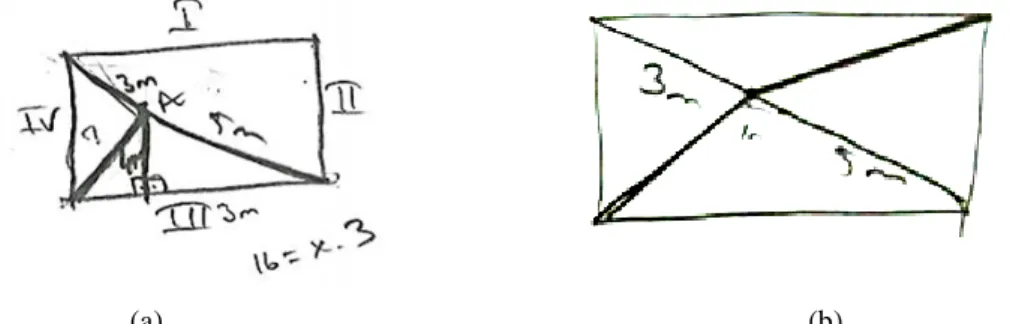
E1 I am not sure about the correctness of √74 because it is a square root number. If I try to solve the problem again, I am not sure I can get the correct result. [He again read statements in the problem]. In this case, I want to place the point in middle of the rectangle [see Figure 7-a]. Let’s take I, II, III and IV. Here is 3 meters and here is 5 meters. So, 16= 3x. Hmm…[by smiling].
R2 I could not absolutely understand what you made on your last drawing. Could you explain? E2 I thought the tree may be in the middle of the garden. I tried to draw a shape in which the tree
is inside of the garden.
R3 Why could not you decide the place of tree as soon as you read the question?
E3 Because I could not decide whether the tree is inside or on the fence. So, I decided to draw a new figure in which I placed I, II, III, and IV. I thought maybe I get to solution by try it. I reached 3-4-5 triangle.
R4 What asks the question?
E4 The distance of the point of tree to the fourth corner.
R5 Could you show the distance of the point of tree to the third corner [in Figure 7-a] E5 [By smiling] I took the sides as the corners. This is a big mistake.
R6 Ok, I wonder that what you mean with 8 for this rectangle [in Figure 7-a]? E6 It means that 3+5=8.
R7 How did you make sure yourself about the linearity?
E7 I thought it is a diagonal. I want to draw a new figure. [He drew rectangle in Figure 7-b] R8 What do you think about the linearity of these line segments?
E8 They cannot be linear because I remember that if they are linear they bisect each other. Here, 3-5. So, here is no linearity. I found √74 (remember Figure 1-c), but, it is not correct. I did not remember the diagonal properties. So, I cannot solve the problem.
Excerpt 3: Efe’s attempts to produce new representations
(a) (b)
Figure 7. (a) Pictorial representation in which Efe placed the point inside of the garden. (b) The representation in which Efe placed given values in the problem
changed in his final representation. From Efe’s explanations (E2 and E3), we again understood that he still was not sure about the exact place of tree in the garden. Then, the researcher guided him (R4), which enabled that the student recognized his own mistake arising from treating sides of rectangles as the corner points in Figure 7-a. In the following, the researcher asked additional questions in order to understand the student’s knowledge about the diagonal properties of rectangle. In this regard, we can infer from Efe’s last explanations that he don’t have enough knowledge about diagonal properties of a 2D geometric figure. Consequently we concluded that the lack of knowledge about basic geometric concepts might block to the student in terms of producing new representations and getting correct result.
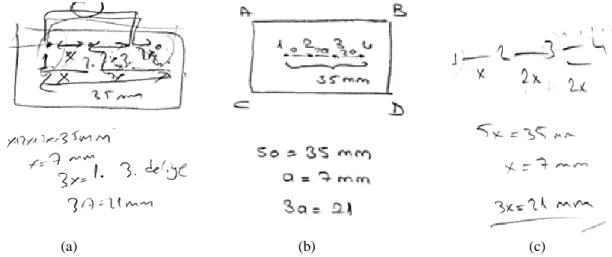
Plaque Problem Results: Throughout prompting interviews, students also changed their representations that they produced in thinking-aloud sessions of plaque problem. Their new representations were illustrated in Figure 8.
Figure 8. Participants’ updated representations of Plaque problem in prompting interviews (a) Alp’s representations (b) Oya’s representations (c) Efe’s representations
The interactional process between the students and the researcher were similar for the Plaque Problem. For example, when researcher encouraged Alp and Oya by the prompting questions to explain how they were confident about the correctness of the result, they recognized their uncertainty about the correctness of their obtained result. By this way, they decided to read problem. After reading the statements in the problem, they realized their carelessness about ―four holes to be on the same line‖. After that, they similarly produced new pictorial and symbolic representations with the correct arrangements for the holes and reached correct results (see Figure 8-a and Figure 8-b).
On the other hand, as an illustrative excerpt, interactional process between the researcher and Efe was given in the following to present how the researcher’s prompting questions influenced on Efe’s production of representations.
R1 Why did not you get the solution?
E1 In all geometry problems in the class, we use figures given in the problem. But, this includes only verbal expressions. I do not like draw geometric shapes.
R2 Why did not you try to solve the problem by drawing some shapes?
E2 I don’t like drawing, but I can try now. [He drew Figure 8-c]. I thought the distance among 1st and 4th holes is given 35 mm. At that time, 35= 5x, From this, x=7. Problem asks the distance between 1st and 3rd hole. Namely, 3x=21. Ok, I’m sure about my answer [by smiling].
R3 Now, what do you think about easiness of the question?
E3 In the first time, I found it a little bit difficult. I initially tried to make an equation, but it wasn’t work. However, after drawing something considering the statements in the problem, I realized this problem is easy. I mustn’t ignore other types of representations when solving word problems.
Excerpt 4: Efe’s awareness on the power of producing pictorial representations
The interviewer’s first why question provided him to concentrate on the reason of his incomplete problem solving. After that, the researcher asked the reason why he did not draw any rectangular shape to the solution (remember Figure 3-c). By this question, we understood that the student did not like drawing geometric figures
because he was accustomed to see them already given in the textbooks (E1 and E2). At this process, he needed to read problem situation and produce a pictorial representation as a line denoting the number of the holes in Figure 8-c. After understanding the relation among givens in the problem, he updated symbolic representations. At the end of the excerpt, we realized that he gained awareness about the potential power of using different representations in terms of successful word problem solving by the researcher’s question about difficulty level of problem (R3).
Results and Discussion
This research was conducted to investigate secondary school students’ representations for solving geometric word problems in different clinical interviewing processes. More specifically, the focus was to understand changes/developments in students’ representations through think-aloud interviews (TAIs) and open-ended prompting interviews (OEPIs).
In think-aloud process, students generally began to solve geometric word problem by translating verbal statements to pictorial representations. As they read over a new statement in the problem, they connected it the current text base by making referential connections. However, it was observed that students’ reading abilities/text comprehension influenced their problem solving process and representations (Bernardo, 1999; Çelik & Taşkın, 2015; Daroczy et al., 2015; Erdem, 2016; Gooding, 2009; Pape, 2004; Sezgin-Memnun, 2014; Varol & Kubanç, 2015; Vilenius-Tuohimoa, Aunola, & Nurmi, 2008). According to the researchers, the reasons of students’ many incorrect answers in word problem solving were associated with comprehending problem text (Clarkson, 1991; Riley & Greeno, 1988). In think-aloud interviewing process, students in the current study similarly could not make a complete reading of the statements by considering semantic and linguistic structure of geometric word problems. Due to the local understanding of the statements, they produced useless representations and did not reach correct solutions. However, if they understand their mistakes, they changed construction of the problem representations or they updated and elaborated their initial representations. For instance, Alp visualized the holes in the plaque not to be on the same line for the second geometric word problem. In the thinking-aloud, he carefully read problem and he changed his pictorial representations. Nevertheless, he did not notice the statement of ―four holes to be on the same line‖ in the problem. Moreover, once they represented the information in the problem, they planned to make arithmetic computations that are necessary to solve the problems. At this stage, they immediately focused on arithmetic computations with the numbers and keywords in the problem instead of constructing a qualitative understanding of the problem situation, which frequently leads them to produce incorrect symbolic representations (Lewis & Mayer, 1987; Verschaffel, De Corte, & Pauwels, 1992). Thus, in think-aloud sessions, all students having different success levels surprisingly preferred a short-cut heuristic approach based on computations although Mayer and Hegarty (1996) proposed that successful problem solvers prefer an in-depth rational approach based on problem understanding. What can be the reasons of this situation?
In Turkey, the university entrance examination gives shape the all aspect of secondary school education (Basturk, 2010). In the preparation process of the exam, students mostly solve multiple-choice questions by using correct and quick procedural ways. Furthermore, geometry questions are generally given with pictorial or symbolic representations instead of purely verbal representations in geometry lessons. Hence, students are not accustomed to geometric problems presented in verbal format (Sezgin-Memnun, 2014). In this sense, we recommend that national education policy must change the structure of the university entrance examination and mathematics curriculum in order to develop students’ reasoning and geometric problem solving abilities in Turkey. In the exams, it can be asked open-ended questions to evaluate students’ problem solving abilities and representations because students’ actions in problem solving may not be completely understood through multiple choice questions. In this sense, frameworks and items in PISA and TIMSS can be utilized when making reform in national education policy because problem solving is the heart of both frameworks and they involve open-ended items that require producing multiple representations instead of solely focusing on multiple choice questions.
intervention. However, the data gathered in think-aloud interview sessions was not sufficient to completely understand the reasons why students were uncertain about the correctness of their responses and representations and why they changed pictorial/symbolic representations. Besides, the presence of multiple representations in thinking-aloud sessions does not guarantee the presence of cognitive links between them (Noss & Hoyles, 1995; Sacristan, 2002) because there are another crucial factors that affect geometric problem solving such as reading comprehension ability, feelings, linguistic structure of the problem and geometrical knowledge. In this regard, open-ended prompting interviews performed after thinking-aloud gave a chance to the researchers in terms of getting inside learners’ minds to evaluate their conceptual understanding and to draw inference about their mathematical knowledge by examining their changing representations and explanations. For instance, by means of the researcher’s questions in the open-ended prompting interview process, all students were able to realize the problematic situations that were due to their inadequate reading comprehension abilities. This awareness provided them the opportunities to update representations and to comprehend geometric word problems. At that time, students’ updated representations were useful to understand their mistakes and knowledge capacities about a geometric concept as rectangle and its diagonal properties. As a conclusion, we recommend that researchers can utilize both clinical interviews together in order to examine students’ mathematical thinking and representations.
The results of the current study can be also evaluated as an indicator to show the correctness of the idea related to if given enough time and support/guidance, students may productively construct new and correct representations (diSessa, 2004). In this sense, we suggest that it will be useful that secondary school mathematics teachers may give more opportunities and time to their students in terms of explaining themselves verbally in classrooms instead of focusing the problems by only short-cut heuristic approach. Furthermore, teachers may use geometric problems involving various representations at a same time. For example, they can give geometric word problem to the students. After students try to solve the problems, teacher can give symbolic and pictorial form of same geometric problem. Thus, students are able to enhance their reading comprehension abilities, visualization and algebraic thinking and knowledge about geometric concepts when solving geometric word problems.
As a final point, we also want to share some possible implications for future studies in the light of the results obtained from our in-depth analysis. We support the idea of providing advanced training in clinical interview methods for primarily researchers and then prospective teachers in teacher preparation programs at universities (Bobis, Clarke, Clarke, Thomas, Wright, Young-Loveridge, & Gould, 2005; Ginsburg, 2009; Groth, Berhgner, & Burgess, 2016; Heng & Sudarshan, 2013; Hunting, 1997; Lesseig, Casey, Monson, Krupa, & Huey, 2016; Jenkins, 2010; McDonough et al., 2002). Some researchers argue that the vast majority of teacher questions consist of short-answer and low-level questions that require students to recall facts, rules, and procedures (graesser & Person, 1994), rather than high-level questions that require students to draw inferences and synthesize ideas (Hiebert & Wearne, 1993). Yet, teachers’ questions are crucial to scaffold students’ engagement with the mathematical task and to create opportunities for learning high-level mathematics (Kazemi & Stipek, 2001; Stein, Remillard, & Smith, 2007). Accordingly, McDonough et al. (2002) claimed that if prospective teachers use interviews with students they can enhance their knowledge and skills in the following ways: the increasing awareness of the kinds of strategies the children use, receiving the power of giving children one-to-one attention and time, modelling the kinds of questions and tasks that are powerful in eliciting children’s’ understanding etc. It is evident that finding time to conduct one-to-one interviews with students as an assessment tool may be difficult for in-service teachers because there are many students in each classroom. However, we believe that if prospective teachers, to be clinician, have enough opportunity to deepen students’ mathematical understanding within clinical interviews process through their teacher preparation courses rather than only observing students in mathematics lessons as a requirement of field experience, they can expand their experience of how a learner’s mind works mathematically, what that learner understands about a concept, problem or topic by engaging in interactive communications with the learner.
become comfortable with and acquire skills in the use of clinical interviews to understand students’ mathematical thinking, some training programs or workshops can be organized by teacher educators. For example, in these training programs, prospective teachers can examine students’ mathematical thinking in the scope of video-based courses at universities. Then, they can interview students at schools in the scope of fieldworks. Alternatively, an interview module can be created to train prospective teachers in the scope of method courses (Lesseig et al., 2016).
As a limitation, we focused on only three different achievement level students due to the nature of case study in the current study. Case studies require a thick data to provide detailed information about the participants. For this reason, it can be difficult to cope with huge data set if we conduct the study with more participants. At this point, we think that this study can be conducted more students if there are enough trained clinical interviewers in order to theorize or generalize the structure of students’ representations in problem solving throughout a number of interviews and word problems. Further, another implication can be related to the status of students’ talkativeness in interviews. In the current research, we found necessary to include only talkative students to the study because think-aloud interviews require the participants to explain all details of their thoughts in problem solving process. As an alternative perspective, we think that a similar study can be conducted with the students who are ordinarily silent in classrooms in order to elicit such students’ representations in geometric word problems. In this regard, McDonough et al. (2002) proposed that interviews afford unique opportunities to understand the mathematical thinking of silent students in the classrooms. This can be an alternative approach to investigate how silent students’ minds turn inside out when they solve geometric word problems in different clinical interviews.
Another remarkable point in the current study was related to the nature and number of geometric word problems. In this research, we used two word problems having similar written statements. We believe that it can be useful to examine students’ representations in algebraic, geometric and arithmetic word problems. Thus, researchers have a chance to examine how students’ representations and problem solving process change in different problem types during both clinical interview processes. Finally, we observed that students had anxiety as they could not correctly understand the problems. They sometimes claimed their inability in language and grammatical issues creates problems when reading a text. For this reason, students claimed that they produced incorrect mathematical representations. From this point of view, it might be useful to examine the influence of cognitive and linguistic demands of verbal problems (Sherman & Gabriel, 2016; Wang et al., 2016) on students’ reasoning and representations in both clinical interview types.
References
Aronsson, K. & Hundeide, K. (2002). Relational rationality and children’s interview responses. Human Development, 45(3), 174–186.
Bannert, M., & Mengelkamp, C. (2008). Assessment of metacognitive skills by means of instruction to think aloud and reflect when prompted. Does the verbalization method affect learning?. Metacognition and Learning, 3(1), 39-58.
Basturk, S. (2010). First year secondary school mathematics students’ conceptions of mathematical proofs and proving. Educational Studies, 36(3), 283–298.
Bernardo, A. (1999). Overcoming obstacles to understanding and solving word problems in mathematics. Educational Psychology, 19(2), 149-163.
Björn, P. M., Aunola, K., & Nurmi, J. E. (2016). Primary school text comprehension predicts mathematical word problem-solving skills in secondary school. Educational Psychology, 36(2), 362-377.
Bobis, J., Clarke, B., Clarke, D., Thomas, G., Wright, B., Young-Loveridge, J., & Gould, P. (2005). Supporting teachers in the development of young children’s mathematical thinking: Three large scale cases. Mathematics Education Research Journal, 16(3), 27-57.
Boonen, A. J., van Wesel, F., Jolles, J., & van der Schoot, M. (2014). The role of visual representation type, spatial ability, and reading comprehension in word problem solving: An item-level analysis in elementary school children. International Journal of Educational Research, 68, 15-26.
Braun, V., & Clarke, V. (2006). Using thematic analysis in psychology. Qualitative research in psychology, 3(2), 77-101.
Cai, J., & Wang, T. (2006). US and Chinese teachers' conceptions and constructions of representations: A case of teaching ratio concept. International Journal of Science and Mathematics Education, 4(1), 145-186. Cankoy, O., & Özder, H. (2011). Bağlam ve görsel anlatımların matematiksel sözel problem çözümüne etkisi