Evolving the IBM software-licensing structure to provide
a foundation for the future.
Processor-value-unit licensing for middleware
To support your business objectives
Over the past few years, software licensing for middleware on distributed systems (non-IBM System z™ platforms)
has become more complex. In the face of these changes, IBM clients have requested:
• A licensing structure that is as simple as possible, understanding that this simplicity must be balanced against precise measurements of the potential value that a business can receive from its middleware. This structure includes eliminating fractional licenses at the processor-core level.
• Greater flexibility in deploying middleware licenses on servers that use multicore chip technologies, using subcapacity licensing where clients have partitioned those systems more granularly.
• Continued delivery of middleware price-performance improvements across differing chip technologies as the underlying hardware performance improves.
Making these changes has affected the per-processor licensing metric that includes products across the IBM DB2®, IBM Lotus®, IBM Tivoli® and
IBM WebSphere® portfolios.
Historically, most people considered the per-processor licensing metric to provide a reasonable surrogate for software value. The majority of
distributed processors in the past were single application servers, and all the software costs on those servers could be associated with one application. This made the processor a good representative for the value a company received from the middleware
supporting applications on a particular server—and the processor was simple to understand and manage.
Under this licensing approach, one software license was required per processor core. So, if a system had four processor cores, a company would need four software license entitlements. However, with the widespread adoption of multicore chip technologies in today’s servers, the per-processor licensing approach no longer meets the needs of underlying processor technologies.
When x86 dual-core chips were introduced in 2005, the performance of each processor core declined compared with the previous generation of processor cores. As a result, to deliver software price-performance improvements, most leading middleware vendors, including IBM, made exceptions to their one-license-per-processor- core policy and required only one license entitlement for the two cores on the x86 dual-core chip. Effectively, this resulted in half a license for each processor core. Unfortunately, this fractional approach has made middleware licensing more complex. Adding to this complexity, vendors have effectively introduced multiple licensing levels or tiers depending on the specific processor or chip type on which the program runs.
Alternative strategies to improved chip performance
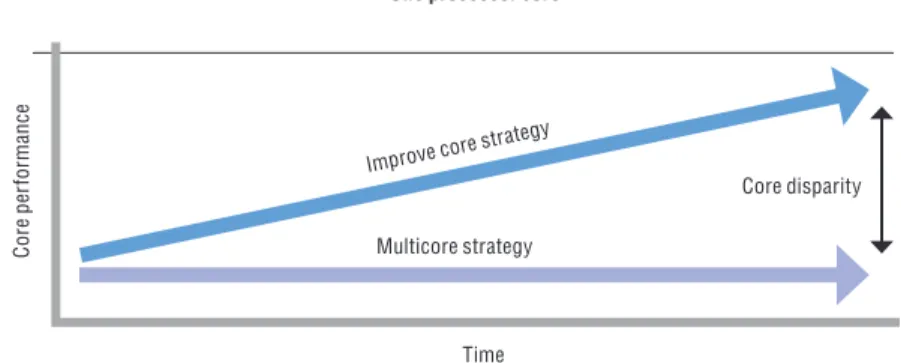
In the past, hardware chip vendors delivered performance improvements by increasing the speed of the processor core. Recently, however, many chip vendors have begun using an alternative strategy for improving chip performance.
Some vendors, primarily those offering IBM POWER™ processor systems,
continue to improve the performance of each processor core. Other vendors are increasing the number of cores on a chip (hence, multicore) to drive overall chip performance, whereas their processor core performance remains relatively flat. These different strategies can increase the processor-core performance disparity between differing chip technologies. This increasing disparity, in turn, has led to the need to differentiate software per-processor license requirements across these technologies.
Figure 1. Alternative strategies to improved chip performance
Evaluating middleware alternatives
With leading middleware vendors
having different tiers within their
licensing structures, software pricing
can be confusing.
The number of license entitlements
alone tells only half the story. To
understand the real impact, you need to
evaluate the bottom-line pricing by
comparing the price per processor core
that you have to pay for each of your
middleware alternatives. You can make
this comparison by multiplying the
entitlements per processor by the price
per processor.
Co
re
p
er
fo
rm
an
ce
One processor core
Time
Core disparity Multicore strategy
Improve core str ategy
Licensing granularity is required
Some have suggested that middleware licensing should be at the chip level rather than at the processor-core level. However, with the processing power available in today’s processor cores, most organizations increasingly want to partition their systems and run only some programs in a subset of the total processors in the system. That’s why IBM introduced subcapacity licensing more than a year ago. With multicore chips, licensing at the chip level would often result in a company having to pay more for its licenses than it is actually using. Licensing at the processor-core level helps eliminate this problem.
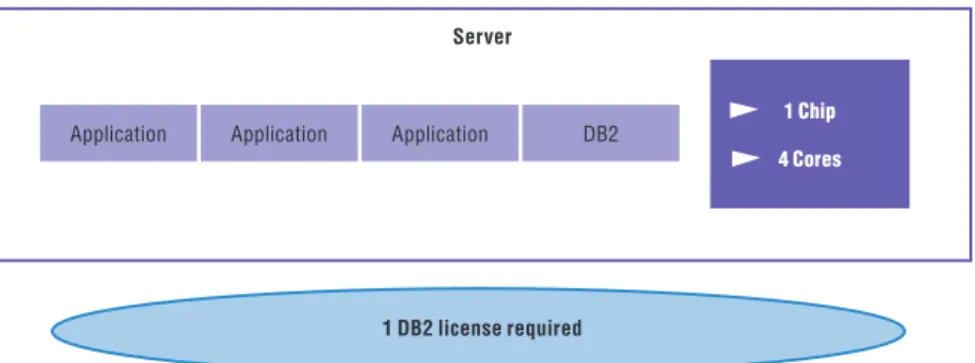
For example, consider a company that has a server with one quad-core chip (four processor cores on a chip). It wants to run an application on three of those processor cores and run an IBM DB2® system in the remaining
processor core. Using subcapacity
licensing, that company would need a license for that one core only (see Figure 2). If per-chip licensing were used, the company would have to pay for licenses for all four processor cores even though DB2 is being used on only one core. This situation is going to worsen as the number of cores per chip continues to increase. Because of this trend, IBM and most middleware vendors continue to license to the processor core.
Introducing processor-value-unit licensing
IBM is addressing licensing issues by introducing the per-processor licensing replacement—processor-value-unit licensing. A processor-value-unit is a unit of measure that can be used to differentiate licensing of middleware on processors and, over time, can evolve to differentiate processor families based on relative performance. Initially, however, IBM is focusing on a simple transition with the conversion to the new processor value units without changing the price for middleware deployed on existing processors.
Simpler structure
Now, IBM middleware that previously used the per-processor licensing metric can be licensed in processor value units. IBM has converted the three broad licensing tiers or levels that existed in the prior structure, and all existing processors have been assigned to one of those tiers. For each product, you have to acquire the appropriate number of processor value units for the specific processor on which the software is deployed.
All the processors within a processor family are assigned to the same tier. A processor family is a group of processors within a given processor technology that can vary in clock speed or cache size, but have the same or similar processor design and performance characteristics. With this pricing structure, IBM is not splitting families—and you don’t have to worry about having to buy more processor-value-unit licenses when you install minor technology upgrades to your existing hardware.
Server
Application Application Application DB2 1 Chip
4 Cores
1 DB2 license required
Simple conversion
To convert existing per-processor licenses to the new processor- value-unit licenses, IBM has used a conversion factor of 100. For example, each core on an x86 dual-core-based system required one half of one license entitlement before this announcement. To convert this to processor value units, you would multiply the 0.5 per processor license by the conversion factor of 100 to get the new processor-value-unit requirement of 50.
By using a conversion factor of 100, IBM has eliminated fractional licenses and simplified the task of determining the number of licenses required on a server. And just like the previous licensing structure, processor value units for a product are fully transferable among systems. This capability helps protect your middleware investments and increase your flexibility to evolve your system architecture as your business needs change.
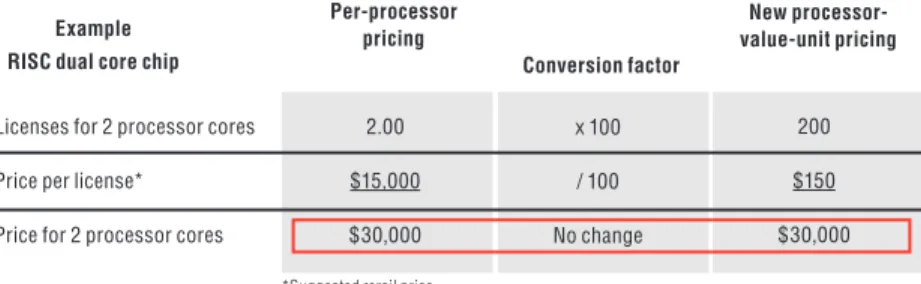
To convert license prices from per-processor prices to processor-value-unit prices, IBM has also used a conversion factor of 100. In this case, though, instead of multiplying today’s price by 100, IBM has divided it by 100 to get the new price-per-processor- value-unit. The net effect of this change is that a company’s price for current processor technologies doesn’t change. You can see this effect clearly in using IBM WebSphere Application Server Network Deployment as an example.
Figure 3. Converting from previous system to processor-value-unit licensing
Chip type
Single-core (all chips) RISC dual-core x86 dual-core RISC Sun T1 octi-core
Old structure entitlements per
processor 1.00 1.00 0.50 0.30
x 100 x 100 x 100 x 100
100 100 50 30 Conversion factor
New structure value-unit entitlements per
processor
Figure 4. Sample conversion to processor-value-unit licensing using WebSphere Application Server Network Deployment
Licenses for 2 processor cores Price per license*
Price for 2 processor cores
Per-processor pricing
2.00 $15,000 $30,000
x 100 / 100 No change
200 $150 $30,000 Conversion factor
New processor- value-unit pricing Example
RISC dual core chip
Greater flexibility and software price-performance improvements
The structure of processor-value-unit licensing delivers the flexibility to provide continued software price-performance improvements. As processor technology evolves from generation to generation, IBM can still deliver software price-performance improvements. This, along with subcapacity licensing, helps make it possible for you to consolidate servers and workloads to optimize your middleware deployment.
As IBM places new processor families in the processor-value-unit structure, a key objective is to continue to deliver middleware price-performance improvements. Over time, new processors can be differentiated based on relative performance, among other factors. To determine this relative performance, IBM will assess a number of different industry-standard benchmarks, including
transaction-processing and processor-based standard benchmarks. Other factors that can determine the number of processor value units include market conditions and a requirement to maintain a simple structure that balances precision with simplicity.
What’s in it for you
With processor-value-unit licensing, IBM has made the structure clearer and simpler for you to administer by reducing the complexity of fractional licenses. The structure also provides the flexibility and granularity you want when you license IBM middleware, enabling subcapacity licensing at the core level. This structure also provides licenses that are transferable across distributed systems, which helps protect your existing investments.
Using processor-value-unit licensing doesn’t mean that middleware prices will change. And you can expect that IBM will continue to deliver software price-performance improvements as new processor technologies are announced.
The benefits of this structure aren’t limited to new multicore chip technologies, but can also position IBM and its clients to address the adoption of new hardware and software technologies over time. The bottom line? This new structure provides a smooth transition to a simpler pricing structure, without affecting current prices—and at the same time, offers a sustainable licensing foundation for the future.
For more information
To learn more about processor-value- unit pricing, visit:
ibm.com/software/sw-lotus/ services/cwepassport.nsf/wdocs/ pvu_licensing_for_customers
(Current as of July 25, 2006. Please refer to Passport Advantage for the current table.) Figure 5. Adding new processor technologies to the licensing structure
Chip type
Single-core (All platforms) RISC dual-core x86 dual-core RISC Sun T1 octi-core Intel® itanium dual-core
Power 5 QCM dual-core
Processor value units per core
100 100 50 30 100
50
New to address the introduction of the latest
multicore technologies Transitioned from per-
WSS11253-USEN-00
© Copyright IBM Corporation 2006 IBM Corporation
Software Group Route 100 Somers, NY 10589 U.S.A.
Produced in the United States of America 10-06
All Rights Reserved
DB2, IBM, the IBM logo, Lotus, POWER, System z, Tivoli and WebSphere are trademarks of International Business Machines Corporation in the United States, other countries or both. Intel is a trademark of Intel Corporation in the United States, other companies or both. Other company, product and service names may be trademarks or service marks of others.