Does Small Really
Make a Difference?
A review of the literature on the
effects of class size on teaching
practice and pupils’ behaviour
and attainment
Valerie Wilson
Does Small Really Make a Difference?
A review of the literature on the effects of class size on
teaching practice and pupils’ behaviour
and attainment
ISBN 1 86003 066 1
Copyright © 2002 The Scottish Council for Research in Education First published June 2002
The views expressed are those of the authors and are not necessarily those of the Scottish Council for Research in Education or the funders, the Scottish Executive Education Department.
Contents
Page
Executive Summary v
1. Introduction 1
1.1 Background to the review 1
1.2 Aims and scope 1
1.3 Definition 1
1.4 Search methods 2
1.5 Organisation of the review 4
2. Nature of the Evidence 5
2.1 Introduction 5
2.2 Reviews 5
2.3 Correlational studies 7
2.4 Meta-analyses 8
2.5 Experimental studies 9
2.6 Summary 10
3. Class Size and Pupil Attainment 11
3.1 Introduction 11
3.2 Does achievement improve in smaller classes? 11
3.3 Which groups benefit most? 13
3.4 Do the findings apply to a British context? 14
3.5 Is there any Scottish evidence? 16
3.6 Summary 17
4. Class Size and Teaching Practices 19
4.1 Introduction 19
4.2 Characteristics of effective teaching 19
4.3 The impact of class size on classroom procedures 20 4.4 The use of classroom assistants (teachers’ aides) 25
4.5 Teachers’ training for small-sized classes 26
4.6 Summary 27
5. Class Size and Pupil Behaviour and Motivation 28
5.1 Introduction 28
5.2 Pupil behaviour 28
5.3 Attendance and exclusions 31
5.4 Attitudes to learning and teaching 32
5.5 Summary 32
6. Conclusions 34
6.1 Introduction 34
6.2 Does class size impact on pupil attainment? 34
6.3 Which stages of education benefit most from class size reduction? 34 6.4 How does class size manipulation impact on teaching practices? 35 6.5 What effects does class size reduction have on pupils’ learning? 35 6.6 What is the impact of class size reduction on pupils’ behaviour,
attendance and motivation? 36
References 37
Executive Summary
The Scottish Executive Education Department (SEED) commissioned the Scottish Council for Research in Education (SCRE) to review the literature on the effects of class size on styles of teaching practice and on pupil behaviour and attainment. The review was conducted between September and November 2001. UK and international literature, mainly from the USA and published during the past twenty years, was the main focus of the study. Evidence from previous reviews, correlational studies, meta-analyses and experimental interventions are presented here. Few British, and no specifically Scottish, studies, emerge from the review.
Aims and findings
A summary of the questions addressed during this review and the main findings are presented below: a far from straightforward picture emerges as much of the existing evidence is at best confusing, sometimes even contradictory. The class size debate has tended to polarise researchers. On the one hand, many believe that a significant reduction in class size, especially for children in the early years of schooling, will improve pupil attainment; while on the other, some suggest that such gains are prohibitively expensive and that alternative methods of raising attainment would be more cost-effective. In summary:
Does class size impact on pupil attainment?
• There is sufficient evidence, mainly from American studies, to show that reductions in class size are associated with improvements in pupil achievements.
• Major benefits accrue from reductions in class sizes to below 20 pupils to one teacher.
• American evidence shows that using full-time classroom assistants in regular-sized classes as a means of achieving a lower pupil:adult ratio does not appear to increase pupil achievement. This remains a puzzling result and may indicate that classroom assistants require training in how to support children’s learning before benefits will occur.
• Conflicting evidence arises from some British studies, which seem to indicate that attainment decreases in classes of 25–30 and begins to level out, or increase, with groups of over 30 pupils. The explanation may lie in within class groupings and teaching practices.
Which stages of education benefit most from class size reduction?
• Most researchers are agreed that the benefits of class size reduction are more marked in the early stages of a child’s schooling, ie kindergarten through Grade 3 (5–8 years).
• American evidence indicates that the benefits of class size reduction were most marked with groups of black children. Supporters of class size
reduction assume that similar benefits could be achieved in other countries for young children, especially those from minority or disadvantaged groups.
• The STAR Lasting Benefits study shows that the initial advantages gained from early exposure to small classes are still evident at Grade 10 (age 16 years).
• British evidence of the impact of class size broadly confirms American results and reports decreasing scores in literacy with increasing class size. However, critics suggest that a very narrow range of outcome measures have been used to assess pupil achievement.
• Examination results in some British secondary schools record higher results from larger sets, but those were composed mainly of more able pupils.
How does class size manipulation impact on teaching practices?
• Most studies report that teachers believe that class size affects their teaching practices, in particular the way they organise within-class groups and the amount of time they can devote to individual children.
• Teachers report feeling less stressed and more able to cope with their workload in smaller classes.
• Research evidence shows a difference between the way teachers claim they would organise their classes if class sizes were reduced and their actual classroom practices. Researchers suggest that this is a consequence of few teachers having been taught specifically how to teach in smaller classes and it could be rectified during initial or in-service teacher education.
What effect does class size reduction have on pupils’ learning?
• There is a paucity of evidence on the effects of class size on pupils’ learning.
• Despite this lack of evidence, studies show that teachers, headteachers, parents and school governors all believe that class size impacts on pupils’ learning. Teachers claim that smaller classes afford them more opportunities to get to know children and devote more time to pupils’ individual learning needs.
• Observational studies of within-class groupings show little evidence of collaborative learning taking place amongst pupils: most appear to learn individually while sitting within groups.
• Pupils usually have more physical space within which to learn in classes composed of smaller numbers of pupils. However, little research attention has been devoted to the impact of the classroom environment, space and furniture on pupils’ learning.
Executive Summary
What is the impact of class size reduction on pupils’ behaviour, attendance and motivation?
• Most studies show that teachers of smaller classes report that these are quieter and more easily managed than larger ones. Therefore, potential discipline problems are prevented from arising.
• In general direct evidence relating pupils’ disciplinary records to participation in smaller classes is absent. Most studies resort to proxy measures of behaviour, such as exclusion, ‘drop out’ and attendance rates.
• American researchers, however, claim that fewer of those pupils who experienced smaller classes in the early years of schooling subsequently ‘dropped out’ of school at Grade 10 (16 years). Their exclusion and absence rates are also lower.
• There is some European evidence to link larger class and school sizes with increases in the number of incidents of pupil pushing, crowding and other aggressive behaviour.
• Research suggests a complex inter-relationship between pupils’ behaviour and their attitudes towards learning and attainment. Class size may be one influence but the evidence is inconclusive.
Finally, although most researchers agree that there is a relationship between small classes and pupil achievement, especially in the early years, some claim that there are more cost-effective ways of providing young children with individualised attention when they most need it. Alternative approaches to organising within-class and across-year groupings, more one-to-one tuition from teachers and classroom assistants during the working day and peer tutoring are alternatives which now need to be evaluated. At present there is no definitive evidence to show which of these is most effective. The current ‘trade-off’ of costs and benefits continues.
1: Introduction
1.1 Background to the review
The impact of class size on pupils’ attainment, attitudes and motivation, and its concurrent relationship to teaching practices and teachers’ workload and motivation, is probably the most written about, but least researched, topic in educational research. The continuing debate on the topic is a reflection not only of the perceived centrality of the issue to raising pupil attainment but also to the lack of a consensus to emerge from the research findings. What exactly does the research evidence tell us? How extensive and reliable is that evidence? And can the findings be applied to Scottish education? These are the themes which will run throughout this short review of published literature which the Scottish Executive Education Department (SEED) asked the Scottish Council for Research in Education to undertake as part of its service level agreement.
1.2 Aims and scope
The overall aim of the review is to report on literature published during the past 20 years in the UK and abroad, particularly that emanating from the USA, related to class size and its impact on a range of pedagogical and related factors. The review will provide an overview of findings from disparate studies which have focused exclusively on pupil attainment, teaching styles, behaviour management, pupil attendance and motivation with a view to identifying the optimum class size for various purposes and the stages at which class size manipulation can provide the greatest benefits for pupils and teachers.
Seven research questions have been applied to the literature. They are:
1. Which class sizes provide the greatest benefits and what are the problems presented by other class sizes?
2. Which stages of education benefit most from different class sizes? 3. What is the impact of class size on the teaching process?
4. What is the impact of class size on pupils’ learning? 5. What is the impact of class size on pupils’ attainment? 6. What is the impact of class size on pupils’ behaviour?
7. What is the impact of class size on characteristics such as attendance and pupil motivation?
In addition, where it is available, data relating to the financial consequences of reducing class sizes are explored.
1.3 Definitions
As will become apparent throughout this review, much of the research into class size has been conducted by researchers in schools in the USA, where terms may be defined in different ways from those commonly used in the United Kingdom. In addition the organisational format may have no exact British equivalent.
While nursery, primary and secondary schools are standard stages within all Scottish education authorities, this review attempts to incorporate findings from kindergarten (USA) and reception classes (England and Wales) and also infant, first, junior, middle and secondary schools in both the state and the independent sectors (England and Wales) and elementary, junior and senior high schools (USA) without conflating the evidence. These differences may be more than semantic and reflect age and curricular distinctions unique to particular educational systems.
To aid interpretation, the following definitions of class size have been adopted throughout this report. These have been adapted from the report prepared by researchers at Nottingham University for the National Association of Headteachers (Day et al, 1996) and should help the reader judge the strength of the evidence against various meanings of the term ‘class size’.
Pupil-teacher ratio (PTR) is a ratio which is determined by dividing the full-time equivalent number of pupils on a school roll by the full-full-time equivalent number of qualified teaching staff, including the headteacher, but excluding short-term cover. These ratios must be used with caution because they include teacher non-contact time which may greatly reduce the ratio while not giving an accurate reflection of the teaching unit experienced by pupils and teachers. Pupil-adult ratio (PAR) is the ratio of full-time equivalent number of pupils on a school roll to the full-time equivalent number of adults in the school. These ratios may be extremely misleading as they include not only teacher non-contact time but also include non-teaching staff such as classroom assistants/teachers’ aides.
Class size(CS) is the total number of pupils allocated to a teacher for all or some of his/her teaching timetable. The average class size in a school is the total number of children in the school divided by the number of classes.
Pupil experienced teaching unit (PETU) is the size of unit in which pupils experience learning during their timetabled day. This will rarely equal the average class size for the school or the pupil-teacher ratio and may also vary as the day/week progresses with use of streaming, setting and within class groupings and the presence of other adults in the classroom.
1.4 Search methods
Many policy-makers now seek to ground their decisions on an evidential-base but what constitutes high quality evidence is far from obvious. As in previous SCRE reviews (Harlen & Malcolm, 1997), we aim here to utilise the concept of ‘best evidence synthesis’ which Slavin (1987 and 1990) borrowed from the law profession and applied to reviewing educational research. It requires the reviewer to identify criteria for determining good quality research and to place more emphasis on those studies which match the criteria than those which have identifiable shortcomings.
Introduction
It should be noted that other researchers have developed different approaches to identifying high quality evidence. For example, the Campbell Collaboration (Boruch et al, 1999) sets a premium on evidence generated from randomised field trials (RFTs). As will become apparent below, few of the studies published on the impact of class size can meet this strict criterion. We have, therefore, not excluded a number of small-scale studies, such as those undertaken by Galton et al (1996) on the effect of class size on teachers’ practices which, while not meeting the quality criterion, do offer insights into an under-researched aspect of the topic. In these cases, we indicate the scale of the study and the dangers inherent in generalising from such small samples.
Of greater relevance to educational policy, the Department for Education and Skills is currently supporting the Evidence Informed Policy and Practice in Education Initiative (EPPI) at the London University Institute of Education. The Centre has developed a set of ‘Review Guidelines’(EPPI, 2001) to help reviewers identify good evidence by working in review groups which systematically identify, map and assess key documents. Significantly, the Centre recommends that the process will take one researcher-year and should include users of the research as members of the review group.
It is against this background that this current review should be placed and its limitations made explicit. First, this review was undertaken within a very short timescale which can hardly do justice to the large volume of published work. Over a thousand items were identified using a combination of ‘class size’ and ‘teacher-pupil’ or ‘student ratio’ key words. Second, although criteria were established (the search strategy is described in greater detail in Appendix A1), adherence to strict criteria for best evidence was not always possible. For example, there is a paucity of well-planned experimental studies of class size in the UK, and the application of strict criteria by the reviewer would have left the review heavily dependent upon evidence from the USA. In addition, some studies simply do not provide sufficient information upon which to judge the quality of evidence. Many claim to have re-analysed data from other sources, without necessarily describing how the original data was generated.
The criteria for inclusion of studies in this review will give preference to:
• studies concerned primarily with primary and secondary school-aged pupils
• studies concerned with class size (using various definitions) but not school size
• reports of well-designed experimental interventions into class size
• reports of analysis and reanalysis of statistical evidence relating to class size
• reports which have been published in peer-reviewed journals; exceptions will be made for conference papers which are relevant but where evidence of peer reviewing is absent
• first hand accounts rather than reporting the numerous reviews of existing literature
• studies conducted during the past twenty years; with the exception of earlier work, ie by Glass and Smith (1978) which is of enduring significance. In an attempt to limit the number of articles considered and focus on primary sources, all reports in newspapers, the Times Educational Supplement, the Times Higher Educational Supplement, teachers’ professional journals and newsletters have been excluded; so too have Government policy documents. This review comes then with a ‘health warning’. Although it has been conducted systematically, it is impossible within the time frame to be confident that errors have not crept in, either by including studies which failed to meet the strict criteria or excluding ones which other researchers may have considered worthy of inclusion.
1.5 Organisation of the review
Given the volume of literature identified during the search, the review is organised by research question. It is presented in six sections of which this introduction is the first and in which we present the aims, research questions, definitions and scope of the search strategy.
In Chapter 2 the nature of the evidence arising from previous research reviews, correlational studies, meta-analyses and experimental designs is presented. Chapter 3 discusses the relationship between class size and pupil attainment and considers under which conditions, and with which groups of pupils, these results were achieved.
The impact of class size on both teaching practices and pupil behaviour and motivation are themes which have more recently begun to emerge from the class size literature. These are explored respectively in Chapters 4 and 5. Some attempt is also made to consider the attitudes of the key stakeholders – teachers, headteachers, parents and school governors – to the class size debate and how, if at all, this affects behaviour within the classroom.
The final chapter offers some conclusions which arise from the review and indicates the possible implications, including costs and benefits for Scottish education.
2: Nature of the Evidence
2.1 Introduction
This section provides an overview of the research evidence on the effects of class size. In total approximately 1000 references were identified in the seven databases searched and these have been categorised into four main types: reviews, correlation studies, meta-analyses and experimental studies. The nature and limitations of each are examined in order to establish the credibility of the source before the outcomes are explored in more detail in subsequent sections.
2.2 Reviews
Previous reviewers of class size data have tended to adopt a three-fold categorisation of the evidence. See for example the briefing paper produced by Semple (SOED, undated) in which correlational studies, meta-analyses and experimental studies are identified. Given the number of reviews of research identified in this current search, some of which use the ‘best evidence’ approach described in Section 1 above, we suggest that reviews be considered as an additional and discrete category of evidence. Burstall (1979), for example, points out that the lack of a consensus about what the evidence means stands in ‘sharp contrast with the deeply held conviction of teachers and parents that smaller classes must inevitably bring about an improvement in the quality of life in the classroom, with consequent beneficial effects on children’s social, emotional and intellectual development’.
Much of the research identified by reviewers was conducted in the USA, with the state of Tennessee’s Student Teacher Achievement Ratio (STAR) Programme being held up by many as the ‘gold standard’ for class size research. There is, however, often a note of exasperation implicit in the some of the reviewers’ choices of title. A policy paper (US Dept. of Education, 1998) asks: ‘Reducing Class Size: What do we know?’ – a title also chosen by Pritchard (1999). Krueger and Hanushek (2000) allude to the ‘Class Size Policy Debate’; while Finn (1998 and undated) asks ‘What does research tell us?’ and ‘What is known? What is next?’ All of the above were written in an American policy context of a decentralised education system in which much of the responsibility and authority for the organisation and delivery of public (ie state) education lies with locally elected school boards.
In a British context, but still largely dependent upon American evidence, four reviews are of interest. First, the National Association of Headteachers in England commissioned the University of Nottingham School of Education to survey the literature related to class size and the quality of teaching and learning. A team led by Professor Christopher Day (Day et al, 1996) presents the evidence against a background which included rising class sizes in England and Wales (from 26.8 to 27.3 in English primary schools between 1991 and 1995 compared with 24.7 and 24.7 respectively in Scotland over the equivalent period) and a report from OFSTED (1995) which suggests that the class size
debate can be uncoupled from attempts to improve the quality of compulsory age schooling.
OFSTED’s findings, based upon the large number of inspection reports carried out in English schools, suggest that:
• Class size should not be a significant factor in the debate on the quality of pupils’ learning because government is not in a position to increase funding to the point at which the reduction in the number of pupils in a class will generate significant gains.
• Class size is only one factor in the government’s discussion of how schools need to improve the efficiency with which they manage present levels of funding. The key to school improvement is not through reducing class sizes, but through better teaching methods and the quality of leadership in schools.
• Assessments of the quality of education are to be based on pupils’ development in the ‘basics’ and are to be measured via simple testing and assessment schemes and school inspections which will allow for comparisons to be made between schools and local education authorities (Day et al, 1996, p8).
This stands in contrast to the Scottish Executive’s promise in Making it Work Together (Scottish Executive, [1999]) to reduce class size in P1, P2 and P3 to 30 or less by August 2001, a promise which was repeated in 2001 in A Programme for Government (Scottish Executive, 2001).
The second significant review of published literature, compiled by the same team and which should be read in conjunction with the NAHT review, is an annotated bibliography (Watling, 1996). This is accessible from the University of Nottingham School of Education website. The researchers identified over 1500 references to papers, articles and books on class size research, of which almost 200 have been annotated. It should however, be noted that the criteria for inclusion are not specified.
Perhaps of greater significance than the first two reviews because it is cited by so many other researchers is the review prepared by Blatchford and Mortimer (1994) from London University Institute of Education. Similar to other reviewers, Blatchford and Mortimer summarise the evidence from correlational, meta-analysis and experimental studies. They reflect on the apparent inability of research to verify the common sense assumption of enormous consequence that smaller class sizes in schools will lead to educational benefits for pupils. We shall return to commonly held perceptions in Chapter 4. The researchers note the long-running disagreement about the possible impact of class size; the paucity of longitudinal studies (with rare exceptions such as STAR in Tennessee and Prime Time in Indiana), the different ways in which available evidence is interpreted and the enormous resource implications for policy-makers and school administrators of manipulating class size.
Nature of the Evidence
‘Probably all of us would take the view that – other things being equal – children are more likely to receive a better quality of education in small classes’ (Blatchford & Mortimer, 1994, p412) is how they put it. Yet they have to conclude that at best the evidence is inconclusive, at worst contradictory.
Reviews provide a convenient précis of an extensive body of research literature. Unfortunately, some reviewers have inadvertently contributed to the confusion which surrounds the topic by uncritically presenting findings which do not conform to ‘best evidence’ practices and/or by using the evidence to lobby for one case or the other.
2.3 Correlational studies
Although the most frequently quoted correlational studies fall outwith the past twenty years (the timescale for this review), it is worth considering what they have contributed to the debate. Correlational studies seek a relationship or association between naturally occurring events, for example between class sizes as they exist without any manipulation, and various measures of pupil attainment. Often data from existing large-scale monitoring programmes, such as that generated from the Assessment of Performance Unit (APU) is analysed. Some, such as the ORACLE study (Galton & Simon, 1980) were based upon classroom observations.
In Scotland, it might be assumed that results from the Assessment of Achievement Programme (AAP) in primary schools would provide information of a possible correlation between class size and attainment. Unfortunately, as Thorpe (1997) explains it is not possible to draw firm conclusions on the impact of class size on AAP tests. Although the sample size for English 1995 and Science 1996 was sufficiently large (1950 and 1200 respectively) only 120 pupils were drawn from classes of between 21 and 25. Confidence was further reduced by the ways in which class size information was collected from schools: headteachers provided some information; while in other schools information was extracted from class lists or schools telephoned to confirm class sizes. Cluster sampling further reduced confidence, and it was impossible to differentiate between pupils who were in different forms of composite classes.
Thorpe suggests three ways in which these difficulties inherent in AAP could be addressed: by increasing the size of the sample, increasing the confidence of data provided by headteachers or matching schools so that differences due to class size in Scottish primary schools which are very similar in other ways might be detected. This clearly has resource implications for the Scottish Executive. Correlational studies provide association but rarely are these sufficient to explain events. Unfortunately, they have also produced findings which are counter-intuitive. Earlier studies (Morris, 1959 and Wiseman, 1967) found that children in larger classes tended to do better than those in smaller ones even when some attempt was made to control for other variables such as parental occupation, school size and length of schooling. And Galton and Simon (1980) were forced to conclude that larger classes did not necessarily result in lower
rates of progress in basic skills. Other factors, such as teachers, their style of teaching and the distribution of pupils, may very well come into play in explaining the findings. In later sections we shall see that there is a tendency in many secondary schools to teach more able children, whom one would expect to achieve higher results, in larger classes.
2.4 Meta-analyses
What they believed to be the confusing and inconclusive nature of the published literature on class size led researchers to the develop meta-analyses. Glass and Smith (1978, 1982) were particularly forthright in their criticism arguing that previous searches seemed haphazard, narrative and discursive, lacking quantitative rigor, and afraid to generalise. Where quantitative methods had been applied, they lacked statistical significance, used crude classifications of class size, and failed to integrate results to provide an answer to the question: ‘What is the ideal class size?’ To overcome these difficulties, meta-analysis was developed.
In the most famous, but now dated, study to utilise this method, Glass and Smith collected information from 77 previous studies of class size, coded information using 25 specific items and analysed it using a regression analysis. This yielded 725 comparisons based upon 900,000 pupils spanning 70 years of research in a dozen countries. The results are unequivocal. The researchers claim that ‘the curve revealed a definite inverse relationship between class-size and pupil learning … only one factor substantially affected the curve – control for smaller and larger classes’ (Glass & Smith, 1978, pV). In short, as class size increases, achievement decreases. This relationship remained stable over different subjects, ie reading, mathematics, language and social sciences, and different age ranges from 5 to 19 years. However, significantly, the researchers note that reductions in class size have more beneficial effects at the lower end, ie below 20 pupils per class, whereas differences at the higher end over 25 pupils have little effect. If correct, this conclusion has serious implications for current Government policy to reduce classes to 30.
Despite the apparent certainty offered by meta-analysis, some doubts have been raised about the validity and reliability of the method. Clearly any defects in the original studies would also be reflected in the meta-analysis. Of more serious concern, differences in educational contexts, curricula and values, will have been conflated in the process of analysis. The studies utilised by Glass and Smith were undertaken between 1900 and 1979; over a quarter date from 1910-1919 and many were undertaken in educational systems which cannot be compared with our own. It is, therefore, questionable whether the generalisations derived from this particular meta-analysis can be applied to our own system.
Nature of the Evidence
2.5 Experimental studies
The research methods outlined above rely mostly on naturally occurring events, ie they utilise situations as they exist within schools and classes in different countries without manipulating class size or other variables. Under these conditions, it is difficult, some would maintain impossible, to attribute pupil achievement solely to class size isolated from the impact of school, community or wider socio-economic factors. In addition, many of these studies have relied upon a narrow range of standardised tests of reading and mathematics as outcome measures of pupil achievement (Burstall, 1979) and have been conducted over very short time spans. Experimental class size research attempts to overcome these problems.
The classic experimental model is based upon a controlled intervention accompanied by pre- and post- testing to ascertain pupil performance. The best-known studies of this type are the Indiana Prime Time (Pate-Bain & Achilles, 1986) and the Tennessee Student Teacher Achievement Ratio (STAR) (Finn & Achilles, 1990; Nye et al, 1992) projects. Both build upon earlier studies (Glass & Smith, 1978) which claimed little gain in achievement could be expected from reducing class size from 40 to 35 or 30 but that substantial reductions, down to 15:1, would be required to yield higher results.
Both projects were extensively funded by state legislatures. In the STAR study, pupils and their teachers were randomly assigned to three types of class size:
• small (13-17 pupils)
• regular (22-25 pupils)
• regular (22-25) plus a full-time teaching aide.
The STAR experiment was unique in terms of the number of pupils involved and timescale over which it ran. Seven thousand pupils were drawn from 79 schools within 42 school districts in inner city, suburban and rural locations. Researchers charted the progress of this cohort of pupils from when they entered Kindergarten (aged 5) in 1985 through to Grade 3 (aged 8) in 1989. A later study followed them as they progressed to high school (Grade 10) to assess the lasting benefits of being in small classes.
The results from these experiments are claimed to be conclusive: small classes of approximately 15 pupils can lead to enhanced performance in reading and mathematics tests in the early years of schooling, especially for disadvantaged pupils. However, many researchers remain unconvinced. Some suggest that the recommended reduction of 15:1 is unrealistic and unachievable in most education systems. Others, particularly Slavin (1987, 1990) criticise STAR for its failure to explore within-class grouping and alternative ways of providing individualised attention through collaborative learning and peer-tutoring. Even those who accept that the STAR experiment showed that achievement was higher in small classes, do not believe that a ratio of 15:1 by itself causes pupil gains: it is perceived to be a facilitating factor which allows or encourages
teachers to change their teaching practices. This issue will be explored in greater detail in Chapter 4 below.
2.5 Summary
In this section the nature and extent of the existing published research on class size is discussed. The main conclusions are that:
• studies on the effects of class size on pupil achievement fall within one of four categories: literature reviews, correlational studies, meta-analysis or experimental designs
• each type has its strengths and weaknesses in terms of providing a valid and reliable answer to the question: ‘What is the impact of class size on pupils’ attainment?’
• evidence from well-designed, longitudinal experimental studies, such as the STAR project in Tennessee, are accorded higher credibility than findings from the other three types
• there is a paucity of British evidence, although one major project funded by the Department of Education and Skills (Blatchford et al, in press) is about to report, and none refers specifically to the impact of class size on pupil achievement in Scottish schools
• most class size studies have relied on a narrow range of outcome measures, ie attainment on standardised tests of reading and mathematics, to judge pupils’ progress
• the class size debate has polarised researchers with some believing that the evidence produced over the past twenty years is conclusive (Glass & Smith, 1978; Nye et al, 1992; Finn & Achilles, 1990; Goldstein & Blatchford, 1998); while others (Slavin, 1990; Galton & Simon, 1980; Galton et al, 1996; Bennett, 1996; Hargreaves et al, 1998) argue that part of the answer to the conundrum lies in within-class teaching practices.
3: Class Size and Pupil Attainment
3.1 Introduction
In this section evidence of the impact of class size on pupil attainment is presented. Most of the research was undertaken in the USA and funded by state legislatures. Few relevant British studies have been identified, and none compare with the American ones in terms of scale and duration of the experiment. The evidence is examined, first, to assess whether it establishes a relationship between class size and pupil achievement and, second, to determine which groups appear to benefit most, if at all, from reductions in class size.
3.2 Does achievement improve in smaller classes?
Identifying the impact of class size on pupil attainment has preoccupied educational researchers in many countries since the early twentieth century. Despite this widespread interest, most studies have been undertaken in the USA, often with state aid. The reasons are not hard to detect: class size research is both difficult and costly to initiate and to sustain. Some also suggest that for reasons of equity, it is unethical and politically unwise to conduct experimental and control studies on children.
Early evidence (Glass & Smith, 1978) concluded that smaller classes can increase pupil performance. Yet as we saw in Chapter 2 above, these findings were not universally accepted. Glass and Smith were accused of comparing uncontrolled with controlled experiments and criticised for combining results from kindergarten to college levels. To overcome these problems, Robinson (1990) reanalysed the studies and confirmed that there are benefits from being taught in smaller classes, especially during children’s formative years.
Experimental evidence to corroborate this general conclusion comes primarily from two projects: the Indiana Prime Time project and the Tennessee Student-Teacher Achievement Ratio (STAR) study. Both were state-funded. In 1981, the Indiana General Assembly approved an initial $300,000 to reduce student-teacher ratios to 14:1 in 24 kindergarten, first and second grade classes around the state. Robert Orr, the state governor explained the underlying rationale as: ‘Children spend their first few school years learning to read, and the rest of their lives reading to learn’ (Pate-Bain & Achilles, 1986, p663). The two-year project yielded three important outcomes:
• firstly, students in classes with pupil/teacher ratios of 14:1 scored higher on standardised tests than those in larger classes (ie over 22 students)
• secondly, students in smaller classes had fewer behavioural problems
• thirdly, teachers of smaller classes felt that they themselves were more productive and efficient than they had been when they taught larger groups. This evidence was accepted as conclusive by the state legislature which in 1984 assigned an additional $19 million for the reduction of all first-grade classes in
the state. Unfortunately insufficient funds were available to achieve the desired ratio of 14:1 but nevertheless, classes were reduced to 18:1.
The Tennessee STAR project is probably the most significant experimental study in terms of its size, scope, and the number of citations to it in the research literature. Following a small-scale study of class size manipulation in one Nashville school, Pate-Bain (Nye et al, 1992) persuaded the Tennessee state legislature to commit more than $12 million to a major study of class size in kindergarten to Grade 3. This project was implemented in 1985 and involved approximately 7000 children in 79 schools throughout the state in city, suburban and rural areas. Children and teachers were randomly assigned to three types of class:
• small, ie 13 to 17 pupils
• regular, ie one teacher for from 22 to 25 students; and
• regular with aide, ie one teacher for 22 to 25 students with a full-time teacher aide.
The results were impressive (Nye et al, 1992). In both reading and mathematics pupils in small classes performed significantly better than pupils in regular or regular with teaching aide and the benefits of having been taught in smaller classes was still evident at high school level (Pate-Bain et al, 1999). On the basis of this evidence Blatchford and Mortimer (1994) believe that it is incorrect to say that there is no proven connection between class size and attainment. Certainly it was sufficient for other states to follow the examples set by Indiana and Tennessee.
By the 1990s similar class manipulation projects were underway in California (Stecher & Bohrnstedt, undated), Wisconsin (Molnar et al, 1999), and Florida (Florida Department of Education, 1998). In Canada, the University of Alberta co-operated with the city of Edmonton (Edmonton Public School, 2001) to monitor the impact of small classes in the city’s schools.
Although the above projects were of varying sizes, all seem to have been initiated with significant amounts of public funding in an attempt to raise pupils’ achievement. For example, the state of California made $1.5 billion available annually to the Class Size Reduction programme. The overall aim was to reduce class sizes in kindergarten to Grade 3 from 30 to 20 pupils or less. In 1996 Californian school districts were offered a flat rate of $650 dollars for each student in a reduced class; an extra $400 million was spent on additional educational facilities and the teaching workforce for kindergarten to Grade 3 was increased by 38%. By 1998 approximately 1.6 million students were being taught in smaller classes and small benefits were beginning to be reported. By Grade 3 the percentage of students whose standard achievement tests scores were above the 50th national percentile had increased by 2 to 4 percentage points in reduced classes. The evaluators consider this to be a small but significant gain.
Class Size and Pupil Attainment
Wisconsin introduced a similar class reduction project – Student Achievement Guarantee in Education (SAGE) in 1996. Thirty schools within 21 school districts joined the programme. These schools were required not only to reduce class sizes in kindergarten to Grade 3 classes to 15:1, but also to extend their school opening hours, introduce a rigorous curriculum and demand teacher professional accountability. Post-test results for those in small classes improved by 3 to 7 percentage points. However, in this intervention it is impossible to ascribe the achievement gains solely to reductions in class size as the three other factors may have influenced pupil performance.
Edmonton Public School system spent $0.5 million on a class reduction programme in 1999. Class sizes in Grade 1 were reduced to 15:1 in ten schools and pupils’ reading comprehension and writing abilities were tested. Of the 161 pupils, 22% increased their percentile ranking in the four month pre- and post-test period. Only 16% had demonstrated word accuracy at the mid-Grade 1 level in January compared to 71% four months later. Similar gains, from 38% to 75% respectively, were recorded for writing and composition.
There seems little doubt that consistent results have been achieved from experimental class reduction projects in North America. However, two questions remain: ‘Who benefits most?’ and ‘Is it the most cost-effective way of addressing under-achievement?’.
3.3 Which groups benefit most?
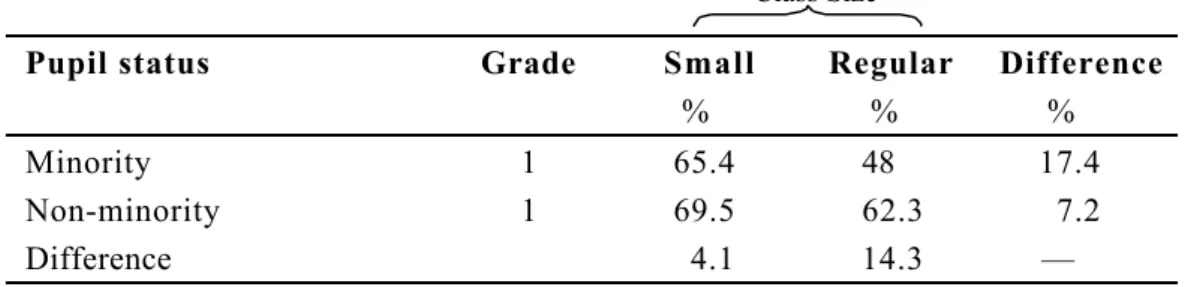
Although researchers from the STAR project report raised achievement for all pupils taught in small classes, an examination of evidence shows that some groups benefited more than others. As we can see from Table 3.3 below, the percentage increase for children from ethnic minority backgrounds in small classes was far greater than for non-minority children – an advantage of 17% compared to 7%.
Table 3.3: Average per cent of pupils passing Basic Skills First Test (BSF) reading: Grade 1, STAR
Pupil status Grade Small Regular Difference
% % %
Minority 1 65.4 48 17.4
Non-minority 1 69.5 62.3 7.2
Difference 4.1 14.3 —
(Source: Nye et al, 1992, p20)
There is little experimental evidence from British studies to show which groups of children benefit most from class reduction. Earlier examination of Inner London Education Authority data by Mortimer (1988) discovered a somewhat confusing picture: pupil attainment seemed to increase as class size increased up to around 25 pupils; decreased between 25 and 30 and then increased again in the 30 to 40 range, but pupil progress in maths was greater in junior schools of
below average class size. The results were statistically significant for younger year groups. Similar results were reported by OFSTED (OFSTED, 1995). The decline in Key Stage 1 results was so persistent in classes of up to 30 that it recommended class reduction in the early years. Massey (1997) found in an analysis of results for 9000 candidates who were entered for GCSE Mathematics with the Midland Examining Group in 1994 a positive correlation between achievement and class size. However in the highest tier, results continued to rise for both independent and state pupils as class sizes rose to 28 and 35 respectively. This is probably a reflection of teachers’ views that able pupils can learn without much individual attention, and their consequent assignment to larger classes.
3.4 Do the findings apply to a British context?
As we have seen above, compared with the scale and volume of research generated from the USA, very little work has been undertaken by British researchers (Day et al, 1996). To what extent then are the findings from the USA applicable to schools and pupils in Britain? This is the question which researchers at the London University Institute of Education explored first by reanalysing STAR data (Blatchford & Mortimer, 1994; Goldstein & Blatchford, 1997); and second, by undertaking the largest class size project in Britain to date. We shall consider each in turn.
Goldstein and Blatchford (1997) agree that STAR’s researchers have demonstrated differences between the achievement levels of pupils in small and larger classes. Their reanalysis confirms that:
• those pupils in small kindergarten and Grade 1 classes have higher scores in mathematics and reading than those children who were taught in ‘regular’ or ‘regular plus a full-time teaching aide’ classes; and
• although both black and white children in small classes score higher than those in larger classes, the biggest effect is for black children in small classes.
Despite accepting these general findings from the STAR project, Goldstein and Blatchford raise a note of caution. They believe that even randomised control trials, such as STAR which are generally viewed as the ‘gold standard’ of class size research, do not necessarily guarantee valid or generalisable findings. A ‘compositional effect’ in which more low or high ability children may have been assigned to some classes will influence outcomes. In addition, children, their parents and teachers will all know that the group compositions and ‘anticipated expectations’ of each may affect their progress. They also point out the narrowness of the outcome measures used by STAR and affirm their belief that education should be judged by more than children’s performance on a series of cognitive tests. But by far the most serious criticism is reserved for the assumption embedded in STAR that children and classes can function, and their progress be assessed, independently of the complex education systems of which
Class Size and Pupil Attainment
project, Goldstein and Blatchford (1997) argue that the predictive value of the findings for British schools is limited. A valid British-based experiment would require:
• good initial pupil achievement data, (such as a baseline assessment test)
• ways of measuring processes within the classroom, including teachers’ expectations
• multi-level modelling to show the effects of different variables on pupils’ achievements
• more detailed qualitative and case study research to attempt to generate specific theories about how changes in class size actually produce changes in children’s cognitive and affective attributes; and
• a cost-benefit analysis of various ways of distributing resources, for example by reducing class size, increasing the size of school buildings or purchasing more text books. They cite one study (Jamison, 1987) who found that greater gains accrued from introducing text books in a poorly resourced country than from reducing class sizes and suggests more studies are required.
Some of these conditions have been met in the London University Institute of Education’s own longitudinal class size study (Blatchford et al, in press), in which they adopted an observational rather than an interventionist approach, thus avoiding some of the problems inherent in an experiment/control design. The study was sufficiently large to match some of the state-funded American projects. Approximately 9330 children in 368 classes within 220 primary schools were involved. Eight different local education authorities in England agreed to participate. The first cohort of children joined the study in 1996 upon their entry to reception class at age 4. A second cohort and an additional five LEAs were recruited in 1997. On joining the project children were assessed using the Avon Reception Entry Assessment which covers literacy and mathematics, and assessed again at the end of the first year using the Reading Progress Test. Teachers from participating classes were offered training and they provided information each term on the registered and ‘experienced’ class sizes which the sample children experienced. Further information, such as their entitlement to free schools meals, which could affect their performance, was collected for all pupils and all the information was analysed using a multi-level model.
The findings accord with American evidence but further insight is added. Again the message is clear: an association was found between class size and pupils’ attainment on standardised tests. Test scores for literacy decreased as class size increased but with little apparent change in classes of between 18 and 25 pupils. Significantly the relationship was not linear which implies that the effect of the reduction in class size depends on the actual class size itself. The interaction between class size and disadvantage is also reported. In mathematics, there appears to be a small amount of change for class sizes from about 20 to 25, and
again low achievers show the largest effects from being taught in small classes with increasing reductions in their expected achievement up to a class size of 30. For middle and high baseline pupils, there is little change in attainment above a class size of 22. Across the study, boys made less progress than girls. Significantly the researchers report that the skills and knowledge which children have on entry to school are important determinants of their subsequent progress.
The message is very clear: class size does affect children’s academic attainment during their first year in school. Those most affected are the ones who enter school with the lowest skills and knowledge. However, for those low achieving children, class size must be reduced to below 20 if they are to benefit from the reduction.
3.5 Is there any Scottish evidence?
Only one reference to class size in Scottish schools was identified in the search of published literature (see Appendix A1). Referring to her research with disadvantaged pre-school children, Watt (1996) argues that if children from disadvantaged backgrounds are to succeed in school their teachers need to know them, and that requires knowledge which comes in a large part from the educational process of interaction between teacher and child in the classroom. As she puts it:
It needs professional knowledge and commitment. It also needs time…What seems to be needed is one teacher and a relatively small number of children. Class size is not, of course, an end-in-itself: it is what happens within the class that matters and what is made possible by smaller numbers. (p145)
She believes that this should come as no surprise because all young children are dependent upon adults and the disadvantaged more than most.
A second source of Scottish evidence arises from the AAP surveys referred to in Chapter 2.3 above. Thorpe (1997) reports that the highest performing pupils in the 1995 English and 1996 Science surveys were to be found in very small composite classes of under 20 pupils. Unfortunately this particular result is unreliable because it confounds information about small classes with small composite classes and small schools. All 97 pupils in the smallest composite Primary 4 classes taking part in the survey were from 24 schools which lay outside the survey’s confidence level, thus making it unsafe to generalise. Major changes would be required to the AAP if it were to be used for assessing the relationship between class size and attainment in Scottish schools.
There are other potential sources of information about class size in Scottish schools but these have not been analysed here. The School Census provides accurate pupil-teacher ratios but these give a misleading picture of the teaching units which children experience within schools.
Class Size and Pupil Attainment
records, the choice of outcome measures (ie HMI performance indicators, results from national tests or 5–14 assessment levels) and whether information gathered from different sources will provide a reliable picture.
Additional data on class size is probably embedded within a number of research projects which have been commissioned by the Scottish Executive’s Educational Research Unit. These include evaluations of early intervention (Fraser et al, 2001); core skills at Higher Still (Thorpe et al, on-going); classroom assistants (Wilson et al, 2000); pupils and teachers’ days in the primary classroom (McPake et al 1999a); and setting and streaming (McPake et al, 1999b). Further analysis might be worthwhile.
3.6 Summary
Despite the controversy which for the past twenty years has surrounded the class size debate, a number of areas of general agreement emerge. We can conclude that:
• the literature presents a confusing and sometimes contradictory picture of whether and how the reduction of class size impacts on pupil achievement
• most of the studies of class size have been conducted in the USA, with few reports of specifically British or Scottish research projects
• the evidence from North American studies, in particular the large state-funded experiments, have demonstrated an association between class size and pupil achievement, ie as class sizes reduce pupil attainment rises
• there is some disagreement about how much classes must be reduced in size to achieve significant improvements in pupil performance: some argue that benefits are most marked in classes of fewer than 15 pupils (Achilles et al, 1993); while others (Glass & Smith, 1978) suggest that the major benefits from reduced class size are obtained as size is reduced below 20 pupils
• most researchers agree that effects are most marked with younger children, Kindergarten to Grade 3, and that subsequent experience of small classes in their later schooling will not compensate for lack of exposure to small classes in the formative years
• in American projects the benefits of class size reduction were most marked with young black children
• benefits in most studies were measured by a narrow range of outcome measures, ie progress in reading and mathematics. A more comprehensive assessment of pupils’ progress using both cognitive and affective indices would be desirable
• evidence from a large-scale English study broadly confirms American results and reports a decreasing score in literacy with increasing class size, little apparent change in performance between class sizes of about 18 and 25 and low achievers benefiting the most
• some evidence from secondary schools shows that pupil attainment is higher in larger classes, but this is probably due to assigning more able pupils to larger ‘sets’.
The above represents an impressive amount of evidence of an association between class size and pupil achievement. However, a statistical association does not constitute an explanation and we are still left with the unresolved issue: why and how does pupils’ attainment rise as class sizes fall? For an answer to these questions we turn in the next section to the teaching practices which occur within classrooms.
4: Class Size and Teaching Practices
4.1 Introduction
We have seen so far that research has accumulated a wealth of data on the implications of having small size classes. However, different approaches have provided contradictory conclusions to questions, which seem to teachers and parents to have obvious answers. Clearly, policy-makers operating in a value–for–money context have to be convinced that the benefits of class size reduction would be sufficient to justify huge extra expense. Some recent studies have pointed out that relating class size to outcomes in terms of pupil achievement, which we reported in Chapter 3, omits mediating factors which can impact on teaching and learning processes. In this section the focus will turn to what happens in classrooms, in particular which opportunities for teaching are available when class size is reduced and how teachers respond to those opportunities. The answers to these questions may be helpful in two ways:
• Firstly, it may help to settle whether class size is an important factor in raising the quality of education and improving pupil performance, and more importantly how and why this may be so; and
• Secondly, it may explain why previous studies have not always found a link between class size differences and outcomes, if teachers involved in previous investigations did not alter their teaching styles and classroom organisation.
This section reviews data which already exists on comparative classroom practices within the context of the class size debate. Often this occupies a section within large research reports, but in a minor role. Attention here will be given to teacher approaches in general, followed by comment on features of classroom interaction which research suggests are important factors in effective teaching – individual attention given to pupils, the provision of feedback, within-class grouping of pupils, classroom organisation and the utilisation of classroom assistants. Finally, mention will be made of the need for teacher in-service education associated with teaching in small classes, a theme which researchers have pointed to frequently in recent years.
4.2 Characteristics of effective teaching
As part of the influential STAR initiative in Tennessee, Pate-Bain et al (1992) identified a number of classroom activities which characterised effectiveness in small class teaching. These included:
• basic instruction completed more quickly allowing time for additional material to be taught
• more in-depth teaching
• more opportunities used to engage in first-hand learning
• increased use of learning centres
Further, using the class unit as a measure rather than individual students, they identified those teachers whose classes achieved the top 15 per cent average gains in reading and mathematics during the project. A number of similar characteristics, strongly associated with effective teaching, were observed in those teachers. These were:
• affective behaviour, including enthusiasm for teaching
• positive attitudes towards children
• recognising pupil success with praise
• using humour in promoting learning and motivating pupils
• engaging children through a variety of creative activities
• using assertive discipline
• having high expectations
• maintaining good communication with parents.
How these characteristics and approaches to classroom teaching have been investigated will be looked at next.
4.3 The impact of class size on classroom procedures
Teachers have a number of choices to make when planning for teaching and learning in their classrooms. It is generally accepted that they should:
• match the individual learner’s needs to the pupil’s age, abilities and rate of progress
• plan the use of material resources, especially how time will be allocated to teacher exposition, question and answer sessions, individualised learning and group work.
• remain sufficiently flexible to take account of opportunities for teaching as they arise.
However, a number of research reports have indicated that many teachers engaged in teaching small classes do not meet this ideal because they have not changed their methods from those they use in larger classes (Sharpson et al, 1980; Galton & Simon, 1980). This may in part explain why some research has found little association between class size reduction and pupils’ progress. For example, a state-wide statistical survey in Florida suggested that teacher practices may potentially be more important than class size reduction per se.
Research supports alternative measures to reduction in class size that do improve student achievement. These measures are related more to improving teaching practices than to the number of students in a classroom. (Florida Department of Education, 1998, p11) Other reports which specifically took classroom observations into account, noted a relationship between the nature of teaching practices and the quality of
Class Size and Teaching Styles
teaching practices were very similar in reduced and non-reduced size classes, except that more time was spent on working one-to-one, for example with ‘problem readers’. Similarly, the SAGE project in Wisconsin (Molnar et al, 1999) which looked at classrooms in some detail found that:
Reduced class size permits some movement towards more student-centred teaching but the main effect appears to be a focus on students as individuals. Many, if not most, of the techniques and methods that teachers use may be the techniques and methods that they have used in normal-sized classrooms. The difference is that now techniques and methods are directed at individuals and frequently…This attention to individuals is implemented in one-to-one situations, in small groups formed on the basis of need, and in total class situations through response and critique and it is a continual, pervasive feature of classroom life. (p176)
The thrust of this view is that teaching in small classes allows teachers to do more effectively what they know is the right thing to do (Achilles et al, 1999). However, the SAGE project hints that despite the greater opportunities for individualized learning, it remains largely ‘teacher-centred, teacher controlled’ and that ‘student choice, independence and interest are of less concern than individual content coverage’ (p173). This seems to imply that a different and radical approach to teaching in small classes may be possible but that teachers either cannot make the change or think that minor readjustments (or none) are needed in classrooms with fewer children.
In England, Hargreaves et al (1998) observed that there was little variation in the teaching style of teachers when they worked with large or small classes. Seven pairs of teachers were matched and, as ‘buddies’, taught each others’ classes. This provides some illumination on teacher behaviour despite the short amount of time which teachers were allowed to have with their ‘new’ classes, thus making knowledge and familiarity between teacher and pupils so slight as to hamper the opportunity for ‘effective’ teaching. However, similar work in a longitudinal study may be worth promoting.
A number of studies have already pointed to styles of teaching or listed characteristics of effective teaching which have emerged as a result of their observations. The ORACLE study in England (Galton et al, 1980) identified six different styles of teaching, two of which they considered to be especially effective when matched to pupil progress. Both involved high levels of attention given to individual pupils and the most successful involved posing challenging questions and giving direct feedback. Later work in PRISMS (Galton & Patrick, 1990) which looked at classes in a total of 62 small schools, found similar interactions between teacher and pupils in both small and large classes but differences were noted in pupil behaviour. Pupils in large infant classes engaged in more ‘off-task’ talk whilst in small (junior) classes pupils spent more time working alone. Limited findings here suggest that in smaller classes there is:
• more sustained interaction between teachers and pupils
• more feedback on work
• less time spent on routine supervision
• less time spent exercising classroom control
• less time given to ‘housekeeping’
• less time spent on managing the classroom and more on direct teaching which allowed teachers to ‘engage in more enquiring questioning, ask more task-related questions, make more statements’ and to be ‘more involved with the task when interacting with pupils’. (Hargreaves et al, 1998, p789). A project in Alberta (Edmonton Public Schools, 2001) has provided a detailed description of those teacher practices in small classes which were considered to be effective. These teachers:
• individualised learning for pupils
• developed productive learning environments
• achieved a richer, more creative and complete curriculum
• used active learning
• integrated reading, writing and speaking
• supported students’ personal skill development
• employed a repertoire of literacy processes
• grew, themselves, through teacher support.
What emerges here is a picture of quality teaching practices. In earlier research, Glass and Smith (1982) suggested that effective small class teaching was associated with the better use of teaching materials, good planning and a variety of activities used with imagination. Cooper (1989) added improved quality of assessment to the list so that teachers were able to monitor pupils’ progress and needs more immediately and accurately.
Findings from a variety of sources all point out that the major importance of small classes is that they allow teachers to give more attention to the individual pupil. Pate-Bain (1992) and Bennett (1994, 1996) placed individual attention high on their list of opportunities from teaching in small classes, as also did a survey of headteacher and teacher opinions outlined in a report by NAHT (Day et al, 2001). The SAGE research asserted: ‘Individualisation, the practice that seems to be the main effect of having reduced-size class, needs to be examined in greater depth’ (p176).
However, what is meant by ‘individualisation of learning’ varies considerably across the reports. The SAGE study pointed to teachers helping individual students rather than students following their own objectives. It suggested that the type of teaching observed in small-sized classes was still ‘teacher-centred, teacher-controlled teaching’ and that ‘student choice, independence and interest are of less concern than individual contact coverage’ (p173). In interviews in the
Class Size and Teaching Styles
same project, however, teachers pointed to their greater knowledge of individual pupils, especially their personalities and task progress.
The Alberta project saw individualised learning as a complex combination of monitoring assessment, giving attention and feedback together with direct provision of encouragement, support correction, challenge and practice. Individualised attention was seen to be of particular value for some groups. Slavin (1989) argued that providing low attainers with one-to-one tutoring for a portion of their day is probably the most effective educational strategy for them. The SAGE project indicated how individual attention helped shy and struggling students, and in Scotland, Watt (1996) noted that individual attention was of especial value for young disadvantaged pupils ‘in order to [help them] come to terms with what school is all about’ (p145). All point out how small classes facilitate such individual attention, but more research would identify ways in which teachers could use the opportunities provided by small-sized classes more effectively.
A second key feature of individualisation mentioned in research is immediate feedback on work done (Edmonton Public Schools, 2001). Galton et al (1980) point out that the effectiveness of the ‘challenging question’ style often relies upon immediate feedback to an individual pupil. The report by NFER (Jamison et al, 1998) looked at feedback practices in assessment and listening to reading at Key Stage 1 as effective ways of progressing learning but these were so time-consuming that teachers resorted to breaks and lunchtimes to continue teaching. Even so, small classes were seen to allow more time to give praise and recognition to individuals. More detailed knowledge of individual learners allowed teachers to pick up on language skills in, for instance, a science lesson, and monitoring targets for individual pupils was easier to manage.
Within-class groupings is a third factor which features in class size research. It is a complex and contentious area and one which a previous SCRE review addressed (Harlen & Malcolm, 1997). Blatchford et al (2001) defined grouping conceptually in terms of proximity of member seating and working on the same task. Clearly class size and within-class groupings are connected and have implications for learning experiences. Blatchford et al (2001) undertook a major study involving 3157 groupings in 331 schools, looking at size and number of groups, adult presence and interaction. Their findings show how the number of groups increased with the size of the class: over all three year-groups studied, small classes (under 20 pupils) had an average of just 3 groups; larger classes approached 6. Also, the size of the grouping decreased with the size of the class: in classes of over 25, pupils were more likely to be in a large group of 7 to 10. More whole-class teaching took place when classes were small. Teachers believed that groups of 7 to 10 pupils had a negative educational effect in terms of quality of teaching, pupil concentration, and their contribution to group work. However, it was found that at all ages studied, pairs and tryads of pupils were least likely to have an adult present. The number of adults in classes increased with the number of groups. This study’s conclusions suggest that the