Report
Bologna Process Stocktaking
Report from a working group appointed by the Bologna Follow-up Group
to the Conference of European Ministers Responsible for Higher Education,
This project has been funded with support from the European Commission within the framework of the Socrates Programme.
Table of contents
Executive Summary ...5 Acknowledgements ...8 Chapter 1
The Bologna Process and Stocktaking ...9 Chapter 2
Criteria and Benchmarks for Stocktaking ...15 Chapter 3
Analysis of Results ...25 Chapter 4
Conclusions and Recommendations ...42
Appendix 1
Terms of Reference for the Stocktaking...53 Appendix 2
Consolidated List of Questions ...57 Annex
Executive Summary
Context of the stocktaking report
At the Berlin Ministerial Meeting in September 2003, Ministers with responsibility for higher education requested the Bologna Follow-up Group to undertake a stocktaking exercise on the progress made in three priority action lines – quality assurance, the two-cycle degree system and recognition of degrees and periods of study. They also requested the group to identify corrective action where appropriate.
In March 2004, the Bologna Follow-up Group established a working group to carry out the stocktaking exercise. The working group has prepared this report for the May 2005 Ministerial Meeting in Bergen.
Findings of the stocktaking exercise: good news for the Bologna Process
This report concludes that there is good news for the countries involved in the Bologna Process: the collective and voluntary inter-governmental process is a success.
Common goals are being pursued and targets are being met by the great majority of countries. There is also good news for higher education institutions, who are working hard to implement the Bologna actions, and who can now see their achievements made visible. Finally, there is good news for students, because the Bologna Process is creating a better and more open world of learning, with enhanced mobility, transparency, transfer and recognition of qualifications.
Recommendations of the Working Group on Stocktaking
The Working Group on Stocktaking believes that additional mechanisms should be put in place to strengthen further the progress on the three action lines included in the stocktaking exercise, and makes the following five recommendations:
1. Initiate a process of formal engagement with employer organisations at national and European level
2. Establish a working group to identify the key issues associated with equitable access, and to develop possible benchmarks to measure action in this area
3. Each participating country should prepare an action plan to improve the quality of the process associated with recognition of foreign qualifications
4. Develop support mechanisms to assist participating countries in implementing the Bologna Process
5. Continue the stocktaking exercise, in collaboration with the Bologna Follow-up Group and with participating countries. Methodology used in the stocktaking
This report presents the Bologna Scorecard, which the working group developed as a way of giving a “big picture” overview of progress on the three priority action lines. The scorecard is based on objective criteria and benchmarks, and it is a good way to show collective achievement of the targets set by the Ministers in Berlin. It also provides a useful set of baseline data against which progress can continue to be measured in the future. The scorecard for each country is intended as a progress chart, not as an absolute measurement. It is not designed to make comparisons between countries.
The Working Group on Stocktaking is confident that this report will assist Ministers in their deliberations in Bergen and will contribute to the further development of a collaborative model of stocktaking for the future.
Content of this report
Chapter 1 sets the context of the stocktaking exercise, and describes how the relevant stakeholders were involved in the process.
Chapter 2 explains the ten criteria and the colour-coded benchmarks that were used to determine the level of progress made by participating countries on the three priority action lines.
Chapter 3 analyses the results for each of the criteria and indicates the areas where progress has been especially strong or weak.
Chapter 4 reviews the outcomes of the stocktaking exercise, and identifies a series of recommendations that will further strengthen the
implementation of the Bologna Process.
The terms of reference of the working group and a list of the data sources are included in Appendix A and Appendix B. The Annex to the report includes the scorecards for each of the participating countries.
Acknowledgements
This work was made possible as a result of financial support from the European Commission through the Socrates Programme. Thankfully, their support was not only financial, but was evident in their willingness to facilitate analysis of data from the ‘non-Socrates’ countries by
EURYDICE. In addition, the Council of Europe generously supported the participation of representatives from Croatia and the Russian Federation in the working group meetings. The working group would like to pay particular tribute to Patricia Wastiau-Schlüter, Head of Unit, EURYDICE European Unit who not only endured ‘constant adjustments’ to their questionnaire at our behest , but who provided invaluable assistance in the preparation of this exercise. Similarly, the working group was fortunate to have an expert of the calibre of Cynthia Deane, whose experience and excellence guided the emergence of the objective criteria. As chair of the Working Group on Stocktaking, I would like to pay tribute to my colleagues on the group whose contributions, energy and good humour made this innovative and challenging task feasible. I would also like to acknowledge the work of Sverre Rustad of the Secretariat in the Norwegian Ministry of Education and Research.
Finally, I would like to thank the Bologna Follow-up Group
representatives from each of the participating countries who provided the material in the National Reports, which in turn forms the basis of the stocktaking report.
I am confident that the working group has produced a report which provides an objective statement of the level of progress made on the three priority action lines between Berlin and Bergen, and identifies some key issues to address as we move forward to 2010. I also believe that, while this first exercise has been a learning experience for all of us, the report provides a clear methodology for the next phase of stocktaking.
Ian McKenna
Chair, BFUG Working Group on Stocktaking April 2005
Chapter 1
The Bologna Process and Stocktaking
Background to the stocktaking exercise
At the Berlin meeting in September 2003, Ministers with responsibility for higher education agreed that a stocktaking exercise should be conducted, to measure the progress made in implementing certain reforms within the European Higher Education Area. Specifically, the Berlin Communiqué stated:
With a view to the goals set for 2010, it is expected that measures will be introduced to take stock of progress achieved in the Bologna Process. A mid-term stocktaking exercise would provide reliable information on how the Process is actually advancing and would offer the possibility to take corrective measures, if appropriate. Ministers charge the Follow-up Group with organising a stocktaking process in time for their summit in 2005 and undertaking to prepare detailed reports on the progress and implementation of the
intermediate priorities set for the next two years:
• quality assurance
• two-cycle system
• recognition of degrees and periods of studies.
Participating countries will, furthermore, be prepared to allow access to the necessary information for research on higher education
relating to the objectives of the Bologna Process. Access to data banks on ongoing research and research results shall be facilitated.
The Working Group on Stocktaking
At its meeting in Dublin on 9 March 2004, the Bologna Follow-up Group established a Working Group on Stocktaking to undertake this task. The members of the working group were:
Ian McKenna (Ireland), Chair Jan Levy (Norway)
Aleksa Bjeliš (Croatia)
Peter van der Hijden (EU Commission) Germain Dondelinger (Luxembourg) Marlies Leegwater (Netherlands) Victor Chistokhvalov (Russia).
The working group meetings were also attended by Mirjana Polić Bobić, Deputy Minister for Higher Education, Croatia; Sverre Rustad, Norwegian Secretariat, and Patricia Wastiau-Schlüter, Head of Unit, EURYDICE European Unit.
The terms of reference for the working group are included in Appendix A. The working group met five times:
21April 2004 – Amsterdam 15 June 2004 – Dublin 26 January 2005 – Brussels
17–18 February 2005 – Dubrovnik 30-31 March 2005 – Glasgow.
In late 2004, the Norwegian Ministry of Education and Research engaged an expert, Cynthia Deane, to assist the working group in undertaking the analysis which forms the basis of this report.
Methodology adopted by the working group for the stocktaking exercise
The Working Group on Stocktaking wanted to ensure that its work would draw on a number of existing data sources, so that the completion of a questionnaire would not represent too great a burden in each country. The group spent its first two meetings determining the indicators to be used in the stocktaking process. When these were established, the working group consulted with partners including the European
University Association (EUA), the National Unions of Students in Europe (ESIB) and EURYDICE to ensure that
• questions these bodies intended to raise in their surveys would not be repeated in the stocktaking;
• thepartners were willing to raise the stocktaking questions with their constituents as part of their own surveys;
• where similar questions were asked, the results would be shared to build a complete picture of progress on the priority action lines. Arising from these discussions, the working group identified the various sources of data for the stocktaking, as outlined in Appendix B.
National Reports
Along with the material prepared by EURYDICE, the National Reports represented the main source of information for the stocktaking exercise. To ensure clarity of response, a standard report template was developed, which was posted on the Bologna Process website ( http://www.bologna-
bergen2005.no/Docs/01BFUG/040614-B/BFUGB3_6_NReports-Template.doc). The National Reports allowed members to provide discursive or qualitative commentary on their progress on the priority action lines to complement the information in the EURYDICE report. All forty participating countries in the Bologna Process completed their National Reports in accordance with the standard format. It is important to emphasise, however, that the working group relied upon each
participating country to respond accurately to the questions in the structured report format. The group had neither the remit nor the resources to validate the content of National Reports.
EURYDICE Questionnaire
As part of the preparations for the Berlin Ministerial Meeting in 2003, EURYDICE prepared a report, Focus on the Structure of Higher Education in Europe. The detailed and quantitative analysis in this report was
acknowledged as being particularly helpful in giving a sense of the scale of reform taking place in the European Higher Education Area. Building on the success of the 2003 report, EURYDICE had planned a similar report for the 2005 Bergen meeting.
The working group requested EURYDICE to extend its review beyond the 31 countries normally covered by its network, to provide a uniform
analysis of the European Higher Education Area. With the acknowledged support of the EU Commission, EURYDICE generously agreed to
undertake the analysis of data for the remaining nine participating countries, by issuing similar questionnaires to the respective Bologna Follow-up Group representatives in these countries. 1 The working group,
through the Secretariat, supported the representatives in their efforts to complete the material. EURYDICE has indicated that a degree of caution must be exercised with regard to the outcome of the analysis for these participating countries, given that they were not familiar with EURYDICE verification and other procedures.
All forty participating countries of the Bologna Process completed EURYDICE questionnaires in the required format.
Other data sources
The Working Group on Stocktaking drew upon the expertise and
information provided by a number of other partners as appropriate. As noted in Appendix B, ESIB agreed to pursue a number of issues with its members on behalf of the working group. However, since the ESIB survey covered only 32 countries, the scope to use its results was limited.
Notwithstanding this, the results of the ESIB survey were incorporated into the initial scores issued to the relevant countries as part of the review stage.
1Albania, Andorra,Bosnia and Herzegovina, Croatia, the Holy See, Russia, Serbia and Montenegro,
The Council of Europe provided the information on the Lisbon
Recognition Convention. In addition the EUA, which did not directly contribute to the stocktaking exercise, raised many issues in its Trends IV report (prepared by the EUA for its convention in Glasgow, March 2005) which complement the findings in Chapter 3 of this report. This also applies to the general conclusions of the survey conducted by ESIB. It is important to note that with the diverse range of material presented to the Ministers at the Bergen meeting, it is quite possible that there will be differences in outcomes or emphasis. This is to be expected given the variety of data sources and the differing perspectives represented within each report. However, the working group wishes to emphasise that such minor differences should not detract from the essential messages of this report or of any other report to the Ministerial Meeting.
Procedures used in the analysis of data
It was clear to the working group that the Ministers required an objective measurement of progress in the Bologna Process, and this represented a very real challenge for the stocktaking process. The group formed the opinion that an analysis based only on the National Reports might create an unduly optimistic picture. On the other hand, there are very few examples of the application of rigorous scoring methodologies in the area of higher education policy reform. In seeking a solution, the working group had three overriding aims:
(a) The report must provide an objective basis for Ministers to judge the level of progress within the EHEA;
(b) Members of the Bologna Follow-up Group must have the
confidence that the procedures adopted are fair and representative; (c) The conclusions should be independently determined.
The working group agreed that these objectives could best be achieved by developing a scorecard as the main stocktaking instrument. This is an effective methodology for establishing a broad comparative picture according to objective criteria. The approach is based on similar models, for example the Lisbon Scorecard developed by the Centre for European Reform and the balanced scorecard approach, which combines qualitative
(National Reports) and quantitative (EURYDICE statistical material) measures and can be applied in a range of organisational contexts. At the beginning of 2005 the working group, together with the
independent expert, developed a set of criteria and benchmarks for a scorecard, which would measure progress on each of the three priority action lines. At the meeting in Dubrovnik in February 2005, this work was completed. The methodology and procedure for the stocktaking process was agreed by the Bologna Follow-up Group at its March 2005 meeting in Mondorf, Luxembourg. The scorecard criteria and benchmarks are
described in Chapter 2 of this report.
Based on an interpretation of the data from the sources mentioned above, initial scores on each criterion were assigned to each country. In March 2005, the initial scorecards were issued to country representatives, who reviewed the material to ensure that the interpretation accurately reflected the national picture. Where a country sought to adjust its initial score, it was required to provide appropriate supporting material, and the expert, in consultation with the working group where necessary, assigned final scores on the basis of this material.
Chapter 2
Criteria and Benchmarks for Stocktaking
Developing the Bologna Scorecard
The focus of the stocktaking exercise was to take account of the progress on the three priority action lines at the beginning of 2005. The data gathered also provide a useful benchmark against which future trends and progress in the Bologna Process can be measured. As mentioned in the previous chapter, during the early part of 2004 the Working Group on Stocktaking drew up a list of questions for the stocktaking process, linked to the main action lines identified in the Berlin Communiqué. For each of the questions, data sources were identified, and the process of gathering data began in autumn 2004. (Appendix B includes the consolidated list of questions and the data sources.)
Elaboration of scorecard criteria
The working group reviewed each of the three actions lines, and
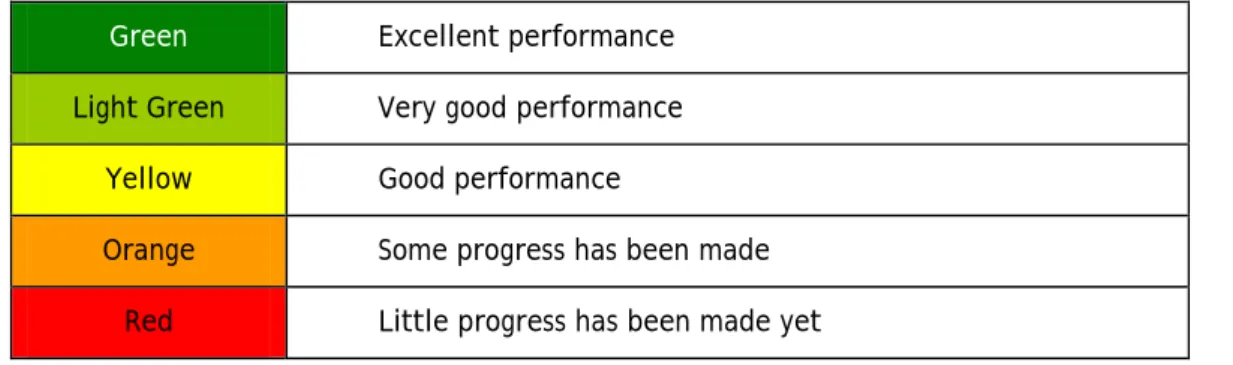
elaborated key criteria for each one. Each criterion was further expanded on the basis of five benchmarks, which would serve to measure the extent of progress. These were subsequently colour-coded, as shown in Table 2.1 below.
Table 2.1: Explanation of Colour Codes used in Bologna Scorecard
Green Excellent performance
Light Green Very good performance
Yellow Good performance
Orange Some progress has been made
Criteria for Quality Assurance
At their meeting in Berlin, Ministers acknowledged that the quality of higher education is a central factor in the establishment of the EHEA. In particular, they stressed the need to develop mutually-shared criteria and methodologies for quality assurance.
The Berlin Communiqué continued:
They also stress that consistent with the principle of institutional autonomy, the primary responsibility for quality assurance in higher education lies with each institution itself and this provides the basis for real accountability of the academic system within the national quality framework.
Therefore, they agree that by 2005 national quality assurance systems should include:
• A definition of the responsibilities of the bodies and institutions involved
• Evaluation of programmes or institutions, including internal assessment, external review, participation of students and the publication of results
• A system of accreditation, certification or comparable procedures • International participation, co-operation and networking.
Based on this statement, the working group established the following criteria for this action line:
1. Stage of development of quality assurance system 2. Key elements of evaluation systems
3. Level of participation of students
4. Level of international participation, co-operation and networking
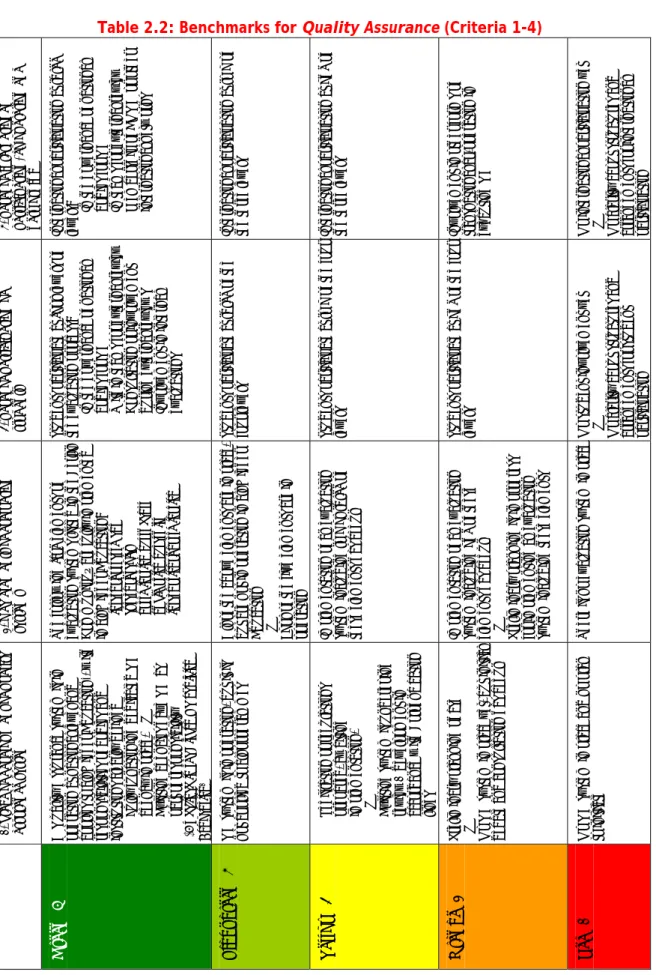
Table 2.2: Benchmarks for Quality Assurance (Criteria 1-4)
4. Level o
f in ter n ationa l pa rt ic ip at io n , c o-o p er at io n a n d n et w or king In te rnation al p artic ipation at thre e levels: In the gove rnanc
e of natio
na
l
bodies for QA
In tea m s for exte rn al r evie w Me mbe rs hi p o f E N Q A o r o the r international networks In te rnation al p artic ipation at two of th e th re e le ve ls In te rnation al p artic ipation at one of th e th re e le ve ls In volveme
nt in o
the
r fo
rms of
tr
ans
national co-operation i
n execu ting QA No in ternational par tic ipation yet OR No c larit y a bou t s tr u ct ur es an d ar range m ents fo r int er na tional pa rt ic ipation
3. Level o
f partic ipatio n o f stude nt s Stud en ts pa rt ic ip ate at fo u r le vels of the evaluatio n p rocess : In th e go ve rn an ce o f na ti on al bodies for QA W it hi n tea m s f or exte rnal review C onsultation or involveme nt du ri ng e xt ernal r eviews Involveme
nt in i
nte rnal ev al ua ti on s Stud en ts pa rt ic ip ate at th ree of the four leve ls Stud en ts pa rt ic ip ate at tw o of the four levels Stud en ts pa rt ic ip ate at on e o f t he f our levels No s tu d en t i nv ol vem ent y et OR No c larity about str u ct u res and ar ra ng em en ts fo r st u d en t par ticip at ion 2. Key elements of evaluati on sys tems The following fi ve el em en ts o f ev alu at ion s ystems lis ted in the Be rlin C omm u niqué ar e ful ly i m pleme nted
in all Higher Ed
ucation : int erna l asse ss me nt ex te rn al r ev ie w participat
ion of st
ude nt s pu blic ation o f resu lts int ernation al p art ic ipation
All of the above
elements a
re
in p
lace,
but are
not in ope
ration i
n all Higher
Educa
tion
OR Fou
r
of the f
ive e lements are in operation Impleme ntation
of an e
valu at io n system inc luding tw o o r t h re e of thes e elemen ts h as begun Impleme ntation
of an e
valu at io n system inc luding on e of th es e el em en ts h as be gu n OR Prelimina ry
planning is i
n p rogre ss for i m pleme nti
ng an evaluation
sy st em in cl ud in g t hes e el em en ts T her e i s no ev al u at io n sy st em in pl ac e
1. Stage o
f d evelopmen t o f qual ity as su ra nc e s yst em
A Quality Ass
u
ra
nce sys
tem is in
oper
ation at nati
onal level a
nd
app
lie
s to all Hig
her Educa tion *, with re sponsibilities o f bodies and institutions clearl y d ef ined Fully func ti onin g dedicate d QA agency in p la ce, OR Existing agencies have QA as part of res pons ibility (*As defi ne d i n t he Lisbon R ec og nit io n Co nv en ti on 2) QA sys
tem is in
operation, b ut i t i s not ap plied to all prog ra mmes Legisla tion or re gu lations pr ep ar ed , a wait ing implemen ta ti on , OR Existing sys tem i s unde rg oing review / develop m en t in acc ord ance with B ologna a ction lines Pr elimi nar y p lanning phase OR
No QA s
ys
tem in pl
ac e ye t, but i ni tial d eb ate and co ns ul tatio
n has be
gun N o Q A s ys tem i n pla ce a nd no pl an to in itiate t green (4) ow ( 3) ge (2 ) is bo n R ec ognit io n C on ve nt io n de fines hig her ed ucatio n as : all ty pe s of cour ses o f st ud y, or se ts o f cour se
s of s
tudy , tr ai ning o r training for r ese ar ch a t t he p ost -sec on dar y lev el w hic h a re sed b y t he re le va nt a ut hor ities o f a Pa rt y as belon gin g to its hi gh er e ducatio n s yst em .
Criteria for the Two-cycle Degree System
In 2003, Ministers noted the progress made on this action line as evidence of the wide scale and comprehensive restructuring of the European higher education landscape. The Berlin Communiqué stated that:
All Ministers commit themselves to having started the implementation of the two cycle system by 2005.
Ministers also noted that the objective of this reform programme was to offer improved access for students to the second and third cycles. Specifically, Ministers stated that:
First and second cycle degrees should have different orientations and various profiles in order to accommodate a diversity of individual, academic and labour market needs. First cycle degrees should give access, in the sense of the Lisbon Recognition Convention, to second cycle programmes. Second cycle degrees should give access to doctoral studies.
Against this background, the working group developed the following criteria for this action line:
5. Stage of implementation of two-cycle system 6. Level of participation in two-cycle system 7. Access from the first cycle to the second cycle.
As already described above, the data for these criteria were sourced in the National Reports, and in the EURYDICE data. In addition, the ESIB survey provided some material on the third criterion, which was later validated by the countries as part of their review of the initial scorecards. The benchmarks for each of these criteria are shown in Table 2.3 below.
Table 2.3: Benchmarks for Two-cycle Degree System (Criteria 5-7)
5. Stage of implementation of two-cycle system
6. Level of student enrolment in two-cycle system
7. Access from first cycle to second cycle
Green (5) A two-cycle degree system is being implemented on a wide scale in 2005
81-100 per cent of students are enrolled in the two-cycle system in 2005
There is access* for all students to at least one second cycle programme without major transitional problems (*Access means having the right to apply for admission)
Light green (4) A two-cycle degree system is being implemented on a limited scale in 20053
51-80 per cent of students are enrolled in the two-cycle system in 2005
There is relatively smooth access for the majority of students with minor structural or procedural problems
Yellow (3) Legislation or regulations prepared, awaiting
implementation OR
Existing system is undergoing review/ development in accordance with Bologna action lines
25-50 per cent of students are enrolled in the two-cycle system in 2005
There are a number of first cycle programmes that do not provide access to the second cycle
Orange (2) Preliminary planning or pilot phase is being conducted
1-24 per cent of students are enrolled in the two-cycle system in 2005
Access is limited for the majority of students because of structural or procedural obstacles
Red (1) A two-cycle degree system is not yet in place
No students are enrolled in the two-cycle system in 2005
There are currently no arrangements for access from the first cycle to the second cycle
3 Note: A score of Light green(4) on this criterion can correspond to a score of 4, 3 or 2 on the next criterion.
Criteria for Recognition of Degrees and Periods of Study
The Berlin Communiqué was very specific on the critical role played by various recognition instruments in the promotion of student mobility. On the Diploma Supplement, Ministers set the objective that
… every student graduating as from 2005 should receive the Diploma Supplement automatically and free of charge. It should be issued in a widely-spoken European language.
The Convention on the Recognition of Qualifications concerning Higher Education in the European Region – known as the ‘Lisbon Recognition Convention’ – has provided the legal framework for the recognition of other countries’ qualifications. Ministers regarded the convention as a critical instrument for students wishing to take up mobility opportunities. The Berlin Communiqué contained the following specific commitment:
Ministers underline the importance of the Lisbon Recognition Convention, which should be ratified by all countries participating in the Bologna Process, and call on the ENIC and NARIC networks along with the competent National Authorities to further the implementation of the Convention.
Similarly, Ministers have acknowledged the role of credit systems, and have emphasised the important role of the European Credit Transfer System (ECTS) in this area. The Berlin communiqué stated that:
Ministers stress the important role played by the European Credit Transfer System (ECTS) in facilitating student mobility and international curriculum development. They note that ECTS is increasingly becoming a generalised basis for the national credit systems. They encourage further progress with the goal that the ECTS becomes not only a transfer but also an accumulation system, to be applied consistently as it develops within the emerging
The working group identified the following criteria for this action line:
8. Stage of implementation of the Diploma Supplement 9. Ratification of the Lisbon Recognition Convention 10. Stage of implementation of ECTS.
The benchmarks for these criteria are shown in Table 2.4 below.
Table 2.4: Benchmarks for Recognition of Degrees and Periods of Study (Criteria 8-10)
8. Stage of implementation of Diploma Supplement
9. Ratification of Lisbon
Recognition Convention 10. Stage of implementation of ECTS
Green (5) Every studentin 2005 will receive the graduating Diploma Supplement automatically and free of charge, issued in a widely-spoken European language
Convention has been signed and ratified and a national information centre (ENIC/NARIC) is in operation
ECTS credits are allocated in the majority of Higher Education programmes, enabling credit transfer and accumulation
Light green (4) Every student graduating in 2005 can receive the Diploma Supplement on request and free of charge, issued in a widely spoken European language
Convention has been signed and ratified but a national information centre is not yet in operation
ECTS credits are allocated in a limited number of programmes, enabling credit transfer and accumulation
Yellow (3) The Diploma Supplement will be issued to some students or in some programmes in 2005
Convention has been signed and the process of ratification has begun
A national system for credit transfer and accumulation is in place, which is compatible with ECTS
OR
The national credit transfer and accumulation system is being gradually integrated with ECTS
Orange (2) There are plans to begin implementing the Diploma Supplement in 2006
OR Preliminary
planning/pilot testing, or initial debate/
consultation has begun
Convention has been signed but the process of ratification has not begun
A national system for credit transfer and accumulation is in place, but it is not compatible with ECTS
OR
There are plans for future implementation of ECTS
Red (1) There are currently no arrangements for implementing the Diploma Supplement
The Convention has not
been signed There is currently no credit system in place and no plans to introduce it
Applying the Bologna Scorecard
The working group used the scorecard to analyse the information in both the National Reports and the EURYDICE reports. The benchmarks were applied with equal rigour to each participating country. As previously indicated, the initial scores were issued to country representatives in the Bologna Follow-up Group, who were invited to review the material in consultation with appropriate stakeholders. The working group
considered this to be an important part of the stocktaking process. Not only did it ensure that the scores were valid, but it also addressed concerns that some countries had expressed about the methodology. Thirty-four (34) countries responded to the working group, either
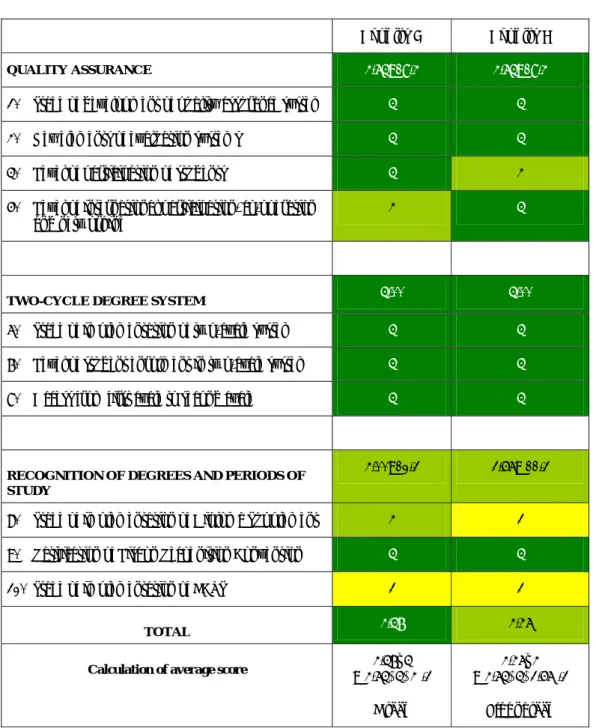
requesting changes to their scores or verifying that the scores were correct. The expert revised scores on the basis of additional information provided, with the exception of ten (10) cases which were considered by the group. This resulted in an adjustment to the scores in seven (7) cases. In the remaining three (3) cases, the countries were advised of the reason why their scores were not changed. Table 2.5 below shows an example of how the scorecard was applied and how the “average” values were calculated.
Table 2.5: Example of Application of Bologna Scorecard
Country A Country B
QUALITY ASSURANCE 4.75=19/4 4.75=19/4
1. Stage of development of quality assurance system 5 5
2. Key elements of evaluation systems 5 5
3. Level of participation of students 5 4
4. Level of international participation, co-operation and networking
4 5
TWO-CYCLE DEGREE SYSTEM 5.00 5.00
5. Stage of implementation of two-cycle system 5 5
6. Level of student enrolment in two-cycle system 5 5
7. Access from first cycle to second cycle 5 5
RECOGNITION OF DEGREES AND PERIODS OF STUDY
4.00=12/3 3.67= 11/3
8. Stage of implementation of Diploma Supplement 4 3
9. Ratification of Lisbon Recognition Convention 5 5
10. Stage of implementation of ECTS 3 3
TOTAL 4.58 4.47
Calculation of average score =(4.75+5+4)/3 4.58~5
(Green)
4.47~4 =(4.75+5+3.67)/3
Added value of the Bologna Scorecard
The working group considers that the Bologna Scorecard adds value to the stocktaking process for a number of reasons. Firstly, it is a systematic and effective framework of analysis that enables us to see the “big picture”, and to answer the question: how are we doing on these priority action lines? Secondly, it integrates quantitative and qualitative measures, with a five-point scoring system based on descriptive rubrics allowing a focused analysis of the different action lines. Thirdly, the scorecard is a good method for dealing with large amounts of material from different sources, and for taking stock of collective progress against objective criteria. Finally, it also generates baseline data that can be used to measure progress in the future.
However, the working group recognises that there are also certain risks in using such a methodology. For example it is inevitable that participating countries will compare their position relative to their neighbours or that some observers will seek to develop ‘league tables’. The working group was very conscious of this aspect, and it cannot preclude such actions. However, it urges that all should remain focused on the key objective – namely, making the EHEA a reality. Each participating country has voluntarily subscribed to this objective. The methods of implementation and the required legislative processes vary between countries. As such, the pace of implementation may differ from one country to the next. The outcome of this analysis merely reflects this.
The Working Group on Stocktaking is confident that it has made the best possible use of the available resources, both human and financial, and that the methodology adopted has brought appropriate transparency to the stocktaking process. For the future, however, the working group suggests that the stocktaking process should be integrated in parallel with the implementation of the Bologna actions, and that countries should be encouraged to use the scorecard as a self-monitoring tool.
Chapter 3
Analysis of Results
This chapter presents an overview of the scores for the three priority action lines and the ten scorecard criteria that were described in the previous chapter. An “at a glance” summary of all scores is shown on pages 40-41 below. The detailed scorecard for each country is included in the Annex.
The Bologna Process is working
Table 3.1 gives a summary of the number of countries that scored in each colour category for the three priority action lines: quality assurance, the two-cycle degree system and recognition of degrees and periods of study.4
Table 3.1: Summary of Average Scores for the Three Priority Action Lines Number of countries in each colour category
Action lines Green Light green Yellow Orange Red Quality
assurance 15 13 7 8 0
The two-cycle degree system
18 13 4 6 2
Recognition of degrees and periods of study
14 20 9 0 0
Score for all three action lines
10 19 11 3 0
4 While there are 40 countries, there are two separate scores for three of the countries: Belgium, Serbia and Montenegro, and the United Kingdom.
The key message is that the Bologna Process is working. Almost all participating countries have embarked upon the reform process along the lines articulated by Ministers in Bologna in 1999. The great majority of countries fall within the categories of ‘Excellent Performance’ or ‘Very Good Performance’ as defined within the stocktaking exercise. In that respect, Ministers can be confident that the European Higher Education Area (EHEA) is beginning to take shape.
While there is a more detailed analysis of each criterion later, it is worth highlighting here the aspects of the Bologna Process where participating countries have made most progress. The following criteria recorded the highest average scores:
• Ratification of the Lisbon Recognition Convention
• Implementation of the European Credit Transfer System (ECTS) • Implementation of the two-cycle degree system.
It is also important to reflect on the criteria where participating countries had the lowest rate of progress:
• Participation of students in quality assurance processes • Level of student enrolment in the two-cycle degree system • International participation in quality assurance.
Measuring progress on Quality Assurance
The great majority of countries have made excellent or very good progress on developing and implementing their quality assurance systems.
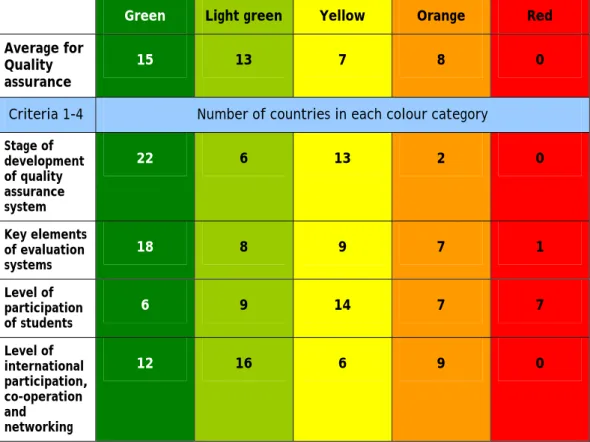
The most important message is that there has been very good progress on the development of quality assurance systems. This is supported by a detailed analysis of each criterion. Table 3.2 gives a summary of the scores of the countries on the four quality assurance criteria.
Table 3.2: Summary of scores for Quality Assurance (Criteria 1-4)
Green Light green Yellow Orange Red
Average for Quality assurance
15 13 7 8 0
Criteria 1-4 Number of countries in each colour category
Stage of development of quality assurance system
22 6 13 2 0
Key elements of evaluation systems
18 8 9 7 1
Level of participation of students
6 9 14 7 7
Level of international participation, co-operation and
networking
Criterion 1 - Stage of development of quality assurance system
Almost all countries have a quality assurance system in place for higher education.
In 22 countries, a Quality Assurance (QA) system is in operation at national level and is applied throughout higher education. Allied to this, there is a clear definition of the responsibilities of agencies and
institutions. In these countries, there is either a fully functioning dedicated QA agency in place, or existing agencies have QA as part of their responsibility. A further 6 countries have a QA system in operation, but it is not applied to all higher education programmes.
In 13 countries, the process of development is at an advanced stage, with either legislation or regulations awaiting implementation. Equally, it is possible that the existing system is being reviewed or developed in accordance with Bologna action lines. In 2 countries, planning for the establishment of a QA system is at a preliminary stage, or initial debate and consultation on the matter has begun within the higher education system.
Based on an analysis of National Reports, it is clear that there is a range of organisational models in QA agencies. Many are entirely independent agencies, set up specifically for the purpose of managing quality assurance across all higher education institutions. Others have evolved from
existing agencies, and have had their functions or mandate expanded to include quality assurance along the lines suggested in the Bologna
Process. In some countries, the quality assurance agency is located within a Ministry or other Government agency with responsibility for overseeing higher education.
Most QA agencies appear to have an inclusive and representative structure, especially in the composition of their governing body. They have a range of reporting relationships, usually involving some form of liaison between the Ministry of Education and other Government
Ministries, the national rectors’ conference, and other non-governmental organisations.
The nature of responsibilities undertaken by QA agencies usually include those that were described in the ENQA study of 2003:
• quality Improvement/ quality assurance • disseminating knowledge and information • accreditation.
In introducing and implementing quality assurance systems in higher education, countries mention in their reports some of the issues they have encountered, for example stakeholder support, availability of the required resources and expertise, and the difficulty in some cases of involving international peers because of language problems.
Many countries mention membership of ENQA, or participation in its activities as an observer by non-members, as being especially helpful in establishing QA policies and practices. This emphasises the value of promoting continued networking between countries as a way of promoting good practice and the sharing of experience.
Criterion 2 - Key elements of evaluation systems
Most countries have QA systems that match the criteria set out in the Berlin Communiqué.
In the Berlin Communiqué, the following five elements were identified as important elements in evaluation systems:
• internal assessment • external review
• participation of students • publication of results • international participation.
In 18 countries, all five elements are fully implemented in all higher education. In a further 8 countries, either all of the elements are in place but they are not yet in operation in all higher education, or four of the five elements are in operation.
In 9 countries, implementation of an evaluation system including two or three of these elements has begun, and in 7 countries, implementation of an evaluation system including one of these elements has begun, or preliminary planning is in progress for implementing an evaluation system including these elements. In just one country, there is no evaluation system in place.
Student participation is the element that is most often missing, followed by publication of reports. In many countries, the structures for student participation are not yet fully developed. This indicates the need for enhanced collaboration between student organisations and QA agencies, both at national and international levels.
A further issue emerges with regard to the publication of results – this is critical to the openness and transparency of QA systems. In some
countries, there is already a very open culture of making the reports of evaluations available to the public. In other countries, universities and other higher education institutions have traditionally operated
independently, without public scrutiny, so the requirement to publish QA reports will require a level of culture change.
Criterion 3 - Level of participation of students
Many countries have made some progress in involving students in quality assurance.
Notwithstanding the earlier observation on student participation, many countries have made some progress in involving students in quality assurance. However, a small number of countries have not yet begun to involve students at any level in QA.
The working group reviewed this criterion, and determined that it was possible to measure student participation at four levels:
• in the governance of national bodies for QA • within teams for external review
• consultation or involvement during external reviews • involvement in internal evaluations.
In 6 countries, students participate at all four levels, and in another 9 countries, they participate at three of the four levels. Fourteen (14)
countries involve students at two of the four levels, and in 7 countries they participate at only one of the four levels.
In 7 countries, there is either no student involvement yet, or there is no clarity about structures and arrangements for student participation. An analysis of the National Reports indicates that students are most likely to participate in internal reviews. Only a small number of countries have students as members of the governing bodies for QA agencies. There is a need for the recognition of students as full partners in the QA process, with the capacity to contribute a unique and valuable perspective at all stages.
Criterion 4 - Level of international participation, co-operation and networking
The level of international participation, co-operation and networking is excellent or very good in the great majority of countries.
All countries have at least begun to introduce an international dimension to their QA systems. Formal international participation in QA is possible at three levels:
• in the governance of national bodies for QA • in external review teams
• membership of ENQA or other international networks.
Twelve (12) countries have international participation at all three levels, and 16 countries have international participation at two of the three levels. In 6 countries, there is international participation at one of the three levels. Nine (9) countries are involved in other forms of transnational
co-operation in undertaking QA, for example pilot projects or informal international networks.
Only a small number of countries have international participation in the governance of national bodies for QA. In some cases, legal or statutory reasons prevent it, while language may also present an obstacle in many cases.
It is also important to note that since 2003, ENQA has been reviewing its criteria for membership, and during this time it has not processed any applications for membership. (This situation is likely to change soon with its evolution into the European Association for Quality Assurance.) However, this criterion could also be met through participation in other international networks, such as the International Network for Quality Assurance Agencies in Higher Education (INQAAHE). It was
acknowledged by many countries that such networking had a significant influence on the development of their QA policies and practice.
The nature of international participation in governing bodies for QA is worthy of comment. In most cases, a small number of people (usually only one or two) from another country are invited to become members of the governing body. They attend meetings, participate in policy making and perform an advisory role. A more active and meaningful form of collaboration is shown in the case of the joint agency that has been set up by the Netherlands and the Flemish Community of Belgium. In this case, the QA agency is jointly governed by the two Ministries, with full
exchanges of practice at all levels of the process. This is a model which could be more fully explored by other countries, especially small countries and those that have a shared language.
Measuring progress on the Two-cycle Degree System
The great majority of countries have made excellent or very good progress in implementing the two-cycle system by 2005.
The target set by Ministers to have begun implementing the two-cycle degree system by 2005 has largely been met. With one exception, all participating countries have embarked on this process. In the remaining country, some experimental attempts have been made at introducing the two-cycle degree system. Table 3.3 gives a summary of the countries’ scores on the criteria for the two-cycle degree system.
Table 3.3: Summary of scores for the Two-cycle Degree System
(Criteria 5-7) Scorecard
criteria Green Light green Yellow Orange Red Average for
the two-cycle degree system
18 13 4 6 2
Criteria 5-7 Number of countries in each colour category
Stage of implement-ation of two-cycle system
24 9 4 5 1
Level of student enrolment in two-cycle system
17 6 7 10 3
Access from first cycle to second cycle
Criterion 5 - Stage of implementation of two-cycle system
The two-cycle degree system is being implemented in the great majority of countries in 2005.
In 24 countries, the two-cycle degree system is being implemented in 2005 on a wide scale, while in 9 countries it is being implemented on a limited scale. Implementation in this instance should be taken to mean that countries have completed the legislative process and are introducing the two-cycle system in their higher education institutions in 2005 (i.e. either for the academic year 2004-2005 or for 2005-2006).
In 4 countries, either legislation or regulations have been prepared and are awaiting implementation, or existing degree structures are undergoing review or development in accordance with the Bologna action lines. Five (5) countries are engaged in a preliminary planning or pilot phase which will lead to the implementation of the two-cycle degree system, while only one country has not yet started work on putting the two-cycle system in place.
The level of change that was necessary to implement the two-cycle system in some countries has been considerable, while in others it was minimal. It has not been possible within this stocktaking exercise to measure the scale of effort required, and this should be borne in mind in any analysis of the results.
Some fields of study remain outside the two-cycle system in a number of countries: in particular, medicine and related fields, engineering,
architecture and law.
Criterion 6 - Level of student enrolment in two-cycle system
In most countries, more than half of the students are enrolled in the two-cycle system in 2005.
In 17 countries, 81-100 per cent of students are enrolled in the two-cycle system in 2005, and in 6 countries, 51-80 per cent are enrolled. A further 7 countries have 25-50 per cent enrolment, and 10 countries have 1-24 per cent. In just 3 countries, no students are enrolled in the two-cycle system in 2005.
It should be noted that these figures are broad estimates based on the limited information that was available in the National Reports and in the EURYDICE summaries. While EURYDICE requested data for students enrolled in the autumn term of 2004, many countries have provided information that relates to estimated figures for 2005-2006. The scores for this criterion are therefore based on enrolments in 2005 - either for the academic year 2004-2005 or 2005-2006. Allowing for this wide definition, the fact remains that this criterion reflects the substantial progress being made with regard to the implementation of the two-cycle degree system. Criterion 7 - Access from first cycle to second cycle
The great majority of countries have arrangements to allow access for all students to at least one second-cycle programme.
In the Berlin Communiqué, the principle of access is based on the
definition in the Lisbon Recognition Convention – that is, having the right to apply for admission. In 19 countries, there is access for all students to at least one second-cycle programme without major transitional problems. In 12 countries, there is relatively smooth access for a majority of students with minor structural or procedural problems. Three (3) countries offer a number of first cycle programmes that do not provide access to the second cycle. Access to second cycle programmes is limited for the majority of students in 7 countries because of structural or procedural obstacles. In 2 countries, it is currently not possible to speak of access from the first cycle to the second cycle, as the relevant structures are not yet in place.
The scores on this criterion are based on the National Reports and on the information provided by ESIB. The National Reports provide information only on the position in principle, based on policy or legislation. The stocktaking exercise has gathered no information on the actual level of access and transfer of students from the first cycle to the second cycle.
Measuring progress on Recognition of Degrees and Periods of Study
There is good progress in almost all countries on recognising degrees and periods of study.
Of the three priority action lines, this records most progress, reflecting primarily the number of countries that have ratified the Lisbon
Recognition Convention. Table 3.4 gives a summary of the scores on the three criteria for recognition of degrees and periods of study.
Table 3.4: Summary of scores for Recognition of Degrees and Periods of Study (Criteria 8-10)
Scorecard
criteria Green Light green Yellow Orange Red Average for
Recognition of degrees and periods of study
14 20 9 0 0
Criteria 8-10 Number of countries in each colour category
Stage of implementation of Diploma Supplement
17 10 12 2 2
Ratification of Lisbon Recognition Convention
29 5 5 1 3
Stage of implementation of ECTS
Criterion 8 - Stage of Implementation of Diploma Supplement
Almost all countries have introduced the Diploma Supplement in at least some programmes in 2005.
In 17 countries, every student graduating in 2005 will receive the Diploma Supplement automatically and free of charge, issued in a widely-spoken European language – these conditions were identified very specifically by the Ministers in Berlin. The remaining countries are at various stages of implementation. In 10 countries, it can be issued to every student on request. In 12 countries the Diploma Supplement will be issued to some students or in some programmes in 2005. Two (2) countries either plan to begin implementing the Diploma Supplement in 2006, or have begun preliminary planning, pilot testing or initial debate and consultation about its introduction. Only 2 countries currently have no arrangements in place for implementing the Diploma Supplement.
While it is acknowledged that there are various approaches to implementing the Diploma Supplement throughout the countries participating in the Bologna Process, it should be possible for the 26 countries that do not yet meet all of the conditions outlined in the Berlin Communiqué to adjust their processes so that they will comply with these conditions in the near future.
Criterion 9 - Ratification of Lisbon Recognition Convention The great majority of countries have signed and ratified the Lisbon Recognition Convention and also have a national information centre in operation.
Twenty-nine (29) countries have signed and ratified the Convention and have a national information centre (ENIC/NARIC) in operation. In a further 5 countries, the Convention has been signed and ratified but a national information centre is not yet in operation. The Convention has been signed and the process of ratification begun in 5 countries, and in one country, it has been signed but the process of ratification has not yet begun. Finally, 3 countries have not yet signed the Convention.
The Lisbon Recognition Convention is the one legal instrument
all countries attach due importance to it. However, as noted in Chapter 4, it alone cannot facilitate recognition – this requires a culture change within national higher education systems.
Criterion 10 - Stage of implementation of ECTS
The great majority of countries are implementing the European Credit Transfer System (ECTS) in at least some programmes.
In 20 countries, ECTS credits are allocated in the majority of higher
education programmes, enabling credit transfer and accumulation, and in 12 countries ECTS credits are allocated in a limited number of
programmes. In 9 countries, there is either a national system for credit transfer and accumulation that is compatible with ECTS, or the national credit transfer and accumulation system is being gradually integrated with ECTS.
Two (2) countries have either a national system for credit transfer and accumulation which is not compatible with ECTS, or they plan to implement ECTS in the future.
The pattern here is similar to the Diploma Supplement, with many
countries in transition from a national credit system to ECTS. As a way of promoting further development, it might be useful to examine more closely the practice in countries which have already successfully adapted their national system to integrate it with ECTS.
Stocktaking confirms that there is good progress in the three priority action lines
The findings emerging from the detailed analysis in this chapter confirm the extent of progress being made by participating countries within the Bologna Process. This portrays a positive picture, and given that these action lines are central to the success of the process, this should come as no surprise. However, it is important that the results of this stocktaking exercise should be considered in the wider context of the various
contributions to the Ministerial Meeting in Bergen. The implications of the findings for the future development of the process are discussed more fully in Chapter 4.
Bologna Scorecard Summary
Quality Assurance 2-cycle Recognition
D evel o pme n t Eva lu ati on syst em s P art ici p at io n of stude n ts In te rna ti o na l p art ic ip atio n Sc or e Q A Im pl em ent atio n Stude n t en ro lm en t Ac ce ss Score 2-c yc le Di pl om a Supp le me n t Lis bon Rec . C onv en ti o n EC TS Sc or e Rec ognit io n Tot a l Sc or e Albania Andorra Austria
Belgium (Flemish Community)
Belgium (French Community)
Bosnia and Herzegovina
Bulgaria Croatia Cyprus Czech Republic Denmark Estonia Finland France Germany Greece Holy See Hungary Iceland Ireland Italy
Bologna Scorecard Summary
Quality Assurance 2-cycle Recognition
D evel o pme n t Eva lu ati on syst em s P art ici p at io n of stude n ts In te rna ti o na l p art ic ip atio n Sc or e Q A Im pl em ent atio n Stude n t en ro lm en t Ac ce ss Score 2-c yc le Di pl om a Supp le me n t Lis bon Rec . C onv en ti o n EC TS Sc or e Rec ognit io n Tot a l Sc or e Liechtenstein Lithuania Luxembourg Malta Netherlands Norway Poland Portugal Romania Russia
Serbia and Montenegro/Serbia
Serbia and Montenegro/Montenegro
Slovakia
Slovenia
Spain
Sweden
Switzerland
"the former Yugoslav Republic of Macedonia"
Turkey
UK - England, Wales and Northern Ireland
Chapter 4
Conclusions and Recommendations
Good progress on achieving the targets set in Berlin
The three priority action lines that the Ministers identified in the Berlin Communiqué set tangible targets for participating countries to achieve in the two-year period before the Bergen meeting. The goals of enhancing quality, promoting reform of degree structures and improving recognition for periods of study are critical factors for the successful realisation of the European Higher Education Area (EHEA).
The very good progress made on achieving these targets as measured in this stocktaking exercise represents real commitment on the part of all participating countries to making the European Higher Education Area a reality.
Good progress on Quality Assurance
In Berlin, Ministers acknowledged the importance of quality assurance in the establishment of the EHEA. More than half of the participating countries have quality assurance structures in place. Critically, almost half have systems built on the elements identified in the Berlin
Communiqué. It is also encouraging to note that international participation and networking feature in many of the systems. This evidence, combined with the consensus which underpinned the work of the European Association for Quality Assurance (ENQA), augurs well for the continued progress in this area.
Students are not yet fully involved
However, this progress should not mask a deficit in quality assurance, and in particular the absence of student participation in quality assurance procedures. Four levels of participation were identified – governance structures, external review teams, consultation or involvement during external reviews, and involvement in internal evaluations – and less than 14% of participating countries have involvement at all four levels. This is
also borne out by the EURYDICE analysis. In material provided by ESIB to the working group, ESIB noted that the majority of cases of good practice with regard to student participation are based on the individual and voluntary effort of higher education institutions (HEIs), and
conversely, other institutions make conscious decisions not to promote student involvement. While the working group would not go as far as ESIB – after all, most quality assurance systems have at least one level of student participation – there is a need to move as quickly as possible to accommodate student representation in keeping with the principles of good practice.
Quality assurance systems must lead to real quality improvement Finally, while good progress has been made on establishing quality
assurance systems, this is just the first step. Systems or processes will drift in the absence of committed ownership. Trends IV identified this as a challenge for the future. There is a risk that excessive emphasis on the process could actually displace the end objective – namely, the
enhancement of quality in higher education. It is important, therefore, to view progress in this area as evidence of establishment of a system – it is not evidence that the culture of quality assurance has filtered through all strands of the higher education life. The ultimate success of this objective relies on the willingness of institutions, their staff and their students to embrace systematic quality assurance as central to their respective roles in the delivery of higher education.
Good progress on the Two-Cycle Degree System
The adoption of the two-cycle degree system, with its origins in the Sorbonne Declaration, is seen as critical to the future of the EHEA, and its implementation throughout the area is well under way. Already by 2005, at least 55 per cent of countries have the system in place on a wide scale, with a further 21 per cent having it in place in a more limited capacity. More importantly, the percentage of students covered by the two-cycle degree system is also increasing. It is safe to predict that the objectives of this action line will be achieved by 2010. The stocktaking analysis also indicates that access between cycles is available for all students in 44 per cent of participating countries, while some minor structural or procedural problems exist in a further 28 per cent of countries.
Some issues identified by students
It is on the issue of access that some controversy exists. The terminology used in the Berlin Communiqué defined access in terms of the ‘right to apply for admission’ – the definition provided in the Lisbon Recognition Convention. However, ESIB in their submission looked at access in the meaning of “admission” and factors influencing student choice. They cited transitional difficulties for students seeking to progress between cycles, for example the need to undertake bridging courses when moving between the university and non-university sector. They also mentioned restrictions that are placed on progression to the next cycle, including limits on numbers, enrolment examinations and selection procedures. Finally, they indicated that there were restrictions on movement between different fields of study in different cycles and that tuition fees also posed a barrier.
Clearly, such an analysis extends the definition of access into areas which could potentially create difficulty for stakeholders in many participating countries. It also extends the impact of the Bologna Process into other public policy domains, some of which lie outside the remit of Ministers with responsibility for higher education. Equally, it is clear that any
extension of the definition of access must be done with a clear vision of the issue to be addressed. Moreover, it should be done in a manner which can be agreed and accepted by all within the Bologna Follow-up Group.
Need for engagement of social partners
Trends IV highlighted a key objective of the emerging two-cycle degree system. It is acknowledged that the degree awarded on completion of the first cycle should have different orientations, in order to accommodate a diversity of academic, individual and labour market needs. It is a matter of concern that qualifications issued by the authorities that have
undertaken a programme of qualification reform in accordance with the Bologna principles have failed to secure support and suffer from a ‘lack of credibility among students and employers’. Such perceptions clearly damage the reform process, and perhaps, more importantly, create wrong impressions for those outside the EHEA. It is vital that these issues are tackled as a matter of urgency, and while institutions and governments may pursue the line proposed within Trends IV, this goes deeper and must