OPA549
High-Voltage, High-Current
OPERATIONAL AMPLIFIER
DESCRIPTION
The OPA549 is a low-cost, high-voltage/high-current opera-tional amplifier ideal for driving a wide variety of loads. This laser-trimmed monolithic integrated circuit provides excellent low-level signal accuracy and high output voltage and current. The OPA549 operates from either single or dual supplies for design flexibility. The input common-mode range extends below the negative supply.
The OPA549 is internally protected against over-temperature conditions and current overloads. In addition, the OPA549 provides an accurate, user-selected current limit. Unlike other designs which use a “power” resistor in series with the output current path, the OPA549 senses the load indirectly. This allows the current limit to be adjusted from 0A to 10A with a resistor/potentiometer, or controlled digitally with a voltage-out or current-out Digital-to-Analog Converter (DAC). The Enable/Status (E/S) pin provides two functions. It can be monitored to determine if the device is in thermal shutdown, and it can be forced low to disable the output stage and effectively disconnect the load.
The OPA549 is available in an 11-lead power package. Its copper tab allows easy mounting to a heat sink for excellent thermal performance. Operation is specified over the ex-tended industrial temperature range, –40°C to +85°C.
FEATURES
●
HIGH OUTPUT CURRENT:
8A Continuous
10A Peak
●
WIDE POWER-SUPPLY RANGE:
Single Supply: +8V to +60V
Dual Supply:
±
4V to
±
30V
●
WIDE OUTPUT VOLTAGE SWING
●
FULLY PROTECTED:
Thermal Shutdown
Adjustable Current Limit
●
OUTPUT DISABLE CONTROL
●
THERMAL SHUTDOWN INDICATOR
●
HIGH SLEW RATE: 9V/
µ
s
●
CONTROL REFERENCE PIN
●
11-LEAD POWER PACKAGE
APPLICATIONS
●
VALVE, ACTUATOR DRIVERS
●
SYNCHRO, SERVO DRIVERS
●
POWER SUPPLIES
●
TEST EQUIPMENT
●
TRANSDUCER EXCITATION
●
AUDIO POWER AMPLIFIERS
OPA549 V+
E/S
RCL
RCL sets the current limit
value from 0A to 10A. (Very Low Power Dissipation)
ILIM
VO
V– Ref
ES Pin
Forced Low: Output disabled. Indicates Low: Thermal shutdown.
OPA549 OPA
549
Please be aware that an important notice concerning availability, standard warranty, and use in critical applications of Texas Instruments semiconductor products and disclaimers thereto appears at the end of this data sheet.
SBOS093E – MARCH 1999 – REVISED OCTOBER 2005
Output Current ... See SOA Curve (Figure 6) Supply Voltage, V+ to V– ... 60V Input Voltage Range ... (V–) – 0.5V to (V+) + 0.5V Input Shutdown Voltage ... Ref – 0.5 to V+
Operating Temperature ... –40°C to +125°C
Storage Temperature ... –55°C to +125°C
Junction Temperature ... 150°C
Lead Temperature (soldering, 10s) ... 300°C
ESD Capability (Human Body Model) ... 2000V NOTE: (1) Stresses above these ratings may cause permanent damage. Exposure to absolute maximum conditions for extended periods may de-grade device reliability.
CONNECTION DIAGRAM
–In
+In Ref ILIM
E/S V+ VO 1 3 5 7 9 11 2 4 6 8 10 V–
Tab connected to V–. Do not use to conduct current.
Connect both pins 1 and 2 to output. Connect both pins 5 and 7 to V–. Connect both pins 10 and 11 to V+.
ABSOLUTE MAXIMUM RATINGS
(1)For the most current package and ordering information, see the Package Option Addendum at the end of this datasheet or see the TI website at www.ti.com.
PACKAGE/ORDERING INFORMATION
ELECTROSTATIC
DISCHARGE SENSITIVITY
This integrated circuit can be damaged by ESD. Texas Instru-ments recommends that all integrated circuits be handled with appropriate precautions. Failure to observe proper handling and installation procedures can cause damage.ESD damage can range from subtle performance degradation to complete device failure. Precision integrated circuits may be more susceptible to damage because very small parametric changes could cause the device not to meet its published specifications.
ELECTRICAL CHARACTERISTICS
Boldface limits apply over the specified temperature range, T
A= –40
°
C to +85
°
C.
At TCASE = +25°C, VS = ±30V, Ref = 0V, and E/S pin open, unless otherwise noted.
OPA549T, S
PARAMETER CONDITION MIN TYP MAX UNITS
OFFSET VOLTAGE VOS
Input Offset Voltage VCM = 0V, IO = 0 ±1 ±5 mV
vs Temperature dVOS/dT TCASE = –40°C to +85°C ±20 µV/°C
vs Power Supply PSRR VS = ±4V to ±30V, Ref = V– 25 100 µV/V
INPUT BIAS CURRENT(1)
Input Bias Current(2) I
B VCM = 0V –100 –500 nA
vs Temperature TCASE = –40°C to +85°C ±0.5 nA/°C
Input Offset Current IOS VCM = 0V ±5 ±50 nA
NOISE
Input Voltage Noise Density en f = 1kHz 70 nV/√Hz
Current Noise Density in f = 1kHz 1 pA/√Hz
INPUT VOLTAGE RANGE
Common-Mode Voltage Range: Positive VCM Linear Operation (V+) – 3 (V+) – 2.3 V
Negative VCM Linear Operation (V–) – 0.1 (V–) – 0.2 V
Common-Mode Rejection Ratio CMRR VCM = (V–) – 0.1V to (V+) – 3V 80 95 dB
INPUT IMPEDANCE
Differential 107 || 6 Ω || pF
Common-Mode 109 || 4 Ω || pF
OPEN-LOOP GAIN
Open-Loop Voltage Gain AOL VO = ±25V, RL = 1kΩ 100 110 dB
VO = ±25V, RL = 4Ω 100 dB
FREQUENCY RESPONSE
Gain Bandwidth Product GBW 0.9 MHz
Slew Rate SR G = 1, 50Vp-p Step, RL = 4Ω 9 V/µs
Full-Power Bandwidth See Typical Curve
Settling Time: ±0.1% G = –10, 50V Step 20 µs
Total Harmonic Distortion + Noise(3) THD+N f = 1kHz,R
L = 4Ω,G = +3, Power = 25W 0.015 %
OUTPUT
Voltage Output, Positive IO = 2A (V+) – 3.2 (V+) – 2.7 V
Negative IO = –2A (V–) + 1.7 (V–) + 1.4 V
Positive IO = 8A (V+) – 4.8 (V+) – 4.3 V
Negative IO = –8A (V–) + 4.6 (V–) + 3.9 V
Negative RL = 8Ω to V– (V–) + 0.3 (V–) + 0.1 V
Maximum Continuous Current Output: dc(4) ±8 A
ac(4) Waveform Cannot Exceed 10A peak 8 A rms
Output Current Limit
Current Limit Range 0 to ±10 A
Current Limit Equation ILIM = 15800 • 4.75V/(7500Ω + RCL) A
Current Limit Tolerance(1) R
CL = 7.5kΩ (ILIM = ±5A), RL = 4Ω ±200 ±500 mA
Capacitive Load Drive (Stable Operation) CLOAD See Typical Curve
Output Disabled
Leakage Current Output Disabled, VO = 0V –2000 ±200 +2000 µA
Output Capacitance Output Disabled 750 pF
OUTPUT ENABLE/STATUS (E/S) PIN Shutdown Input Mode
VE/S High (output enabled) E/S Pin Open or Forced High (Ref) + 2.4 V
VE/S Low (output disabled) E/S Pin Forced Low (Ref) + 0.8 V
IE/S High (output enabled) E/S Pin Indicates High –50 µA
IE/S Low (output disabled) E/S Pin Indicates Low –55 µA
Output Disable Time 1 µs
Output Enable Time 3 µs
Thermal Shutdown Status Output
Normal Operation Sourcing 20µA (Ref) + 2.4 (Ref) + 3.5 V
Thermally Shutdown Sinking 5µA, TJ > 160°C (Ref) + 0.2 (Ref) + 0.8 V
Junction Temperature, Shutdown +160 °C
Reset from Shutdown +140 °C
Ref (Reference Pin for Control Signals)
Voltage Range V– (V+) – 8 V
Current(2) –3.5 mA
POWER SUPPLY
Specified Voltage VS ±30 V
Operating Voltage Range, (V+) – (V–) 8 60 V
Quiescent Current IQ ILIM Connected to Ref IO = 0 ±26 ±35 mA
Quiescent Current in Shutdown Mode ILIM Connected to Ref ±6 mA
TEMPERATURE RANGE
Specified Range –40 +85 °C
Operating Range –40 +125 °C
Storage Range –55 +125 °C
Thermal Resistance, θJC 1.4 °C/W
Thermal Resistance, θJA No Heat Sink 30 °C/W
TYPICAL CHARACTERISTICS
At TCASE = +25°C, VS = ±30V, and E/S pin open, unless otherwise noted.–60 –40 –20 0 20 40 60 80 100 120 140 –130 –120 –110 –100 –90 –80 –70 –60 –50 –40
Input Bias Current (nA)
Temperature (°C)
INPUT BIAS CURRENT vs TEMPERATURE
–IB +IB –30 –20 –10 0 10 20 30 –200 –180 –160 –140 –120 –100 –80 –60 –40 –20 –0
Input Bias Current (nA)
Common-Mode Voltage (V) INPUT BIAS CURRENT vs COMMON-MODE VOLTAGE 1 10 100 1k 10k 100k 1M 10M 120 100 80 60 40 20 0 –20 –40 0 –20 –40 –60 –80 –100 –120 –140 –160 Gain (dB) Phase ( ° ) Frequency (Hz) OPEN-LOOP GAIN AND PHASE
vs FREQUENCY 0 5 10 15 20 25 30 9 8 7 6 5 4 3 2 1 0
Current Limit (A)
Supply Voltage (V)
CURRENT LIMIT vs SUPPLY VOLTAGE
+ILIM, 5A –ILIM, 5A +ILIM, 2A –ILIM, 2A +ILIM, 8A –ILIM, 8A –75 –50 –25 0 25 50 75 100 125 30 25 20 15 10 5 0
Quiescent Current (mA)
Temperature (°C)
QUIESCENT CURRENT vs TEMPERATURE
VS = ±30V
VS = ±5V
IQ Shutdown (output disabled)
–75 –50 –25 0 25 50 75 100 125 9 8 7 6 5 4 3 2 1 0
Current Limit (A)
Temperature (°C)
CURRENT LIMIT vs TEMPERATURE
5A
2A 8A
TYPICAL CHARACTERISTICS
(Cont.)
At TCASE = +25°C, VS = ±30V, and E/S pin open, unless otherwise noted.
1 10 100 1k 10k 100k 300 250 200 150 100 50 0 Voltage Noise (nV/ √ Hz) Frequency (Hz)
VOLTAGE NOISE DENSITY vs FREQUENCY
10 100 1k 10k 100k 1M 120 100 80 60 40 20 0
Power-Supply Rejection Ratio (dB)
Frequency (Hz)
POWER-SUPPLY REJECTION RATIO vs FREQUENCY –PSRR +PSRR –75 –50 0 50 100 AOL 125 120 110 100 90 80 AOL , CMRR, PSRR (dB) Temperature (°C)
OPEN-LOOP GAIN, COMMON-MODE REJECTION RATIO, AND POWER-SUPPLY REJECTION RATIO
vs TEMPERATURE CMRR PSRR 20 100 1k 10k 20k 1 0.1 0.01 0.001 THD+N (%) Frequency (Hz)
TOTAL HARMONIC DISTORTION + NOISE vs FREQUENCY G = +3 RL = 4Ω 0.1W 1W 10W 75W –75 –50 –25 0 25 50 75 100 125 1 0.9 0.8 0.7 0.6 0.5 0.4 0.3 0.2 0.1 0 16 15 14 13 12 11 10 9 8 7 6 Gain-Bandwidth Product (MHz) Slew Rate (V/ µ s) Temperature (°C)
GAIN-BANDWIDTH PRODUCT AND SLEW RATE vs TEMPERATURE
SR+ SR– GBW 10 100 1k 10k 100k 100 90 80 70 60 50 40 Common-Mode Rejection (dB) Frequency (Hz)
TYPICAL CHARACTERISTICS
(Cont.)
At TCASE = +25°C, VS = ±30V, and E/S pin open, unless otherwise noted.
5 4 3 2 1 0 VSUPPLY – VOUT (V) Temperature (°C)
OUTPUT VOLTAGE SWING vs TEMPERATURE
–75 –50 –25 0 25 50 75 100 125 IO = +8A IO = –8A IO = +2A IO = –2A 1k 10k 100k 1M 30 25 20 15 10 5 0 Output Voltage (Vp) Frequency (Hz)
MAXIMUM OUTPUT VOLTAGE SWING vs FREQUENCY Maximum output voltage without slew rate-induced distortion. 0 2 4 6 8 10 5 4 3 2 1 0 VSUPPLY – VOUT (V)
Output Current (A)
OUTPUT VOLTAGE SWING vs OUTPUT CURRENT
(V+) – VO (V–) – VO –40 –30 –20 –10 0 10 20 30 40 5 4 3 2 1 0 –1 –2 –3 –4 –5
Leakage Current (mA)
Output Voltage (V) OUTPUT LEAKAGE CURRENT vs APPLIED OUTPUT VOLTAGE
RCL = ∞
RCL = 0
Leakage current with output disabled.
OFFSET VOLTAGE PRODUCTION DISTRIBUTION Percent of Amplifiers (%) Offset Voltage (mV) –4.7 –4.23 –3.76 –3.29 –2.82 –2.35 –1.88 –1.41 –0.94 –0.47 0 0.47 0.94 1.41 1.88 2.35 2.82 3.29 3.76 4.23 4.7 25 20 15 10 5 0
OFFSET VOLTAGE DRIFT PRODUCTION DISTRIBUTION Percent of Amplifiers (%) Offset Voltage (µV/°C) 0 4 8 12 16 20 24 28 32 36 40 44 48 52 56 60 64 68 72 76 80 84 25 20 15 10 5 0
TYPICAL CHARACTERISTICS
(Cont.)
At TCASE = +25°C, VS = ±30V, and E/S pin open, unless otherwise noted.
0 5k 10k 15k 20k 25k 30k 35k 70 60 50 40 30 20 10 0 Overshoot (%) Load Capacitance (pF) SMALL-SIGNAL OVERSHOOT vs LOAD CAPACITANCE G = –1 G = +1
LARGE-SIGNAL STEP RESPONSE G = 3, CL = 1000pF
10V/div
5µs/div
SMALL-SIGNAL STEP RESPONSE G = 1, CL = 1000pF
50mV/div
2.5µs/div
SMALL-SIGNAL STEP RESPONSE G = 3, CL = 1000pF
100mV/div
APPLICATIONS INFORMATION
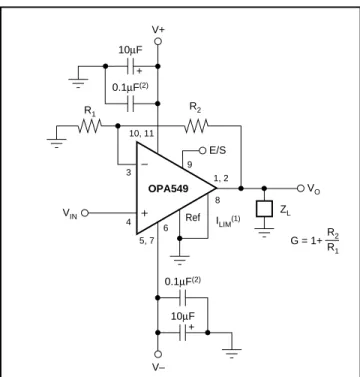
Figure 1 shows the OPA549 connected as a basic noninverting amplifier. The OPA549 can be used in virtually any op amp configuration.Power-supply terminals should be bypassed with low series impedance capacitors. The technique shown in Figure 1, using a ceramic and tantalum type in parallel, is recommended. Power-supply wiring should have low series impedance. Be sure to connect both output pins (pins 1 and 2).
CONTROL REFERENCE (Ref) PIN
The OPA549 features a reference (Ref) pin to which the ILIM and the E/S pin are referred. Ref simply provides a reference point accessible to the user that can be set to V–, ground, or any reference of the user’s choice. Ref cannot be set below
the negative supply or above (V+) – 8V. If the minimum VS is used, Ref must be set at V–.
ADJUSTABLE CURRENT LIMIT
The OPA549’s accurate, user-defined current limit can be set from 0A to 10A by controlling the input to the ILIM pin. Unlike other designs, which use a power resistor in series with the output current path, the OPA549 senses the load indirectly. This allows the current limit to be set with a 0µA to 633µA control signal. In contrast, other designs require a limiting resistor to handle the full output current (up to 10A in this case).
Although the design of the OPA549 allows output currents up to 10A, it is not recommended that the device be operated continuously at that level. The highest rated continuous current capability is 8A. Continuously running the OPA549 at output currents greater than 8A will degrade long-term reli-ability.
Operation of the OPA549 with current limit less than 1A results in reduced current limit accuracy. Applications requir-ing lower output current may be better suited to the OPA547 or OPA548.
Resistor-Controlled Current Limit
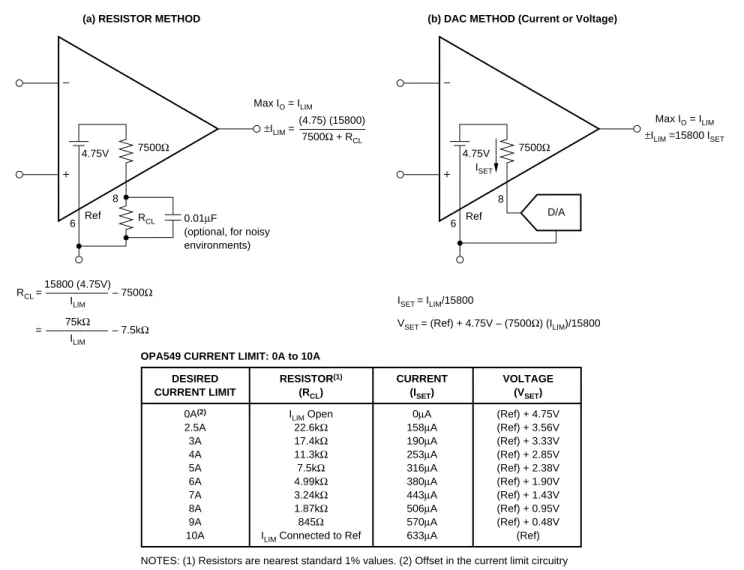
See Figure 2a for a simplified schematic of the internal circuitry used to set the current limit. Leaving the ILIM pin open programs the output current to zero, while connecting ILIM directly to Ref programs the maximum output current limit, typically 10A.
With the OPA549, the simplest method for adjusting the current limit uses a resistor or potentiometer connected between the ILIM pin and Ref according to Equation 1:
R 75kV
I – 7.5k CL
LIM
= Ω (1)
Refer to Figure 2 for commonly used values.
Digitally-Controlled Current Limit
The low-level control signal (0µA to 633µA) also allows the current limit to be digitally controlled by setting either a current (ISET) or voltage (VSET). The output current ILIM can be adjusted by varying ISET according to Equation 2:
ISET = ILIM/15800 (2)
Figure 2b demonstrates a circuit configuration implementing this feature.
The output current ILIM can be adjusted by varying VSET according to Equation 3:
VSET = (Ref) + 4.75V – (7500W)(ILIM)/15800 (3) Figure 11 demonstrates a circuit configuration implementing this feature.
FIGURE 1. Basic Circuit Connections.
POWER SUPPLIES
The OPA549 operates from single (+8V to +60V) or dual (±4V to ±30V) supplies with excellent performance. Most behavior remains unchanged throughout the full operating voltage range. Parameters that vary significantly with operat-ing voltage are shown in the Typical Characteristics. Some applications do not require equal positive and negative out-put voltage swing. Power-supply voltages do not need to be equal. The OPA549 can operate with as little as 8V between the supplies and with up to 60V between the supplies. For example, the positive supply could be set to 55V with the negative supply at –5V. Be sure to connect both V– pins
(pins 5 and 7) to the negative power supply, and both V+ pins (pins 10 and 11) to the positive power supply. Package tab is internally connected to V–; however, do not use the tab to conduct current.
G = 1+ R2 R1 ZL E/S 8 9 10, 11 3 4 5, 7 6 1, 2 R2 ILIM(1) Ref R1 0.1µF(2) 10µF OPA549 V– V+ + + VIN 10µF 0.1µF(2) VO
NOTES: (1) ILIM connected to Ref gives the maximum
current limit, 10A (peak). (2) Connect capacitors directly to package power-supply pins.
FIGURE 2. Adjustable Current Limit.
ENABLE/STATUS (E/S) PIN
The Enable/Status Pin provides two unique functions: 1) output disable by forcing the pin low, and 2) thermal shutdown indication by monitoring the voltage level at the pin. Either or both of these functions can be utilized in an application. For normal operation (output enabled), the E/S pin can be left open or driven high (at least 2.4V above Ref). A small value capacitor connected between the E/S pin and CREF may be required for noisy applications.
Output Disable
To disable the output, the E/S pin is pulled to a logic low (no greater than 0.8V above Ref). Typically the output is shut down in 1µs. To return the output to an enabled state, the E/S pin should be disconnected (open) or pulled to at least 2.4V above Ref. It should be noted that driving the E/S pin high (output enabled) does not defeat internal thermal shutdown; however, it does prevent the user from monitoring the thermal shutdown status. Figure 3 shows an example implementing this function. This function not only conserves power during idle periods (quiescent current drops to approximately 6mA) but also allows multiplexing in multi-channel applications. See Figure 12 for two
OPA549s in a switched amplifier configuration. The on/off state of the two amplifiers is controlled by the voltage on the E/S pin. Under these conditions, the disabled device will behave like a 750pF load. Slewing faster than 3V/µs will cause leakage current to rapidly increase in devices that are disabled, and will contribute additional load. At high temperature (125°C), the slewing threshold drops to approximately 2V/µs. Input signals must be limited to avoid excessive slewing in multiplexed applications.
FIGURE 3. Output Disable. OPA549 E/S CMOS or TTL Ref Logic Ground 7500Ω RCL 0.01µF
(optional, for noisy environments) 8 6 8 6 4.75V RCL = – 7500Ω
OPA549 CURRENT LIMIT: 0A to 10A
NOTES: (1) Resistors are nearest standard 1% values. (2) Offset in the current limit circuitry
may introduce approximately ±0.25A variation at low current limit values.
DESIRED CURRENT LIMIT 0A(2) 2.5A 3A 4A 5A 6A 7A 8A 9A 10A RESISTOR(1) (RCL) ILIM Open 22.6kΩ 17.4kΩ 11.3kΩ 7.5kΩ 4.99kΩ 3.24kΩ 1.87kΩ 845Ω
ILIM Connected to Ref
CURRENT (ISET) 0µA 158µA 190µA 253µA 316µA 380µA 443µA 506µA 570µA 633µA VOLTAGE (VSET) (Ref) + 4.75V (Ref) + 3.56V (Ref) + 3.33V (Ref) + 2.85V (Ref) + 2.38V (Ref) + 1.90V (Ref) + 1.43V (Ref) + 0.95V (Ref) + 0.48V (Ref) (a) RESISTOR METHOD
15800 (4.75V) ILIM = – 7.5kΩ 75kΩ ILIM 7500Ω ISET = ILIM/15800
VSET = (Ref) + 4.75V – (7500Ω) (ILIM)/15800
(b) DAC METHOD (Current or Voltage)
D/A ISET 4.75V Ref Ref ±ILIM = Max IO = ILIM (4.75) (15800) 7500Ω + RCL Max IO = ILIM ±ILIM =15800ISET
Thermal Shutdown Status
The OPA549 has thermal shutdown circuitry that protects the amplifier from damage. The thermal protection circuitry dis-ables the output when the junction temperature reaches approximately 160°C and allows the device to cool. When the junction temperature cools to approximately 140°C, the output circuitry is automatically re-enabled. Depending on load and signal conditions, the thermal protection circuit may cycle on and off. The E/S pin can be monitored to determine if the device is in shutdown. During normal operation, the voltage on the E/S pin is typically 3.5V above Ref. Once shutdown has occurred, this voltage drops to approximately 200mV above Ref. Figure 4 shows an example implementing this function.
FIGURE 4. Thermal Shutdown Status.
FIGURE 5. Output Disable and Thermal Shutdown Status.
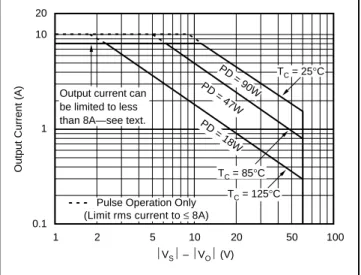
FIGURE 6. Safe Operating Area.
External logic circuitry or an LED can be used to indicate if the output has been thermally shutdown, see Figure 10.
Output Disable and Thermal Shutdown Status
As mentioned earlier, the OPA549’s output can be disabled and the disable status can be monitored simultaneously. Figure 5 provides an example of interfacing to the E/S pin.
SAFE OPERATING AREA
Stress on the output transistors is determined both by the output current and by the output voltage across the conduct-ing output transistor, VS – VO. The power dissipated by the output transistor is equal to the product of the output current and the voltage across the conducting transistor, VS – VO. The Safe Operating Area (SOA curve, Figure 6) shows the
The safe output current decreases as VS – VO increases. Output short circuits are a very demanding case for SOA. A short circuit to ground forces the full power-supply voltage (V+ or V–) across the conducting transistor. Increasing the case temperature reduces the safe output current that can be tolerated without activating the thermal shutdown circuit of the OPA549. For further insight on SOA, consult Application Report SBOA022 at the Texas Instruments web site (www.ti.com).
POWER DISSIPATION
Power dissipation depends on power supply, signal, and load conditions. For dc signals, power dissipation is equal to the product of output current times the voltage across the con-ducting output transistor. Power dissipation can be mini-mized by using the lowest possible power-supply voltage necessary to assure the required output voltage swing. For resistive loads, the maximum power dissipation occurs at a dc output voltage of one-half the power-supply voltage. Dissipation with ac signals is lower. Application Bulletin SBOA022 explains how to calculate or measure power dissipation with unusual signals and loads.
THERMAL PROTECTION
Power dissipated in the OPA549 will cause the junction temperature to rise. Internal thermal shutdown circuitry shuts down the output when the die temperature reaches approxi-mately 160°C and resets when the die has cooled to 140°C. Depending on load and signal conditions, the thermal protec-tion circuit may cycle on and off. This limits the dissipaprotec-tion of the amplifier but may have an undesirable effect on the load. Any tendency to activate the thermal protection circuit indi-cates excessive power dissipation or an inadequate heat sink. For reliable operation, junction temperature should be limited to 125°C maximum. To estimate the margin of safety in a complete design (including heat sink) increase the ambient temperature until the thermal protection is triggered.
1 2 5 10 VS – VO (V) 20 50 100 10 20 1
Output Current (A)
0.1
Pulse Operation Only
(Limit rms current to ≤ 8A)
Output current can be limited to less than 8A—see text.
TC = 125°C TC = 85°C TC = 25°C PD = 90W PD = 47W PD = 18W OPA549 E/S HCT Logic Ground Ref
E/S pin can interface with standard HCT logic inputs. Logic ground is referred to Ref. OPA549 E/S Open Drain (Output Disable) HCT (Thermal Status Shutdown) Logic Ground Ref
Open-drain logic output can disable the amplifier's output with a logic low. HCT logic input monitors thermal shutdown status during normal operation.
Use worst-case load and signal conditions. For good reliabil-ity, thermal protection should trigger more than 35°C above the maximum expected ambient condition of your applica-tion. This produces a junction temperature of 125°C at the maximum expected ambient condition.
The internal protection circuitry of the OPA549 was designed to protect against overload conditions. It was not intended to replace proper heat sinking. Continuously running the OPA549 into thermal shutdown will degrade reliability.
AMPLIFIER MOUNTING AND HEAT SINKING
Most applications require a heat sink to assure that the maximum operating junction temperature (125°C) is not exceeded. In addition, the junction temperature should be kept as low as possible for increased reliability. Junction temperature can be determined according to the Equations:
TJ = TA + PDθJA (4)
where θJA = θJC + θCH + θHA (5)
TJ = Junction Temperature (°C) TA = Ambient Temperature (°C) PD = Power Dissipated (W)
θJC = Junction-to-Case Thermal Resistance (°C/W) θCH= Case-to-Heat Sink Thermal Resistance (°C/W) θHA = Heat Sink-to-Ambient Thermal Resistance (°C/W) θJA = Junction-to-Air Thermal Resistance (°C/W) Figure 7 shows maximum power dissipation versus ambient temperature with and without the use of a heat sink. Using a heat sink significantly increases the maximum power dissipa-tion at a given ambient temperature, as shown in Figure 7. The challenge in selecting the heat sink required lies in determining the power dissipated by the OPA549. For dc output, power dissipation is simply the load current times the voltage developed across the conducting output transistor, PD = IL (VS – VO). Other loads are not as simple. Consult the SBOA022 Application Report for further insight on calculat-ing power dissipation. Once power dissipation for an applica-tion is known, the proper heat sink can be selected.
Heat Sink Selection Example—An 11-lead power ZIP
pack-age is dissipating 10 Watts. The maximum expected ambient temperature is 40°C. Find the proper heat sink to keep the junction temperature below 125°C (150°C minus 25°C safety margin).
Combining Equations (4) and (5) gives:
TJ = TA + PD ( θJC + θCH + θHA ) (6) TJ, TA, and PD are given. θJC is provided in the Specifications Table, 1.4°C/W (dc). θCH can be obtained from the heat sink manufacturer. Its value depends on heat sink size, area, and material used. Semiconductor package type, mounting screw torque, insulating material used (if any), and thermal joint
compound used (if any) also affect θCH. A typical θCH for a mounted 11-lead power ZIP package is 0.5°C/W. Now we can solve for θHA:
θHA = [(TJ – TA)/PD] – θJC – θCH
θHA = [(125°C – 40°C)/10W] – 1.4°C/W – 0.5°C/W θHA = 6.6°C/W
To maintain junction temperature below 125°C, the heat sink selected must have a θHA less than 6.6°C/W. In other words, the heat sink temperature rise above ambient must be less than 66°C (6.6°C/W • 10W). For example, at 10W Thermalloy model number 6396B has a heat sink temperature rise of 56°C (θHA = 56°C/10W = 5.6°C/W), which is below the required 66°C required in this example. Thermalloy model number 6399B has a sink temperature rise of 33°C (θHA = 33°C/10W = 3.3°C/W), which is also below the required 66°C required in this example. Figure 7 shows power dissipation versus ambient temperature for a 11-lead power ZIP package with the Thermalloy 6396B and 6399B heat sinks.
FIGURE 7. Maximum Power Dissipation vs Ambient Temperature.
Another variable to consider is natural convection versus forced convection air flow. Forced-air cooling by a small fan can lower θCA (θCH + θHA) dramatically. Some heat sink manufacturers provide thermal data for both of these cases. Heat sink performance is generally specified under idealized conditions that may be difficult to achieve in an actual application. For additional information on determining heat sink requirements, consult Application Report SBOA021.
0 25 50 75 100 125 30 20 10 0 Power Dissipation (W) Ambient Temperature (°C) Thermalloy 6399B HA = 5.6°C/W assume CH = 0.5°C/W OPA549 JC = 1.4°C/W JA = 7.5°C/W Thermalloy 6396B HA = 3.3°C/W assume CH = 0.5°C/W OPA549 JC = 1.4°C/W JA = 5.2°C/W θ θ θ θ θ θ θ θ with Thermalloy 6396B Heat Sink, θJA = 7.5°C/W with Thermalloy 6399B Heat Sink, θJA = 5.2°C/W PD = (TJ (max) – TA)/ JA (TJ (max) – 150°C) θ
with No Heat Sink,
JA = 30°C/W
avoided with clamp diodes from the output terminal to the power supplies, as shown in Figure 8. Schottky rectifier diodes with a 8A or greater continuous rating are recom-mended.
VOLTAGE SOURCE APPLICATION
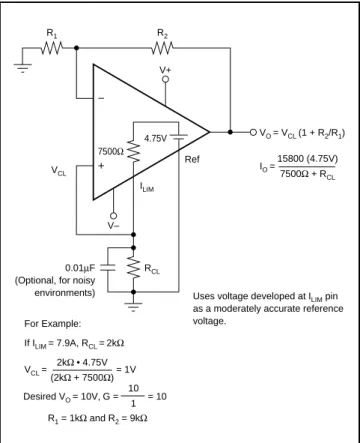
Figure 9 illustrates how to use the OPA549 to provide an accurate voltage source with only three external resistors. First, the current limit resistor, RCL, is chosen according to the desired output current. The resulting voltage at the ILIM pin is constant and stable over temperature. This voltage, VCL, is connected to the noninverting input of the op amp and used as a voltage reference, thus eliminating the need for an external reference. The feedback resistors are selected to gain VCL to the desired output voltage level.
As mentioned earlier, once a heat sink has been selected, the complete design should be tested under worst-case load and signal conditions to ensure proper thermal protection. Any tendency to activate the thermal protection circuitry may indicate inadequate heat sinking.
The tab of the 11-lead power ZIP package is electrically connected to the negative supply, V–. It may be desirable to isolate the tab of the 11-lead power ZIP package from its mounting surface with a mica (or other film) insulator. For lowest overall thermal resistance, it is best to isolate the entire heat sink/OPA549 structure from the mounting surface rather than to use an insulator between the semiconductor and heat sink.
OUTPUT STAGE COMPENSATION
The complex load impedances common in power op amp applications can cause output stage instability. For normal operation, output compensation circuitry is typically not re-quired. However, for difficult loads or if the OPA549 is in-tended to be driven into current limit, an R/C network may be required. Figure 8 shows an output R/C compensation (snub-ber) network which generally provides excellent stability.
FIGURE 8. Motor Drive Circuit.
FIGURE 9. Voltage Source.
G = – = –4R2 R1 10Ω (Carbon) 0.01µF R2 20kΩ R1 5kΩ OPA549 V– V+ VIN Motor D1 D2 D1, D2 : Schottky Diodes 7500Ω RCL ILIM 0.01µF
(Optional, for noisy environments) 4.75V IO = 15800 (4.75V) 7500Ω + RCL VO = VCL (1 + R2/R1) Ref V+ VCL VCL = = 1V Desired VO = 10V, R1 = 1kΩ and R2 = 9kΩ G = = 1010 1 For Example: 2kΩ • 4.75V (2kΩ + 7500Ω) If ILIM = 7.9A, RCL =2kΩ V– R2 R1
Uses voltage developed at ILIM pin
as a moderately accurate reference voltage.
A snubber circuit may also enhance stability when driving large capacitive loads (> 1000pF) or inductive loads (motors, loads separated from the amplifier by long cables). Typically, 3Ω to 10Ω resistors in series with 0.01µF to 0.1µF capacitors is adequate. Some variations in circuit values may be required with certain loads.
OUTPUT PROTECTION
Reactive and EMF-generating loads can return load current to the amplifier, causing the output voltage to exceed the power-supply voltage. This damaging condition can be
PROGRAMMABLE POWER SUPPLY
A programmable source/sink power supply can easily be built using the OPA549. Both the output voltage and output current are user-controlled. See Figure 10 for a circuit using potentiometers to adjust the output voltage and current while Figure 11 uses DACs. An LED connected to the E/S pin through a logic gate indicates if the OPA549 is in thermal shutdown.
FIGURE 10. Resistor-Controlled Programmable Power Supply.
FIGURE 11. Digitally-Controlled Programmable Power Supply.
G = 1 + = 109kΩ 1kΩ 9kΩ 1kΩ OPA549 +5V +5V 0.12V to 2.5V 0V to 4.75V Output Adjust Thermal Shutdown Status (LED) 74HCT04 R ≥ 250Ω E/S VO = 1V to 25V IO = 0 to 10A 9 6 8 4 3 Ref ILIM 10.5kΩ 499Ω 10kΩ Current Limit Adjust 1kΩ 20kΩ 0.01µF V– V+ = +30V V– = 0V DAC B 1/2 DAC7800/1/2 1/2 DAC7800/1/2(3) 10pF IOUT B RFB B AGND B 0.01µF ILIM Thermal Shutdown Status (LED) 74HCT04 R ≥ 250Ω 9kΩ 1kΩ VO = 7V to 25V V+ = +30V V– = 0V IO = 0A to 10A G = 10 Ref 8 9 1, 2 E/S 6 4 3 DAC A +5V +5V VREF B DGND 10pF IOUT A RFB A OUTPUT ADJUST OPA549
CURRENT LIMIT ADJUST AGND A VREF A
Choose DAC780X based on digital interface: DAC7800—12-bit interface, DAC7801—8-bit interface + 4 bits, DAC7802—serial interface.
1/2 OPA2336 1/2 OPA2336 VREF –5V
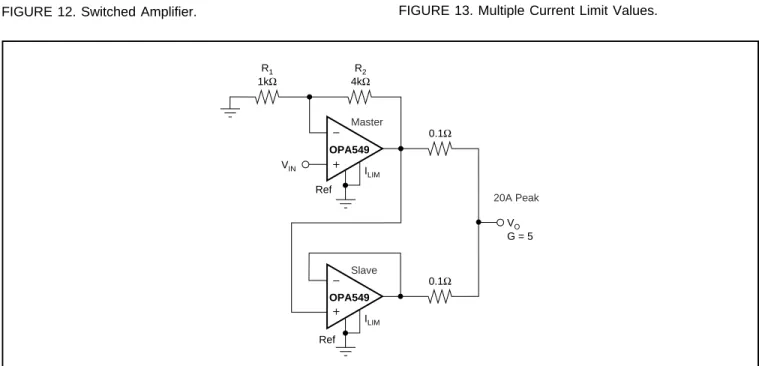
FIGURE 13. Multiple Current Limit Values. FIGURE 12. Switched Amplifier.
FIGURE 14. Parallel Output for Increased Output Current. E/S R2 R1 VIN1 OPA549 VO E/S R4 R3
Limit output slew rates to ≤ 3V/µs (see text).
VE/S VIN2 OPA549 OPA549 RCL2 RCL1 Ref
Close for high current (could be open drain output of a logic gate).
ILIM ILIM Ref Ref R1 1kΩ R2 4kΩ OPA549 OPA549 VO G = 5 VIN 0.1Ω 0.1Ω ILIM Master Slave 20A Peak
PACKAGE OPTION ADDENDUM
www.ti.com 22-Oct-2013
PACKAGING INFORMATION
Orderable Device Status
(1)
Package Type Package Drawing Pins Package Qty Eco Plan (2) Lead/Ball Finish (6) MSL Peak Temp (3)
Op Temp (°C) Device Marking
(4/5)
Samples
OPA549S ACTIVE Power Package KVC 11 25 Green (RoHS
& no Sb/Br)
CU SN N / A for Pkg Type -40 to 85 OPA549S
OPA549SG3 ACTIVE Power Package KVC 11 25 Green (RoHS
& no Sb/Br)
CU SN N / A for Pkg Type -40 to 85 OPA549S
OPA549T ACTIVE TO-220 KV 11 25 Green (RoHS
& no Sb/Br)
CU SN N / A for Pkg Type -40 to 85 OPA549T
OPA549TG3 ACTIVE TO-220 KV 11 25 Green (RoHS
& no Sb/Br)
CU SN N / A for Pkg Type -40 to 85 OPA549T
(1)
The marketing status values are defined as follows:
ACTIVE: Product device recommended for new designs.
LIFEBUY: TI has announced that the device will be discontinued, and a lifetime-buy period is in effect.
NRND: Not recommended for new designs. Device is in production to support existing customers, but TI does not recommend using this part in a new design. PREVIEW: Device has been announced but is not in production. Samples may or may not be available.
OBSOLETE: TI has discontinued the production of the device.
(2)
Eco Plan - The planned eco-friendly classification: Pb-Free (RoHS), Pb-Free (RoHS Exempt), or Green (RoHS & no Sb/Br) - please check http://www.ti.com/productcontent for the latest availability
information and additional product content details.
TBD: The Pb-Free/Green conversion plan has not been defined.
Pb-Free (RoHS): TI's terms "Lead-Free" or "Pb-Free" mean semiconductor products that are compatible with the current RoHS requirements for all 6 substances, including the requirement that
lead not exceed 0.1% by weight in homogeneous materials. Where designed to be soldered at high temperatures, TI Pb-Free products are suitable for use in specified lead-free processes.
Pb-Free (RoHS Exempt): This component has a RoHS exemption for either 1) lead-based flip-chip solder bumps used between the die and package, or 2) lead-based die adhesive used between
the die and leadframe. The component is otherwise considered Pb-Free (RoHS compatible) as defined above.
Green (RoHS & no Sb/Br): TI defines "Green" to mean Pb-Free (RoHS compatible), and free of Bromine (Br) and Antimony (Sb) based flame retardants (Br or Sb do not exceed 0.1% by weight
in homogeneous material) (3)
MSL, Peak Temp. - The Moisture Sensitivity Level rating according to the JEDEC industry standard classifications, and peak solder temperature. (4)
There may be additional marking, which relates to the logo, the lot trace code information, or the environmental category on the device. (5)
Multiple Device Markings will be inside parentheses. Only one Device Marking contained in parentheses and separated by a "~" will appear on a device. If a line is indented then it is a continuation of the previous line and the two combined represent the entire Device Marking for that device.
(6)
PACKAGE OPTION ADDENDUM
www.ti.com 22-Oct-2013
Important Information and Disclaimer:The information provided on this page represents TI's knowledge and belief as of the date that it is provided. TI bases its knowledge and belief on information
provided by third parties, and makes no representation or warranty as to the accuracy of such information. Efforts are underway to better integrate information from third parties. TI has taken and continues to take reasonable steps to provide representative and accurate information but may not have conducted destructive testing or chemical analysis on incoming materials and chemicals. TI and TI suppliers consider certain information to be proprietary, and thus CAS numbers and other limited information may not be available for release.
IMPORTANT NOTICE
Texas Instruments Incorporated and its subsidiaries (TI) reserve the right to make corrections, enhancements, improvements and other changes to its semiconductor products and services per JESD46, latest issue, and to discontinue any product or service per JESD48, latest issue. Buyers should obtain the latest relevant information before placing orders and should verify that such information is current and complete. All semiconductor products (also referred to herein as “components”) are sold subject to TI’s terms and conditions of sale supplied at the time of order acknowledgment.
TI warrants performance of its components to the specifications applicable at the time of sale, in accordance with the warranty in TI’s terms and conditions of sale of semiconductor products. Testing and other quality control techniques are used to the extent TI deems necessary to support this warranty. Except where mandated by applicable law, testing of all parameters of each component is not necessarily performed.
TI assumes no liability for applications assistance or the design of Buyers’ products. Buyers are responsible for their products and applications using TI components. To minimize the risks associated with Buyers’ products and applications, Buyers should provide adequate design and operating safeguards.
TI does not warrant or represent that any license, either express or implied, is granted under any patent right, copyright, mask work right, or other intellectual property right relating to any combination, machine, or process in which TI components or services are used. Information published by TI regarding third-party products or services does not constitute a license to use such products or services or a warranty or endorsement thereof. Use of such information may require a license from a third party under the patents or other intellectual property of the third party, or a license from TI under the patents or other intellectual property of TI.
Reproduction of significant portions of TI information in TI data books or data sheets is permissible only if reproduction is without alteration and is accompanied by all associated warranties, conditions, limitations, and notices. TI is not responsible or liable for such altered documentation. Information of third parties may be subject to additional restrictions.
Resale of TI components or services with statements different from or beyond the parameters stated by TI for that component or service voids all express and any implied warranties for the associated TI component or service and is an unfair and deceptive business practice. TI is not responsible or liable for any such statements.
Buyer acknowledges and agrees that it is solely responsible for compliance with all legal, regulatory and safety-related requirements concerning its products, and any use of TI components in its applications, notwithstanding any applications-related information or support that may be provided by TI. Buyer represents and agrees that it has all the necessary expertise to create and implement safeguards which anticipate dangerous consequences of failures, monitor failures and their consequences, lessen the likelihood of failures that might cause harm and take appropriate remedial actions. Buyer will fully indemnify TI and its representatives against any damages arising out of the use of any TI components in safety-critical applications.
In some cases, TI components may be promoted specifically to facilitate safety-related applications. With such components, TI’s goal is to help enable customers to design and create their own end-product solutions that meet applicable functional safety standards and requirements. Nonetheless, such components are subject to these terms.
No TI components are authorized for use in FDA Class III (or similar life-critical medical equipment) unless authorized officers of the parties have executed a special agreement specifically governing such use.
Only those TI components which TI has specifically designated as military grade or “enhanced plastic” are designed and intended for use in military/aerospace applications or environments. Buyer acknowledges and agrees that any military or aerospace use of TI components which have not been so designated is solely at the Buyer's risk, and that Buyer is solely responsible for compliance with all legal and regulatory requirements in connection with such use.
TI has specifically designated certain components as meeting ISO/TS16949 requirements, mainly for automotive use. In any case of use of non-designated products, TI will not be responsible for any failure to meet ISO/TS16949.
Products Applications
Audio www.ti.com/audio Automotive and Transportation www.ti.com/automotive
Amplifiers amplifier.ti.com Communications and Telecom www.ti.com/communications
Data Converters dataconverter.ti.com Computers and Peripherals www.ti.com/computers
DLP® Products www.dlp.com Consumer Electronics www.ti.com/consumer-apps
DSP dsp.ti.com Energy and Lighting www.ti.com/energy
Clocks and Timers www.ti.com/clocks Industrial www.ti.com/industrial
Interface interface.ti.com Medical www.ti.com/medical
Logic logic.ti.com Security www.ti.com/security
Power Mgmt power.ti.com Space, Avionics and Defense www.ti.com/space-avionics-defense
Microcontrollers microcontroller.ti.com Video and Imaging www.ti.com/video
RFID www.ti-rfid.com
OMAP Applications Processors www.ti.com/omap TI E2E Community e2e.ti.com
Wireless Connectivity www.ti.com/wirelessconnectivity
Mailing Address: Texas Instruments, Post Office Box 655303, Dallas, Texas 75265 Copyright © 2013, Texas Instruments Incorporated