Alyssa A. Spoonts. Understanding Gaps in Special Collections Education Through a Content Analysis of Syllabi. A Master’s Paper for the M.S. in L.S degree. April 2018. 35 pages. Advisor: Elizabeth Ott
This study aims to understand the gaps in the education of future special collections
professionals by examining syllabi for rare book and special collections librarianship courses. The history of library education will show that special collections coursework has not
historically held an important place in library school curricula. Today, however, courses in rare book and special collections librarianship are an essential means by which future special collections professionals develop the specialized skills needed for success in the profession. Using content analysis, this study compares syllabi for special collections librarianship courses at ALA-accredited library and information science programs with ACRL’s Guidelines: Competencies for Special Collections Professionals to identify gaps and overlooked areas in library school curricula.
Headings:
Library school curriculum
Library education
Library school students
Library special collections
Rare book libraries
UNDERSTANDING GAPS IN SPECIAL COLLECTIONS EDUCATION THROUGH A CONTENT ANALYSIS OF SYLLABI
by
Alyssa A. Spoonts
A Master’s paper submitted to the faculty of the School of Information and Library Science of the University of North Carolina at Chapel Hill
in partial fulfillment of the requirements for the degree of Master of Science in
Library Science.
Chapel Hill, North Carolina
April 2018
Approved by
Table of Contents
Introduction ... 2
Literature Review ... 6
Methods ... 19
Results ... 23
Discussion ... 27
Conclusion ... 29
Introduction
Rare book librarians are a happy breed of men and women. We share common experiences and common pleasures, but there is nothing common about us. … As temporary custodians of the world’s greatest books and manuscripts which record man’s highest and also his lowest aspirations and his unending struggle to understand the world about him, to improve or to change it, or even unwittingly to destroy it, we share a personal destiny with the world of the past and the expectations of the world to come.1
Frederick R. Goff, former Curator of Rare Books at the Library of Congress, spoke
these words in a 1974 lecture at the Boston Public Library. In his speech, called “The
Delights of a Rare Book Librarian,” Goff perfectly captures the philosophy that drives
special collections librarianship. The work of special collections librarians, as Goff suggests,
centers around the materials held in a collection, materials of historical and cultural import.
These materials are unique--not only because of their content, but sometimes because of
their provenance, their production, or their construction. Because of the materials housed in
special collections libraries, the work of special collections librarians is different from that of
academic librarians at large. Consider, for example, the work of collection development.
Special collections libraries do not collect new materials that are currently being produced in
duplicate, and the acquisition of materials cannot rely on an algorithm. Professionals
involved in collection development consider the history, focus, strengths, and weaknesses of
existing collections and select additional materials carefully, while also taking the mission of
their institution, budgetary restrictions, and preservation and conservation concerns
into account.
Likewise, security concerns in a special collections library are different from that of
general collections in academic libraries. The uniqueness of the materials, their monetary
value, and their cultural import make security a top priority. If something is lost, a patron
cannot simply be fined for the cost of its replacement--replacing an item might be
impossible. Additionally, one of the primary functions of a special collections library is the
preservation of culture and history, which cannot be accomplished without strict security
measures governing the use of collections.
For the same reason, special collections professionals must be able to understand
every facet of the materials in their charge. The leather, paper, or wood from which a book is
made could be as important as what is contained within its pages, and could have significant
implications for the preservation and conservation of that item. Additionally, preservation
and conservation efforts in special collections must take into account the historical nature of
the materials, their monetary and cultural value, and historical practices used to create them,
providing access to the materials in the present while ensuring their access in the future.
Access is yet another area in which special collections are different. In special
collections libraries, researchers do not have the relatively unfettered access that they enjoy
in general collections. Rather, their use of collections must take place under supervision and
sometimes with the help of a special collections professional to help them understand
exactly why they are restricted in their use of the collections. These restrictions, while
ensuring the safety of the materials in a special collections library, also provide an obstacle to
outreach that is difficult for these libraries to overcome, since future visitors and patrons
collections before they’ll come through the door. For these reasons, special collections
librarians require a specialized set of skills and knowledge that prepare them to work with
the materials in a special collections setting.
How the education of special collections professionals is conducted and what that
education entails has long been a matter of debate among leaders in the field. While the
subject of education is understood to encompass both current members of the profession
and students hoping to work in special collections, little attention has been paid to students
enrolled in graduate programs in library science and the way that their education in special
collections is conducted. Understanding what special collections librarianship skills are
taught in degree-granting programs in library science and how they are taught is essential to
ensuring that future special collections professionals receive the specialized knowledge that is
required to successfully enter the profession. What exactly constitutes that specialized
knowledge has been in constant flux over the last century, as emphasis has from shited from
subject expertise to a more holistic set of skills and competencies, one that overlaps with all
academic librarianship but contains more specialized skills for special collections.
In 2001, growing concern over the state of special collections education led the
Association of Research Libraries (ARL) to call together the Task Force on Special
Collections, an action that set in motion a chain of events that ultimately led to the creation
of “Guidelines: Competencies for Special Collections Professionals,” which was approved by
the Association of College and Research Libraries (ACRL) in 2008.
Nearly a decade later, in March 2017, the ACRL Board approved a revision to the
Competencies. This new document updated the skills required by positions in rare book and
special collections librarianship, adding new skills that had become necessary in the
Competencies, these guidelines are intended to serve many purposes for current and hopeful
members of the profession and for educators, detailing the fundamental competencies
required by the profession in a measurable way.
In the introduction to the Competencies, the following purpose is laid out:
This document is intended to define professional practice and to foster a sense of community and common identity among special collections professionals [my emphasis]. We hope that the statement will prove helpful to those planning a career in special collections,
archives, and libraries current members of the profession and administrators writing or reviewing position descriptions and making hiring decisions. Additionally, this document hopes to assist educators developing library and information studies (LIS) curricula by clarifying relevant skill sets and by identifying educational priorities for future special collections professionals [my emphasis]. These competencies aim to be measurable and to be written in a way that will allow their users to assess progress toward learning objectives and career development.2
Therefore, the Competencies are not intended as a checklist of skills that must be
attained for success in special collections librarianship. Rather, the dual nature of the
Competencies provides for a clearer understanding of the philosophy that underlies the
profession and some specific, actionable skills related to facets of the work that special
collections professionals may be called upon to do. Additionally, the format of the
Competencies and the delineation of skills helps to contextualize special collections work in
the greater context of academic librarianship as a whole.
As such, it is unclear how students are served by the existence of the Competencies
and how the Competencies are addressed in rare book and special collections librarianship
courses. This coursework is essential to ensuring that students are prepared to enter the
profession when they complete their library school training. The goal of this research is to
clarify the role of coursework in training rare book and special collections librarians. By
comparing course syllabi for courses in rare book and special collections librarianship to the
ACRL’s Competencies for Special Collections Professionals, this study aims to identify
whether or not the courses students take in library school adequately prepare them to meet
the minimum competency levels as set forth in the guidelines.
Literature Review
A Brief History of Special Collections Education
Writing in 1988, William J. Joyce laid out the development of special collections in
the United States in four distinct phases. The first phase, which began in the late nineteenth
century, “entailed little more than identifying and segregating rare books” from the
collections of the earliest libraries at colleges and universities in the United States, but with
no provisions made for staff or for using the collections.3 The advent of rare book
collections in American institutions of higher learning took place concurrently with an uptick
in the antiquarian book trade and the rise of the great bibliophile collectors such as J.P.
Morgan and Henry Huntington. If staff were hired to look after these collections,
particularly those held in colleges and universities, their role was more akin to that of a
custodian rather than a librarian.4
Joyce’s second phase began in the early 20th century, at which time “‘treasure rooms’
and ‘rare book rooms’ began to appear.”5 Alice Schreyer notes that during this time the
prices of rare books began to rise sharply, causing institutions to understand the importance
of safeguarding the materials already in their collections.6 The treasure room model
proliferated as collections grew through donations and bequests from wealthy alumni “who
felt that ‘special’ collections (in this context, the term implied exceptional and superior)
3 Joyce, “The Evolution of the Concept of Special Collections in American Research Libraries.”
4 One notable exception to this is Belle da Costa Greene, librarian to J.P. Morgan and first director of the Morgan Library. Though Greene had no formal librarianship training, her keen eye and expertise with illuminated manuscripts built the Morgan collection into one of the preeminent rare book collections in the world. See: Ardizzone, An Illuminated Life: Belle Da Costa Greene’s Journey from Prejudice to Privilege.
would enhance the prestige of their alma mater.”7 Note the difference between Scheyer’s use
of the historical term special collections and the way that this term is commonly used today.
While today special collections are generally regarded as collections of materials focused on a
single topic, geographic area, or theme, the special collections that Schreyer refers to were
largely collections of rare books, particularly by authors important in the Western literary
canon, and were called special because of the rare and unique nature of the materials.
In these “treasure rooms” the emphasis was placed largely on safeguarding the
materials, and little no to attention was paid to access and use; curators of these collections
generally came “from the faculty or the booktrade,” and access was largely based on personal
relationships between advanced scholars and curators.8 Little to no regard was paid to
opening these collections for research purposes, and the importance and value of the books
in these collections was conflated with their monetary value rather than their cultural value
or their usefulness as primary sources.
The decades between the world wars, particularly the 1930s, saw the rise of the
scholar librarian. In these positions, librarians added scholarship to their custodial and
curation responsibilities. In this era, Joyce’s third phase, there was a marked rise in
professionally trained special collections librarians.9 However, as Roderick Cave points out,
the knowledge that these librarians applied to the collections in their charge came largely
from other academic disciplines, such as textual studies and history.10 This continued the
pattern of special collections librarians possessing subject specific knowledge, with skills and
knowledge learned through formal library training building upon that foundation.
7 Ibid.
8 Ibid. Schreyer’s point about early collection curators coming from among university faculty or from the antiquarian book trade still rings true today, as limited academic job opportunities lead more scholars with PhDs in the humanities into “alt-ac” careers in libraries, archives, and museums.
The 1960s and 70s brought about the beginning of Joyce’s fourth and final phase.11
During this period, there was a “rapid expansion of state university systems” and scholarly
research became more disciplinarily defined.12 Therefore, it makes sense that collections
would have begun to develop along disciplinary lines as well. This era also saw a turn toward
special collections librarians developing subject specialties through additional advanced
degrees. As colections grew and developed in disciplinary siloes, subject specific knowledge
helped special collections librarians fulfill their roles and rise to meet the changing needs of
scholars and researchers. This trend continues today, as many higher level positions in
special collections require multiple advanced degrees.13 The pattern of subject specialization
echoes an earlier period in which special collections librarians came from departmental
faculty and brought their subject expertise with them.
It is difficult to situate special collections education within the history of library
schools, because many historical treatments of the development of library school curricula
omit special collections librarianship entirely. Discussions of American library education
from 1929, 1949, 1966, and 1976 contain no mention of special collections librarianship or
related courses, and few scholars within special collections have studied the history of the
field with an eye to education.14 Even more recent works that could reasonably be expected
to discuss special collections librarianship, such as Mary Ellen Quinn’s Historical Dictionary of
Librarianship, there is no mention of rare books or special collections, and the section on
bibliography treats only enumerative, and not descriptive, bibliography.15
11 Since Joyce was writing about the development of special collections libraries in 1988, it is conceivable that we might add a fifth phase to his analysis: the digital age. Certainly special collections librarianship has changed enough in the 30 intervening years to warrant this addition.
12 Joyce, “The Evolution of the Concept of Special Collections in American Research Libraries.”
13 Hansen, “Education, Training, and Recruitment of Special Collections Librarians: An Analysis of Job Advertisements.” 14 See: Churchwell, The Shaping of American Library Education; Churchwell, “Education for Librarianship in the United States: Some Factors Which Influenced Its Development between 1919 and 1939”; White, The Origins of the American Library School; Berelson, Education for Librarianship: Papers Presented at the Library Conference, University of Chicago, August 16-21, 1948.
Special Collections Education Today
At the turn of the twenty-first century came the question of what exactly special
collections librarianship looked like in the digital age, and understanding the evolution of the
profession became a prevailing concern among practitioners. In 2001, “what’s so special
about special collections” was the focus of the first issue of RBM. Topics discussed in that
issue included:
• The importance of online cataloging
• Teaching from archives and connecting people with collections
• Digital facsimiles and the primacy of physical objects
• Librarians’ enthusiasm for collections
• Interpretation as central to what makes a collection special
It is interesting to note that nearly twenty years later, many of these topics are still being
discussed, albeit in the context of even greater digital change.
In the new century, special collections librarianship was different from what it had
been fifty years before, but what had changed? Mark Dimunation asserts that his
predecessors at the Library of Congress wouldn’t recognize his job as the same one they had
held, nor understand many of his daily duties.16 Speaking in particular of his predecessor
Frederick R. Goff, whose tenure at the Library of Congress began in the mid-1940s,
Dimunation says,
When Goff signed on to his position, the Rare Book Collection comprised 127,000 volumes. Today the collection numbers well more than 800,000 volumes. I live in a very different world than that of my predecessors. Our language is different, and that difference mirrors the pace and emphasis of our daily work. Goff ’s vocabulary included card sets, multiliths, cardex, microcard,
order department, secretary, and carbon copy. Today, my language is as if from the
moon: HVAC, EEOcompliant, indirectcostrecovery, vendor code, pixel count, Web harvesting, K–12, keywords, and bar codes.
He further states that in terms of daily duties, “what has evolved over the past fifty
years is in essence a new profession” with many of the same objectives but placed in an
entirely new context. So for Dimunation, at least, the addition of digital technologies, an
expanded audience for collections, environmental and preservation concerns, and budgetary
restrictions have changed the profession so completely that it would be unrecognizable to
past practitioners.
The last decade has seen greater collaboration and understanding between and
among special collections professionals and librarians from other areas of librarianship.
However, a historic view of the profession suggests that special collections education exists
necessarily in a separate space from other forms of librarianship, largely because of the
cultural importance of the materials held in special collections. Michael Garabedian asserts
that the culture of exclusivity that continues to plague special collections rises in part from
this view of the profession, by both special collections professionals and members of the
library community at large.17 The “inculcation of exclusivity” to which special collections
professionals often fall victim, which Daniel Traister calls “absorption,” is also a byproduct
of the way that special collections education is generally conducted.18 In other words, library
school students are often taught that special collections libraries are exceptional cases in
many common areas of librarianship, including collection development, reference and
preservation and conservation.
Indeed, best practices in special collections libraries are often different enough from
other areas of librarianship that the common solution in library schools is to create a class
17 Garabedian, “‘You’ve Got to Be Carefully Taught’: American Special Collections Library Education and the Inculcation of Exclusivity.”
solely focused on special collections librarianship rather than to incorporate those skills into
other, broadly focused classes. All too often, even our colleagues within the library
profession have an alarming tendency to view special collections as repositories of esoterica
with little relevance to modern trends in librarianship.19 However, as Alice Schreyer noted,
“education and training for special collections librarianship cannot be separated from
discussions of our identity, our mission, and our interrelationships with our professional
colleagues”.20 Simply put, special collections librarians require specialized skills in addition to
the skills fundamental to all 21st-century librarianship. However, one skill set does not
supercede the other. Rather, the two sets of skills must work in concert with each other. For
instance, a cataloger in an academic library setting would not necessarily need to have an
understanding of descriptive bibliography. However, in the opposite direction, the same is
not true. A cataloger working in special collections probably needs to know descriptive
bibliography and understand cataloging and subject analysis more generally.
The most recently published articles and textbooks on rare book and special
collections librarianship place bibliography at the heart of the skills required by members of
the profession.21 Steven K. Galbraith and Geoffrey D. Smith go so far as to say that
“bibliography, in all its varieties, is the backbone of rare books librarianship,” though they
further qualify this statement with the addendum that “bibliography is an academic field of
its own and cannot be covered comprehensively in a single rare book librarianship course.”22
This focus on the book as a physical object continues to place the codex at the center of
special collections, in spite of a recent analysis of special collections job advertisements by
19 Samuelson and Coker, “Mind the Gap: Integrating Special Collections Teaching.” 20 Schreyer, “What’s So Special about Special Collections Librarians?”
21 Sidney E. Berger, Rare Books and Special Collections (Chicago: Neal-Schuman, 2014); Steven K. Galbraith and Geoffrey D. Smith, Rare Book Librarianship : An Introduction and Guide (Santa Barbara: Libraries Unlimited, 2012); Susan Stekel Rippley, “The Education and Hiring of Special Collections Librarians,” RBM: A Journal of Rare Books, Manuscripts, and Cultural Heritage
6, no. 2 (2005): 82–90.
Kelli Hansen, which discovered that entry level special collections positions require many
more skills than basic bibliography.23 In particular, Hansen points to the apparent blurring of
the lines between archivists and special collections librarians, with many job descriptions
combining special collections librarianship with specialized knowledge about archival
processing and description.24
The same sentiment is echoed by Schreyer et al., who note the combination of
historically disctinct job categories.25 As the skills required for special collections work are
expanding, traditional categories and job duties have been redefined to reflect the field as it
stands now. However, Scheyer et al. also acknowledge the cultural divide that persists
between special collections librarians, archivists, and other academic librarians.26
The RBMS website contains a list of ALA-accredited library and information science
graduate programs in which each entry contains information about whether or not a named
specialization in special collections or rare books is available in that program. In this case,
specialization is defined as a named track or degree distinction which is pre-set, so students
do not have to “build” the specialization by putting relevant courses together. Of the 59
programs listed on the site, three programs have a specialization in rare books or special
collections librarianship: Indiana University Bloomington, Palmer School at Long Island
University, and University of Toronto. Other programs suggest that students can create
specializations by combining relevant coursework, but courses listed for each of these
programs on the RBMS website are not always offered every semester or even every year, so
23 Hansen, “Education, Training, and Recruitment of Special Collections Librarians: An Analysis of Job Advertisements.” 24 Ibid.
25 Schreyer et al., “Education and Training for Careers in Special Collections: A White Paper Prepared for the Association of Research Libraries Special Collections Task Force.”
students interested in those programs would have to choose courses carefully to ensure they
could craft their own specialization in rare book or special collections librarianship.27
External Programs
Programs like Rare Book School at the University of Virginia, the Book History
Workshop at Texas A&M University, and California Rare Book School at UCLA are all
touted as useful training tools for special collections professionals.28 However, these
programs are not without significant limitations, particularly for library school students. First
of all, financial support for participation in programs such as Rare Book School is limited.
The out-of-pocket costs for these programs are likely to be too great for library school
students, especially since funding for library and information science degrees is equally
scarce.
Furthermore, the requirement of an ALA-accredited library or information science
degree for most special collections positions suggests that student should be able to learn the
fundamental competencies of rare book and special collections without having to turn to
external programs. Reliance on external programs is concerning, as students who want to
pursue special collections careers may be left without means to acquire the necessary
education if programs do away with rare book and special collections courses altogether.
External programs should be considered professional development rather than as primary
sources of special collections education.
ACRL Guidelines: Competencies for Special Collections Professionals
In 2001, in response to growing concern over the state of special collections
education in the new century, the ARL appointed a Task Force on Special Collections, which
27 For more information, see:
https://rbms.info/committees/membership_and_professional/educational_opportunities/directory/
28 These formal instruction programs and others are listed on the Continuing Education and Professional Development page of the RBMS website:
was charged with creating a list of core competencies for special collections librarians. By
2003, the Task Force had created a document titled Research Libraries and the Commitment to
Special Collections, and in 2004 Alice Schreyer, head of the Task Force on Special Collections,
published the white paper “Education and Training for Careers in Special Collections”.29 In
this document, Schreyer et al. asserted that the growing demands of the digital age made it
necessary to create a list of core competencies for special collections professionals. Acting
on Schreyer et al.’s findings, the ACRL appointed a new task force under the auspices of the
Rare Books and Manuscript Section (RBMS), which produced “Guidelines: Competencies
for Special Collections Professionals.”30 This document was approved by the ACRL in July
2008.
In 2013, a new task force was appointed to determine whether or not the guidelines
should be amended, revoked, or renewed without changes. This new task force was called in
accordance with ACRL’s Guide to Policies and Procedures, which states that “each standard,
guideline, and framework document approved by ACRL is reviewed every five years after
approval.”31 The competencies as they currently stand are a result of amendments made to
the original document; they were approved in March 2017.
The new document, also titled “Guidelines: Competencies for Special Collections
Professionals,” combines important skills for all academic and research librarians with more
particular skills associated with special collections librarianship. The document is separated
into two main sections, Fundamental Competencies and Specialized Competencies. This
separation acknowledges the diverse nature of special collections, that part of what makes
29 “Competencies for Special Collections Professionals,” 2017. 30 Ibid.
special collections “special” is their uniqueness, their variation in terms of scope, nature of
the materials, and institutional mission.32
The Fundamental Competencies are meant to encompass a wide array of different
positions and responsibilities within special collections. This section has as its foundation the
Association of Southeastern Research Libraries’ (ASERL) document “Shaping the Future:
ASERL’s Competencies for Research Librarians,” adopted in 2000. According to the Task
Force, “the fundamental competencies should answer the question, ‘What defines a special
collections professional on the most basic level?’ regardless of the type of work one
performs.”33 These competencies detail a knowledge base that is common to all special
collections professionals, and on which the other skills should be founded. As such, all
special collections professionals should:
1. Understand the enduring cultural and intellectual value of special collections
2. Comprehend the history of and best practices for materials found in special
collections
3. Possess linguistic skills relvant to their collections
4. Possess knowedge related to book history and book arts, as well as subject
knowledge relevant to their collections
5. Understand the value of archival materials and concepts related to archival theory
6. Promote special collections through outreach and advocacy
7. Promote and support diverse collections, diverse audiences, and the integration of
special collections into the broader institutional mission
8. Participate in professional organizations
9. Commit to lifelong learning and the development of specialized competencies.34
The Fundamental Competencies are couched largely in cognitive terms. For this reason, they
constitute a mindset for special collections professionals rather than a set of measurable
skills. They are no less important than actionable skills, however, as many of the skills
described in the Fundamental Competencies relate directly to the philosophies that provide
the foundation for special collections work.
The Fundamental Competencies also lay the groundwork for the Specialized
Competencies, which detail the specific skills required by special collections work. The
Specialized Competencies combine cognitive terms with actionable skills, so they are more
measurable and useful for assessment. This section is divided into eight subsections:
collection development; description and access; information technologies and data
management; instruction; management, supervision, and leadership; preservation and
conservation; promotion and outreach; reference. Each of these sections are further divided
into specific, measurable skills. While all of the skills in this section are important, it is clear
that not all special collections professionals will have duties that encompass all areas and
skills covered. Rather, the skills detailed in each subsection are important for any
professional working in that area.
In many ways, the skills outlined in the Specialized Competencies look much the
same as the skills any academic librarian might need to know. Collection development,
description and access, outreach—thse are important in any library, in fact. However, it is
essential that these topics be covered in rare book and special collections courses because
the mindset and underlying philosophy of special collections are different from a public
library or an academic library. Concepts illustrating this mindset—and its importance to
special collections—are identified in each section of the Specialized Competencies. Consider
this statement about collection development, taken from the Competencies: “By deciding
what or what not to collect, librarians and archivists actively participate in the preservation
of intellectual and cultural history.”35 While many of the skills associated with collection
development could be said to be universally applicable, surely the difference—the thing that
makes special collections special—lies in this underlying philosophy. This suggests that the
culture of exclusivity censured by Garabedian and Traister is not based so much in the actual
skills of special collections librarians but rather in the reasoning behind special collections
work.
The stated purpose for the Competencies is to “define professional practice and to
foster a sense of community and common identity among special collections professionals”
including students considering a career in special collections, administrators writing job
descriptions, current professionals in the field, and educators teaching rare book and special
collections courses in library schools.36 While this stated goal is admirable, it is unclear how
exactly educators are taking the competencies into account when writing syllabi for courses.
Courses in rare book and special collections librarianship are an essential part of the
education of future special collections professionals. For many students, these courses are
the only specialized instruction they receive in their field while in library school, so it is
essential for these courses to prepare students to enter the field with a basic level of
proficiency. Unfortunately, the ACRL Competencies make it difficult to understand exactly
what basic proficiency looks like in terms of actual, measurable skills. Certainly the
Fundamental Competencies provide an essential knowledge base for anyone interested in a
career in special collections, but those “soft skills,” as Deirdre Stam put it, are not sufficient
for most entry level positions in special collections.37
The literature supports the idea that courses in rare book and special collections
librarianship are an important part of the education of future practitioners in the field.
However, too little attention has been paid to the actual skills that are taught in these courses
and how those skills are taught. Instead, focus has been placed on the value of external
programs, which come with a number of limitations. In addition, even though many skills,
such as collection development, will likely be taught in other library school courses, it is
essential for courses in rare book and special librarianship to teach these concepts from the
perspective of special collections.
Understanding exactly how the ACRL Competencies for Special Collection
Professionals are addressed in rare book and special collections courses will provide a clearer
view of how future special collections professionals are educated and what intervention
might be necessary to ensure that students receive the instruction that they need to enter the
field successfully. Interestingly, the writers of the ACRL Competencies do not assume that
“a degree in library and information studies is required for appointment at the professional
level,” though they “[recognize] the important role played by library schools in creating a
knowledge base and a set of shared values.”38 With this view of the role of library schools in
mind, the goal of this research is to answer the following question: how are the ACRL
Competencies for Special Collections Professionals addressed in current syllabi?
Methods
This study examines syllabi for courses in rare book and special collections
librarianship offered at ALA-accredited library and information science graduate programs.
Content analysis was selected as the best method for data analysis because of the qualitative
nature of the research questions. The methods by which data were collected and analyzed are
indebted to Jason Mickel and Elizabeth Anne Teaff’s “Visual Literacy Synthesized: A
Content Analysis of Syllabi to Build a Better Visual Literacy Course” (2015).
Selection Criteria
Syllabi for use in this study were selected using the following criteria:
• Courses were taught between academic year 2012-2013 and the present.
• Courses were taught at ALA-accredited library and information science
programs in the United States and Canada.
• Courses were taught for a full semester or the equivalent of 3 credit hours.
• Topics covered in the course are focused on rare books and special
collections librarianship. (Archives and records management courses with
special collections components were not included.)
The ACRL released the first iteration of the Competencies for Special
Collections in 2008, so syllabi selected for inclusion in this study had to have been created
after that date. In order to ensure enough time for instructors of rare books and special
collections courses, a buffer of two academic years was given between the release of the
ACRL Competencies and the earliest date for syllabi to be considered as part of this study.
Only courses that were taught in ALA-accredited library or information science
rare books and special collections librarianship can be found elsewhere (at Rare Book
School, for instance), a focus was placed on the types of courses that would prepare
librarians before their careers had begun rather than serve as post-graduate professional
development. While the ACRL Competencies acknowledge that not all special collections
positions will require master’s degrees in library or information science, this type of degree is
currently one of the most common (perhaps the most common) way to enter the profession.
Therefore, it is essential for students matriculating in ALA-accredited library and
information science who are interested in careers in special collections to have the option of
taking courses that will help them contextualize the skills associated with librarianship in the
particular mindset of special collections.
Syllabi for archival studies courses were not included in this study, as it was assumed
that these kinds of courses would only marginally touch on rare book and special collections
librarianship. While positions in special collections often require some amount of overlap in
knowledge and skills, the archival profession is distinct from special collections librarianship
in several fundamental ways, which would have made the inclusion of archives course syllabi
in this study inefficacious. For instance, archival description and metadata schemas are
inherently different from cataloging practices used for rare books. Additionally, archival
classes do not generally teach bibliography, and the codex is not central to archival
pedagogy. However, it is worth noting that the ACRL Competencies do include archival
skills and knowledge of archival theory in the Fundamental Competencies. Furthermore,
some skills may be readily transferrable between special collections and archives, such as
reference, which in both cases often relies on intimate acquaintance with a specific
Gathering Samples
Two means were employed to gather syllabi for the sample. First, publicly available
syllabi were retrieved from the internet using a targeted Google search, which generated 12
syllabi. In the initial search, the phrase “rare books librarianship course syllabus” was used.
Ten pages of results were reviewed, with a focus on links to pdf documents, though other
formats such as Word documents and web pages were also considered. The search was
abandoned after three consecutive pages returned no usable results. The same process was
repeated with the search phrase “special collections librarianship course syllabus.” The
samples generated with each search were compared to ensure that no syllabi were repeated,
then checked against a list of ALA-accredited library and information science graduate
programs to confirm their eligibility for inclusion.
To generate additional samples, an anonymous survey was sent to contacts at 60
ALA-accredited library and information science programs in the United States and Canada.
The contact information used to compile this contact list was pulled from the ALA’s
database of accredited programs. This survey generated an additional 3 syllabi.
The ALA website contains a searchable database of accredited library and
information science programs, which users can filter by speciliazation, among other criteria.
Using this function, users can determine which programs offer specializations in particular
areas of librarianship.39 In order to contextualize the sample size, a search was conducted in
this database to determine the number of programs that purport to offer special collections
courses. This search returned 21 programs, all of which list special collections as a
specialization in their program and have reported as much to the ALA.
Content Analysis
The content analysis was completed using NVivo Pro. First the ACRL Competencies
were coded into nodes according to the natural divides built into the document by its
creators, namely: fundamental competencies and specialized competencies. Specialized
competencies were then coded into the following subsection nodes: collection development;
description and access; information technologies and data management; instruction;
management, supervision, and leadership; preservation and conservation; promotion and
outreach; reference. These titles were taken directly from the ACRL Competencies and
reflect the natural subdivisions of the document. Syllabi were coded with a focus on course
descriptions and learning outcomes and readings.
Word frequency queries were completed using NVivo’s native word frequency
function, with stop words and stemming enabled. The following words and their stems were
used added to the list of stop words, as it was reasonable to assume that they would occur in
all syllabi: association, book, collection, course, demonstrate, develop, information,
introduce, librarian, manuscript, material, program, rare, relate, role, source, special, student,
study, topic, and understand.
Content analysis was employed to answer two research questions:
• RQ1: What common themes and concepts are taught in rare book and special
collections courses?
• RQ2: How are ACRL’s Guidelines: Core Competencies for Special CollectionsProfessionals
Results
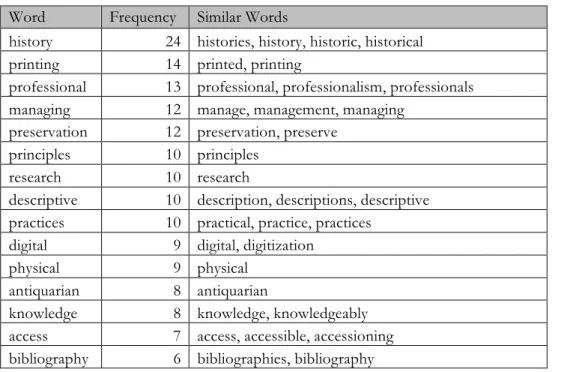
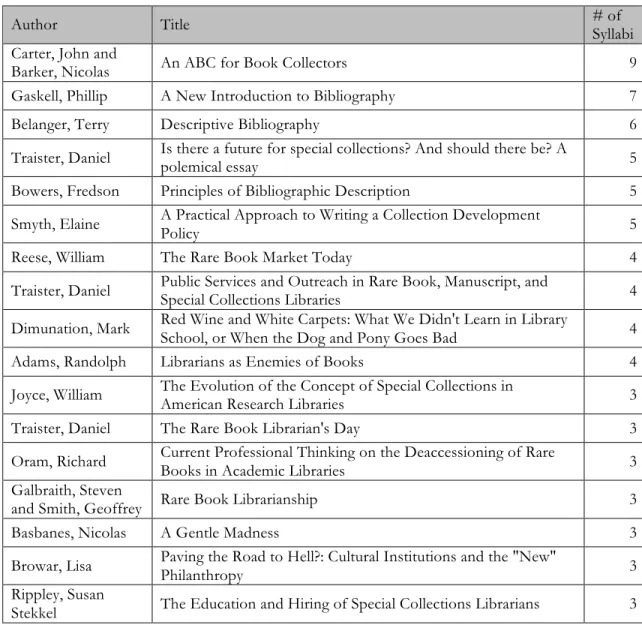
In an effort to answer RQ1, tables 1-3 address the common elements across the
coded syllabi. Table 1 shows the fifteen words found most frequently in the course
descriptions. Similarly, table 2 shows the fifteen most frequent words in the readings. Table
3 contains a list of readings that were found on at least 3 of the coded syllabi. Word
frequency tables also show the similar words, or stems, that were included in the count for
each term.
Table 1: 15 most frequent words in course descriptions
Word Frequency Similar Words
history 24 histories, history, historic, historical
printing 14 printed, printing
professional 13 professional, professionalism, professionals
managing 12 manage, management, managing
preservation 12 preservation, preserve
principles 10 principles
research 10 research
descriptive 10 description, descriptions, descriptive
practices 10 practical, practice, practices
digital 9 digital, digitization
physical 9 physical
antiquarian 8 antiquarian
knowledge 8 knowledge, knowledgeably
access 7 access, accessible, accessioning
Table 2: 15 most frequent words in readings
Word Frequency Similar Words
research 109 research, researcher, researchers, researching professional 87 professional, professionalism, professionals description 71 description, descriptions, descriptive
competency 70 competencies, competency
digitized 70 digital, digitization, digitize, digitized, digitizing
archival 63 archival, archive, archives, archiving
access 59 access, accessed, accessible, accession, accessioning
ACRL 57 ACRL
history 56 histories, history
preservation 54 preservation, preserve, preserving
prints 54 print, printed, printing, prints
institutions 54 institute, institution, institutional, institutions
practices 52 practical, practice, practices
knowledge 50 knowledge, knowledgeably
Table 3: Readings that appear in at least three (1/4) of the coded syllabi
Author Title # of
Syllabi Carter, John and
Barker, Nicolas An ABC for Book Collectors 9
Gaskell, Phillip A New Introduction to Bibliography 7
Belanger, Terry Descriptive Bibliography 6
Traister, Daniel Is there a future for special collections? And should there be? A polemical essay 5
Bowers, Fredson Principles of Bibliographic Description 5
Smyth, Elaine A Practical Approach to Writing a Collection Development Policy 5
Reese, William The Rare Book Market Today 4
Traister, Daniel Public Services and Outreach in Rare Book, Manuscript, and Special Collections Libraries 4
Dimunation, Mark Red Wine and White Carpets: What We Didn't Learn in Library
School, or When the Dog and Pony Goes Bad 4
Adams, Randolph Librarians as Enemies of Books 4
Joyce, William The Evolution of the Concept of Special Collections in
American Research Libraries 3
Traister, Daniel The Rare Book Librarian's Day 3
Oram, Richard Current Professional Thinking on the Deaccessioning of Rare Books in Academic Libraries 3 Galbraith, Steven
and Smith, Geoffrey Rare Book Librarianship 3
Basbanes, Nicolas A Gentle Madness 3
Browar, Lisa Paving the Road to Hell?: Cultural Institutions and the "New"
Philanthropy 3
Rippley, Susan
Stekkel The Education and Hiring of Special Collections Librarians 3
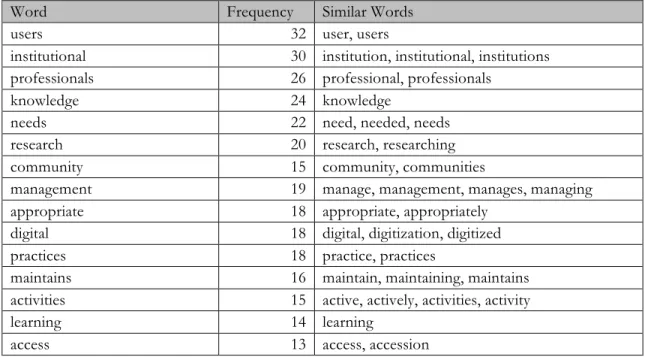
Tables 4 and 5 address RQ2 and the ACRL Competencies. Table 4 shows the fifteen
most frequent words in the ACRL Core Competencies. Table 5 shows which of the ACRL
Table 4: 15 most frequent words in ACRL Guidelines: Core Competencies for Special Collections Professionals
Word Frequency Similar Words
users 32 user, users
institutional 30 institution, institutional, institutions
professionals 26 professional, professionals
knowledge 24 knowledge
needs 22 need, needed, needs
research 20 research, researching
community 15 community, communities
management 19 manage, management, manages, managing
appropriate 18 appropriate, appropriately
digital 18 digital, digitization, digitized
practices 18 practice, practices
maintains 16 maintain, maintaining, maintains
activities 15 active, actively, activities, activity
learning 14 learning
access 13 access, accession
Table 5: Number of syllabi that included ACRL Guidelines: Core Competencies for
Special Collections Professionals
Competency # of Syllabi
Collection Development 9
Description and Access 11
Information Technology and Data Management 8
Instruction 1
Management, Supervision, and Leadership 6
Preservation and Conservation 8
Promotion and Outreach 8
Discussion
Analysis of word frequencies across the course descriptions and readings clarifies the
focus of the classes represented in the syllabi. In order to further clarify the data, words that
were assumed to be associated with all rare book and special collections librarianship courses
were added to a list of stop words. Those words included association, book, collection,
course, demonstrate, develop, information, introduce, librarian, manuscript, material,
program, rare, relate, role, source, special, student, study, topic, and understand.
At the surface level, it seems that courses place an equal emphasis on digital and
physical objects. However, the addition of words like history, printing, descriptive, and
bibliography suggest that likely there is much more emphasis placed on the physical aspects
of special collections librarianship. This is to be expected, since many archival studies
courses will cover born digital and digitized materials, whereas it is unlikely that students will
be exposed to concepts like descriptive bibliography outside of book history or special
collections librarianship courses. However, this emphasis on the book as a physical object
may mean that students in these courses fail to receive instruction in the considerations
attached to digitization projects, including access and preservation concerns.
An analysis of the readings also shows that many of the same readings are being
taught in these courses. Not shown in the table, but still interesting, is the fact that many
authors appear multiple times across the syllabi. Articles by Alice Schreyer, for instance, are
taught in 4 of the syllabi, but different articles are taught each time. Readings also largely
focus on descriptive bibliography, with five of the most frequent readings dealing directly
with descriptive bibliography. One of the five is a textbook
By searching the text of each syllabus for specific words related to each of the
Competencies were reflected in the readings of at least half of the syllabi. Most of the
competencies are referenced in a single class meeting; in other words, promotion and
outreach is discussed in one session and covered in a single set of readings. The main
exception to this is descriptive bibliography, which two or more class periods in most coded
syllabi.
The Fundamental Competencies, as discussed above, are focused on addressing the
underlying philosophy of special collections work. As such, they provide a cognitive
framework around which students and professionals can build the skills outlined in the
Specialized Competencies. However, in order for students to better understand the skills that
they need to develop, it is essential for them to understand and use the Competencies
throughout their graduate programs. Having a clear understanding of the Competencies will
help students choose courses and ensure that they are prepared to enter the profession after
graduation.
The only underrepresented competency is instruction. This is not surprising,
considering the limitations of the traditional class format. However, given the likelihood
likely that most students would not be employed in the kinds of positions that would allow
them to gain instruction experience, teachers of rare book and special collections courses
might do well to incorporate an assignment in which students are required to teach their
classmates about a specific topic related to the class.
The most frequently occurring words in the Competencies paint a picture of the
profession as user- and community-focused, with an eye to digital initiatives, research, and
access. In comparison, courses seem to be less focused on potential users and more focused
on specific skills sets. However, as users are the ultimate beneficiaries of these skills, this
This study is not without its limitations. First and foremost, not all rare book and
special collections courses offered by ALA-accredited library science programs are
represented here. Many programs do not make their syllabi publicly available, and there was
a low response rate to the researcher’s request for syllabi. Additionally, while there are a
limited number of ALA-accredited programs that offer rare book and special collections
courses, the total number of samples represents less than half of the total programs who
identify themselves to the ALA as offering a special collections course. More than one
institution is represented twice in the sample set, albeit by syllabi for different years and
courses taught by different instructors. Second, only three of the coded syllabi were for
courses that were taught after the ACRL updated the Core Competencies in March 2017. It
is reasonable to believe, therefore, that older syllabi may not reflect the current standards.
Finally, content analysis is necessarily subjective, relying as it does on the researcher’s own
opinions and analysis. Attempts have been made to handle the data as objectively as
possible, but it is important to note the bias inherent in the system.
Conclusion
This study used content analysis to examin course syllabi for rare book and special
collections librarianship courses compared to the ACRL Guidelines: Competencies for Special
Collections Professionals in order to identify gaps in the education of future special collections
professionals. While there are significant limitations to the study, several recommendations
can be made based on the results.
First, professors and librarians teaching rare book and special collections
the ACRL requirement that all such guidelines be revisited every five years after approval. As
special collections librarianship changes, so will the Competencies, and it is essential that
these courses keep pace with developments in the profession. Graduate courses in rare book
and special collections librarianship should, at the very least, provide students with a clear
understanding of the requirements of the profession and help them to situate their skills and
their mindset in the context of special collections work.
Students would be well-served by using the Competencies as a framework to guide
them in their choice of courses, graduate positions, internships, and professional
development opportunities. In many ways, students who intend to pursue careers in special
collections must be the authors of their own destinies in terms of molding their library
school education to their particular interests.
Rare books and special collections librarianship courses are an essential means by
which future special collections professionals gain the skills they need to enter the
profession. While it is difficult to quantify exactly how many entry level special collections
jobs require applicants to be proficient in all areas of the ACRL Competencies, undoubtedly
basic proficiency in most of these skills is important at the entry level. Since continuing
education programs such as Rare Books School may be cost prohibitive for students without
financial assistance, it is of the utmost importance that the courses they take in library school
Bibliography
Association of College and Research Libraries. “Competencies for Special Collections Professionals,” 2017.
Association of College and Research Libraries. “Guide to Policies and Procedures,” 2006.
Ardizzone, Heidi. An Illuminated Life: Belle Da Costa Greene’s Journey from Prejudice to Privilege. New York: W. W. Norton & Company, 2007.
Berelson, Bernard, ed. Education for Librarianship: Papers Presented at the Library Conference, University of Chicago, August 16-21, 1948. Chicago: American Library Association, 1949.
Berger, Sidney E. Rare Books and Special Collections. Chicago: Neal-Schuman, 2014.
Cave, Roderick. Rare Book Librarianship. Hamden, CT: Linnet Books, 1976.
Churchwell, Charles D. The Shaping of American Library Education. Chicago: American Library Association, 1975.
Churchwell, Charles D. “Education for Librarianship in the United States: Some Factors Which Influenced Its Development between 1919 and 1939.” University of Illinois at Urbana-Champaign, 1966.
Desroussilles, François Dupuigrenet. “Bridging the Gap: A View from France.” RBM: A Journal of Rare Books, Manuscripts, and Cultural Heritage 7, no. 1 (March 1, 2006): 64–68.
Dimunation, Mark. “Red Wine and White Carpets: What We Didn’t Learn in Library School, or When the Dog and Pony Goes Bad.” RBM: A Journal of Rare Books, Manuscripts, and Cultural Heritage 7, no. 1 (2006): 73–84.
Fleming, Patricia. “Education and Training of Special Collections Professionals, Librarians, and Archivists in Canada.” RBM: A Journal of Rare Books, Manuscripts & Cultural Heritage, 2006.
Galbraith, Steven K., and Geoffrey D. Smith. Rare Book Librarianship : An Introduction and Guide, n.d.
Garabedian, Michael. “‘You’ve Got to Be Carefully Taught’: American Special Collections Library Education and the Inculcation of Exclusivity.” RBM: A Journal of Rare Books, Manuscripts, and Cultural Heritage 7, no. 1 (2006): 55–63.
Goff, Frederick R. The Delights of a Rare Book Librarian: Delivered on the Occasion of the Second Annual Bromsen Lecture, April 27, 1974. Boston: Trustees of the Public Library of the City of Boston, 1975.
Hansen, Kelli. “Education, Training, and Recruitment of Special Collections Librarians: An Analysis of Job Advertisements.” RBM: A Journal of Rare Books, Manuscripts, and Cultural Heritage 12, no. 2 (2011): 110–32.
Healey, Elspeth, and Melissa Nykanen. “Channeling Janus: Past, Present, and Future in the RBMS Membership Survey.” RBM: A Journal of Rare Books, Manuscripts, and Cultural Heritage 17, no. 1 (March 1, 2016): 53–81.
Hubbard, Melissa, and Ann K.D. Myers. “Bringing Rare Books to Light: The State of the Profession.” RBM: A Journal of Rare Books, Manuscripts, and Cultural Heritage 11, no. 2 (September 1, 2010): 134–51.
Joyce, William L. “The Evolution of the Concept of Special Collections in American Research Libraries.” Rare Books and Manuscript Librarianship 3, no. 9 (1988): 19–29.
Landis, William E. “Personas and Archetypes: Envisioning the 21st-Century Special
Collections Professional.” RBM: A Journal of Rare Books, Manuscripts, and Cultural Heritage
7, no. 1 (March 1, 2006): 40–48.
Lynch, Beverly P. “Professional Associations and Library Education.” RBM: A Journal of Rare Books, Manuscripts, and Cultural Heritage 11, no. 1 (2010): 32–46.
Overholt, John. Five Theses on the Future of Special Collections. RBM: A Journal of Rare Books, Manuscripts, and Cultural Heritage. Vol. 14. Association of College and Research Libraries, 2013.
Quinn, Mary Ellen. Historical Dictionary of Librarianship. Lanham, Maryland: Rowman & Littlefield, 2014.
Reynolds, Matthew C. “Lay of the Land: The State of Bibliographic Instruction Efforts in ARL Special Collections Libraries.” RBM: A Journal of Rare Books, Manuscripts, and Cultural Heritage 13, no. 1 (March 1, 2012): 13–26.
Schmitt, Cassandra A. “Review, Rare Book Librarianship: An Introduction and Guide, by Steven K. Galbraith and Geoffrey D. Smith.” RBM: A Journal of Rare Books, Manuscripts, and Cultural Heritage 14, no. 2 (September 1, 2013): 121–23.
Schreyer, Alice D. “What’s So Special about Special Collections Librarians?” RBM: A Journal of Rare Books, Manuscripts, and Cultural Heritage 7, no. 1 (2006): 49–54.
Schreyer, Alice, Jaia Barrett, Michèle Cloonan, Mary Jackson, William Joyce, Bill Landis, Judy Panitch, and Merrily Taylor. “Education and Training for Careers in Special
Collections: A White Paper Prepared for the Association of Research Libraries Special Collections Task Force,” 2004.
http://www.arl.org/storage/documents/publications/special-coll-career-training-nov04.pdf.
Sheehan, Jennifer K. “Review, Ambassadors of the Book: Competencies and Training for Heritage Librarians, by Raphaele Mouren.” RBM: A Journal of Rare Books, Manuscripts, and Cultural Heritage 14, no. 2 (September 1, 2013): 123–24.
Smith, Steven Escar. “From ‘Treasure Room’ to ‘School Room’: Special Collections and Education.” RBM: A Journal of Rare Books, Manuscripts, and Cultural Heritage 7, no. 1 (March 1, 2006): 31–39.
Stam, Deirdre C. “Bridge That Gap! Education and Special Collections.” RBM: A Journal of Rare Books, Manuscripts, and Cultural Heritage 7, no. 1 (March 1, 2006): 16–30.
Traister, Daniel. “Is There a Future for Special Collections? And Should There Be? A Polemical Essay.” RBM: A Journal of Rare Books, Manuscripts, and Cultural Heritage 1, no. 1 (2000): 54–76.