Digital Subscriber Line (DSL) Testing
Overview
At the center of any successful DSL service deployment is a well-designed test plan. Since a customer’s first impression is so powerful, the ability to deliver a new service on time and as expected goes a long way toward building an enduring customer relationship. But a good DSL test platform is more than a customer service tool; it is a core process that affects the efficiency and ability of the service provider to provision the DSL service profitably. The goal of a solid DSL test plan is to ensure that the greatest number of lines are provisioned in the least amount of time and supported with the fewest number of people. This tutorial will focus on the basic aspects of DSL testing.
Topics
1. Introduction
2. The Basic Components of Test Management 3. Right-Sizing a DSL Test Access Solution 4. Conclusion—Modularity Is the Key to Success Self- Test
Correct Answers Glossary
1. Introduction
Reducing Service Activation Costs
The first objective of any DSL test plan is to test remote customer loops from a central command center or network operations center (NOC). This capability, commonly referred to as single-ended testing, enables service providers to do the following:
Web ProForum Tutorials
http://www.iec.org The International Engineering Consortium Copyright © 2/16
• Identify disturbers in the binder group
• Verify acceptance criteria for new installations
• Resolve post-installation issues
All of these capabilities should be accomplished without dispatching an engineer to the central office or customer site. The resulting savings are clearly significant with respect to actual costs of service activation. Perhaps more important, a significant savings in time and effort is also realized, allowing the service provider to secure a larger revenue base quicker and with a higher degree of customer satisfaction.
Building Blocks of a DSL Test System
A DSL loop management and test system consists of three basic components: 1. Test access
2. Test instruments 3. Test automation
These three components must work together to establish an ordered process for testing, provisioning, and documenting DSL service deployments. These three components can be purchased individually or as a suite. It should be understood, however, that over time, each component will likely need to evolve independently of the others to address new issues, changing requirements, and better
technology.
The purpose of this tutorial is to help service providers understand the role of each of these components and to use this information to implement a DSL test system that meets the unique needs of the network rollout.
2. The Basic Components of Test
Management
The following is a description of each component followed by an overview of how they can vary.
Test Access
As noted above, a DSL test system is justified because it reduces the number of truck rolls required to test and provision a new service. To achieve this objective,
Web ProForum Tutorials
http://www.iec.org The International Engineering Consortium Copyright © 3/16
the means to physically connect a test probe to a copper pair in a remote central office is required. In a traditional plain old telephone service (POTS) network, test access is provided via the Class-4 or Class-5 voice switch. Unfortunately this access point is not adequate for most DSL loop testing because it only provides access to the voiceband portion of the circuit. For comprehensive testing, full broadband test access is required. With a few exceptions, the majority of DSL access multiplexer (DSLAM) vendors have not provided test access as part of their offering.
Key elements of a good loop management system are discussed as follows:
Vendor-Neutral Loop Access
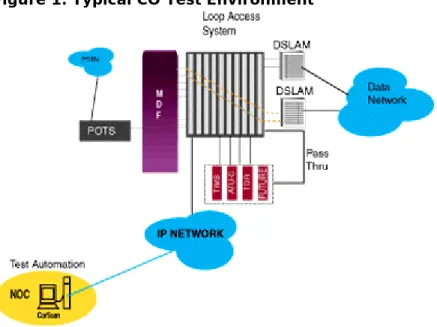
To address the need for independent test access, service providers can turn to vendor-neutral loop access systems to provide test access. Many vendors augment test access with additional loop switching functionality to perform remote service changes or protection switching. Figure 1 shows a test access switch in place between the main distribution frame (MDF) in the central office and the DSLAM equipment.
Figure 1. Typical CO Test Environment
Test Head Options
Depending upon the manufacturer, a test head is either installed external to the test access switch or mounted internally in the chassis. The relative advantage of either approach depends upon the specific circumstances of the service provider. In general, an external test head solution provides the test planner with more flexibility. An unbundled test head and access switch enables the planner to select the best test equipment for a specific task and/or redeploy existing test resources already in place.
Web ProForum Tutorials
http://www.iec.org The International Engineering Consortium Copyright © 4/16
Switching Functionality
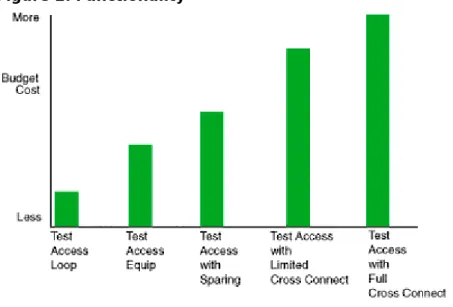
Loop management functionality of an access switch ranges across two axes and varies with respect to switching functionality and cost as shown in Figure 2. As noted later in this tutorial, a test planner should first evaluate the type of switching and test access functions required and then select the right access system for his requirements. By carefully evaluating requirements, test planners can determine the right size for their test access system and thus maximize the capital expenditure funds available.
Figure 2. Functionality
Control Integration
Control is an important element of any loop management system (LMS) and will determine how easily an integrated solution can be developed. Most LMSs
provide multiple methods of connecting to the switch including Internet protocol (IP), asynchronous transfer mode (ATM), and dial-in modem communication ports. Industry standard control protocols such as simple network management protocol (SNMP), TL1, and Telnet, as well as simple command line interfaces, provide well-defined control interfaces for management via a common network (e.g., IP). Ideally the LMS will include pass-through ports for control of an external test head, eliminating the need for an additional communication link. Functions of an external LMS include all or some of the following:
• Remote test and loop management
• Test access toward the loop
Web ProForum Tutorials
http://www.iec.org The International Engineering Consortium Copyright © 5/16
• Split-mode for bidirectional testing
• Bridge the loop
• Equipment sparing
• Cross-patching
• Tone generation (independent of the test probe)
• Pass-through port for external test head control
Intelligent Test Device
A DSL test device designed for the central office (i.e., test probe) enables a
network technician to remotely perform a variety of tests during the life cycle of a DSL service. The following tests fall into several categories. The following is a brief description of each one.
Prequalification Testing
This is a cursory test that predicts a loop’s ability to support DSL. This test augments customer loop records and provides a more accurate prediction of line performance.
Preinstallation Testing
This is typically performed after the incumbent local-exchange carrier (ILEC) has unbundled the loop and terminated it in the competitive local-exchange carrier’s (CLEC’s) equipment and before the line is accepted. Based upon the line
characteristics in the interconnect agreement, a network technician will test the loop to verify the absence of elements that would limit the ability to support the ordered DSL service.
Preinstallation tests typically include both traditional POTS testing as well as a variety of broadband tests. POTS testing is useful for three reasons:
1. DSL performance can be inferred from traditional metallic tests. 2. Traditional narrowband test results are more widely understood and
accepted.
3. Central office technicians are better equipped to resolve traditional narrowband issues.
Single-ended broadband testing (such as time-domain-reflectometry [TDR]) is also important because it enables NOC technicians to accurately predict line
Web ProForum Tutorials
http://www.iec.org The International Engineering Consortium Copyright © 6/16
speeds, determine loop length, identify bridge taps, and detect load coils to determine if the line will perform as ordered.
Spectral Interference Monitoring
DSL service can be severely compromised by disturbers (e.g., T-1 service) in the bundle. Disturbers may be present at the time of the cutover or introduced at some future time. Consequently, it is beneficial to conduct baseline spectral analysis at cutover and periodically monitor the line over the life of the service.
Post-installation Testing
In addition to spectral analysis, DSL service testing will be required periodically to resolve service disputes and to troubleshoot equipment failures. A series of broadband tests may be required to characterize the line, compare it to baseline measurements, and to identify cross-talk issues. Testing toward the DSLAM may also be required using a “golden” modem to verify line-card performance.
In summary, effective DSL test probes can provide some or all of the following capabilities:
• Traditional POTS tests (TIMS, c-msg, VF insertion loss, etc.)
• TDR measurements
• Background noise measurement
• Load coil and bridge tap detection
• Power spectral density measurement
• Identification of interferers and disturbers
• ADSL transmission unit–CO/ADSL transmission unit–remote (ATU– C/ATU–R)
• Longitudinal balance
Test Automation
Test management is the third critical piece in the DSL solution. The test
operations support system (OSS) becomes the window through which the NOC technician views and manages the remote loop testing and also the most
compelling reason to invest in a DSL testing solution. The information available to the test technician via the test OSS is used to make crucial decisions regarding line acceptance and service availability. How this information is presented,
Web ProForum Tutorials
http://www.iec.org The International Engineering Consortium Copyright © 7/16
shared, and archived will impact the overall efficiency of the DSL service deployment.
The following are key functions of an automated test management platform:
Loop Access and Management
Through the test OSS interface, test technicians select which loop to test and what type of test connection to make (i.e., break toward loop, break toward equipment, split mode or bridge). For test access systems that offer additional loop management capabilities, these functions are also managed through the test OSS, allowing test technicians to make service changes or spare out faulty line cards.
Test Automation
Most tests performed by the test head actually consist of a number of individual tests. A test OSS will predefine a variety of test routines that can be invoked with a single command. Automation also enables supersets of predefined test routines to be created to quickly conduct a comprehensive battery of tests.
Real Time Results Reporting
To aid the test technician’s decision making, the test OSS will enable predefinition of acceptable test results and present the results in a simple statement (e.g., OK) or graphic symbol (e.g., thumbs up). Detailed reports are also available and useful in negotiating a resolution with the ILEC technician.
Results Sharing
Test OSS can form a part of an automated flow-through provisioning process. In this scenario, test results (typically a result summary) are shared with other OSS elements. Application programming interfaces (APIs) based upon open standards (i.e., SNMP, common object request broker architecture [CORBA], extensible markup language [XML]) enable the test OSS to share data with a larger pool of network management systems (NMSs) and element management systems (EMSs) systems.
Historical Analysis
DSL performance and characteristics have a tendency to change over time.
External interference, as well as disturbers in the binder group, can be introduced after the initial installation and thus go unnoticed during cutover testing.
Periodic line monitoring and comparison against initial test results can provide useful evidence of performance degradation. The same information can be used to negotiate a resolution and lead to faster service restoration.
Like loop access systems, test automation solutions range from stand-alone real-time test management solutions to more complex and fully integrated test OSSs. A modular building-block approach to the DSL test access system enables the test
Web ProForum Tutorials
http://www.iec.org The International Engineering Consortium Copyright © 8/16
OSS to evolve over time to match functionality and complexity with the operational requirements.
3. Right-Sizing a DSL Test Access Solution
When it comes to designing a DSL test system, it is important to understand the unique requirements of the service deployment. The key areas to consider include the following:
• The interconnect agreement/working relationship with the ILEC
• Flow-through provisioning/OSS strategy
• End-user service level agreements (SLAs) and expectations
The model for each of these areas will vary with each service provider’s business plan and thus impact the selection of each DSL test component. The following are some examples.
Interconnect Agreement/ILEC Relationship—
Impacts Selection of a Test Vendor
• What prequalification information is available from the ILEC?
• What are the agreed acceptance criteria?
• What test results will the ILEC accept/understand?
• What types of problems can be resolved quickly?
• What is the strategy for resolving more complicated issues like spectral disturbers in both the pre- and post-sale scenarios?
Answers to these questions impact the selection of a test device/probe. Standards for DSL performance have not been adopted across the industry. As test results form the basis of any service resolution, it is reasonable to assume that
undisputed test results will lead to quicker problem resolution and fewer fingers pointing.
Web ProForum Tutorials
http://www.iec.org The International Engineering Consortium Copyright © 9/16
Flow-Through Provisioning/OSS Interaction—
Impacts Test OSS Strategy
• What test information needs to be shared with other OSS components in the provisioning process?
• How long should results be stored?
• Who will have access to the results?
• What OSS systems are already in place?
• How does information need to be shared?
• What is the short-term versus long-term OSS strategy?
Answers to these questions will help companies determine what type of OSS solution to implement. New-to-market service providers may prefer a stand-alone, “out of the box” solution that can provide an immediate solution for qualifying and testing customer loops and gaining market penetration. Established service providers may evolve the OSS strategy to incorporate
additional operation efficiencies and new business initiatives and thus require a more customized solution.
End-User Service-Level Expectations—Impacts
Loop Access and Management Platform
• What is the customer’s expectation for service assurance?
• Will SLAs be established?
• Is equipment sparing required?
• How frequently will customers switch to new services?
• What is the customer’s expectation for problem resolution?
Answers to these questions will help companies determine what degree of loop management functionality, i.e., switching of lines, is required. Sites that require periodic testing of loops can be satisfied with a lower-cost test access platform. Business-class customers who are concerned with the suitability of DSL for mission-critical could benefit from a loop management platform that provides automatic line-card protection.
Web ProForum Tutorials
http://www.iec.org The International Engineering Consortium Copyright © 10/16
4. Conclusion—Modularity Is the Key to
Success
In short, the key to success is flexibility. When it comes to a DSL test plan, one size does not fit all. All three components discussed in this tutorial will evolve over time and improve. Tests will become more accurate, new test standards will be agreed upon, and spectral testing will become increasingly important. Test software and OSS integration needs will also evolve. New tools will give service providers real competitive advantages. Test access needs will also change in line with customer-service expectations and operational efficiency goals. By
understanding each of the components of a DSL test design, service providers can design a modular platform that addresses immediate test requirements while remaining flexible enough to respond to unforeseen forces of change. The successful service provider will be the one that plans for change.
Self-Test
1. The first objective of any DSL test plan is to test remote customer loops from a central command center or _____________________________.
a. service switching center b. local loop
c. control tower
d. network operations center
2. Which of the following is not one of the basic components of a DSL loop management and test system?
a. test automation b. test instruments c. test loops
d. test access
3. One disadvantage of a DSL test system is that it increases the number of truck rolls required to test and provision a new service.
a. true b. false
Web ProForum Tutorials
http://www.iec.org The International Engineering Consortium Copyright © 11/16
4. A _______________ is installed external to the test access switch or mounted internally in the chassis.
a. test head
b. vendor-neutral loop c. support axis
d. voice switch
5. Which of the following is a function of an external LMS? a. remote test and loop management
b. test access toward the DSLAM c. equipment sparing
d. pass-through port for external test head control e. all of the above
6. POTS testing is useful because
______________________________________.
a. DSL performance can be inferred from traditional metallic tests b. traditional narrowband test results are more widely understood and
accepted
c. central-office technicians are better equipped to resolve traditional narrowband issues
d. all of the above
7. Business-class customers who are concerned with the suitability of DSL for mission-critical could benefit from a loop management platform that provides automatic line-card protection.
a. true b. false
8. According to this tutorial, the key to success is flexibility. a. true
Web ProForum Tutorials
http://www.iec.org The International Engineering Consortium Copyright © 12/16
b. false
9. The majority of DSL access multiplexer (DSLAM) vendors provide test access as part of their offering.
a. true b. false
10. Effective DSL test probes can provide which of the following capabilities? a. TDR measurements
b. load coil and bridge tap detection
c. identification of interferers and disturbers d. longitudinal balance
e. all of the above
Correct Answers
1. The first objective of any DSL test plan is to test remote customer loops from a central command center or _____________________________.
a. service switching center b. local loop
c. control tower
d. network operations center
See Topic 1.
2. Which of the following is not one of the basic components of a DSL loop management and test system?
a. test automation b. test instruments
c. test loops
Web ProForum Tutorials
http://www.iec.org The International Engineering Consortium Copyright © 13/16
See Topic 1.
3. One disadvantage of a DSL test system is that it increases the number of truck rolls required to test and provision a new service.
a. true
b. false
See Topic 2.
4. A _______________ is installed external to the test access switch or mounted internally in the chassis.
a. test head
b. vendor-neutral loop c. support axis
d. voice switch See Topic 2.
5. Which of the following is a function of an external LMS? a. remote test and loop management
b. test access toward the DSLAM c. equipment sparing
d. pass-through port for external test head control
e. all of the above
See Topic 2.
6. POTS testing is useful because
______________________________________.
a. DSL performance can be inferred from traditional metallic tests b. traditional narrowband test results are more widely understood and
accepted
c. central-office technicians are better equipped to resolve traditional narrowband issues
Web ProForum Tutorials
http://www.iec.org The International Engineering Consortium Copyright © 14/16
d. all of the above
See Topic 2.
7. Business-class customers who are concerned with the suitability of DSL for mission-critical could benefit from a loop management platform that provides automatic line-card protection.
a. true
b. false See Topic 3.
8. According to this tutorial, the key to success is flexibility.
a. true
b. false See Topic 4.
9. The majority of DSL access multiplexer (DSLAM) vendors provide test access as part of their offering.
a. true
b. false
See Topic 2.
10. Effective DSL test probes can provide which of the following capabilities? a. TDR measurements
b. load coil and bridge tap detection
c. identification of interferers and disturbers d. longitudinal balance
e. all of the above
Web ProForum Tutorials
http://www.iec.org The International Engineering Consortium Copyright © 15/16
Glossary
APIapplication programming interface
ATM
asynchronous transfer mode
ATU–C
ADSL transmission unit–CO
ATU–R
ADSL transmission unit–remote
CLEC
competitive local-exchange carrier
DSL
digital subscriber line [also xDSL]
DSLAM
digital subscriber line access multiplexer
EMS
element management system
ILEC
incumbent local-exchange carrier
IP
Internet protocol
LMS
loop management system
MDF
main distribution frame
NMS
network management system
NOC
network operations center
OSS
Web ProForum Tutorials
http://www.iec.org The International Engineering Consortium Copyright © 16/16
POTS
plain old telephone service
SLA
service-level agreement
SNMP
simple network management protocol
TDR
time domain reflectometry
XML