1
Chapter 21a
Electrochemistry
:
The
Electrolytic Cell
2
Electrochemistry
Electrochemical reactions are oxidation-reduction reactions.
| The two parts of the reaction are physically separated.
z The oxidation reaction occurs in one cell.
z The reduction reaction occurs in the other cell.
3
Electrochemistry
| There are two kinds electrochemical cells.
1. Electrochemical cells containing spontaneous
chemical reactions are called voltaicorgalvanic cells.
The generation of electric current from a chemical
reaction.
2. Electrochemical cells containing in nonspontaneous
chemical reactions are called electrolytic cells. The use of electric current to produce a chemical change.
4
Electrical Conduction
|Metals conduct electric currents well in a process called metallic conduction.
zIn metallic conduction there is electron flow with no atomic motion.
zMetal atoms changing oxidation states without moving. •E.g. Oxidative phosphorylation
Electrical Conduction
|In ionicor electrolytic conductionionic motion
transports the electrons.
zPositively charged ions, cations, move toward the
negative electrode.
zNegatively charged ions, anions, move toward the
positive electrode.
Electrodes
The following convention for electrodes is correct for either electrolytic or voltaic cells:
|The cathodeis the electrode at which reduction
occurs.
•The cathode is negative in electrolytic cells and positive in voltaic cells.
|The anodeis the electrode at which oxidation
occurs.
•The anode is positive in electrolytic cells and negative in voltaic cells.
7
Electrodes
|Inert electrodes do not react with the liquids or
products of the electrochemical reaction.
|Two examples of common inert electrodes are
graphite and platinum.
8
Electrolytic Cells
Electrical energy is used to force nonspontaneous chemical reactions to occur.
| The process is called electrolysis.
| Two examples of commercial electrolytic reactions
are:
1. The electroplating of jewelry and auto parts. 2. The electrolysis of chemical compounds.
9
Electrolytic Cells
| Electrolytic cells consist of: 1. A container for the reaction mixture.
2. Two electrodes immersed in the reaction mixture. 3. A source of direct current.
| Electrolytic cells uses electrical energy to produce a
chemical change.
z The electrical energy forces a current through a cell that has a negative potential.
z The electrical energy forces a chemical change to occur.
10
Figure 11.19:
(a) A standard galvanic cell (b) A standard electrolytic cell
The cell in (b) has a power source that forces the electrons in the opposite direction from the voltaic cell in (a).
Electrolytic Cell Voltaic Cell
11
Counting Electrons: Coulometry and Faraday’s
Law of Electrolysis
|The stoichiometry of electrolysis processes can
quantify “how much chemical change occurs with the flow of a given current for a specific time”.
12 Counting Electrons: Coulometry and Faraday’s Law of Electrolysis
|Faraday’s Law - The amount of substance
undergoing chemical reaction at each electrode during electrolysis is directly proportional to the amount of electricity that passes through the electrolytic cell.
|A faradayis the amount of electricity that reduces
one equivalent of a species at the cathode and oxidizes one equivalent of a species at the anode.
23
13 Counting Electrons: Coulometry and Faraday’s Law of Electrolysis
|A coulombis the amount of charge that passes a
given point when a current of one ampere (A) flows for one second.
|1 ampere (amp) = 1 coulomb/second
23
-–
–
1 6.022 10
1 1.0
1.0 96, 485
faraday e
faraday mol e
mol e coulombs
≡ ×
≡ ≡
14 Counting Electrons: Coulometry and Faraday’s Law of Electrolysis
|Faraday’s Law states that during electrolysis, one
faraday of electricity (96,485 coulombs) reduces and oxidizes, respectively, one equivalent of the oxidizing agent and the reducing agent.
zThis corresponds to the passage of one mole of electrons
through the electrolytic cell.
23 – 23 –
1 6.022 10
1 6.022 10
equivalent of oxidizing agent gain of e equivalent of reducing agent loss of e
≡ ×
≡ ×
15 Counting Electrons: Coulometry and Faraday’s Law of Electrolysis
| Example: Calculate the mass of palladium produced by the reduction of palladium (II) ions during the passage of 3.20 amperes of current through a solution of palladium (II) sulfate for 30.0 minutes.
( )
2 - 0
: 2 1 2 1 106 2(96, 485) 106 3.20 3.20 1 96, 485
60 3.20 1 ? 30.0 min
min 96, 485
Cathode Pd e Pd mol mol mol
g g
C amp
s mol e C
s C mol e g s C + − − + → = = = -106 3.16 2
mol Pd g Pd g Pd mol e mol Pd
=
16
The Electrolysis of Water
|Hydrogen and oxygen combine spontaneously to
form water.
zThe decrease in free energy that accompanies this spontaneous reaction can be used to run fuel cells to produce electricity.
|The reverse process, which is not spontaneous,
requires energy to occur.
|The formation of oxygen and hydrogen gases from
water can be forced by electrolysis.
The Electrolysis of Water
2
2 2( )
2 2( )
2 2( ) 2( )
4
2 2( ) 2(
2 4 4 2(2 2 2 ) 6 2 4 4
2 2
g g
g g
H O
g g
Anode reaction H O O H e
Cathode reaction H O e H OH
Cell reaction H O H O H OH
The overall reaction is H O H O
+ + → + + + → + → + + + → + – – – – )
Counting Electrons: Coulometry and Faraday’s Law of Electrolysis
|Example: Calculate the volume of oxygen (measured at STP) produced by the oxidation of water during the passage of 3.20 amperes of current for 30.0 minutes.
( ) ( ) ( ) -2 2 2
: 2 4 4
2 1 4 4 22.4 4 96,500
? 3.20 3.20
1 96, 485
1.0 22.4 60 30.0 min min g STP STP STP
Anode H O O H e mol mol mol mol
L C C L O amp
s mol e C
mol L s + − → + + = = = = 2 2 -2 22.4 3.20 1
96, 485 4
0.334 334
STP L O C mol e mol O
s C mol e mol O L O or mL O
− = =
19
The Electrolysis of
Molten
Sodium Chloride
|Liquid sodium is produced at one electrode.
zIndicates that the reaction Na+
(A)+ e-→Na(A)occurs at this electrode.
zIs this electrode the anode or cathode?
zReduction occurs at the cathode.
|Gaseous chlorine is produced at the other electrode.
zIndicates that the reaction 2 Cl-→Cl
2(g)+ 2 e-occurs at this electrode.
zIs this electrode the anode or cathode?
zOxidation occurs at the anode.
20
The Electrolysis of Molten Sodium Chloride
|In all electrolytic cells, electrons are forced to flowfrom the positive electrode (anode) to the negative electrode (cathode).
21
The Electrolysis of Molten Sodium Chloride
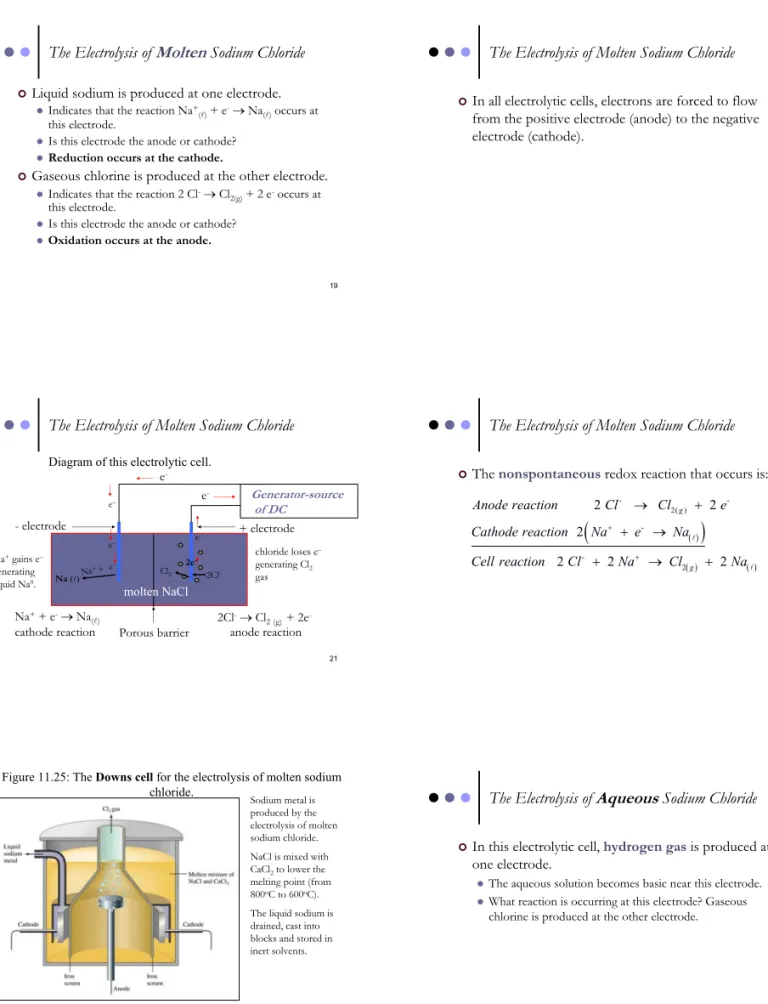
Diagram of this electrolytic cell.
Porous barrier e
-Na++ e-→Na (A) cathode reaction
2Cl-→Cl 2 (g) + 2e -anode reaction
Generator-source of DC
- electrode + electrode
e
-molten NaCl 2Cl– Cl2
2e– e–
Na+ +
Na (A)
e– e–
e–
chloride loses e–
generating Cl2
gas Na+gains e–
generating liquid Na0.
22
The Electrolysis of Molten Sodium Chloride
|The nonspontaneousredox reaction that occurs is:( )
(
)
( ) ( )
-
-2( )
-2
2 2
2
2 2 2
g
g
Anode reaction Cl Cl e
Cathode reaction Na e Na
Cell reaction Cl Na Cl Na
+
+
→ +
+ →
+ → +
A
A
23
Figure 11.25: The Downs cellfor the electrolysis of molten sodium chloride.
Sodium metal is produced by the electrolysis of molten sodium chloride. NaCl is mixed with CaCl2to lower the
melting point (from 800oC to 600oC).
The liquid sodium is drained, cast into blocks and stored in inert solvents.
24
The Electrolysis of
Aqueous
Sodium Chloride
|In this electrolytic cell, hydrogen gasis produced atone electrode.
zThe aqueous solution becomes basic near this electrode.
zWhat reaction is occurring at this electrode? Gaseous chlorine is produced at the other electrode.
25
The Electrolysis of Aqueous Potassium Chloride
( )
( ) ( )
2( )
2 2
2 2 2
2 2
2 2 2
2 2 2
. !
g g
g g
Anode reaction Cl Cl e
Cathode reaction H O e H OH
Cell reaction Cl H O H Cl OH
Na is a spectator ion Note that water is electrolyzed+
→ +
+ → +
+ → + +
– –
– –
– –
What reaction is occurring at this electrode? These experimental facts lead us to the following nonspontaneous electrode reactions:
26
The Electrolysis of Aqueous Potassium Chloride
2 H2O + 2e-→H2 (g) + 2 OH
-cathode reaction
2Cl-→Cl 2 (g) + 2e
-anode reaction
Cell diagram
Battery, a source of direct current e-flow
- electrode + electrode e-flow
aqueous NaCl
Cl2gas H2gas
+ pole of battery
–pole of battery
27
Electrolytic Cells
|In all electrolytic cells the most easily reduced species is reducedand the most easily oxidized species is oxidized.
28
Commercial Applications of Electrolytic Cells
Electrolytic Refining and Electroplating of Metals
|Impure metallic copper can be purified
electrolytically to ≈100% pure Cu.
zThe impurities commonly include some active metals plus less active metals such as: Ag, Au, and Pt.
|The cathode is a thin sheet of copper metal
connected to the negative terminal of a direct current source.
|The anode is large impure bars of copper.
Commercial Applications of Electrolytic Cells
|The electrolytic solution is CuSO4and H2SO4|The impure Cu dissolves to form Cu2+.
|The Cu2+ions are reduced to Cu at the cathode.
(
)
( ) ( )(
)
( ) ( )0 2
s aq
2+ 0
aq s
Anode impure Cu Cu 2e
Cathode very pure Cu 2e Cu
Net rxn. No net rxn.
+ −
−
→ +
+ →
Commercial Applications of Electrolytic Cells
|Any active metal impurities are oxidized to cationsthat are more difficult to reduce than Cu2+.
zThis effectively removes them from the Cu metal.
0 2
0 2
2 2
Zn Zn e
Fe Fe e
And so forth for other active metals
+ −
+ −
→ +
31
Commercial Applications of Electrolytic Cells
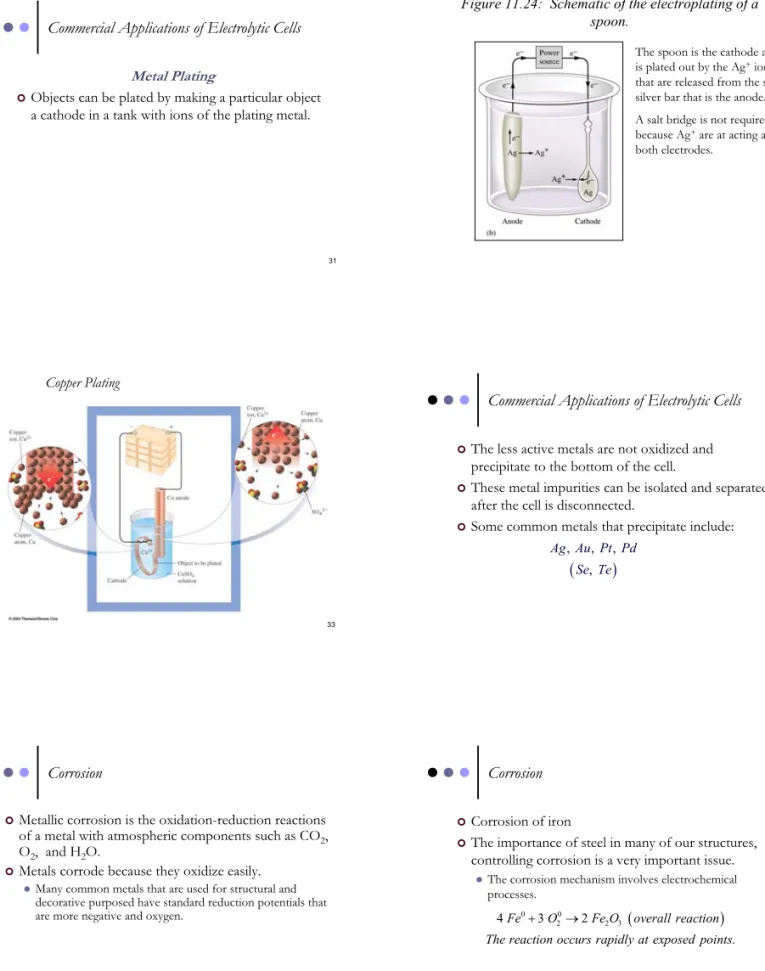
Metal Plating
|Objects can be plated by making a particular object
a cathode in a tank with ions of the plating metal.
32
Figure 11.24: Schematic of the electroplating of a spoon.
The spoon is the cathode and is plated out by the Ag+ions that are released from the solid silver bar that is the anode. A salt bridge is not required because Ag+are at acting at both electrodes.
33 Copper Plating
34
Commercial Applications of Electrolytic Cells
|The less active metals are not oxidized and
precipitate to the bottom of the cell.
|These metal impurities can be isolated and separated
after the cell is disconnected.
|Some common metals that precipitate include:
(
)
, , , , Ag Au Pt Pd
Se Te
35
Corrosion
|Metallic corrosion is the oxidation-reduction reactions
of a metal with atmospheric components such as CO2,
O2, and H2O.
|Metals corrode because they oxidize easily.
zMany common metals that are used for structural and decorative purposed have standard reduction potentials that are more negative and oxygen.
36
Corrosion
|Corrosion of iron
|The importance of steel in many of our structures,
controlling corrosion is a very important issue. zThe corrosion mechanism involves electrochemical
processes.
(
)
0 0
2 2 3
4 3 2
.
Fe O Fe O overall reaction
The reaction occurs rapidly at exposed points
37
Corrosion
|The surface of steel is not uniform.
zThe chemical composition of steel is not a homogeneous mixture.
zStress points are produced on the surface due to physical strains.
zAt these stress areas, iron can be more easily oxidized in some regions than in other regions.
o Oxidized areas act as anodes o The other areas act as cathodes
38 Fe2+ions travel through the surface moisture to the region acting as a cathode.
In the region of the cathode, the Fe2+ions react with O 2to form rust.
The moisture acts as a salt bridge in the process of corrosion. Without moisture, steel does not rust.
steel
39
Corrosion Protection
| Some examples of corrosion protection.
1. Plate a metal with a thin layer of a less active (less easily oxidized) metal.
"Tin plate or chromium plate for steel" " " .
40
Corrosion Protection
2. Galvanizing, the coating of steel with zinc, provides a more active metal on the exterior.
.
The thin coat of Zn must be oxidized before Fe begins to rust
Zinc
Steel
Corrosion Protection
3. Connect the metal
to a sacrificial anode, a piece of a more active metal.
.
Soil pipes and ship hulls have Mg and Zn on the exterior as sacrificial anodes
Corrosion Protection
Magnesium is easily oxidized; protecting the iron from oxidation.
43
Corrosion Protection
4. Allow a protective film to form naturally.
0 0
2 2 3
2 3
4 3 2
, .
Al O Al O
Al O forms a hard transparent film on exterior of aluminum foil
+ →
44
Corrosion Protection
5. Paint or coat with a polymeric material such as
plastic or ceramic.
.
Steel bathtubs are coated with ceramic
45
End of Chapter 11b
| Electrochemistry is an important part of the electronics industry.