Digital Energy
Multilin
GE Multilin technical note
Neutral voltage unbalance function at
grounded wye capacitor banks
GE publication number: GET-8544
Copyright © 2010 GE Multilin
Neutral voltage unbalance function at grounded wye capacitor banks
Introduction
The C70 neutral overvoltage unbalance function (ANSI 59NU) compensates for both the system unbalance (V0), and the bank inherent unbalance using balancing factors kAB and kAC. The operating quantity equation for a perfectly balanced bank (kAB=kAC= 1) takes the following familiar simplified form.
(Eq 1) In this equation, VX is a bank neutral point voltage and V0 is a bus (system voltage) which can either calculated from phase voltages or supplied externally from broken delta VT. It is preferable to have the bus voltage supplied from a three-phase voltage VT, since the C70 can compensate for bank inherent unbalance by applying balancing coefficients. The auto-setting procedure is available to automatically calculate these coefficients.
For greater sensitivity and security, the relay applies the differential principle with the restraint quantity Vrest calculated as follows.
(Eq 2) The neutral overvoltage unbalance element operates if:
(Eq 3) Where S is a user-programmable slope factor.
The neutral overvoltage unbalance element can be applied to both ungrounded and grounded capacitor banks. Applying neutral overvoltage unbalance to ungrounded banks appears logical and simple. However, it may not be so obvious for grounded banks. In this case, the banks are grounded through a neutral capacitor with a single-phase VT across the capacitor or grounded through a CT to measure the neutral current or equivalent neutral voltage. This application note attempts to clarify the C70 application for these type of grounded bank configurations.
Vop = VX–V0
Vrest = VX+V0
Neutral point voltage equivalent
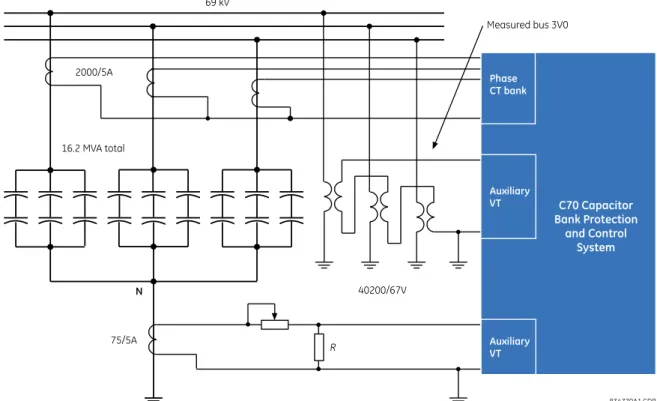
The following figure depicts two possible grounding arrangements for the capacitor bank. • Grounded through neutral capacitor.
• Grounded through neutral CT.
In any configuration the value of the resistor R has to be chosen so that the voltage which appears at the neutral point (one phase voltage at the bus equals zero) across resistor R through the CT/auxiliary VT input matches the bus V0 value.
Figure 1: Neutral arrangement for grounded wye banks
In the case of neutral CT configuration, it can be achieved by calculating value of the resistor in neutral CT secondary as follows:
(Eq 4) In the above equation:
• VB(LL) is bus phase-to-phase bus voltage (in kV). • SB is the bank reactive power rating (in MVA).
• VTN is the auxiliary VT input ratio setting, which may be same as bus VT ratio or used
to achieve balance if an exact resistor value is not possible. • CTN is the neutral CT ratio.
The voltage derived from the current in the neutral secondary resistor is shifted 90° from the bus V0 voltage. The relay automatically compensates for this if the Neutral Voltage
Unbalance 1 Ground setting is programmed as “CTxR (grnd)”. Alternative: measured bus 3V0
Phase CT bank
CT
C70 Capacitor Bank Protection
and Control System
N N
R R
Alternative
Phase VT bank Auxiliary VT
Auxiliary VT
834769A1.CDR
R VB LL( )
2 CT
N
× 3×SB×VTN
GENERAL CALCULATIONS
Application example
Consider a capacitor bank with the following ratings. • Bus phase-to-phase bus voltage VB(LL)= 69 kV. • Bank reactive power rating SB= 16.2 MVA. • 900 kVAR capacitor can rated 19.92 kV. • Phase VT ratio is 600:1.
• VT secondary = 67 V. • Neutral CT is 75/5A.
Each capacitor can consists from N= 10 capacitor sections. Two capacitors cans are connected in series (P= 2) and there are three parallel strings (S= 3) in each phase. Figure 2: Sample bank configuration
General calculations
The nominal current of the capacitor bank is calculated as follows.(Eq 5) The impedance of the healthy phase capacitors stack is calculated as follows.
(Eq 6) The impedance of the capacitor can is calculated as follows.
(Eq 7) Measured bus 3V0
Phase CT bank
75/5A
C70 Capacitor Bank Protection
and Control System
N
R
Auxiliary VT
Auxiliary VT
834770A1.CDR
16.2 MVA total 2000/5A
69 kV
40200/67V
Inom SB 10
3
× 3×VB LL( )
--- 16.2 MVA 10
3
× 3 69 V×
--- 133.55 A
= = =
ZP VB LL2( )
SB
--- (69 V)
2
16.2 MVA
--- 293.89 Ω
= = =
ZC ZP×S P
--- 293.89 Ω×3
2
--- 440.84 Ω
UNBALANCE CALCULATIONS
The impedance of the capacitor section is calculated as follows.
(Eq 8) From the formula above, the value of resistor R in the neutral CT secondary is estimated as follows.
(Eq 9) In the above equation, the voltage auxiliary input ratio is assumed same as the phase voltage input ratio.
The calculations of VN and V0(bus) provide a quick check that the resistor value for one system phase voltage is equal to zero. The VN value is calculated as follows.
(Eq 10) The V0(bus) value is calculated as follows.
(Eq 11) The VN and V0(bus) values are practically the same.
Unbalance
calculations
For a fuseless sample bank as shown above with sections in one string and S = 3 parallel strings, the general equation to calculate ground SC = N × P = 10 × 2 = 20 series capacitor current for n failed sections is shown below.(Eq 12) The neutral point secondary voltage with one failed section (n = 1) is calculated as follows.
(Eq 13) This can also be expressed in per-unit values as = 0.3825 V / 67 V = 0.0057 pu. The neutral point secondary voltage with two failed sections (n = 2) is calculated as follows.
(Eq 14) This can also be expressed in per-unit values as = 0.8076 V / 67 V = 0.0121 pu. The neutral point secondary voltage with three failed sections (n = 3) is calculated as follows.
(Eq 15) This can also be expressed in per-unit values as = 1.2826 V / 67 V = 0.0191 pu. From the calculations above, the alarm pickup setting is chosen for the failure of one section as follows.
(Eq 16)
ZS
ZC N
--- 440.84 Ω
10
--- 44.084 Ω
= = =
R VB LL( )
2 CT
N
× 3×SB×VTN
--- (69 V)
2
15 × 3 16.2 MVA 600× ×
--- 2.449 Ω
= = =
VN Inom×R
CTN
--- 133.55 A 2.449 × Ω
15
--- 22.131 V
= = =
V0(bus) (VB LL( )×103)⁄( 3)
3 VT× BUS
--- 69000 V⁄ 3
3 600×
--- 22.132 V
= = =
IGn Inom (SC–n)×S+n SC–n
( )×S
---–1
⎝ ⎠
⎛ ⎞
× =
VN(n=1) I
G(n=1) CTR
N
---× 133.55 A (20 1– )×3+1 20 1–
( )×3
---–1
⎝ ⎠
⎛ ⎞
× 2.449 Ω
15
---× 0.3825 V
= = =
VN(n=1)(pu)
VN(n=2) I
G n=2
( ) R
CTN
---× 133.55 A (20 2– )×3+2 20 2–
( )×3
---–1
⎝ ⎠
⎛ ⎞
× ×2.449 ---15 Ω 0.8076 V
= = =
VN(n=2)(pu)
VN(n=3) I
G(n=3) CTR
N
---× 133.55 A (20 3– )×3+3 20 3–
( )×3
---–1
⎝ ⎠
⎛ ⎞
× ×2.449 ---15 Ω 1.2826 V
= = =
VN(n=3)(pu)
59NUalarm 0.9 VN(n=1)
× 0.9 0.0057 pu× 0.0051 pu
RELAY CONFIGURATION
The trip pickup setting is chosen as midway between the second and third capacitor section failures as follows.
(Eq 17)
Relay configuration
If the external 3V0 voltage is brought into the relay, then the C70 model with two VT banks must be ordered to protect capacitor bank according to the application example. One VT bank is sufficient for calculated 3V0. For externally brought 3V0 and two type L CT/VTmodules in the “F” and “M” slots.
Program the following settings in the System Setup > AC Inputs > Current menu.
Program the following settings in the System Setup > AC Inputs > Voltage menu.
Program the following settings in the System Setup > Signal Sources menu. 59NUtrip VN
n=2
( ) V
N(n=3)
+ 2
--- 0.0121 pu 0.0191 pu+
2
--- 0.0156 pu
RELAY CONFIGURATION
Program the following settings in the Grouped Elements > Group 1 > Voltage Elements > Neutral Voltage Unbalance menu.
Appendix
As was mentioned above in the case of neutral CT connections, the value of resistor R must be chosen so that the voltage drop across R at the neutral point through the CT/auxiliary VT input transformation matches the bus V0 value for a single phase to ground fault. This R
value is derived as follows.
If the fault occurs on phase A, then V0 is calculated as follows.
(Eq 18) The impedance of each leg of bank is calculated as follows.
(Eq 19) The neutral current is calculated as follows.
(Eq 20) The secondary current in neutral resistor is calculated as follows.
(Eq 21) The voltage across secondary resistor is calculated as follows.
(Eq 22) Assume that the voltage setting for the auxiliary VT ratio, VTN, is set the same as the bus VT ratio. It is desired that following magnitudes are equivalent.
(Eq 23)
V0 13---(0+VB+VC) 1
3
---(VB+VC)
= =
Z VB LL( )
2
SB
---=
IN VB+VC VB LL2( )⁄SB
---=
IN sec( ) CT1
N
--- VB+VC
VB LL2( )⁄SB
---× =
VN sec( ) R CT1
N
---× VB+VC
VB LL2( )⁄SB
---× =
VTN×R CT1
N
---× VB+VC
VB LL2( )⁄SB
RELAY CONFIGURATION
We therefore have:
(Eq 24)
R 1 CT⁄ N VB LL2( )⁄SB
---× 1
3
---=
R
⇒ CTVTN
N
--- VB LL( )
2
3×SB
---× =