National Institute of Standards & Technology
Certificate
Standard Reference Material
®
1866b
Common Commercial Asbestos
This standard reference material (SRM) is comprised of three commercial-grade asbestos materials: chrysotile, asbestiform grunerite (amosite), and asbestiform riebeckite (crocidolite). These are the types of asbestos that were, or are, commonly used in commerce. These asbestos materials are typical of the asbestos found in bulk samples during routine asbestos inspections of building materials. The optical properties of these materials have been characterized so that this SRM may serve as a primary calibration standard in the identification of asbestos with polarized light microscopy (PLM) [1−3]. However, various conditions, such as geographic origin or acid/heat treatment of the asbestos, could cause the optical properties of the asbestos in bulk insulation samples to vary considerably from the materials comprising this SRM. A unit of SRM 1866b consists of a set of three bottles: one bottle containing chrysotile, one bottle containing asbestiform grunerite (amosite), and one bottle containing asbestiform riebeckite (crocidolite). Each bottle contains between 1 gram and 3 grams of material.
Certified Properties and Uncertainties: The certified properties for chrysotile and amosite in SRM 1866b are located
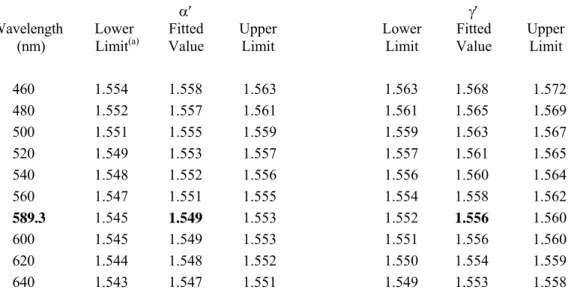
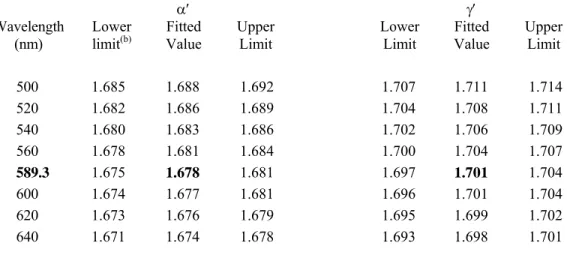
in Tables 1 and 2, respectively. Refractive indices were measured in the range of visible wavelengths by using the double variation method [4] on individual fibers of chrysotile and amosite asbestos. Certified values of refractive index for each of 2 principal orientations, α′ and γ′, are reported at 10 and 8 wavelengths in the visible spectral range for chrysotile and amosite, respectively. Expanded uncertainties were calculated as simultaneous tolerance interval values [5] designed to cover 95 % of the refractive index values measured at the nominal wavelengths at a 95 % confidence level [6] and corrected for bias from calibration measurements.
Supplemental Information: The refractive indices of crocidolite could not be certified due to the strong absorption
characteristics of crocidolite in the range of visible wavelengths. Crocidolite can be positively identified by PLM using the supplemental information provided. Additional characteristic properties of chrysotile and amosite that are primarily qualitative in nature, but necessary for positive identification of these phases by PLM, are also given as supplemental values.
Expiration of Certification: The certification of this SRM is valid until 12 January 2015, within the uncertainties
specified, provided the SRM is handled and stored in accordance with the instructions given. However, the certification will be nullified if the SRM is damaged, contaminated, or otherwise modified.
Maintenance of Certification: NIST will monitor representative solutions from this SRM lot over the period of its
certification. If substantive changes occur that affect the certification before the expiration of certification, NIST will notify the purchaser. Registration (see attached sheet) will facilitate notification.
Characterization of the Standard Reference Material was performed in the NIST Surface and Microanalysis Science Division by J.R. Verkouteren. Data used in the certification from the original issues of this standard were collected by J.M. Phelps, E.S. Windsor, D.M. Hues, and E.B. Steel.
Statistical analysis of the certification data was provided by S.D. Leigh of the NIST Statistical Engineering Division.
Richard R. Cavanagh, Chief Surface and Microanalysis Science Division
Gaithersburg, MD 20899 Robert L. Watters, Jr., Chief
The support aspects involved in the issuance of this SRM were coordinated through the NIST Measurement Services Division.
Source and Packaging of Materials1: SRM 1866b is the second reissue of SRM 1866 prepared from the same lots of
materials used to issue both SRM 1866 and SRM 1866a. The original lots of material were purchased in the late 1980’s by the Research Triangle Institute (RTI) from the Ontario Research Foundation, and were held in the asbestos repository at RTI under the direction of R.L. Perkins, and now B.W. Harvey. The source locality of the chrysotile is an unspecified mine in Canada, and the source localities of amosite and crocidolite are unspecified mines in South Africa. The materials were mixed by hand and sampled to produce the individual units available in this SRM under the direction of B.W. Harvey.
Special Handling Requirements: Proper procedures for the safe handling of asbestos must be employed during
preparation, analysis, and storage of this SRM. Store this SRM in the original bottles, tightly closed, and within the range of normal room temperature and humidity.
INSTRUCTIONS FOR USE
For typical use, remove a small amount of material from one of the bottles to place in a drop of immersion liquid of known refractive index on a glass slide, and cover with a glass cover slip. Observe the optical properties with a polarized light microscope for comparison with those described in the Supplemental Information. Measure the refractive indices according to procedures described in standard optical microscopy texts [7,8] or applicable methods [1−3] from a minimum of 10 fibers to determine the correspondence between measured values and reference values. The measurement of at least 10 fibers is sufficient to account for the natural variability in the refractive index of individual fibers.
Refractive indices of chrysotile and asbestiform grunerite (amosite) are given in Tables 1 and 2 for the wavelengths listed. The values in bold at 589.3 nm are used for standard measurements in white light with polarized light microscopy. The values reported at other wavelengths may be useful for measurements performed with the method of dispersion staining (or focal screening) described in references 3 and 9.
Table 1. Certified Values of Refractive Index for Chrysotile Asbestos in SRM 1866b
α′ γ′
Wavelength
(nm) LimitLower (a) Value Fitted Upper Limit Lower Limit Value Fitted Upper Limit
460 1.554 1.558 1.563 1.563 1.568 1.572
480 1.552 1.557 1.561 1.561 1.565 1.569
500 1.551 1.555 1.559 1.559 1.563 1.567
520 1.549 1.553 1.557 1.557 1.561 1.565
540 1.548 1.552 1.556 1.556 1.560 1.564
560 1.547 1.551 1.555 1.554 1.558 1.562
589.3 1.545 1.549 1.553 1.552 1.556 1.560
600 1.545 1.549 1.553 1.551 1.556 1.560
620 1.544 1.548 1.552 1.550 1.554 1.559
640 1.543 1.547 1.551 1.549 1.553 1.558
Table 2. Certified Values of Refractive Index for Grunerite (Amosite)in SRM 1866b(a)
α′ γ′
Wavelength
(nm) Lower limit(b) Fitted Value Upper Limit Lower Limit Fitted Value Upper Limit
500 1.685 1.688 1.692 1.707 1.711 1.714
520 1.682 1.686 1.689 1.704 1.708 1.711
540 1.680 1.683 1.686 1.702 1.706 1.709
560 1.678 1.681 1.684 1.700 1.704 1.707
589.3 1.675 1.678 1.681 1.697 1.701 1.704
600 1.674 1.677 1.681 1.696 1.701 1.704
620 1.673 1.676 1.679 1.695 1.699 1.702
640 1.671 1.674 1.678 1.693 1.698 1.701
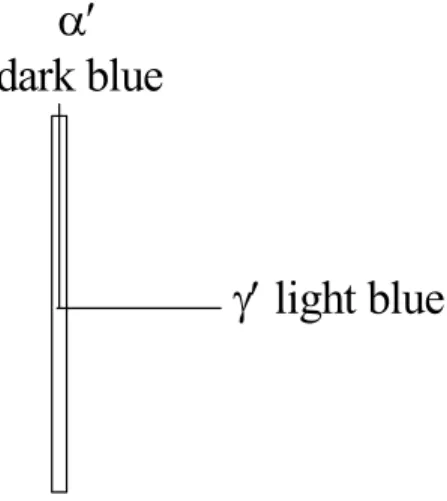
Individual asbestos fibrils from commercial asbestos cannot generally be resolved using polarized light microscopy because they are small compared to the wavelength of light in the visible region. For this reason, for samples of chrysotile, grunerite (amosite) and riebeckite (crocidolite) displaying primarily parallel extinction, the refractive indices are measured on fibers (comprised of many fibrils) and two values are reported, α′ and γ′. For the orientation of
α′ and γ′ with respect to fiber morphology for the three asbestos types, please see Figures 1−3 in the “Supplemental Information” section.
(a) The major asbestiform mineral phase present, and the phase for which the refractive indices are listed, is grunerite (amosite).
Another asbestiform phase with much lower refractive indices is present at concentrations ≤ 5 %. This accessory asbestiform phase has not been characterized for this SRM.
(b) The reported lower and upper limits are uncertainties that were computed as simultaneous tolerance interval values designed to
cover 95 % of the refractive index values measured at the nominal wavelength at a 95 % confidence level. The grunerite (amosite)
γ' lower tolerance limits have been conservatively adjusted for special dispersive effects at the lower range of wavelengths. The uncertainties reported here do not take into account error in the measured wavelengths nor the internal correlation associated with the measurements on each fiber that is characteristic of these particular dispersion curves. The uncertainties reflect the composite measurement variation introduced by the double variation method and by multiple analysts, fibers, and refractive index liquids.
SUPPLEMENTAL INFORMATION
γ′
light blue
α′
dark blue
Figure 1. Schematic Riebeckite (Crocidolite) Fiber
γ′
α′
Figure 2. Schematic Grunerite (Amosite) Fiber
Riebeckite (Crocidolite)
Refractive Indices: between 1.684 and 1.696 for both α′ and γ′, with γ′ slightly larger than α′.
Texture: asbestiform(a)
Color: blue in hand specimen, α′ dark blue, γ′ light blue Birefringence: low (anomalous red color)
Extinction: mostly parallel(b)
Sign of Elongation: negative
Concentration of Asbestos(c): > 90 % by weight or volume
Accessory Phases(c): possible magnetite and quartz
Grunerite (Amosite)
Texture: asbestiform(a)
Color: grey-brown in hand specimen, α′ colorless, γ′ colorless to very light brown Birefringence: medium (nγ′ - nα′ = 0.023)
Extinction: mostly parallel(b)
Sign of Elongation: positive
Concentration of Asbestos(c): > 90 % by weight or volume
Accessory Phases(c): possible magnetite and quartz, second asbestiform phase with refractive indices
significantly different from grunerite (amosite) may be present at very low
concentration
Chrysotile
Texture: asbestiform(a)
Color: grey-brown in hand specimen, α′ colorless, γ′ colorless Birefringence: low (nγ′ - nα′ = 0.007)
Extinction: parallel or wavy Sign of Elongation: positive
Concentration of Asbestos(c): > 90 % by weight or volume
Accessory Phase(c): possible magnetite
(a) Asbestiform: crystallizes with the habit of asbestos. These commercial asbestos minerals possess properties such as long fiber length and high tensile strength. Under the light microscope, these materials exhibit the asbestiform habit characterized by the following:
1) mean aspect ratios ranging from 20:1 to 100:1 or higher for fibers longer than 5 μm 2) very thin fibrils, usually less than 0.5 μm in width
3) parallel fibers occurring in bundles 4) fiber bundles displaying splayed ends 5) fibers in the form of thin needles 6) fibers showing curvature
(b) Thicker fibrils showing oblique extinction are rare, but do occur. (c) Evaluated by means of PLM and X-ray diffraction
REFERENCES
[1] U.S. Environmental Protection Agency Interim Method for the Determination of Asbestos in Bulk Insulation
Sample: Polarized Light Microscopy; 40 CFR Pt. 763, Subpt. F, App. A. (1987).
[2] Perkins, R.L.; Harvey, F.W.; Method for the Determination of Asbestos in Bulk Building Materials; U.S. Environmental Protection Agency EPA/600/R-93/116, Office of Research and Development, Washington, DC (1993).
[3] McCrone, W. C.; Asbestos Identification; McCrone Research Institute, Chicago, IL (1987).
[4] Verkouteren, J.R.; Steel, E.B.; Windsor, E.S.; Phelps, J.M.; Accuracy of the Double Variation Technique of Refractive Index Measurement; J. Res. Natl. Inst. Stand. Technol., Vol. 97, p. 693 (1992).
[5] Miller, R.G.; Simultaneous Statistical Inference; pp. 123−125 (Sect. 4.2, eq. 30), McGraw-Hill: (1966).
[6] ISO; Guide to the Expression of Uncertainty in Measurement; ISBN 92-67-10188-9, 1st ed., International Organization for Standardization: Geneva, Switzerland (1993); see also Taylor, B.N.; Kuyatt, C.E.; Guidelines for Evaluating and Expressing the Uncertainty of NIST Measurement Results; NIST Technical Note 1297, U.S. Government Printing Office: Washington, DC (1994); available at http://physics.nist.gov/Pubs/.
[7] Bloss, F. D.; An Introduction to the Methods of Optical Crystallography; Holt, Rinehart and Winston, Inc.: New York (1961).
[8] Kerr, P.F.; Optical Mineralogy; McGraw-Hill, Inc.: New York (1977).