M E L A NOGASTER1 I. J. AGOL
Timiriaziev Biological Institute, Moscow, U.S.S.R.
Received April 28, 1930
INTRODUCTION
In the fall of 1927, after publication of MULLER’S well known results; the Genetics Laboratory of the Moscow ZOOTECHNICAL INSTITUTE, under the guidance of Professor SEREBROVSKY, undertook a series of experiments on the action of X-rays on mutation and on some other special problems of interest to our laboratory.2 The results of these experiments were published in the Journal of Experimental Biology3 and reported by Professor SERE- BROVSKY a t the meeting on Genetics and Selection in Leningrad; therefore they will not be discussed a t length in this paper. Only one phenomenon of great importance which was described in the former paper will be exam- ined in connection with the present work.
Out of a great number of mutations, which took place in Drosophila melanogaster subjected to X-rays, DUBININ discovered two genes of the type of “scute” (reduction of bristles on different regions of the body). A
careful examination disclosed that they were neither identical with the previously known mutation scute (according to our terminology scute’) nor with each other. Although similar in some characters, they possess well determined differences. I n other words, the mutations discovered by Du-
BININ are not repeated mutations in the strict sense of the word. The dis- tinctive characters of each are as follows:4
Scute’ (PAYNE 1920) reduces the bristles of the head, the sternal, ab- dominal and scutellar bristles and the first notopleural bristle on each side. Scute2 reduces the sternal and scutellar bristles and in some measure the humeral bristles of both sides.
Scute3 reduces the bristles of the head, abdomen, sides, the frontal pair
1 Reported at the All-Union Meeting of Genetics and Selection, 1929.
’
This work was subsidized by the ALL-UNION COMMUNISTIC ACADEMY. It gives the author a special pleasure to express his profound appreciation to this institution for the unremitting and generous assistance shown to our work.J A. S. SEREBROVSKY, N. P. DUBININ, I. J. AGOL, V. H. SLEPKOV and V. E. ALTSHULER, “Mu-
tations by X-rays in Drosophila melanogaster,” Journal of Experimental Biology, series A. V. lV,
1928. (U.S.S.R.)
4 Mutations se1, st, s,S are numbered according to the chronological order of their discovery.
of dorsocentral bristles and the two bristles between the first and second pair of legs. Besides, scute3 is characterised by a diminished viability and allows the production of practically no homozygous females.
I n compounds, the different types of the gene scute result in a partial reversion to the wild-type, revealing only those characters which are com- mon to both genes present in the compound, while characters specific of each mutation disappear. This fact proves beyond doubt that the two genes are not quite allelomorphic.
The varied combination of characters in different mutations of the scute type made possible a differentiation of the region of the chromosome, occu- pied by the different transgenes of the scute type, into separate districts, as well as a planning of this region. Theoretical considerations and experi- mental data led H. P. DUBININ to the establishment of the following order of step-wise allelomorphs of the type scute:
scute,3 yellow,
scute,’ scute.2
The data discovered by DUBININ bear on one of the most important problems in genetics,-the structure and nature of the gene. A further investigation in this direction is most important, especially because the material used by DUBININ (only three step-wise allelomorphs of the type scute) was not sufficient to solve such a fundamental problem, however im- portant DUBININ’S general scheme may seem.
A comparative examination of a maximum number of transgenes of the type scute is necessary for a final solution of this problem. MULLER’S method promised a sure success in this respect, although MULLER himself, in connection with his work on reverse mutations, mentions his failure as well as that of other investigators to obtain a transgene of type scute from its normal allelomorph by means of X-rays. This fact seems to be accidental, which is well shown by the results obtained by DUBININ and myself, and quite recently by GAISSINOVICH of our laboratory, who dis- covered scute6 (reduction of the sternal and scutellar bristles) and by SEREBROVSKY, who discovered scute6 (reduction of ocellar, postvertical, first and second orbital and first notopleural bristles). This mutation was chosen by our laboratory for investigation, because of the possibility of very accurate determination of its manifestation. The difference in reduc- tion of bristles in different allelomorphs is easily measured and facilitates the work. I n this respect the mutation of type scute is to be preferred to many other mutations.
Males, one to two weeks old with the "signal gene" yellow in the sex chromosome, were chosen as objects for roentgenization. The therapeutic tube of COOLIDGE with a tungsten anticathode and a 1 mm aluminum filter was used for the purpose. A 50 K.V. and 5 m. amp. current was used, the flies were placed a t a distance of 16-17 cm from the anticathode and subjected to roentgenization. After the exposure to X-rays, they were crossed with virgin females of 2 types: double-X mainly yy and partly s C w scw, and in a few cases with females with one X chromosome of sc t v sw B
C1 structure.
TRANSGENE SCUTE.4 THE CHARACTERISTICS AND LOCATION O F THE GENE
I n one of the cultures, obtained from crossing a yellow male exposed for two hours to X-rays, and a yy female, a yellow male with a considerable reduction of bristles of type scute was discovered.
Investigation proved that this mutation was not a repeated mutation in the strict sense of the word. Even though it possessed characters similar to those of the previously known mutations scute,' scute2 and it differed from them in some respects. The new mutation, named scute,4 is manifested phenotypically in the following way (figure 1). Gene scute4 reduces the bristles on the head with the exception of the first verticals, reduces the scutellar bristles, the bristles of the sides with the exception of
TABLE 1
Grade of redgution of bristles on different parts of the body of the scut8 males.
NAME OF BRISTLES
Ocellars Postverticals Orbitals Vertical I
Vertical I1
Dorsocentrals Scu tellars Humerals Presu turals Notopleural I Notopleural I1 Supraalars* Postalars*
Bristles between the first and the second pair of legs
PERCENT OF PRESENCE
0
0 100 0 100 0 0 0
8,82
96 100
61,76 11,8
0
PERCENT OF ABSE"
100
100 0 100 0 100 100 100
91,18
4
0 88,2
38,24
100
the second notopleural, one supraalar bristle on each side and also acts on the bristles between the first and second pair of legs. The bristles on the abdomen and on the sternites in particular, are also greatly reduced. All these characters are constant and their combination is characteristic of
scute4 only. The bristles on various parts of the body of a large number of flies of different generations were counted. Digressions from the above mentioned characteristics in the mutation discovered were so negligible as
HUMERALS
OCEL
L ARS:
ORBITALS
-
. LARS
.;,
""I-
I
1 '
STERNOPLEURALS
VERTICALS
'POS TVER T/CALS
A
FIGURE 1.-Top view of head and side view of Drosophila melanogaster. A, wild-type; B, muta- tion scute.' The positions of absent bristles are indicated by dots, but no such marks are actually present on the flies.
to be of no account. The table on page 256 shows the degree of reduction
of bristles on different parts of the body in the male scute4 (table 1).
SCZ 0 - S 2 0 6 0 0 0 0 0 37 85 12 37 2 0 0 0 0 0
the corresponding sternites of the abdomen of a normal male. The number sternopleurals on both sides approaches the normal, if we do not take into consideration the considerable reduction in size and the frequent absence of 2 large bristles. It is not possible to determine accurately the percentage
of presence and absence of the large sternopleurals, since on account of their diminution in size, they cannot be distinguished from the other ster- nopleural bristles.
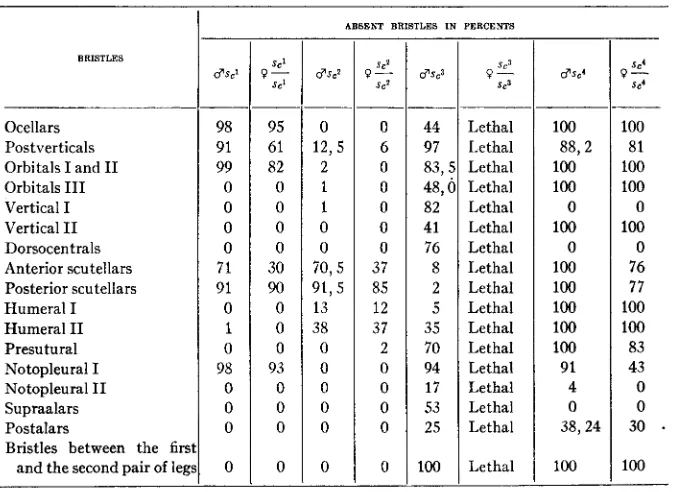
The comparative study of separate allelomorphs of type scute reveals the complexity of each: separate characters both recur and disappear in various combinations of different scute allelomorphs. Scute4 can be said to summarize the actions of all of its other allelomorphs (scl, sC2, s,3) with the exception of the action on the frontal dorsocentral bristle (scute3) and on the wings (scute2).
If scute4 were a partial allelomorph in relation to the previously known transgenes of type scute, then only the coinciding, homozygous districts
TABLE 2
Grade of redaution of bristles in the males and fentales of different nmtations of the type scute.
ABSENT BRISTLES I N PERCENTS
I
6 7 3 2
44 97 83,s 48,O 82 41 76 8 2 5 35 70 94 17 53 25 100 Lethal Lethal Lethal Lethal Lethal Lethal Lethal Lethal Lethal Lethal Lethal Lethal Lethal Lethal Lethal Lethal Lethal _ _ _ _ _ _ _ . 100 100 100 0 100 0 100 100 100 100 100 91 4 0 88,2 38,24 100 Ocellars Postverticals Orbitals I and I1 Orbitals I11 Vertical I
Vertical I1
Dorsocentrals Anterior scutellars Posterior scutellars Humeral I
Humeral I1 Presutural Notopleural I
Notopleural I1 Supraalars Postalars
Bristles between the first and the second pair of legs
sc4
0 -
so4
98 95 0 91 61 12,s 99 82 2
0 0 1
0 0 1
0 0 0
0 0 0
7 1 30 70,s 91 90 91,s 0 0 13 1 0 38
0 0 0
0 0 0
0 0 0
0 0 0
0 0 0
98 93 o
100 81 100 100 0 100 0 76 7 7 100 100 83 43 0 0
30
.
100
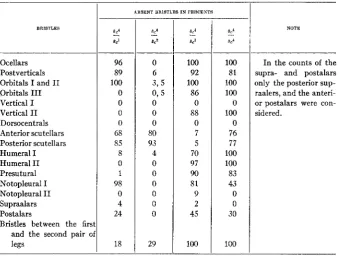
must be revealed, while differing mutational characters must disappear. The experiments support this theory entirely. The next two tables illus- trate the results obtained by me (tables 2 and 3 ) . Table 2 shows the de- gree of reduction of bristles in various parts of the body of different mutants of type scute. Table 3 shows the degree of similar reductions in different compounds of the same types.
TABLE 3
Grade of reduction of bristles in the compounds of scute4 with other genes of the type scute.
BRISTLES
Ocellars Postverticals Orbitals I and I1
orbitals I11 Vertical I
Vertical I1 Dorsocentrals Anterior scutellars Posterior scutellars Humeral I
Humeral I1
Presutural Notopleural I
Notopleural I1 Supraalars Postalars
Bristles between the firs and the second pair o legs 96 89 100 0 0 0 0 68 85 8 0 1 98 0 4 24 18
ARSENT BRISTLES IN PERCENTS
8 2
8 2
0 6
-
3 , s 0,s 0 0 0 80 93 4 0 0 0 0 0 0 29 100 92 100 86 0 88 0 7 5 70 97 90 81 9 2 45 100 100 81 100 100 0 100 0 76 77 100 100 83 43 0 0 30 100 NOTE
In the counts of the supra- and postalars only the posterior sup- raalers, and the anteri- or postalars were con- sidered.
The tables given above show that on the area, where the allelomorphs of the compound have different phenotypic manifestations, reversal toward the normal always takes place. Scute' in compound with scute4 counter- acts the reduction of the last orbital bristles, second vertical, both hu- meral, presutural, second supraalar, and diminishes considerably the per- centage of reduction of postalars and of bristles between the first and second pair of legs (100 percent-18 percent). Scute2 in compound scute4/ scute2 counteracts the reduction of all bristles on the head, all side bristles with the exception of the humerals, and likewise lowers considerably the percentage of reduction of bristles between the first and second pair of legs (from 100 percent to 29 percent).
Scute3 in compound scute4/scute3 diminishes in a marked degree the percentage of reduction of scutellars (from 100 percent to 6 percent), while losing under the influence of scute4 its ability to reduce the dorsocentral bristles.5
Besides, the reduction of bristles on the sternites in all mutations type scute should be noted. The total number of bristles on the first three sternites is expressed as follows: in the male scute-26.4, in the female- scute1/scute1-32.01 ; in the male s c ~ t e ~ l 5 . 6 , in the female scute2/scute* -16.6; in the male scute3-31; in the male scute-28.75; in the female scute4/scute4 -30.44; in compound scute4/scutet28.94; scute4/scute2-
22.1; scute4/scute3-29.72. The entire quantity of sternopleural bristles on
both sides is: in the male scutel--16.86, in the female scute1/scute1-17.5; in the male scute2-16.4, in the female scute2/scute2-17.1; in male scute3 -9.8, in the male scute-15.5; in the female scute4/scute4 -15.8.
I n this way, the comparative study of the action of each separate trans- gene-s,', s,2, s,3, and s,4 (table 2) together with the action of each in compound with transgene s,4 (table 3), leaves no doubt that the transgenes examined are not altogether allelomorphic in relation to each other. The reversal to the wild (normal) type always follows in that district, where the separate members of the compound exhibit different phenotypical manifestations (figure 2).
The comparative study of compounds of scute4 and the other transgenes of type scute permits the establishment of a row of basic (elementary) districts, which enter as components in some transgenes and are not acted upon in others. As an example, the fact may serve that the area which conditions the reduction of ocellar, orbital and the first notopleural bristles is established in the following manner. Compound scute4/scu te6 exhibits the manifestation of ocellar, postvertical and the first and second orbital and first notopleural bristles; compound se4/s,Z exhibits a reversal to nor- mal of ocellar, first and second orbital and first notopleural bristles, but prevents the manifestation of post-vertical bristles. It follows that the district acting on the postvertical bristles can be combined independently of the districts acting on the ocellar, orbital and notopleural districts.
A comparative analysis of all compounds of type scute does not allow US yet to divide this district into more elementary ones, since in all of these compounds, the reduction of bristles, conditioned by this district, mani- fests itself always as a whole. By means of a comparative analysis of com- pounds of scute4 and the other transgenes of type scute (in this case we
in such females is given for comparison with other compounds.
call them analysers) one can establish the following seven elementary districts in transgene scute4:
first district, determining the reduction of ocellar, first and second orbital and first notopleural bristles (analysers s,4/s: and sC4/sc2) ; second district, determining the reduction of postvertical bristles (analysers s,4/sC2 and
s>/s,6); third district, determining the reduction of the second vertical and supraalar bristles (analysers sC4/sc3, s,4/sc1, sc4/sc2) ; fourth district, deter- mining the reduction of scutellar bristles (analysers s,4/sc5 and s>/~>) ;
fifth district, determining the reduction of humeral bristles (analysers
sL4/sC2, s>/s,6 and s,4/s,3) ; sixth district, determining the reduction of sternal bristles (s,4/sC3 and sC4/sc5) ; seventh district, determining the reduction of bristles between the first and second pair of legs (s>/s,3).
The study of females homozygous for scute4 revealed the fact that the percentage of reduction of bristles in such females in comparison with their degree of reduction in males scute4 is lower (table 2 ) . Such a decrease in the quantity of bristles can be observed in all females homozygous for every gene of type scute. This phenomenon has not yet been adequately ex- plained. We are not able to say at present whether this phenomenon is determined by the sexual dimorphism of Drosophila or whether i t depends on other causes. A similar decrease in the reduction of bristles in the homo- zygous condition can be observed in the mutation recently discovered by N. E'. DUB IN IN.^
The determination of the position of scute4 in the series of step allelo- morphs of type scute in the usual way, that is by calculating the percen- tage of crossing over, seems a difficult problem to solve, inasmuch as we are not able to obtain a crossing over between the separate transgenesof
type scute.:
I did not have a t my disposal triploid females producing a certain per- centage of crossing over, between yellow and scute. This problem, how- ever, can be solved in another way. I attempted to determine the position of scute4 by means of a comparative analysis of its characters and the characters of other transgenes scute. The phenotype of transgene scute' is a resultant phenotype of the separate districts of all of its step allelo- morphs, except the district which influences the dorsocentral bristles. We now come to the conclusion that the region occupied by scute4 is a sum of the other regions, occupied by all other known genes of type scute. But scute4 does not include all of the transgene scute2, which is manifested phenotypically in wrinkled, spoon-like wings, in addition to reduction of bristles; that is, the object of its action in this case is more extensive than that of scute4. This fact allows us to assume that the right end of gene scute2 may have a common district with transgene spoon, lying a t locus This mutation (named shd) is manifested phenotypically as follows: coarse and diminished
eyes, reduction and doubling of bristles. This transgene is situated in the sex chromosome in the region of Notch or somewhat to the left of it.
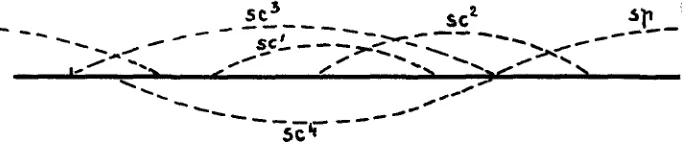
0.2 on the map, and possessing a similar manifestation on the wings. We do not observe such an action on wings in scute4, consequently it does not extend so much to the right. The right end of gene scute4 lies to the left of the right end of scute,2 hence does not include all gene scute2. In such a manner, we arrive a t the following determination of the position of trans- gene scute4. ' It extends over the greater part of transgenes, scute', scute3,
and scute2, its right end approaching transgene spoon, without touching it. The position of scute' in the series of step allelomorphs, may be ex- pressed in the following scheme (figure 3 ) .
SP
-e---
sc2
--
sc3
s , C L - -
*/-= --
--
- \ / /,
- \.
.
-.
0 * \ ,-
---
/ - - - 4
-
--\
/
0 4
-a .
I4 0
-.-
-0- * - - _ _ _ _ - - . c c
sc 4
\
..
% / / "
FIGURE 3.-Series of step allelomorphs sc3, sc4, s2, s,2, . s,
The insufficient data regarding additional cases of step allelomorphs, does not yet allow us to build up an accurate scheme, which would include all known districts. As we obtain additional cases of partial allelomorphs type scute, we will be able to determine definitely the boundaries of sep- arate districts, to study accurately the special position of these districts and to build up a plan of the basegene. Consequently, our efforts should be directed towards getting new mutations type scute. One more mutation in the sex chromosome of Drosophila has been discovered by N. P. DUBININ, related phenotypically to mutations type scute (reduction of bristles of different parts of the body). If this transgene should really prove to be a
new partial allelomorph type scute, we will have in addition to yellow and spoon, seven allelomorphs type scute.* Such a series of partial allelomorphs will help us in the solution of the problem of the structure of genes.
SOME THEORETICAL CONCLUSIONS
The results concerning the phenomenon of step allelomorphism described above lead us to very important conclusions in regard to the nature and structure of the gene. We first arrive a t the conclusion that the gene is not, a t least not always, something homogeneous, indivisible, but may be repre- sented by a complex organization, composed of separate districts joined with each other, each possessing its specific action. The connection be- n The mutation discovered by N. P. DUBININ has since been found to be a new step allelo- morph type scute. I t is recorded in our laboratory as scute.' As this goes to press, the count of
mutations of the scute locus totals approximately three dozen.
tween districts is constant in each separate transgene. In other words each given transgene possesses a definite number of districts in some way joined with each other. Such are, for instance, the different combinations of districts in various allelomorphs of type scute, which arose as mutations in individuals of the wild-type.
the traditional view of allelomorphism. We may consider as allelomorphs not only those genes which cointide throughout their extent and do not allow any reversal to the wild-type in compounds, but also those genes which coincide only in one or several districts and which produce a partial reversal to the normal (wild) type in compounds. The presence of a large number of comparatively independent districts in the basegene leads us to conclude that the possibility of a strict repetition of changes in all districts is very small; it follows that the newly arising allelomorphs must in most cases be partial or incomplete, some of their districts coinciding with those of other transgenes. Such are, for example, the allelomorphs scute', scute2, scute3, scute4, scutes, scute6 and scute'. The three allelo- morphs type dachsous belong to this category. For instance, the transgene dachsous' includes the districts of the chromosome acting both on the crossveins and the shape of wings. The wings remain normal in the muta- tion dachsous3, but i t includes the district acting on the ovary which was left normal by the former transgene. The compound between these two transgenes manifests only those characters which are related to the district of the chromosome included by both transgenes. All other allelomorphs should be thoroughly investigated in this direction, as well as the so-called repeated mutations. We can assume theoretically a long stair of allelo- morphs, which gradually pass from one gene into another and extend throughout the entire length of the chromosome. Two different genes not allelomorphic in relation to each other may be partial allelomorphs in relation to another gene, for instance, spoon and scute', in relation to
scu te2.
I will indicate another important conclusion drawn from the phenome- non of step allelomorphism. It has to do with crossing over. If the entire chromosome is continuous, that is, if one gene passes directly into another, then the crossing over may pass only through the gene and not between genes, since step allelomorphism exludes any spaces between genes.
normal allelomorph of scute4 is not the same as that of scute3, scute2, or scute’. The latter all represent different regions in the normal chromo- some.9
LITERATURE CITED
ALTENBURG, E., 1928 The limits of radiation frequency effective in producing mutations. Amer.
DUBININ,”. P., 1929 AUelomorphentreppeen bei Drosophila melanogaster. Biol. Zbl. 49: 328-339. GAGER, C. S., and BLAKESLEE, A. F., 1927 Chromosome and gene mutations in Datura following
GOODSPEED, T. H., and OLSON, A. R., 1928a The production of variation in Nicotiana species by Nat. 62: 540-545.
exposure to radium rays. Proc. Nat. Acad. Sci. Wash. 13: 75-79.
X-ray treatment of sex cells. Proc. Nat. Acad. Sci. Wash. 14: 6669. 1928b Progenies from X-rayed sex-cells of tobacco. Science 67: 46.
HANCE, R. T., 1928 The reaction of homozygous and heterozygous adult characters under the
HANSON, F. B., 1928a The effects of X-rays on productivity and the sex ratio in Drosophila me-
influence of X-rays (Abstr) Anat. Rec. 37: 176.
lanogaster. Amer. Nat. 62: 352-362.
19281, The effects of X-rays in producing return gene mutations. Science 67: 562-563.
HANSON, F. B., and HEYS, F. M., 1928 The effects of radium in producing lethal mutations in
MULLER, H. J., 1927a Artificial transmutation of the gene. Science 66: 84-87. Drosophila. Science 68: 115-116.
19271, The problem of genic modification. Proceedings of the Fifth International Congress, Supplementband of the Z. indukt. Abstamm.-u. VererbLehre 1: 234-260.
1928 The measurement of gene mutation rate in Drosophila, its high variability and its de- pendence upon temperature. Genetics 13: 279-357.
PATTERSON, J. T., 1928 The effect of X-rays in producing mutation in the somatic cells of Droso- phila melanogaster. Science 68: 4143.
SEREBROVSKY, A. S., 1926 The influence of the gene “purple” on crossing over between the genes “black” and “cinnabar” in Drosophila melanogaster. J. Exp. Biol. (U.S.S.R.) T 2: 55- 100.
SEREBROVSKY, A. S., DUBININ, N. P., AGOL, I. I., SLEPKOV, V. N., and ALTSHULER, V. E., 1928 The production of mutations by X-rays. J. Exp. Biol. (U.S.S.R.) 3-4: 161-180. STADLER, L. J., 1928a Genetic effects of X-rays in maize. Proc. Nat. Acad. Sci. Wash. 14: 69-75. TIMOFELF-RESSOVSKY, 1929 Riickgenovariationen und die Genovariabilitit in verschiedenen
WEINSTEIN, A., 1918 Coincidence of crossing over in Drosophila melanogaster. Genetics 3: 135-
1928 The production of mutation and rearrangements of genes by X-rays. Science 67: 376- 1928b Mutation in barley induced by X-rays and radium. Science 68: 168.
Richtungen. Arch. EntwMech. Org. 115: 620-635.
173.
377.
WHITING, P. W., 1928 The production of mutation by X-rays in Hadrobracon. Science 68: 58.
This possibility was predicted by A. S. SEBEBROVSKY in 1926 in his paper on “The effect of