© 2015, IRJET.NET- All Rights Reserved
Page 823
Review of Natural Convective Heat Transfer from Interrupted
Rectangular Fin Array
T. T. Kapade
1, D. D. Palande
21
PG Student, Heat Power, MCOERC, Nasik, Maharashtra, India
2
Associate Professor, Mechanical Department, MCOERC, Nasik, Maharashtra, India
---***---Abstract -
Natural Convection can be improvised by using Interrupted fins. Interrupted fins are made by creating slots on solid continuous fins. This investigation concentrates over effect of change in number of equidistant slots (inline interruption). The channel flow through between two plate fins, rate of heat transfer decreases as flow becomes fully developed after some length. The interruption on fin will increase rate of heat transfer by permitting maximum air flow rate and keeps air to be in contact with fin surface (also will increase mixing of air) in spite reduction in surface area of fin. this can reduces weight of fin. This investigation is over experimental and Numerical analysis of external natural convection. The optimum interruption length for maximum fin array and angle of inclination for thermal performance can offer compact relationship for the Nusselt number supported geometrical parameters for interrupted walls.Key Words:
Heat transfer, Natural convection,
Interrupted fins, Optimum gap
1. INTRODUCTION
The design of economical cooling ways within which is important for reliable performance of high power density electronics. Range of failure mechanisms in electronic devices, like inter-metallic growth, metal migration, and formation of void, are related to thermal effects. In actual, the speed of such failures nearly doubles with every 10°C increase on top of the operational temperature (~80°C) of high power electronics. Besides the harm that excess heat can cause, it will increase the movement of free electrons within semiconductors, causes a rise in signal noise of processor. Consequently, electronics thermal management is of crucial importance as is reflected within the market. This power dissipation generates heat that might be a by-product in several engineering applications. This unwanted by-product can decrease the performance of the systems since nearly every engineering system is supposed to figure within a specific temperature limits. Surpassing these limits by
increase in heating, might lead on to a failure of system. Currently, the thermal losses of power electronic devices are increasing. At the same time, decreasing there sizes. Consequently, heat sinks need to dissipate higher heat fluxes in every new style and design. Therefore, making efficient cooling solutions to satisfy these challenges is of predominant importance and has direct impacts on the performance and reliableness of electronic and power electronic devices.
The techniques used in the cooling of high power density electronic devices vary wide, counting on the application and the needed cooling capability. the heat generated by the electronic components has got to pass through a complex network of thermal resistances to the setting.
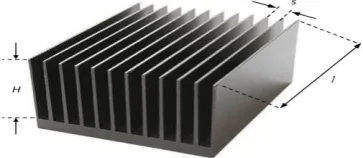
The focus of this study is on natural convection heat transfer from interrupted, vertical and rectangular fins. However, a lot of overview on pertinent literature within the area of natural heat transfer from fins is provided during this section. a range of theoretical expressions, graphical correlation, empirical equations are developed to represent the coefficients for natural convection heat transfer from vertical plates and vertical channels. These studies were principally centered on geometrical parameters of the heat sinks and fins, like fin spacing(S), fin height(H), fin length(L), as well as, fin directions.
© 2015, IRJET.NET- All Rights Reserved
Page 824
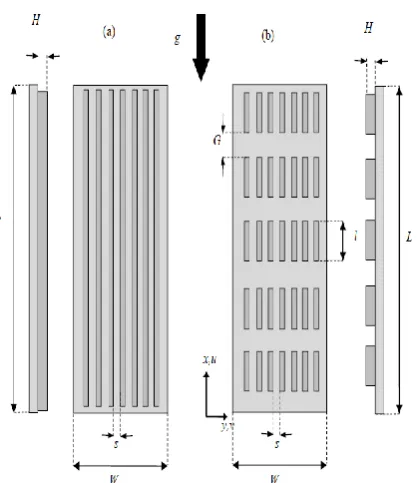
Fig -2: Schematic of the considered heatsink geometry: a) continuous rectangular finned heatsink and b) interrupted rectangular finned heatsink.
2. LITERATURE REVIEW
Bodoia and Osterle [1] used a numerical approach to analyze the developing flow within the channel and also the heat transfer between symmetrically heated, isothermal plates. They aimed to predict the channel length needed to attain a fully developed flow as a operate of the channel breadth and wall temperature. Ofi and Hetherington used a finite element method to check the natural convective heat transfer from open vertical channels with uniform wall temperature. They determined that fluid velocity could also be vertical only.
Starner and McManus [2] calculated natural heat transfer coefficients for four different {completely different} fin arrays and 3 different base plates. Flow patterns for every case were discovered by using smoke filaments. Parameters that were varied in their study were the fin spacing and the height, respectively. Welling and Wooldridge [3], who investigated large arrays with comparable fin heights, confirmed the findings of [13] for the vertically based mostly fin array orientation. They provided an equation for optimum value of the ratio of fin height to fin spacing and showed the importance of the fin spacing in their results. The way the ratio of fin height to fin spacing varies with temperature was conjointly reported.
Aihara [4,5] investigated the natural convection and radiation heat transfer from eleven large vertically based fin arrays. within the former work [9], He conducted an experimental study of the heat transfer from the bottom plate. The effect of fin geometry and temperature on the average heat transfer coefficient has been studied
and an empirical correlation was obtained. In their latter work [7], a series of experiments targeted on heat transfer from the fins reported. Supported their experimental information, they proposed a correlated average Nusselt number.
Chaddock [6] investigated the natural convection and radiation heat transfer from twelve large vertically based fin arrays. only one value of base-plate breadth to the fin length ratio was used whereas the fin thickness was kept constant. The fin spacing and also the fin height were varied and that they showed the importance of the radiation in calculations of total heat transfer, about 20% of the total heat transfer. the observations of that study was a report on the optimum fins-spacing Yazicioglu and Yuncu [14] additionally carried out an experimental investigation on natural convection heat transfer from rectangular fin arrays on a vertical surface to see the effects of fin height(H), fin spacing(S) and temperature distinction between the fin base and also the surroundings on heat transfer. They developed a correlation for optimum fin spacing and discussed the impact of fin height, fin length and fin spacing on the interference of boundary layers, flow pattern, and heat transfer.
Bar-Cohen and Rohsenow [8] performed an analytical study to analyze the natural convective heat transfer from two parallel plates. They developed a relationship for Nusselt number in terms of the Ra number for each, isothermal and iso-flux plate cases and reported a correlation for the optimum fin spacing. They claimed that the value of the Nusselt number lies between two extremes that are related to the separation between the plates, or in other words, the channel width. For large spacing, the plates appear to have very little influence upon one another looking like they're isolated; the Nusselt number during this case approaches its isolated plate limit.
Karki and Patankar [10] and Cengel and Ngai [11] that restricted naturally cooled vertical shrouded fins. The authors conducted an experimental study and investigated the result of shrouds on fins performances.
Culham et al. [12] correlated the Nusselt number with characteristic length scale supported the squared root of the wetted area for the three dimensional bodies. The wetted area of a fin is the surface that is exposed to the air flow. an agreement of less than 9-11 between the proposed relationship and therefore the numerical data showed that the selection} of the squared root of area as the characteristic length for natural convection from rectangular fins was a suitable choice.
© 2015, IRJET.NET- All Rights Reserved
Page 825
2.1 Literature Review For Inclined Fin Array
H. Yuncu, G. Anbar [16] investigated natural convection heat transfer for 15 sets of rectangular fin array with horizontal base. Fin spacing(S) and fin height(H) was varied from 6mm to 26mm and 6.2 to 83mm, respectively, meanwhile fin length and fin thickness was kept constant at 100 and 3mm, respectively. They found that fin spacing to fin height(H) ratio is robust factor influence for convective heat transfer. They concluded that optimum fin spacing is not dependent on temperature difference however it decreases with increase in fin height. For fin height 16 and 26mm, optimum fin spacing found eleven.6 and 10.4mm, respectively.
S. Baskaya, M. Sivrioglu, M. Ozek [18] analyzed parametric effect of horizontally oriented fin array over natural convection heat transfer. They stated that to get optimum performance in terms of overall heat transfer, influence of all design parameters must be considered. They found that optimum fin spacing for L=127mm and L=154mm are Sopt= 6 and 7 mm, respectively. Q/Ab values will reduced with increase in fin length since flow pattern changes from single chimney to multiple chimney flow. They reported that since shorter fin manufacture more dominant single chimney flow, the overall value for the heat transfer coefficient reduces with fin length. On other hand, the heat transfer coefficient values increase with increase within the fin height. Overall heat transfer enhanced with increase in fin height (H), the height of the fin and decreases in L, the length of the fin, thus increase in H/L.
H. M. Mobedi, H. Yuncu [19] numerically studied steady state natural convection heat transfer from short fin array for Rayleigh number ranging from 120 to 39000. They concluded that H/L ratio is governing parameter for fluid field and flow pattern. Furthermore, for H/L≤0.25 and S≥10mm, flow field is up and down type flow pattern.
L. Dialameh, M. Yaghoubi, O. Abouali [21] studied 128 fin geometries with short length and thick fins. Aluminum rectangular fins of 3mm< t < 7mm with length L≤ 50mm were tested. They illustrated two type of flow pattern in channel. They concluded that for maximum heat transfer, optimum value of fin spacing Sopt=7 for fin arrays with H/L≤0.24. They commented that for fin arrays with H/L>0.24 and S/L<0.2, air enters from the fin end region while another range, air enters from middle parts of fin.
Study on effect of inclination of base on heat transfer has been made by S. V. Naidu, V. Dharma Rao et.al [22]. Five different inclination angles 0°, 30°, 45°, 60°,90° were selected. They observed that the convection heat transfer rates are increasing from 0°,decreasing from 30° to 45° and again increasing from 45° to 60° and 60° to 90° inclination for orientation of vertical base with vertical fins.
© 2015, IRJET.NET- All Rights Reserved
Page 826
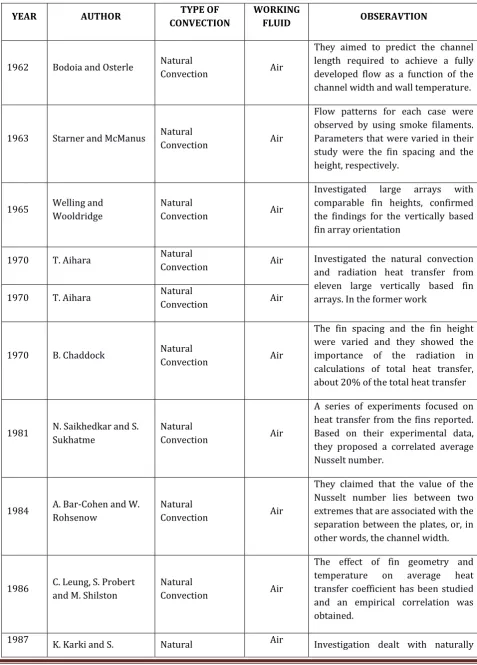
Table -1: Experimental works on the Fins in natural convection for interrupted fin array
YEAR AUTHOR TYPE OF
CONVECTION
WORKING
FLUID OBSERAVTION
1962 Bodoia and Osterle Natural
Convection Air
They aimed to predict the channel length required to achieve a fully developed flow as a function of the channel width and wall temperature.
1963 Starner and McManus Natural
Convection Air
Flow patterns for each case were observed by using smoke filaments. Parameters that were varied in their study were the fin spacing and the height, respectively.
1965 Welling and Wooldridge
Natural
Convection Air
Investigated large arrays with
comparable fin heights, confirmed the findings for the vertically based fin array orientation
1970 T. Aihara Natural
Convection Air Investigated the natural convection and radiation heat transfer from
eleven large vertically based fin arrays. In the former work
1970 T. Aihara Natural
Convection Air
1970 B. Chaddock Natural
Convection Air
The fin spacing and the fin height were varied and they showed the importance of the radiation in calculations of total heat transfer, about 20% of the total heat transfer
1981 N. Saikhedkar and S. Sukhatme
Natural
Convection Air
A series of experiments focused on heat transfer from the fins reported. Based on their experimental data, they proposed a correlated average Nusselt number.
1984 A. Bar-Cohen and W. Rohsenow
Natural
Convection Air
They claimed that the value of the Nusselt number lies between two extremes that are associated with the separation between the plates, or, in other words, the channel width.
1986 C. Leung, S. Probert and M. Shilston
Natural
Convection Air
The effect of fin geometry and
temperature on average heat
transfer coefficient has been studied and an empirical correlation was obtained.
© 2015, IRJET.NET- All Rights Reserved
Page 827
Patankar Convection cooled vertical shrouded fins
1991 Y. Cengel and T. Ngai Natural
Convection Air
An experimental study and
investigated the effect of shrouds on fins performances.
1995 J. Culham, M. M. Yovanovich
Natural
Convection Air
An agreement of less than 9% between the proposed relationship and the numerical data showed that the selection of the squared root of area as the characteristic length for natural convection from rectangular fins was a suitable choice.
2007 M. Fujii Natural
Convection Air
Investigated large arrays with comparable fin heights, confirmed the findings for the vertically based fin array orientation.
2007 B. Yazicioglu and H. Yuncu
Natural
Convection Air
They provided an equation for optimum value of the ratio of fin height to fin spacing and showed the importance of the fin spacing in their results. The way the ratio of fin height to fin spacing varies with temperature was also reported.
2014 MehranAhmadi, GolnooshMostafavi
Natural
Convection Air
© 2015, IRJET.NET- All Rights Reserved
Page 828
ACKNOWLEDGEMENT
I am pleased to say that this paper would not have been completed without the able guidance and complete support of Prof. D. D. Palande, who helped me at each and every step in every possible way. He always provided me with access to the latest technology and facilities and encouragement at every point and took active participation in the achievement of my objective. My foremost heartfelt thanks go to Prof. J. H. Bhangale (Head of Department) and Prof. N. C. Ghuge. I am grateful to all colleagues and my friends for giving me the helping hand.
REFERENCES
[1] J. Bodoia and J. Osterle, “The development of free convection betwen heated vertical plates,” Journal of heat transfer, vol. 84, pp. 40-44, 1962.
[2] K. Starner and H. N. McManus, “An experimental investigation of free-convection heat transfer from rectangular-fin arrays,” Journal of heat tranfer, vol. 85, no. 3, pp. 273-278, 1963.
[3] J. Welling and C. Wooldridge, “Free convection heat transfer coefficients from rectangular vertical fins,” Journal of heat transfer, vol. 87, no. 4, pp. 439-445, 1965.
[4] T. Alhara, “Natural convection heat transfer from vertical rectangular-fin arrays: Part 2, heat transfer from fin-edges,” Bulletin of the JSME, pp. 1182-1120, 1970.
[5] T. Alhara, “Convection heat transfer from vertical rectangular-fin arrays (part 3, heat transfer from fin-flats),” Bulletin of JSME, pp. 1192-, 1970.
[6] B. Chaddock, “Free convection heat transfer from vertical rectangular fin arrays,” ASHRAE journal, vol. 12, pp. 53-60, 1970.
[7] N. Saikhedkar and S. Sukhatme, “Heat transfer from rectangular cross-sectioned vertical fin arrays,” in Proceedings of the sixth national heat and mass transfer conference, India, 1981.
[8] A. Bar-Cohen and W. Rohsenow, “Thermally optimum spacing of vertical, natural convection cooled, parallel plates,” Journal of heat transfer, vol. 106, no. 1, pp. 116-124, 1984.
[9] C. Leung, S. Probert and M. Shilston, “Heat transfer performance of vertical rectangular fins protruding from bases: effect of fin length,” Journal of applied energy, vol. 22, no. 4, pp. 313-318, 1986.
[10] K. Karki and S. Patankar, “Cooling of a vertical shrouded fin array by natural convection numerical study,” Journal of heat transfer, vol. 109, pp. 671-676, 1987.
[11] Y. Cengel and T. Ngai, “Cooling of vertical shrouded-fin arrays of rectangular profile by natural convection: an experimental study,” Journal of heat transfer engineering, vol. 12, no. 4, pp. 27-39, 1991. [12] J. Culham, M. M. Yovanovich and S. Lee, “Thermal
modeling of isothermal cuboids and rectangular heat sinks cooled by natural convection,” IEEE transaction
on components, packaging and manufacturing technology, vol. 18, no. 3, pp. 559-566, 1995.
[13] M. Fujii, “Enhancement of natural convection heat transfer from a vertical heated plateusing inclined fins,” Heat Transfer—Asian Research, vol. 36, no. 6, pp. 334-344, 2007.
[14] B. Yazicioglu and H. Yuncu, “Optimum fin spacing of rectangular fins on a vertical base in free convection heat transfer,” Journal of heat and mass transfer, vol. 44, no. 1, pp. 11-21, 2007.
[15] MehranAhmadi, GolnooshMostafavi, “Natural convection from rectangular interrupted fins”, International Journal of Thermal Sciences vol. 82 (2014), pp.62-71
[16] H. Yuncu, G. Anbar, An experimental investigation on performance of rectangular fins on a horizontal base in free convection heat transfer, Heat Mass Transfer 33 (1998) 507–514.
[17] T. A. A. Daloglu, “Natural convection in a periodically finned vertical channel,” International Communications in Heat and Mass Transfer, vol. 26, no. 8, p. 1175–1182, 1999.
[18] S. Baskaya, M. Sivrioglu, M. Ozek, Parametric study of natural convection heat transfer from horizontal rectangular fin arrays, Int. J. Thermal Sci. 39 (2000) 797–805.
[19] H M. Mobedi, H. Yuncu, A three dimensional numerical study on natural convection heat transfer from short horizontal rectangular fin array, Heat Mass Transfer 39 (2003) 267–275.
[20] S. Nada, “Natural convection heat transfer in horizontal and vertical closed narrow enclosures with heated rectangular finned base plate,” vol. 50, 2007.
[21] L. Dialameh, M. Yaghoubi, O. Abouali, Natural convection from an array of horizontal rectangular thick fins with short length, Appl. Thermal Eng. 28 Applied Sciences, Vol. 5, No. 9, Sept. 2010.
[23] IlkerTari, Mehdi Mehrtash, Natural convection heat transfer from inclined plate-fin heat sinks, International Journal of Heat and Mass Transfer 56 (2013) 574–593.
© 2015, IRJET.NET- All Rights Reserved
Page 829
BIOGRAPHIES
T. T. Kapade received B.E. degree in Mechnical Engineering from Savitribai Phule Pune University, in 2011 and pursuing M.E. degree in Heat Power from Savitribai Phule Pune University.
Prof. D. D. Palande received B.E. degree in Mechanical Engineering from Government college of engineering Karad and M.E. in Thermal from Government College of Engineering Amravati. Pursuing PhD from Nagpur University. He has experience of 20 years.