Automation in Hydroponic System using
Control Circuit
Soniya Joshi1 , Vrushali Gujar2
Assistant Professor, Department of Electrical Engineering, Trinity college of Engineering and Research, KJ’s
Educational Institute, Pune, Maharashtra, India1
B.Tech Scholar, Department of Electrical Engineering, Trinity college of Engineering and Research, KJ’s Educational
Institute, Pune, Maharashtra, India2
ABSTRACT: India is an agricultural country so Agriculture is the most important sector of Indian economy. But now a days, India is facing many problems in agricultural sectors due to drought, flood, industrialization and insufficient raining. Considering the situation, the present study has been focused on hydroponic system. Hydroponics is a subset of hydro culture. The science of soil-less gardening is called hydroponics. It basically involves growing healthy plants without using traditional soil and thereby replacing it by using mineral rich water solution. Generally, a plant requires nutrients, water, and sunlight for its growth. Hydroponics is the practice of growing plants using only water, nutrients and a growing medium. Hydroponics not only saves water but also saves land. In hydroponics system instead of using soil the root system of crops is supported using an inherent medium like perlite, Rockwool and clay pellets etc. The idea behind hydroponics is to remove as many barriers as possible between plant roots and the water, oxygen and nutrients which they require for its growth. In conventional hydroponic system, operator is required to handle all processes such as, giving water to plants at regular intervals. In the present project we have done automation using following equipments: Microcontroller Arduino Nano, Sensors (Proximity,Moisture), Motor pump set, Solar panel, Battery, Charge controller, Solenoid valve, Conveyor belt assembly, Sprinkler etc.
KEYWORDS: Hydroponics, Control Circuit
I. INTRODUCTION
This Automated Hydroponic systems automatically delivers nutrients into the water for different crops. The mix of Water and nutrient solution is continuously circulates the water with the help of sprinkler. This system uses less water and fertilizer as compared to soil. Also the system becomes more advanced, more accurate and cost effective so that farmers can use this system in large scale which is a challenge that must be addressed in a future. Overall automated hydroponic system using microcontroller provides more flexible and more efficient operation than manually operated hydroponic system.
as light intensity and duration temperature, humidity, pH of the solution and mineral nutrients. Hydroponics does not use soil, instead the root system is supported using an inert medium such as perlite, rockwool, clay pellets, peat moss, or vermiculite. The basic premise behind hydroponics is to allow the plants roots to come in direct contact with the nutrient solution, while also having access to oxygen, which is essential for proper growth.
India is an Agricultural country but now a days, India is facing many problem in agricultural sectors due to the drought, flood, and insufficient raining. Due to industrialization the land is in trouble and cost required for this is much more. In conventional hydroponic system operator is required to handle the all process such as, to give water to plants at regular intervals. This includes some requirement of manpower, periodic observation and also it is time consuming process. To overcome these drawbacks we have done automation in our study.
II. LITERATURE SURVEY
The cool thing about hydroponics is that there are many different types of hydroponics systems available. Some of the best hydroponic systems on the market combine different types of hydroponics into one hybrid hydroponic system. Hydroponics is unique in that there are multiple techniques you can use to get the nutrient solution to your plants. Deepwater Culture (DWC), also known as the reservoir method, is by far the easiest method for growing plants with hydroponics.
Many Researchers have worked on the hydroponic system, advances in the development of a hydroponic system for the cherry tomato culture based on the nutrient film technique are presented. The monitoring parameters for the nutritious hydroponic solution are the pH and the electrical conductivity. Sensors and conditioning circuits were designed and implemented to monitor such parameters. The physical irrigation system based on PVC tubing was designed and is presented as well. Preliminary results showed high accuracy on pH measurements with a correlation coefficient of 0.994 for expected values and a standard deviation of 0.01 after repeated measurements. The final goal is the integration of the developed sensors and circuits into a full control greenhouse system for a simple, easy to use and low cost soilless culture platform. In another research the control system of hydroponics nutrient solution and analyses the affecting factor and controlling difficulty. Control process of EC and PH is a highly nonlinear process and coupling with pure time delay. Comparing with neural network and least square fit, particularly explains the optimal controlling method, then adopts the least square fit with neural BP network. The method successfully solves the nonlinear, coupling and pure time delay of the control system. The paper presents the advantage and introduces realization of the method. Real time control test shows that the method has better dynamic and robustness than PID control. Hydroponics method of growing plants is using mineral nutrient solution in water, without soil. Terrestrial plants may be grown with their roots in the mineral nutrient solutions only or in an inert medium. One of the hydroponic types was Deep Water Culture (DWC). Deep Water Culture (DWC) is a hydroponic technique that supplies water which contain nutrient direct to the roots of the plant continuously. This technique will ensure the roots of the plant always submerge in water and oxygen. The advantage of DWC system is highly oxygenated uses less fertilizer and low maintenance cost and monitoring time. In this research, pH value is automatically controlled by pH sensor where a sensor reads the value of water with nutrient in the reservoir and maintained to the requirements needed using solution mixer in the valve. Other than that, water in reservoir is continuously maintained through level control which triggers valve to control water flow into or out from the reservoir.
III. PROPOSED METHODOLOGY AND DISCUSSION
are full. Simple charge controllers stop charging a battery when they exceed a set high voltage level, and re-enable charging when battery voltage drop back below that level. Pulse width modulation (PWM) and maximum power point tracker technologies are more electronically sophisticated, adjusting charging rates depending on the battery's level, to allow charging closer to its maximum capacity.
Fig 1: Showing the Block diagram Fig 2: Showing the detailed Experimental design.
Fig. 3 and Fig. 4: showing circuit diagram and layout photo of charge controller respectively.
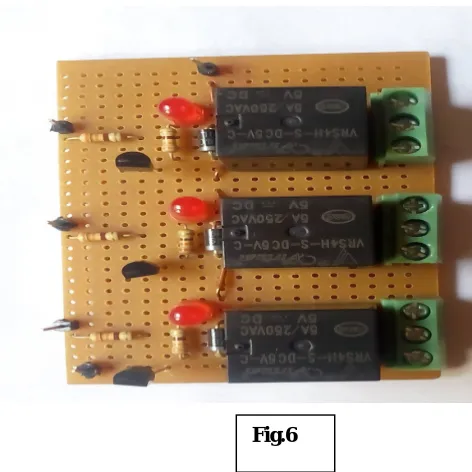
Relay driver circuit is used to drive the different motors such as pump motor, conveyor motor, and bow motor etc. The relay driver circuit not only provide the supply to motors but also it used for protection purpose. Relay driver circuit consist of three relays transistors, LEDs and freewheeling diodes .Relays are used for protection purpose. When sudden power loss occurs then stored energy of inductor is not suddenly discharges that time freewheeling diode dissipates the stored energy of inductor.
Fig 5 and Fig. 6: showing the circuit diagram and layout of relay driver circuit respectively.
Table 1: Showing Component Rating
S.No. COMPONENTS RATINGS NUMBERS
1. Relays (Electromechanical) 5A,250V,AC
5V DC
4.
2. LED 5mm (RED) 4.
3. Freewheeling Diode 4.
4. Transistors BC557 4.
5. Resistors I. 220Ω 4.
6. Supply Terminal 2 Pin 4.
Fig. 5
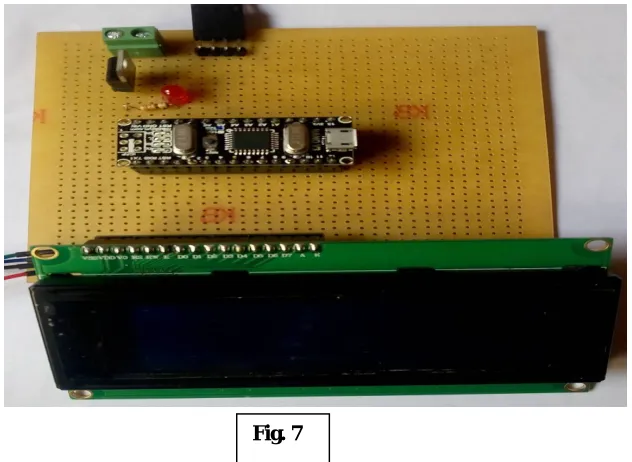
Fig. 7 Showing Microcontroller and display circuit
Table 2: Showing Component Rating
V. RESULTS
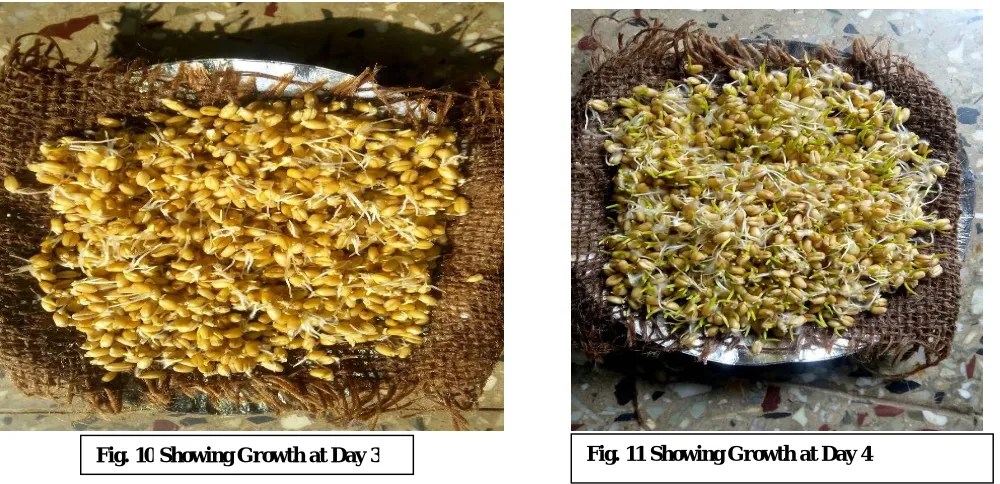
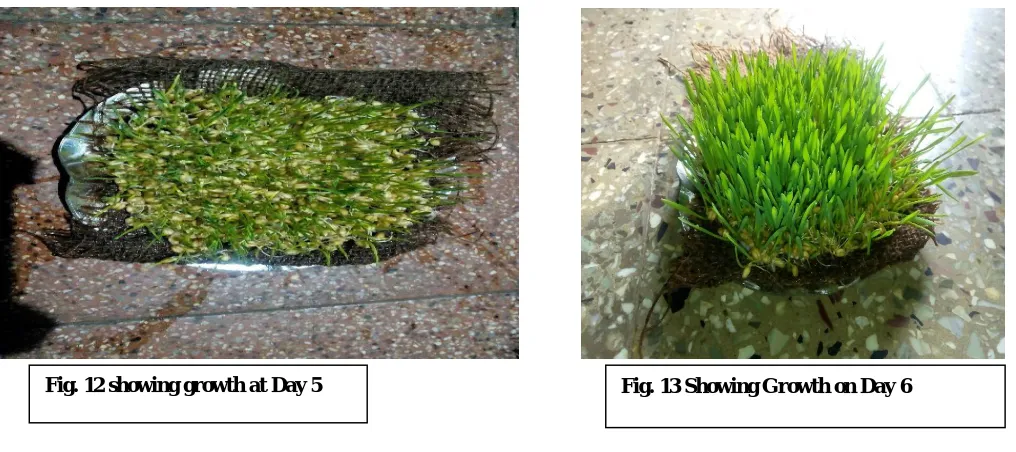
Based on the methodology followed we got following results as depicted in the figures shown below at various time intervals (Day 1 to Day 6 respectively in Fig 8 to Fig.13) by applying hydroponic system on wheat.
Fig. 7
S.No COMPONENTS RATINGS NOs.
1. LCD Display 16×2 1.
2. LED 5mm (RED) 1.
3. Arduino Nano V3 30 Pins, 5V 1.
4. Voltage Regulator 7809 1.
5. Supply Terminals 2Pin 1.
6. Press Button 1.
At different days post treatment there is continuous growth of the seed leads started from germination to fully grown plant.
Fig. 9 Showing Growth at Day 2
VI. CONCLUSIONS
From this project we studied about implementation of hydroponic system using control circuit. It describes automation in various processes such as to check moisture and temperature automatically and accordingly supply nutrient reach water for particular time interval .This System uses less water and fertilizers as compared to soil system. Hence overall automated hydroponic system provide more flexible and more efficient operation than manually operated hydroponic system.
REFERENCES
[1] P. Imas, “Recent Techniques in Fertigation of Horticultural Crops in Israel,” Workshop Presented at the IPI-PRII-KKV, February, 1999.
[2] T. L. Robinson and W. C. Stiles, “Fertigation effects on apple tree growth, cropping, and dry matter partitioning,” New York Fruit Quarterly, Horticultural Society of N.Y, vol. 12, 2004.
[3] D. Savvas; G. Manos, “Automated Composition Control of Nutrient Solution in Closed Soilless Culture Systems,” J. Agric. Engng Res, vol. 73, 1999, pp. 29-33.
[4] J.D. Townsend, “Fertigation—uniformity of fertilizer application through drip irrigation systems,” Proceedings of the 4th international, microirrigation congress, Albury-Wodonga, Australia, 1988.
[5] S. Krishna, Nemali, W. Marc, van Iersel. “An automated system for controlling drought stress and irrigation in potted plants,” Scientific Horticulture, vol. 110, 2006, pp.292–297
[6] R. P. Bracy, R. L. Parish, R. M. Rosendale, “Fertigation uniformity affected by injector type,” Hort. technology 13, 2003, pp. 103–105.
[7] J. Li, Y. Meng, B. Li, “Field evaluation of fertigation uniformity as affected by injector type and manufacturing variability of emitters,” Irrig Sci, vol. 25, 2007, pp. 117–125.
[8] G.S. Campbell, An Introduction to Environmental Biophysics. Springer, New York. 1986.
[9] J.G Atherton, and J. Rudich, “The Tomato Crop: A Scientific Basis for Improvement. Chapman and Hall, London/New York,” 1986, pp. 581-644. [10] M. Sneh, “The history of fertigation in Israel. In: Proc. Dhalia Greidinger Int Symp. on Fertigation. Technion, Haifa, Israel,” 26 March - 1 April, 1995, pp 1-10.
[11] Mardi A.K., Penanaman Secara Fertigasi, Koperasi Institute Pertanian Ayer Hitam Berhad, 2000.
[12] K. Rezuwan, M. Shahid, A. Mohd, Mohd Soom, F. Abdullah, “Response of fertigation on capsicum growth under naturally ventilated tropical greenhouse,” International Symposium on Greenhouses, Environmental Controls and In-house Mechanization for Crop Production in the Tropics and Sub-Tropics. Acta Hort. (ISHS), vol. 710, 2003, pp. 275-280
[13] A. Cooper, 1979. The ABC of NFT. Grower Books. London, pp. 59-62.
[14] J. Portree, Greenhouse Vegetable Production Guide for commercial Grower, Province of British Columbia, Ministry of Fisheries and Food, 2006, pp 9-12. [15] R. Kamaruddin, “Naturally Ventilated Tropical Green House for temperate crop production”, Technology article of Malaysian Agricultural research and Development Institute, MARDI, 2003.