Cloud-Based Video Streaming Techniques
Based on Real-World Experiments
Sweta Sri 1, Dr.R.China Appala Naidu 2
PG Scholar, Department of CSE, St.Martins Engineering College, Dhulapally, Secundrabad, Teleangana, India1 Professor, Department of CSE, St.Martin’s Engineering College, Dhulapally, Secundrabad, Teleangana, India2
ABSTRACT: Embedded Devices provides most of the function that a pc system gives. Easy maintenance is the main attraction of android smart phones. In this paper, Articulate Features for Mobile-Social TV System using Cloud Computing is proposed. In common the problem while using the smart phones is the large power consumption. This function runs all the complex modules in cloud. The system effectively utilizes IaaS (Infrastructure-as-a-Service) cloud services to offer the living-room experience. Open Nebula sunstone using as the open source tool for implementing the cloud technology. IaaS cloud performs efficient stream transposing that matches the current connectivity quality of the mobile user. DASH servers are used for the adaptive streaming and cooperative communication. Various designs for flexible transcending capabilities- battery efficiency of mobile devices and spontaneous social interactivity together provide an ideal platform for mobile social TV services.
KEYWORDS: Adaptive video streaming, Cloud, Synchronization
1. INTRODUCTION
Developing multi-media content for effective indication over reasoning of cloud based centered mobile system with limited data rates, such as the 3G-324M system needs skills and knowledge. It needs an knowing of the fundamentals that have an effect on movie quality, such as codec choice and compression, and the use of specific resources, such as the FFMPEG Development, and Zencoder Cloud centered Development API which can be used to validate that the material of videos clip data file are effectively specified for end customers.
1.1 Video Fundamentals
Due to bandwidths of mobile networks are limited, video data must be encoded/compressed considerably. This part wraps the fundamentals of encoded video and its characteristics within different networks.
1.2. Networks for Video Streaming
Table 1: illustrates the network atmospheres used for distributing video services with different aspects.
Network Bandwidth Terminals Codecs Image Size
3G-324M 64 Kbps Video Handsets H.263,MPEG- QCIF,CIF 4,H.264
3G 256-768 Video handsets, smart H.263, H.264, QCIF, CIF Wireless Kbps phones MPEG-4
Broadband 768 Kbps Smart phones, soft client H.264 QCIF, CIF
IP on PC
Enterprise 2-5 Mbps Soft client H.264 CIF, 4CIF, HD WiMax, 2-100 Mbps PC, TV, portable devices H.264 CIF, 4CIF,
1.3. Audio/Video Codecs
An audio codec is a system applying criteria that encode and decode electronic digital audio information according to a given sound extendable or movies online sound structure. The item of the criteria is to signify the great stability sound indication with lowest bitrates while protecting the excellent.
Examples: AAC, ADPCM, MP3, WMA, PCM, Vorbis, Dolby AC-3.
A video codec, brief for Encoder/Decoder, is used to encode video information to accomplish a very low bitrate. Examples: MPEG-2, H.263, MPEG-4 and H.264.
To accomplish such small bitrate audio/video, codecs make use of both lossless and lossy compression methods. We can accomplish this by third celebration system like FFMPEG open source libraries and Zencoder cloud-based encoding API.
Compression performance is the capability of a codec to encode or decode more video/audio features into an information flow described by fewer bits. The better the quality and sharpness of the multimedia clip by using useful codec compression.
1.4 Video Streaming
In streaming procedure, it clip data file is sent to the end individual in a (more or less) continuous flow. It is simply a strategy for shifting information such that it can be prepared as a stable and ongoing flow and it is known as Streaming or encoded movie that is sent across information system is known as Streaming. Streaming movie is a series of "moving images" that are sent in compacted form over the Internet and shown by the audience as they appear A end user never hang on to obtain a large data file before viewing it clip or enjoying the sound.
1.4.1 Streaming Principle
Real-time video functions require media packets to arrive in a timely manner; excessively delayed packets are useless and are treated as lost [6]. In streaming programs it is necessary for the information packets to reach their location in regular basis because the wait can cause the network blockage, and can result in the decrease in all those packets suffering from extreme wait. This causes decrease in quality of information, the synchronization between customer and hosting server to be damaged and mistakes to distribute in the provided movie.
Two kinds of steaming are, real-time and pre-recorded streaming. User Datagram Protocol (UDP) is used for streaming which delivers the multi-media flow as a sequence of small packets [4]. The majority of transport protocols perform over an RTP stack, which is implemented on top of UDP/IP to provide an end-to-end network transport for video streaming.
1.4.2 Video Streaming Architecture
A cloud based mobile movie streaming scheme is represented in Figure 1. [3]. A cloud based source implements a streaming hosting server which is responsible for retrieving, sending and adapting it clip flow. Depending on the function, it clip may be protected on-line for a real-time broadcasting or pre -encoded and stored for broadcasting an on demand [3].
Figure: 1 Video streaming architecture
II. LITERATURE SURVEY
a number of mobile tv systems have been launched with more advanced features in the hardware and software modules in the mobile phones.yu wu et al in [1] proposed the design of a cloudbased,novel mobile social tv system (cloudmov).the system effectively utilizes both paas (platformas-a-service) and iaas (infrastructure-as-a-service)cloud services to offer the living-room experience of video watching to a group of disparate mobile users who can interact socially while sharing the video.for, getting good streaming quality as experienced by the mobile users with time-varying wireless connectivity, a surrogate is employed for each user inthe iaas cloud for video downloading and social exchanges on behalf of the user.mahadev satyanarayanan et al in [2] proposed a new system architecture in which, a mobile user can exploits virtual machine (vm) technology to rapidly instantiate customized service software on a nearby cloudlet. the mobile device typically functions as a thin client with respect to the service. a key point to exploit the potentialities of wi-fi hotspots is managing the scarce energetic resources of mobile devices.in [3] sokol kosta et al propose a smartphone that have been launched with most advanced features inhardware due to which they are more complex. In this paper thinkair, a framework is proposed due to which developers can migrate their smartphone applications to the cloud. thinkair provides methodlevel computation offloading in the cloud. it focuses on the elasticity and scalability of the cloud and enhances the power of mobile cloud computing by parallelizing method execution using multiple virtual machine (vm) images. it shows that a parallelizable application can invoke multiple vms to execute in the cloud in a seamless and on-demand manner such as to achieve greater reduction on execution time and energy consumption. it finally uses a memory hungry image combiner tool to demonstrate that applications can dynamically request vms with more computational power in order to meet their computational requirements.existing media providers such as youtube and hulu deliver videos by turning it into a progressive download is proposed in [4]. the paper presents cloudstream: a cloud-based video proxy that can deliver high-quality streaming video. this is done by transcoding the original video in real time to a scalable codec format. the multi-level transcoding parallelization framework have two mapping options (hallsh-based mapping and lateness-first mapping) that optimize transcoding speed and reduce the transcoding jitters while preserving the encoded video quality. toon coppens et al in [5] propose amigotv is a prototype implementation that combines broadcast television with rich communication and community support. nicolas ducheneaut et al in [6] discuss media research has shown that people enjoy watching television as a part of socializing in groups.
Cloud Streaming Server Video Input
Codec Video Storage
Qos Control Transport Protocol
III. VIDEO ENCODING TECHNIQUES
Video codecs employ a range of encoded/decoded methods to fit videos signal into the allocated channel bandwidth. These encoding methods can influence the generating quality of it differently. An understanding of development concepts can help a material provider determine what material will look best on a mobile phone, and emphasize some of the expected tradeoffs when generating multi-media data files.
Rapid bandwidth decrease can be carried out by using video encoded/decoded methods such as [1]: a. Eliminating mathematical redundancies
b. dropping quality size (CIF to QCIF)
c. Using less frames per second (15 fps to 10 fps)
Further bandwidth decrease can be carried out by utilizing the styles within it information and eliminating redundancies. Image compression depends on removing information that is indiscernible to the audience. Motion settlement provides interpolation between frames, using less information to signify the change. The objective of videos encoder/decoder is to take out redundancies in it flow and to scribe as little information as possible. To achieve this objective, the encoder examples it flow in two ways:
a. In time durations from successive frames (temporal domain) b. Between nearby pixels in the same frame (spatial domain)
A video decoder pieces it flow together by treating the development process. The decoder reconstructs it flow by adding together the pixel variations and shape variations to form complete video. In current video encoding principles requirements such as MPEG and H263 families.
2.1. Encoded Video Stream
An encoded video stream consists of two types of encoded frames [1]:
2.1.1. I-Frames
An I-frame is encoded as a single image, without referencing to any other frames. Each 8x8 block is first transformed from the spatial domain into the frequency domain [5]. This is known as a key frame, for the reason that it signifies the referrals key of it video content flow. All pixels that describe the image are defined in the I-frame. Videos clip decoder must begin with an I-frame to decode it clip flow because without an I-frame, a movie decoder has no referrals to determine how movie pixels have changed as the earlier frame. For this reason, compressed movie recordings normally do not begin until an I-frame is received by the videos device.
2.1.2. P-Frames
A P-frames is encoded relative to past reference frame [5], which can either be an I-frame or a before P-frame. The quantity of information in a P-frame is many times small than the quantity of information in an I-frame. If videos clip begins understanding on a P-frame at an endpoint, an individual might see either scrambled movie or no movie, because there is no referrals frame.
2.2. Video Streaming package (.MP4, .3GP)
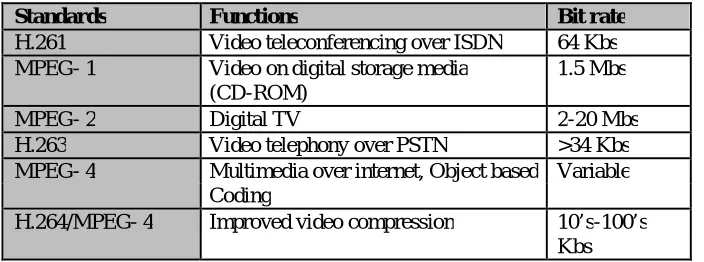
Table 2. Presents an overview of different versions of two standard families
Standards Functions Bit rate
H.261 Video teleconferencing over ISDN 64 Kbs MPEG- 1 Video on digital storage media 1.5 Mbs
(CD-ROM)
MPEG- 2 Digital TV 2-20 Mbs H.263 Video telephony over PSTN >34 Kbs MPEG- 4 Multimedia over internet, Object based Variable
Coding
H.264/MPEG- 4 Improved video compression 10’s-100’s Kbs
2.3. Video Streaming limitations
Multimedia streaming is confined by the network channel potential, 3G-324M channel bandwidth, Multi-coded stream, Transcoding, Packet loss, Bandwidth supervision and endpoint features.
IV. VIDEO STREAMING TECHNIQUES
There are various streaming techniques for different mobiles, Embeded Devices describe below:
3.1. Progressive Download
The mobile customers have the choice to gradually get a compressed data clip partitioned in the appropriate codecs for the product to play by using HTTP or HTTPS. As the data file starts to gradually download, play-back is started enabling an almost immediate watching of the material [8]. In the qualifications, the press gamer is constantly on the download the rest of the material. By comparison, without modern download the user would have to wait for the whole data file to obtain to the product before watching would start. During the play-back process, audiences are able to seek back and forth through the whole press data file. If the audience looks for forward to a point in the schedule that has not yet downloadable, the press gamer stop play-back until the data comes.
3.2. HTTP Live Streaming
Hyper text transport protocol (HTTP) structured multimedia streaming communications protocol carried out by Apple company is known as Hyper text transport protocol (HTTP) Live Streaming (HLS).For Apple company products like IOS, Ipad and Iphone etc.,this is an adaptive streaming multimedia distribution standard protocol. It is an exemplified and segmented in MPEG family transport channels and M3U8 - MP3 Playlist File (UTF-8) to offer live and on-demand multimedia data by utilizing H.264 multimedia codec. On the behalf of most suitable channel or stream like bandwidth, platform and CPU limits selected by device instantly, it downloads available bits for buffering to play multimedia file. HLS streaming provides the best user experience, but its benefits also include good IT practices and important business considerations:
1) The best user experience - There are different formats of multimedia or video files available on server in form of numerous versions, an iPhone end user can not stream a better high quality version of the multimedia or video than iPad end user watching over 3G network.
2)Achieve more audiences - Transfer protocols are not supported for video delivery contents but firewall and routers settings are supported for video delivery with Hyper text transport protocol (HTTP) that’s why viewers can access video easily.
4)Protected video clip information- The HTTP Live Streaming(HLS) requirements have conditions to make sure protection of the stream data, so it is fantastic information for Tv-stations or marketers for those users used to certified content stream. Using AES-128, the complete HTTP Live Streaming (HLS) stream is protected over network infrastructure.
Many reputed IT companies are using HTTP Live streaming service to enhance the streaming power in their mobile domain infrastructure.
Adobe Systems for Adobe Flash Media Server product.
Livestation for multimedia channels France 24, RT, and Al Jazeera English. Microsoft in IIS Media Services 4.5.
Google in Android 3.0 Honeycomb. HP in webOS 3.0.5.
FFMPEG added HTTP Live Streaming and encoding support for various mobile devices
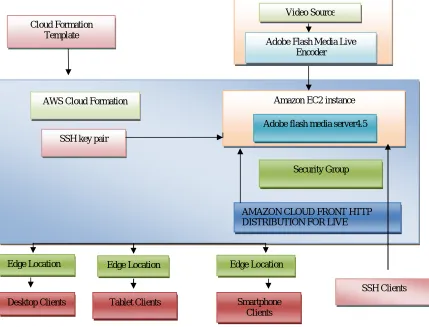
Figure 2 and Explanation shows my practical work for mobile video streaming on Cloud with streaming server by using Amazon Cloud Front services which have lots of components which are playing key role.
Figure 2. Cloud Front Live streaming architecture
Figure 2. Cloud Front Live streaming architecture
Cloud Formation Template
Video Source
Adobe Flash Media Live Encoder
Amazon EC2 instance
Adobe flash media server4.5
Security Group
AMAZON CLOUD FRONT HTTP DISTRIBUTION FOR LIVE STREAMING
AWS Cloud Formation
SSH key pair
Edge Location Edge Location Edge Location
Desktop Clients Tablet Clients Smartphone Clients
V. CONCLUSION
The Audio in audio/video basics which deliver video on network infrastructure with required bandwidth and codecs then after we discussed about the video streaming architecture that develop streaming servers which are responsible for downloading, uploading and adapting the video stream content in 3G or others networks.
For streaming the multimedia file over network, video compression techniques are major issue to encode the different types of audio/video file for different mobile devices. Compression can be performed by FFMPEG Encoding; Zencoder cloud based Encoding API which provides lots of Encoding techniques which are solution for the cloud based environments.
Then we presented the main issue of video streaming techniques for streaming the video over the internet or cloud based network for iPhone, Android, Windows phone and Embeded Devices. Apple Company provides the solution for video streaming in terms of HTTP Live streaming
REFERENCES
1. Dejan Kovachev, Tian Yu and Ralf Klamma, “Adaptive Computation Offloading from MobileDevices into the Cloud” IEEE InternationalSymposium on Parallel and Distributed Processing with Applications, 2010.
2. J. Y. B. Lee,” Scalable continuous media streamingsystems: Architecture, design, analysis and Implementation, “Kong Kong, China. 2005. 3. D.Mills. Simple Network Time Protocol (SNTP) Version 4, IETF Networking Working Group, Request For Comments: 4330. Febraury 2006. Available from: http://tools.ietf.org/html/rfc4330.
4.J. Santos, D. Gomes, S. Sargento, R. L. Aguiar, N. Baker, M. Zafar, and A. Ikram, “Multicast/broadcastnetwork convergence in next generation mobile networks,” Comput. Netw. vol. 52, pp. 228–247,Febraury 2008.
5. DVB-H, http://www.dvb-h.org/.
6. NoSQL Date base, http://nosqldatabase.org/
7. Hatem BETTAHAR, “Tutorial on Multicast Video Streaming Techniques”, SETIT 2005, 3rd International Conference: Sciences of Electronic, Technologies of Information and Telecommunications March 27- 31, 2005 –TUNISIA. \
8.Mamoona Asghar, Saima Sadaf , Kamran Eidi, Asia Naseem, Shahid Naweed “SVS - A Secure Scheme for Video Streaming Using SRTPAES and DH”, European Journal of Scientific Research ISSN 1450-216X Vol.40 No.2 (2010), pp.177-188 © EuroJournals Publishing, Inc. 2010.
9. Jian Zhou, “New Techniques for Streaming MPEG Video over the Internet”, UMI Microform 3111144, Copyright 2004 by ProQuest Information and Learning Company, pp. 11-26.
M D Walker, M Nilsson, T Jebb and R Turnbull “Mobile video-streaming”, BT Technology Journal-Vol 21 No 3- July 2003.
10. Jianyu Dong “Efficient and Effective Streaming Technologies for 3-D Wavelet Compressed Video”, the Ohio State University 2002. 11. FFMPEG x264 Encoding Guide, http://ffmpeg.org/trac/ffmpeg/wiki/x264EncodingGuide.
12. Zencoder cloud based iOS/Mobile Encoding, https://app.zencoder.com/docs/guides/encoding-settings/ios-and-mobile.
BIOGRAPHY
1.Sweta Sri received Bachelor of Engineering degree from Jodhpur Institute of Engineering & Technology, Jodhpur Rajasthan India affiliated to Kota Technical University(RTU) and pursuing Master of Technology (M.Tech) (2014-2016) in Computer science and Engineering from St.Martins College of engineeringHyderabad India affiliated to JNTU Hyderabad India.
2. Dr.R.Ch.A.Naidu completed his M.Tech, Ph.D from University of Mysore, Mysore and Andhra University, Vishakhapatnam respectively. He has more than 13 years of teaching experience. He is presently working in CSE Dept as a Professor in St Martin‟s Engineering