ABSTRACT
GOWNIVARIPALLI, YASASWINI JYOTHI. Hybrid Cache, Bank, and Controller Aware Coloring for Multicore Real-Time Systems. (Under the direction of Dr. Frank Mueller.)
Real-time systems require tight bounds on the Worst Case Execution Time (WCET) of a task. Modern multicore CPUs provide multiple levels of storing data (caching) and differ-ent paths to access memory (banks) that improve the performance but also introduce unpre-dictability in task execution time. To obtain predictable task execution times, developers have to consider the WCET, which may void the benefits of modern CPUs and may lead to low utilization of resources.
On multicore platforms, caches present a source of unpredictability as standard heap al-located regions do not provide guarantees on the cache set that will hold a particular page translation. This unpredictability can lead to cache misses and consequently task inter-ference resulting in loose bounds on the WCET. Memory access latency varies significantly depending on where the data is located in Non-Uniform Memory Access (NUMA) systems and how banks are interleaved. Data allocations without locality awareness may experience high memory latency so that execution times become highly unpredictable, resulting in loose bounds on the WCET of tasks and overly conservative scheduling with low utilization of modern CPUs.
The goal of this work is to obtain tighter bounds on the WCET of a task while still using the benefits of modern CPUs. The coloring technique is applied for the Last Level Cache (LLC) and memory for this reason. The design reuses the existing Application Programming Interface (API) so that changes are transparent. The interface works with a minimal modifications to existing applications to provide LLC and bank-aware heap allocation.
© Copyright 2015 by Yasaswini Jyothi Gownivaripalli
Hybrid Cache, Bank, and Controller Aware Coloring for Multicore Real-Time Systems
by
Yasaswini Jyothi Gownivaripalli
A thesis submitted to the Graduate Faculty of North Carolina State University
in partial fulfillment of the requirements for the Degree of
Master of Science
Computer Science
Raleigh, North Carolina
2015
APPROVED BY:
Dr. Xipeng Shen Dr. Guoliang Jin
DEDICATION
BIOGRAPHY
ACKNOWLEDGEMENTS
TABLE OF CONTENTS
LIST OF TABLES . . . vi
LIST OF FIGURES . . . vii
Chapter 1 Introduction . . . 1
1.1 Hypothesis . . . 1
1.2 Contributions . . . 2
Chapter 2 Background. . . 3
2.1 Cache Organization . . . 3
2.2 DRAM Organization . . . 3
2.3 Memory Controller . . . 5
Chapter 3 Design . . . 7
3.1 Kernel design . . . 7
3.2 Application Programming Interface (API) design . . . 8
3.2.1 Normal API . . . 8
3.2.2 Color API . . . 8
Chapter 4 Implementation . . . 10
Chapter 5 Architecture . . . 13
Chapter 6 Results . . . 14
6.1 Synthetic Benchmarks . . . 14
6.2 Standard Benchmarks . . . 16
6.2.1 NAS Parallel Benchmark Results . . . 16
6.2.2 Parsec Benchmark Results . . . 18
6.2.3 Real-time Experiment with Malardalen Benchmarks . . . 21
Chapter 7 Related work . . . 24
Chapter 8 Future scope . . . 26
Chapter 9 Conclusion . . . 27
REFERENCES . . . 28
LIST OF TABLES
LIST OF FIGURES
Figure 2.1 Multicore Cache Organization . . . 4
Figure 2.2 AMD Opteron 6128 . . . 4
Figure 2.3 DRAM Device Organization . . . 5
Figure 2.4 Structure of DRAM Controllers . . . 6
Figure 3.1 LLC color identifier on AMD Opteron 6128 . . . 8
Figure 3.2 mmap() color arg: Bit identifiers . . . 9
Figure 3.3 Coloring LLC and Memory . . . 9
Figure 4.1 mmap() API and control flow for coloring . . . 12
Figure 6.1 Latency as a function of distance to memory controller . . . 15
Figure 6.2 Synthetic benchmark with LLC and memory(bank) coloring . . . 16
Figure 6.3 Synthetic benchmark with LLC and controller coloring . . . 16
Figure 6.4 NPB-IS benchmark . . . 17
Figure 6.5 Parsec with memory attackers . . . 19
Figure 6.6 Multi threaded Parsec (Blackscholes) . . . 20
Figure 6.7 LLC (L3) miss-rate of Parsec (x264) . . . 21
Chapter 1
Introduction
Multicore processors share resources like the LLC and memory across all the cores. When part/all of the data used by different tasks map to the same sets in LLC, eviction and refill of the cache line may occur for each task. If tasks use the same bank to access memory there will be contention. Both scenarios will lead to variable latency in task execution. A Non-Uniform Memory Architecture partitions sets of cores into a “node” with a local memory controller, such that memory accesses may be resolved locally or via the on-chip interconnect from a remote node and its memory. Each memory node consists of multi-level resources called channel, rank and bank. The banks can be accessed in parallel to increase memory throughput. When tasks running on different cores access memory concurrently, performance varies significantly across cores depending on which node data is located on and how banks are shared. The latency of accessing memory of a remote node is significantly longer than that of accessing memory local to the node. Even for the same memory node, conflicts between shared-bank accesses result in unpredictable memory access latency. The latency is worse when all running tasks map their data to same cache line. As a result, the WCET bound of tasks has to be conservatively (over-)estimated, which may result in low system utilization due to potentially inferior memory performance.
1.1
Hypothesis
1.2
Contributions
We have designed and implemented a coloring approach that affects heap memory allocations at LLC, bank, and controller levels. Two tasks can request colors in six possible ways: 1) different local controllers and different sets; 2) different local controllers and same LLC-sets; 3) different banks of same controller and different LLC-LLC-sets; 4) different banks of same controller and same LLC-sets; 5) same banks and different LLC-sets; and 6) same banks and same LLC-sets. Option one gives the lowest latency and option six the highest for accesses. Programmers can assign one (or more) colored LLC-sets and memory banks exclusively per task. Migration of a task to a different core can be avoided by pinning it to a core. The underlining kernel establishes that heap allocation is done such that LLC-set and memory bank isolation is established across tasks. This effectively shortens the WCET and makes execution more predictable. A novelty of our LLC and memory-aware coloring API is that it does not need any linking of additional libraries. Our approach requires the developer to make a single mmap() call during initialization with an appropriate set of color arguments to enable colored allocation for all subsequent malloc() calls. We have modified the Linux kernel to support colored allocation.
Our design and implementation contributions are:
1. We design and implement a new heap allocator that guarantees isolation between two tasks while accessing LLC.
2. We conduct an experimental evaluation of our heap allocator to demonstrate task isolation realized by LLC coloring.
3. We integrate bank and controller aware coloring with our LLC coloring.
4. We conduct an experimental evaluation of our heap allocator to demonstrate task isolation realized by integrated LLC, bank, and controller aware coloring.
Chapter 2
Background
Data access latency is affected by the following aspect: (1) whether or not the data is located in the cache; (2) how the memory banks interleave and how much of the accesses contend; and (3) where the data is actually located, i.e., the local memory node or the remote memory node. In this section, we provide a brief description of these three aspects. Our description is based on LLC and DDR3 SDRAM memory systems.
2.1
Cache Organization
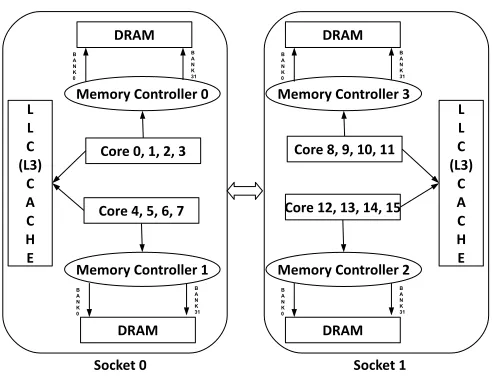
Most modern CPU architectures have multiple levels of cache hierarchy within in a single chip. For example, the cache hierarchy in an AMD Opteron 6128 single socket is as shown in Fig. 2.1. Each core has access to a local L1 and L2 cache and all cores share the LLC. A miss in L1 initiates an access to L2, and a miss in L2 initiates an access to L3. A miss in LLC initiates an access to memory.
2.2
DRAM Organization
Core 0
L1
D L1I
L2
Core 1
L1
D L1I
L2
Core 2
L1
D L1I
L2
Core 3
L1
D L1I
L2
Core 4
L1
D L1I
L2
Core 5
L1
D L1I
L2
Core 6
L1
D L1I
L2
Core 7
L1
D L1I
L2
LLC Cache Controller
Shared LLC (L3) Cache
Figure 2.1: Multicore Cache Organization
Core 0, 1, 2, 3 L L C (L3) C A C H E L L C (L3) C A C H E Memory Controller 1 Memory Controller 2
Memory Controller 3 Memory Controller 0
Core 4, 5, 6, 7
Core 8, 9, 10, 11
Core 12, 13, 14, 15 DRAM B A N K 0 B A N K 31 DRAM B A N K 0 B A N K 31 DRAM B A N K 0 B A N K 31 DRAM B A N K 0 B A N K 31
Socket 0 Socket 1
Figure 2.2: AMD Opteron 6128
Columns Ro w s Ro w D ec od er Co m m an d D ec od er Row Buffer Column Decoder Bank 0 Bank ... Bank 7 DRAM Chip Command Bus Address Bus Data Bus Column Address Ro w A dd re ss 8-bits
Figure 2.3: DRAM Device Organization
2.3
Memory Controller
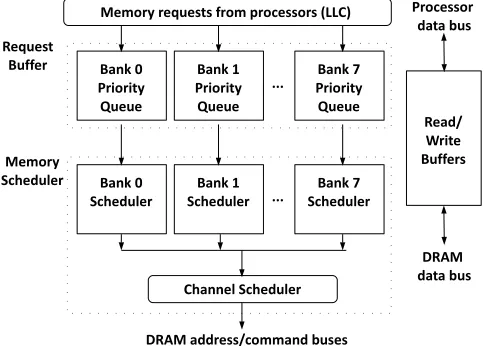
Bank 0 Priority Queue
... Bank 1 Priority Queue
Bank 7 Priority Queue
Bank 0
Scheduler SchedulerBank 1 ... SchedulerBank 7 Memory requests from processors (LLC)
Channel Scheduler
DRAM address/command buses
Read/ Write Buffers
DRAM data bus Processor
data bus Request
Buffer
Memory Scheduler
Chapter 3
Design
3.1
Kernel design
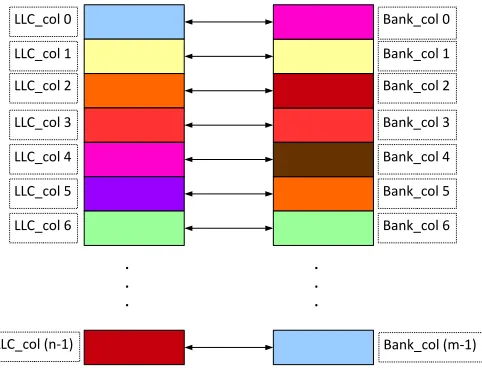
Our design is based on the number of sets available in LLC, and the number of banks available within a memory controller. We assign llc color and bank color to each physical page based on the LLC-set and the memory bank to which the physical page belongs to (Fig. 3.3).
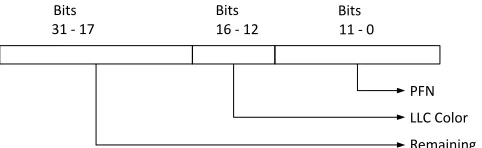
The LLC color of a physical page is determined as follows:
N LLC =S/(W ∗L) (3.1)
B={lg(P)...lg(L+lg(N LLC)−1} (3.2) P F N =physical address >> lg(P) (3.3)
llc color= (P F N)&(2powN LLC) (3.4)
where
NLLC - Number of LLC colors, B - bits to identify LLC color of page, PFN - page frame number,
S - LLC size, W - LLC ways, L - LLC line size, P - page size.
PFN LLC Color Remaining 31 - 17 11 - 0
Bits Bits 16 - 12
Bits
Figure 3.1: LLC color identifier on AMD Opteron 6128
Opteron 6128 (Magny core) [1].
The bank color of a physical page is determined as follows:
bank color=channel∗N C+rank∗N R+bank∗N B (3.5)
where
channel - channel to which the physical page belongs, rank - memory rank to which the physical page belongs, bank - memory bank to which the physical page belongs, NC - number of channels available within a memory controller, NR - number of ranks available within a memory controller, NB - number of banks available within a memory controller.
Channel, rank, and bank information is obtained from AMD Opteron 6128 (Magny core) [1].
3.2
Application Programming Interface (API) design
3.2.1 Normal API
void *mmap (start, length, prot, flags, fd, offset);
3.2.2 Color API
void *mmap (color arg, 0, COLOR ALLOC, ...)
color arg: Used to represent the color identification bits as shown in Fig. 3.2. size: Zero is used to mark that this is a special call for coloring
Color identifier Node color Bank Color LLC Color TLB Color Reserved 31 30 29 - 20 19 18 17 16 15-0
Bit Bit Bits Bit Bit Bit Bit Bits
Set/Clear color Unused
Figure 3.2: mmap() color arg: Bit identifiers
. . .
. . .
LLC_col 0
LLC_col 1
LLC_col 2
LLC_col 3
LLC_col 4
LLC_col 5
LLC_col 6
LLC_col (n-1)
Bank_col 0
Bank_col 1
Bank_col 2
Bank_col 3
Bank_col 4
Bank_col 5
Bank_col 6
Bank_col (m-1)
Chapter 4
Implementation
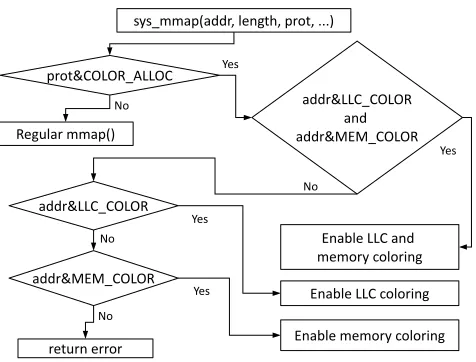
In our design, the Application Programming Interface (API) for colored allocation is provided through the mmap() system call. Using mmap() instead of a new system call reduces the developer efforts of linking with a new library and it does not require an extra system call in the kernel. For colored allocation, the address is used to pass the color information(set/clear color, coloring level: LLC/memory/both, color identifier), and the length argument of mmap() is passed as zero. We differentiate a mmap() colored request call from a regular call by interpreting the length argument in the kernel. In regular Linux, when the kernel observes the length as zero, it returns an error to the application. In our colored implementation, when the kernel identifies the length argument as zero, it considers it as a colored call and marks in the task struct of the process that it is requesting a colored allocation. The kernel stores the requested LLC and bank color(s) in task struct of the process. All subsequent calls to malloc() will be served by our colored allocation strategy in the kernel. In summary, when an application needs a colored page, it issues an mmap() call with the colored information as the first argument (address) and zero as the second argument(length). Fig. 4.1 demonstrates the interpretation done in the kernel when the mmap() system call is called by the application. When the application requires more memory than can be satisfied by a single memory bank, multiple banks needed to be requested by making multiple mmap() calls.
channel, rank and bank information obtained from Peripheral Component Interconnect (PCI) registers/BIOS. Coloring is provided as a configuration option in the Linux kernel, which can be selected using the standard Linux kernel configuration.
The Linux kernel page allocation strategy is modified to support colored allocation requests. In our implementation, the Linux kernel maintains pages in a corresponding color list. It is a two-dimensional array supporting a combination of LLC and bank colors. When the task requests an LLC color B and a bank color A, color list[A][B] is searched. If a free page is found, it is returned. If the list is empty, the kernel will try to pull pages from buddy allocation lists and add them to the respective color list. Once the required entry with matching LLC and bank color is found, it will be returned. If the task is requesting for only LLC coloring, then the page with a matching LLC color is returned without considering its bank color. Similarly, if the task is requesting only bank coloring then the page with a matching bank color is returned without considering its LLC color. If the task has requested for multiple LLC/bank colors, the first matching page is returned. The overhead of building color lists will be imposed only when the corresponding list is empty. Therefore, subsequent requests for allocation will be faster.
sys_mmap(addr, length, prot, ...)
prot&COLOR_ALLOC
addr&LLC_COLOR and addr&MEM_COLOR
addr&LLC_COLOR
addr&MEM_COLOR Regular mmap()
return error
Enable LLC and memory coloring
Enable LLC coloring
Enable memory coloring
No
No
No No
Yes
Yes
Yes
Yes
Chapter 5
Architecture
We investigated the LLC and memory organization of contemporary architectures. The ARM Tegra3 (Kayla) [2] has a smaller associative LLC (8 ways), one/two memory banks, which made is hard to provide memory isolation on this platform. The AMD Opteron 6128 (Magny core) [1] has a higher associative LLC (96 ways), multiple memory banks (32) per controller, and four memory controllers.
Chapter 6
Results
We assess the performance of LLC aware allocation, LLC plus bank aware allocation, and LLC plus controller aware allocation using synthetic micro-benchmarks and standard benchmarks from Parsec [4] and NAS Parallel Benchmarks [3].
6.1
Synthetic Benchmarks
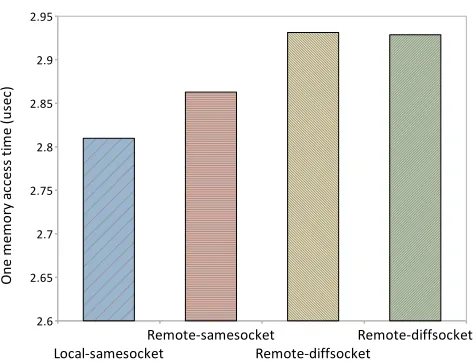
We assessed the access latency to different controllers with a synthetic benchmark. We bind the synthetic program to a specific core in one controller and try to access memory across different controllers in the system. Fig. 6.1 depicts access latency (y-axis) for different access types (x-axis). We observed that the access latency to memory for the local controller (Local-samesocket) is the lowest, followed by the remote controller in same socket (Remote-samesocket). The mem-ory access latency to controllers in a different socket (Remote-diffsocket) is the highest.
Local-samesocketRemote-samesocketRemote-diffsocketRemote-diffsocket 2.6 2.65 2.7 2.75 2.8 2.85 2.9 2.95 O ne m em or y ac ce ss ti m e (u se c)
Figure 6.1: Latency as a function of distance to memory controller
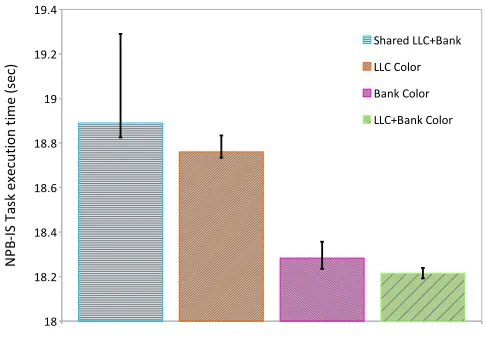
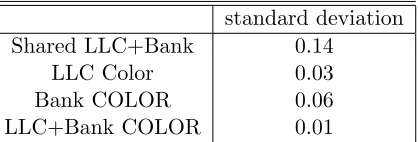
execution time (20.6 seconds, standard deviation 0.01) when all tasks access not only different banks but also different LLC sets (LLC+bank coloring). We observed a 26.43% improvement with our LLC+bank coloring over shared LLC+bank along with lower and tightly bounded execution time with our coloring techniques.
1 2 3 4 5 6 7 8 9 10 20 21 22 23 24 25 26 27 28 29 30 Shared LLC+Bank LLC Color Bank Color LLC+Bank Color Experiment Number Ex ec ut io n tim e of fo re gr ou nd ta sk (s ec )
Figure 6.2: Synthetic benchmark with LLC and memory(bank) coloring
1 2 3 4 5 6 7 8 9 10
1.5 1.55 1.6 1.65 1.7 1.75 1.8 1.85 1.9 1.95 2 Controller LLC+Controller Color Experiment Number Ex ec ut io n tim e of fo re gr ou nd ta sk (s ec )
Figure 6.3: Synthetic benchmark with LLC and controller coloring
6.2
Standard Benchmarks
We have modified standard benchmarks to replace static allocation with dynamic allocation. We also pin a task/thread to a core to avoid task/thread migration effects.
6.2.1 NAS Parallel Benchmark Results
18 18.2 18.4 18.6 18.8 19 19.2 19.4 Shared LLC+Bank LLC Color Bank Color LLC+Bank Color
IS with 4 OpenMP Threads
N PB -IS T as k ex ec ut io n tim e (s ec )
Figure 6.4: NPB-IS benchmark
Table 6.1: NPB-IS
standard deviation Shared LLC+Bank 0.14
LLC Color 0.03
Bank COLOR 0.06
LLC+Bank COLOR 0.01
6.2.2 Parsec Benchmark Results
We investigate the performance and predictability for the PARSEC benchmark suite [4]. The Parsec suite focuses on emerging workloads and is said to be representative of next-generation shared-memory programs for chip-multiprocessors. We have created a multi-task workload where one or more ‘memory attackers’ run in the background to assess their interference on memory latency for a foreground task similar to prior work [16], [11]. E.g., if there are four tasks in the experiment, one of them (the foreground task) is a Parsec benchmark and the others (background) are memory attackers. Fig. 6.5 shows an average execution time of the Parsec task over ten runs along with error bars denoting the maximum and minimum execution time. Shared LLC+bank (worst case of buddy allocation) has the highest latency and maximum vari-ance as indicated by the error bars. For comparison, we have included the single run of a Parsec program (‘parsec without attackers’). It uses the general buddy allocator and does not have memory attackers in the background. We observe that fluidanimate has the highest gain due to coloring: shared LLC+bank (58 seconds, standard deviation 0.18) compared to LLC+bank coloring (6.5 seconds, standard deviation 0.01) i.e., a 88.79% improvement in execution time. Swaptions has the lowest gain due to coloring: shared LLC+bank (4.2 seconds, standard de-viation 0.04) compared to LLC+bank coloring (3.2 seconds, standard dede-viation 0.01), i.e., a 23.81% improvement in execution time. Our observation is, with LLC+bank aware allocation we can reduce the task execution time, achieve better system utilization, and provide tighter bounds/less variance on execution time.
25 35 45 55 65
Shared LLC+Bank LLC Color Bank Color LLC+Bank Color Parsec w/o attackers
ti
m
e(
se
c)
blackscholesbodytrackferretfluidanimatefreqmineraytraceswaptionsvips x264cannealstreamcluster 0 5 10 15 20 25 Pa rs ec ta sk e xe cu tio n
Figure 6.5: Parsec with memory attackers
execution time than one thread. This is due to parallelization and because each thread accesses a different LLC and bank, which avoids LLC conflicts and interleaves bank accessing. Eight threads have lower execution time than four threads. This is again because of parallelization and less contention for LLC sets and banks. We observe that our coloring provides better results with increased number of threads, as we avoid conflicts among threads by allocating different LLC(s) and bank(s) to each thread. We observe that when we increase the number of threads to sixteen, performance does not improve compared to four/eight threads. This is because of thread synchronization requirements and also because of inter-controller access delays while accessing a different socket. As shown in Fig. 2.2, eight cores are in one socket and the other eight cores are in another socket. Sixteen threads require more access synchronization involving multiple controllers. The result is a smaller improvement in execution time than four/eight threads. We have observed the inter-controller access latency using our synthetic benchmark in Fig. 6.1. We observe that our coloring technique has less variance across different runs, as indicated by the standard deviation in Table. 6.2. We conclude that our LLC+bank coloring achieves benefits for multi-threaded applications, but we shall also consider hardware access delays while allocating resources to tasks.
1thread 4threads 8threads 16threads
0.1 1 10
Shared LLC+Bank LLC Color Bank Color LLC+Bank Color
Pa rs ec ta sk e xe cu tio n tim e (s ec ) ( lo g sc al e)
Figure 6.6: Multi threaded Parsec (Blackscholes)
Table 6.2: Multi threaded Parsec
1thread standard deviation
Shared LLC+Bank 1.7
LLC Color 0.01
Bank COLOR 0.01
LLC+Bank COLOR 0.01
4threads standard deviation
Shared LLC+Bank 0.01
LLC Color 0.01
Bank COLOR 0
LLC+Bank COLOR 0
8threads standard deviation
Shared LLC+Bank 0.05
LLC Color 0.01
Bank COLOR 0.01
LLC+Bank COLOR 0.01
16threads standard deviation
Shared LLC+Bank 1.4
LLC Color 0.01
Bank COLOR 0.03
LLC+Bank COLOR 0.01
1 2 3 4 5 6 7 8 9 10 0
0.01
0.1 Shared LLC+Bank LLC Color Bank Color LLC+Bank Color
Experiment Number L3 m is s ra te o f p ar se c pr og ra m (l og s ca le )
Figure 6.7: LLC (L3) miss-rate of Parsec (x264)
We measure the LLC miss rate of x264 using LIKWID [14], an open source software that we have configured for the AMD Opteron. Fig. 6.7 depicts Parsec’s x264 task execution time in log scale (y-axis) across our different coloring techniques for a sequence of ten runs (x-axis). We observe nearly zero variance across different runs in all coloring techniques. We observe that the LLC miss-rate is the highest when all tasks share LLC+bank. The LLC miss-rate reduces with LLC coloring as the attackers and x264 use different LLC sets, i.e., we observed a 39% reduction in the LLC miss rate compared to shared LLC+bank. Only with bank coloring, we observed that, we do not achieve much improvement in the LLC miss rate as tasks contend for same cache sets. Our integrated LLC+bank coloring has the lowest LLC miss rate for x264 compared to shared LLC+bank as it avoids LLC conflicts and interleaves banks across attackers and the x264 code, i.e., we observed a 95.3% reduction in the LLC miss rate.
6.2.3 Real-time Experiment with Malardalen Benchmarks
1450 1500 1550 1600
Select
3000 3100 3200 3300
Compress
1800 1850 1900
ST
0 2 4
6 BS
Ta
sk
e
xe
cu
tio
n
tim
e
(u
se
c)
Shared LLC+Bank LLC Color Bank Color LLC+Bank Color
Figure 6.8: Malardalen programs as RT-tasks
Table 6.3: Malardalen RT-Tasks
Select standard deviation
Shared LLC+Bank 28.85
LLC Color 12.88
Bank COLOR 11.58
LLC+Bank COLOR 8.48
Compress standard deviation
Shared LLC+Bank 21.05
LLC Color 7.64
Bank COLOR 3.09
LLC+Bank COLOR 3.02
ST standard deviation Shared LLC+Bank 10.39
LLC Color 2.73
Bank COLOR 6.13
LLC+Bank COLOR 2.27
BS standard deviation Shared LLC+Bank 0.99
LLC Color 0.48
Bank COLOR 0.32
Chapter 7
Related work
Puaut et al. [12] proposed a compiler approach to make paging more predictable. The main idea of the paper is to identify page in and page out points of virtual pages at compile time. This method relies on the static knowledge of the possible references between virtual pages of tasks. However, the focus of their work is to make demand paging more predictable while ours is on task isolation with respect to cache and memory.
Compiler-directed page coloring proposed by Bugnion et al. [5] involves three key phases. First, a compiler creates a summary of array references and communicates this information to the run-time system. The run-time system then uses machine-specific parameters like the cache size to generate a preferred color for the physical frame. The operating system then uses this color as a hint in a best effort to honor them. This technique is applicable to physically indexed caches. Our technique does not require profiling or modifications to the compiler.
Software cache partitioning is related to our idea. This is commonly known as cache coloring. The main idea of this technique is to color physical frames such that two frames of different color will not map to the same cache set. Liedtke at al. [8] proposed OS-controlled cache partitioning. Mancuso et al. [9] used memory profiling to identity hot pages in virtual memory. Then, the kernel subsequently allocates physical frames to these pages, such that there are no cache conflicts. Ward et al. [15] proposed cache locking and cache scheduling for the last level caches. Their scheme treats cache ways as resources that must be acquired by tasks before beginning their execution. The technique requires support for hardware cache locking from the processor. Our approach does not depend on any architectural features like cache locking.
rently on different cores do not access physical memory that maps to the same DRAM bank. Thus, PALLOC reduces DRAM bank-level interference between tasks. Though these techniques enable real-time tasks to use dynamic memory, they provide only either cache or bank coloring, but not both. Our approach works for reduced interference across the tasks at both cache and memory level accesses.
Chapter 8
Future scope
Chapter 9
Conclusion
This work contributes the design and implementation of LLC coloring and the integration of LLC, bank, and controller coloring for multicore real-time systems. The new allocator compre-hensively considers LLC, memory bank, and controller to color while allocating memory to a task, without requiring hardware modifications. Developers have to include our header file and add a few initialization calls to an application to request specific LLC and bank colors for the entire program. Our kernel modifications are easily portable across different kernel versions and different architectures provided the information to identify LLC sets and memory banks. With our approach, accesses to a remote memory node can be avoided for all tasks while bank and LLC access conflicts are reduced.
REFERENCES
[1] AMD Bios and kernel developers guide (bkdg) for amd family 15h models 00h-0fh proces-sors. http://developer.amd.com/wordpress/media/2012/10/31116.pdf, 2010.
[2] ARM Tegra3 Kayla Platform. http://www.nvidia.com, 2013.
[3] David H Bailey, Eric Barszcz, John T Barton, David S Browning, Russell L Carter, Leonardo Dagum, Rod A Fatoohi, Paul O Frederickson, Thomas A Lasinski, Rob S Schreiber, et al. The nas parallel benchmarks. International Journal of High Performance Computing Applications, 5(3):63–73, 1991.
[4] Christian Bienia, Sanjeev Kumar, Jaswinder Pal Singh, and Kai Li. The parsec benchmark suite: Characterization and architectural implications. InProceedings of the 17th interna-tional conference on Parallel architectures and compilation techniques, pages 72–81. ACM, 2008.
[5] Edouard Bugnion, Jennifer M Anderson, Todd C Mowry, Mendel Rosenblum, and Monica S Lam. Compiler-directed page coloring for multiprocessors. In ACM SIGPLAN Notices, volume 31, pages 244–255. ACM, 1996.
[6] Jan Gustafsson, Adam Betts, Andreas Ermedahl, and Bj¨orn Lisper. The m¨alardalen wcet benchmarks: Past, present and future. http://www.mrtc.mdh.se/projects/wcet/benchmarks.html, 2010.
[7] J¨org Herter, Peter Backes, Florian Haupenthal, and Jan Reineke. Cama: A predictable cache-aware memory allocator. In Real-Time Systems (ECRTS), 2011 23rd Euromicro Conference on, pages 23–32. IEEE, 2011.
[9] Renato Mancuso, Roman Dudko, Emiliano Betti, Marco Cesati, Marco Caccamo, and Rodolfo Pellizzoni. Real-time cache management framework for multi-core architectures. InReal-Time and Embedded Technology and Applications Symposium (RTAS), 2013 IEEE 19th, pages 45–54. IEEE, 2013.
[10] Miguel Masmano, Ismael Ripoll, Alfons Crespo, and Jorge Real. Tlsf: A new dynamic memory allocator for real-time systems. InReal-Time Systems, 2004. ECRTS 2004. Pro-ceedings. 16th Euromicro Conference on, pages 79–88. IEEE, 2004.
[11] Xing Pan and Frank Mueller. Controller-Aware Memory Coloring for Multicore Real-Time Systems. Real-Time Systems Symposium (RTSS), IEEE, 2015.
[12] Isabelle Puaut and Damien Hardy. Predictable paging in real-time systems: A compiler approach. InReal-Time Systems, 2007. ECRTS’07. 19th Euromicro Conference on, pages 169–178. IEEE, 2007.
[13] Nobuhiro Suzuki, Hyoseung Kim, Dionisio de Niz, Bjorn Andersson, Lutz Wrage, Mark Klein, and Ragunathan Rajkumar. Coordinated bank and cache coloring for temporal protection of memory accesses. In Computational Science and Engineering (CSE), 2013 IEEE 16th International Conference on, pages 685–692. IEEE, 2013.
[14] Jan Treibig, Georg Hager, and Gerhard Wellein. Likwid: Lightweight performance tools. InCompetence in High Performance Computing 2010, pages 165–175. Springer, 2012.
[15] Bryan C Ward, Jonathan L Herman, Christopher J Kenna, and James H Anderson. Out-standing paper award: Making shared caches more predictable on multicore platforms. In
Real-Time Systems (ECRTS), 2013 25th Euromicro Conference on, pages 157–167. IEEE, 2013.
Appendix A
Appendix-A
blackscholesbodytrackferretfluidanimatefreqmineraytraceswaptionsvips x264cannealstreamcluster 0
2 4 6 8 10 12 14 16 18 20 22 24
Pa
rs
ec
ta
sk
e
xe
cu
tio
n 25
35 45 55 65 75
Shared LLC+Bank LLC Color Bank Color LLC+Bank Color Parsec w/o attackers No Color (Buddy)
tim
e(
se
c)