Tail Irrigation Water Problem with Value
Engineering
Prerna Sutariya
1Assistant Professor, Department of Civil Engineering, Sigma Engineering College, Matar, Gujarat, India1
ABSTRACT:Shortage of irrigation water is a challenge frequently occurs at Canal Tail-end (CT). This paper uses Value Engineering (VE) methodology to find solutions of this problem. VE methodology includes collecting information about the water shortage at CT, analyse functions of canals, develop creative ideas, assess creative ideas based on evaluation criteria, obtain a short list of value alternatives, and develop value alternatives using Life Cycle Cost (LCC) and Net Present Value (NPV). Study results indicate that VE methodology is a problem solving tool that helps in finding solutions with focus on achieving the basic function of the system.
KEYWORDS:Canal tail-end, Irrigation, Value engineering, Life cycle cost
I. INTRODUCTION
Surface irrigation system is commonly used in Egypt and consists of four grades of open canals; main, branch, distribution, and field canals. Surface irrigation system suffers from water shortage at Canal Tail-end (CT) which means that the actual canal discharge is less than the designed discharge at the end of the canal. Water shortage at CT is caused mainly by;
Widening of the Canal Cross Section (CCS) due to routine maintenance which decreases the velocity of water.
Water losses due to conveyance and seepage along canal path.
Obtaining insufficient water at the canal intake.
Growing crop patterns requiring extra amount of irrigation water than the designed canal discharge.
II. RPROBLEMIDETIFICATIONANDOBJECTIVES
From the previous literature, these researches studied the shortage of water at CT. While some of researches didn’t offer a solution for this problem [Ring et al. [18], Soliman and Manadely [19], Mateos et al. [13]], the rest offered one solution [Al- Jayyousi [2], Adhikari et al. [1], Hussain [11], Morgado et al. [15], Allam and Negm [3]]. The main objective of this paper is utilizing Value Engineering (VE) methodology to find alternatives for water shortage at CT which maintain and/or enhance the function of water conveying system with the minimum cost. The objective of VE isn’t to cut the cost, rather it enhances the performance and mains the main function of the water conveying system. The adopted methodology focuses on finding solutions for this problem assuming,
1. The soil type other than heavy clay and pure sand.
2. Climate condition is semi-arid.
The methodology adopted to achieve the research objectives:
1. Collect information about this problem and its effect on the crop yield. 2. Function analysis of canal and interrelationships between functions.
3. Develop creative ideas to solve this problem.
4. Asses creative ideas generated from the previous step based on evaluation criteria weighted by panel of experts. 5. Design the short list of value alternative and calculate the benefits from saving water and increasing crop yield. 6. Evaluate the short list of value alternative by Life Cycle Cost (LCC)
7. Select the best value alternative to solve the water shortage atCT
III. DATECOLLECTION
There are two types of data are collected, data for value analysis and field data for the case study. The data used in value analysis is collected in three stages, the first and second stages are brain storming sessions but the third stage is a questionnaire.
Stage 1:
The first brain storming session is employed using a panel of experts in irrigation engineering to identify other ways to irrigate land at CT.
Stage 2:
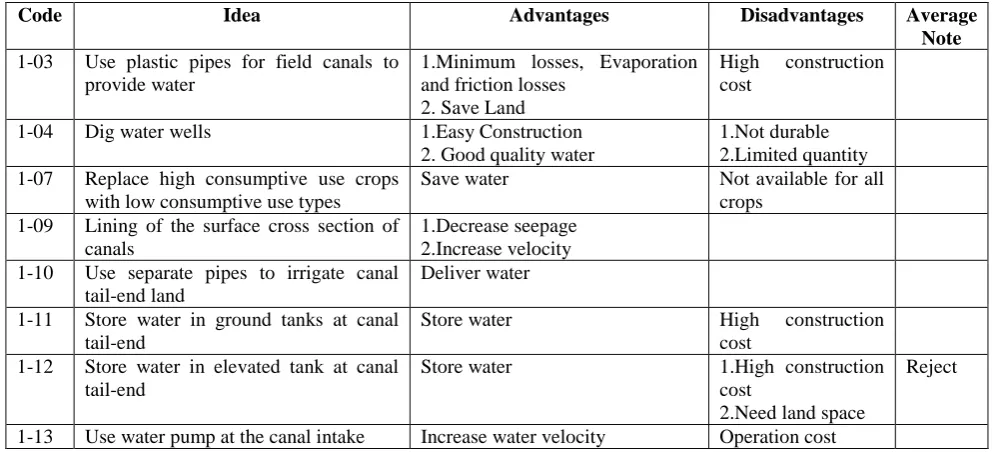
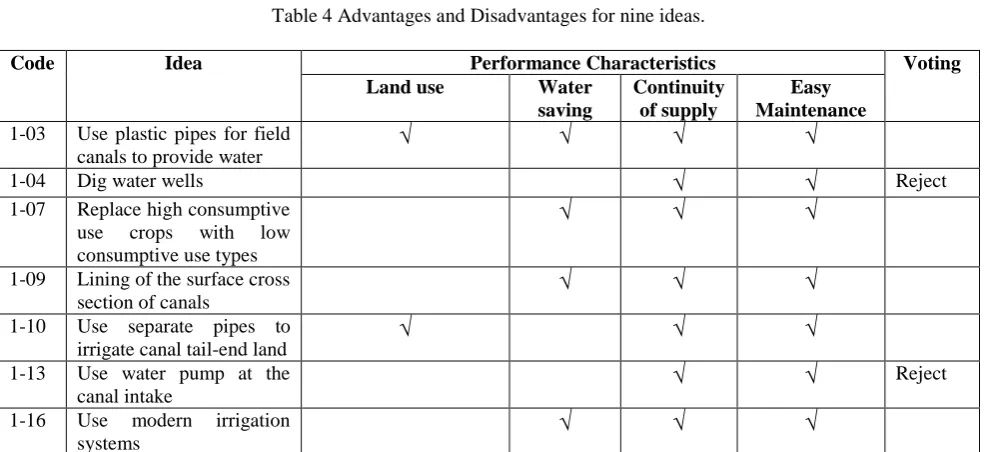
The second brain storming session is conducted in five steps to identify the problem. These steps depend on idea screening, the first and second steps are ‘‘(GO or NO GO) and Champion” to select the best ideas. In the third step (Go for It) the advantages and dis-advantages are discussed for the accepted ideas and take the average voting. The fourth step is ‘‘Trade-off Study” which is done depending on performance characteristics (as land use, water saving, continuity of supply and easy maintenance) to select the final alternatives to solve end tail-end canal problem. The last step in this stage is ‘‘Customer Acceptance” to determine the acceptance criteria and develop proposal scenarios. The conclusion of these two stages is developing some value alternatives (VA) from the final ideas to put an integrated solution for canal end problem.
Stage 3:
IV.VALUEENGINEERING
Value Engineering (VE) was introduced into the construction industry in the early 1960s by Dell’Isola and became a trend thereafter. It is a systematic and organized process that maximizes the different values of multi-disciplinary stakeholders in a construction project. Traditionally, VE is a value enhancing tool rather than just a method of cost cutting [6]. VE is an intensive, interdisciplinary problem solving activity that focuses on improving the value of the functions that are required to accomplish the goal, or objective of any product, process, service, or organization. VE is an organized approach directed at analysing the function of systems, equipment, facilities, services and supplies for the purpose of achieving their essential functions at the lowest life cycle cost consistent with required performance, quality and safety. The highest performance in VE is achieved especially when the purpose is mainly increasing the value rather than reducing the costs. Therefore, VE is used to determine the best design alternatives for projects. Rezania et al. [17] used value engineering to ensure the success of irrigation and drainage projects. Annappa and Panditrao [4] presented the basic fundamental of value engineering that can be implemented in any product to optimize its value. Annappa and Panditrao [5] introduced how to apply Value Engineering in the industry by using tools such as Function analysis, Functional Evaluation and Decision Matrix to find the best possible alternative from the choices.
1) Value Engineering methodology: VE uses rational logic (a unique ‘‘how” - ‘‘why” questioning technique) andthe analysis of function to identify relationships that increase value. It is considered a quantitative method similar to the scientific method, which focuses on hypothesis- conclusion approaches to test relationships, and operations research, which uses model building to identify predictive relationships. All VE methodology should contain the following minimal essential features:
a. Description of the objectives and scope of the project in enough details to assure direction of the study.
b. Goals for the study.
c. Schedule for completion of each phase of VE including the anticipated VE study timing.
d. Establishment of a target data for formal presentation of project results. 2) Application of VE on irrigation water shortage at canal tail-end
There are six phases to apply VE on irrigation water shortage atcanal tail-end, these phases are:
1. Information Phase
In this phase, the current conditions of the project and the goalsof the study are reviewed and defined. The problem is shortage ofirrigation water at CT due to one or more of the following reasons:
a. Consumption of irrigation water at the beginning of canal; b. Obstacles in the CCS prevents water from reaching its tail end; c. Discharging insufficient irrigation water into the canalintake;
d. Widening of CCS due to the routine maintenance;
e. Irrigation water losses due to conveyance and seepage.
2. Function Analysis Phase
This phase focuses on understanding the system element from afunctional perspective; what must it do, rather than how it is currentlydoing. Functions are defined using two-words, active verb/measurable noun. The studied system is the irrigation systemwhich includes branch, distribution, and field canals. System elementsunder consideration are canal cross section (CCS’s) forbranch, distribution, and field canals.
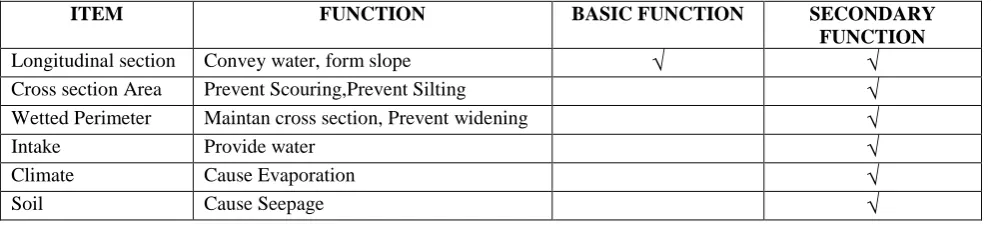
a. Identify CCS Functions:CCS functions are identified as; convey water, provide water,prevent scouring, prevent silting, cause seepage, and causeevaporation
b. Classify CCS Functions:Irrigation system has many functions that could be classifiedinto basic and secondary.
a) Basic function is the most important action performed by asystem. Basic functions of CCS are convey water,
form slop,and provide water to farm land along its whole length.
Required function is a secondary function that is essentialto support the performance of the basic function underthe current design. Required functions of CCS are to preventscouring, prevent silting, maintain cross section, andprevent widening.
Unwanted function is a negative function caused by themethod used to achieve the basic function. Unwantedfunctions of CCS are cause seepage and cause evaporation
ITEM FUNCTION BASIC FUNCTION SECONDARY
FUNCTION
Longitudinal section Convey water, form slope
√
√
Cross section Area Prevent Scouring,Prevent Silting
√
Wetted Perimeter Maintan cross section, Prevent widening
√
Intake Provide water
√
Climate Cause Evaporation
√
Soil Cause Seepage
√
Table 1 presents the classification of irrigation system itemsinto basic and secondary functions.
c) Develop Function Model of CCS:
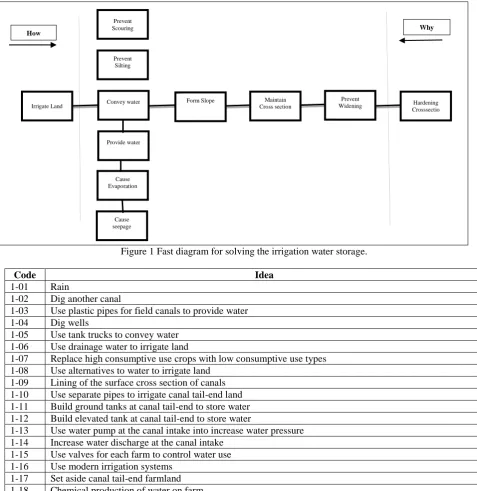
The functions of solving water shortage at CT are defined usinga Functional Analysis System Technique (FAST) diagram. Thisdiagram represent a function displaying the inter-relationship offunctions to each other in a ‘‘how-why” logic as shown inFig. 1. The logical question ‘how’ is applied to each function startingfrom lift to right. Then the logical question ‘why’ is applied tovalidate FAST diagram starting from right and left. Functionssatisfying ‘how–why’ logic form ‘Major Critical Path’ functionsto be put in line. The higher order function of the irrigationsystem is ‘‘irrigate land”, where the causative function is‘‘Hardening Cross section”.
3. Creative Phase
Creative techniques are employed to identify other ways to performthe system functions by first session of brain storming fromthe point of view of 38 experts in engineering and have knownthe nature of the area and its problems. We can irrigate land atCT using methods shown in Table 2.
4.Evaluation Phase
Second stage of brain storming is conducted to identify theproblem from the same experts. The questionnaire depends onidea screening steps:
(a) GO - NO GO
Scratch ideas that hold no interest. (b) Champion
Someone support the idea. (c) GFI (Go For It)
Discuss pros/cons and vote.GFI is team average.Combine ideas; add new ideas.Record all assumptions when voting. (d) Trade-Off Study
Quantify performance characteristics. Select top candidates using Pair-wise Comparison, etc. Could use software such as Expert Choice. Record all assumptions when voting.
(e) Customer Acceptance
Determine & quantify customer acceptance criteria. Rate surviving ideas against norm &risk. Develop proposal scenarios.
5. Development Phase
The purposes of this phase are analysis, the questionnaire isdone to develop a short list of ideas and develop those with meritinto value alternatives. The remaining ideas -after voting- are fiveideas (I-03, I-07, I-09, I-10 and I-11). Three value alternatives aredeveloped from these ideas to put an integrated solution for canalend problem. These value alternatives are:
Figure 1 Fast diagram for solving the irrigation water storage.
Code Idea
1-01 Rain
1-02 Dig another canal
1-03 Use plastic pipes for field canals to provide water
1-04 Dig wells
1-05 Use tank trucks to convey water
1-06 Use drainage water to irrigate land
1-07 Replace high consumptive use crops with low consumptive use types
1-08 Use alternatives to water to irrigate land
1-09 Lining of the surface cross section of canals
1-10 Use separate pipes to irrigate canal tail-end land
1-11 Build ground tanks at canal tail-end to store water
1-12 Build elevated tank at canal tail-end to store water
1-13 Use water pump at the canal intake into increase water pressure
1-14 Increase water discharge at the canal intake
1-15 Use valves for each farm to control water use
1-16 Use modern irrigation systems
1-17 Set aside canal tail-end farmland
1-18 Chemical production of water on farm
Table 2 Methods to irrigate land at the end. Prevent
Scouring
Prevent Silting
Convey water
Provide water
Cause Evaporation
Cause seepage
Irrigate Land Form Slope
Maintain Cross section
Prevent
Widening Hardening Crosssectio
Code Idea GO or NO GO Champion
1-01 Rain NO GO -
1-02 Dig a new canal from another route NO GO -
1-03 Use plastic pipes for field canals to provide water GO Yes
1-04 Dig wells GO Yes
1-05 Use tank trucks to convey water NO GO
-1-06 Use drainage water to irrigate land GO No
1-07 Replace high consumptive use crops with low consumptive use types GO Yes
1-08 Use alternatives to water to irrigate land NO GO
-1-09 Lining of the surface cross section of canals GO Yes
1-10 Use separate pipes to irrigate canal tail-end land GO Yes
1-11 Build ground tanks at canal tail-end to store water GO Yes
1-12 Build elevated tank at canal tail-end to store water GO Yes
1-13 Use water pump at the canal intake into increase water pressure GO Yes
1-14 Increase water discharge at the canal intake GO No
1-15 Use valves for each farm to control water use GO No
1-16 Use modern irrigation systems GO Yes
1-17 Set aside canal tail-end farmland GO No
1-18 Chemical production of water on farm NO GO
-Table 3 Voting on methods to irrigate land at the end.
(1) Value alternative 1 (VA-1) : This alternative includes lining of the surface cross sections of canals (I-09) and replacing high consumptive use crops with low consumptive use types (I-07).
(2) Value alternative 2 (VA-2) :This alternative includes using modern irrigation system (I-16) and replacing high consumptive use crops with low consumptive use types (I-07).
(3) Value alternative 3 (VA-3) :This alternative includes using separate pipes to irrigate canal tail-end land (I-10) and using plastic pipes for field canals to provide water (I-03)
Code Idea Advantages Disadvantages Average
Note 1-03 Use plastic pipes for field canals to
provide water
1.Minimum losses, Evaporation and friction losses
2. Save Land
High construction
cost
1-04 Dig water wells 1.Easy Construction
2. Good quality water
1.Not durable 2.Limited quantity
1-07 Replace high consumptive use crops
with low consumptive use types
Save water Not available for all
crops 1-09 Lining of the surface cross section of
canals
1.Decrease seepage 2.Increase velocity 1-10 Use separate pipes to irrigate canal
tail-end land
Deliver water
1-11 Store water in ground tanks at canal tail-end
Store water High construction
cost 1-12 Store water in elevated tank at canal
tail-end
Store water 1.High construction
cost
2.Need land space
Reject
1-16 Use modern irrigation systems 1.Save water
2. Suitable for more crops.
1.Not for all crops 2.Not for all soil types
Table 4 Advantages and Disadvantages for nine ideas.
Code Idea Performance Characteristics Voting
Land use Water
saving
Continuity of supply
Easy Maintenance 1-03 Use plastic pipes for field
canals to provide water
√
√
√
√
1-04 Dig water wells
√
√
Reject1-07 Replace high consumptive
use crops with low
consumptive use types
√
√
√
1-09 Lining of the surface cross
section of canals
√
√
√
1-10 Use separate pipes to
irrigate canal tail-end land
√
√
√
1-13 Use water pump at the
canal intake
√
√
Reject1-16 Use modern irrigation
systems
√
√
√
Table 5 Trade off only.
6. Evaluation Criteria Phase
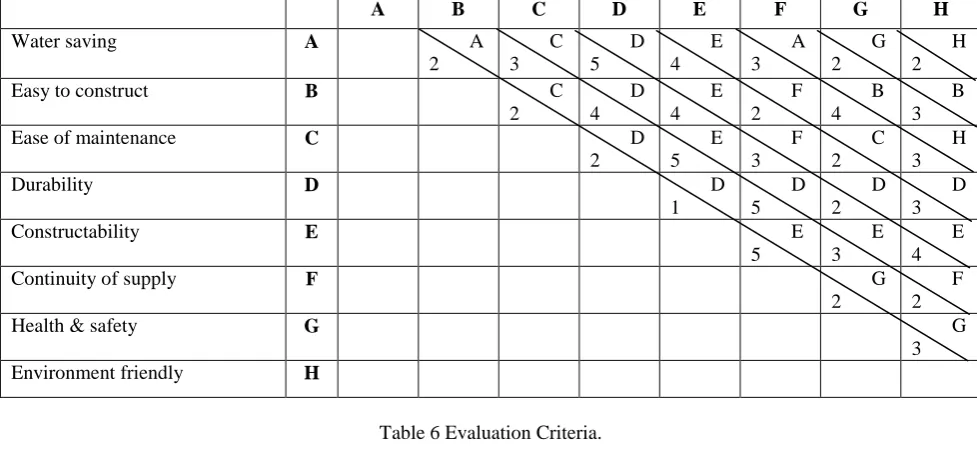
There are eight main evaluation criteria to evaluate previously stated VA as shown in Table 6. A questionnaire is done to evaluate the value alternatives by using the evaluation criteria don’t have equal importance. A comparison matrix is utilized to calculate the weights of evaluation criteria. A scale of 0 to 5 is used to express the importance of each evaluation criteria relative to the others. A score of 0 is assigned to the comparison matrix when both criteria are equally important, while a score of 5 is assigned to the comparison matrix when a criteria is extremely important than the other. A score of 1, 2, 3, and 4 is assigned to the comparison matrix for in-between values. The comparison matrix shown in Table 6 indicates the evaluation criteria which are more important and the degree of its importance relative to the other evaluation criteria. In order to calculate weights of evaluation criteria, relative importance score for each evaluation criterion in Table 6 is added together and divided by the overall relative importance score of all evaluation criteria. Final weights of evaluation criteria are shown in Table 7.
V. VALUEALTERNATIVESCORING
VI.CALCULATINGLIFECYCLECOST
Life Cycle Cost (LCC) is a methodology to calculate the total cost of a system from inception to disposal. LCC is the sum of all recurring and non-recurring costs over the life span of a given system. It includes purchase price, installation, operation, maintenance and upgrading costs. On the other hand, Net Present Value (NPV) is
defined as the difference between the present value of cash inflows and cash outflows. Therefore, NPV method is used to evaluate VA’s using LCC. Eq. (1) is used in calculating NPV for VA’s [16]:
NPV = Ci + Re-Sr + Aa + M + E
whereCi: investment costs; Re: replacement costs; Sr: resale value at the end of life span; Aa: annually recurring operating, maintenance and repair costs (except energy costs); M: non-annually recurring operating, maintenance and repair cost (except energy costs); E: energy costs.
A B C D E F G H
Water saving A A
2 C 3 D 5 E 4 A 3 G 2 H 2
Easy to construct B C
2 D 4 E 4 F 2 B 4 B 3
Ease of maintenance C D
2 E 5 F 3 C 2 H 3
Durability D D
1 D 5 D 2 D 3
Constructability E E
5
E 3
E 4
Continuity of supply F G
2
F 2
Health & safety G G
3
Environment friendly H
Table 6 Evaluation Criteria.
Evaluation Criteria Weight VA – 1 VA – 2 VA – 3
A Water saving 0.06 5 9 7
B Easy to construct 0.08 9 4 7
C Ease of maintenance 0.08 9 6 8
D Durability 0.26 7 9 8
E Constructability 0.30 8 7 8
F Continuity of supply 0.08 7 9 9
G Health & safety 0.08 6 9 8
H Environment friendly 0.06 7 9 8
Table 7 Weight of evaluation criteria and value alternatives score.
Evaluation Criteria Weight VA – 1 VA – 2 VA – 3
A Water saving 0.06 0.3 0.54 0.42
B Easy to construct 0.08 0.72 0.32 0.56
C Ease of maintenance 0.08 0.72 0.48 0.64
D Durability 0.26 1.82 2.34 2.08
E Constructability 0.30 2.4 2.10 2.40
F Continuity of supply 0.08 0.56 0.72 0.72
G Health & safety 0.08 0.48 0.72 0.64
H Environment friendly 0.06 0.42 0.54 0.48
Total Value 1.00 7.42 7.76 7.94
Table 8 Scores of value alternative.
VII. NETPRESENTVALUEOFVA’S
To study the benefits of using VE and LCC in evaluating the pervious alternatives, an area of 4.2 × 10⁸m2 is used as the study area. The soil composition of this area is silty-clay and the crop pattern is low consumptive use of water as vegetables, citrus and fruits.
1) Alternatives design
(a) VA-1
This alternative includes lining surface irrigation system of canals and using low consumptive use crops. This alternative is accompanied with surface drainage system. The surface cross section of canals and drains is designed by Manning formula according to the crop consumptive use as a trapezoidal cross section [12]. The crop consumptive use is calculated using Blanny- Criddle method [8].
(b) VA-2
This alternative includes using modern irrigation system as trickle (drip) system and using low consumptive use crops. The component of this system (emitters, sub-main and main lines, control head and pumps) are designed [9], the five pumps are used in series.
(c) VA-3
This alternative includes using separate pipes (which convey the flow from the main or branch canals) to irrigate branch and distribution canals tail-end land as well as using plastic pipes (usually made from PVC) for field canals to convey water to the field. The crop pattern is the same as that used in VA-1 and VA-2. Hazen- William formula is used to design VA-3 taking into consideration that irrigation water is pressurized in pipes using two pumps in series at the canal intake [10].
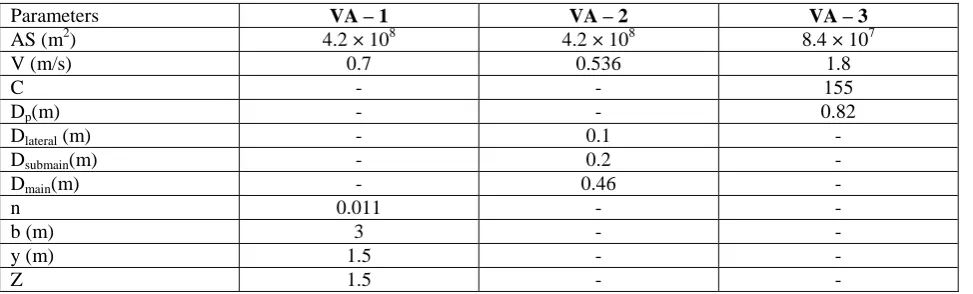
Parameters VA – 1 VA – 2 VA – 3
AS (m2) 4.2 × 10⁸ 4.2 × 10⁸ 8.4 × 10⁷
V (m/s) 0.7 0.536 1.8
C - - 155
Dp(m) - - 0.82
Dlateral (m) - 0.1 -
Dsubmain(m) - 0.2 -
Dmain(m) - 0.46 -
n 0.011 - -
b (m) 3 - -
y (m) 1.5 - -
A (m2) 7.9 - 0.53
P (m) 8.4 - -
R (m) 0.93 - -
L (m) 4300 - 4300
Llateral (m) - 190 -
Lsubmain (m) - 610 -
Lmain (m) - 1800 -
S 4.2 × 10⁻⁶ - 6.5 × 10⁻⁶
Q (m3/s) 5.53 5.53 1.0
HE (m) 0.0003454 - 0.013
HF(m) 0.0141594 - 0.9
HT(m) - - 0.003
Hex(m) - - 0.04
HLtotal(m) 0.015 - 1.32
HP (horse) - 600 442
PW (kilowatt/h) - 500 390
Table 9 Details for three alternatives design.
AS: area served (m2).V: flow velocity (m/s).C: Hazen-William coefficient.Dp: separate pipe diameter (m).Dlateral: lateral pipe diameter (m).Dsubmain: sub-main pipe line diameter (m).Dmain: main pipe line diameter (m).n: Manning coefficient for lining canal.b: bed width of surface canal cross-section(m).y: water depth of surface canal cross section (m).z: side slope of surface canal cross section.A: cross-sec area (m2).P: wetted perimeter (m).R: hydraulic radius (m).L: canal length (m).Llateral: lateral pipe line length (m).Lsubmain: sub-main pipe line length (m).Lmain: main pipe line length (m).S: slope of water in the cross section.Q: system flow (m3/s).HE: Head losses due to entrance (m).HF: Head losses due to friction (m).HT: head losses due to network grasses (m).Hex: head losses due to exit (m).HLtotal: Total head losses (m). HP: pump capability (horse).PW: electric energy (kilowatt/h).
VA – 1 VA – 2 VA – 3
Excavation volume (m3) 30.6 × 10⁷
-
19.2 × 10⁷Total initial cost (Billion L.E.) 2.1 2.9 2.38
Annual operating and maintenance cost (Billion L.E.) 0.006 0.08 0.009
Total cost as a present value (Billion LE.) 2.157 3.65 2.46
Table 10 the cost of alternatives.
Details for the design of three alternatives are shown in Table 9. First, each VA is designed to obtain the dimension and parameters of its element. Next, the initial and annul operating and maintenance cost is calculated for each VA as shown in Table 10. Calculating the net annual crop benefit (NACB) requires calculating the Basic Net Annual Crop Benefit (BNACB) and the Extra Net Annual Crop Benefit (ENACB). BNACB is benefits from the crop yield cultivated in the basic area, whilst ENACB is benefits from crop yield cultivated in extra land using the saved water.
2) Basic net annual crop benefit
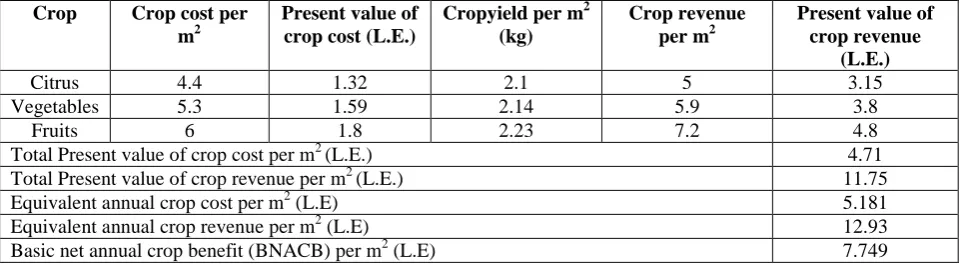
BNACB is the yield of crops cultivated in the basic area within one year rotation. The percentage area cultivated with vegetables, citrus and fruits is 33% each. Eq. (2) is used to convert the future value to the present value while Eq. (3) is used to convert the present value to annual value [10].
Pv= F/ (1 + i)N
wherePv: the present value; F: the future value; i: interest rate, and N: number of years.
where An: annual value, Pv: present value, i: interest rate, and N: number of years. Interest rate used is equal to 10% whereas the crop yield is obtained at the end of the first year. Table 11 shows present value of crop cost, present value of crop revenue, equivalent annual crop cost, equivalent annual crop revenue, and basic net annual crop benefit.
3) Extra net annual crop benefit
ENACB is benefits from crop yield cultivated in extra land usingwater saved from using each VA. Water saved for each VA is usedto cultivate extra area with the same crops used in the basic area.The ENCB is calculated for each VA as shown in Table 12.
4) Value index
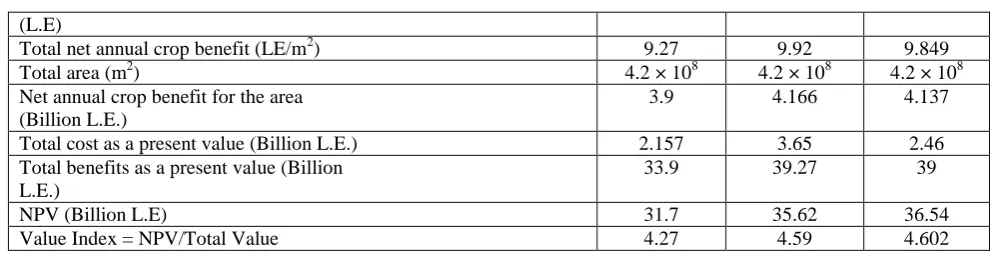
Total Net annual crop benefit per m2 is calculated for each alternativeby adding benefits from the crop yield cultivated in the basicarea (BNACB) plus benefits from crop yield cultivated in extra landusing the saved water (ENACB).Total benefits for each alternative is calculated as a presentvalue the NPV is calculated as subtraction of total cost as a present
Value from total benefits as a present value. To take the last decisionfor the best alternative to solve tail-end canal shortage, thetwo methods (VE and LCC) are connected by division the value ofNPV over VE value to find the value index. The best alternativeobtains the largest value index. These calculations are shown inTable 12.
VIII. DISCUSSIONOFRESULTS
Referring to Table 8, the total value of VA-3 is greater than VA-1 and VA-2 by 6.5% and 6.7%, respectively. Therefore, VA-3 is the best alternative fulfilling the evaluation criteria and achieving the basic function of canal. Table 12 shows that there is water saving fromall VA’s, however VA-2 saves more water allowing the largest extraarea to be cultivated using saved water. Total net annual crop benefitof VA-2 is greater than VA-1 and VA-3 by 6.4% and 0.7%, respectively.
The NPV of VA-3 is greater than VA-1 and VA-2 by 13.2% and2.5%, respectively. The value index of VA-3 is greater than VA-1 andVA-2 by 7.2% and 0.26%, respectively. As a result of previous discussion,VA-3 become the best alternative to avoid water shortageat CT. VA-3 is achieved using separate pipes to irrigate branch and distribution canals tail-end land as well as using PVC pipes for field canals. The irrigation water is pressurized in pipes using two pumps in series at the canal intake.
Crop Crop cost per
m2
Present value of crop cost (L.E.)
Cropyield per m2 (kg)
Crop revenue per m2
Present value of crop revenue
(L.E.)
Citrus 4.4 1.32 2.1 5 3.15
Vegetables 5.3 1.59 2.14 5.9 3.8
Fruits 6 1.8 2.23 7.2 4.8
Total Present value of crop cost per m2 (L.E.) 4.71
Total Present value of crop revenue per m2 (L.E.) 11.75
Equivalent annual crop cost per m2 (L.E) 5.181
Equivalent annual crop revenue per m2 (L.E) 12.93
Basic net annual crop benefit (BNACB) per m2 (L.E) 7.749
Table 11 Crop cost and benefit per m2
Design alternatives VA – 1 VA – 2 VA – 3
Saves water (m3/sec) 2.0 2.82 2.73
Extra area cultivated by saved water (m2) 1.3 × 10⁷ 1.86 × 10⁷ 1.8 × 10⁷
Extra net annual crop benefit result by Extra area cultivated with saved water
1.52 2.17 2.1
(L.E)
Total net annual crop benefit (LE/m2) 9.27 9.92 9.849
Total area (m2) 4.2 × 10⁸ 4.2 × 10⁸ 4.2 × 10⁸
Net annual crop benefit for the area (Billion L.E.)
3.9 4.166 4.137
Total cost as a present value (Billion L.E.) 2.157 3.65 2.46
Total benefits as a present value (Billion L.E.)
33.9 39.27 39
NPV (Billion L.E) 31.7 35.62 36.54
Value Index = NPV/Total Value 4.27 4.59 4.602
Table 12 Calculation of value Index
IX.CONCLUSIONS
Water saving alternatives include saving irrigation water by enhancing the non-efficient surface irrigation system including water shortage at CT. Causes of this water shortage include: widening of CCS; water losses due to conveyance and seepage along canal path; obtaining insufficient water at the canal intake, and growing crop patterns requiring extra amount of irrigation water than the designed canal discharge. Water shortage at CT has a negative impact on the crop yield of the cultivated lands on both sides of the canal end.
In this study, VE methodology was utilized to find alternativesfor water shortage at CT which maintain and/or enhance the function of water conveying system with minimum cost. VE steps are:
Collecting information about this problem and its effect on thecrop yield.
Function analysis of canal and interrelationships betweenfunctions;
Develop creative ideas to solve this problem.
Asses creative ideas generated from the previous step based onevaluation criteria weighted by panel of experts.
A short list of value alternative is generated using evaluationcriteria weights multiplied by alternative score to find the totalvalue. The largest total value is for the third alternative.
Value alternatives are designed and the benefits from savingwater and increasing crop yield are calculated.
LCC methodology is applied to evaluate the three value alternativesby calculating NPV for each alternative.
The value index is obtained by dividing NPV over total value foreach value alternative.
The best value alternative to prevent water shortage at CT is VA-3; using separate pipes to irrigate branch and distribution canalstail-end land as well as using PVC pipes for field canals. The irrigationwater is pressurized in pipes using one pump at the canalintake.
REFERENCES
[1] Al-Jayyousi. Rehabilitation of irrigation distribution systems: the case of Jericho City. Water Resour Manage 1999;13:117–32.
[2] Allam, Negm. Agricultural drainage water quality analysis and its suitabilityfor direct reuse in irrigation: case study: Kafr El-Sheikh
Governorate, Egypt. In:Seventeenth International Water Technology Conference, IWTC17.
[3] Annappa, Panditrao. Application of value engineering for cost reduction – acase study of universal testing machine. Int J AdvEngTechnol,
IJAET 2012;4(1):618–29.
[4] Annappa, Panditrao. Application of value engineering for cost reduction ofhousehold furniture product - a case study. Int J Innov Res Sci,
EngTechnol2014;3(10):16577–83.
[5] Chen, Tsai, Liou, Shen. A simplified way of implementing value engineering forpublic works. Applied Mechanics and Materials, Trans Tech
Publications,Switzerland 2013;357–360:2925–30.
[6] Development Support Center (dsc). Tail-Enders and Other Deprived in theCanal Water Distribution. Government of India: Final Report
Prepared for thePlanning Commission; 2003.
[7] Elnashar. The combined effect of water-logging and salinity on crops yield.IOSR J Agric Veterinary Sci 2013;6(4):45–54.
[8] Elsayed, Elnashar. Irrigation principals. Zagazig University Press; 2016.
[10] Hussain, 2011. Rehabilitation of Lower Chenab Canal (LCC) System PunjabPakistan, Pakistan Engineering Congress 71st Annual Session Proceedings.
[11] Khiry, Mowfy, El-Nashar. Selection of drains coverings type in eastern of Egypt.Int J Res EngTechnol 2014;3(6):330–8.
[12] Mateos, Lozano, Baba, Baghil, Abdoul Diallo, Go´ mez-Macpherson, Comas,Connor. Irrigation performance before and after rehabilitation of
arepresentative, small irrigation scheme besides the Senegal River,Mauritania. Agric Water Manage, Elsevier 2010;97(6):901–9.
[13] Mahmoud. Efficient Reuse of Irrigation Drainage Water in Agriculture, Beheragovernorate, Egypt Thesis submitted in partial fulfillment of
the requirementsfor the degree of Master of Science in Integrated Water Resource Management(IWRM). University of Jordan; 2014.
[14] Morgado, Grandão, Britoand, Lopes, Feiteira. Portuguese irrigation canals:lining solutions. J Perform ConstrFacil ASCE 2012;26(4):507–15.
[15] Peterson. Construction accounting and financial management. PearsonEducation Inc.; 2005.
[16] Rezania, Sharifipour, Meshkizadeh, Zibanchi. Optimization of the design ofirrigation and drainage networks using value engineering – case
study. In:Jofeir Irrigation and Drainage Network, South West of Iran, ICID 21stInternational Congress on Irrigation and Drainage, Tehran, Iran.
p. 15–23.
[17] Ring, Proznia, Renwick and Wilson. Irrigation Infrastructure Rehabilitation inAlberta; 35 Years of Government/Industry Cooperation,
Irrigation Toolbox;2005. p. 451–78.