Technology (IJRASET)
Value Engineering In Construction Industry
Ms.Sayali Dhayalkar1, Mr.Hemanshu Ahire2
Department of Civil Engineering, D. Y. Patil Institute of Engineering & Technology, Pune, India
Abstract—The Value Engineering is an intensive, interdisciplinary problem solving activity that focuses on improving the value of the functions that are required to accomplish the goal, or objective of any product, process, service, or organization. Value Engineering is an effective problem solving technique. Value engineering is essentially a process which uses function analysis, team- work and creativity to improve value. Value Engineering can be applied during any stage of a project’s design development cycle. However, the greatest benefit and resource saving are typically achieved early in the development and conceptual design stages. VE may be applied more than once during the life of the project. In this paper we have discussed the concept of Value Engineering, its job plan and the effective implementation of it through a case study.
Keywords—Value Engineering, Job plan, Functions Analysis, Cost.
I. INTRODUCTION
Value Engineering is the systematic application of recognized techniques which identify the function of the product or service, establish a monitory value for that function and provide the necessary function reliability at the lowest overall cost. The purpose of the Value Engineering Systematic Approach is to provide each individual with a means of skillfully, deliberately and systematically analyzing and controlling the total cost of product. This total cost control is accomplished, in the main, by the systematic analysis and development of alternative means of achieving the functions that are desired and required. Value engineering results in the increased use of alternative less expensive material, cheaper design, weight reduction, new methods of manufacturing, indigenization, etc., to give the same or better performance, quality and efficiency at a lower overall cost. In order to produce a product or service to be competitive in the open market, the best value is determined by two considerations, namely, function and cost of product. Value of a product or service can be enhanced either by increasing the function or decreasing the cost or both while maintaining the performance quality and reliability.
II. LITERATURE REVIEW
1. Kelly (2011)- Value Management (VM) and the analysis techniques involved is applicable as an design management methodology, and is argued as being as relevant to civil engineering infrastructure projects, as it is to architecturally orientated building projects. VM is a systematic means to improve the value of products and services and might be argued as essential in any objective comparison of the available alternative fit-for-use materials and specification options in (civil) engineering design. VM can be defined as 'a service that maximises the functional value of a project by managing its development from concept to use through the audit of all decisions against a value system determined by the client'.
2. Wixson and Heydt (2000)- He comment on the importance of 'people', stating that it is the people involved in the team that have a direct bearing on the success of a value management study; therefore, top level managerial support is critical (Cheah 2005). Whilst acknowledging this to be the case, it might be suggested that the mining industry currently exploiting the huge resources available in the northern region of Western Australia (an area the size of Western Europe with a population of just 2.5 million) have traditionally regarded infrastructure support as a somewhat peripheral concern.
Technology (IJRASET)
4. Amiruddin Ismail, Rahim Aminzadeh(2010)- To assess the effects of a VE study needs to consider not only the final economy but also the reciprocation relationship between Value Engineering with time, relationship between VE with quality and then study reciprocation between the expeditor and the construction participants. However VE, highway projects are reviewed and opportunities for better, less expensive means of completing the projects are analyzed. The intention is to improve project quality and productivity, foster innovation, optimize design elements and ensure overall economical costs. The goal of a VE study is to achieve implement excellence. Its objectives are to improve quality, minimize total ownership costs and decrease time.
III. HISTORICAL BACKGROUND
Value Engineering had its origin during World War II, at General Electric, when innovation was required because of material shortages. Some critical materials were difficult to obtain, and a great many of substitutions had to be made. Mr. Harry Erlicker, a vice president, made the observation that many times these changes resulted in lower costs and improved products. This encouraged him to seek an approach to intentionally improve a products value. He assigned Lawrence D. Miles, a staff engineer in 1947, the task of finding a more effective way to improve a product's value. In 1985, the Value Engineering process had gained worldwide acceptance. It spawned an international organization, Society of American Value Engineers International (SAVE Int.), dedicated to its practice, and the certification of competent practitioners. In 1997, SAVE approved a standard for Value Engineering Methodology.
IV. VALUE ENGINEERING METHODOLOGY
The value methodology is a systematic process that follows the Job Plan. The Job Plan consists of some phases. The recommended VE methodology (Job Plan) used by the VE team during the Workshop has five distinct phases. Briefly, these phases are:
A. Information Phase
The VE team gains as much information as possible about the project design, background, constraints, and projected costs. The team performs a function analysis and relative cost ranking of systems and sub-systems to identify potential high cost areas. The information phase also includes preparation of the cost and energy models from cost data assembled before the workshop began.
B. Function and Creative Phase
The VE team uses a creative group interaction process to identify alternative ideas for accomplishing the function of a system or sub-system. Functional analysis forces a broader and more comprehensive understanding of the project by Stimulating intense discussion and by compelling the team to view aspects they might not normally have considered VE team evaluates the ideas developed during the creative phase.
C. Evaluation/Analytical Phase
The ideas generated during the Speculative/Creative Phase are screened and evaluated by the team. The ideas showing the greatest potential for cost savings and project improvement are selected for further study. VE team evaluates the ideas developed during the creative phase. The VE team ranks the ideas. Ideas found to be irrelevant or not worthy of additional study are disregarded; those ideas that represent the greatest potential for cost savings and improvements are selected for development.
D. Development/Recommendation Phase
The VE team researches the selected ideas and prepares descriptions, sketches and life cycle cost estimates to support the recommendations as formal VE proposals. During the development phase of the VE study each designated idea is expanded into a workable solution. The development consists of the recommended design, capital and life cycle cost comparisons and a descriptive evaluation of the advantages and disadvantages of the proposed recommendations.
E. Report Phase
Technology (IJRASET)
V. DATA ANALYSIS
Case study of a cement concrete road construction site has taken to study value engineering application.
Name of Road Coastal Road, Goregaon (Wes), Mumbai Type of Road Cement Concrete
Length of Road 1186 m
Width of Road 27.45m (4 Lane) Total Cost( Phase 1) 114736126RS
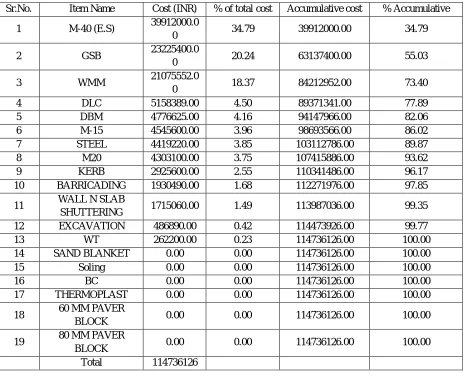
[image:4.612.76.542.266.642.2]In this Master format and uniformat was prepared. After preparation of masterformat and uniformat next step is to apply Pareto Law 20/80 which comes through ranking of the function according to their costs in descending order. Normally, around 20% of the functions constitute around 80% of the cost. These functions (20%) are the subject of value engineering. Weight for each criterion is assigned to reflect relative importance based on the project attributes that has been clearly verified and defined.
TABLE I FUNCTIONS OF UNIFORMAT RANKED IN DESCENDING ORDER
Sr.No. Item Name Cost (INR) % of total cost Accumulative cost % Accumulative
1 M-40 (E.S) 39912000.0
0 34.79 39912000.00 34.79
2 GSB 23225400.0
0 20.24 63137400.00 55.03
3 WMM 21075552.0
0 18.37 84212952.00 73.40 4 DLC 5158389.00 4.50 89371341.00 77.89 5 DBM 4776625.00 4.16 94147966.00 82.06 6 M-15 4545600.00 3.96 98693566.00 86.02 7 STEEL 4419220.00 3.85 103112786.00 89.87 8 M20 4303100.00 3.75 107415886.00 93.62 9 KERB 2925600.00 2.55 110341486.00 96.17 10 BARRICADING 1930490.00 1.68 112271976.00 97.85
11 WALL N SLAB
SHUTTERING 1715060.00 1.49 113987036.00 99.35 12 EXCAVATION 486890.00 0.42 114473926.00 99.77 13 WT 262200.00 0.23 114736126.00 100.00 14 SAND BLANKET 0.00 0.00 114736126.00 100.00 15 Soling 0.00 0.00 114736126.00 100.00
16 BC 0.00 0.00 114736126.00 100.00
17 THERMOPLAST 0.00 0.00 114736126.00 100.00
18 60 MM PAVER
BLOCK 0.00 0.00 114736126.00 100.00
19 80 MM PAVER
BLOCK 0.00 0.00 114736126.00 100.00
Total 114736126
Technology (IJRASET)
Sr.No. Item Name Cost (INR)
1 M-40 (E.S.) 39912000.00 2 GSB 23225400.00 3 WMM 21075552.00 Total 84212952.00
VI. CONCLUSIONS
Value Engineering can be applied during any stage of a project’s design development cycle. However, the greatest benefit and resource saving are typically achieved early in the development and conceptual design stages. VE may be applied more than once during the life of the project. Early application of VE helps to get the project started in the direction, and repeated application helps to filter the project’s direction based on new or changing information. It is important available and compare quality elements of the design with the owner’s requirements. The application of Pareto Law 20/80 states that around 20 % of the functions constitute around 80% of the cost. These functions (20%) are the subject of value engineering. Likewise It was noticed that the first 3 items (out of 13) forms 73.4% of the total cost. This means 23.07% of the functions form 73.4% of the cost which is very closed to Pareto Law. As a conclusion, the area of value engineering analysis and study will be controlled by the first three functions.
VII. ACKNOWLEDGMENT
I would like to express my gratitude towards my respected guide Prof. Hemanshu Ahire sir for his constant encouragement and valuable guidance during this work. Also I m thankful to Mr. Pravin Bhurke sir who gave us details of infrastructure project(road) for case study of this dissertation. And also to express gratitude towards all those who helped me directly or indirectly in many ways in complication of this research work.
VIII. FUTURE SCOPE
A. It can be use to control human resources on the field.
B. It is useful to any activity which is having alternatives to reduce cost.
C. There is often a tendency on projects to try to gain more scope within the budget.
REFERENCES
[1] Usama EI Sadawi, “A Value Engineering Methodology for low income Housing Projects in Gaza Strip” The Islamic University – GAZA, August 2008 [2] A. J. Dell'Isola.” Value Engineering Cost Effectiveness... A Tool for the Designer too” vol 1 no. 5 February 1969
[3] Srinath Perera, Gayani Karunasena, Kaushalya Selvadurai. “Application of value management in construction industry”, Built-Environment-Sri Lanka -Vol. 04, Issue 01:2003
[4] Nick Rich. “Value analysis Value Engineering” Lean Enterprize Research Centre,United kingdom, January 2000 [5] Abdulaziz S. Al-Yousefi, “value Engineering application benefits in sustainable construction.” Saudi Arabia [6] Dr. S.V. Deodhar,(2010) "Construction Equipment and Planning," Khanna Publishers Delhi. Fourth Edition .
[7] K.K. Chitkara,(2011) "Construction Project Management Planning, Scheduling, and Controlling," Second Edition, Tata McGraw Hill Education Private Limited New Delhi 2011.
[8] A. Ismail, R Aminzadeh, A. Aram and I.Arshad. (2010)“Using of value engineering in main road construction”. Journal of applied science, ISSN-1812-5654. 10(22) 2950-2953, Malaysia.
[9] AkintolaOmigbdun (Nov 2001), “Value engineering and optimal building construction”. Journal of architectural engineering vol.7, No. 2 paper no 17241.40-43Nigeria.