ISSN(Online): 2320-9801
ISSN (Print) : 2320-9798
I
nternational
J
ournal of
I
nnovative
R
esearch in
C
omputer
and
C
ommunication
E
ngineering
(An ISO 3297: 2007 Certified Organization)
Vol. 3, Issue 9, September 2015
Videos with Highly Dynamic Scenes Recovery
Using Rain Pixel Algorithm
Priyanka Shinde
1, Pushpanjali Bachhav
2, Archana Dhage
3, Hitendra Chaudhari
4,Prof. Ashvini Y. Bhamare
5 B. E. Students, Dept. of Computer, BVCOE&RI, Nashik, Pune University, Maharashtra, India1,2,3,4Assistant Professor, Dept. of Computer, BVCOE&RI, Nashik, Pune University, Maharashtra, India5
ABSTRACT: Rain removal is a highly useful and important technique in many applications such as surveillance and movie editing. In the recent years several rain removal algorithms have been proposed, where photometric, chromatic, and probabilistic properties of the rain pixels have been utilized to detect and remove the rainy effect. The existing methods generally work well with relatively static and light rain scenes, but when dealing with heavier rainfall in dynamic scenes in motion, these existing methods give very poor results. The proposed algorithm is based on the concept of motion segmentation for dynamic scene. After applying chromatic and photometric constraints for rain detection, several rain removal filters are applied on the rainy image such that their dynamic properties as well as motion occlusion clues are taken into consideration; both spatial and temporal information are then adaptively exploited during rain pixel recovery. Extensive simulation results show that the proposed algorithm shows a much better performancefor rainy scenes with large motion than the existing algorithms.
KEYWORDS: Motion segmentation, motion occlusion, dynamic scene, motion buffering, adaptive filters, rain removal, noise suppression.
I. INTRODUCTION
Rain removal is a very tedious task. In some of videos there occurs fluctuations in the videos, these fluctuations are caused due to dynamic objects or the camera motion object motion, etc, due to this fluctuations the pixel intensity gets changed through its original values also due to rain there is fluctuations in the pixels to remove this rain and the fluctuation there are many methods proposed in that the main need was to detect the rain and replace it by its original value of the pixels. First the analysis was done by Garg and Nayar in account to photometric [1][2] and the physical properties. They detect the intensity and temporary constraints by their observations but they could work for the uniform velocities and directions of the rain drop were limited. Zang proposed further methods in which the chromatic properties where took into considerations [3]. In this the R, G, B intensity changes for those objects which are in motion. This algorithm worked only for static scenes and also for only certain colour backgrounds.
Tripathi proposed probabilistic spatial-temporal model where they detect fluctuations and the intensity range this model was applicable for both static and the dynamic background but this method did not work for the heavy rain and speedily moving objects. The short coming of the existing methods is the prediction of rain covered pixel's original value and also the rain detection. Due to this the areas having motion is affected and important information are erased a ghost effect is observed.
ISSN(Online): 2320-9801
ISSN (Print) : 2320-9798
I
nternational
J
ournal of
I
nnovative
R
esearch in
C
omputer
and
C
ommunication
E
ngineering
(An ISO 3297: 2007 Certified Organization)
Vol. 3, Issue 9, September 2015
II. LITERATURE SURVEY
Rain removal is very useful and important technique in applications such as security surveillance, video or movie editing, vision based navigation system, and video indexing/retrieval. Wide ranges of algorithms using various types of techniques are used by various authors.
a. Photometric and Dynamic Model
Kshitiz Garg and Shree K. Nayar [1] in 2007 presented first complete analysis of the visible effects of rain on an imaging system and the various factors that affects it. To handle the photometric rendering of rain in computer graphics and rain in computer vision they develop systematic algorithm. They first develop photometric model that describes the intensities produced by individual rain streaks and then they develop a dynamic model that captures the spatiotemporal properties of rain. Together, these models describe the complete visual appearance of rain. By using these models they develop a new algorithm for rain detection and removal. By modelling the scattering and chromatic effects of rain, Narasimhan and Nayar successfully recovered “clear day” scenes from images taken by them in bad weather. But, their assumptions such as the uniform velocities and directions of rain drops limited its performance.
b. Temporal and Chromatic Properties
By using both temporal and chromatic properties of rain drops Xiaopeng Zhang, Hao Li [3] presented a K-mean clustering algorithm for rain detection and removal. The temporal property of rain states that an image pixel is never always covered by rain throughout the entire video. The chromatic property of rain states that the changes of R (red), G(green), and B(blue) values of rain affected pixels are approximately the same. This algorithm can detect and remove rain streaks in both stationary and dynamic scenes, using both temporal and chromatic properties of rain which are taken by stationary cameras. But it gives wrong result for those scenes of video which are taken by moving cameras. To handle these situations the video can be stabilized for rain removal and destabilized to restore camera motion effects after rain removal. It can handle both light rain and heavy rain conditions. This method can be applied to static background only, and it gives out false result for particular foreground colures.
c. Motion Segmentation
Jie Chen and Lap-Pui Chau used a novel approach for rain removal. This algorithm is based on motion segmentation of dynamic scenes. The pixel intensity variation of a rainy scene is caused by rain and object motion. The variation of pixel intensity caused by rain need to be removed, and the ones caused by object motion need to keep it as it is. Therefore motion field segmentation naturally becomes a fundamental procedure of these algorithms. Proper threshold value is set for detecting the intensity variation caused by rain. For rain detection after applying photometric and chromatic constraints, rain removal filters are applied on pixels such that their dynamic property as well as motion occlusion clue are considered; both temporal and spatial information are then adaptively use during rain pixel recovery. These algorithms give better performance over others for rain removal in highly dynamic scenes with heavier rainfall. Fig.2 shows the block diagram of rain removal pixel using motion segmentation.
ISSN(Online): 2320-9801
ISSN (Print) : 2320-9798
I
nternational
J
ournal of
I
nnovative
R
esearch in
C
omputer
and
C
ommunication
E
ngineering
(An ISO 3297: 2007 Certified Organization)
Vol. 3, Issue 9, September 2015
D. Probabilistic Model
K. Tripathi and S. Mukhopadhyay [5] proposed a efficient, simple, and probabilistic model based rain removal algorithm. This algorithm is well to the rain intensity variations. Probabilistic approach automatically adjust threshold and effectively differentiate the rain pixels and non-rain moving object pixels. Differentiation is done between the rain pixel and non-rain moving objects by using the time evolution of pixels in consecutive frames. This algorithm does not assume shape, size and velocity of the raindrops and intensity of rain, which makes it robust to different rain conditions. Here, it is assumed that the video capturing camera is static. There is a significant difference in time evolution between the rain pixel and non-rain pixels in videos. This difference is analysed with the help of the skewness and the Pitman test for symmetry. Quantitative results show that proposed algorithm gives the less number of miss and false detection in comparison with the other algorithms. This algorithm helps to reduce the complexity and execution time because it works only on the intensity plane.
E. Bilateral Filter
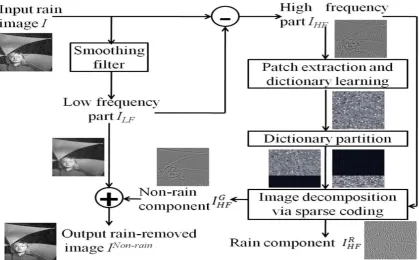
Li-Wei Kang and Yu-Hsiang Fu propose a single image- based rain removal framework based on morphological component analysis via properly formulating rain removal as an image decomposition problem. The proposed method first decomposes an image into the low and high-frequency parts using a bilateral filter, instead of directly applying a conventional image decomposition technique. The HF (High Frequency) part is then decomposed into a “rain component” and a “nonrain component” by performing sparse coding and dictionary learning based on morphological component analysis. This is first method which remove rain streak while conserving geometrical details in a single frame, where no temporal or motion information among successive images is required. Here decomposing rain steaks from an image is fully automatic and self-contained, where no extra training samples is required.
Fig. 2.2 Block Diagram ofProposed Rain Streak Removal Method
F. Spatiotemporal Properties
ISSN(Online): 2320-9801
ISSN (Print) : 2320-9798
I
nternational
J
ournal of
I
nnovative
R
esearch in
C
omputer
and
C
ommunication
E
ngineering
(An ISO 3297: 2007 Certified Organization)
Vol. 3, Issue 9, September 2015
velocity of raindrops which makes it realistic to different rain conditions. This method reduces the buffer size, which reduces the system cost, delay and power consumption. This method gives out wrong result for dynamic scenes.
III. SYSTEM ARCHITECTURE
Fig.3.1.System Architecture
IV. MATHEMATICAL MODEL
M= (V, A, R, VF, O, I) Where,
V=Rainy Video A=Algorithm used R=Rain Pixel VF=Video Frames O=Optical flow
I=Intensity (Image Brightness) V= {VF1, VF2, VF3… VFn} Where,
VF1, VF2, VF3... VFn are different frames inVideo N=Number of algorithms used for resultant video
A= {MS, RD, SR} Where,
MS=Motion Segmentation RD=rain detection SR=Scene Recovery
A. Motion Segmentation:
In motion segmentation optical flow is used to evaluate theExistence of motion. ∂I/∂x ∂x/∂t + ∂I/∂y ∂y/∂t + ∂I/∂t=0 --- (1)
I(x, y, t) =Image brightness at pixel p(x, y) at time t. Let,
ISSN(Online): 2320-9801
ISSN (Print) : 2320-9798
I
nternational
J
ournal of
I
nnovative
R
esearch in
C
omputer
and
C
ommunication
E
ngineering
(An ISO 3297: 2007 Certified Organization)
Vol. 3, Issue 9, September 2015
Exu + Eyv + Et=0 --- (2) u, v=optical flow velocities
B. Rain Detection:
Intensity fluctuation caused by rain can be detected bysetting the threshold value as follows, Idiff= {1, IN- IN-1 >=Dth
0, IN - IN-1 <Dth} Where,
Idiff=binary difference map
IN - IN-1=Gray scale Intensity differences between twoSuccessive frames. Dth=threshold value.
C. Motion Exclusion:
Rain pixels within the motion object andthe background need to be treated separately Irain is divided into two sets: Sm and Sb
Sm= {I(x, y) |Irain(x, y) =1 & BM(x, y, n) =1} Sb={I(x, y) |Irain(x, y) =1 & BM(x, y, n) =0} Sp=Sc-Sm-Sb
Where,
Sm=rain candidate pixels in the motion target area. Sb=rain candidate pixels in the background area. Sp=pixel that are not covered by rain.
Sc=complete set of frame pixel. BM=motion buffer.
D. Scene Recovery:
Three buffer for separating the frames for rain removal, BI (len, wid, stk) =Video frame buffer
BR (len, wid, stk) =Rain buffer BM (len, wid, stk) =motion buffer Len*wid=Video frame size Stk=Depth of buffer.
V. APPLICATIONS
Rain Pixel recovery algorithm finds application in the field of: 1) Security surveillance
2) Vision based navigation
3) Video/movie editing
4) Video indexing/retrieval.
VI. DISCUSSIONANDOUTCOMES
ISSN(Online): 2320-9801
ISSN (Print) : 2320-9798
I
nternational
J
ournal of
I
nnovative
R
esearch in
C
omputer
and
C
ommunication
E
ngineering
(An ISO 3297: 2007 Certified Organization)
Vol. 3, Issue 9, September 2015
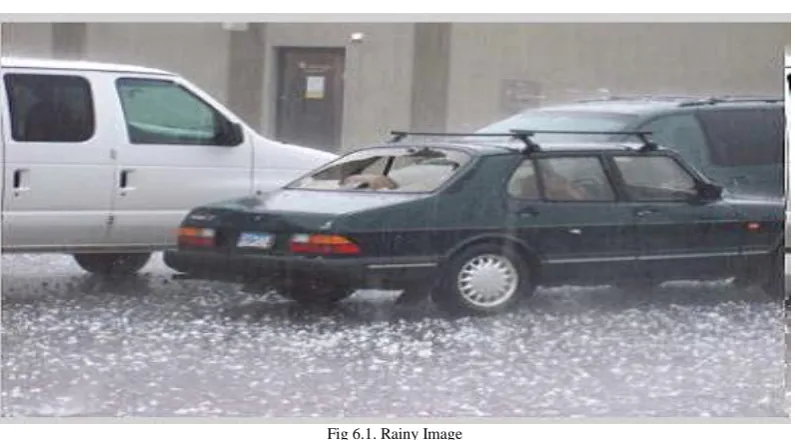
Fig 6.1. Rainy Image
The fig. 6.2 shows that the cars are also not blurred by the rain removal algorithm in spite of its large motion occlusion, and no leaving trails (ghost effect) are observable.
In general, the results show that the proposed rain removal algorithm has a much better performance over others for rain removal in highly dynamic scenes than any other existing algorithms
Fig 6.2. Rain Pixel Removal Image
VII.
CONCLUSION
ISSN(Online): 2320-9801
ISSN (Print) : 2320-9798
I
nternational
J
ournal of
I
nnovative
R
esearch in
C
omputer
and
C
ommunication
E
ngineering
(An ISO 3297: 2007 Certified Organization)
Vol. 3, Issue 9, September 2015
VIII. ACKNOWLEDGMENT
We feel immense pleasure in thanking Prof. C. K. Patil, Principal of B. V. C. O. E & RI, for having permitted. We wish to express our deep sense of gratitude to Prof. H. D. Sonawane, H. O. D. of computer department who had been a source of inspiration. We thank all staff members of our college and friends for giving their co-operation. We would like to thank our Parents with whose blessing; we would not have been able to accomplish our goal.
REFERENCES
1. K. Garg and S. K. Nayar, “Detection and removal of rain from videos,” in Proc. IEEE Conf. Comput. Vis. Pattern Recognit., vol. 1, Jul. 2004, pp. 528–535.
2. K. Garg and S. K. Nayar, “Vision and rain,” Int. J. Comput Vis., vol. 75, no. 1, pp. 3–27, 2007.
3. X. Zhang, H. Li, Y. Qi, W. K. Leow, and T. K. Ng, “Rain removal in video by combining temporal and chromatic properties,” in Proc. IEEE Int. Conf. Multimedia Expo, Jul. 2006, pp. 461–464.
4. A. K. Tripathi and S. Mukhopadhyay, “A probabilistic approach for detection and removal of rain from videos,” IETE J. Res., vol. 57, no. 1, pp. 82–91, Mar. 2011.
5. A. Tripathi and S. Mukhopadhyay, “Video post processing: Low-latency spatiotemporal approach for detection and removal of rain,” IET Image Process., vol. 6, no. 2, pp. 181–196, Mar. 2012.
6. A. Verri and T. Poggio, “Motion field and optical flow: Qualitative properties,” IEEE Trans. Pattern Anal. Mach. Intell., vol. 11, no. 5, pp. 490– 498, May 1989.
7. A. Ogale, C. Fermuller, and Y. Aloimonos, “Motion segmentation using occlusions,” IEEE Trans. Pattern Anal. Mach. Intell., vol. 27, no. 6, pp.988–992, Jun. 2005.
8. J. P. Koh, “Automatic segmentation using multiple cues classification,” M.S. dissertation, School Electr. Electron.Eng., NanyangTechnol.University, Singapore, 2003.
9. B. K. Horn and B. G. Schunck, “Determining optical flow,” Artif. Intell., vol. 17, pp. 185–203, Jan. 1981.
10. M. Shen and P. Xue, “A fast algorithm for rain detection and removal from videos,” in Proc. IEEE Int. Conf. Multimedia Expo, Jul. 2011, pp. 1–6.
11. C. M. Bishop, Pattern Recognition and Machine Learning. New York, NY, USA: Springer-Verlag, 2006, pp. 423–455, Ch. 9.