ISSN(Online): 2320-9801
ISSN (Print) : 2320-9798
I
nternational
J
ournal of
I
nnovative
R
esearch in
C
omputer
and
C
ommunication
E
ngineering
(An ISO 3297: 2007 Certified Organization)
Vol. 3, Issue 9, September 2015
Concealed Fingerprint Toning Using Extended
Features
J. Shiny Duela
1, P. Ramya
*2Department of Computer Science and Engineering, Jerusalem College of Engineering, Chennai, Tamil Nadu, India1 Lecturer, Department of Computer Science Engineering, Bharath University,Chennai, Tamil Nadu, India 2
*Corresponding Author
ABSTRACT- Latent Fingerprint Identification is of critical importance to law enforcement agencies in identifying suspects. Latent Fingerprints are inadvertent impressions left by fingers on surfaces of object. While tremendous progress has been made in plain and rolled fingerprint matching, latent fingerprint matching continues to be a difficult problem. We study a number of extended features at all three levels, including ridge flow map, ridge quality map and ridge skeleton. Feature extraction and matching algorithms are developed for each type of feature. Relative contribution of each feature towards the overall matching accuracy is evaluated by incrementally adding features to baseline features (minutiae). Based on extensive experiments, all the extended features lead to some improvement in latent matching accuracy.
KEYWORDS:Toning, Latent print, Binarization, Thinning
I.INTRODUCTION
Over the past 40 years, Automated Fingerprint Identification Systems (AFIS) have played a major role in forensics and criminal investigations. However, these systems have not yet eliminated the need for manual examination and matching of fingerprints by experienced human experts, particularly for latent prints. ―AFIS technology, since its onset, has utilized a very limited amount of fingerprint detail. Latent print experts rely on far more information in effecting individualizations or exclusions than just ending ridges and bifurcations‖. Fingerprint features are generally categorized into three levels. Level 1 feature is the macro details of the fingerprint such as ridge flow and pattern type. Level 2 features refer to the Galton characteristics or minutiae, such as ridge bifurcations and endings.
Level 3 features include all dimensional attributes of the ridge such as ridge path deviation, width, shape, pores, edge contour, incipient ridges, breaks, creases, scars, and other permanent details. The current FBI standard of fingerprint resolution for AFIS is 500 ppi (50 microns pitch), which is inadequate to automatically and reliably extract Level 3 features, such as pores (60 microns in radius). As a result, state of the art AFIS technology is primarily based on Level 1 and Level 2 features. With the advances in fingerprint sensing technology, many high resolution (i.e., 1000 ppi) sensors are now available that makes the extraction of extended features more feasible[1]. The extended features that are well understood and often used by latent experts include minutiae shape, dots and pores. They are utilized in latent matching when they are present in the input image and discernible to reach accurate conclusions.
ISSN(Online): 2320-9801
ISSN (Print) : 2320-9798
I
nternational
J
ournal of
I
nnovative
R
esearch in
C
omputer
and
C
ommunication
E
ngineering
(An ISO 3297: 2007 Certified Organization)
Vol. 3, Issue 9, September 2015
A. Fingerprint principle
According to criminal investigators, fingerprints follow 3 fundamental principles. A fingerprint is an individual characteristic; no two people have been found with the exact same fingerprint pattern. A fingerprint pattern will remain unchanged for the life of an individual; however, the print itself may change due to permanent scars and skin diseases. Fingerprints have general characteristic ridge patterns that allow them to be systematically identified.
There are three main types of fingerprints: visible prints, latent prints and impressed prints. Visible prints are also called patent prints and are left in some medium, like blood, that reveals them to the naked eye. They can be when blood, dirt, ink or grease on the finger come into contact with a smooth surface and leave a friction ridge impression that is visible without development[3]. Latent prints are not apparent to the naked eye. They are formed from the sweat from sebaceous glands on the body or water, salt, amino acids and oils contained in sweat. The sweat and fluids create prints must be developed before they can be seen or photographed. They can be made sufficiently visible by dusting, fuming or chemical reagents.
Impressed prints are also called plastic prints and are indentations left in soft pliable surfaces, such as clay, wax, paint or another surface that will take the impression. They are visible and can be viewed or photographed without development. A single rolled fingerprint may have as many as 100 or more identification points that can be used for identification purposes. These points are often ridge characteristics. There are many different ridge characteristics, although some of them are more common than others. These points can be used as points of comparison for fingerprint identification. Depending on how prevalent the ridge characteristics, fewer or more points of comparison may be needed for a positive identification.
B.Fingerprint Classes
There are 3 specific classes for all fingerprints based upon their visual pattern arches, loops, and whorls. Arches are found in about 5% of fingerprint patterns encountered. The ridges run from one side to the other of the pattern, making no backward turn. Ordinarily, there is no delta in an arch pattern; no re-curving ridge must intervene between the core and delta points[4]. There are four types of arch patterns: plain arches (Fig 1.1), radial arches, ulnar arches and tented arches (Fig 1.2). Plain arches have an even flow of ridges from one side to the other of the pattern, no ―significant up thrusts‖ and the ridges enter on one side of the impression, and flow out the other with a rise or wave in the center.
Loops occur in about 60-70 % of fingerprint patterns encountered. One or more of the ridges enters on either side of the impression, re-curves, touches or crosses the line running from the delta to the core and terminates on or in the direction of the side where the ridge or ridges entered. Each loop pattern has is one delta and one core and has a ridge count.
Whorls are seen in about 25-35 % of fingerprint patterns encountered. In a whorl, some of the ridges make a turn through at least one circuit. Any fingerprint pattern which contains 2 or more deltas will be a whorl pattern. There are four types of whorl patterns. Plain whorls (Fig 1.5) consist of one or more ridges which make or tend to make a complete circuit with two deltas, between which an imaginary line is drawn and at least one re-curving ridge within the inner pattern area is cut or touched[5]. Central pocket loop whorls (Fig 1.6) consist of at least one re-curving ridge or an obstruction at right angles to the line of flow, with two deltas, between which when an imaginary line is drawn, no re-curving ridge within the pattern area is cut or touched. Central pocket loop whorl ridges make one complete circuit which may be spiral, oval, circular or any variant of a circle. Double loop whorls consist of two separate and distinct loop formations with two separate and distinct shoulders for each core, two deltas and one or more ridges which make, a complete circuit. Between the two at least one re-curving ridge within the inner pattern area is cut or touched when an imaginary line is drawn. Accidental whorls (Fig 1.8) consist of two different types of patterns with the exception of the plain arch; have two or more deltas or a pattern which possess some of the requirements for two or more different types or a pattern which conforms to none of the definitions.
II.RELATED WORK
A. Matching Latent Fingerprint
ISSN(Online): 2320-9801
ISSN (Print) : 2320-9798
I
nternational
J
ournal of
I
nnovative
R
esearch in
C
omputer
and
C
ommunication
E
ngineering
(An ISO 3297: 2007 Certified Organization)
Vol. 3, Issue 9, September 2015
for rolled/plain fingerprint not for latent [10]. An extensive account of similar cases has been brought to light by the innocence project. These incidents and findings have undermined importance of latent fingerprint as forensic evidences in court of law. This is evident from recent ruling of a Baltimore court which excluded fingerprint as evidence in a murder trial because the prosecutor was not able to justify the procedure followed in latent fingerprint matching as being sufficiently error free[1].
A. Online Fingerprint Verification
A Warping model samples the ridge curve and uses thin-plate spines for estimating the nonlinear deformation. The subjects did not consciously distort their fingerprints when interacting with the sensor and, hence, one cannot predict the nature of the distortions present in the acquired images beforehand[5]
III. EXISTING SYSTEM
A.Automated Fingerprint Identification System
Automated Fingerprint Identification Systems (AFISs) have played an important role in many forensics and civilian applications. There are two main types of searches in forensics AFIS.
1) Ten-Print Searches: It typically involve comparing relatively high-quality, professionally obtained fingerprint images—for example, prints taken during an arrest or booking or as part of a background check with fingerprint records in an agency database, such as the FBI’s Integrated Automated Fingerprint Identification System (IAFIS) or a state’s criminal fingerprint database.
2) Latent print searches: It is considerably more complicated than 10-print searches. In a latent print search, a fingerprint examiner attempts to identify an individual by comparing a full or partial latent fingerprint from a crime scene with the records contained in an AFIS database[6]. Latent prints are regularly of poor quality and may be only a partial print, and often fingerprint examiners may not even know from which finger a given latent print came.
B.ACE-V Procedure
1) Analysis: It refers to assessing the latent fingerprint to determine whether sufficient ridge information is present in the image to be processed and to mark the features along with the associated quality information. The latent print analysis is usually performed manually by a human expert.
2) Comparison: It refers to the stage where an examiner compares a latent image to a reference print to ascertain their similarity or dissimilarity. Fingerprint features at all three levels (Level 1, Level 2, and Level 3) are compared at this stage.
3) Evaluation: It refers to classifying the fingerprint pair individualization (identification or match) exclusion (nonmatch), or inconclusive.
4) Verification: It is the process in which another examiner independently reexamines a fingerprint pair in order to verify the results of the first examiner.
B. Limitations Of Existing System
There are many limitations of existing system. Many fingerprints are of poor quality of latent prints in terms of clarity[7]. We can’t compare small finger area in latent prints as compared to rolled prints. Large non-linear distortion due to pressure variation occurs.
IV.PROPOSEDWORK
Based on a conventional fingerprint feature extraction algorithm, which outputs ridge skeleton image and minutiae, and a baseline minutiae matcher, which outputs minutiae correspondences and minutiae match score, encoding and matching algorithms are developed for extended features at three levels:
ISSN(Online): 2320-9801
ISSN (Print) : 2320-9798
I
nternational
J
ournal of
I
nnovative
R
esearch in
C
omputer
and
C
ommunication
E
ngineering
(An ISO 3297: 2007 Certified Organization)
Vol. 3, Issue 9, September 2015
1. At Level 1, three types of extended features are considered, including ridge flow map, ridge wavelength map, and ridge quality map. These features are used in local matching stage to facilitate minutiae pairing as well as in global matching stage to help separate genuine matches and impostor matches.
2. At Level 2, a ridge skeleton matching algorithm is developed. Starting with the most similar minutiae pairs, the skeleton matching algorithm establishes skeleton correspondence through a skeleton propagation procedure. After skeleton matching is finished, a skeleton match score is computed.
3. At Level 3, four types of extended features are considered, including pores, dots, incipient ridges, and ridge edge protrusions[8]. A topological level 3 feature matching algorithm is developed for latent to full fingerprint matching. Unlike most existing level 3 feature matching algorithms that only consider the feature location, the proposed algorithm enforces the topological relationship between level 3 features, minutiae, and ridge skeletons.
A. System Architecture
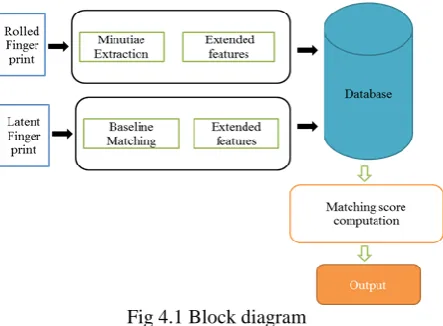
The block diagram (Fig 4.1) describes the process of improving the accuracy in the fingerprint identification based upon the matching process. Generally the process is initiated with the extraction of minutiae alone but here we come across many difficulties because of the poor quality ridge impressions which spoils the accuracy of the fingerprint process thereby we use some of the extended features such as ridge flow map, ridge quality map and skeleton to improve the accuracy[9]. We include three modules namely enrolling, matching and performance computation. Enrolling process includes the enrollment of the fingerprints both latent and rolled in the databases which includes certain process namely of minutiae extraction and extended feature extraction. Enrolling process includes Binarization, thinning and minutiae extraction, then based upon the matching score computation its understandable that the performance accuracy increases when using these extended features in addition to minutiae.
Fig 4.1 Block diagram
B. Minutiae Extraction
Minutiae extraction process includes feature extraction algorithm which comprises Binarisation, Thinning, and Minutiae.
ISSN(Online): 2320-9801
ISSN (Print) : 2320-9798
I
nternational
J
ournal of
I
nnovative
R
esearch in
C
omputer
and
C
ommunication
E
ngineering
(An ISO 3297: 2007 Certified Organization)
Vol. 3, Issue 9, September 2015
Thinning: Thinning is a morphological process that successively erodes away the foreground pixels until they are one pixel wide. Here we divide each iteration into two sub iterations. in the first iteration, the contour point p1 is deleted from the digital pattern if it satisfies the following conditions.
(a) 2 _< B(P1) -< 6 (b) A(P1)= 1 (c) P2*P4*P6 = 0 (d) P4*P6*P8 = 0
where A(P1) is the number of 01 patterns in the orderedset p2,p3,p4….p8,p9 that are the eight neighbours of p2and B(p1) is the number of nonzero neighbours of p1.In the second iteration, only conditions c and d are changed and given as follows.
(c) P2*P4*P8 = 0 (d) P2*P6*P8 = 0
Purpose of thinning is to gain the skeleton structure of fingerprint image[11]. It reduces image consisting of ridges and valleys into a ridge map of unit width.
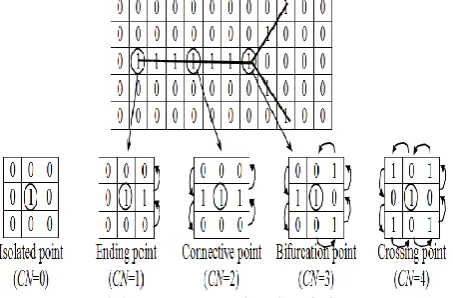
Minutiae: Extracting the minutiae points from the fingerprint image is the second module. From a thinned image, we can classify each ridge pixel into the following categories according to its 8-connected neighbors. A ridge pixel is called an isolated point if it does not have any 8-connected neighbor. An ending if it has exactly one 8-connected neighbor. An edge point if it has two 8-connected[12]. A bifurcation if it has three 8 connected. A crossing if it has four 8-connected. Spurious minutia pixels include Ending that lie on the margins of the region of interest, Two nearest endings with the same ridge orientation, ending and bifurcation that are connected and close enough, two bifurcations that are too close. Input for minutiae extraction is the binarised image as a 256*256 array from the previous module. Corresponding output is the set of minutiae points with ( x , y ) and their relative displacement.
Minutiae computation:
Table 4.1 Minutiae computation
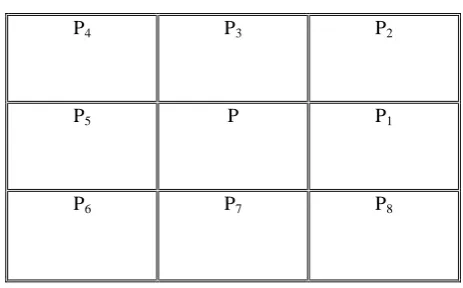
The points indicate the crossing point number (Table 4.2) which is computed based on the number of 0s and 1s in the adjacent cells.
Table 4.2 Crossing number table P4 P3 P2
P5 P P1
P6 P7 P8
ISSN(Online): 2320-9801
ISSN (Print) : 2320-9798
I
nternational
J
ournal of
I
nnovative
R
esearch in
C
omputer
and
C
ommunication
E
ngineering
(An ISO 3297: 2007 Certified Organization)
Vol. 3, Issue 9, September 2015
Ridge Endings and Bifurcations: In the biometric process of finger scanning, a ridge is a curved line in a finger image. Some ridges are continuous curves, and others terminate at specific points called ridge endings (Fig 4.2). Sometimes, two ridges come together at a point called a bifurcation (Fig 4.2). Ridge endings and bifurcations are known as minutiae.
Fig 4.2 crossing number
C. Extended features: Ridge Flow map:
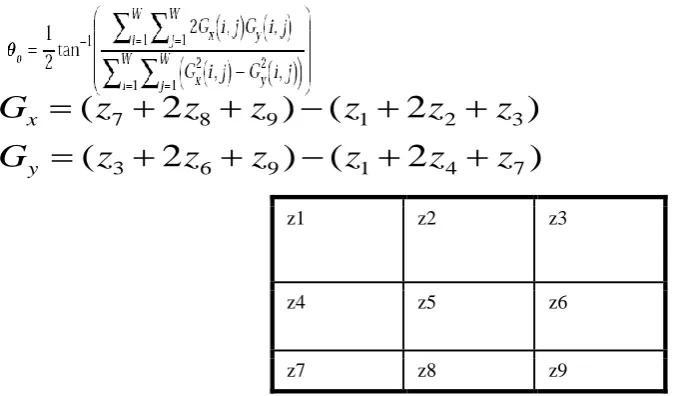
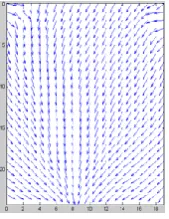
The purpose of this map is to represent areas of the image with sufficient ridge structure. Well-formed and clearly visible ridges are essential to reliably detecting points of ridge ending and bifurcation[13]. Orientation is the angle formed by the ridges with the horizontal axis (Fig 4.3).Find the local orientation of the ridge in small areas of the image (Table 4.3).
Divide image into blocks of size WxW
Compute gradients [Gx Gy] (Eqn 1) at each pixel in block Orientation at each block.
It is computed using
Table 4.3 Orientation computation z1 z2 z3
z4 z5 z6
z7 z8 z9
ISSN(Online): 2320-9801
ISSN (Print) : 2320-9798
I
nternational
J
ournal of
I
nnovative
R
esearch in
C
omputer
and
C
ommunication
E
ngineering
(An ISO 3297: 2007 Certified Organization)
Vol. 3, Issue 9, September 2015
Ridge Quality map:
Ridge quality map are obtained by dividing the image into non overlapping blocks of size 16 x 16 and assigning a quality value to each block. The image quality of a fingerprint may vary, especially in the case of latent fingerprints, it is critical to be able to analyze the image and determine areas that are degraded and likely to cause problems. Several characteristics can be measured that are designed to convey information regarding the quality of localized regions in the image[14]. These include determining the directional flow of ridges in the image and detecting regions of low contrast, low ridge flow, and high curvature. These last three conditions represent unstable areas in the image where minutiae detection is unreliable, and together they can be used to represent levels of quality in the image. We define three quality levels for a block:
level 0 (background)
level 1 (clear ridge flow and unreliable minutiae)
level 2 (clear minutiae)
Quality measures:
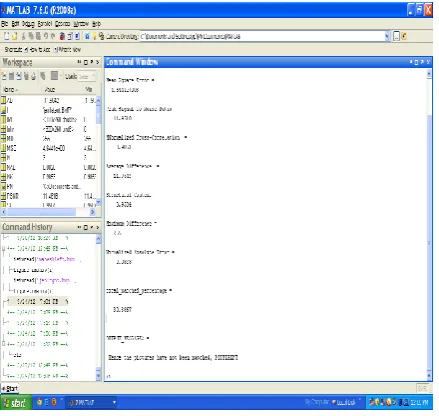
1) Mean Square Error: The MSE represents the cumulative squared error between the reconstructed and the original image. The lower value of MSE represents the lower error in the reconstruction of the image.
MSE= 2
2) Peak Signal-to-noise ratio:The PSNR computes the peak signal-to-noise ratio and represents a measure of the peak error in decibels, between two images. This ratio is often used as a quality measurement between the original and a compressed or reconstructed image. The higher value of the PSNR represents the better the quality of the reconstructed image.
PSNR = 10 log =10 log
Normalised Cross-Correlation: Normalized correlation is one of the methods used for template matching, a process used for finding incidences of a pattern or object within an image
NK =
Skeleton:
Minutiae can be deemed an abstract representation of ridge skeleton. However, the skeleton image contains more information than minutiae. uses an adaptive thresholding algorithm to compute binary image from the input gray scale fingerprint image,use a thinning algorithm to compute the fingerprint skeleton from the binary image.Use Rutovitz Crossing Number to extract minutiae from the skeleton of fingerprint image;postprocessing the minutiae set according to some heuristic rules.computaion is as similar to that of thinning.
Fig 4.4 Crossing number for skeleton
ISSN(Online): 2320-9801
ISSN (Print) : 2320-9798
I
nternational
J
ournal of
I
nnovative
R
esearch in
C
omputer
and
C
ommunication
E
ngineering
(An ISO 3297: 2007 Certified Organization)
Vol. 3, Issue 9, September 2015
The skeleton image of fingerprint is scanned and all the minutiae are detected using the properties of CN, as illustrated in Fig. 4.4. Ideally, the width of the skeleton should be strictly one pixel. However, this is not always true.
Fig. 5 shows some examples, where the skeleton has a two-pixel width at some bug pixel locations. We define a bug
pixel as the one with more than two 4- connected neighbors (marked by bold italic 1 and 0). These bug pixels exist in the fork regions where bifurcations should be detected, but they have CN = 2 instead of CN>2. The existence of bug pixels may (i) destroy the integrity of spurious bridges and spurs, (ii) exchange the type of minutiae points, and (iii) miss detecting true bifurcations, as illustrated in Fig. 6. Therefore, before minutiae extraction, we develop a validation algorithm to eliminate the bug pixel while preserving the skeleton connectivity at the fork regions[15]. By scanning the skeleton of fingerprint image row by row from top–left to bottom–right, we delete the first bug pixel encountered and then check the next bug pixel again for the number of 4-connected neighbors. If the number of 4-connected neighbors after the deletion of the previous bug pixel is still larger than two, it will also be deleted; otherwise it will be preserved and treated as a normal pixel. After this validation process, all the pixels in the skeleton satisfy the CNproperties.
D. Matching
1) Ridge flow matching: Score enhancement is computed based on the area size of matching ridge flow. If the ridge flow does not match, the score penalized. Ridge Flow is automatically extracted from skeleton for latent print. It can be compared even where minutia does not exist.
2) Quality matching:
Two factors are combined to produce a quality measure.They are
Quality Map
Pixel Intensity Statistics
Ridge quality map are obtained by dividing the image into non overlapping blocks of size 16 x 16 and assigning a quality value to each block. The image quality of a fingerprint may vary, especially in the case of latent fingerprints, it is critical to be able to analyze the image and determine areas that are degraded and likely to cause problems. Pixel Intensity statistics: The second factor for quality matching is based on pixel intensity statistics within the immediate neighborhood of the minutiae point. A high quality region within a fingerprint image is expected to have a significant contrast that will cover full grayscale spectrum.
3) Skeleton matching: Skeleton matching with that of minutiae is made possible by Score enhancement based on the length of matching Skeleton lines. Hara and Toyama describe an interesting skeleton matching algorithm, which consists of the following steps:
1) select the most reliable minutiae pair from all the matched minutiae pairs as the base paired minutiae (BPM); 2) remove minutiae pairs that are inconsistent with BPM;
3) modify the two skeleton images to make them more similar;
4) incrementally match skeleton points guided by the matched minutiae or skeleton points.
While their approach needs at least three pairs of correctly matched minutiae to guide the skeleton matching process, our approach needs only a pair of correctly matched minutiae as starting point, which is useful in matching latent prints with very small area. The proposed skeleton matching algorithm is an improved version of the algorithm. Its main steps are briefly described as follows.
1. Similarity between minutiae of two fingerprints is computed.
2. For each of the five most similar minutiae pairs, steps 3 to 5 are performed to
establish correspondence between skeletons of two fingerprints and compute a matching score. The maximum value of these scores is used as the skeleton matching score.
3. The associated skeletons of the initial minutiae pair are assumed to be matched and used as a reference.
4. Skeletons adjacent to reference skeleton pair are aligned according to reference skeleton pair and then matched. Newly matched skeletons are used a new reference.
5. A skeleton matching score is computed.
IV.RESULTSANDIMPLEMENTATION
ISSN(Online): 2320-9801
ISSN (Print) : 2320-9798
I
nternational
J
ournal of
I
nnovative
R
esearch in
C
omputer
and
C
ommunication
E
ngineering
(An ISO 3297: 2007 Certified Organization)
Vol. 3, Issue 9, September 2015
A. Rolled Fingerprint Grayscale Image
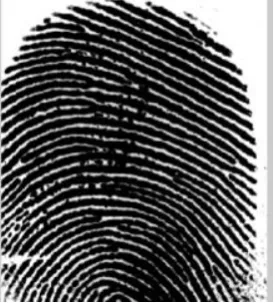
A grayscale image (Fig 5.1) is an image in which the value of each pixel is a single sample that is it carries only intensity information. Grayscale intensity is stored as an 8 bit integer giving 256 possible different shades of gray from black to white. Here the below image is the grayscale image of a rolled fingerprint.
Fig 5.1 Gray scale image for rolled fingerprint
B. Binarised Image
Binarisation (Fig 5.2) is the enhancement process of grayscale image in which some post processing and preprocessing methods are used to remove the noise and disturbances in the gray scale image.
Figure 5.2 Binarised image for rolled fingerprint
C. Thinned Image
Thinning is a morphological operation that is used to remove selected Foreground pixels from binary images, somewhat like erosion or opening. It can be used for several applications, but is particularly useful for skeletonization. In this mode
ISSN(Online): 2320-9801
ISSN (Print) : 2320-9798
I
nternational
J
ournal of
I
nnovative
R
esearch in
C
omputer
and
C
ommunication
E
ngineering
(An ISO 3297: 2007 Certified Organization)
Vol. 3, Issue 9, September 2015
Fig 5.3 Thinned image for rolled fingerprint
D. Minutiae Template
This represents Minutiae template (Fig 5.4), extracted from the Rolled fingerprint ridges. Generally these minutiae are extracted using the three general methods such as Binarisation, Thinning and Minutiae detection. These includes both the false minutiae that is of bad quality which are neglected for further process and true minutiae that are used for the further process which is used for increasing the accuracy.
Fig 5.4 Minutiae template for rolled fingerprint
E. Ridge flow
In addition to minutiae we use some features which comprise ridge flow. The below image (Fig 5.5) is the representation of the ridge flow direction of the fingerprint which represents areas of the image with sufficient ridge structure.
Fig 5.5 Ridge Flow map for rolled fingerprint
F. Performance measure
ISSN(Online): 2320-9801
ISSN (Print) : 2320-9798
I
nternational
J
ournal of
I
nnovative
R
esearch in
C
omputer
and
C
ommunication
E
ngineering
(An ISO 3297: 2007 Certified Organization)
Vol. 3, Issue 9, September 2015
Fig 5.6 Accuracy for minutiae matching
Fig 5.7 Accuracy for extended features
VI.CONCLUSION AND FUTURE WORK
A. Conclusion
In this paper, we have proposed a system for matching latent fingerprints with rolled fingerprints. The matching module consists of minutiae matching, orientation field matching, and skeleton matching. The rank-1 identification rate of 25 percent of the baseline minutiae matcher was improved to 40 percent when ridge quality map, ridge flow map, and skeleton were incrementally used. The importance of various extended features has also been studied and the experimental results indicate that ridge quality map, and ridge flow map are the most effective features in improving the matching accuracy.
B. Future Enhancement
ISSN(Online): 2320-9801
ISSN (Print) : 2320-9798
I
nternational
J
ournal of
I
nnovative
R
esearch in
C
omputer
and
C
ommunication
E
ngineering
(An ISO 3297: 2007 Certified Organization)
Vol. 3, Issue 9, September 2015
REFERENCES
[1] A.K.Jain, J.Feng, A.Nagar, and K.NandaKumar, ‖On Matching Latent Fingerprints,‖ IEEE Computer Vision and Pattern Recognition Workshop Biometrics,pp.1-8,june 2008.
[2] Mahalakshmi K., Prabhakar J., Sukumaran V.G., "Antibacterial activity of Triphala, GTP & Curcumin on Enterococci faecalis", Biomedicine, ISSN : 0970 2067, 26(Mar-4) (2012) pp. 43-46.
[3] J.Feng, ‖Combining Minutiae Descriptors for Fingerprint Matching‖, Pattern Recognition, vol.41, no.1,pp.342-352,2008.
[4] ―Conclusion of Circuit Court Judge Susan Souder-Grants Motion to Exclude Testimony of Forensic Fingerprint Examiner,Maryland v.Bryan Rose,‖2007.
[5] Bhuvaneswari B., Hari R., Vasuki R., Suguna, "Antioxidant and antihepatotoxic activities of ethanolic extract of Solanum torvum", Asian Journal of Pharmaceutical and Clinical Research, ISSN : 0974-2441, 5(S3) (2012) pp. 147-150.
[6] V.N.Dvornychenko and M.D.Garris,‖Summary Of NIST Latent Fingerprint testing Workshops,‖2006.
[7] A.K.Jain,L.Hong and R.M.Bolle,‖Online FingerPrint Verification‖ IEEE Trans Pattern Analysis and Machine Intelligence,vol.19,apr 1997.
[8] Sathyanarayana H.P., Premkumar S., Manjula W.S., "Assessment of maximum voluntary bite force in adults with normal occlusion and different types of malocclusions", Journal of Contemporary Dental Practice, ISSN : 1526-3711, 13(4) (2012) pp.534-538.
[9] S.A. Cole, ―More than Zero: Accounting for Error in Latent Fingerprint Identification,‖ J. Criminal Law and Criminology, vol. 95, no. 3, pp. 985-1078, 2005.
[10]Selva Kumar S., Ram Krishna Rao M., Deepak Kumar R., Panwar S., Prasad C.S., "Biocontrol by plant growth promoting rhizobacteria against black scurf and stem canker disease of potato caused by Rhizoctonia solani", Archives of Phytopathology and Plant Protection, ISSN : 0323-5408, 46(4) (2013) pp.487-502.
[11]M. Tico and P. Kuosmanen, ―Fingerprint Matching Using an Orientation-Based Minutia Descriptor,‖ IEEE Trans. Pattern Analysis and Machine Intelligence, vol. 25, no. 8, pp. 1009-1014, Aug. 2003.
[12]Subha Palaneeswari M., Abraham Sam Rajan P.M., Silambanan S., Jothimalar, "Blood lead in end-stage renal disease (ESRD) patients who were on maintainence haemodialysis", Journal of Clinical and Diagnostic Research, ISSN : 0973 - 709X, 6(10) (2012) pp.1633-1635.
[13]A.K. Jain, Y. Chen, and M. Demirkus, ―Pores and Ridges: High- Resolution Fingerprint Matching Using Level 3 Features,‖ IEEE Trans. Pattern Analysis and Machine Intelligence, vol. 29, no. 1,pp. 15-27, Jan. 2007.
[14]International Biometric Group (IBG), ―Analysis of Level 3 Features at High Resolutions: Phase II—Final Report,‖ technical report, 2008.
[15]J. Feng, S. Yoon, and A.K. Jain, ―Latent Fingerprint Matching: Fusion of Rolled and Plain Fingerprints,‖ Proc. Second Int’l Conf. Biometrics, pp. 695-704, June 2009.
[16]Dr. T.Nalini, Dr.K.Manivannan, Vaishnavi Moorthy, Efficient Remote Data Possession Checking In Critical Information Infrastructures Ensuring Data Storage Security In Cloud Computing, International Journal of Innovative Research in Computer and Communication Engineering, ISSN (Online): 2320 – 9801,pp 12-18, Vol. 1, Issue 1, March 2013
[17] Dr.K.P.Kaliyamurthie, Cervical Cancer Screening and Classification Using Acoustic Shadowing, International Journal of Innovative Research in Computer and Communication Engineering, ISSN(Online): 2320-9801,pp 1659-1662, Volume 1, Issue 8, October 2013
[18]Dr.K.P.Kaliyamurthie, Automated Information Retrieval System Using Correlation Based Multi- Document Summarization Method, International Journal of Innovative Research in Computer and Communication Engineering, ISSN(Online): 2320-9801,pp 4328-4335, Vol. 1, Issue 7, September 2014
[19] Dr.K.P.Kaliyamurthie, D.Parameswari, Modelling Cloud Storage, International Journal of Innovative Research in Computer and Communication Engineering, ISSN: 2249-2651,pp 1-5, Volume1 Issue3 Number2–Dec2011