Optimization of Machining Process
Parameters in Abrasive Water Jet Machining
Thilak.M1, Anandan A2, Arockia George G3, Elangovan A4, Karthikeayan S5
Assistant Professor, Department of Mechanical Engineering, TRP Engineering College, Tiruchirapalli, India1
UG Scholars, Department of Mechanical Engineering, TRP Engineering College, Tiruchirapalli, India 2,3,4,5
ABSTRACT: This paper attempts to select the significant process parameters by Taguchi methodology while
machining of Aluminium 6063 by AWJM. Different process parameters like pressure, feed rate, standoff distance and abrasive flow in three different levels are selected for optimization with two contravene responses, higher MRR and lower Ra by a single parametric combination. For Design of experiment L16 orthogonal array is prepared to set the input significant parameters for final product is calculated for better optimization purpose also different combinations of the factors are ranked on basis of grey relational grade.
1. INTRODUCTION
Abrasive water jet machining also known as a water jet is an industrial tool capable of cutting a wide variety of materials using a very high-pressure jet of water, or a mixture of water and an abrasive substance. The term abrasive jet refers specifically to the use of a mixture of water and abrasive to cut hard materials such as metal or granite, while the terms pure water jet and water-only cutting refer to water jet cutting without the use of added abrasives, often used for softer materials such as wood or rubber. Water jet cutting is often used during fabrication of machine parts. It is the preferred method when the materials being cut are sensitive to the high temperatures generated by other methods. Water jet cutting is used in various industries, including mining and aerospace, for cutting, shaping, and reaming. Water jet technology evolved in the post-war era as researchers around the world searched for new methods of efficient cutting systems. This system used a 100,000 psi (690 MPa) pump to deliver a hypersonic liquid jet that could cut high strength alloys such as PH15-7-MO stainless Aluminium 6063. Used as a honeycomb laminate on the Mach 3 North American XB-70 Valkyrie, this cutting method resulted in delaminating at high speed, requiring changes to the manufacturing process. While not effective for the XB-70 project, the concept was valid and further research continued to evolve water jet cutting.
II. LITERATURE REVIEW
et al. developed the predictive models for estimating the characteristics of the channels milled by an AWJ. The models are verified and found to agree well with the experimental data. M. M. Korat, et al. reviewed the research work carried out from the inception to the development of AWJM within the past decade. It reports on the AWJM research relating to improving performance measures, monitoring and control of process, optimizing the process variables. A wide range of AWJM industrial applications for different category of material are reported with variations.Dixit et al examined the role of water jet in
heavy construction in general and particularly how it affects the regional contractors in the northeast. M.Uthayakumaret al considered the assessment of the process parameters in abrasive waterjet cutting of redmud reinforced banana/polyester hybrid composite. Jiazhong Xu et al.conducted experimental research on several typical materials cut by water-jet cutting machine equipped with phased intensifier is conducted, which is valuable for design, manufacture and technological application of high pressure water equipment. M.A. Azmir at al.,conducted a practical study for analyzing the surface roughness and kerf taper ratio of glass/epoxy composite laminate machined using abrasive water jet machine.
III. PROBLEM IDENTIFICATION
Taguchi method is applied to find optimum process parameter for Abrasive water jet machining (AWJM). Abrasive water jet machining is a non–traditional process of removal of material by impact erosion of high pressure, high velocity of water and entrained high velocity of grit abrasives on a work piece. Experimental investigation were conducted to assess the influence of abrasive water jet machining (AWJM) process parameters on MRR of Aluminium. The approach was based on Taguchi’s method and analysis of variance (ANOVA) to optimize the AWJM process parameter for effective machining and to predict the optimal choice for each AWJM parameter such as pressure, standoff distance, Abrasive flow rate and Traverse rate. For each combination of orthogonal array we have Conducted three experiments and with the help of ANOVA it is found that these parameters have a significant influence on machining characteristics such as metal removal rate (MRR). The analysis of the Taguchi method reveals that, in general the standoff distance significantly affects the MRR while, Abrasive flow rate affects the surface Roughness. Experiments are carried out using orthogonal array by varying pressure, standoff distance, Abrasive flow rate and Traverse rate respectively. Experimental results are provided to verify this approach..
IV. METHODOLOGY
A well planned set of experiments, in which all parameters of interest are varied
over a specified range, is a much better approach to obtain systematic data. Mathematically speaking, such a complete set of experiments ought to give desired results. Usually the number of experiments and resources (materials and time) required are prohibitively large. Often the experimenter decides to perform a subset of the complete set of experiments to save on time and money! However, it does not easily lend itself to understanding of science behind the phenomenon. The analysis is not very easy (though it may be easy for the mathematician/statistician) and thus effects of various parameters on the observed data are not readily apparent. In many cases, particularly those in which some optimization is required, the method does not point to the BEST settings of parameters. A classic example illustrating the drawback of design of experiments is found in the planning of a world cup event, say football. While all matches are well arranged with respect to the different teams and different venues on different dates and yet the planning does not care about the result of any match (win or lose)!!!!
Obviously, such a strategy is not desirable for conducting scientific experiments.
4.1 PROPERTIES OF AN ORTHOGONAL ARRAY
The orthogonal arrays have the following special properties that reduce the number of experiments to be conducted. 1. The vertical column under each independent variables of the above table has a special combination of level settings. All the level settings appear an equal number of times. For L9 array under variable 4, level 1, level 2 and level 3 appears thrice. This is called the balancing property of orthogonal arrays.
3. The sequence of level values for conducting the experiments shall not be changed. This means one cannot conduct experiment 1 with variable 1, level 2 setup and experiment 4 with variable 1, level 1 setup. The reason for this is that the arrays of each factor columns are mutually orthogonal to any other column of level values. The inner product of vectors corresponding to weights is zero. If the above 3 levels are normalized between -1 and 1, then the weighing factors for level 1, level 2 , level 3 are -1 , 0 , 1 respectively. Hence the inner product of weighing factors of independent variable 1 and independent variable 3 would be (-1 * -1+-1*0+-1*1)+ (0*0+0*1+0*-1) + (1*0+1*1+1*-1) =0
4.2 TAGUCHI’S METHOD - EFFECT OF SIGNAL TO NOISE RATIO
Noise factors are those that are either too hard or uneconomical to control even though they may cause unwanted variation in performance. It is observed that on target performance usually satisfies the user best, and the target lies under acceptable range of product quality are often inadequate. If Y is the performance characteristic measured on a continuous scale when ideal or target performance is T then according to Taguchi the loss caused L(Y) can be modeled by a quadratic function as shown in equation (1)
L(Y) = K(Y-KT2) …….. (1)
The objective of robust design is specific; robust design seeks optimum settings of parameters to achieve a particular target performance value under the most noise condition. Suppose that in a set of statistical experiment one finds a average quality characteristic to be K and standard deviation to be σ. Let desired performance be K1. Then one make
adjustment in design to get performance on target by adjusting value of control factor by multiplying it by the factor . Since on target is goal the loss after adjustment is due to variability remaining from the new standard deviation. Loss after adjustment shown in equation (2):
K (μ0/ μ2) σ2………….. (2)
4.3 GREY RELATIONAL ANALYSIS
4.4 VARIABLES USED
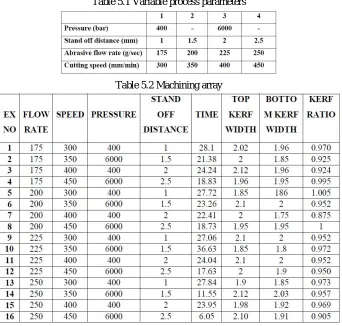
Table 5.1 Variable process parameters
Table 5.2 Machining array
5. RESULTS AND DISCUSSION
An objective of this study is to find out optimal conditions of Abrasive water jet machining machine for minimizing machining time and kerf width. For this single specimen of Aluminium 6063-T6 was bought in which 16 cuts were made. The mechanical properties of Aluminium 6063 are given in table 1.1 As per the literature review Water pressure, cutting speed, abrasive flow rate, and standoff distance were considered as most important parameters. In order to perform minimum experiments Taguchi method has been employed. For this L16 orthogonal array is considered. Experiment results and various response graph for machining time,Kerf width were obtained.
Taguchi Analysis: TIME, KERF RATIO versus FLOW RATE, SPEED, PRESSURE, STAND OFF DISTANCE
* NOTE * Design is not orthogonal.
* ERROR * Factor PRESSURE is highly correlated with other terms. No calculations were done.
Response Table for Signal to Noise Ratios Nominal is best (10×Log10 (Ybar^2/s^2)) STAND OFF
Level FLOW RATE SPEED PRESSURE DISTANCE 1 -2.277 -2.398 -2.362 -2.398
Delta 0.669 0.739 0.449 0.739 Rank 3 1.5 4 1.5
RESPONSE TABLE FOR MEANS STAND OFF
Level FLOW RATE SPEED PRESSURE DISTANCE 1 12.046 14.328 13.311 14.328
2 11.994 12.078 10.107 12.078 3 13.648 12.295 12.295 4 9.150 8.136 8.136
Delta 4.499 6.191 3.204 6.191 Rank 3 1.5 4 1.5
VI. CONCLUSION
A grey relational grade obtained from the grey relational analysis and Taguchi’s method were used to optimize the process parameters of abrasive water jet machine with multiple characteristics (Flow rate, Cutting speed, Standoff distance, Pressure) the experimental results shows that the parameters pressure plays a predominant role in machining. Based on the pressure the responses (machining time, Kerf width) can be optimized.
REFERENCES
1. Ruzhong Yan, Zhentong Liu, He Zhu, Aug 2014 , Study on Processing Characteristics of Constrained Abrasive Jet Polishing
2. E Lemma, L. chen, July 2002 Study Of Cutting Fiber-Reinforced Composites By Using Abrasive Water-Jet With Cutting Head Oscillation 3. K. S. Jai Aultrin and M. Dev Anand -2014Experimental Framework and Study of AWJM Process for an Aluminium 6061 Alloy Using RSM 4. K.Kalpana V.Mythreyi M.Kanthababu 2015 Review on Condition Monitoring of Abrasive Water Jet Machining System Predictive Models for
the Geometrical Characteristics of Channels Milled by Abrasive Waterjet
5. T.Nguyen, J. Wang, N.M. Kwok, H. Li and Q.P. Ha - 2015 A Review on Current Research and Development in Abrasive Waterjet Machining 6. M. M. Korat, Dr. G. D. Acharya, Water jet machining: an advance manufacturing process
7. Abhishek Dixit, Vikas Dave, M.R. Baid, Experimental investigation of the process parameters in abrasive waterjet cutting of redmud reinforced banana/polyester hybrid composites
8. M.Uthayakumar, V.Arumugaprabu M.Kathiresan, Design and Experiment Research on Abrasive Water-jet Cutting Machine Based on Phased Intensifier