Database Outsourcing with Hierarchical Authenticated Data Structures
Mohammad Etemad Alptekin K¨upc¸¨u Crypto Group, Koc¸ University, Istanbul, Turkey
{metemad, akupcu}@ku.edu.tr
Abstract
In an outsourced database scheme, the data owner delegates the data management tasks to a remote service provider. At a later time, the remote service is supposed to answer any query on the database. The essential requirements are ensuring the data integrity and authenticity with efficient mechanisms. Current approaches employ authenticated data structures to store security information, generated by the client and used by the server, to compute proofs that show the answers to the queries are authentic. The existing solutions have shortcomings with multi-clause queries and duplicate values in a column.
We propose a hierarchical authenticated data structure for storing security information, which alleviates the mentioned problems. Our solution handles many different types of queries, including multi-clause selection and join queries, in a dynamic database. We provide a unified formal definition of a secure outsourced database scheme, and prove that our proposed scheme is secure according to this definition, which captures previously separate properties such as correctness, completeness, and freshness. The performance evaluation based on our prototype implementation confirms the efficiency of our proposed scheme, showing about 3x to 5x enhancement in proof size and proof generation time in comparison to previous work, and about only 4% communication overhead compared to the actual query result in a real university database.
Keywords: Databases outsourcing, Hierarchical authenticated data structures, Authenticated join processing.
1
Introduction
Huge amount of data is being produced everyday due to the widespread use of computer systems in organizations and companies. Data needs protection, and most of companies lack enough resources to provide it. By outsourcing data storage and management, they free themselves from data protection difficulties, and concentrate on their own proficiency.
Consider a university who stores all data about students, faculty, and courses in a relational database, with limited resources and equipment for hosting a large amount of data and handling a large volume of queries, especially at the beginning and end of each semester. The university wishes to outsource data management to a remote database service provider who offers mechanisms to access and update the database online.
An important problem is that by data outsourcing, the owner loses the direct control over her data and should rely on answers coming from the remote service provider (who is not fully trusted). Therefore, there should exist mechanisms giving the data owner (the client) the ability for checking the integrity of the outsourced data. To make sure that the remote server operates correctly, the client should verify the answers coming from the server in response to her queries [15]. The remote server sends to the client a verification object (vo) along with the answer to the query (the result set). The vo gives the client the ability to verify that the server’s answer is authentic. Since the client may be a portable device with limited processing power, the vo should be small, and efficiently verifiable. The client uses the vo to verify that the query answer is [42, 18, 41, 15, 29]:
• complete: the result set sent to the client is exactly the set of records that are the output of executing the query, i.e., no record is added or removed.
• correct: the result set sent to the client is provided by the client already, i.e., no unauthorized modification. • fresh: the result set sent to the client is provided using the most recent data on the server, and does not belong
to old versions, i.e., no replay attacks.
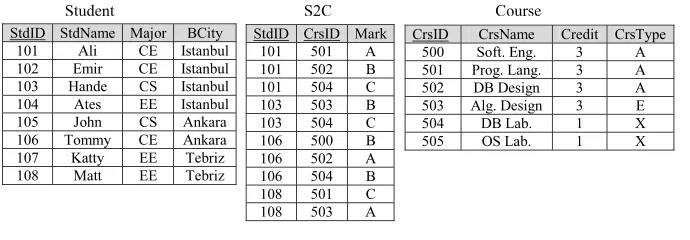
Assume that the university database is outsourced, and the client wants to execute the query: SELECT * FROM Student WHERE stdID>105. A small part of the database together with the result of this query is shown in Figure 1. We want the completeness, correctness, and freshness properties hold in the returned answer, guaranteeing that the answer is genuine.
(a) Our sample database.
(b) The result set of the querySELECT * FROM Student WHERE StdID > 105.
Figure 1: Our sample database (a), and the result of a query on it (b).
The authenticated range query is a way of providing completeness in the outsourced database context. Multiple implementations have been proposed by researchers using different data structures [33, 6, 25, 29, 42, 30, 18, 32, 28, 15]. In all these methods, the records are linked together in a way that we can prove there is no extra or missing record in between. It requires two records surrounding the (sorted) result set: one immediately before the first record (the left boundary record) and one immediately after the last record (the right boundary record). They together are referred to as the boundary records. We call such data structures with the ability to prove the predecessor (left boundary) and successor (right boundary) ordered.
We know that the primary key (PK) column in a table, as thestdIDin theStudenttable in our example, contains unique values, while non-PK columns may contain duplicate values, as the major and stdName columns in our example. We want to perform authentic queries on all searchable columns (the columns that can be used to build clauses) of a table. The general method is to sort a table by each searchable column, and build an authenticated data structure (ADS) on the result, that will be used to generate cryptographic proofs for queries having a clause using the column. There is a problem with duplicate values in non-PK searchable columns [32, 19]: a total order on the values of searchable columns is required to build the ADS, which together with the fact that the duplicate values belong to different records, make building the ADSs complicated. As clarified later, the existing solutions are not efficient.
We introduce a hierarchical ADS scheme (HADS) for solving this problem. HADS is also advantageous in proof generation for multi-clause (multi-dimensional) queries. The HADS can be stored in the same database [4], or separately. Storing the HADS separately breaks the tie to a specific database and brings more flexibility. This way, the DBMS used for data storage can be changed without affecting the proof system.
The rationale behind this work is to relate everything to the PKs. Since the PKs are unique identifiers of records in a database, they enable us to compare and combine the results of different queries and check the correctness and completeness at the same time (freshness is provided by storing a constant-size metadata locally at the client). This is an important distinction between our HADS and similar (multi-level) ADSs, as their proofs cannot be combined and compared together. We also support dynamic databases where the data owner issues modification queries (Insert, Delete, Update), in a provable manner. We believe that our HADS may also be of independent interest, applicable to other scenarios.
Our contributions can be summarized as follows:
• We provide a unified security definition for an outsourced database scheme (ODB) that captures completeness, correctness, and freshness simultaneously.
• We formalize the hierarchical ADS scheme and prove its security, for the first time.
• We build a provably-secure ODB using HADS that supports efficient proof generation for not only single-clause but also multi-clause queries.
• We handle proofs on columns containing duplicate values with around 3x to 5x better efficiency, regarding both proof generation time and size, compared to previous work.
• Our scheme supports the tables with composite keys, for the first time.
• Our ODB construction efficiently handles proofs for join queries, even for multi-table joins, non-equijoins, and queries containing both join and selection.
1.1 Related Work
Inefficient approaches. An elementary way to verify the authenticity of an answer to an outsourced database query
is to sign each table and store the signature locally. This method requires sending the whole table to the client for verification, and hence, does not scale up. Another method is to compute and store, with each record, a signature that verifies the contents of the record. The problems are that computing a signature (for each record) is an expensive operation, and this method does not provide completeness.
ADS-based approaches. A more suitable approach towards answer verification is to use ADSs [6, 21, 33, 9, 41,
42] to store authentication information, and send the relevant parts of these ADSs to the client to prove authenticity of the answer.
Devanbu et al. [6] proposed one of the first schemes using ADS for checking integrity of the remote data. They used a Merkle hash tree to store the security information about an outsourced static data (which changes infrequently). The scheme supports the projection and simple join operations inefficiently.
Pang and Tan [33] used one or more verifiable B-trees (VB-tree) for each table. The VB-tree is an extension of B-tree using the Merkle hash tree. A VB-tree is generated (using the table sorted on that column) for each searchable column of the table. This method does not support completeness [32], and found insecure for the insecurity of the function used to compute the signatures [28].
A variant of this method, named MB-tree, is also used in the literature [6, 25, 29, 42]. MB-tree is similar to VB-tree except that a light hash function is used instead of expensive signatures. The client stores locally the root’s digest, or signs and stores it on the server.
Another line of work is using an authenticated skip list to store the required information for the verification [30, 41]. It is suitable and efficient enough for this purpose, especially when we consider dynamic scenarios. Wang and Du [41] proved that such ADSs provide soundness and completeness for one-dimensional range queries, and multiple ADSs are required for multi-dimensional range queries.
Palazzi [30, 31] built one authenticated skip list for each searchable column in each table. For a query with one clause, a proof is computed using the corresponding skip list and sent back to the client along with the result set. For multi-clause queries, the result set of one clause that is finished earlier is considered and separated into a ‘YesSet’ and a ‘NoSet’ by applying the other clauses on top. The result sent to the client is a larger set than the real result set of the query, and hence, is not efficient. The problem is that each proof authenticates a set, and these sets cannot be compared against each other.
Authenticated range query is an important method used to prove the completeness (i.e., no extra records and no
missing ones), which works as follows [6, 18, 42, 28]:
• Find the contiguous nodes storing the values corresponding to the result set of the query, as well as the left boundary record and the right boundary record. Note that, to be able to work with such proofs, the underlying ADS needs to be ordered.
• Compute the ADS membership proofs of the boundary records. • Put all these values into the verification object and send it to the client.
• The client uses the values in the result set together with the membership proofs to reconstruct the corresponding part of the ADS, and computes the digest.
• She compares the computed digest with the locally stored metadata. If they are the same, then the query result is accepted, and rejected otherwise.
If the proof is accepted, the set{left boundary record, result set, right boundary record} is guaranteed by the ordered ADS to be a sorted and contiguous set of values, with no extra or missing value between them [41, 21].
Hierarchical ADSs. Due to their widespread use, work has been done to improve the efficiency of authenticated
range queries. Nuckolls [29] proposed a flexible structure called Hybrid Authentication Tree, which uses the one-way accumulators in upper levels to break the dependence on tree height of the MB-tree.
Goodrich et al. [15] gave a super-efficient answer verification method by decoupling the authentication structure from the search data structure. They divided a tree with n leaves (and height log n) into sub-trees with log n leaves (and height O(log log n)), and stored their roots in another structure. The sub-trees are divided further into sub-trees with O(log log n) leaves. This process is repeated recursively up to an optimal level. Note that none of the previous work formalizes or generalizes such hierarchical ADSs.
Hash chaining is another method for providing authentic query results where the records are linked together to
[ri−1,]ri,ri+1 together, i.e., compute h([h(ri−1)|]h(ri)|h(ri+1)), where h is a collision resistant hash function, and ‘|’
denotes the concatenation. The first and last records are linked to special records indicating the beginning and end of the records. [18, 32, 28, 15]. To provide authentic proofs, the client either computes signatures for the links, or relates them to each other in a tree structure.
Upon receipt of a query, the server (1) executes the query, (2) finds the result set and the boundary records, (3) computes the proof as either the set of links’ signatures, or the corresponding part of the tree, and (4) sends them all to the client. Using signatures, the verification object contains a linear (in the size of the result set) number of signatures, and hence, computation and communication costs are high. The aggregated hash chaining [26, 28] tries to reduce the proof size by combining multiple proofs into one, using the aggregation capability of the underlying scheme. The main problems with such schemes are the cost of updates and the lack of join possibility.
Provable join. Devanbu et al. [7] pre-computed all possible joins and constructed the corresponding ADS to
enable proof generation by the server. They further suggested constructing the ADS on the differences between the values of the matching columns in the result set. This way, they can support queries with equi-join (difference = 0),
>-clause (difference>0), and<-clause (difference<0).
Li et al. [18] proposed the Embedded Merkle B-tree (EMB-tree) whose nodes consist of regular B+-tree entries augmented with an embedded MB-tree, and used it to support authentic join queries. To join two tables R and S, R⋊⋉C
i=Cj S, where Ci ∈R and Cj ∈S, they: (1) find the smaller table, say R, (2) insert it as a whole into the vo,
along with its proof, and (3) for each vk∈Ci, construct a range query proof for the query ‘SELECT * FROM S WHERE Cj =vk’, and append it to the vo. It requires|Ci|-many range queries, hence, is not efficient regarding the client and server computation, and communication.
Pang et al. [34] used signature aggregation to propose a scalable query result authentication mechanism for dy-namic databases. Their first attempt is similar to the schemes of Li et al. [18], and results in a huge verification object. Their second attempt uses a certified Bloom filter [2] to show that some of records of the first table has no matching records on the second table.
Join algorithms that use the ADSs for both tables and generate reasonable proofs are proposed by Yang et al. [42]. The first algorithm, Authenticated Indexed Sort-Merge join, is an efficient form of previous join algorithms with one ADS [18, 34], and eliminates the repeated range queries and redundant proofs. The second algorithm, Authenticated Indexed Merge join, improves the previous algorithm using two ADSs, one for each table. It traverses each ADS once, and each required node is inserted only once into the vo. Although it is efficient regarding both computation and communication, for any (mis)match, two boundary records are inserted into the vo, which is unnecessary as we show in our join algorithms. The third algorithm, Authenticated Sort-Merge join, is used to perform the join on a column for which no ADS is generated. The server inserts the whole first table into the vo, together with the matching records of the second table, and the rank lists used to prove the matching. The client verifies all of them and generates matching pairs (the expected result) locally.
Recently, an integrity-checking mechanism is given for join queries performed by an untrusted computational server working together with some trusted storage servers [5]. The client gives the storage servers a query, an encryp-tion key, and informaencryp-tion on how to inject some fake records (markers and twins) into the result. The storage servers execute the query, inject the fake records, encrypt and send the result to the computational server who performs the join and sends the final result to the client.
Private query processing. Carbunar and Sion [3] suggested a private join on the outsourced databases that
supports equi-join, and can be extended to support range join queries, assuming an honest-but-curious server. For each value in a column, the client finds all matching values in all other tables, encrypts them, and stores them all in a Bloom filter. For a join between two tables, the client computes a trapdoor and sends it to the server, so that the server can find all matching pairs of the requested tables, and send the corresponding records. The scheme is not computation- and storage-efficient, especially for range queries and dynamic data. Another privacy-preserving join scheme proposed by Ma et al. [20] only supports equi-join, but uses randomized trapdoors. It is not computation-efficient, since for a join between two columns A and B, each value ai∈A should be checked against all values bj∈B. In both schemes, there are no (correctness, completeness, and freshness) proofs accompanying the server answers.
1.2 Overview of Our Solution
each table, we have a table ADS, which stores the names of the columns in that table. For each column, we have a column ADS that stores the unique values in that column. Finally, the bottommost ADSs are primary key ADSs, associated with each unique value viin a column Cj, storing the primary key (PK) values of the records having viin column Cj. For example, in our sample database in Figure 1, a column-level ADS formajorwill contain only three leaves, with labelsCE,CS,EE. The lower-level ADS connected to theCEwill contain the primary key values 101, 102, and 106. Similarly, the lower-level ADS connected toCSwill contain 103 and 105. Note that, our HADS definition is flexible, and hence such a four-level hierarchy is not a requirement, but a sample deployment that makes sense.
Efficient duplicate handling. The reason for the necessity of such a hierarchical structure comes from the
short-comings of previous ADS-based solutions. Note that columns, such asmajor, contain duplicate values. Obviously, such duplicates can be made unique, for example, by appending a random perturbation [19], hash of the record [31], or the replica number [32]. Yet, the server should traverse the whole resulting (big) ADS to search for a value. Since the HADS stores the unique values in an upper level, which is a much smaller ADS, the server first finds a value in this ADS, and accesses the whole related values in the lower level, without further computation. As an example, consider a column containing 1000 unique values, each of which is repeated 100 times. A regular (single-level) ADS would need to integrate 100,000 values, whereas our HADS will have one upper-level ADS with 1000 values, and 1000 lower-level ADSs with 100 values each. Hence, instead of searching for 100 values in an ADS with 100,000 values, the server looks for only one value in an ADS with only 1000 values (and access the whole lower-level ADS storing 100 values). This results in great performance improvements regarding both communication and computation. We use multi-proof supporting ADSs (e.g., the FlexList [11]) to construct the HADSs, which in turn, makes efficient authenticated range queries possible. A multi-proof supporting ADS generates an efficient (non-)membership proof for a set of values, instead of separate proofs for each value in the set. The proof for the clause a<coli<b, indeed, consists of membership proofs of a and b, and the values matching the clause.
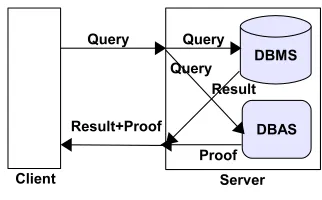
Figure 2: Server architecture.
Server architecture. There are two parts on the server side: the DBMS
(database management system) who stores the client data and responds to the SQL queries coming from the client, and the DBAS (database authentication system) who stores the security information in the form of the ADSs and HADSs, and generates cryptographic proofs to the queries. The DBMS choice is independent of our work, and any available DBMS can be employed. But, we design and implement our own DBAS. Since our DBAS works independently of the underlying DBMS (on the same query), our proofs do not include any extra record, making it an efficient scheme. Figure 2 shows this architecture.
Join. Another advantage of the HADS is an improved join algorithm. Since we use similar ordered HADSs, the
items contained in them are comparable, and hence proving mutual memberships (i.e., for ‘AND’ connector and join queries) is easy. To join two tables on two columns, we start at the leftmost leaf nodes of both ADSs and compare them together. If they store the same value, it is reflected in the proof. Otherwise, we jump over the nodes of the ADS containing the smaller value, to a node containing the smallest value that is less than or equal to the bigger value. This process goes on until the end of either ADS is met. The proof size and proof generation time is reduced due to the lack of duplicates.
Combining proofs. Another important advantage of our scheme is that since the HADS ties all values to their
related PKs, all proofs prove to the client the authenticity of a set of PKs. This makes possible the results of the proofs to be compared and combined together, which was a common problem among most of the existing solutions [7, 32, 28, 31]. Stated differently, for queries with more than two clauses, the server starts by generating proof for the first two clauses on their ADSs, and uses the result (that is not in the form of an ADS) with the next clause, who has an ADS, to generate a new proof. This is repeated (with proper ordering on the clauses, detailed in Section 5.4) until all clauses are processed. Thus, more than two clauses or joins on more than two tables can be handled as well.
2
Preliminaries
Notation. We use N to denote the number of records of a table, and|Ci|to denote the number of distinct values in a column. The symbol ‘|’ denotes the concatenation, h denotes a collision-resistant hash function, and PPT stands for probabilistic polynomial time. ‘PK’ denotes ‘primary key’ in a database table, and ‘pk’ stands for ‘public key’.
A functionν(k): Z+→[0,1]is called negligible if∀polynomials p,∃constant k0s.t.∀k>k0,ν(k)<|1/p(k)|.
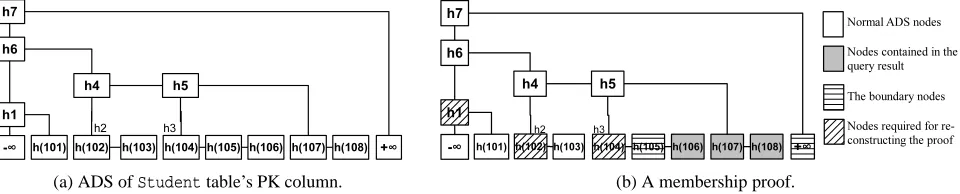
(a) ADS ofStudenttable’s PK column. (b) A membership proof.
Figure 3: (a) An ADS storing the PK column of theStudenttable, and (b) the membership proof for the querySELECT StdID FROM Student WHERE StdID > 105.
Hash functions are functions that take arbitrary-length strings, and output strings of some fixed length. Let
h :
K
∗M
→C
be a family of hash functions, whose members are identified by k∈K
. A hash function family is collision resistant if∀PPT adversariesA
,∃a negligible functionν(ℓ)such that: Pr[k←K
;(x,x′)←A
(h,k):(x′6= x)∧(hk(x) =hk(x′))]≤ν(ℓ), whereℓis the security parameter of the hash function family (e.g., related to|k|).An authenticated data structure (ADS) is a scheme for data authentication, where untrusted responders answer client queries and provide cryptographic proofs that the answers are valid [39, 40, 35, 16]. The client constructs the ADS and uploads it to a server who answers later queries. On receipt of membership queries, the server sends back a proof, using which the client can verify the answer against some local metadata. There are different types of ADSs: accumulators, authenticated skip lists, authenticated hash tables, Merkle hash trees, 2-3 trees. We provide a formal definition in Appendix A.
A one-way accumulator [1] is defined as a family of one-way, quasi-commutative hash functions. A function f : X∗Y →X is quasi-commutative if∀x∈X,y1,y2∈Y : f(f(x,y1),y2) = f(f(x,y2),y1). Benaloh and de Mare [1]
proposed a one-way accumulator based on an RSA modulus.
The authenticated skip list is an extension of a skip list [37]. It is constructed using a commutative hash function h, which in turn can be constructed from a collision resistant hash function f as: h(x,y) = f(min(x,y),max(x,y)). The leaves store hashes of data items, and each intermediate node stores hash of a function of values of its children. The values on the path from a leaf node up to the root constitute a proof of membership. Merkle hash tree [23] is another widely used ADS for static data. Both ADSs have linear space complexity, and logarithmic proof size and verification time, in the number of the items stored [16]. Figure 3a presents an authenticated skip list storing the PK column of the Studenttable, and Figure 3b illustrates the membership proof for the querySELECT StdID FROM Student WHERE StdID>105.
Papamanthou et al. [36] introduced the authenticated hash table, which constitutes a hierarchy of one-way accumulators.It keeps either the query or update time constant while providing the other with sub-linear complexity.
An ordered ADS can be used to show some elements are consecutive (essential for authenticated range queries). A total order on the elements to be stored in an ordered ADS is required. Assume that x,y and z are consecutive elements of a total order(A, <)such that x<y<z, and A is stored at ADSA. Informally, we say ADSAis ordered if it can prove that x= predecessor(y) and z=successor(y) for all consecutive x,y,z∈A. The Merkle hash tree and authenticated skip list are ordered ADSs, while the accumulator is not. An ordered ADS is perfectly suited for authenticated range queries.
A multi-proof ADS can prove (non-)membership of multiple elements in one proof. To prove (non-)membership of a set of elements, it does not need to do the job for each element one-by-one, and instead, generates a proof showing (non-)membership of all elements in only one traversal of the ADS. This will reduce the server computation, the communication, and the client verification, though not asymptotically. These ADSs suit the authenticated range queries well. FlexList [11] is an ADS with multi-proof capabilities.
3
Hierarchical Authenticated Data Structures
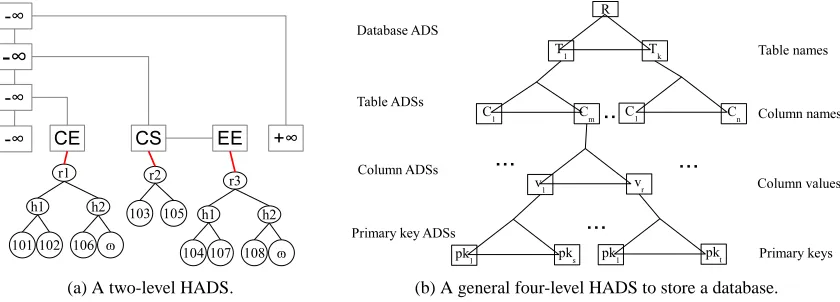
(a) A two-level HADS. (b) A general four-level HADS to store a database.
Figure 4: HADS constructions with different levels to store security information for a database.
database in Figure 1) using authenticated skip list and Merkle hash tree at the first and second levels, respectively. Similarly, Figure 4b shows a general four-level HADS architecture to store a database (the ADSs are represented as tree for simplicity, but they can be of any type as long as they can store digest of the corresponding lower level ADSs). An HADS scheme is an ADS scheme defined with three PPT algorithms(HKeyGen, HCertify, HVerify)to distinguish them from non-hierarchical ADSs. Definitions A.1, A.2, A.3, A.4 (using HADS algorithm names) provide a formal framework for HADS schemes.
3.1 HADS Construction
We construct an HADS using (possibly different) ADSs at multiple levels in a hierarchical structure. First, all lowest-level ADSs are constructed using the data (in the form of different groups). Then, these ADSs are divided into groups according to some relation, and their digests together with information about where they are stored and the data of the upper level, are used to build the upper-level ADSs. This process is followed until a single ADS is built whose root will be stored as metadata by the client.
To generate a membership proof, the client should provide the server with the required information directing the traversal on the HADS at all levels. In other words, the client tells the server which element(s) at each level should be looked for. The server follows down the HADS until the last level, generates and combines the proofs for all levels, and sends the resultant proof to the client. If ADSs with modification capabilities are used, a similar recursive strategy is employed for provable modification operations as well.
We provide the input as a set of(key,value) pairs in a way that the pairs needed for the upper levels appear first. The command execution will begin on the topmost ADS, and be directed by the input data customized to proper sub-ADSs at each level. A query command uses the keys, while a modification requires both the keys and values.
3.2 HADS Operations
TheHKeyGenalgorithm generates a public and private key pairs for each level, combines all public keys into pk, and all private keys into sk, and outputs the result as the private and public key pair of the HADS (Algorithm 3.1). Again, even though conceptually one may employ different ADS structures or use the same structure with different keys within the same level, to keep the presentation simple, we present as all ADSs at level i being of the same type and with the same key pair.
Algorithm 3.1:HKeyGen, run by the client.
Input: the security parameter k, no. of levels n, and the underlying structure of each level. Output: the private and public keys of the HADS
1 skHADS={}//private key of the HADS.
2 pkHADS={}//public key of the HADS. 3 for i = 1 to n do
4 (sk,pk) =ADSi.KeyGen(1k)//Ask level i ADS to produce its security keys.
5 skHADS=skHADS∪sk 6 pkHADS=pkHADS∪pk 7 return(skHADS,pkHADS)
Since the ADSs are tied together such that each leaf node of an ADS at level i stores a link to an ADS at level i+1, their proofs will be combined together according to their order in the hierarchy, as presented in Algorithm 3.2. The HADS proof contains all required ADS proofs. To simplify this operation, we use another PPT algorithm as a helper method to find the sub-ADSs of a given ADS:
Find(key,value)→({(ADS′,{(key′,value′)})}) This is used (inside HCertify) to interpret the input data and find the next level ADS(s) together with the related input value(s). It traverses the current ADS with the provided key(s) and finds the leaf node(s) storing address(es) of the ADS(s) at the next level to continue with. Finally, it outputs the set of next-level ADSs and their(key′,value′)pairs. Examples are given in Section 4.3.1.
Algorithm 3.2:HCertify, run by the server.
Input: the public key pk, the command cmd, the data given as a (key, value) pairs. Output: the generated proof
1 Pown={}// Proof of the current ADS.
2 Pchild={}// Proof of all children combined together. 3 {(ADS',{(key', value')})}= Find(key, value)
// Output is null if already at the bottommost level.
4 for each element e∈ {(ADS', (key', value'))}do
5 P=e.ADS′.HCertify(pk,cmd,e.(key′,value′))//Ask each child compute proof.
6 Pchild=Pchild|P// Combine the proofs.
7 Pown=Certify(pk,OP,(key,value))//Compute this ADS proof (not hierarchical).
8 return Pchild|Pown
TheHVerifyis also a recursive process that is run by the client to verify each level’s proof in a bottom-up manner. It first verifies the bottommost ADSs. If they are all accepted, then it uses their digests together with the proofs of the above-level ADSs to verify the level above, and so forth. Finally, when the upper-most level is reached and a single digest is obtained, which is verified against the local metadata.
4
Outsourced Database Scheme
4.1 Model
The outsourced database (ODB) model, as depicted in Figure 5, is composed of three parties: the data owner, the querier, and the service provider. The data owner performs the required pre-computations, uploads the database, and gives the querier(s) the security information she needs for verification. The data owner then may perform modifica-tions (insertion, deletion, or update) on the outsourced database.
Figure 5: The ODB model.
The service provider (or simply, the server) has the required equipment (software, hardware, and network resources) for storing and maintaining the database in a provable manner. We do not know or care about the internal structure of the server, i.e., the server may use some levels of replication and distribution to increase the performance and availability. The querier (or the user) issues a query to the server, who executes the query, computes the result set, generates the proof, and sends all back to the querier. The querier then verifies the answer using the security information given by the data owner. For the sake of a simpler presentation, we refer to them as the client. It is possible to have multiple queriers or data owners, and data owners can also act as queriers. In this paper, we focus on the single-client case.
We decouple the real data from the authentication information on the service provider. The DBMS is a regular database management system responsible for storing and updating the data, and executing the queries on the data and giving the answer back. The DBAS (database authentication system) stores the authentication information about the data, and generates the proofs to be sent to the client. Thus, a DBAS can be used together with any DBMS, and the focus of this work is to construct an efficient and secure DBAS. The DBMS and DBAS together constitute an ODB.
Adversarial Model. The remote server is not fully trusted: he can either act maliciously, or be subverted by
4.2 Definitions
An outsourced database requires certification and verification algorithms, similar to an ADS. Thus, the following definitions follow the same ideas. A corollary to this is that an ADS scheme can be employed to construct an ODB system (or vice versa).
Definition 4.1 An outsourced database scheme consists of three probabilistic polynomial-time algorithms
(OKeyGen, OCertify, OVerify) where:
• OKeyGen(1k)→(sk,pk): is a probabilistic algorithm run by the client to generate a pair of secret and public keys(sk,pk)given the security parameter k. She keeps both keys, and shares only the public key with the server. • OCertify(pk,cmd)→(ans,π): is run by the server to respond to a command cmd issued by the client. It produces an answer ans and a proofπthat proves authenticity of the answer. If the command is a modification command, the answer is empty, and the proof proves that the modification is done properly.
• OVerify(pk,sk,cmd,ans,π,st)→({accept,reject},st′): is run by the client upon receipt of the answer ans and proof π, to be verified using the public and private key pair. It outputs an ‘accept’ or ‘reject’ notification. If the command was a modification command and the verification result is ‘accept’, then, the client updates her local metadata as st′, according to the proof.
Definition 4.2 ODB security game. There are two parties playing this game: the challenger who acts as the client,
and the adversary who plays the role of the server.
Key generation The challenger generates the private and public key pair(sk,pk) usingOKeyGen. She keeps both keys locally, and sends the public key to the adversary.
Setup The adversary specifies a command cmd (either a query or a modification) together with an answer ans and
a proof π, and sends them to the challenger. The challenger runs the algorithmOVerify, and notifies the adversary about the result. If the command was a modification command, and the proof is accepted, then the challenger applies the changes on her local metadata. The adversary can repeat this interaction polynomially-many times. Let D be the database resulting from verified commands.
Challenge The adversary specifies a command cmd′, an answer ans′, and a proofπ′, and sends them to the challenger. He wins if the answer ans′is different from the result set of running cmd′on D, and cmd′,ans′,andπ′are verified as accepted by the challenger.
Definition 4.3 ODB Security. We say that an ODB scheme is secure if no PPT adversary can win the ODB security
game with non-negligible probability.
Note that the ODB security game covers all previously separate guarantees: correctness, completeness, and freshness. This is simply due to the fact that the game requires that no adversary can return a query answer together with a valid proof such that the returned answer is different from the answer that would have been produced by the actual database. If any one of the freshness, completeness, or correctness guarantees were to be invaded, the adversary would have won the game. Looking ahead, in our proofs, the challenger keeps a local copy of the database, and can detect whether or not the adversary succeeded. If he succeeds, our reduction shows that we break some underlying security assumption.
4.3 Generic ODB Construction
A generic way to construct an ODB is to employ a regular DBMS, together with a DBAS built using a number of ADSs. A common problem among all previous ODB schemes is the existence of duplicate values in non-PK columns, since making an ordered ADS (which is necessary for range queries) requires a total order on the data items. The existing solutions [6, 32, 19, 31] are not efficient (see Section 6.2). Our HADS solves the problem efficiently, and easily generates proofs for the answers to multi-dimensional queries.
If the query has a clause on a non-PK column, say coli, containing duplicate values, the result set of the query includes all records with the specified value(s) in coli. The way we can identify these records and compare them with the result set of the other clauses is to relate each record to its corresponding (unique) PK.
Note that the PK-set includes only the PK values, not the whole records. Any membership scheme can be used for assigning the PK-set to a non-PK value, regarding the client and server processing power, and communication requirements of the application under construction. The only difference is the type of corresponding proof that is generated by the server and verified by the client. This brings the flexibility to support multiple membership schemes, and select one based on the state of the system at that time (further discussed in Section 4.4). The PK-sets of distinct elements of columnmajorare shown in Figure 4a.
We construct the DBAS in the following way. Since all values in the PK column(s) are distinct, we use a regular (single-level) ordered ADS to store the corresponding security information, similar to the ones presented in the pre-vious work [30, 41]. An example ADS for storing the PK column of theStudenttable, using an authenticated skip list is presented in Figure 3a. For a non-PK column, for simplicity, a two-level HADS stores the security informa-tion: the distinct values are located at the first (upper) level (i.e., each duplicate value is stored exactly once), and the corresponding PK-sets of these values are located at the second (lower) level. A sample HADS for storing themajor column of theStudenttable is illustrated in Figure 4a. It uses an authenticated skip list at the first level, whose leaves are tied to Merkle hash tree digests at the second level.
The client locally stores the digests of the HADSs of each searchable column as metadata. Later, she checks the authenticity of server’s answers against these digests. This method requires the client to store digests in the number of searchable columns in the database. As an alternative design, the client can put the digests of searchable column of each table in another ADS (the table ADS), and on top of them make another ADS (the database ADS) just as in Figure 4b. Then, she needs to store only the digest of this new (four-level) HADS as metadata. One may further extend this idea to multiple databases a user owns, and then multiple users in a group, and so forth. By increasing the number of levels of the HADS, it is possible to always make sure the client stores a single digest. This presents a nice trade-off between the client storage and the proof-verification performance. For the sake of simple presentation, we will employ two-level HADS constructions.
Using the authenticated range query for proof generation ensures completeness. Freshness is provided through storing the digest(s) at the client side. To provide correctness (i.e., the horizontal proof [30]), we store the hash of the corresponding record, h(record), with each PK. In flat ADSs like the accumulator, the hash values are tied to the elements, while in tree-structured ADSs, the hash values are stored at the leaves. (The computation of values of the intermediate nodes, if there exists any, depends on the underlying structure of the ADS in use.) The ADS of the PK column of a table T is built using the set of all PK values and hashes of their records {(pki,h(recordi))}|iT=|1 as
(key, value) pairs. For a non-PK searchable column coljof a table T with d distinct values{vi}di=1, the corresponding HADS is constructed as follows: For each distinct vi ∈colj, a second-level ADS is built using the (key, value) pairs {(pks,h(records))}, where pks∈PK(vi). Then, a first-level ADS storing pairs {(vi,h(h(vi)|h(digest of the corresponding second-level ADS)))}is constructed.
The client outsources these (H)ADSs together with the database, while keeping their digests locally as metadata. Later, upon receipt of a proof and answer (result set), she performs the verification using the information provided in the proof and hashes of the records in the result set. If all records are used (to be discussed in Section 4.3.2) and the proofs verify according to the local digests, then the client accepts the proof and the answer.
We decouple the security information from the real data as Goodrich et al. [15] did. The DBAS stores the security information and generates proofs to be sent to the client. The DBMS stores the client’s data. They can reside both on the same machine, or on different machines. By using techniques in [30, 41, 4], it is possible to implement authenticated skip list or Merkle tree proofs of the DBAS using a DBMS as well. In such a case, the DBAS can share the same DBMS with the data, or use a separate DBMS. When the server receives a command, he relays it to both the DBMS and the DBAS, collects their responses, and forwards them to the client. We focus on the DBAS, since the DBMS has nothing to do with proof generation and authentication.
HADS proofs. The membership proofs of HADSs for non-PK columns consist of two parts: the first part proves
the (non-)existence of the unique value(s) in the column, and the second part ties each value to the respective PK-set. A key difference with a regular ADS is that after showing the existence of a value in the first-level ADS, all values in the related second-level ADS (storing the related PK-set) should be included without further computation, since they all share the same values in the queried column. This reduces both the proof size (communication) and proof generation time (server computation). However, the client verification cost for HADS is very close to ADS, since she needs to reconstruct the whole second-level ADS along with the membership path in the first-level ADS. For the ADS, the client reconstructs the whole sub-tree consisting of the values in the proof.
(a) Proof generation in an ADS after duplicate elimination. (b) Proof generation using HADS
Figure 6: A comparison of proof generation and proof sizes in an ADS and an HADS.
total. Using a duplicate elimination mechanism [6, 32, 19, 31], we can store such a table inside a regular ADS. The HADS builds a first-level ADS of size d, whose leaves are each connected to a second-level ADS of size r, leading to HADS size rd. Therefore, the server storage remains the same. However, for a query about a value viin Cj, the ADS proof size and proof generation time both are O(2 log rd+r) =O(log r+log d+r), while those of the HADS are both O(log d+r). The ADS uses a range query with 2O(log rd)cost, and processes the r values as the result set. However, the HADS finds vi at the first-level ADS with cost O(log d)and accesses all r values in the second-level ADS. This is presented in Figure 6 and further detailed in Section 4.3.2.
4.3.1 Illustrative Examples
We give some examples to better understand our construction.
Selection in a four-level HADS (Figure 4b). The DBAS first converts the query SELECT
* FROM Student WHERE major in(‘CE’,‘CS’) and BCity=‘Istanbul’ to (key, value) pairs: (Student,{(major,{CE,CS}),(BCity,{Istanbul})}). Then, it asks the HADS to generate and return the corresponding proof. The HADS runsHCertify. With the help of theFindalgorithm that decomposes the converted query into the proper parts and finds the next-level ADSs,HCertifyworks as follows: It asks the database ADS to give its proof, given the converted query. The database ADS, in turn, executes theFindalgorithm, which interprets the converted query and uses the keyStudentto find the next-level ADS. Then, the database ADS asks theStudent ADS to recursively give its proof, supplying it with the input{(major, {CE,CS}), (BCity, {Istanbul})}. Now, theStudent ADS, via theFind algorithm, finds two next-level ADSs: the major ADS and the BCity ADS, and asks them to give their proofs by providing the required inputs{CE,CS} and {Istanbul}, respectively. These two ADSs, working in parallel, repeat the same steps and find the last-level ADSs storing the PK-sets of valuesCE,CS, andIstanbul, and ask them to give their proofs. After receiving proofs from the last-level ADSs, themajorADS and theBCity ADS generate and add their own proofs, and relay the result back to theStudent ADS who will do the same job and send the result to the database ADS. The database ADS generates and adds its own proof and sends the resultant full proof to DBAS to hand on to the client.
Selection in a two-level HADS. Figure 7 presents another example showing the proof generation with a two-level
HADS, for the query SELECT * FROM Student WHERE major=‘CS’ and stdId=103, which is translated by the DBAS into ‘(Student,{(major, {CS}),(stdId, {103})})’. The first level is an authenticated skip list containing unique values of themajorcolumn, and the second level has three Merkle hash trees containingstdIdvalues match-ing eachmajorvalue (i.e., their PK-sets). The first-level ADS needs to prove membership of CS. This can be done by returning ‘h′1,CS,h(EE),h(+∞)’; essentially the result, together with the hashes of the nodes required to obtain the corresponding digest. At the second level, the Merkle tree needs to prove membership of103. This is done by returning ‘103,h(105)’. The generated verification object will look like: vo=‘h′1,CS(103,h(105)),h(EE),h(+∞)’. The client can verify both levels using this vo together with the hash of the records in the returned result.
ta-Figure 7: Proof generation forSELECT * FROM Student WHERE major=‘CS’ and stdId=103.
ble: INSERT INTO Student VALUE(109,‘Cem’,‘CE’,‘Izmir’). This adds the pair (109,h(record)), where h(record)=h(h(109)|h(‘Cem’)|h(‘CE’)|h(‘Izmir’)), into the ADS of the PK column. We further need to add (109,h(record)) to the second-level ADS associated with CE. Once this is done, since the digest of the CE ADS would be modified, we need to reflect this in the major ADS as well. Similarly, we need to construct a newIzmir ADS, containing only (109,h(record)), and add its digest to the BCity ADS. Therefore, using two-level HADS constructions, there will be three parts in the translated command: (109,h(record)) to be executed by the ADS of the PK column, (CE,(109,h(record))) for the major HADS, and (Izmir,(109,h(record))) for theBCity HADS. In a four-level HADS construction, the translated command looks like: (Student,{hstdId, (109,h(record))i,hmajor,(CE,(109,h(record)))i,hBCity,(Izmir,(109,h(record)))i}).
Verification. Verification is fulfilled similarly in a bottom-up manner. The client first verifies the PK-sets’ proofs.
If all are verified, it goes on to use them for verifying the column ADSs’ proofs. If this step also was successful, its results are used to verify proofs of the table ADSs (theStudent table, in our example). Finally, the database ADS proof is verified in a similar manner. If all proofs are verified employing all and only the records in the answer, then the client accepts the answer as authentic.
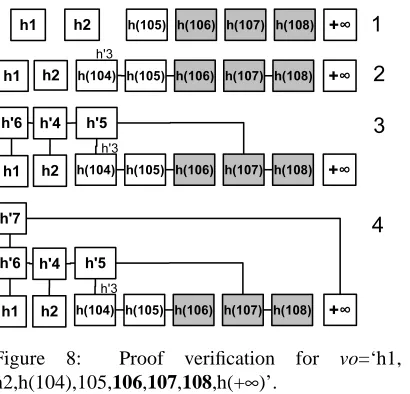
Figure 8: Proof verification for vo=‘h1, h2,h(104),105,106,107,108,h(+∞)’.
Since the verification is accomplished similarly at all levels, we give an example showing verification in the ADS of Figure 3b, where the proof vo=‘h1,h2,h(104),105,106,107,108,h(+∞)’ is given for the querySELECT * FROM Student WHERE StdID>105. The verifica-tion algorithm extracts the result set{106,107,108} and the bound-ary records{105,+∞}, and checks whether 105<106 <107<108<
+∞(step 1). If the check is passed, it uses h(104) to compute h′3 (step 2). In the step 3, it uses h′5 and h(107) to compute h′5, which is used together with h2 to compute h′4, which in turn, is used along with h1 to compute h′6. Finally, it uses h′6 and h(+∞) to computes h′7, the digest of the computed ADS. Now, it compares h′7 against the digest stored locally (h7). This process is illustrated visually in Figure 8. Note that, a full proof would also contain information about the levels of these nodes in a skip list, but those parts are hid-den for the sake of a simpler presentation. Thus, assume that the server also tells the client where to connect these nodes at in the proof.
4.3.2 Proof Generation
To provide details on how the DBAS generates proofs, we consider different cases where the query has only one clause, or multiple clauses. For each case we discuss how the proof is generated, and what is included in the proof.
One-dimensional queries: contain only one clause. There are two possible cases:
an example, using authenticated skip list as the underlying ADS, where the result set is (106, 107, 108), and the boundary records are 105 and+∞. The proof looks like: vo=‘h1,h2,h(104),105,106,107,108,+∞’.
• The clause is on a non-PK column: A sample query isSELECT * FROM Student WHERE major=‘CE’. The server uses the HADS of themajorcolumn to findCEat the first level. If not found, he puts the non-membership proof in vo. Otherwise, he puts the CE’s membership proof and all values in its PK-set (in the second-level ADS) in the vo. In contrast to storing duplicate-eliminated data in regular ADSs, the first-level ADS is very small, and all values in the second-level ADS are used without further computation. The proof will look like: vo=‘h(−∞),CE(101,102,106),h′5,h(+∞)’, using Figure 7.
Multi-dimensional queries: For each clause, the server asks the corresponding HADS to give its proof, collects
them into the verification object vo, and sends it to the client. Upon receipt, the client verifies all proofs one-by-one, and accepts if all are verified. If the clauses were connected by ‘OR’, then each proof verifies a subset of the received records, and the result set should be the union of all these verified records. For ‘AND’, each proof verifies a superset of records in the result set, and hence the answer is the intersection of results of the individual clauses. Therefore, each proof must verify all records in the result set. An important distinction between our HADS and previous schemes [7, 32, 28, 31] is that our proofs can be compared and combined together. Possible scenarios for two-clause case are: • One clause on the PK, the other on a non-PK column: For example, the query isSELECT * FROM Student WHERE StdID > 105 AND major = ‘CE’. Since the order in which the clauses are applied is not important for the proof, we can consider the non-PK clause first, then apply the PK clause on the results of the first step. Therefore, the server first applies the non-PK clause on the corresponding first-level ADS, and then, applies the PK clause on the resultant second-level ADSs. Finally, he adds them both to the vo, and sends it to the client. On Figure 7, this method produces the proof vo=‘h(-∞),CE(h(101),102,106),h′5,h(+∞)’.
• Both clauses on non-PK columns: A sample query isSELECT * FROM Student WHERE BCity=‘Istanbul’ AND major=‘CE’. The server generates one proof for each clause, each containing the first-level ADS proof for the value itself (e.g.,IstanbulandCE) and the corresponding PK-set, puts them into the vo, and sends it to the client. Each proof proves authenticity of a set of PK values (of the same table) that can be combined and compared together. If the clauses were connected by ‘AND’, the client only takes their intersection and checks whether the result set contains only records with these PKs. For ‘OR’, union of these authentic sets is used. The above process can be generalized to more than two clauses and supports any combination of ‘AND’, ‘OR’, and ‘NOT’ operators. The client verifies the proofs, performs a number of set operations on the resulting authentic sets of PKs, and compares them with the result set. Note that in all our proofs, we do not require any additional
records to be sent to the client on top of the result set of the original query.
4.3.3 Tables with Composite Keys
The foreign keys are used to relate the tables to each other, and hence some tables may employ composite keys (i.e., a PK includes multiple columns). This, in turn, makes the construction problematic: we cannot relate a non-PK column to any of the foreign key columns due to the existence of duplicate values (each foreign key column alone may contain duplicate values). Previous schemes [31, 42] that use regular ADSs cannot handle this case efficiently, as they need to construct and use multiple ADSs for each column.
Figure 9: Storing the columnMarkfrom tableS2Cwith composite PK (stdIdandcrsId).
4.4 Efficient ODB Construction
Different ADSs can be chosen for HADS levels subject to their requirements and the application. We employed two-level HADSs, with special role and considerations for each level. We compare the existing ADSs and investigate their eligibility to be used in each level. We consider three classes of ADSs: linear (e.g., one-way accumulator [1]), sublinear (e.g., authenticated hash tables [36]), and logarithmic (e.g., authenticated skip list [13, 10]).
For each level in an HADS, an ADS can be chosen subject to the requirements of that level and the application. We employed two-level HADSs, each level having a special role and posing special considerations. We compare the existing ADSs and investigate their eligibility to be used in each level. We consider three classes of ADSs: linear (e.g., one-way accumulator [1]), sublinear (e.g., authenticated hash tables [36]), and logarithmic (e.g., authenticated skip list [13, 10]).
First level. This level stores the distinct values of a column, and generates the first part of the proof to be sent
to the client. Proof generation is based on the authenticated range queries, which implies that this level should use an ordered ADS. One-way accumulator and hash tables do not support this property efficiently, and hence cannot be used for this level.
Therefore, we choose the authenticated skip list (alternatively, the Merkle hash tree) to be used in the first level. The proof time/space is O(log(|Ci|))for an update, and O(log(|Ci|) +t)for a query with O(t)records in the result set. There are|Ci|distinct values, on average, stored in the first-level ADS, therefore, the storage complexity is 2|Ci|, which is O(|Ci|).
Second level. This level stores the PK-sets of values in the first level. For one-dimensional queries, and
multi-dimensional queries connected with ‘OR’, the order of values in the PK-set is not a matter of importance, thus, any ADS can be used with time/space trade-offs discussed below. The second-level ADSs of multi-dimensional queries connected with ‘AND’ should be compared to generate efficient proofs, hence, an ordered ADS should be employed.
Accumulator. For each distinct value in a column, an accumulated value is computed using all values in its
PK-set. For each PK value, a witness is computed which proves that it belongs to the specified PK-set. If we need to select all PK values, the second-level proof is essentially empty, but to select a subset of the PK values (mostly required for ‘AND’), the witnesses of the selected PK values are required to be sent to the client.
For each distinct value in the first-level ADS, N/|Ci|PK values and witnesses should be computed and stored, on average, where N is the total number of records in the table. In total, 2|Ci|+|Ci| ∗N/|Ci|=2|Ci|+N (which is O(|Ci|+N)) storage is required (including the 2|Ci|space for the first-level ADS).
A proof for each value is made up of two parts, one for the first-level ADS (e.g., for authenticated skip list, a path from the leaf up to the root, which is O(log|Ci|)), and the other is the accumulated value along with all values in the PK-set, which is N/|Ci|(the accumulated value is already included in the hash value stored at the corresponding leaf of the first-level ADS). The client herself can check validity of the PK-set against the accumulated value. Therefore, for a result set of size t, the asymptotic size of vo will be O(log|Ci|) +2t≃O(log|Ci|+t).
The main problem with the accumulator is the cost of update: with each update, all witnesses should be updated using costly operations (e.g., modular exponentiation).
Authenticated hash table. This is a sublinear membership scheme with constant query and verification time,
making it an interesting scheme for clients with resource-constrained devices. It is a good choice if the data is static. For a leaf node storing vi, we put the PK-set of viin an authenticated hash table, and store its digest at the level above. On average, N/|Ci| PK values are linked to each leaf node, hence, we require O(|Ci|+ (1+ε)N/|Ci| ∗ |Ci|) = O(|Ci|+ (1+ε)N))≈O(|Ci|+N)storage (including the O(|Ci|)space for the first-level ADS). Here,εis a constant.
The first-level ADS proof is the same, but the authenticated hash table requires only constant proof size ε[35], reaching (O(log|Ci|) +t) for t records in the result set. Moreover, hash operations are much faster than modular exponentiations of the accumulator.
Merkle tree or authenticated 2-3 tree or authenticated skip list. These are logarithmic membership schemes
with logarithmic height and proof size. The way the second-level schemes are modified, or the proofs are generated, are the same as for the first-level.
Each node requires ≈2(N/|Ci|) storage to store the PK-set, therefore, 2|Ci|+2|Ci| ∗N/|Ci|=2(|Ci|+N) = O(|Ci|+N) storage is required to store a column. The proof size and time for one record are both O(log|Ci|+ log(N/|Ci|)) =O(log N), and for r=tN/|Ci|records are both O(log|Ci|+r).
Table 1: A comparison of schemes for the second level where the first level is a logarithmic ADS, for storing a single table. Proof size and verification time is given for one-dimensional queries. s and t denote the number of searchable columns, and the number of records in the first level, respectively.
Accumulator Authenticated hash table Storage 2N+ (s−1)(2|Ci|+2N) 2N+ (s−1)(2|Ci|+N) Proof size 2 log|Ci|+t+2tN/|Ci| 2 log|Ci|+t+2t∗N/|Ci| Verification time t(log|Ci|+N/|Ci|) t(log|Ci|+N/|Ci|) Update time log N+ (s−1)(log|Ci|+N/|Ci|) log N+ (s−1)(log|Ci|+N/|Ci|)
Authenticated skip list Storage 2N+ (s−1)(2|Ci|+2N) Proof size 2 log|Ci|+t+tN/|Ci| Verification time t(log|Ci|+2N/|Ci|)
Update time log N+ (s−1)(log|Ci|+log N/|Ci|) =s log N
skip list at both levels is the efficient choice leading to O(log|Ci|+r) proof size and time for r=tN/|Ci|records, and O(log N)update time for one record. Other alternatives can be chosen regarding the requirements of applications, such as the database being static or dynamic.
5
Join
In relational database systems, data is organized (divided) into a set of tables. An important and frequently-used operation is, therefore, the join operation, which collects data from two (or more) tables to produce new results. In outsourced databases, the server should perform the join and generate the proof that will be verified by the client. The server can utilize any existing optimal join algorithm, since we put no restriction on the DBMS part. Instead, we design our DBAS proof generation algorithms to produce efficient proofs minimizing the server’s effort, the communication, and the client’s computation.
5.1 Overview
Our join algorithms use HADSs for both (all) tables that are built on the columns on which the join is formed. Since the HADSs keep the same relationships between the (values of) tables they are created for, we can generate proofs proving correctness of those relations.
Without loss of generality, consider a one-to-many relationship, which is the most widely used relationship: R
⋊
⋉rid=rid S, i.e., the PK column ofR, rid, is used as a foreign key inS.Rcontains only distinct values in column rid, whileSmay contain duplicate values. The HADS ofSties each distinct value in rid to its respective PK-set inS. Now, we can easily compare the ADS ofRbuilt on rid with the first-level ADS of the HADS ofS(storing unique values) built on rid, and generate efficient proofs. (Note that only the first-level ADS of the HADS, which is very small in size, is used for comparison, and in case of any match, all values in the respective second-level ADS are reflected into the vo without further computation.) Besides, as the values are stored sorted, the server traverses each ADS only once.
Efficient proof generation. Compared to [18, 34] that for each value of the first table, perform a range query on
the second table, and [42] that uses range queries efficiently, ours is more efficient as it converts range queries into equalities for matches. The problem with [42] is that for each value in the first ADS, the set of matching values in the second ADS is surrounded by two more records, for completeness. Since we store and compare unique values in HADSs, a value in the first (H)ADS either matches only one value in the second (H)ADS that is shown by equality in vo, or does not match any value in the second (H)ADS that is shown using range queries. In addition, the first-level ADSs that we use for proof generation are very small compared to those of all previous work, reducing the proof size and proof generation time.
Other join types. The HADS, in addition to the equi-join, supports non-equi-join and multi-way join as well.
Although an inefficient way of doing a non-equi-join betweenRandSis performing a range query onSfor each record inR, our non-equi-join algorithm traverses each ADS only once, and is very efficient. Our algorithm for multi-way join queries can be generalized to support queries of the form T1⋊⋉a=aT2⋊⋉a=aT3⋊⋉a=a..., between n tables.
5.2 Two-way Join
Consider equi-join on two tables R and S represented as R⋊⋉C
i=Cj S, where Ci and Cj are columns of R and S,
Either Ci or Cj is a PK column that is used as foreign key in the other table. The generated vo is a set of PKs
that can be used for comparison or combining with other vo’s.
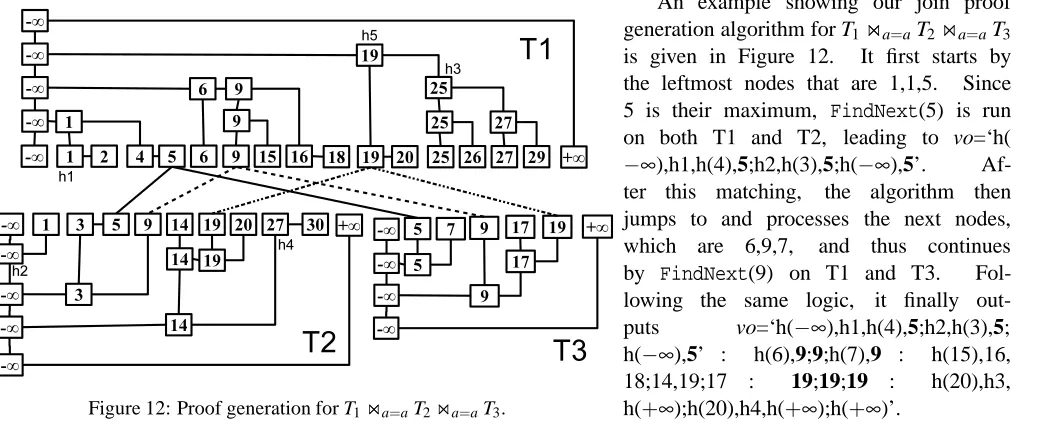
The server uses HADSR(Ci)and HADSS(Cj)for proof generation. He starts by the smallest item (e.g., leftmost leaf node in a tree or skip list type ADS) in the first-level ADS of one of the HADSs, and searches for its value, say vi, on the other HADS. If the value is found on the other HADS, both values are inserted into the vo showing a matching. Otherwise, the boundary records (the two consecutive values on the other HADS that vi would have been located between them), together with the vi, are inserted into the vo. This shows that vi has no matching on the other table. Once finished working on it, he jumps to the next expected node. By the expected node, we mean the item that either is immediately after the current node or stores the closest value to the current value of the other HADS. If the current and expected nodes are not successive, then the required intermediate information (e.g., for authenticated skip list, the levels and digests corresponding to a part of the ADS not included in the proof) needed for verifying the ADS by the client, will be added to the vo. We use the algorithmFindNextto find the expected node:
FindNext(vi)→(nodej,nodek) If vi is null, then return the node immediately following the current node as nodej (nodekwill be null). Given a value vi, if a node storing viis found, add the required information of the interme-diate nodes into the vo and return the node storing vi as nodej (nodek will be null again). Otherwise, add the needed information of the intermediate nodes into the vo and return the two consecutive boundary nodes nodej and nodek storing vjand vk, respectively, such that vj<vi<vk.
Consider the join Student ⋊⋉stdId=stdId S2C, where both tables have an HADS on column stdId:
HADSStudent(stdId) and HADSS2C(stdId). The proof generation works as follows: Traverse both HADSs until
the leftmost leaf node (at the first level) storing the values v1(in HADSStudent(stdId)) and v′1(in HADSS2C(stdId)):
• v1=v′1: Add them into the vo (showing a matching), run the FindNext() on both HADSs to find the next
values v2and v′2, and repeat the process with v2and v′2.
• v16=v′1: Add the larger value, say v1, into the vo and run HADSS2C(stdId).FindNext(v1)to find a matching
on HADSS2C(stdId). If it returns one node, a matching has been found, therefore, repeat the process with
v1 and the value of the matched node. On the other hand, if HADSS2C(stdId).FindNext(v1) returns two
nodes, say nodej and nodek, there is no matching, but the value of nodek may be equal to the value of the next node of v1. Therefore, add v1, nodej.val, and nodek.val into the vo, then find the node immediately after v1 as node2=HADSStudent(stdId).FindNext(), and repeat the process with node2.val, and nodek.val. The
Algorithm 5.1 illustrates this process.
Figure 10: HADS ofstdId(tableS2C).
Using HADSStudent(stdId) from Figure 3a and
HADSS2C(stdId) from Figure 10, we generate proof forStudent
⋊
⋉stdId=stdId S2C. For simple presentation, we put in the vo only
the values and hashes stored on nodes, and leave out the other infor-mation required for verification (e.g., the level in an authenticated skip list). Furthermore, we separate each round by a column ‘:’, parts belonging to each HADS inside a round by a semi-column ‘;’, and values inside each part by a comma ‘,’. Within a round, values of HADSStudent(stdId)appear first.
We start with the smallest values in the HADSs: v1=101 and
v′1 = 101. Since there is a matching, 101 is added into the vo (vo=‘101;101(501,502,504)’). Then, the FindNext() is run on both HADSs to find the next values: v2 =102
and v′2 =103. Since v′2 >v2, 103 is inserted into the vo and HADSStudent(stdId).FindNext(103) is executed
(during which h(102) will be added into the vo as an intermediate value, resulting in vo=‘101;101(501,502,504) : h(102);103(503,504)’), returning the node storing v3=103. Due to the matching, 103 is again added into the vo
(vo=‘101;101(501,502,504) : h(102),103;103(503,504)’), andFindNext() is run on both HADSs that will result in: v4=104 and v′3=106. Again, 106 is added into the vo and HADSStudent(stdId).FindNext(106)is executed
(dur-ing which h(104),h(105) will be added into the vo as intermediate values, resulting in vo=‘101;101(501,502,504) : h(102),103;103(503,504) : h(104),h(105);106(500,502,504)’), returning the node storing v6=106, to be added
into the vo due to the matching. Then, FindNext() is executed on both HADSs, which will give: v7 = 107
and v′4 =108. 108 will be added into vo and HADSStudent(stdId).FindNext(108) results in v8 =108.