© 2013, IJCSMC All Rights Reserved
310
RESEARCH ARTICLE
Comparative Study of Different CPU
Scheduling Algorithms
Miss. Jayashree S. Somani
1, Miss. Pooja K. Chhatwani
2¹
Information Technology Department, Dr. N. P. Hirani Institute of Polytechnic, Pusad, India
²
Information Technology Department, Dr. N. P. Hirani Institute of Polytechnic, Pusad, India
1
[email protected] ; 2 [email protected]
Abstract— In Multiprogramming operating system, CPU scheduling plays a very important role. CPU scheduling deals with the problem that to which process the CPU should be allocated. For scheduling the processes in different ways, there are many different scheduling algorithms.
This article deals with various scheduling algorithms like First-Come-First-Serve (FCFS) scheduling algorithm, Shortest Job First (SJF) scheduling algorithm, Priority scheduling algorithm, Round Robin (R-R) scheduling algorithm, Multilevel Queue scheduling algorithm and Multilevel Feedback Queue scheduling algorithm.
FCFS scheduling algorithm is based on First-in-first-out concept and is non-pre-emptive scheduling algorithm. It is generally suitable for batch systems. SJF scheduling algorithm can be either pre-emptive or non-pre-emptive and it is based on burst time of the processes. Priority scheduling algorithm is necessarily a form of pre-emptive scheduling algorithm and it is based on the priorities given to the processes. R-R scheduling algorithm is also a pre-emptive scheduling algorithm and is based on the given time-quantum. It is generally suitable for time sharing systems. In multilevel queue scheduling, when the process enters in the system, it is permanently assigned to a queue depending upon its nature. It is pre-emptive in nature. Multilevel feedback queue is also pre-emptive and it allows the processes to move between queues.
Keywords— Scheduling algorithm; First-Come-First-Serve scheduling; Shortest Job First scheduling; Priority scheduling; Round Robin scheduling; Multilevel Queue scheduling; Multilevel Feedback Queue scheduling
I. INTRODUCTION
© 2013, IJCSMC All Rights Reserved
311
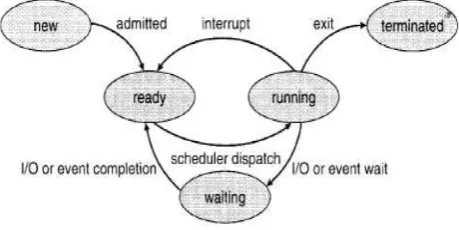
There are five states in which a process stay. These states are New, Ready, Run, Wait and Terminate. The Operating System helps in determining which process is allocated to CPU with the help of CPU schedulers. The algorithms concern with CPU schedulers is known as CPU Scheduling algorithms. Thus, scheduling is nothing but the arrangement of processes in ready queue such that the CPU utilization and throughput of the system is as maximum as possible.II. SCHEDULING CRITERIA
For judging the various scheduling algorithm, there are many scheduling criteria: A. CPU utilization
It keeps the CPU as busy as possible. It must have maximum value.
B. Throughput
The number of processes that complete their execution per unit of time. It must have maximum value. C. Turnaround time
It is the amount of time to execute a particular process. It must have minimum value.
D. Waiting time
It is the amount of time a process has been waiting in the ready queue or in the waiting state. It must have minimum value.
E. Response time
It is the time from the submission of the request until the first response is produced. It is the time it takes to start responding, not the time it takes to output the response.
III. SCHEDULING ALGORITHMS
Basically the scheduling algorithms are divided into two categories as Pre-emptive and Non-pre-emptive scheduling algorithms.
In non-pre-emptive, once the CPU has been allocated to a process, the process keeps the CPU until it releases the CPU either by terminating or switching to the waiting state.
In pre-emptive, CPU allocated to a process is switched if another process of higher priority is scheduled. In this case, the currently running process is interrupted and moved to the ready state by the operating system.
Following are the various scheduling algorithms:
A. First-Come- First- Serve (FCFS) Scheduling
© 2013, IJCSMC All Rights Reserved
312
Example:Processes Burst Time
P1 24 ms
P2 03 ms
P3 03 ms
Gantt chart:
Thus, average waiting time is 17 ms.
Advantages:
FCFS scheduling is simple to write and understand.
Disadvantages:
Average waiting time under FCFS policy is quite long.
May lead to poor overlap of I/O and CPU since CPU-bound processes will force I/O bound processes to wait for the CPU, leaving the I/O devices idle.
B. Shortest-Job-First(SJF) Scheduling
© 2013, IJCSMC All Rights Reserved
313
Example:Processes Burst Time
P1 24 ms
P2 03 ms
P3 03 ms
Gantt chart:
Thus, average waiting time is 03 ms.
Advantages:
Provably optimal with respect to minimizing the average waiting time
I/O bound jobs get priority over CPU bound jobs
Disadvantages:
If the shortest burst time processes are continuously adding in the ready queue, then long burst time processes will not get the CPU ever. This problem is called as “Starvation”.
Impossible to predict the amount of CPU time a job has left.
C. Priority Scheduling
© 2013, IJCSMC All Rights Reserved
314
Example:Processes Burst Time Priority
P1 24 ms 02
P2 03 ms 01
P3 03 ms 03
Gantt chart:
Thus, average waiting time is 10 ms.
Advantages:
It provides relative importance to each process by providing priorities to them.
Disadvantages:
If high priority processes are always available in the queue, then low priority processes do not get the CPU ever. This problem is called as “Starvation”.
D. Round-Robin(RR) Scheduling
Round robin scheduling is a pre-emptive version of first-come, first-served scheduling. Processes are dispatched in a first-in-first-out sequence but each process is allowed to run for only a limited amount of time. This time interval is known as a time-slice or time quantum. In this, the ready queue is treated as the circular queue.
© 2013, IJCSMC All Rights Reserved
315
Example:Processes Burst Time
P1 24 ms
P2 03 ms
P3 03 ms
Time quantum=04 ms.
Gantt chart:
Thus, average waiting time is 5.66 ms.
Advantages:
Round robin scheduling is fair in that every process gets an equal share of the CPU.
It overcomes the problem of Starvation.
Disadvantages:
Average waiting time can be bad.
Giving every process an equal share of the CPU is not always a good idea. For instance, highly interactive
processes will get scheduled no more frequently than CPU-bound processes.
E. Multilevel Queue Scheduling
The processes can be classified into different groups depending upon their situation. For example, the common division between processes is foreground processes and background processes. Foreground processes are interactive processes and background processes are batch processes. These types of processes have different response-time requirements and scheduling needs. Also, foreground processes have priority over background processes.
© 2013, IJCSMC All Rights Reserved
316
Also, there must be scheduling among the queues which are implemented on the basis of:1) Fixed-priority pre-emptive scheduling: In this, each queue has absolute priority over lower priority queue.
Let’s take an example of five queues listed below in the order of priority as shown in fig 6 above:
System processes
Interactive processes Interactive editing processes
Batch processes
Student Processes
In this, no process in the lower priority queues could run unless all the higher priority queues were empty. So, in our example, if the interactive editing process entered in the ready queue while a batch process was running, then the batch process would be pre-empted. In this, there is a possibility of starvation.
2) Time-slice among the queues: Here, each queue gets a certain portion of CPU time, which it can then schedule among its various processes. By considering our example, the foreground queue can be given 80% of the CPU time for R-R scheduling among its processes, whereas the background queue receives 20% of the CPU time for FCFS scheduling among its processes.
F. Multilevel Feedback Queue Scheduling
In multilevel queue scheduling, the processes are permanently assigned to a queue when they enter in the system. But, multilevel feedback queue allows the processes to move between the queues. In this, the processes are categorized according to their CPU bursts.
The lower priority queue contains the process that uses too much CPU time.
The I/O-bound and interactive processes are kept in the higher priority queue.
If the process waits too long in a lower-priority queue, then it may be moved to a higher-priority queue. Thus, the multilevel feedback queue scheduling prevents starvation.
© 2013, IJCSMC All Rights Reserved
317
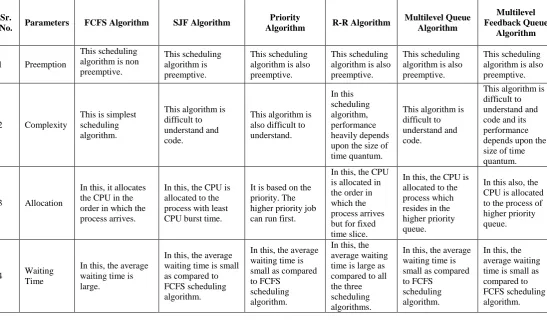
COMPARISON OF VARIOUS SCHEDULING ALGORITHMSSr.
No. Parameters FCFS Algorithm SJF Algorithm
Priority
Algorithm R-R Algorithm
Multilevel Queue Algorithm
Multilevel Feedback Queue
Algorithm
1 Preemption
This scheduling algorithm is non preemptive.
This scheduling algorithm is preemptive.
This scheduling algorithm is also preemptive.
This scheduling algorithm is also preemptive.
This scheduling algorithm is also preemptive.
This scheduling algorithm is also preemptive.
2 Complexity
This is simplest scheduling algorithm.
This algorithm is difficult to understand and code.
This algorithm is also difficult to understand. In this scheduling algorithm, performance heavily depends upon the size of time quantum.
This algorithm is difficult to understand and code.
This algorithm is difficult to understand and code and its performance depends upon the size of time quantum.
3 Allocation
In this, it allocates the CPU in the order in which the process arrives.
In this, the CPU is allocated to the process with least CPU burst time.
It is based on the priority. The higher priority job can run first.
In this, the CPU is allocated in the order in which the process arrives but for fixed time slice.
In this, the CPU is allocated to the process which resides in the higher priority queue.
In this also, the CPU is allocated to the process of higher priority queue.
4 Waiting Time
In this, the average waiting time is large.
In this, the average waiting time is small as compared to FCFS scheduling algorithm.
In this, the average waiting time is small as compared to FCFS
scheduling algorithm.
In this, the average waiting time is large as compared to all the three scheduling algorithms.
In this, the average waiting time is small as compared to FCFS
scheduling algorithm.
In this, the average waiting time is small as compared to FCFS scheduling algorithm.
V. CONCLUSION
© 2013, IJCSMC All Rights Reserved
318
[6] D. M. Dhamdhere, “Operating Systems: A Concept Based Approach”, Second edition, Tata McGraw-Hill, 2006.[7] Vikram Singh, Tirlok Gabba, “Comparative Study of Processes Scheduling Algorithms Using
Simulator”, IJCBR, Volume 4 Issue 2 May 2013
[8] Zafril Rizal M Azmi, Kamalrulnizam Abu Bakar, Abdul Hanan Abdullah, Mohd Shahir Shamsir, Wan Nurulsafawati Wan Manan, “Performance Comparison of Priority Rule Scheduling Algorithms Using Different Inter Arrival Time Jobs in Grid environment”, International Journal of Grid and Distributed Computing, Vol. 4, No. 3, September, 2011
[9] Halim Zaim, “Design of a Scheduler Comparison of Different Scheduling Algorithm”, Vol. 3, No. 2 May2003.