5 January 1978
l;.1
English EditionEuropean Communities
EUROPEAN PARLIAMENT
Working Documents
1977 -1978
DOCUMENT 454/77·
Report
drawn up on behalf of the Committee on Economic and Monetary Affairs
on the communication from the Commission of the European Communities to
the Council (Ooc. 246/77) concerning aftion programme for aeronautical
research
Rapporteur: Mr G.
..
CARPENTIERBy letter of 18 August 1977, the President of the Council of the
European Communities requested the European Parliament, pursuant to
Article 235 of the EEC Treaty, to deliver an opinion on the proposal
from the Commission of the European Communities to the Council concerning an action programme for aeronautical research.
The President of the European Parliament referred this proposal
to the committee on Economic and Monetary Affairs as the canmittee
responsible and to the Committee on Energy and Research and the
committee on Budgets for their opinions.
On 21 September 1977 the Committee on Economic and Monetary
Affairs appointed Mr Carpentier rapporteur.
It considered this proposal at its meeting of 1 December 1977.
At the same meeting the canmittee adopted the motion for a resolution unanimously.
Present: Sir Brandon Rhys-Williams, acting chairman; Mr Notenboom,
vice-chairman; Mr Carpentier, rapporteur; Lord Ardwick, Mrs Dahlerup, Mr Dalyell (deputizing for Lord Bruce of Donington), Mr Haase, Mr Lange,
Mr Normanton, Mr Ripamonti, Mr Spinelli and Mr Stetter.
'I'he opinions of the Committee on Energy and Research and the committee on Budgets are attached.
CONTENTS
A. MOTION FOR A RESOLUTION ..
...
·
...
5B. EXPLANJ\TORY STATEMENT
.
...
7Opinion of tha Committee on Energy and Research •••
11
Opinion of the Committee on Budgets
...
16
A
The Committee on Economic and Monetary Affairs hereby submits to
the European Parliament the following motion for a resolution, together
with explanatory statement:
MOTION FOR A RESOLUTION
embodying the opinion of the European Parliament on a communication
from the Commission of the European Communities to the Council concerning an action programme for aeronautical research
The European Parliament,
h1wing ro9ard Lo the proposal from the Commission of the European
CommuniUes to the Council (COM(77) 362 final),
having been consulted by the Council pursuant to Article 235 of
the EEC Treaty (Doc. 246/77),
having regard to the report of the Committee on Economic and
Monetary Affairs and the opinions of the Committee on Energy
•
and Research and the Committee on Budgets (Doc. 454/77),
1. confirms the need for a common policy for the aeronautical industry
so as to ensure the independence and competitiveness on the
international market of this sector, which is a source of technical
progress and provider of employment;
2. considers that a multiannual action programme for research must be
implemented in this sector at Community level, particularly in the
light of likely technological developments and the growing pace
of research and development in the United states:
3. considers that the action programme put forward by the Commission
fulfils the criteria of effectiveness and minimum cost needed to
justify it at community level;
4. Points out, however, that the figures given in the programme are only
a rough guide and that it is for the budgetary authority to decide each
year what funds are required to enable this programme to be pursued on
a multiannual basis;
5. Calls on the Commission to ensure that, as regards the implementation of research contracts, its choice of undertakings satisfies the
conditions of fai.r canpeti tion as between equally qualified contender I irmn i11 Uw Mombor. S1.at.e11;
6. (a) Urges the Council to take a decision as soon as possible on the action prograrrune for the European aeronautical sector which was put forward by the Commission on 3 October 1975, as the first step towards a genuine common aeronautical policy:
(b) Awaits the report announced by the Commission1 on the intentions of the Member States and the companies concerned so that the common policy for the aeronautical sector can develop along the most practical lines possible;
7. Approves therefore the provisions of the action programme for aeronautical research submitted by the Commission and expects the Council, pursuant to its declaration of 14 March 1977, to adopt the relevant decisions as soon as possible •
•
1 Report of proceedings, January 1977 - OJ No. 211, p.139
B
EXPLANATORY STATEMENT
1. During the debate on an oral question tabled by Mr Guldberg on behalf of the Conunittee on Economic and Monetary Affairs on 13 January
1
1977, the European Parliament called on the Commission to submit as soon as possible, pursuant to the entry in the 1977 budget, at the request of the European Parliament, of a relevant appropriation of
8 mu.a., a detailed proposal for basic research in the aeronautical
industry. The action programme for aeronautical research contained in
the Commission's conununication to the Council of 26 July 1977 (Doc. 246/77)
meets this request.
I. OBJECTIVES OF THE ACTION PROGRAMME FOR AERONAUTICAL RESEARCH
2. The Commission's action progranune makes reference to the Action
Progranune for the European Aeronautical Sector, submitted by the
conunission on 3 October 1975, and to its communication on the objectives of a common research and development policy of 3 November 1975. Moreover, the council of Ministers, in its declaration of 14 March 19772, fixed certain industrial policy objectives in the aeronautical sector,
including that of exploring the opportunities and procedures for a joint
effort in technological research.
The first phase of the Conunission's programme comprises immediate
research activities in two sectors. The following objectives are
proposed with regard to helicopters:
- fuel economy through improvements in aerodynamic efficiency of rotors
and fuselage;
nuisance reduction by research on external noise produced by helicopters;
- improvement of operational safety by studies on materials behaviour;
- widening the operational scope for helicopters.
1Report of proceedings - OJ No. 211 of January 1977, p. 132 2oJ No. c 69 of 19 March 1977
In the airframe sector research and development would concern increasing structural life of airframes and reducing maintenance costs.
3. The Commission's proposals for immediate research activities thus correspond to the two primary categories of objectives laid down in its common programme for certain areas of technological research, i.e. the short and medium-term projects, for which there is a need to extend and improve present technologies with a view to perfecting the products in question, aircraft or components, by improvements in direct operating costs and nuisance reduction.
The second phase of this action programme for research may comprise activities in the aircraft engines and equipment sector, as well as research infrastructure in the aeronautical sector. In this connection the programme refers to the construction in Europe of a large transsonic wind tunnel which would enable experiments to be carried out in conditions approaching the sound barrier. This will involve basic research involving a high economic risk, because there can be no guarantee that the research results can ever be put to use. In the specific case of the transsonic wind tunnel, the costs and the problems of operation and unilization are particular justifications for Community rather than national aid.
The Commission plans to submit its proposal to the Council on this question during 1978.
The Committee on Economic and Monetary Affairs fully approves the principle of developing aeronautical research at Community level because what is at stake is the international competitiveness of the European aeronautical industry and its technical independence, particularly with the prospect of the emergence of a new generation of aircraft in the 1980's.
II. IMPLEMENTATION OF THE ACTION PROGRAMME
The procedures for implementing the action programme call for the following remarks:
(a) cooperation between undertakings in the Member States
4. As regards research in the helicopter sector, the action programme
refers to an agreement of June 1975 signed by the four European helicopter manufacturers with the aim of more closely coordinating
their activities in the development of transport helicopters and advanced
technology.
Research in this field has already begun, but, as the Commission points out1 'current effort in this field may well be insufficient in
comparison to the increased pace of research and development in the
United States'. The Commission's action programme thus aims at
encouraging such Community collaboration as has already taken place by,
inter alia, associating research institutes in this effort.
5. In the airframes sector, the Commission's document points out that 'each research project will be undertaken by a group of manufacturers,
with one acting as project leader, and will be set up in such a way as
to involve participation by research establishments•2•
Moreover, the action programme includes a proposal for a decision setting up, for the duration of the progra~e, a consultative committee
for the management and coordination of the research programmes, consisting
of two representatives from each Member State plus two members to be
appointed by the Colllll\ission. The duties of this committee will be, in
particulur, to assist the Commission in the choice of the firms or
organiz-ation8 to which the work is to be entrusted, the choice of project directors
and the evaluation of the results of the work at each stage of the programme,
6. In this connection, the Commission must do all in its power to ensure that the research and development contracts are not awarded solely to firms
from certain Member States and that strict conditione regarding fair
competition are applied to interested undertakings and any subcontractors from all Member States,
I
TJo,·. 246/77, Annex I, p. 1
/.
Doc. 24(,/"/7, Annox II, p. 1
Annex IV of the document contains provisions concerning the
safeguarding of industrial know-how and inventions. The granting of
licences to exploit inventions, if such licences enable products or
equipment manufactured in a third country to be imported into the
Community, are to be·subject to the prior authorization of the Commission.
Moreover, when selecting contractors, the Community is to accord priority
to those having concluded or having agreed to conclude between themselves
an agreement on the joint exploitation of inventions and know-how1•
(b) Financing of the programme
7. One of the prime considerations for the Committee on Economic and
Monetary Affairs is the quality of the projects and their suitability for
meeting the real needs of potential customers. In this connection, the
fact that the industry would contribute 20% towards total financing of
the programme constitutes, as the Commission points out2, an additional
guarantee as regards the expected quality and efficiency of the research
programmes. Moreover, at least as regards the helicopter sector, the
Commission's action programme merely constitutes the extension of research
activities already being undertaken at the initiative of the European manufacturers themselves.
The total Community contribution to the various programmes would anount
to 36.7 mu.a., comprising 14.7 mu.a. in the helicopter sector and 22 mu.a. in the airframe sector. This expenditure would be spread over
five years (1977-1981). The Committee on Economic and Monetary Affairs
fully endorses a Community programme which replaces national aid, the
duplication and overall inefficiency of which it has frequently condemned.
Finally, pursuant to Articie 3 of the proposal for a decision3, the European Parliament and the Scientific and Technical Research Committee
(CREST) are to be kept informed about the programme's implementation.
The programme as a whole therefore deserves approval, and it is to be
hoped that the Council will adopt it as soon as possible so that the
activities proposed in it can get under way within the time limits laid down.
1
246/77, Annex IV, 1 and 2
Doc. pp.
2
246/77, 4
Doc. IV, p.
3
246/77, Annex V, 2
Doc. p.
OPINION OF THE COMMITTEE ON ENERGY AND RESEARCH
Draftsman: Lord BESSBOROUGH
On 28 September 1977 the Committee on Energy and Research appointed
Lord BESSBOROUGH draftsman.
It considered the draft opinion at its meeting of 20 October 1977
and adopted it unanimously by 10 votes.
Present: Mrs Walz, chairman; Mr Flamig, vice-chairman; Lord Bessborough,
draftsman; Mr Covelli, Mr Edwards, Mr Fuchs, Mr Mitchell (deputizing for
Mr Lczzi), Mr Osborn, Mr Vandewiele (deputizing for Mr H.W. Maller) and
Mr Vanvelthoven.
INTRODUCTION
1. This communication from the Commission to the council for an action
programme concerning aeronautical research is based partly on the commission's
'Action Programme for the European Aeronautical Sector' (1975), and partly
on the communcation entitled 'Common Research and Development Policy
-Objectives, Priorities and Resources' (1975). In March 1977 the council fixed certain industrial policy objectives in the aeronautical sector,
including 'exploring the opportunities and procedures for a joint effort (in technological research) particularly with a view to ••• the future
generation of aircraft ••• (and) ••• improved use of the facilities and capabilities of Member States•1.
2. In collaboration with the parties conce~ned in the aeronautical sector (the industry, government experts and research institutions), and taking the
above programmes as a basis, the Commission has established the following research objectives:
the development of a strategy and a procedure for preparing
future measures;
- the adoption of a number of measures which could be implemented immediately.
3. The Committee on Energy and Research has the task of assessing the content of the action programme from an industrial policy angle. It will
assess how far the research policy guidelines set for the action programme
correspond to the general objectives of the Community's research and
development policy. In a previous report the Committee on Energy and Research dealt with general objectives and resources for research2•
II. FUTURE MEASURES/LONG-TERM STRATEGY
4. In its document the Commission states that the preparation of the
programme 'has demonstrated the need to agree on a systematic procedure to cover collaborative activities and studies, bringing together representatives of the Commission, governmental authorities~ industry, research centres and
users, •..•• the objectives of which would be to institute ••••••
investig-ations into the aircraft industry's technological objectives and the
nec-essary ~ ,3 I
1
coM (77) 162 final, p.l
2
see Mr KIU RG 's report (Doc. 71/76, on the objectives, priorities and
resources for a common research and development policy)
3
coM (77) 362 final, p.3
5. If the necessity of defining clear objectives is a new insight on the
part of the Commission, as this quotation would seem to indicate, it is
gratifying that they have realised it. This committee has said repeatedly
that, in the absence of clear aims and clear and objective criteria for
achieving them, action in any area whatsoever can only result in fragmented
and disjointed research projects, something to be avoided at all costs.
6. It is therefore most gratifying to see that the commission intends to
establish a consultative committee for ae~onautical research (under CREST). The committee's terms of reference:
- to define technological objectives for aeronautical
research over the next decade based on requirements and
the constraints which social trends may impose:
- to investigate to what extent the existing national
research programmes are orientated towards the
objectives:
- to define methods of linking national and community
action:
- to lay down methods of finance and implementing
provisions (best use of resources).
7. ·rhese are clear terms of reference, which the committee can endorse.
Thus at least they make possible a clear research policy, although perhaps
confined to very limited areas of the aeronautical industry. At any rate
the initial stage under the proposal for immediate action will certainly
affect a very small part of the European aircraft industry.
8. An earlier report by the committee stressed that 'the absence of a
common industrial policy handicaps the implementation and further consolidation of a research policy, especially in the area of advanced technology•1•
Although there is still no common industrial policy, the committee considers
that the proposal for a long-term strategy may lead to clarification of
some components of a general industrial policy, and must therefore be
welcomed. However, it needs to be continually stressed that the best basis
for research and development policy is an overall system of objectives Eor industrial research programmes. On the other hand, the committee welcomes the
commission's practical approach, and its intention to initiate action in
areas where a basis for wider cooperation exists as indicated by its proposal
for immediate action. This meets another requirement to which the committee has frequently pointed for the optimum use of research facilities which can
best be achieved by coordination of current action.
1
KRIEG report, Doc. 71/76, motion for a resolution, paras 5 and 8.
III. THE PROPOSAL FOR IMMEDIATE ACTION
a. Objectives
9. On the basis of existing collaboration within the Community, or where
such collaboration seems desirable, the Commission proposes a five-year
research programme (1977-81) in the following fields:
- techological research in the helicopter manufacturing
sector
- technological research in the airframe manufacturing
sector.
10. In its choice of research areas which the committee welcomes
-the commission has selected areas not only where there is existing
collabor-ation and which have to bear heavy research and development costs, and where
there is strong competition, particularly from the USA, but also under the
community's general sectoral policy objectives (or aspects of them), that is
to say:
b.
- energy -saving/ protection of the environment/ safety
(helicopter programme):
- safety (airframe manufacture programme)
Implementation
11. For the two areas of research, the Commission has drawn up well-defined guidelines for each subject to be studied. These subjects were
chosen in cooperation after discussion with the parties concerned and on
the basis of research selection criteria, the importance of which has repeat-edly been stressed by the committee:
- subject sufficiently large to exceed the capabilities of any single firm:
- commercial motivation:
- general interest for all firms:
- sufficient fleJQibility for adaptation to available funding:
- possible participation by research institutions.
12. The subjects were therefore selected on the basis of objective criteria which are both the heart of, and the argument for Community cooperation.
13. The commission action programme also includes detailed descriptions of the various research subjects. The committee does not intend to go into technical detail, but would merely point out that each brief includes both
the objective of the research and a clear outline of the work to be carried
out.
The committee sees this as evidence of a precise conception of the
course of the programme, which seems to give some guarantee of a positive
result, as well as providing a yardstick for the planned review of the
programme at about its half-way stage.
J4. '!'he commission is to ensure the implementation of the programme,
assb1l cd by a consultative commitcee for management and coordination. ·rhis commiLLee, sel up under the research programme, will consist of two represent-atives from each Member State plus two members appointed by the Commission.
Article 4 of the draft Couneil decision setting up this consultative
committee reads: 'The Member States and the Commission will consult
together, through the committee, with a view to promoting coordination of their programmes ••.•• '. The Committee on Energy and Research considers it
absolutely vital that the parties concerned faithfully observe this provision,
which is fundamental to the Community programme.
IV. CONCLUSION
15. From the foregoing it is clear that the committee on Energy and Research
supports this proposal for an action programme for aeronautical research.
Although the Community regrettably has no common industrial policy, the planned
long-term strategy may prove valuable in establishing objectives for one aspect
of industrial policy.
16. The committee has always stressed the need for clear aims and objective.
criteria for selection and execution in respect of any research programme.
It is glad to note that the commission's action programme satisfied this
elementary requirement. Only in this way can we expect best use to be made
of the available facilities, but it must be repeated that all parties concerned
must comply with the provisions on coordination: a successful outcome and
the prospects for further community action to assist the European aeronautical
industry depend on it.
--
....···
OPINION OF THE COMMITTEE ON BUDGETS
Draftsman: Mr S. ALBER
On 21 September 1977 the Committee on Budgets appointed Mr ALBER
draftsman.
At its meeting of 24/25 November 1977 i t considered the draft opinion
and adopted i t unanimously.
Present: Mr Lange, chairman; Mr Alber, draftsman: Lord Bessborough,
Lord Bruce of Donington, Mr L'Estrange, Mr Notenboom, Mr Schreiber, Mr Shaw
and Mr Spinelli.
I. PRELIMINARY COMMENTS
1. This communication from the commission contains two progranmes and sets
of measures relating to aeronautical research and is based on the action
programme for the European aeronautical sector proposed by the commission
on 1 October 1975 (COM(75) 475 final).
2. The original action programme put forward by the commission met with
the approval of the European Parliament (Doc. 203/76), although attention
was drawn to the need to put the programme into concrete form after an
appropriate decision in principle had been taken by the Council on a
common policy for the aeronautical sector.
3. A declaration by the Council of the European Communities of 14 March
19771 specified further industrial policy objectives in the aeronautical sector.
4. The present proposal for two Council decisions is intended to be a
first step towards putting this agreed policy into practice.
II. FINANCIAL IMPLICATIONS
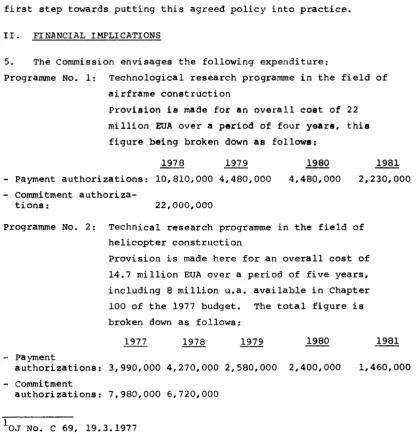
5. The Commission envisages the following expenditure:
Programme No. 1: Technological research programme in the field of
airframe construction
Provision is made for an overall cost of 22 million EUA over a period of four years, this
figure being broken down as follows:
- Payment authorizations: 10,810,000 4,480,000
1980 4,480,000
1981 2,230,000
- Commitment
authoriza-tions: 22,000,000
Programme No. 2: Technical research programme in the field of helicopter construction
- Payment
Provision is made here for an overall cost of
14.7 million EUA over a period of five years,
including 8 million u.a. available in Chapter
100 of the 1977 budget. The total figure is
broken down as follows:
1977 1981
authorizations: 3,990,000 4,270,000 2,580,000 2,400,000 1,460,000
- Commitment
authorizations: 7,980,000 6,720,000
1
OJ No. C 69, 19.3.1977
[image:19.562.63.481.329.764.2]6. Despite the fact that these programmes still need to be translated into proposals and detailed, individual decisions, our committee cannot, at this present juncture, accept these cost estimates, since neither the explanatory memorandum nor the annexes thereto contain a detailed analysis of the figures that are presented. In fact, the Commission has provided no data on any of these measures to justify the expenditure which i t has proposed.
III. SUPPLEMENTARY INFORMATION
7. The draftsman of this opinion asked the Commission to supply details of the following as requested earlier by the Committee on Budgets in its interim opinion on the original action programme (Doc. 319/75):
l. the annual budgetary provision over a four to five year period for the basic and applied research and development programme and the basic research progranune;
2. the other elements of finance envisaged (contributions or investments from Member States and from the industry);
B. the way in which these funds would be managed;
4. for the part to be charged to the Community budget, the means of covering extra Community expenditure;
(
5. for the part to be raised on the Community's capital markets, the means of including this amount within the Community budget so as to ensure adequate control by the budgetary authority;
6. any administrative expenditure involved;
7. the estimated reduction in national expenditure which would result from the Community assuming certain financial responsibilities.
8. The Commission's present proposal gives full information on points 1, 8 and 6 only.
On the other points the Commission supplied the following information: Point 2·
It is envisaged that 80% of the costs will be financed as non-repayable grants from the Community budget and 20"~ borne by the contracting parties.
Points 4 and 5:
Since the present research programme will involve only grants from the
Community budget, the question of extra expenditure or of raising funds on the capital markets does not arise.
P0int 7:
The Commission was able to confirm that the financial contribution from the Community should result in a corresponding reduction in national expenditure, but i t was not able to give any figures.
IV. CONCLUSIONS
9. Now that these questions have been answered, the Committee on Budgets
can endorse the action programme proposed by the Commission, while emphasising, however, that the figures provided in the programme can only serve as a rough
guide. It points out that the budgetary authority alone can decide each year
what funds are required for the implementation of this programme.