
Hard exclusive wide-angle processes
Peter KrollUniversit¨at Wuppertal, Fachbereich Physik, D-42097 Wuppertal, Germany
Abstract. In this talk the handbag approach to hard exclusive wide-angle processes is reviewed and applications, as for instance two-photon annihilations into pairs of mesons, are discussed.
1 Handbag factorization
Factorization properties of QCD allow us to calculate exclusive processes provided a hard scale is available, either the three Mandelstam variables s,−t,−u are large as compared to a typical hadronic scaleΛ2whereΛis of order 1 GeV (wide-angle processes) or there is a highly virtual photon involved (deeply virtual processes). In the space-like region typical hard processes are real and virtual Compton scattering or photo- and electroproduction of mesons. In these cases the process amplitudes factorize in a hard partonic subprocess (e.g.γ(∗)q
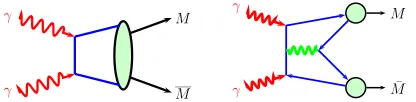
→ γq) and in soft hadronic matrix elements parameterized as generalized parton distributions (GPDs). For time-like processes, e.g. two-photon annihilations into pairs of hadrons, an analogous factorization scheme holds [1–5]. In this case the soft hadronic matrix elements are so-called two-hadron distribution amplitudes, time-like versions of GPDs, see Fig. 1.
One may consider more complicated topologies than shown in Fig. 1 in which n partons are emit-ted and reabsorbed from the hadrons. In order to have quasi-on-shell partons entering the hadrons, a compelling requirement for factorization, n−1 hard gluons are needed to be exchanged between the n active partons. For very large−t and−u one may treat the hadrons in valence quark approximation. Considering for instanceγγ→ MM with an active quark-antiquark pair (n=2). In this case there is no spectator left and, hence, the soft physics is encoded in two meson distribution amplitudes instead of a time-like GPD. This is an example of the so-called ERBL factorization scheme which has been invented forγγ→M ¯M in [6].
The arguments for factorization ofγγ → MM in the wide-angle region have been given in [2]. For the ease of legibility let M be charged pion; the generalization to other pseudoscalar mesons is straightforward. It is of advantage to work in a symmetric (c.m.) frame in which the pions move along the 1-axis. The light-cone plus components of the meson momenta, p and p′, are then equal: p+=p′+
and the skewness, defined byζ=p+/(p++p′+), is 1/2. The momentum fraction of the active quark is as usual defined by z=k+/(p++p′+); the momenta fraction of the antiquark is ¯z=1−z. In order to achieve the factorization in a hard processγγ→q ¯q and a soft transition q ¯q→π+π−, two assumptions
are made in [2]: i) restricted transverse momenta, k⊥i/zi ∼Λ2, for the active partons as well for the spectators, and ii) all virtualities at the parton-hadron vertices are soft of orderΛ2. With the help of these assumptions one can show that the following requirements must hold:
2z−1, sinϕ∼Λ2/s (1)
whereϕdescribes the orientation of the active parton momenta in the 1–2 plane. The second require-ment has two solutions
ϕ≃0 : k≃p, k′≃p′ ϕ≃π: k≃p′, k′≃p (2)
EPJ Web of Conferences DOI: 10.1051/
C
Owned by the authors, published by EDP Sciences, 2012 ,
epjconf 20123/
01019 (2012)
37
701019
γ
γ
M
M
γ
γ
M
¯
M
Fig. 1. Two-photon annihilation in a meson pair within the handbag approach (left) and within the ERBL
factor-ization scheme (right).
One can then derive a factorization formula for the helicity amplitudes
Aµµ′=−
X
q (eeq)2
Z d4k
√
k+k′+Hµµ′(k,k
′) S (k,k′)+axial current term (3)
where due to charge conjugation invariance
S (k,k′)=−S (k′,k), H(k,k′)=−H(k′,k). (4) The soft matrix element S (k,k′) is expected to be strongly peaked when (1) is fulfilled. The two regions k ∼ p and k ∼ p′ where this is the case are related through a rotation byπabout the 3-axis of our coordinate frame. The hard scattering kernelHcan be Taylor expanded around the 1-axis and z=1/2
H±∓=2
p
u/t−pt/u
−(z−¯z)(s/t+u/t) +O
(z−¯z)2, ϕ2
, (5)
where the labels denote the helicities of the photons (H±±=0). In terms of the c.m. scattering angle,
θ, the first term in (5) is proportional to 1/sinθwhile the second one is∝ 1/sin2θ. It can then be shown [2] that for theπ+π−channel the first term in this expansion vanishes due to a conspiracy of charge conjugation and rotation byϕ=π. Keeping therefore only the second term in (5) and perform the integrals in (3) one arrives at
A+−=A−+=−4παelm s2
tuR2π(s), (6)
where the annihilation form factors encoding the soft physics, is defined by
R2π(s)=
X
q=u,d,s
e2qRq2π(s), Rq2π(s)=1 2
Z 1
0
dz (2z−1)Φq2π(z, ζ=1/2,s). (7)
Here, Φq2π is the two-pion distribution amplitude [1] defined as the Fourier transform of a bilocal vacuum-two-pion matrix element of quark field operators. This distribution amplitude also determines the electromagnetic form factor of the pion in the time-like region
Fπ(s)=euFπu(s)+edFπd(s), F q π(s)=
Z 1
0
dzΦq2π(z, ζ=1/2,s). (8)
The energy dependences of the annihilation and electromagnetic form factors are not predicted in the handbag approach.
is set by real Compton scattering in the space-like region [7]. The regions k+ > 0 (γq → γq) and k+<0 (γ¯q
→γ¯q) are related by charge conjugation but not by a rotation.
The above handbag result for theππchannel can easily be generalized to the production of other pairs of pseudoscalar mesons. The corresponding differential cross section reads
dσ
dt(γγ→MM)= 8παelm
s2 1 sin4θ
RMM(s)
2
. (9)
There are six pseudoscalar meson channels available in two-photon annihilations including altogether 18 annihilation form factors. To fix these form factors from experiment is a boring program. However, due to flavor symmetry (the meson pair couples to an U-spin singlet) and due to the absence of isospin 2 (and V-spin 2) states (because the two photons annihilate via a quark-antiquark intermediate state) there are only two independent annihilation form factors, say Ru
2πand R s
2π, or, in other words, a valence and a non-valence form factor. The combinations of the individual flavor contributions appearing in the various channels read in terms of the two independent form factors
Rπ+π− =Rπ0π0 =RK+K− =
5 9R
u 2π+
1 9R
s 2π,
RK0K0 =
2 9R
u 2π+
4 9R
s
2π, Rηπ0 =
1 3√3
(Ru2π−Rs2π), Rηη= 1 3(R
u 2π+R
s
2π). (10) In addition there are a number of relations and triangular inequalities among the cross sections.
2 Results on
γγ
→
MM
The BELLE collaboration has measured the wide-angle cross sections for the six pseudoscalar meson channels up to fairly large energies [8–12]. The data are compatible with a 1/sin4θ behavior for s > 9 GeV2. Given that fact one has only to deal with the form factors or the respective integrated cross sections. It turns out that the inequalities and relations following from flavor symmetry and isospin selection rules are satisfied within errors in general. From (10) and from the statistical factor to be applied to the integrated cross section for identical particles it follows that the ratio of theπ0π0and
π+π−is predicted to be 1/2 in the handbag approach. The data shown in Fig. 2 clearly deviate from 1/2 at low s but seem to approach this value for s ≥9 GeV2 within rapidly growing errors. A small I=2 admixture which may vanish for s→ ∞, can easily explain the deviation from 1/2. Assuming for example that the I = 2 and I = 0 amplitudes are in phase then an admixtureAI=2 < 0.11
AI=0 is sufficient to explain the observed deviation. Thus, the dominance of the I = 0 amplitude is fully consistent with experiment for large s. In Fig. 2 the ratio of theππcombination 1/3(σ(γγ→π0π0)+
σ(γγ → π+π−)) and the K+K−cross sections are shown and can be seen to be compatible with 1 according to the handbag approach, see (10). Note that in the above combination ofππcross sections the interference term between the I=2 and I=0 cancels.
For a few values of the energy the two basic form factors as well as their relative phase,ρ, can directly be extracted from the data on, say, K+K−, K0K¯0andηπ0production. Alternatively, in order to reduce errors, one may perform a combined energy-dependent fit. This fit provides
s|Ru2π|=1.37 GeV2
s
0 s
0.42
s|R2sπ|=0.50 GeV2
s
0 s
1.22
ρ=π
1+tanh 0.63 GeV 2
s−6.0 GeV2
(11)
(s0=9 GeV2). The energy dependencies of the other channels (π+π−,π0π0,ηη) are then fixed in agree-ment with experiagree-ment. The relative phase varies rapidly in the charmonium region and approachesπ
b b b b b b b b b b b b b b b b b
5 10 15 20
0 0.1 0.2 0.3 0.4 0.5 0.6 0.7
s[GeV2
]
σ
(
π
0π 0)/σ
( π +π −) b bb b bb b b b b b b b b b b b
5 10 15 20
0 0.2 0.4 0.6 0.8 1.0 1.2
s[GeV2
]
Rππ
RK+K−
r s r s r s r s r s r s r
s rs
r s r r r r r r r r r b c b c b c b c b c b c b c b c b c b c 0 10 20 30 40 50
5 10 15 20
s[GeV2]
s 3σ [n b Ge V 6]
KSKS ηη ηπ0
Fig. 2. Left: Cross section ratio of neutral and charged pion pair production. Data taken from [9]. Mid: Ratio ofππ
and K+K−annihilation form factors. Data taken from [8]. Right: Data [10–12] and predictions for various cross
sections integrated over|cosθ| ≤0.6. Dashed lines: fit withη−η′mixing is taken into account.
the valence and non-valence form factors. Charged pions and Kaons have the smallest contributions from the non-valence form factor. Therefore, their integrated cross sections drop only slightly faster then s−3. On the other hand, the K0K¯0(=2K
SKS) cross section falls offrapidly with energy because of the relative strong contribution from the non-valence form factor in this case. This is in agreement with experiment as can be seen from Tab. 1 where the effective powers of s obtained by BELLE from fitsσ∝s−neff to its data are shown.
The process of interest has also been investigated in the ERBL factorization scheme [6, 13]. In this approach the mesons are treated in valence quark approximation and the amplitudes are given by a convolution of the distribution amplitudes for the mesons and a hard scattering kernel
A ∼ fM1fM2
Z
dxΦM1(x)
Z
dy ΦM2(y)T (x, y,s, θ) (12)
where fMi is the decay constant of meson Mi. As for the handbag approach the cross section behaves
as 1/sin4θbut its energy dependence is predicted to beσ ∝ s−3, cf. Tab. 1. While this is in rough agreement with experiment for charged mesons the magnitude of the corresponding cross section is underestimated when it is evaluated from a distribution amplitude that is close to the asymptotic form, 6x(1− x) which is favored by current phenomenology and lattice results [14]. The production of neutral meson pairs is generically suppressed, since at leading order ofαsthe bulk of the amplitude is proportional to a charge factor (eq1−eq2)
2for a meson with quark content q1¯q2[6]. Explicit calculations [6, 13] yield values below 0.05 for the ratio ofπ0π0andπ+π−cross sections which is significantly below the experimental results shown in Fig. 2. Because of charge factors the ratio of KSKS and K+K−cross sections is predicted to be even smaller. Despite this suppression of the neutral meson pairs the energy dependencies of the corresponding cross sections is∝ s−3 which is also in conflict with experiment, see Tab. 1. For these reasons it was suggested in [13] that at BELLE energies the production of neutral meson pairs is dominated by a contribution other then the the ERBL mechanism but a quantitative study of the new contribution is lacking.
π+π− K+K− π0π0 ηη ηπ0 K
SKS
neff= 4.0(0.2)(0.7) 3.7(0.2)(0.7) 4.0(0.2)(0.2) 3.9(0.3)(0.2) 5.3(0.6)(0.3) 5.3(0.3)(0.2)
|cosθ|< 0.6 0.6 0.8 0.8 0.8 0.6
3 Other two-photon processes
The meson case can be straightforwardly generalized to the production of baryon-antibaryon pairs. An important difference is that the cross section behaves∝1/sin2θas has been discussed at the of Sect. 1 (see also (5)). Due to the baryon spin there are four GPDs and hence, four form factors of which one decouples in the symmetric frame. Thus, the differential cross section for the production of a BB reads [3]
dσ
dt(γγ→BB)= 4παelm s6sin2θ
s
2Reff
BB
2
+cos2θ s
2RV BB
2
, (13)
where
Reff BB=
r
R
A BB+R
P BB
2 + s
4m2
R
P BB
2
(14) The axial and the pseudoscalar form factors can be disentangled with polarization measurements. As for the meson case (see (7)) each form factor is a sum of individual flavor form factors ( i=V,A,P)
Ri BB=
X
q=u,d,s e2qFiq
BB, F
iq
BB(s)=
Z 1
0 dzΦiq
BB(z,1/2,s), (15) whereΦiq
BBis a baryon-antibaryon distribution amplitude. For comparison the magnetic form factor of the proton reads
GMp = X q=u,d,s
e2qFp ¯pVq, (16)
In Fig. 3 the BELLE data [15] onγγ→ p ¯p are compared to the handbag results [16]. The effective and the vector form factors are parameterized analogously to (11) and the parameters fitted to the data. From Fig. 3 one sees that the data are nicely compatible with a 1/sin2θbehavior. The energy dependence of the form factors is s−3.1, i.e. the integrated cross section falls offas s−7.2at large s. Note that in the ERBL approach the cross section behaves∝s−5.
As for the case of mesons one can show that due to the absence of I =V =2 states and U-spin symmetry there are only three independent flavor form factors for the ground state baryon channels for which one may take the ones for the proton-antiproton channel, Fp ¯piq. The quality of the present data [17, 18] necessitates a simplifying assumption
ρd=Fp ¯pid/F iu
p ¯p, ρs=Fp ¯pis/F iu
p ¯p, (17)
which leads to
σ(γγ→BB)=r2Bσ(γγ→ p ¯p), (18)
with
rΛ=− 3 2
1+2ρd+ρs 4+ρd+ρs
, rΣ0 =−
1 2
5+2ρd+5ρs 4+ρd+ρs
. (19)
A fit to the data [17, 18] provides the results shown in Fig. 3 (ρd =0.75,ρs =−4.1 GeV2/s). Similar results are obtained for theΛΛchannel.
Due to time-reversal invariance the amplitudes forγγ→ p ¯p and p ¯p → γγare the same up to a phase. This offers the opportunity for the FAIR project to study also handbag physics in the wide-angle region. In addition to p ¯p→γγone may study the photon-meson channels. Their amplitudes are still under control of the basic form factors Fp ¯piq. Thus, for instance, for theγπ0channel the annihilation form factors read [16] (i=V,A,P)
Rπi0=
1 eu
√
2
1−ed/euρd 1+(ed/eu)2ρd+(es/eu)2ρs
Rp ¯pi . (20)
b
b b
b b
b
0 0.1 0.2 0.3 0.4 0.5 0.6
0 0.02 0.04 0.06 0.08 0.10 0.12
|cosθ|
n
b
•BELLE
dσ d|cosθ|(γγ→pp¯)
3.0<√s <4.0 GeV
bbbbbbbbbbb bbb
bbbbbb bbbb
bbb bbb
bb bbb
bbbb b
b b
b b
b b b
b b
s 7:2
s 5
2.0 2.4 2.8 3.2 3.6 4.0
p
s[GeV℄
n
b
BELLE
(!pp)
10
1
10 1
10 2
10 3
b c
b c
b c
b c bb
b b
b
b b
b
b
2.0 2.4 √2.8 3.2 3.6 4.0
s[GeV]
σ
(
γ
γ
→
Σ
0¯ Σ 0)
[n
b
] BELLE (•)
L3 (◦) 10
1
10−1
10−2
10−3
Fig. 3. The differential (left) and integrated (mid) cross sections for p ¯p production. Data taken from [15]. Blue solid lines represent the handbag results [16]. Right: Integrated cross section forΣ0Σ0. The data from [17, 18] are
compared to the handbag result.
4 Summary
The basic ideas of the handbag approach for wide-angle scattering are reviewed and applications to several time-like processes such as two-photon annihilations into pairs of mesons or baryon-antibaryons, are discussed. It turns out that this approach seems to work quite well for energies larger than about 3 GeV. Data at higher energies are highly welcome in order to have a clean suppression of subleading terms. In the near future proton-antiproton annihilations into two photons or photon-meson can be measured at FAIR. Such data in combination withγγ→ BB measurements performed at BELLE II would allow for a detailed investigation of the proton-antiproton distribution amplitudes.
Acknowledgement The author wishes to thank the organizers of the MESON 2012 workshop for
inviting him to present this talk.
References
1. M. Diehl, T. Gousset, B. Pire and O. Teryaev, Phys. Rev. Lett. 81, (1998) 1782. 2. M. Diehl, P. Kroll and C. Vogt, Phys. Lett. B 532, (2002) 99.
3. M. Diehl, P. Kroll and C. Vogt, Eur. Phys. J. C 26, (2003) 567.
4. A. Freund, A. V. Radyushkin, A. Schafer and C. Weiss, Phys. Rev. Lett. 90, (2003) 092001. 5. M. Diehl and P. Kroll, Phys. Lett. B 683, (2010) 165.
6. S. J. Brodsky and G. P. Lepage, Phys. Rev. D 24, (1981) 1808.
7. M. Diehl, T. Feldmann, R. Jakob and P. Kroll, Eur. Phys. J. C 8, (1999) 409. 8. H. Nakazawa et al. [BELLE Collaboration], Phys. Lett. B 615, (2005) 39. 9. S. Uehara et al. [BELLE Collaboration], Phys. Rev. D 79, (2009) 052009. 10. W. T. Chen et al. [Belle Collaboration], Phys. Lett. B 651, (2007) 15. 11. S. Uehara et al. [Belle Collaboration], Phys. Rev. D 80, (2009) 032001. 12. S. Uehara et al. [Belle Collaboration], Phys. Rev. D 82, (2010) 114031. 13. V. L. Chernyak, Chin. Phys. C 34, (2010) 822.
14. V. M. Braun et al., Phys. Rev. D 74, (2006) 074501.
15. C. -C. Kuo et al. [Belle Collaboration], Phys. Lett. B 621, (2005) 41. 16. P. Kroll and A. Sch¨afer, Eur. Phys. J. A 26, (2005) 89.
17. K. Abe et al. [Belle Collaboration], hep-ex/0609048.
18. P. Achard et al. [L3 Collaboration], Phys. Lett. B 536, (2002) 24.
![Fig. 2. Left: Cross section ratio of neutral and charged pion pair production. Data taken from [9]](https://thumb-us.123doks.com/thumbv2/123dok_us/8071072.1346150/4.482.44.438.586.641/left-cross-section-ratio-neutral-charged-production-data.webp)
![Fig. 3. The disolid lines represent the handbag results [16]. Right: Integrated cross section forfferential (left) and integrated (mid) cross sections for p ¯p production](https://thumb-us.123doks.com/thumbv2/123dok_us/8071072.1346150/6.482.49.434.54.158/disolid-represent-integrated-section-forerential-integrated-sections-production.webp)
