© 2013, IJCSMC All Rights Reserved 146 Available Online at www.ijcsmc.com
International Journal of Computer Science and Mobile Computing
A Monthly Journal of Computer Science and Information Technology
ISSN 2320–088X
IJCSMC, Vol. 2, Issue. 9, September 2013, pg.146 – 152
RESEARCH ARTICLE
A Comprehensive Study on Fast Image
Dehazing Techniques
Elisée A KPONOU1, Zhengning Wang2, Liping Li3
¹Electronic Engineering & UESTC, China ²Electronic Engineering & UESTC, China ³Electronic Engineering & UESTC, China
1
Abstract—Image dehazing refers to procedures that attempt to remove the haze amount in a hazy image and grant the degraded image an overall sharpened appearance to obtain a clearer visibility and smooth image. In this paper, we studied various fast dehazing techniques like Tan’s dehazing method, Fattal’s dehazing method and Kaiming He et al, dehazing method. Among these methods the Dark Channel Prior (DCP) proposed by He et al, is one of the most essential method used to perform this task. The usage of the DCP to remove haze from an image is explained and a comparison between the DCP and other dehazing method was made in order to make clear people’s mind on the best dehazing method. We applied the DCP on two hundred images and experimental results show that the DCP is better than other dehazing method. This work comes to confirm that the DCP algorithm still and remain the best dehazing method of the century.
Keywords— Image dehazing; bad visibility; Dark Channel Prior; Transmission map
I. INTRODUCTION
© 2013, IJCSMC All Rights Reserved 147 MRF (Markov Random Field) to refine the transmission. He et al, recovered a high-quality haze-free image and good transmission map [2,13].
In this paper, we proposed a comprehensive study on fast image dehazing techniques. The results of the experiment confirm that He et al method is much faster than the previous dehazing method.
The rest of this paper is organized as follows. Section 2 and 3 introduce haze image formation and dehazing techniques, respectively. Section 4 presents a huge experimental results of the dark channel prior proposed by He et al. Comparisons with other dehazing method and conclusions are included in sections 5and 6.
II. HAZYIMAGEFORMATION
Under bad weather such as fog, haze, mist or smog, the contrast and the color of the images are drastically reduced. In computer vision, the equation below is usually used to describe the formation of a foggy or hazy image [1,2,13,19].
( ) ( ) ( ) (1 ( ))
I x J x t x A t x (1) Where I(x) is the hazy image, J(x) is the reconstructed hazy free image, A is the air light [2,13] t(x) is the transmission. The transmission t(x) is known as the portion of light which does not scattered and reached the camera. It is also the portion of light which survive and reaches the camera.
III.FASTDEHAZINGTECHNIQUES
The quality of image taken under bad visibility is always degraded by the presence of fog, haze, smog or mist. Since the atmosphere was affected the contrast of the image is greatly reduced. Dehazing is the process of removing haze from a captured image. During the past decade many researchers have devoted on the problem of how to obtain high quality dehazed image. This section probes into several dehazing methods.
A. Tan’s method
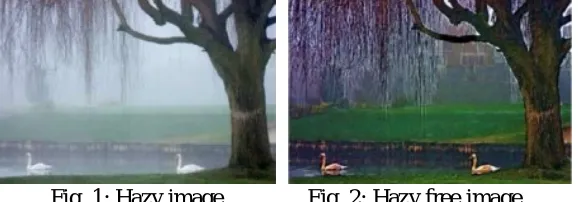
Tan uses the contrast maximization techniques to remove haze from an image. He assumes that a dehazed image must have a high contrast. Tan’s single image dehazing method is mostly based on two basic observations: On the one hand, the images taken under a clear weather are always with enhanced visibility and high color contrast than those taken under bad visibility like foggy weather. On the other hand, airlight whose variation mainly depends on the distance of objects to the viewer tends to be smooth. Based on these two observations and the assumption that neighboring pixels suffered from the same degradation, Tan removes the haze by maximizing the local contrast of the restored image. This method does not intend to fully recover the scene’s original colors. Its purpose is to only enhance the contrast of an input image. This method only over-saturates the image visibility. Unfortunately this approach is physically invalid and makes Tan’s dehazing image lacks color fidelity. Fig. 1 is a haze image and Fig. 2 is its corresponding dehazing result by using Tan’s method. In Fig. 2, we can clearly see the color of the image is over-saturated and the color of the swan after dehazing become red instead of white. This is in contrast with the reality. Tan’s method suffers from color fidelity.
© 2013, IJCSMC All Rights Reserved 148
B. Fattal’s method
Fattal considers that the shading and transmission signals are uncorrelated. Based on this assumption, the airlight-albedo ambiguity can also be resolved. He used Independent Component Analysis (ICA) to estimate the transmission, and then deduct the color of the whole image by Markov Random Field (MRF). The method performs quite well for haze, but declines with scenes involving fog. This method is physically valid and capable to restore the contrasts of complex hazy scene. Moreover, since this method does not assume the haze layer to be smooth, the discontinuities in the scene depth or medium thickness are permitted. This assumption is sometime violated when the shading and transmission signals are correlated and deliver a poor dehazing result. From the Fig. 4 we can see that the dehazing result of Fattal’s method is not very good and some hazes are still not be removed, especially in the thick haze region (rounded by light red lines).
Fig. 3: Hazy image Fig. 4: Hazy free image
C. The Dark Channel Prior
He et al in 2009 rely on the blackbody radiation use dark channel prior approach to remove haze from an image. The blackbody theory can be understood as a theoretical object that absorbs 100% of the radiation that hits it and reflects no radiation and appears perfectly black. Namely in this case, such image’s pixels are called dark pixel and their value must be very close to zero. In hazy images, the intensity of these dark pixels in that channel is mainly contributed by the air light. These dark pixels can directly provide an accurate estimation of the haze transmission. In the DCP approach soft matting method instead of MRF (Markov Random Field) is used to refine the transmission map. He et al, approach is physically valid and is able to perform with distant objects in heavily hazy images. Like any approach using a strong assumption, their approach also has its own limitation. This assumption sometime can not perform well when there is no black body in some local patches. In another way, the dark channel prior is invalid when the scene object is intrinsically the same with the air light (e.g. snowy ground or a white wall) over a large local region and no shadow is cast on it. Although their approach works well for most outdoor hazy images, but it fail on some extreme cases. This is a profitable situation because in such situations haze removal is not critical since haze is rarely visible.
D. Dark Channel Prior theory
In this section we deal with DCP algorithm. The dark channel prior is the observation that a non hazy image at least one color has very low intensity at some pixels for most of non-sky region. The dark channel prior an image J is expressed underneath in equation (4).
( ) ( ) ( ) (1 ( ))
I x J x t x A t x A is always positive and greater than zero, and then we can divide the above equation by A.
( ) ( ) ( )
(1 ( ))
I x J x t x
t x
A A (2)
© 2013, IJCSMC All Rights Reserved 149
0
( ) ( )
max( '( ), )
I x A
J x A
t x t
(3)
The DCP is given by [2,19]:
( ) ( , , ) ( ) min ( min ( ))
dark c
y x c r g b
J x J y
(4)
( , , ) ( ) ( , , ) ( ) ( , , ) ( )
( ) ( ) ( )
min min ( ) min min min min (1 ( )))
c c c
c r g b y x c r g b y x c r g b y x
I y J y J y
t x t x
A A A
(5)
( , , ) ( ) ( )
min min 0
c
c r g b y x J y A (6) ( , , ) ( ) ( )
min min 1 ( )
c
c r g b y x
I y t x A
(7)
( , , ) ( ) ( ) ( ) 1 min min
c
c r g b y x I y t x A
(8)
Where t is the transmission map.
Fig. 5: Hazy image Fig. 6: Hazy free image
The Fig. 5 and Fig. 6 above are respectively the input hazy image and the output hazy fee image. The result is very encouraging.
IV.EXPERIMENTALRESULTSFAST
In our experiments, the DCP algorithm was implemented using Matlab 7.10.0 (R2010a) on Windows 7, CPU 2.5 GHz Core IM 3 processor, 4GB system memory, 64 bits ordinary pc. We first conducted the experiment on several tests images (Tian an men, Hong Kong…). To further validate the validity of the DCP we took many outdoor images and we simulate haze by using equation above (1). We then remove the artificial haze by using the DCP proposed by He at al. The experimental results are shown in Fig. 8 underneath.
© 2013, IJCSMC All Rights Reserved 150 (a) (b) (c) (d)
Fig: 7. shows the experiment result using the two image test
© 2013, IJCSMC All Rights Reserved 151 Fig: 8 shows several dehazing results
V. COMPARISONBETWEENDIFFERENTTECHNIQUES
In this section, an overall comparison of the fast dehazing techniques in terms of the number of arithmetic operations, computation time, dehazing in case of haze existence, and the accuracy of the DCP algorithm will be stated. The DCP algorithm is quite simple, very accurate and so easy to implement. It is very fast and gives a better result than other dehazing algorithms. From the stated facts in the pictures above, it is clear that the DCP proposed by He et al, gives the best result and lowest execution time. It brings highest results in a lowest execution time even with the image degraded with dense haze. But its drawback is it performs poorly when the haze is very heavy especially in the sky region. Fattal dehazing method performs near He’s method when haze is light while Tan method declines slightly.
VI.CONCLUSIONS
To sum up, this paper presents a comprehensive study on fast image dehazing techniques. Likewise, this paper has proved that the DCP algorithms work efficiently even when haze is dense. It only one drawback is the sky region. The DCP fails to remove haze in the sky region. Any way it doesn’t matter because the sky region is already like a haze which is a profitable situation. In terms of hazy image, the DCP algorithm is a better solution because it is very fast, accurate and easy to implement. Moreover, experiment results also confirm that DCP algorithm is suitable choice.
ACKNOWLEDGMENT
This work is supported by National Natural Science Foundation of China “No. 61179060 & 61139003” and by the Fundamental Research Funds for the Central Universities “No. ZYGX2012J019”.
REFERENCES
[1] Xingyong Lv,Wenbin Chen,I-fan Shen “Real-time Dehazing for Image and Video” 18th Pacific Conference on Computer Graphics and Applications, pp.62-69, 2010
[2] Kaiming He, Jian Sun and Xiaoou Tang , “ Single Image Haze Removal Using Dark Channel Prior”, IEEE Transactions on Pattern Analysis and Machine Intelligence, Volume33, Issue12 ,December 2011
[3] R. Fattal. “Single image dehazing”. In SIGGRAPH, pages 1–9(2008).
[4] Soowoong Jeong and Sangkeun Lee, “The Single Image Dehazing based on Efficient Transmission Estimation” IEEE International Conference on Consumer Electronics (ICCE), pp.376-377, 2013
[5] Sun Wei, Han Long, “A New Fast Single-Image Defog Algorithm” IEEE Third International Conference on Intelligent System Design and Engineering Applications, pp.116-119, 2013
© 2013, IJCSMC All Rights Reserved 152 [7] Haocheng Wen,Yonghong Tian, Tiejun Huang, Wen Gao “Single Underwater Image Enhancement with
a New Optical Model” IEEE Transactions on Image Processing, pp. 753-756
[8] Xuan Jin, Zhi-yong Xu “Speed-up single image dehazing using double dark channels” Fifth International Conference on Digital Image Processing (ICDIP 2013)
[9] Xingyong Lv,Wenbin Chen,I-fan Shen “Real-time Dehazing for Image and Video” 18th Pacific Conference on Computer Graphics and Applications, pp.62-69, 2010
[10] R. Fattal. “Single image dehazing”. In SIGGRAPH, pages 1–9(2008).
[11] Robby T.Tan, “Visibility in Bad Weather from a single Image”, Proc. IEEE Conference. Computer Vision and Pattern Recognition, June 2008
[12] Kristofor B. Gibson, V, Truong Q. Nguyen, “An investigation of Dehazing effects on image and Video Coding” IEEE Transactions on Image Processing, vol. 21, issue 2, pp. 662-673, February 2012
[13] Jin-Hwan Kim, Won-Dong Jang, Jae-Young Sim, Chang-Su Kim, “Optimized contrast enhancement for real-time image and video dehazing ” J. Vis. Commun. Image R. 24 pp.410–425, 2013
[14] Gangyi Wang, Guanghui Ren, Lihui and Taifan Quan, “ Single Image Dehazing Algorithm Based on Sky Region Segmentation” Information and Technology journal, vol:12(6) pp. 1168-1175, 2013
[15] Hongying Zhang, Qiaolin Liu, Fan Yang, Yadong Wu, “Single Image Dehazing Combining physics Model and Non-physics Model based Methods ” Journal of Computational Information Systems, Vol:9 (4), pp.1623-1631, 2013
[16] Soowoong Jeong and Sangkeun Lee, “The Single Image Dehazing based on Efficient Transmission Estimation” IEEE International Conference on Consumer Electronics (ICCE), pp.376-377, 2013
[17] Sun Wei, Han Long, “A New Fast Single-Image Defog Algorithm” IEEE Third International Conference on Intelligent System Design and Engineering Applications, pp.116-119, 2013
[18] Yinqi Xiong, Hua Yan, Chao Yu, “Improved Haze Removal Algorithm Using Dark Channel Prior” Journal of Computational Information Systems, vol: 9(14), (2013) 5743–5750