η
and
η
′masses and decay constants
Gunnar Bali1,2,Sara Collins1, andJakob Simeth1,⋆
1Institute for Theoretical Physics, Universität Regensburg, D-93040 Regensburg, Germany
2Department of Theoretical Physics, Tata Institute of Fundamental Research, Homi Bhabha Road, Mumbai 400005, India
Abstract.We present preliminary results for the masses and decay constants of theηand η′mesons using CLSNf =2+1 ensembles.
One of the major challenges in these calculations are the large statistical fluctuations due to disconnected quark loops. We tackle these by employing a combination of noise reduction techniques which are tuned to minimize the statistical error at a fixed cost. On the analysis side we carefully assess excited states contributions by using a direct fit approach.
1 Introduction
Theηandη′play an important role in many QCD processes and are directly connected to the chiral anomaly of QCD. Their electromagnetic transition form factors are of great phenomenological in-terest and have been studied theoretically, e.g., using QCD sum rules [1]. However, little is known about their wavefunctions and the quark mass dependence of singlet-octet mixing and first-principles determinations are needed. On the lattice, theη andη′mesons are difficult to study. Nonetheless, quite some progress has been made, e.g., in [2–10].
The fact that theηandη′states are not flavour eigenstates presents a challenge. The mass eigen-states are mixtures of flavour singlet and octet eigen-states, i.e.,
|η⟩=cosθ|η8⟩ −sinθ|η1⟩, |η′⟩=sinθ′|η8⟩+cosθ′|η1⟩, (1) where the anglesθandθ′will in general depend on the choice of|η1⟩and|η8⟩, e.g., on the scale and the smearing applied.
This can also be expressed in matrix form, (
Cη 0
0 Cη′
) =U
(
C88 C81 C18 C11 )
UT, where C
i j =⟨Pi(x)|Pj(y)⟩, and U(θ, θ′)= (
cosθ −sinθ sinθ′ cosθ′
)
(2) is a non-unitary rotation matrix to allow for possible gluonic and other excited states contributions. Ci jwithi,j∈ {8,1}are correlators connecting pseudoscalar octet and singlet operators, respectively:
P8= √1 6
( ¯
uγ5u+d¯γ5d−2 ¯sγ5s )
and P1= √1 3
( ¯
uγ5u+d¯γ5d+s¯γ5s )
. (3)
When performing the Wick contractions for the matrix elementsCi j, another difficulty emerges:
dis-connected loops appear which are inherently noisy and expensive to compute on the lattice. Efficient solvers for the Dirac equation and noise reduction techniques are mandatory to obtain decent signals. In these proceedings we attempt a determination of the masses and leading distribution amplitudes of theηandη′mesons, refining our techniques on two of the many existingNf =2+1 CLS ensem-bles [11] with non-perturbatively improved Wilson fermions atβ = 3.4, corresponding to a lattice spacinga ≈ 0.0864 fm (determined using √8t0 = 0.415 fm [12]). The first of the two, ensemble U103, is at theNf =3 symmetric point withmπ =mK ≈ 415 MeV. The other, H105, is along the same line of constant average quark mass, withmπ≈287 MeV andmK≈487 MeV.
2 Computation of disconnected loops
The entriesCi jof the matrix in Eq. (2) are given byC88 =13(Cℓℓ¯+2Css¯−2Dℓℓ¯+2Dℓ¯s+2Dsℓ¯−2Dss¯) (4)
C18=C81 = √
2 3
(C
ℓℓ¯−Css¯−2Dℓℓ¯+2Dℓs¯−Dsℓ¯+Dss¯) (5)
C11 =13(2Cℓℓ¯+Css¯−4Dℓℓ¯−2Dℓ¯s−2Dsℓ¯−Dss¯), (6) and are linear combinations of connected and disconnected pseudoscalar correlators,
CP
ff¯(δt)=tr
(
γ5S−f1(δt)γ5S−f1(0)
)
, (7)
DP
fg¯(δt)=tr (
γ5S−f1(δt)
)
tr(γ5S−g1(0) )
, (8)
with light and strange quark flavours f, g ∈ {ℓ,s} andS−1
f being the quark propagator of flavour f. While the connected correlators can be cheaply computed by exploiting theγ5-hermiticity of the Dirac operator (we use one point source per configuration), the disconnected loopsLf(t)=trγ5S−f1(t)
must be estimated stochastically. We do so by inverting the Dirac equation on time-dilutedZ2⊗iZ2
sources, where a distance of 4abetween non-zero time slices was found to be optimal. Additionally, we employ the hopping parameter expansion to improve the signal-to-noise ratio of the loops by exploitingLf(t)=trΓS−f1(t)=κkftrΓDkS−f1(t), whereDhere is the hopping part in the Dirac operator
Sf =1+κfDandk=2 forΓ =γ5andk=4 forΓ =γµγ5are the maximum number of applications that can be used for our action. See [13] and references therein for more details on these noise reduction techniques.
It turned out that 96 stochastic estimates for each quark flavour and time dilution are also sufficient to obtain reasonable signals for the axialvector loop, that is needed for the extraction of the decay constants. When performing this many solves per configuration, it is crucial to employ a modern solver. We use a multigrid solver that has been optimized specifically for the KNL architecture [14].
3 Extraction of physical states
At theNf =3 flavour symmetric point whereSℓ−1 =S−s1the elements of the correlator matrix, Eqs. (4) to (6), simplify leading to a diagonal matrix: In this limit, theηis a pure octet state and equal in mass to the pion, whereas theη′is entirely a singlet:
C88(δt)=Cη(δt)=Cπ(δt), (9)
When performing the Wick contractions for the matrix elementsCi j, another difficulty emerges:
dis-connected loops appear which are inherently noisy and expensive to compute on the lattice. Efficient solvers for the Dirac equation and noise reduction techniques are mandatory to obtain decent signals. In these proceedings we attempt a determination of the masses and leading distribution amplitudes of theηandη′mesons, refining our techniques on two of the many existingNf =2+1 CLS ensem-bles [11] with non-perturbatively improved Wilson fermions atβ = 3.4, corresponding to a lattice spacinga ≈ 0.0864 fm (determined using √8t0 = 0.415 fm [12]). The first of the two, ensemble U103, is at theNf = 3 symmetric point withmπ =mK ≈ 415 MeV. The other, H105, is along the same line of constant average quark mass, withmπ≈287 MeV andmK≈487 MeV.
2 Computation of disconnected loops
The entriesCi jof the matrix in Eq. (2) are given byC88=13(Cℓℓ¯+2Cs¯s−2Dℓℓ¯+2Dℓ¯s+2Dsℓ¯−2Dss¯) (4)
C18=C81= √
2 3
(C
ℓℓ¯−Css¯−2Dℓ¯ℓ+2Dℓs¯−Dsℓ¯+Ds¯s) (5)
C11=13(2Cℓ¯ℓ+Cs¯s−4Dℓℓ¯−2Dℓ¯s−2Dsℓ¯−Ds¯s), (6) and are linear combinations of connected and disconnected pseudoscalar correlators,
CP
ff¯(δt)=tr
(
γ5S−f1(δt)γ5S−f1(0)
)
, (7)
DP
fg¯(δt)=tr (
γ5S−f1(δt)
)
tr(γ5S−g1(0) )
, (8)
with light and strange quark flavours f, g ∈ {ℓ,s} andS−1
f being the quark propagator of flavour f. While the connected correlators can be cheaply computed by exploiting theγ5-hermiticity of the Dirac operator (we use one point source per configuration), the disconnected loopsLf(t)=trγ5S−f1(t)
must be estimated stochastically. We do so by inverting the Dirac equation on time-dilutedZ2⊗iZ2
sources, where a distance of 4abetween non-zero time slices was found to be optimal. Additionally, we employ the hopping parameter expansion to improve the signal-to-noise ratio of the loops by exploitingLf(t)=trΓS−f1(t)=κkftrΓDkS−f1(t), whereDhere is the hopping part in the Dirac operator
Sf =1+κfDandk=2 forΓ =γ5andk=4 forΓ =γµγ5are the maximum number of applications that can be used for our action. See [13] and references therein for more details on these noise reduction techniques.
It turned out that 96 stochastic estimates for each quark flavour and time dilution are also sufficient to obtain reasonable signals for the axialvector loop, that is needed for the extraction of the decay constants. When performing this many solves per configuration, it is crucial to employ a modern solver. We use a multigrid solver that has been optimized specifically for the KNL architecture [14].
3 Extraction of physical states
At theNf =3 flavour symmetric point whereS−ℓ1=S−s1the elements of the correlator matrix, Eqs. (4) to (6), simplify leading to a diagonal matrix: In this limit, theηis a pure octet state and equal in mass to the pion, whereas theη′is entirely a singlet:
C88(δt)=Cη(δt)=Cπ(δt), (9)
C11(δt)=Cη′(δt)=Cπ(δt)−3D(δt). (10)
For sufficiently large times, where excited states can be neglected, both the pion and theη′correlators are single-exponentials. Consequently, the disconnected correlator is a double-exponential
D(δt)=1 3 (
Cπ(δt)− Cη′(δt))→ 1
3 (
Aπexp(−mπδt)−Aη′exp(−mη′δt)), (11)
whereAπ,Aη′ >0. The (lighter) pion mass dominates at large times over the heavyη′, which leaves
only a small window for the extraction of theη′ state: at very small times excited states impede the extraction of the ground state while at large time separations the relative error arising from the disconnected diagrams grows rapidly and makes resolving the small difference to the pion correlator impossible.
10−2
10−1
100
101
0 5 10 15 20
C
(
t
)
·
α
(
nsm
)
δt/a C(δt), nsm= 0
D(δt), nsm= 0
C(δt), nsm= 250
D(δt), nsm= 250
0.1 0.15 0.2 0.25 0.3 0.35 0.4 0.45 0.5
0 2 4 6 8 10 12
C
(
t
)
·
α
(
nsm
)
δt/a
Dℓ¯ℓ, nsm= 0
Dℓℓ¯, nsm= 75
Dℓ¯ℓ, nsm= 125
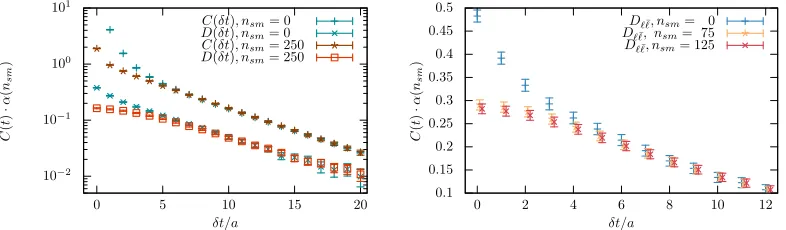
Figure 1. left: Pseudoscalar connected and disconnected correlators are shown, both for local sources and sinks (nsm = 0) and afternsm =125 smearing iterations for U103. The correlators are scaled to match such that they agree at large times. With no smearing excited states are clearly visible both in the connected and the disconnected correlators. right: The same for the light-light disconnected correlator of H105. The smeared correlators do not exhibit significant excited states afternsm=75 iterations.
We employ Wuppertal quark smearing [15] both to the source and the sink loops to enhance the ground over excited states. A small number of smearing iterations turned out to be sufficient to sup-press excited states and achieve moderate errors in the final results. In particular for the disconnected correlators comparably few iterations seem to be sufficient, see Fig.1.
The observations above are also valid away from the symmetric point. There, the correlator matrix, Eq. (2), must first be diagonalized to extract the physical states. This is usually done by solving the generalized eigenvalue problem, yielding the physical correlators as eigenvalues. However, we observed comparably large errors and unstable results when changing the parameters of the method. Instead, we insert Eqs. (4) – (6) into Eq. (2) and obtain a system of three linear equations that we solve for the three independent disconnected correlators,Dℓ¯ℓ,Dℓs¯,andDss¯, yielding similar expressions as at the symmetric point, Eq. (11). In theNf =2+1 case, the resulting formulae are more complex and depend on two anglesθandθ′, two connected correlators for the pion and thess¯, and the wanted ηandη′correlators. Plugging single-exponentials into the correlators, we end up with a total of ten independent parameters.
0
5·10−5
10·10−5
15·10−5
20·10−5
0 5 10 15 20 25 30
D
(
t/a
)
δt/a Dll
Dls
Dss
0 0.2 0.4 0.6 0.8 1
0 2 4 6 8 10
am
eff(′η
)
δt/a ameff
η
ameff η′
amimp η
amimpη′
amfit η
amfit η′
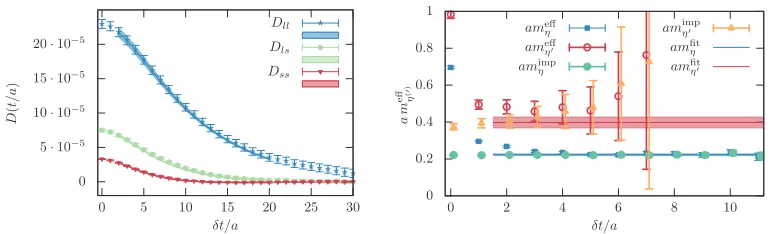
Figure 2. left:Combined fit to the disconnected correlators of H105, using information from a previous fit to
the connected correlators. We obtain typical values ofχ2/d.o.f.≈1 in correlated fits.right:Effective masses for
theηandη′, computed from their reconstructed correlators, denoteda meff
η(′), and with the connected correlators replaced by their fitted curves (a mimpη(′)), along with the fitted mass values from the combined fit. Shaded regions represent the errors of the fitted masses and the fit range of the disconnected correlators. Connected correlators are fitted in the rangeδt/a∈[15,40]. Excited states arising from the connected correlators at earlier times are clearly visible.
connected correlators constrain the fit. This approach is similar in spirit to the subtraction method
of [9,16,17]. Fig.2 demonstrates that the fit describes the data points and the fit errors actually
decrease at large times, confirming our expectations.
Note that in Eq. (2) we chose the octet-singlet basis, which is just one particular choice and we
can as well work in any other basis, e.g., in the flavour basis, where
|η⟩= √1
2cosϑ|u¯γ5u+d¯γ5d⟩ −sinϑ|s¯γ5s⟩ (12)
|η′⟩= √1
2sinϑ
′|u¯γ5u+d¯γ5d⟩+cosϑ′|s¯γ5s⟩, (13)
with different anglesϑ(′). In this case, the fit forms look a bit simpler but the resulting correlators and
masses are (numerically) equal.
To remove any potential constant shifts from our (disconnected) correlators stemming from an incomplete sampling of the topological sectors, we also fit to
−∂ˆ4C(δt)≈C(δt−a)2− Ca (δt+a) (14)
as suggested in [18,19]. We found that this reduces the error and also stabilizes the result with respect
to different fit ranges.
In order to further improve statistics in the mass estimates, and as a cross check on systematic errors we also combine data at finite momentum and fit to the dispersion relation
aE(m,p)=
√
a2m2+a2p2, (15)
wherea2p2 = ∑
µk2µ4π
2
L2
µ is the square of the lattice momentum, Lµ is the number of lattice points
0
5·10−5
10·10−5
15·10−5
20·10−5
0 5 10 15 20 25 30
D ( t/a ) δt/a Dll Dls Dss 0 0.2 0.4 0.6 0.8 1
0 2 4 6 8 10
am
eff (′η
) δt/a ameff η ameff η′ amimp η
amimpη′
amfit η
amfit η′
Figure 2. left:Combined fit to the disconnected correlators of H105, using information from a previous fit to
the connected correlators. We obtain typical values ofχ2/d.o.f.≈1 in correlated fits.right:Effective masses for
theηandη′, computed from their reconstructed correlators, denoteda meff
η(′), and with the connected correlators replaced by their fitted curves (a mimpη(′)), along with the fitted mass values from the combined fit. Shaded regions represent the errors of the fitted masses and the fit range of the disconnected correlators. Connected correlators are fitted in the rangeδt/a∈ [15,40]. Excited states arising from the connected correlators at earlier times are clearly visible.
connected correlators constrain the fit. This approach is similar in spirit to the subtraction method
of [9,16,17]. Fig.2 demonstrates that the fit describes the data points and the fit errors actually
decrease at large times, confirming our expectations.
Note that in Eq. (2) we chose the octet-singlet basis, which is just one particular choice and we
can as well work in any other basis, e.g., in the flavour basis, where
|η⟩= √1
2cosϑ|u¯γ5u+d¯γ5d⟩ −sinϑ|s¯γ5s⟩ (12)
|η′⟩= √1
2sinϑ
′|u¯γ5u+d¯γ5d⟩+cosϑ′|s¯γ5s⟩, (13)
with different anglesϑ(′). In this case, the fit forms look a bit simpler but the resulting correlators and
masses are (numerically) equal.
To remove any potential constant shifts from our (disconnected) correlators stemming from an incomplete sampling of the topological sectors, we also fit to
−∂ˆ4C(δt)≈C(δt−a)2− Ca (δt+a) (14)
as suggested in [18,19]. We found that this reduces the error and also stabilizes the result with respect
to different fit ranges.
In order to further improve statistics in the mass estimates, and as a cross check on systematic errors we also combine data at finite momentum and fit to the dispersion relation
aE(m,p)=
√
a2m2+a2p2, (15)
wherea2p2 = ∑
µkµ24π
2
L2
µ is the square of the lattice momentum, Lµ is the number of lattice points
in direction ˆµ and−Lµ/2 ≤ kµ < Lµ/2 are the integer momentum components. From this fitting
0.2 0.25 0.3 0.35 0.4 0.45 0.5 0.55 0.6
0 1 2 3
aE
a2k2
η disp. rel fit η′ disp. rel fit
0.2 0.4 0.6 0.8 1 1.2
0 0.1 0.2 0.3 0.4 0.5
mη ( ′ ) [Ge V ] m2 π[GeV2]
this work 2017 BRC/UKQCD 2010 UKQCD 2011 HSC 2011 ETMC 2013 RQCD 2014 exp.
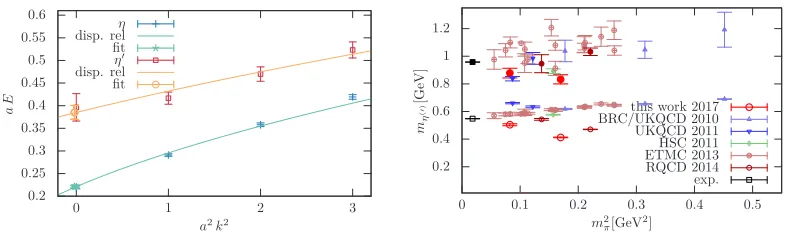
Figure 3. left:Fits to the dispersion relation, Eq. (15), combining data at several momenta. right:Summary
plot of recent lattice determinations of theηandη′masses, cf. [6–9].
approach, we obtain for the U103 ensemble at the flavour symmetric point,
mη=mπ=412(2) MeV, mη′=833(33) MeV, (16)
and away from that point, for H105, at a pion mass of 282 MeV,
mη=504(7) MeV, mη′=878(35) MeV. (17)
Fig. 3compares these results with other lattice determinations and the physical point. It should be
stressed that, like in the RQCD 2014 study [10], the two considered ensembles are on a line of constant
average quark mass and approach the physical point on a different trajectory than other (ms≈const.)
studies.
4 Decay constants
Having extracted masses and the angles, we can construct the correlators
CAiη(′)(δt)=⟨0|Aiµ(δt)|η(′)⟩, CPiη(′)(δt)=⟨0|Pi(δt)|η(′)⟩⟩, Cη(′)η(′)(δt)=⟨η(′)(δt)|η(′)⟩ (18)
wherePi labels the octet (i =8) and singlet (i =1) pseudoscalar local currents, defined in Eq. (3)
andAi
µsimilarly defines the axialvector currents. Using these correlators, one can compute decay
constants which read
⟨0|Ai
µ|η(′)(p)⟩=i fNipµ. (19)
This results in four different effective decay constants at momentum p=0,
fi,eff
η(′) (δt)=ZAi
√
2CAiη(′)(δt)
√
Cη(′)η(′)(δt)mη(′)
exp(mη(′)δt/2), (20)
which are constant over some range inδtwhere excited states can be neglected and the correlators
have not yet vanished in the noise.
For (partial)O(a) improvement, we replace
wherea m8 = a3(ml+2ms) anda m1 = a3(2ml+ms). We take the non-perturbatively determined
improvement coefficientsbAfrom [20],cAfrom [21] andZ8Afrom [22]. For the axial renormalization
factor, the difference betweenZ8A andZA1 is ofO(α2s) and known perturbatively [23]. For this lattice
spacing and action it is at the level of 2 %, which is in line with preliminary recent non-perturbative
estimates [24]. From these numbers, we estimate the systematic uncertainty from renormalization to
be around 5 %. In this work, we take the non-perturbative octet renormalization factor together with
the perturbative difference at a scale of 2 GeV.
−0.04
−0.02 0
0.02
0.04
0.06
0.08
0.1
0.12
0 2 4 6 8 10 12
af
i,
eff
η
(
′
)
δt
af8,eff
η
af1,eff
η
afη8,′eff af1,eff
η′
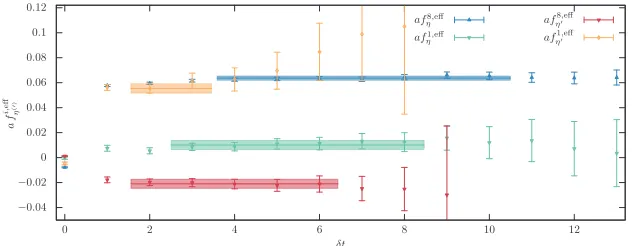
Figure 4. Effective decay constants as defined in Eq. (20) for H105. Shaded regions indicate fit ranges and
errors.
As can be seen in Fig.4, we face the "window problem" again: The axialvector loops are even
noisier than the pseudoscalar ones so that the signal is lost very early in Euclidean time. Also, being local at the sink, we need to take special care of excited states. By fixing the masses to their previously
determined values we can take weighted averages ("one-parameter fits") to each of the effective decay
constants, tuning the ranges individually. The results are compatible with [10], however, f1
η′is quite a
bit larger, which might be due to insufficient treatment of excited states in that channel.
It is common to give the decay constants in the flavour basis, which we recover from the fitted
values by taking the linear combinations at the scale of interest,µ=2 GeV,
fl
η(′) =
√ 1
3fη8(′)+
√ 2
3fη1(′), fηs(′) =−
√ 2
3fη8(′)+
√ 1
3fη1(′). (22)
Usually, these are parameterized in terms of two constants and two angles, (
fl
η fηs
fl
η′ fηs′
)
=
(
fl cosθl −fs sinθs
flsinθl fs cosθs )
=UT(−θl,−θs) (
fl 0
0 fs
)
, (23)
which we extract simply via
θl=arctan
fl
η′
fl
η
, θs=−arctan
fs
η fs
η′
, fl=
fl
η
2 cosθl +
fl
η′
2 sinθl, fs=
fs
η′
2 cosθs−
fs
η
2 sinθs. (24)
Additionally, we monitor unitarity violations by considering the difference of the anglesδθ=θl−θs,
which has a non-vanishing value if there is a gluonic contribution to fi
η(′) and is related to the
low-energy constantΛ1[25],
flfssin(θl−θs)=
√
2
wherea m8 = a3(ml+2ms) anda m1 = a3(2ml+ms). We take the non-perturbatively determined
improvement coefficientsbAfrom [20],cAfrom [21] andZA8from [22]. For the axial renormalization
factor, the difference betweenZA8 andZA1 is ofO(α2s) and known perturbatively [23]. For this lattice
spacing and action it is at the level of 2 %, which is in line with preliminary recent non-perturbative
estimates [24]. From these numbers, we estimate the systematic uncertainty from renormalization to
be around 5 %. In this work, we take the non-perturbative octet renormalization factor together with
the perturbative difference at a scale of 2 GeV.
−0.04
−0.02 0
0.02
0.04
0.06
0.08
0.1
0.12
0 2 4 6 8 10 12
af i, eff η ( ′ ) δt
af8,eff
η
af1,eff
η
afη8′,eff af1,eff
η′
Figure 4. Effective decay constants as defined in Eq. (20) for H105. Shaded regions indicate fit ranges and
errors.
As can be seen in Fig.4, we face the "window problem" again: The axialvector loops are even
noisier than the pseudoscalar ones so that the signal is lost very early in Euclidean time. Also, being local at the sink, we need to take special care of excited states. By fixing the masses to their previously
determined values we can take weighted averages ("one-parameter fits") to each of the effective decay
constants, tuning the ranges individually. The results are compatible with [10], however, f1
η′is quite a
bit larger, which might be due to insufficient treatment of excited states in that channel.
It is common to give the decay constants in the flavour basis, which we recover from the fitted
values by taking the linear combinations at the scale of interest,µ=2 GeV,
fl
η(′) =
√ 1
3fη8(′)+
√ 2
3fη1(′), fηs(′) =−
√ 2
3fη8(′)+
√ 1
3fη1(′). (22)
Usually, these are parameterized in terms of two constants and two angles, (
fl
η fηs
fl
η′ fηs′
)
=
(
flcosθl −fs sinθs
fl sinθl fs cosθs )
=UT(−θl,−θs) (
fl 0
0 fs
)
, (23)
which we extract simply via
θl=arctan
fl
η′
fl
η
, θs=−arctan
fs
η fs
η′
, fl=
fl
η
2 cosθl +
fl
η′
2 sinθl, fs=
fs
η′
2 cosθs −
fs
η
2 sinθs. (24)
Additionally, we monitor unitarity violations by considering the difference of the anglesδθ=θl−θs,
which has a non-vanishing value if there is a gluonic contribution to fi
η(′) and is related to the
low-energy constantΛ1[25],
flfssin(θl−θs)=
√
2
3 fπ2Λ1. (25)
For the two ensembles, we obtain for the decay constants
U103: fl/fπ=1.20(7), fs/fπ=1.27(2), H105: fl/fπ = 1.27(7), fs/fπ= 1.39(5),
(26)
and for the two angles andΛ1
U103: θl=61.3(1.8)°, θs=65.4(1.6)°, δθ=−4.1(3.4)°, Λ1=−0.23(17), (27)
H105: θl=59.7(1.6)°, θs=66.9(1.3)°, δθ=−7.2(2.9)°, Λ1=−0.47(17), (28)
Within present statistics, we findθl ≈θs, i.e., we do not see any strong OZI violation, however, the
difference increases at the H105 ensemble compared to the symmetric point. It will be interesting to
see if this becomes stronger at smaller quark masses.
Compared to phenomenology, the light decay constants have rather large values:
[26,27] fl/fπ =1.07(2), fs/fπ =1.34(6), θl=θs=39.3(1.0), (29)
[28] fl/fπ =1.09(3), fs/fπ =1.66(6), θl=θs=40.7(1.4). (30)
As already mentioned, this might be due to underestimated excited states, in particular in the
corre-latorC1
Aiη′. Being local at the sink, the chosen smearing might be insufficient to completely remove
them. It has also been shown [12] that cutoffeffects are large, e.g., for the combination √8t0fπK in
particular at this lattice spacing. It remains to be seen how the values change when approaching the physical point, i.e., at finer lattices and smaller quark masses.
5 Summary
In these proceedings, we employed several noise reduction techniques to obtain disconnected loops at
a precision that allows us to study theη/η′system on two CLS ensembles.
To extract the physical states, we directly fit to the correlators. This, in combination with quark
smearing enables us to capture the small-t behaviour, encoding theη′physics and still have excited
states under control. In a second fit we incorporate even noisier data from the axialvector channel to determine decay constants directly. The results are encouraging, however, a detailed analysis of systematic errors still remains to be done.
We plan to do so by analysing more CLS ensembles, following two distinct quark mass trajecto-ries. The combination of ensembles along the line of constant average quark mass with ensembles where the strange quark mass is kept fixed, as well as going towards lighter masses will allow for a
controlled chiral extrapolation. Also finite lattice spacing and volume effects will be investigated.
6 Acknowledgments
This work was supported by the DFG SFB/TRR 55. We thank our colleagues in CLS [http:
//wiki-zeuthen.desy.de/CLS/CLS] for the joint effort in the generation of the gauge field ensembles
References
[1] S.S. Agaev, V.M. Braun, N. Offen, F.A. Porkert, A. Schäfer, Phys. Rev.D90, 074019 (2014),
1409.4311
[2] Y. Kuramashi, M. Fukugita, H. Mino, M. Okawa, A. Ukawa, Phys. Rev. Lett.72, 3448 (1994) [3] T. Struckmann et al. (TXL, T(X)L), Phys. Rev.D63, 074503 (2001),hep-lat/0010005
[4] C. McNeile, C. Michael (UKQCD), Phys. Lett. B491, 123 (2000), [Erratum: Phys. Lett.B551,391(2003)],hep-lat/0006020
[5] V.I. Lesk et al. (CP-PACS), Phys. Rev.D67, 074503 (2003),hep-lat/0211040
[6] N.H. Christ, C. Dawson, T. Izubuchi, C. Jung, Q. Liu, R.D. Mawhinney, C.T. Sachrajda, A. Soni, R. Zhou, Phys. Rev. Lett.105, 241601 (2010),1002.2999
[7] J.J. Dudek, R.G. Edwards, B. Joo, M.J. Peardon, D.G. Richards, C.E. Thomas, Phys. Rev.D83, 111502 (2011),1102.4299
[8] E.B. Gregory, A.C. Irving, C.M. Richards, C. McNeile (UKQCD), Phys. Rev. D86, 014504 (2012),1112.4384
[9] C. Michael, K. Ottnad, C. Urbach (European Twisted Mass), PoSLATTICE2013, 253 (2014),
1311.5490
[10] G.S. Bali, S. Collins, S. Dürr, I. Kanamori, Phys. Rev.D91, 014503 (2015),1406.5449
[11] M. Bruno et al., JHEP02, 043 (2015),1411.3982
[12] M. Bruno, T. Korzec, S. Schaefer, Phys. Rev.D95, 074504 (2017),1608.08900
[13] G.S. Bali, S. Collins, A. Schäfer, Comput. Phys. Commun.181, 1570 (2010),0910.3970
[14] P. Georg, D. Richtmann, T. Wettig (2017), inProceedings,35th International Symposium on
Lattice Field Theory (Lattice2017): Granada, Spain, to appear in EPJ Web Conf.
[15] S. Gusken, U. Low, K.H. Mutter, R. Sommer, A. Patel, K. Schilling, Phys. Lett.B227, 266 (1989)
[16] H. Neff, N. Eicker, T. Lippert, J.W. Negele, K. Schilling, Phys. Rev. D64, 114509 (2001),
hep-lat/0106016
[17] K. Jansen, C. Michael, C. Urbach (ETM), Eur. Phys. J.C58, 261 (2008),0804.3871
[18] X. Feng, K. Jansen, D.B. Renner, Phys. Lett.B684, 268 (2010),0909.3255
[19] T. Umeda, Phys. Rev.D75, 094502 (2007),hep-lat/0701005
[20] P. Korcyl, G.S. Bali, Phys. Rev.D95, 014505 (2017),1607.07090
[21] J. Bulava, M. Della Morte, J. Heitger, C. Wittemeier (ALPHA), Nucl. Phys.B896, 555 (2015),
1502.04999
[22] J. Bulava, M. Della Morte, J. Heitger, C. Wittemeier, Phys. Rev. D93, 114513 (2016),
1604.05827
[23] M. Constantinou, M. Hadjiantonis, H. Panagopoulos, G. Spanoudes, Phys. Rev.D94, 114513 (2016),1610.06744
[24] G.S. Bali, S. Collins, M. Göckeler, S. Piemonte, A. Sternbeck, PoSLATTICE2016, 187 (2016),
1703.03745
[25] T. Feldmann, Int. J. Mod. Phys.A15, 159 (2000),hep-ph/9907491
[26] T. Feldmann, P. Kroll, B. Stech, Phys. Rev.D58, 114006 (1998),hep-ph/9802409
[27] T. Feldmann, P. Kroll, B. Stech, Phys. Lett.B449, 339 (1999),hep-ph/9812269