Fioranelli, F., Ritchie, M., and Griffiths, H. (2016) Performance analysis of
centroid and SVD features for personnel recognition using multistatic
micro-Doppler. IEEE Geoscience and Remote Sensing Letters, pp. 1-5.
There may be differences between this version and the published version. You are
advised to consult the publisher’s version if you wish to cite from it.
http://eprints.gla.ac.uk/118187/
Deposited on: 29 April 2016
Enlighten – Research publications by members of the University of Glasgow
http://eprints.gla.ac.uk
Abstract—In this letter we investigate the use of micro-Doppler
signatures experimentally recorded by a multistatic radar system to perform recognition of people walking. Three different sets of features are tested, taking into account the impact on the overall classification performance of parameters such as aspect angle, types of classifier, different values of Signal-to-Noise-Ratio, and different ways of exploiting multistatic information. High classification accuracy of above 98% is reported for the most favorable aspect angle, and the benefit of using multistatic data at less favorable angles is discussed.
Index Terms—Multistatic radar, micro-Doppler, feature
extraction, target classification
I. INTRODUCTION
DDITIONAL modulations on top of the main Doppler shift
generated by a moving person are known as micro-Doppler signatures and are related to the motions of limbs and body [1]. A good review of different applications and uses of human micro-Doppler signatures can be found in [2]. Some include the discrimination between different activities such as walking, running, crawling [3], the possibility of distinguishing human from animals such as dogs or horses, and vehicles [4], and the characterization of free and confined movement of arms related to carrying objects, potentially weapons in some context [5-6]. In all these applications numerical features are extracted from the micro-Doppler signatures and used as input to classifiers. One of the well-known problems in micro-Doppler based classification is the effect on the overall micro-Doppler signature of the aspect angle between the velocity vector of the moving body parts and the line-of-sight of the radar. If this angle has limited values up to approximately 30°, the classification performance appears not to present excessive degradation [2], but for higher angles up to the case limit of 90° the classification is severely hindered [7]. Bistatic and multistatic radar has been suggested as a possible mitigation to this problem [8-10], as the deployment of multiple nodes can provide multi-perspective views on targets, where at least one node can illuminate the target at a favorable aspect angle.
Little work is available in the literature on the use of micro-Doppler signatures to identify and recognize different people
F. Fioranelli, M. Ritchie, and H. Griffiths are with the Department of Electronic and Electrical Engineering, University College London, Torrington
Place, WC1E 7JE, London, UK (e-mail: [email protected],
[email protected], [email protected]).
performing the same activity. This task is expected to be more challenging and therefore require more robust features than classifying between different activities, as the possible targets, i.e. different human subjects, will not be too dissimilar from one another and generate similar signatures. In [11] the authors proposed features based on Cadence Velocity Diagram to discriminate between four subjects running and walking with data extracted from a CW X-band radar. The subjects were moving on a treadmill in indoor controlled tests and classification accuracy above 90% was reported with these data. In our work in [12] we showed preliminary results of using a feature extracted from Singular Value Decomposition (SVD) to identify different people walking on a trajectory perpendicular to the baseline. The feature is extracted from the whole matrices derived from SVD rather than from individual singular vectors.
In this letter the classification performance of this novel SVD-based feature and of features based on the centroid of the micro-Doppler signatures is investigated and compared as a function of different operational parameters using experimental multistatic data. Three different aspect angles and considered and six types of classifiers with different complexity used to perform classification. The robustness of these features as a function of the Signal-to-Noise-Ratio (SNR) is also investigated, as well as the computational efficiency of the different classifiers and features combinations.
The rest of the letter is organized as follows. Section II presents the radar system and the experimental setup. Section III describes the different features and the investigation of their classification performance. Section IV concludes the paper.
II. RADAR SYSTEM AND EXPERIMENTAL SETUP
The data processed in this letter were collected using the multistatic radar system NetRAD, developed at University College London in the past few years and used for previous human micro-Doppler measurements [6, 9]. NetRAD is a coherent pulsed radar with three separate but identical nodes operating at 2.4 GHz (S-band). The RF parameter used for the data collection were linear up-chirp modulation with 0.6 μs duration and 45 MHz bandwidth, 5 kHz pulse repetition frequency (PRF) to ensure that the whole human micro-Doppler signature was contained in the unambiguous micro-Doppler region, and 5 s duration of each dataset to record multiple periods of the average human walking gait. The transmitted
Performance Analysis of Features for Personnel
Recognition Using Multistatic Micro-Doppler
Francesco Fioranelli, Matthew Ritchie, and Hugh Griffiths,
Fellow, IEEE
beamwidth were used.
The experiment took place in an open field at the UCL Sports Ground in December 2014, and the experimental setup is shown in Fig. 1. The three nodes were deployed along a linear baseline with 40 m inter-node separation and the target was located at 70 m from the baseline. Node 3 was used as monostatic transceiver, whereas Node 1 and 2 as bistatic receiver-only nodes. The resulting bistatic angles were therefore 30° and 60° for Node 1 and 2, respectively. As in Fig. 1, separate recordings with the target walking towards one of the node were collected, generating data with three different aspect angles with respect to the line-of-sight of the transceiver node, namely 0° (angle 1), 30° (angle 2), and 60° (angle 3). Three different subjects took part in the experiment. The key body parameters were 1.70 m, 69 kg, average body type for subject 1, 1.77 m, 65 kg, slim body type for subject 2, and 1.87 m, 90 kg, average body type for subject 3. All the subjects were male. The total number of recordings was therefore 135, assuming 3 subjects, 3 nodes, 5 repetitions of the movement, and 3 aspect angles.
Fig. 1. Experimental setup with radar nodes and target
III. DATA ANALYSIS
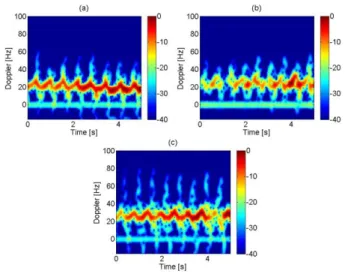
The micro-Doppler signatures were extracted from the data using a Short Time Fourier Transform (STFT) calculated with 0.3 s Hamming window and 95% overlap. An example of monostatic micro-Doppler signatures for the three subjects walking towards the transmitter node are shown in Fig. 2. Differences between the signatures of different subjects can be seen, particularly in the positive/negative peaks due to the movement of the limbs and in the shape and consistency of the main component due to body swaying.
Numerical features to quantify these differences and use them in automatic classifiers are explored in the rest of this section. Prior to feature extraction, each spectrogram was divided into 1 s long blocks to generate 675 blocks, i.e. five times the total number of recorded datasets.
Many parameters can have an impact on the overall classification performance of a multistatic radar system [13]. The analysis in the rest of this section focuses on some of them, namely the different features (either based on SVD or on the centroid of the micro-Doppler feature), the aspect
parameters are kept constant during this analysis, namely the operating frequency of the radar (S-band, 2.4 GHz), the PRF (5 kHz), the dwell time to extract feature samples (1 second), the size of the samples database and the percentage used to train the classifier (675 samples per feature, 20% training).
Fig. 2. Spectrograms of micro-Doppler signatures extracted from monostatic data for subject 1 (a), subject 2 (b), and subject 3 (c), all at aspect angle 1
A. Feature extraction and classification
SVD was applied to the micro-Doppler signatures to extract the first two considered features. Given the matrix M of the micro-Doppler signature, the SVD decomposition is simply given by M = USVT, where U and V are the matrices containing the left and right singular vectors respectively, and
S is the diagonal matrix with the singular values of M. The first feature is given by the standard deviation of the first right singular vectors from V. This feature was used to successfully classify unarmed vs armed personnel in [14]. Features extracted from few singualr vectors have been also reported for the classification of different types of micro-drones [15].
The second feature considers the whole matrices U and V
rather than individual singular vectors. It has been shown that the sum of the intensity of the elements of U can be an effective feature for personnel recognition [12].
The third set of features is extracted from the centroid and the Doppler bandwidth of the micro-Doppler signatures as in (1) and (2), respectively, where fC is the Doppler centroid, BC
the bandwidth, and S(i,j) the spectrograms at the ith Doppler
bin and jth time bin. The centroid is an estimate of the centre of
gravity of the signature, and the bandwidth estimates the intensity of the signature around it. The mean and the standard deviation of centroid and bandwidth are used as features. These four features are used together as input to the classifiers.
f
c(j) =
∑ f(i)S(i,j)i∑ S(i,j)i (1)
B
c(j) = √
∑ (f(i)−fi c(j))2S(i,j)The different types of classifiers used in this letter are linear discriminant analysis (DLDA), diagonal-quadratic discriminant analysis (DQDA), naïve Bayes with kernel functions estimators (NB), nearest neighbors with 3 samples (NN3) and 5 samples (NN5), and classification tree (CT). These are described in more detail in [16]. These classifiers were trained with 20% of the available feature samples, and the remaining samples used to test the performance and determine the error as total number of misclassification events over the total number of samples. The consistency of the performance was evaluated with 100 tests for each classifier using random sample selections for training. The average classification error over these 100 repetitions was calculated and in here the percentage accuracy is reported as 100% minus such error.
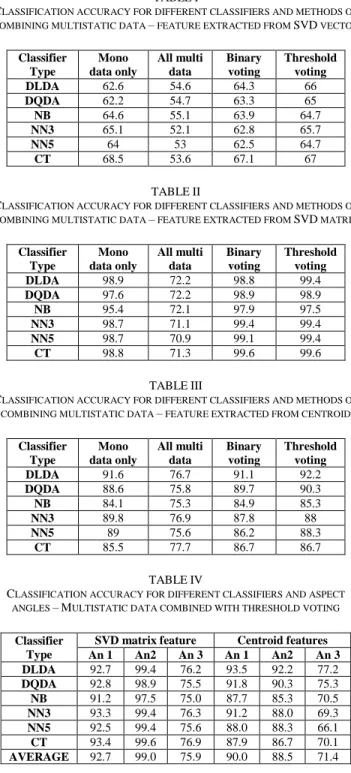
The classification accuracy using the three aforementioned features is reported in tables 1, 2, and 3, respectively. Three different approaches to use multistatic data are compared with the conventional use of only monostatic data. In the first approach feature samples from all radar nodes are used at a single classifier generating the final decision. In the second approach separate classifiers use feature samples of each radar node generating partial decisions, which are then combined through a binary voting procedure, i.e. the final decision has to be voted by two of the three nodes. The last approach considers the level of confidence of each partial decision with a threshold. When two nodes agree on a partial decision with confidence higher than the threshold, they generate the final decision. But if one of the two has lower confidence, and at the same time the third node has higher confidence than the other two nodes, then the final decision is generated by the third node. This approach aims at preventing that two nodes with low confidence may lead to a misclassification event. The threshold was set at 65%, the value providing the best classification after tests with values between 55% and 75% with the available data. In both second and third approaches, the final decision is generated by the node with highest confidence if there is no partial decision reached by at least two nodes.
Table 1, 2, and 3 presents the classification results for the three aforementioned features. The first feature related to an individual singular vector appears to be not suitable for this task of personnel recognition, as the accuracy is below 70%. On the contrary, both the features based on whole SVD matrix and centroid provide good classification results, with accuracy above 98-99% for the former when the voting with threshold approach is used to combine multistatic data. Chosen the type of features, the performance appears to be quite regular for different types of classifiers. It is shown that with the proposed features the separate classification approach yields better results than using a centralized classifier for all multistatic data. This was already observed in previous works [9, 12, 14].
B. Effect of aspect angle and SNR
Table 4 presents the classification results for the different aspect angles and classifiers considered in this letter when
multistatic data are combined with the voting with threshold approach. Only centroid features and features based on the whole SVD matrix are considered. Given the aspect angle, the classification accuracy appears to be quite consistent with different classifiers. SVD features provide better accuracy than centroid features, and this appears to be consistent for each aspect angle. The best classification results are obtained for aspect angle 2 (accuracy above 97% for SVD features), whereas the classification performance degrades significantly at aspect angle 3 for both types of features. This performance reduction is expected, as aspect angle 3 is equal to 60° with respect with the monostatic line-of-sight, hence the least favourable angle among those considered.
TABLEI
CLASSIFICATION ACCURACY FOR DIFFERENT CLASSIFIERS AND METHODS OF
COMBINING MULTISTATIC DATA – FEATURE EXTRACTED FROM SVD VECTOR
Classifier Type Mono data only All multi data Binary voting Threshold voting DLDA 62.6 54.6 64.3 66 DQDA 62.2 54.7 63.3 65 NB 64.6 55.1 63.9 64.7 NN3 65.1 52.1 62.8 65.7 NN5 64 53 62.5 64.7 CT 68.5 53.6 67.1 67 TABLEII
CLASSIFICATION ACCURACY FOR DIFFERENT CLASSIFIERS AND METHODS OF
COMBINING MULTISTATIC DATA – FEATURE EXTRACTED FROM SVD MATRIX
Classifier Type Mono data only All multi data Binary voting Threshold voting DLDA 98.9 72.2 98.8 99.4 DQDA 97.6 72.2 98.9 98.9 NB 95.4 72.1 97.9 97.5 NN3 98.7 71.1 99.4 99.4 NN5 98.7 70.9 99.1 99.4 CT 98.8 71.3 99.6 99.6 TABLEIII
CLASSIFICATION ACCURACY FOR DIFFERENT CLASSIFIERS AND METHODS OF
COMBINING MULTISTATIC DATA – FEATURE EXTRACTED FROM CENTROID
Classifier Type Mono data only All multi data Binary voting Threshold voting DLDA 91.6 76.7 91.1 92.2 DQDA 88.6 75.8 89.7 90.3 NB 84.1 75.3 84.9 85.3 NN3 89.8 76.9 87.8 88 NN5 89 75.6 86.2 88.3 CT 85.5 77.7 86.7 86.7 TABLEIV
CLASSIFICATION ACCURACY FOR DIFFERENT CLASSIFIERS AND ASPECT
ANGLES –MULTISTATIC DATA COMBINED WITH THRESHOLD VOTING
Classifier Type
SVD matrix feature Centroid features
An 1 An2 An 3 An 1 An2 An 3 DLDA 92.7 99.4 76.2 93.5 92.2 77.2 DQDA 92.8 98.9 75.5 91.8 90.3 75.3 NB 91.2 97.5 75.0 87.7 85.3 70.5 NN3 93.3 99.4 76.3 91.2 88.0 69.3 NN5 92.5 99.4 75.6 88.0 88.3 66.1 CT 93.4 99.6 76.9 87.9 86.7 70.1 AVERAGE 92.7 99.0 75.9 90.0 88.5 71.4
different classifiers, respectively for centroid features and SVD features. Only results related to aspect angle 2 are reported in these tables. The voting with threshold approach was used to combine multistatic data. The SNR of the signal prior to STFT calculation and feature extraction was varied by adding a certain amount of noise to obtain SNR between -10 and 10 dB in steps of 5 dB. As expected, a decreasing trend of accuracy with increasing SNR is reported for both types of features. The SVD based features appear to provide better classification results than the centroid based features, with average accuracy above 93% even with SNR equal to 0 dB. In Fig. 3 the classification accuracy as a function of SNR for different aspect angles is shown, for both centroid and SVD based features. The expected increase in accuracy with increasing SNR can be seen, as well as the higher accuracy at the most favourable aspect angles 2 and 1.
TABLEV
CLASSIFICATION ACCURACY FOR DIFFERENT CLASSIFIERS AND SNR–
MULTISTATIC DATA COMBINED WITH THRESHOLD VOTING – CENTROID
FEATURES –ASPECT ANGLE 2
Classifier Type SNR [dB] 10 5 0 -5 -10 DLDA 91.1 90.8 85.7 91.9 77.2 DQDA 88.9 88.7 84.7 80.7 75.0 NB 85.1 83.3 80.5 76.4 69.5 NN3 84.9 84.5 82.4 79.9 74.4 NN5 94.1 84.6 81.2 78.4 74.0 CT 86.9 85.5 81.9 76.8 71.6 AVERAGE 88.5 86.2 82.7 80.7 73.6 TABLEVI
CLASSIFICATION ACCURACY FOR DIFFERENT CLASSIFIERS AND SNR–
MULTISTATIC DATA COMBINED WITH THRESHOLD VOTING –SVD MATRIX
FEATURES –ASPECT ANGLE 2
Classifier Type SNR [dB] 10 5 0 -5 -10 DLDA 98.9 98.5 95.1 85.5 72.7 DQDA 96.4 95.9 93.4 83.0 75.8 NB 93.5 90.8 87.2 76.8 71.9 NN3 98.1 98.6 95.4 87.0 74.3 NN5 98.4 98.3 94.1 83.4 63.2 CT 98.4 98.4 94.9 85.5 78.2 AVERAGE 97.3 96.8 93.4 83.5 72.7
Fig. 3. Classification accuracy as a function of SNR and aspect angle for centroid based features (a) and for SVD-based feature (b)
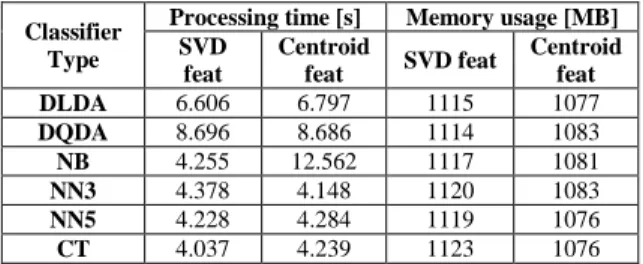
of classifiers and features was also investigated in terms of processing time and memory occupations. The classifiers were implemented in MATLAB and tested on the same desktop computer in the same conditions. The results are summarized in table 7, assuming calculations only for aspect angle 1. The nearest neighbor and the classification tree appear to be the fastest classifiers (approximately 4 s), followed by the discriminant analysis in linear (approximately 6.6 s) and quadratic form (approximately 8.6 s). It is interesting to notice the significant difference in processing time for the Naïve Bayes classifier using different features. This may be related to the fact that for the centroid case there are four features to be used jointly, whereas for the SVD case only one feature. The memory usage appears to be uniform with different classifiers, slightly higher for SVD features in comparison with centroid features.
TABLEVII
COMPUTATIONAL EFFICIENCY AND MEMORY USAGE FOR DIFFERENT
CLASSIFIERS AND FEATURES
Classifier Type
Processing time [s] Memory usage [MB] SVD feat Centroid feat SVD feat Centroid feat DLDA 6.606 6.797 1115 1077 DQDA 8.696 8.686 1114 1083 NB 4.255 12.562 1117 1081 NN3 4.378 4.148 1120 1083 NN5 4.228 4.284 1119 1076 CT 4.037 4.239 1123 1076 IV. CONCLUSIONS
This letter discusses the use of human micro-Doppler signatures as collected by a multistatic radar system for personnel recognition. Three different sets of features were tested on experimental data, namely features based on individual SVD vectors, on the whole matrices deriving from SVD decomposition, and on the centroid of the micro-Doppler signatures, with the last two providing the best classification results. The impact of different parameters on the classification performance was investigated, namely three different aspect angles, six types of classifier, different values of SNR, and different approaches in combining multistatic data.
A single feature based on the whole matrix U derived from SVD appears to provide the best accuracy, above 98% for the most favorable aspect angle, but with degradation down to approximately 75 % for less favorable angles. The different types of classifier do not appear to have a very significant impact on the performance compared with other parameters such as aspect angles, SNR, and types of features.
Future work will investigate different deployment geometries of the multistatic radar nodes to optimize the classification performance and reduce this adverse effect of aspect angles. Additional data will also be collected from different subjects and for different activities to test the robustness of the proposed features.
ACKNOWLEDGMENT
The authors would like to thank Saad Alhuwaimel and Franck Wei for their help in the field experiments. This work has been funded by the IET A F Harvey Prize, awarded to Hugh Griffiths (2013).
REFERENCES
[1] V. C. Chen, D. Tahmoush and W. L. Miceli, ‘Radar Micro-Doppler
Signatures: Processing and Applications’, Institution of Engineering and
Technology, 2014.
[2] Tahmoush, D., ‘Review of micro-Doppler signatures’, IET Radar, Sonar
& Navigation, available online: 29 Oct 2015.
[3] Youngwook, K. and Hao, L., 'Human activity classification based on
micro-Doppler signatures using a support vector machine', IEEE
Transactions on Geoscience and Remote Sensing, vol.47, issue 5, pp.
1328-1337, 2009.
[4] Youngwook, K., Sungjae, H., Jihoon, K., ‘Human detection using
Doppler radar based on physical characteristics of targets’, IEEE
Geoscience and Remote Sensing Letters, 2015, vol. 12, issue 2, pp.
289-293.
[5] Orović, I., Stanković, S., Amin, M., ‘A new approach for classification
of human gait based on time-frequency feature representations’, Signal
Processing, vol.91, issue 6, pp. 1448-1456, 2011.
[6] Fioranelli, F., Ritchie, M., Griffiths, H., ‘Multistatic Human
Micro-Doppler Classification of Armed/Unarmed Personnel’, IET Radar,
Sonar & Navigation, vol. 9, issue 7, pp. 857-865, 2015.
[7] Tahmoush, D. and Silvious, J., 'Radar micro-Doppler for long range
front-view gait recognition', in BTAS '09 IEEE 3rd International
Conference on Biometrics: Theory, Applications, and Systems,
September 2009, Washington DC.
[8] Fairchild, D.P., Narayanan, R.M., ‘Determining human target facing
orientation using bistatic radar micro-Doppler signals’, Proc. SPIE 9082,
Active and Passive Signatures V, 908203, May 2014, Baltimore,
Maryland, USA.
[9] F. Fioranelli, M. Ritchie, H. Griffiths, “Aspect angle dependence and
multistatic data fusion for micro-Doppler classification of
armed/unarmed personnel”, IET Radar, Sonar & Navigation, available online: 28 Jul 2015.
[10] Karabacak, C., Gürbüz, S.Z., Guldogan, M.B., and Gürbüz, A.C.,
'Multi-aspect angle classification of human radar signatures', in Proc. SPIE
8734, Active and Passive Signatures IV, 873408, April 2013, Baltimore,
Maryland, USA.
[11] Ricci, R., Balleri, A., ‘Recognition of humans based on radar micro-Doppler shape spectrum features’, IET Radar, Sonar & Navigation, available online: 17 Jun 2015.
[12] F. Fioranelli, M. Ritchie, H. Griffiths, ‘Personnel recognition based on multistatic micro-Doppler and singular value decomposition features’,
Electronic Letters, available online: 12 Nov 2015.
[13] S. Gürbuz, B. Erol, B. Cagliyan, B. Tekeli, ‘Operational assessment and
adaptive selection of micro-Doppler features’, IET Radar, Sonar &
Navigation, available online: 12 Nov 2015.
[14] Fioranelli, F., Ritchie, M., Griffiths, H., ‘Classification of
unarmed/armed personnel using the NetRAD multistatic radar for
micro-Doppler and singular value decomposition features’, IEEE Geoscience
and Remote Sensing Letters, vol.12, issue 9, pp.1933-1937.
[15] De Wit, J.J.M., Harmanny, R., Molchanov, P., ‘Radar micro-Doppler
feature extraction using the singular value decomposition’, 2014
International Radar Conference, October 2014, Lille, France.
[16] Hastie, T., Tibshirani, R., Friedman, J., ‘The Elements of Statistical
Learning: Data Mining, Inference, and Prediction’, Springer Series in
Statistics, 2009.